
What is the Asia Pacific Cathodic Protection Market Size and Share?
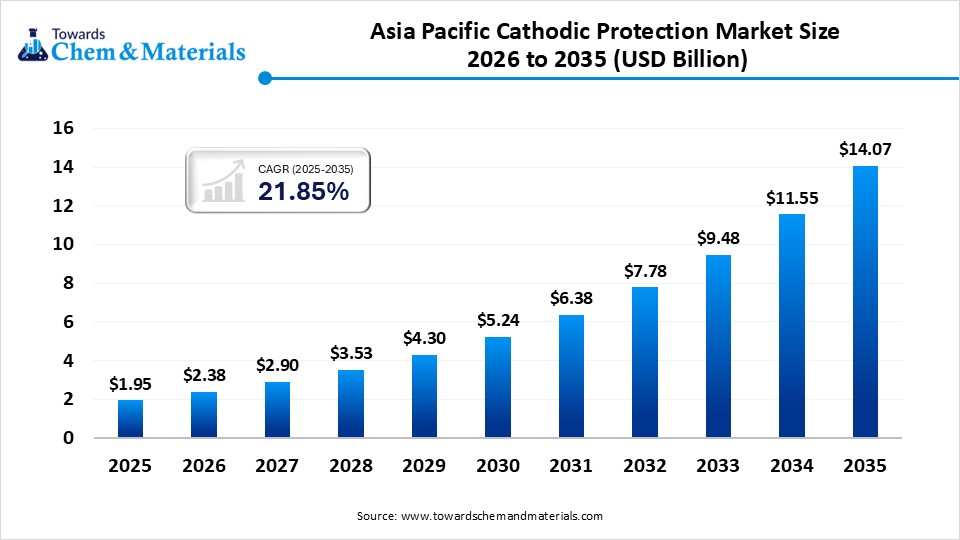
The Asia Pacific cathodic protection market size was valued at USD 1.95 billion in 2025 and is projected to grow from USD 2.38 billion in 2026 to USD 14.07 billion by 2035, exhibiting a CAGR of 21.85% during the forecast period. China dominated the cathodic protection industry with a 41% share in 2025. The growth is driven by rapid industrialization and energy infrastructure investment by industries, as there is growing demand. The high demand for continuous development and electrochemical degradation prevention is a major factor. The key player and their investment in the market also contribute largely to the growth of the market.
Key Takeaway
- By region, China dominated the Asia Pacific cathodic protection market with a share of 41% in 2025
- By solutions, the products segment dominated the market with a 63.40% share in 2025 and is expected to grow at a CAGR of 21.10% over the forecast period.
- By solutions, the services segment held 36.60% market share in 2025 and is expected to have the fastest growth with a CAGR of 23.15% in the forecast period.
- By type, the impressed current segment dominated the market with a 58.30% share in 2025 and is expected to grow at a CAGR of 22.50% over the forecast period.
- By type, the galvanic segment held 41.70% market share in 2025 and is expected to have the fastest growth with a CAGR of 22.50% in the forecast period.
- By applications, the pipeline segment dominated the market with 27.80% share in 2025 and is expected to grow at a CAGR of 21.45% over the forecast period.
- By applications, the buildings segment held 7.90% market share in 2025 and is expected to have the fastest growth with a CAGR of 24.10% in the forecast period.
Market Overview
Asia Pacific Cathodic Protection Market
The market is experiencing growth due to the expansion of energy and pipeline integration, which drives demand for corrosion prevention systems. In China, there are hundreds of kms of underground pipelines, and India is expanding its pipeline network, which increases market demand. Smart cities and urbanizations hit through investment in underground rail systems and advanced water treatment facilities, increasing demand for cathodic protection to prevent harsh conditions and corrosion. This is achieved through technological innovation and advanced monitoring and control systems using AI, which help with maintenance and repair by providing solutions.
The growth is also seen in strategic partnerships between localized manufacturing, IoT-enabled remote monitoring partnerships, and heavy investments in energy and water infrastructure, which is a major growth factor in the market. Industry players are increasing local manufacturing investments and expanding skilled service footprints across Asia-Pacific to reduce deployment costs and secure supply chains.
- For instance, Cetim-Matcor launched a collaborative initiative at its Singapore campus focusing on digital twinning technology for cathodic protection. This collaboration bridges electrochemical engineering with data analytics to create live digital models that predict real-time corrosion on marine structures, bridges, and public utility pipelines without requiring constant manual field testing. (Source: cetim-matcor.com)
Investment Flow for Asia Pacific Cathodic Protection Market 2026
The massive infrastructure development projects and investment due to rapid industrialization increase investment through major gains in the industry. Countries like South Korea and Japan are heavily investing in cathodic protection integrated into smart city networks, including underground rail systems and municipal water grids. Singapore is capitalizing on maritime port expansions and offshore oil and gas operations by investing in IoT-based intelligent monitoring and automation. Specialized corrosion engineering firms collaborate with local engineering, procurement, and construction contractors to localize manufacturing and deployment, which invests in the development. Energy and shipping corporations invest heavily in advanced galvanic and impressed-current systems to safeguard offshore rigs, floating production storage, and vessel hulls.
- The government in China continues to invest massively in localized energy security. China maintains over 770,000 kilometers of underground pipelines. To fund these massive projects, the National Development and Reform Commission has allocated significant capital through ultra-long special treasury bonds, including 160 billion yuan (~$23.5 billion USD) earmarked for 2026 alone. (Source: english.www.gov.cn)
Report Scope
| Report Attributes | Details |
| Market Size in 2026 | USD 2.38 Billion |
| Expected Size in 2035 | USD 14.07 Billion |
| Growth Rate | CAGR of 21.85% |
| Base Year of Estimation | 2025 |
| Forecast Period | 2025-2035 |
| Segment Covered | By Solutions, By Type, By Applications, |
| Key Companies Profiled | Corrpro Asia Pte Ltd / Corrpro Companies (Singapore / Global), Cathodic Protection Technology Pte Ltd (CP TECH) (Singapore), SunRui Marine Environment Engineering Company Ltd. (CSIC) (China), JST Group (Thailand), Savcor Group Limited (Australia), Aegion Corporation (Global / APAC operations), MATCOR, Inc. (Global / APAC distribution), Cathodic Marine Engineering Pte Ltd (Singapore), Corrosion Protection Specialist Pvt. Ltd. (Singapore), smartcorr (Australia), Perma-Pipe International Holdings, Inc. (Global / India operations), BAC Corrosion Control Ltd. (Global / APAC operations), Cathodic Protection Co. Ltd. (Global / APAC distribution), Asia Corrosion Services, Inc. (ACSI) (Philippines), Sepakat Energy Services (Malaysia), Himoya Corrosion Technology (Regional APAC distributor & manufacturer) |
Market Growth Trends:
- The growth in pipeline installation and energy expansion, like in countries such as China, maintains hundreds of kilometers of underground pipelines, which demand protection from corrosion, which scales up the current cathodic protection system, which is a major growth trend in the market.
- The integration of advanced technologies for smart cities and urban transit through cathodic protection in the modernization of municipal water treatment plants and underground rail networks supports growth.
- Digital transformation and integration of IoT systems, which help in real-time monitoring and also in the management of higher-precision operations, which is a major growth trend in the market.
Key Technological Shifts in Asia Pacific Cathodic Protection Market: Predictive Maintenance & Anomaly Detection
The Asia Pacific cathodic protection market is shifting towards technological integration through AI integration, which helps in evaluating the model, predictive maintenance, and anomaly detection, and helps in monitoring degradation and real-time monitoring of defects. The current regulation through AI integration for real-time sensor data analysis helps lower the consumption, which is a major growth factor. Other major technological shifts are the integration of IoT and cloud synergy and digital twin and GIS fusion for stimulating stress scenarios across infrastructure development.
Supply Chain Analysis of the Asia Pacific Cathodic Protection Market
Cathodic Protection Production & Processing
- The Asia Pacific cathodic protection market includes galvanic/sacrificial anode systems and impressed current cathodic protection systems used to prevent corrosion in pipelines, storage tanks, offshore structures, ships, processing facilities, and water infrastructure.
- Nippon Corrosion Engineering provides cathodic protection solutions, including sacrificial anodes and impressed current systems, for marine structures, pipelines, and industrial infrastructure. Its Japanese operations position it strongly within Asia Pacific's corrosion-control industry.
- Key Players: Nippon Corrosion Engineering, Corrtech International, Corrosion Technology Services India, Wah Seong Corporation, Wilson Taylor Asia Pacific, Shenzhen Sunrui Corrosion Protection, and Hunan Corroco International.
Quality Testing & Certification
- Cathodic protection systems are evaluated through design verification, electrical measurements, anode performance testing, potential monitoring, coating assessment, installation inspection, and commissioning procedures. Pipeline systems increasingly follow international standards covering CP design, installation, operation, inspection, and maintenance. ISO 15589-1:2026 is the latest international standard for cathodic protection of on-land pipeline transportation systems.
- Wilson Taylor Asia Pacific operates ISO 9001-certified anode foundries. He provides cathodic protection engineering, site surveys, system design, installation, commissioning, and servicing across markets including China, India, Japan, Korea, Malaysia, Singapore, Thailand, and Vietnam.
- Key Authorities & Standards: ISO, AMPP, NACE, IEC, ISO 15589-1, NACE SP0169.
Distribution to End-Use Industries
- Cathodic protection products and services are supplied through specialized corrosion-control companies, engineering firms, anode manufacturers, distributors, and turnkey contractors. Major end-use industries include oil and gas pipelines, marine and shipbuilding, offshore platforms, refineries, power plants, water and wastewater infrastructure, storage facilities, and transportation infrastructure.
- Wilson Taylor Asia Pacific supplies sacrificial anodes and impressed-current cathodic protection systems for onshore, offshore, marine, refinery, power plant, and infrastructure applications, supported by regional manufacturing and distribution capabilities.
- Key Suppliers: Wilson Taylor Asia Pacific, Nippon Corrosion Engineering, Corrtech International, Corrosion Control International, Shenzhen Sunrui Corrosion Protection, and Hunan Corroco International.
Sustainability Analysis of the Asia Pacific Cathodic Protection Market
The market operates under regulatory compliance and environmental sustainability; manufacturers increasingly use solar-powered rectifiers for off-grid impressed current cathodic protection systems to curb operational emissions. There is a notable industry shift toward non-toxic, greener materials for galvanic sacrificial anodes to align with global Environmental, Social, and Governance targets. Stricter governmental safety and environmental mandates across maritime and energy sectors compel firms to adopt efficient corrosion-control techniques.
What is cathodic protection?
Cathodic protection is a technique used to stop metal from rusting or corroding by making it the cathode, the negative side of an electrochemical cell. When metal is buried in soil or submerged in water, natural electrical currents cause it to lose particles and corrode. Cathodic protection stops this damage by redirecting the corrosion away from the main structure. It is done in two ways, such as a sacrificial anode system and an impressed current system.
What Are the Uses of Cathodic Protection?
Cathodic protection is an electrochemical technique used to control and prevent the corrosion of metal surfaces in contact with soils, water, or other electrolytes.
Main Uses and Applications
- Pipelines: Protects buried or submerged steel pipelines carrying water, oil, gas, and fuels from external rust and soil-induced electrochemical degradation, which is a major advantage or benefit offered.
- Marine Structures: Safeguards ship and boat hulls, offshore oil platforms, dock pilings, lock gates, and harbor structures constantly exposed to highly conductive seawater, which is used by many countries with coastal segments.
- Storage Tanks: Shields internal and external surfaces of above-ground and underground fuel, water, or chemical storage tanks, including domestic water heaters.
- Concrete Reinforcements: Prevents the steel rebar inside concrete bridges, parking structures, and buildings from rusting and cracking the surrounding concrete, especially in chloride-contaminated environments.
- Offshore Energy: Defends offshore wind farm foundations and subsea energy installations against aggressive marine corrosion; this is due to rapid energy expansion.
- Well Casings: Extends the working life of onshore and offshore oil and gas well casings located deep underground due to rapid development and benefits offered.
Asia Pacific Cathodic Protection Premium Pricing Analysis
Premium pricing depends upon the demand for advanced and automated corrosion prevention technologies in industrial environments. The advanced technology and smart systems also add to the costs of the product. The severe marine setups and complex gas wells need higher durability, and custom engineering also adds to the cost. The increased use and demand from consumers for maintaining the pipelines will help in lowering the costs in the coming decades.
Market Carbon Tax Analysis
The market is shaped by carbon pricing and taxes, which push industries toward long-term asset preservation and lower embodied emissions. Carbon emissions and carbon tax benefits include zero operational electrical power requirements and safety measures. Carbon pricing influences manufacturing outputs, and the cost of anodes will also rise. The carbon pricing pressures and regional carbon taxes and trading systems, through evaluation by the Institute for Energy Economics and Financial Analysis, penalize high-emission manufacturing.
Asia Pacific Cathodic Protection Regulatory Landscape
| Country / Region | Regulatory Body | Key Regulations | Focus Areas | Notable Notes |
| China | State Administration for Market Regulation, National Standardization Administration | GB/T 21447, GB/T 21246, GB/T 21448 | Pipeline cathodic protection, corrosion monitoring, electrical isolation | GB/T 21246-2020 specifies measurement methods for cathodic protection parameters of buried steel pipelines. |
| India | Petroleum and Natural Gas Regulatory Board, Bureau of Indian Standards | PNGRB Petroleum and Natural Gas Pipeline Regulations, BIS standards, NACE/AMPP standards | Pipeline integrity, corrosion prevention, cathodic protection systems | Pipeline regulations require cathodic protection systems to meet recognized polarization criteria and provide temporary protection during construction. |
| Japan | Ministry of Economy, Trade and Industry, Japanese Standards Association | High Pressure Gas Safety Act, JIS standards, ISO 15589 series | Pipeline safety, corrosion control, inspection | Cathodic protection requirements are applied alongside protective coatings and pipeline integrity programs. |
| Asia Pacific | National standards authorities, ISO, AMPP | ISO 15589-1:2026, AMPP/NACE SP0169-2024 | CP design, installation, commissioning, monitoring, and maintenance | ISO 15589-1:2026 provides updated requirements for cathodic protection of on-land pipelines, including design, installation, operation, and maintenance. |
Market Dynamics
Drivers
Rapid Industrialization and Urbanization
The market is experiencing growth driven by rapid industrialization, as there is expanding manufacturing in the region, which drives demand for underground utilities and pipelines, and aligning with rapid urbanization fuels the growth. Other major growth drivers are stricter regulatory standards, technological integration, smart city and municipal projects, offshore and marine infrastructure, and oil and gas pipeline expansion, which boost the growth of the market.
Challenges
High Capital and Maintenance Costs
The market is experiencing growth but also has a few challenges that restrict the growth of the market, especially high capital and maintenance costs, as there is a requirement for advanced systems and real-time monitoring tools, which demand maintenance and budget constraints, and small-scale projects. Other major challenges that restrict market growth are shortage of skilled workforce, legacy system integration, harsh and diverse environments, and high price of raw materials.
Opportunities
Smart City and IoT Integration
The market is experiencing growth, driven by growing opportunities that are forming in the market, especially demand for smart city and IoT integration, as regions are investing in cathodic protection, which is integrated with smart sensors, real-time IoT monitoring, and predictive analysis for treatment. Other major growth opportunities are asset life extension, offshore and marine engineering, energy and pipeline projects, and rapid infrastructure expansion, boosting growth.
Segmental Insights
Solutions Insights
The products segment dominated the market with a 63.40% share in 2025 and is expected to grow at a CAGR of 21.10% over the forecast period, driven by advanced monitoring systems like remote and smart IoT-enabled monitoring equipment, which is used for real-time tracking. The core hardware components, like sacrificial anodes and monitoring nodes, are regulated by regular replacement. Massive infrastructure growth drives hardware consumption, further supporting growth.
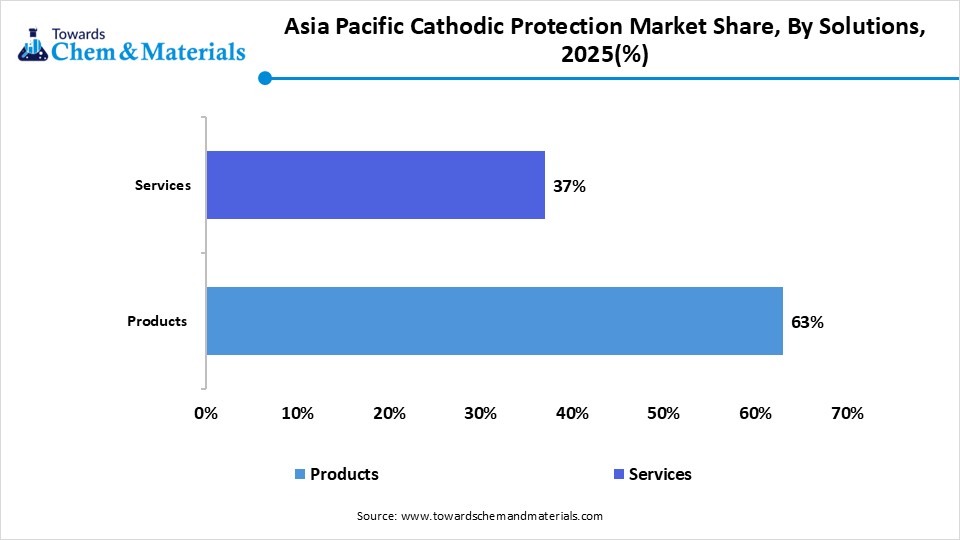
The services segment held a 36.60% market share in 2025 and is expected to have the fastest growth with a CAGR of 23.15% in the forecast period, driven by the growing investments in aging infrastructure refurbishment, offshore fabrication, and industrialization. The other key service types that contribute to the growth are installation services, inspection and monitoring services, design and engineering, and maintenance and repair services, which support the growth of the market.
Type Insights
The impressed current segment dominated the market with a 58.30% share in 2025 and is expected to grow at a CAGR of 22.50% over the forecast period, driven by its ability to provide high current output for massive industrial assets, which fuels growth. They are extensively used for external power, long-term durability, and large-scale use as a power source, and protective massive structures fuel the growth. Rapid industrial growth and industrial infrastructure in the region push demand.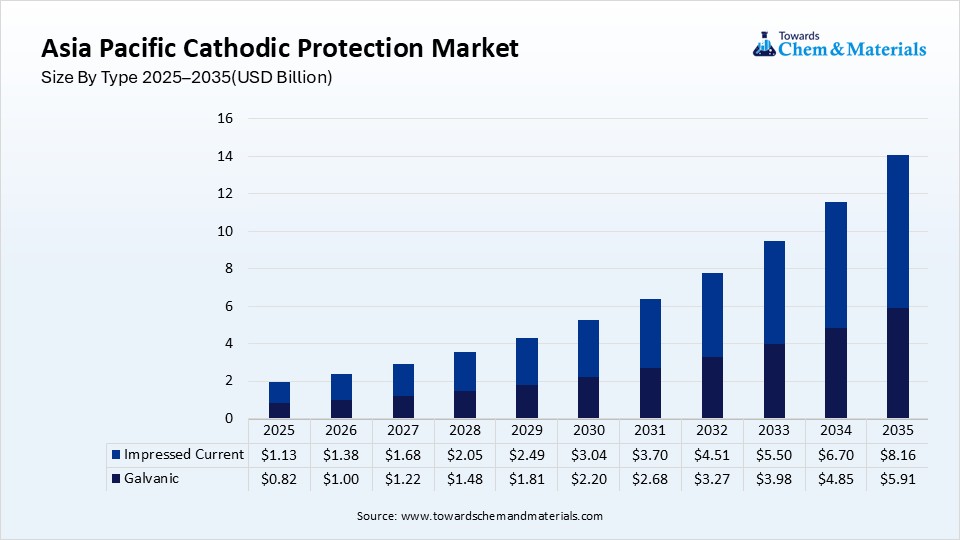
The galvanic segment held a 41.70% market share in 2025 and is expected to have the fastest growth with a CAGR of 22.50% in the forecast period, driven by the high demand for cost-effective, self-powered corrosion prevention in sectors. The major advancements are that they require no external power source, which makes them ideal for use across developing industries, which is a major growth factor. Core drivers that increase the adoption are simplicity and reliability, infrastructure boom and material innovations, especially in industrial spaces, and fuel growth.
Applications Insights
The pipeline segment dominated the market with a 27.80% share in 2025 and is expected to grow at a CAGR of 21.45% over the forecast period, driven by rapid industrialization and urbanization across the region, which drives underground and subsea pipeline construction in regions that drive the growth. The major drivers are smart monitoring, regional scale, and corrosion prevention through systems like galvanic/sacrificial anodes and impressed current cathodic protection, which help prevent damage supporting growth.
The buildings segment held 7.90% market share in 2025 and is expected to have the fastest growth with a CAGR of 24.10% in the forecast period, driven by infrastructural development with increased adoption of corrosion control systems for reinforcing steel bars, which is a major growth factor in the market. The key growth drivers in the building segment are rebar protection, technological shifts, and maintenance of aging assets, which further boost the growth of the market.
Regional Analysis
How did China dominate the Asia Pacific cathodic protection market in 2025?
China's cathodic protection market size was estimated at USD 0.80 billion in 2025 and is projected to reach USD 5.84 billion by 2035, growing at a CAGR of 21.99% from 2026 to 2035. China dominated the Asia Pacific cathodic protection market with a share of 41% in 2025
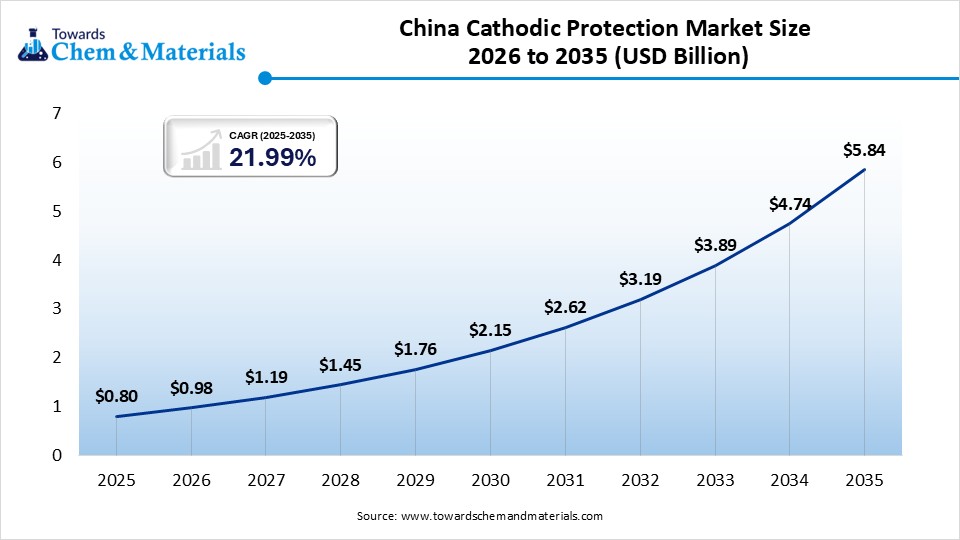
The driven by growing investment in the industry in underground pipeline networks and the development of large-scale industrial and marine applications and also advancement in technology through AI integration, which helps in real-time monitoring of corrosion management through digital monitoring, which also reduces correction time and helps in monitoring losses. The presence of a vast pipeline network in China, operating over 980,000 km of underground pipeline, where cathodic protection plays a major role in safeguarding digital energy transmission, is a major growth factor. The integration of digital systems for monitoring, rather than relying on manual maintenance, is due to technological advancement in the country, which helps in the growth of the industry.
India Cathodic Protection Market Growth Factor
The India cathodic protection market size was estimated at USD 0.31 billion in 2025 and is projected to reach USD 2.32 billion by 2035, growing at a CAGR of 22.30% from 2026 to 2035. India held a market share of 16% in 2025, driven by the massive infrastructure development programs in the region supported by rapid industrialization and a focus on asset longevity, which drives the growth. The infrastructure expansion in the region and the booming energy sector drive demand for the safety of high-value steel assets and marine structure demand for cathodic protection. Technological advancement and stricter safety and environmental regulations, which are enforced by the government, compel companies to invest in reliable corrosion control techniques like impressed current cathodic protection and sacrificial anode cathodic protection, boosting the growth of the market.
Japan Cathodic Protection Market Growth Factor
The Japan cathodic protection market size was estimated at USD 0.37 billion in 2025 and is projected to reach USD 2.74 billion by 2035, growing at a CAGR of 22.17% from 2026 to 2035. Japan held a market share of 19% in 2025, driven by the growing infrastructure maintenance and rapid adoption of smart IoT-enabled monitoring systems. Japan's aging infrastructure and the need for asset integrity for long-term maintenance and refurbishment of older infrastructure to prevent costly corrosion failures are major factors. Smart city and tech integration investment in cathodic protection in smart city infrastructure for advanced water treatment facilities. The government and industries enforce regulatory standards aligned with environmental standards, with wider adoption of CP solutions supporting growth.
South Korea Cathodic Protection Market Growth Factor
South Korea cathodic protection market size was estimated at USD 0.14 billion in 2025 and is projected to reach USD 1.06 billion by 2035, growing at a CAGR of 22.44% from 2026 to 2035.South Korea held a market share of 7% in 2025, driven by the growing investment in cathodic protection through the integration of digitalization in modern urban and smart city frameworks. The expanding metro and underground transit network increases the demand for cathodic protection for current mitigation and for structural longevity, which supports growth. The technological integration of water and wastewater utilities, which require reliable corrosion prevention for metal pipelines and tanks, further supports growth.
Australia Cathodic Protection Market Growth Factor
Australia cathodic protection market size was estimated at USD 0.12 billion in 2025 and is projected to reach USD 0.91 billion by 2035, growing at a CAGR of 22.46% from 2026 to 2035.Australia held a market share of 4% in 2025, driven by the growing demand for oil and gas expansion, which requires reliable protection networks, and this is to overcome and combat the harsh saline environment and its repercussions. The government in Australia follows mandates and safety measures for the maintenance of the offshore and onshore reserves. Key Australian standards like AS 2832.1, AS 2832.2, AS 2832.3, AS 2832.4, and AS 2832.5 are the major factors that are applied and focus on specific structures. Regular testing and design audits, which are used for monitoring mandates for long-term asset integration and stray current control, are major regulatory compliance measures that fuel the growth.
Taiwan Cathodic Protection Market Growth Factor
The Taiwan cathodic protection market size was estimated at USD 0.10 billion in 2025 and is projected to reach USD 0.77 billion by 2035, growing at a CAGR of 9.93% from 2026 to 2035. Taiwan held a market share of 3% in 2025, as it is used for the prevention of metal corrosion in harsh marine industrial and offshore environments like the Taiwan Strait, boosting the growth of the industry. The key applications in Taiwan are offshore wind farms through projects like the Yunlin offshore wind farm, where firms like Corrosion BV supply specialized ICCP systems. For harbor and coastal structures, oil, gas, and utilities are supported by specialized training and monitoring services, further boosting growth.
Indonesia Cathodic Protection Market Growth Factor
The Indonesia cathodic protection market size was estimated at USD 0.08 billion in 2025 and is projected to reach USD 0.63 billion by 2035, growing at a CAGR of 22.92% from 2026 to 2035. Indonesia held a market share of 2% in 2025, driven by the massive and extensive use of protection to safeguard metallic structures from rust through core technologies like sacrificial anode cathodic protection and impressed current cathodic protection systems. The key providers and manufacturers in the region, like PT Aneka Sarana Konstrukindo, PT Perintis Proteksi Sejahtera, and Pusat Cathodic Protection, play a major role in design and production through installation and supplies across the country, which is a major growth factor.
Vietnam Cathodic Protection Market Growth Factor
The Vietnam cathodic protection market size was estimated at USD 0.04 billion in 2025 and is projected to reach USD 0.35 billion by 2035, growing at a CAGR of 24.22% from 2026 to 2035. Vietnam held a market share of 1% in 2025, driven by rapid infrastructure expansion and local corrosion control and cathodic protection expanding, aligning with major refinery, pipeline, and port developments, fueling growth. Companies like Xylem Vietnam provide specialized ICCP systems for seagoing vessels and marine assets. Local service providers and specialized engineering firms like Viet Petroleum and Marine Service Company and V.Tech Electrical Technology help with maintenance and installation, which is a major growth factor in the industry.
Thailand Cathodic Protection Market Growth Factor
Thailand held a market share of 1% in 2025. The growing demand for marine assets and storage tanks with protection integration and demand for sacrificial anodes, which are ideal for the application, and the company like Thai Marine Protection, which is a local manufacturer who specializes in producing these galvanic anodes, play a major role in the growth of the industry. Common applications like civil infrastructure, marine and offshore, oil and gas, and water infrastructure in industrial hubs like Rayong and Bangkok in Thailand are major growth drivers.
Philippines Cathodic Protection Market Growth Factor
The Philippines' cathodic protection market size was estimated at USD 0.02 billion in 2025 and is projected to reach USD 0.21 billion by 2035, growing at a CAGR of 26.51% from 2026 to 2035. The Philippines held a market share of 4% in 2025, driven by the presence of key providers and services in the Philippines, like Skempton Construction Corporation, which offers comprehensive integration of services and systems via Skempton's Cathodic Protection Engineers supported by NACE/AMPP-certified technicians, Asia Corrosion Services, Inc., and ESC Steel Philippines, which helps in the supply of cathodic protection setups for marine and steel structures fuels the growth.
- For instance, PETRONAS launched ProShield+ technology, which is a new and advanced corrosion protection technology operating in both upstream and downstream sectors. (Source: www.offshore-technology.com)
Malaysia Cathodic Protection Market Growth Factor
The Malaysia cathodic protection market size was estimated at USD 0.04 billion in 2025 and is projected to reach USD 0.36 billion by 2035, growing at a CAGR of 24.57% from 2026 to 2035. Malaysia held a market share of 2% in 2025, driven by infrastructure development and demand for protection of submerged or buried steel assets, fueling the growth. The industry standards and training programs in the country are supported through organizations like AMPP, which trains for efficiency. The key providers and specialists in Malaysia, like Norimax and Karatec Resources Sdn. Bhd., OPM Venture Sdn. Bhd., play a major role in the growth and expansion of the market.
- For instance, in June 2026, Tri Star SBN Bhd is eyeing an ACE Market debut on Bursa Malaysia to expand its cathodic protection and manufacturing operations. (Source: www.thestar.com.my)
Singapore Cathodic Protection Market Growth Factor
Singapore cathodic protection market size was estimated at USD 0.06 billion in 2025 and is projected to reach USD 0.49 billion by 2035, growing at a CAGR of 23.37% from 2026 to 2035.Singapore held a market share of 2% in 2025, driven by technological innovation, which helps in optimization and enhance the performance of protection systems, which drives growth. Strict regulations and infrastructure modernization through investment in infrastructure development which is a major growth factors. The maritime hub status drives continuous demand for metal corrosion prevention, fueling growth.
- For instance, in August 2026, i2Cool, which is a technology company that specializes in electricity-free cooling solutions, launched i2Coating CorrroCool, which is an industrial-grade corrosion protection. (Source: macaubusiness.com)
Recent Developments
- In April 2026, IEV Group and Corrosion RADAR have announced a strategic partnership to support corrosion monitoring and asset integrity programs across Southeast Asia. The collaboration covers insulated industrial infrastructure in Malaysia, Indonesia, India, Brunei, Vietnam, and Thailand, where environmental conditions can increase the risk of corrosion developing beneath insulation. (Source: corrosionradar.com)
- In May 2025, a vital waterfront launch structure at Naval Base Ventura County has been restored for operation through a joint effort by the Naval Air Warfare Center Weapons Division, Naval Facilities Engineering Systems Command Southwest, and Naval Construction Group One's Seabees. The structure, called the Vertical Launch Slip, is made of steel and concrete and enables large, unmanned surface targets and remotely operated boats used in weapons testing to be lowered into the water with a mobile Marine Travelift. (Source: www.dvidshub.net)
Competitive Analysis
- The market's key players form strategic partnerships and collaborations led by the leaders for innovation and infrastructure growth, using specialized techniques for protection from corrosion and rusting by players like Furukawa Electric Co., Ltd. and NACE International.
- Furukawa Electric Co., Ltd. invests heavily in research and development to supply advanced CP systems tailored for high-growth zones like Asia-Pacific.
- NACE International offers global consulting, testing, and professional training while building strategic alliances to spread proper corrosion control standards, highlighting its focus on corrosion control standards and professional training. (Source: www.naceindia.org)
- Companies like The Nippon Corrosion Engineering Co., Ltd., MATCOR, Inc., and Corrpro (Aegion Corporation) partner with local contractors and government agencies.
- FORCE Technology & Asia Offshore Solutions formed a strategic partnership in late 2024 to deliver advanced structural monitoring, subsea inspection, and cathodic protection services to Australia’s offshore sector. (Source: www.offshore-energy.biz)
- ZERUST and Highsea Technology Group Partnered to supply vapor corrosion inhibitor preservation and specialized corrosion control solutions for upstream and offshore oil and gas projects throughout China. (Source: www.zerustis.com)
- Encompass Marine & CORROSION established an official partnership to deliver sustainable Impressed Current Cathodic Protection and marine growth prevention systems across maritime sectors. (Source: encompassmarine.com)
- The Association for Materials Protection and Performance hosts dedicated regional events like the East Asia and Pacific Area Conference to facilitate cross-border technical alliances and service provider networking. (Source: ampp.org)
Top Players in the Asia Pacific Cathodic Protection Market & Their Offerings
| Company | Company Type/Position | Major Headquarters | Geographic Presence | Cathodic Protection Offerings | Key Offering/Strength |
| Nippon Corrosion Engineering Co., Ltd. | Japanese cathodic protection specialist | Tokyo, Japan | Japan, Asia Pacific, the Middle East, and other global markets | Sacrificial anodes, impressed current systems, corrosion monitoring, and engineering services | Strong expertise in cathodic protection for ships, pipelines, and industrial infrastructure |
| Nakabohtec Corrosion Protecting Co., Ltd. | Japanese corrosion protection specialist | Tokyo, Japan | Japan and Asia Pacific | Cathodic protection systems, corrosion monitoring, anodes, and engineering services | Strong engineering capabilities for marine, industrial, and infrastructure applications |
| Corrtech International Pvt. Ltd. | Indian corrosion management company | Ahmedabad, India | India, Asia Pacific, and international markets | Cathodic protection systems, anodes, corrosion monitoring, and engineering services | Integrated corrosion protection solutions for pipelines, storage tanks, and industrial assets |
| Corrosion Technology Services India Pvt. Ltd. | Indian cathodic protection service provider | Mumbai, India | India and Asia Pacific | Cathodic protection design, installation, testing, monitoring, and maintenance | Specialized technical and field-service capabilities for energy and infrastructure assets |
| Wilson Taylor Asia Pacific Pte. Ltd. | Regional cathodic protection systems provider | Singapore | Southeast Asia, Australia, and wider Asia Pacific | Sacrificial anodes, impressed current systems, anti-fouling systems, design and installation services | Turnkey cathodic protection expertise for marine, offshore, refinery, power plant, and infrastructure |
Other Top Players Are
- Corrpro Asia Pte Ltd / Corrpro Companies (Singapore / Global)
- Cathodic Protection Technology Pte Ltd (CP TECH) (Singapore)
- SunRui Marine Environment Engineering Company Ltd. (CSIC) (China)
- JST Group (Thailand)
- Savcor Group Limited (Australia)
- Aegion Corporation (Global / APAC operations)
- MATCOR, Inc. (Global / APAC distribution)
- Cathodic Marine Engineering Pte Ltd (Singapore)
- Corrosion Protection Specialist Pvt. Ltd. (Singapore)
- smartcorr (Australia)
- Perma-Pipe International Holdings, Inc. (Global / India operations)
- BAC Corrosion Control Ltd. (Global / APAC operations)
- Cathodic Protection Co. Ltd. (Global / APAC distribution)
- Asia Corrosion Services, Inc. (ACSI) (Philippines)
- Sepakat Energy Services (Malaysia)
- Himoya Corrosion Technology (Regional APAC distributor & manufacturer)
Segments Covered
By Solutions
- Products
- Sacrificial Anodes
- Zinc Anodes
- Aluminum Anodes
- Magnesium Anodes
- Impressed Current Anodes
- MMO/Ti Anodes
- High-Silicon Cast Iron Anodes
- Graphite Anodes
- Transformer Rectifiers
- Air-Cooled Rectifiers
- Oil-Cooled Rectifiers
- Reference Electrodes
- Copper/Copper Sulfate
- Silver/Silver Chloride
- Zinc Reference Electrodes
- Test Stations
- Junction Boxes
- CP Cables & Accessories
- Remote Monitoring & Control Systems
- Services
- CP System Design & Engineering
- Installation & Commissioning
- Inspection & Testing
- Monitoring & Surveys
- Maintenance & Repair
- Consultancy & Asset Integrity Management
- Sacrificial Anodes
By Type
- Galvanic
- Zinc Anode
- Aluminum Anode
- Magnesium Anode
- Impressed Current
- MMO Anode Systems
- High-Silicon Cast Iron Systems
- Graphite Anode Systems
- Transformer-Rectifier Systems
- Deep-Well Anode Systems
- Distributed Anode Systems
By Applications
- Pipeline
- Oil & Gas Pipelines
- Water Pipelines
- Chemical Pipelines
- Offshore/Subsea Pipelines
- Storage Facilities
- Above-Ground Storage Tanks
- Underground Storage Tanks
- Fuel Storage Facilities
- Chemical Storage Facilities
- Processing Plants
- Refineries
- Petrochemical Plants
- Chemical Plants
- Power Plants
- Industrial Processing Facilities
- Water & Wastewater
- Water Distribution
- Wastewater Treatment
- Desalination
- Water Storage
- Transportation
- Ships & Vessels
- Ports & Harbors
- Rail Infrastructure
- Bridges
- Automotive Infrastructure
- Buildings
- Reinforced Concrete Structures
- Parking Structures
- Commercial Buildings
- Industrial Buildings
- Others
- Offshore Platforms
- Marine Structures
- Renewable Energy Structures
- Utility Infrastructure
A Seven-Phase Framework
Our methodology is designed to be universally applicable across commodity chemicals, specialty chemicals, petrochemicals, construction chemicals, coatings, electronic chemicals, industrial gases, agrochemicals, water treatment chemicals, and performance materials. Each phase builds upon the last, creating a layered validation structure that minimizes estimation error and maximizes analytical confidence.
The framework ensures comprehensive market coverage, robust cross-validation, and reliable long-term forecasting — producing market estimates that withstand scrutiny from investors, regulators, and corporate strategy teams.

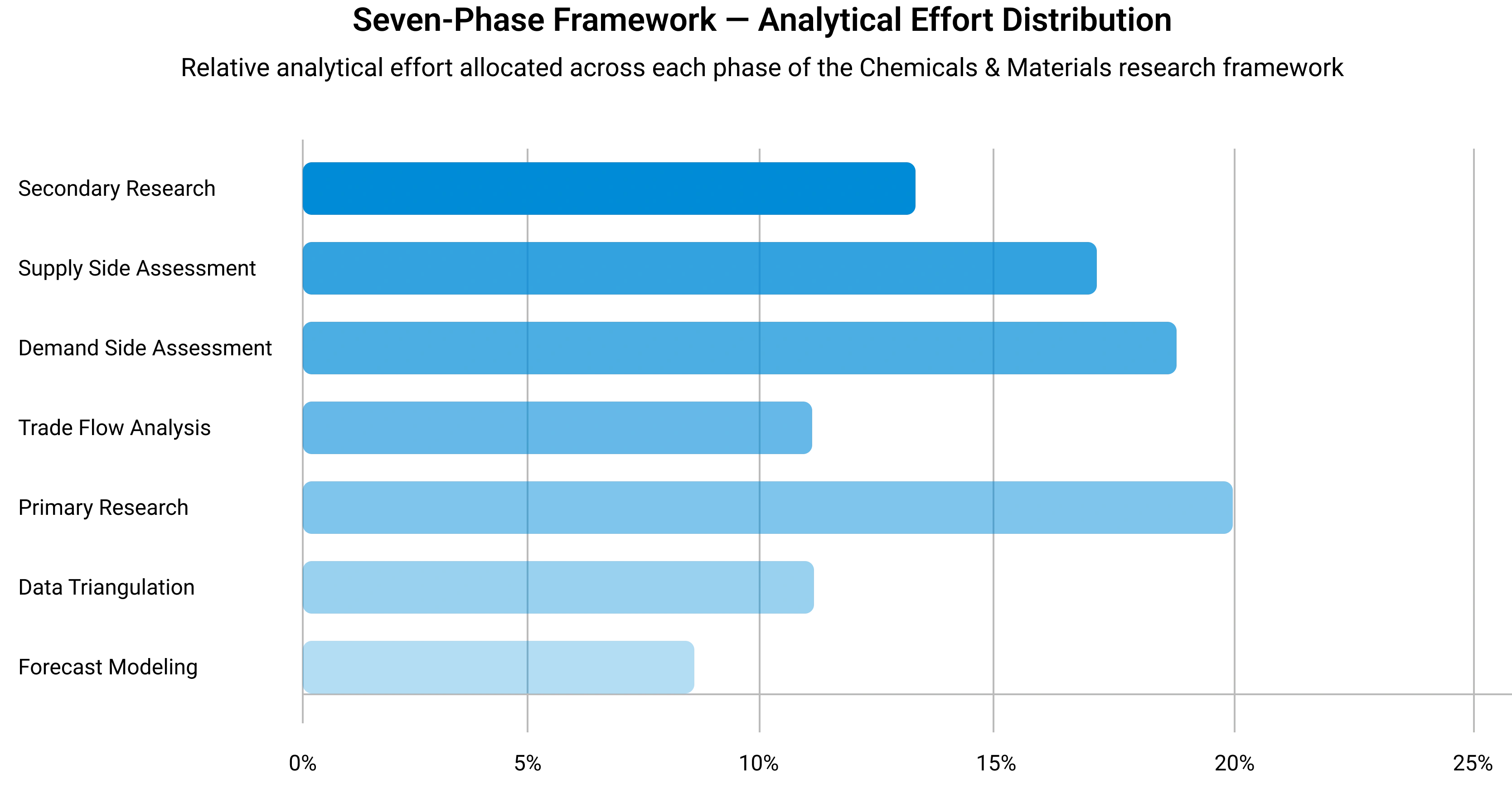
Seven-Phase Framework — Analytical Effort Distribution
Relative analytical effort allocated across each phase of the Chemicals & Materials research framework
Phase 1 - Secondary Research: Establishing the Foundation
Secondary research collects and evaluates publicly available information from authoritative sources, establishing the foundational understanding of market structure, value chain dynamics, competitive landscape, and end-use demand patterns. Every source is evaluated for credibility, recency, geographic relevance, and methodological soundness before inclusion.
Industry Associations
Sources include ACC, CEFIC, ICCA, JCIA, CPCIF, and SOCMA providing production volumes, consumption trends, capacity developments, and sustainability initiatives.
Company Disclosures
Annual reports, investor presentations, earnings transcripts, and regulatory filings reveal product portfolios, manufacturing footprints, capacity expansions, and revenue segmentation.
Government Databases
National statistical offices, customs authorities, environmental agencies, and industrial production databases provide verified statistics on output, trade flows, and regulatory compliance.
Trade Databases
UN Comtrade, ITC, Eurostat, and national customs authorities enable assessment of global product movement, import dependency, and export competitiveness across regions.
Our Secondary Research Sources
- Ministry of Chemicals and Fertilizers
- European Chemicals Agency
- United States Department of Energy
- Ministry of Industry and Information Technology
- Ministry of Economy Trade and Industry
- Ministry of Trade Industry and Energy
- National Institute of Standards and Technology
- Council of Scientific and Industrial Research
- Fraunhofer Society
- National Institute for Materials Science
Phase 2 — Supply-Side Assessment: Mapping Production Capabilities
Production Capacity Analysis
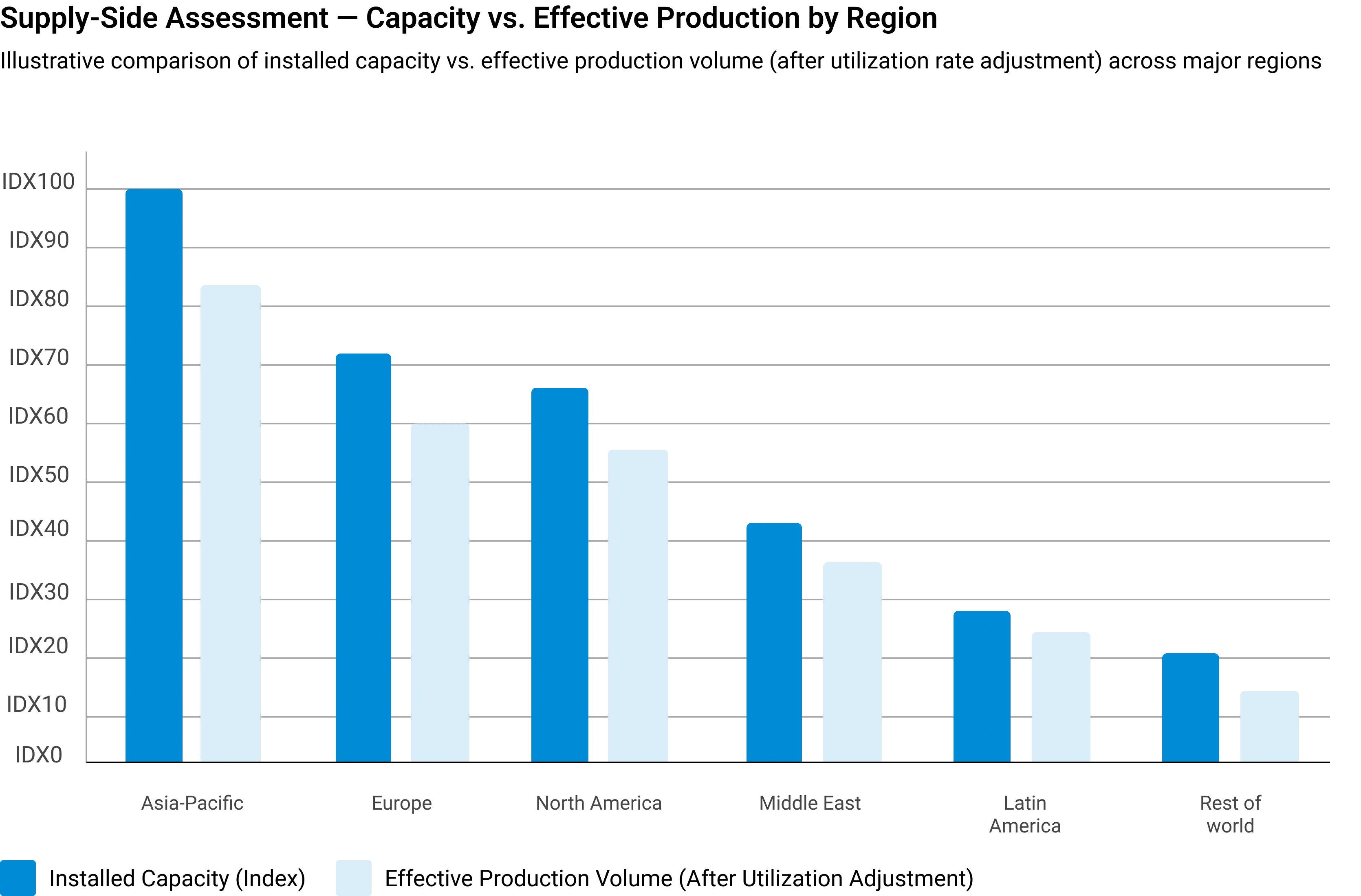
All major manufacturers are assessed for existing installed capacity, planned additions, expansions, new plant announcements, and technology adoption — mapped at global, regional, and country levels.
Capacity Utilization Adjustment
Installed capacity is adjusted using utilization rates based on demand conditions, feedstock availability, plant operating rates, maintenance schedules, and regulatory restrictions.
Manufacturer Revenue Analysis
Product-specific revenues, segment-level performance, regional distribution, average selling prices, and margin trends are evaluated to establish market value estimates.
Supply-Side Assessment — Capacity vs. Effective Production by Region
Illustrative comparison of installed capacity vs. effective production volume (after utilization rate adjustment) across major regions
Phase 3 — Demand-Side Assessment: Quantifying Chemical Consumption
Demand-side analysis quantifies chemical consumption across industries, applications, and geographies — identifying where and how chemicals are consumed throughout the value chain with precision.
End-Use Industry Analysis
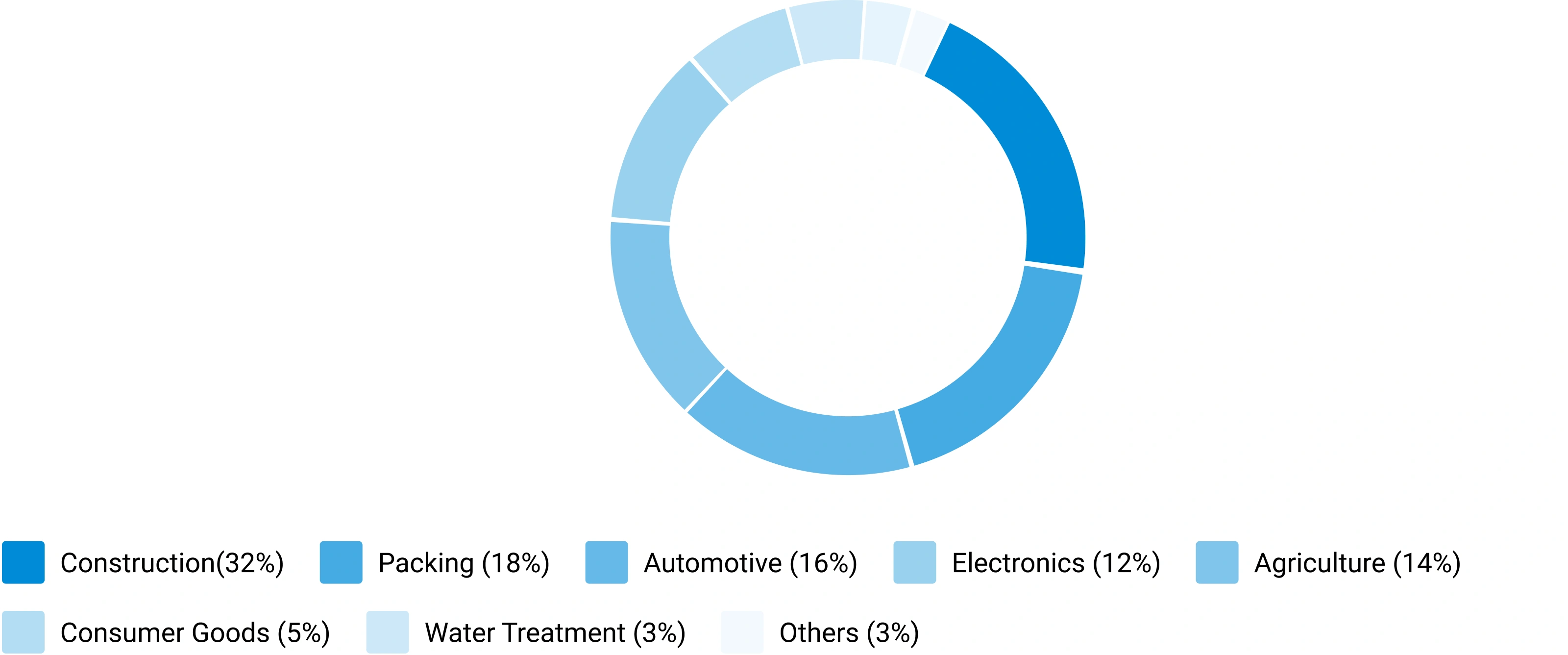
Chemical demand is evaluated across automotive, construction, packaging, electronics, agriculture, healthcare, consumer goods, industrial manufacturing, energy and utilities, and water treatment. Industry output, production trends, and consumption intensity are analyzed to determine demand patterns.
Consumption Modeling
Demand is estimated using measurable indicators: kilograms per vehicle, kilograms per square meter of construction, dosage per cubic meter of water treated, kilograms per hectare of agricultural land, and kilograms per ton of manufactured products. Consumption factors are validated through industry publications and primary interviews.
Application Analysis
The market is segmented by application area to understand product performance requirements, formulation trends, technology adoption, customer preferences, and regulatory requirements improving demand accuracy and segmentation granularity.
Demand-Side Assessment — End-Use Industry Demand Distribution
Illustrative distribution of chemical & materials demand across key end-use industries
Phase 4 - Trade Flow Analysis: Balancing Regional Supply and Demand
Trade flow analysis reconciles regional supply and demand estimates through import and export data, identifying net supply positions, regional dependencies, and market imbalances. It serves as an independent validation layer that tests the consistency of supply-side and demand-side estimates.
Import Analysis
Import data is evaluated to determine volumes, source countries, product dependency, regional supply gaps, and pricing trends — identifying markets that rely heavily on external supply and where domestic production is insufficient to meet demand.
Export Analysis
Export assessments reveal production surplus, export competitiveness, regional manufacturing strength, and global market participation. Export patterns also help validate domestic production estimates and identify net exporting regions.
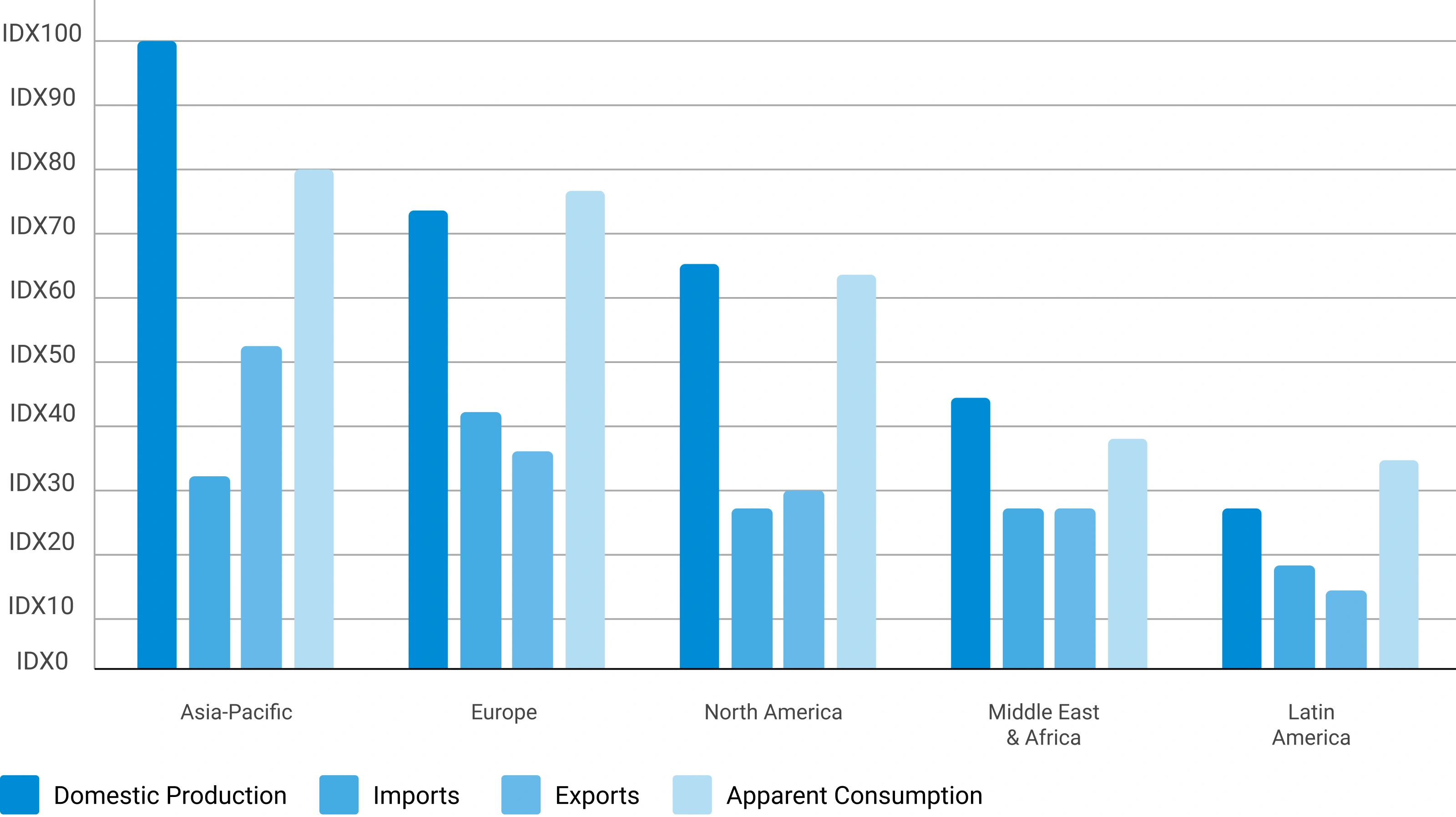
Apparent Consumption Model
Regional consumption is assessed using the standard apparent consumption formula:
Results identify net importing regions, net exporting regions, regional deficits, and surpluses — serving as an independent validation of supply and demand estimates.
Trade Flow Analysis — Net Supply Position by Region
Illustrative apparent consumption vs. domestic production across major regions — positive gap indicates net import dependency
Phase 5 — Primary Research: The Critical Validation Layer
Primary research tests and refines findings from secondary research through direct engagement with industry participants across the supply chain, demand side, and expert community. It captures intelligence that no database or published report can provide — the real-world experience of manufacturers, buyers, and specialists operating in the market.

Supply-Side Interviews
Conversations with chemical manufacturers, raw material suppliers, contract manufacturers, technology providers, and plant operators cover production trends, capacity utilization, pricing developments, technology shifts, and competitive dynamics.

Demand-Side Interviews
Engagement with OEMs, industrial consumers, procurement managers, distributors, formulators, and end-use manufacturers focuses on consumption trends, purchasing behavior, product substitution, demand outlook, and emerging applications.

Industry Expert Consultations
Additional interviews with industry consultants, independent experts, regulatory specialists, technical professionals, and research institutions provide deeper market context and validate key analytical assumptions.
Focus Areas of Primary Research:
Market Size & Forecast Validation
Revenue estimates, volume consumption, growth rates, forecast assumptions, regional demand.Supply Chain & Value Chain Assessment
Raw material sourcing, supply chain challenges, distribution networks, procurement practices.Production & Capacity Analysis
Manufacturing capacity, utilization rates, expansion projects, plant investments.Pricing & Cost Structure Analysis
Product pricing trends, feedstock costs, energy costs, margin pressures, pricing outlook.Competitive Landscape Assessment
Volume and value estimates confirmed to be fully consistent with one another before publicationInterview Volume by Market Scope
| Study Scope | Number of Interviews |
|---|---|
| Niche Market | 20 – 30 |
| Mid-Sized Market | 30 – 50 |
| Global Market | 50 – 80 |
| Highly Fragmented Market | 80 – 120 |
Interview Details:
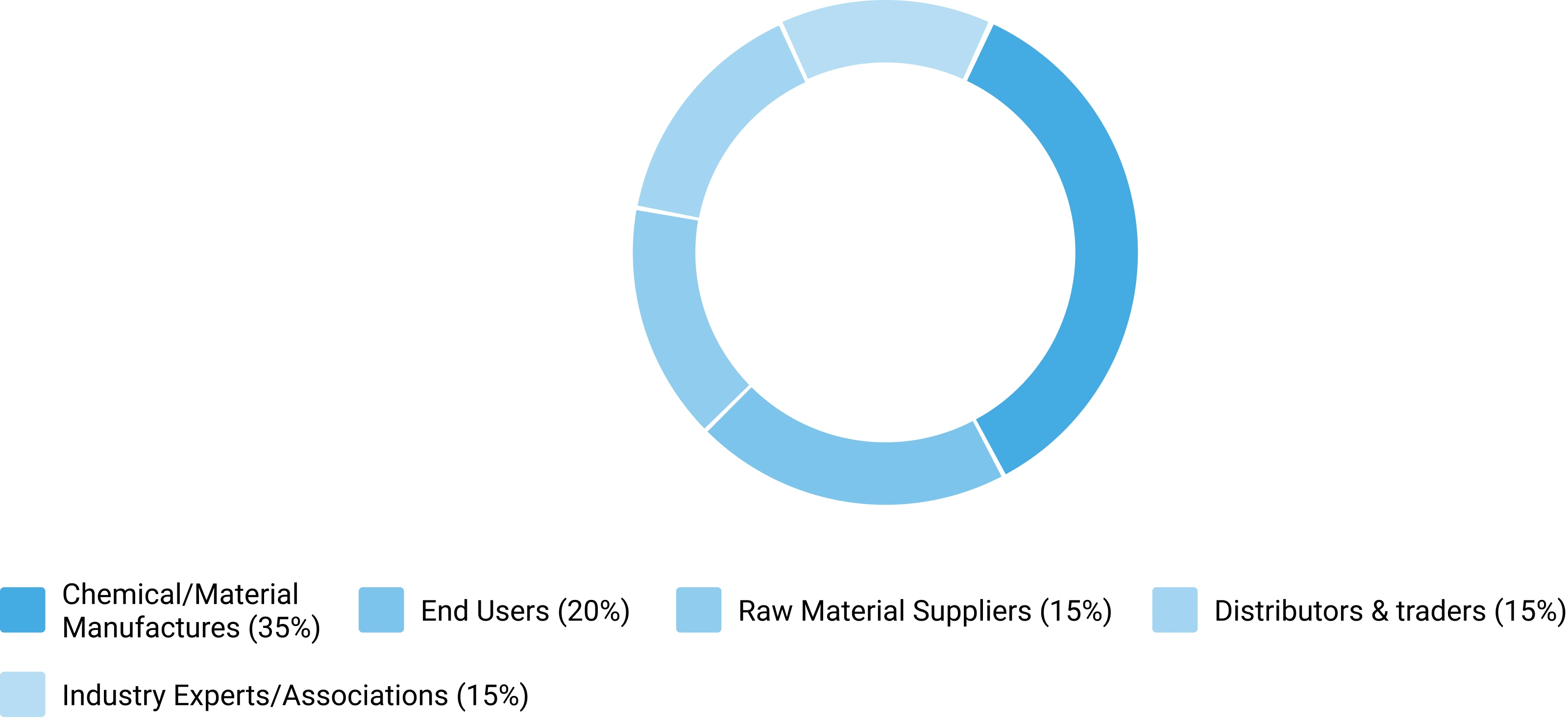
Category : Manufacturers, Suppliers, Distributors, End Users, Experts/Associations
Average Duration : 30–60 Minutes
Interview Mode : Video calls, telephonic interviews, expert consultations
Interview Format : Structured / Semi-Structured questionnaire
Focus Areas of Primary Research:
Market Size & Forecast Validation :
Revenue estimates, volume consumption, growth rates, forecast assumptions, regional demand.
Supply Chain & Value Chain Assessment :
Raw material sourcing, supply chain challenges, distribution networks, procurement practices.
Production & Capacity Analysis :
Manufacturing capacity, utilization rates, expansion projects, plant investments.
Pricing & Cost Structure Analysis :
Product pricing trends, feedstock costs, energy costs, margin pressures, pricing outlook.
Competitive Landscape Assessment :
Market share, competitor positioning, strategic initiatives, partnerships, acquisitions.
Primary Research — Stakeholder Coverage by Category
Distribution of interview respondents across stakeholder categories (% share from PPT data)
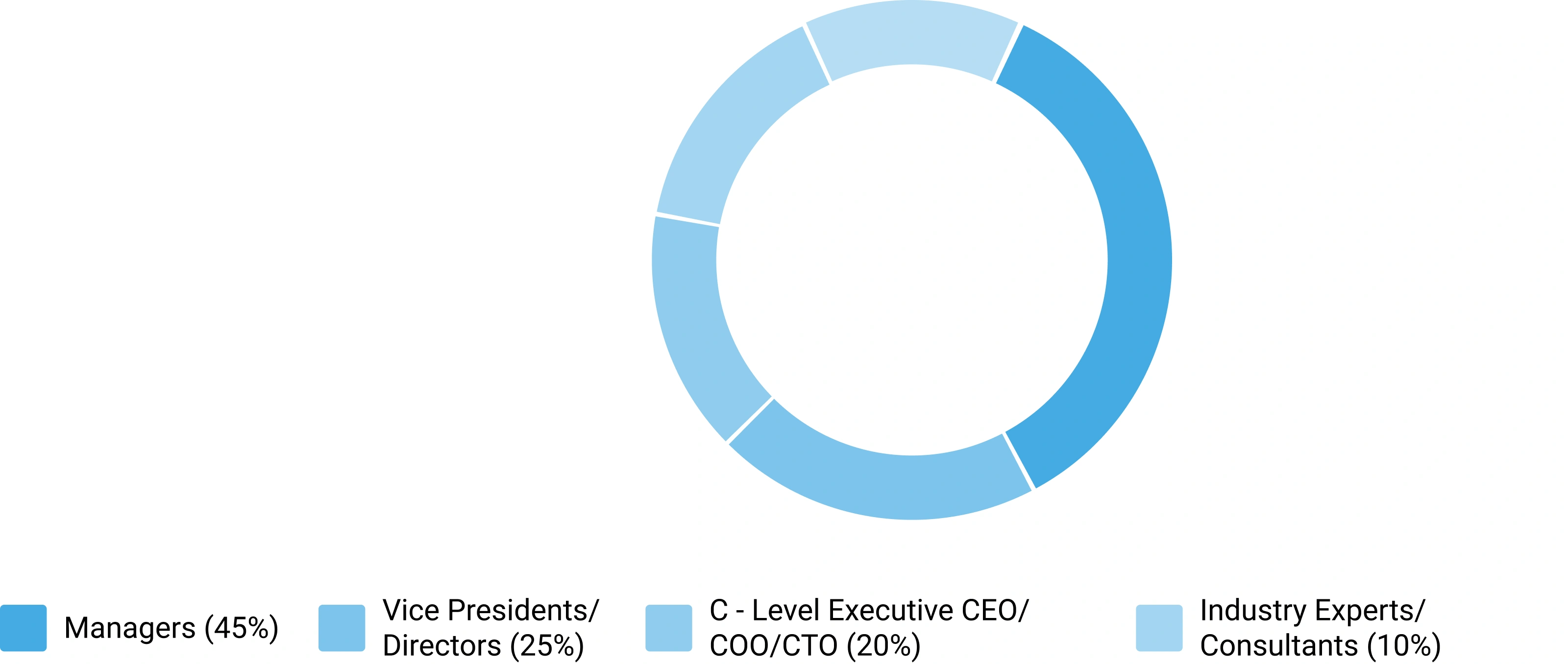
Primary Research — Respondent Designation Profile
Seniority breakdown of interview respondents (% share from PPT data)
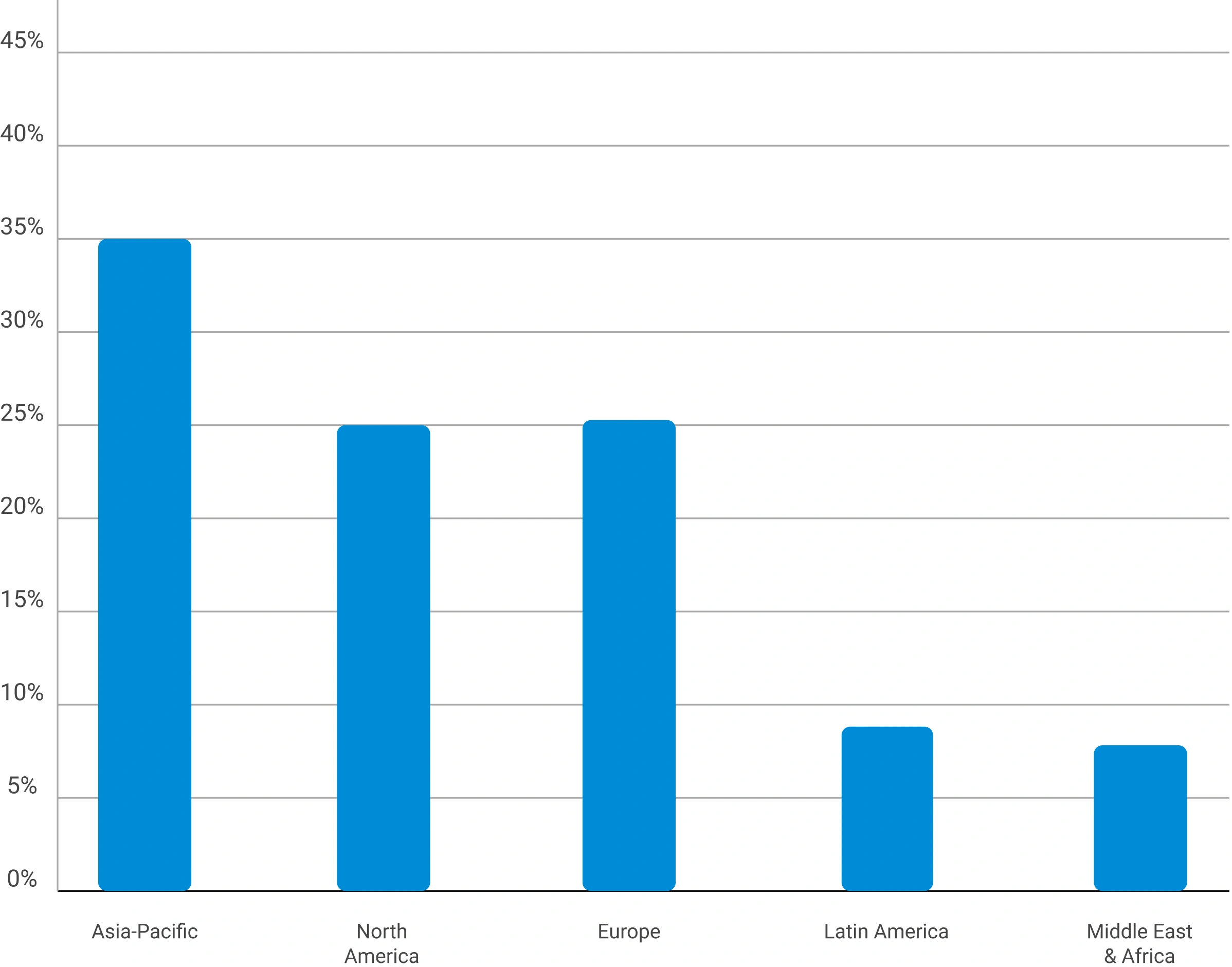
Primary Research — Geographic Coverage of Interviews
Regional distribution of primary research engagement (% share from PPT data)
Phase 6 — Data Triangulation and Market Validation
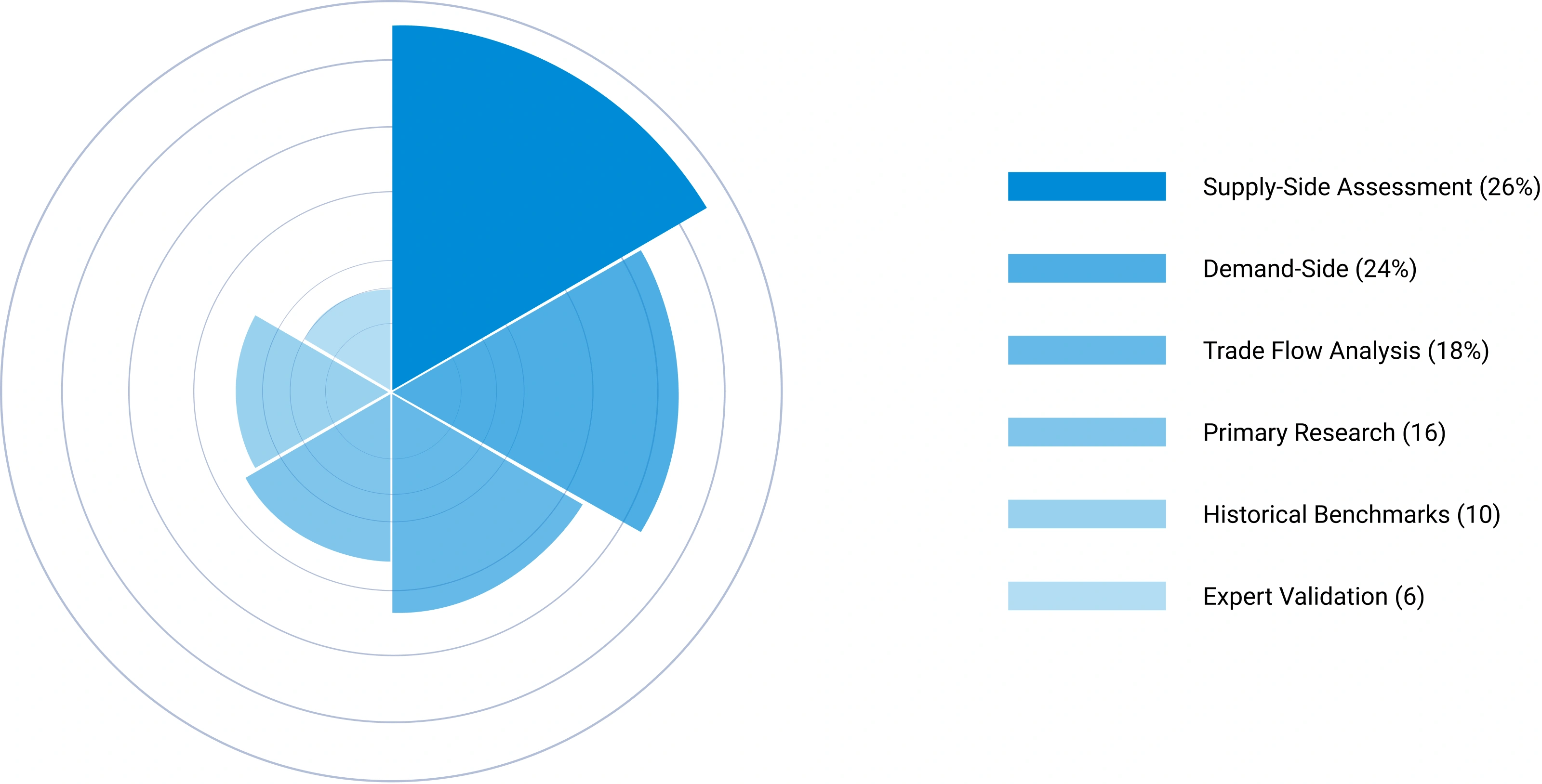
No single methodology is relied upon in isolation. Multiple independent estimation approaches are combined and reconciled to ensure consistency, accuracy, and analytical defensibility. Any material deviations between approaches are investigated and adjusted through additional validation cycles.
The final market size is derived through weighted triangulation of all validated methodologies. Any material deviations between approaches are investigated and adjusted through additional validation cycles. The outcome represents the most realistic assessment of the market based on available evidence and expert confirmation ensuring that volume and value estimates are fully consistent with one another.
Triangulation Framework — Input Contribution Weight
Relative weight each sizing input contributes to the final reconciled market estimate
Phase 7 — Forecast Modeling: Projecting Future Market Evolution
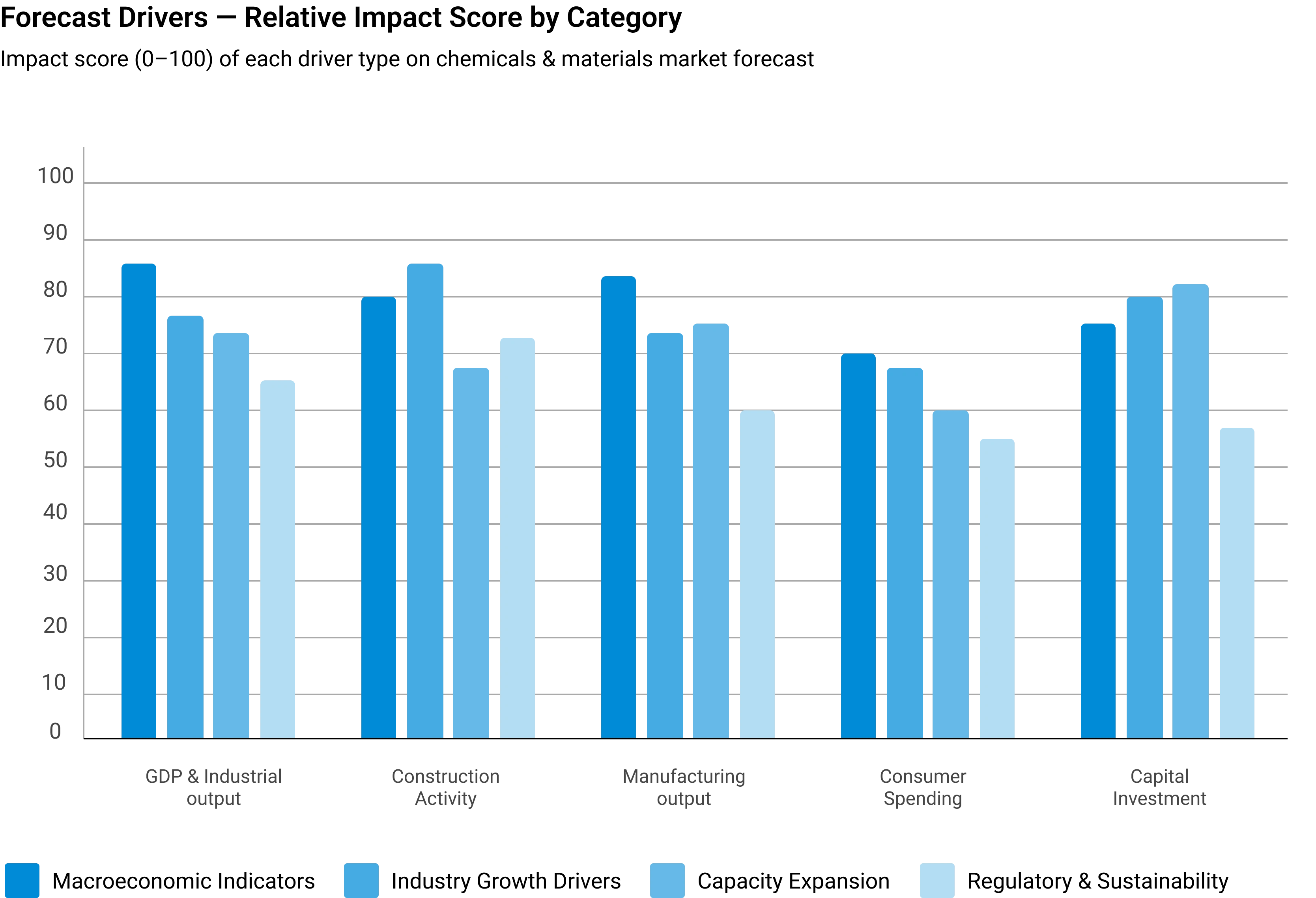
Forecasting evaluates the future trajectory of the market using a combination of quantitative indicators and qualitative assessments across economic, industry, and regulatory dimensions. Rather than simple extrapolation, each driver is independently modeled and integrated into a composite forecast.
Macroeconomic Indicators
GDP growth, industrial production, manufacturing output, construction activity, consumer spending, and capital investment form the quantitative foundation of long-term demand projections. These are applied at country, regional, and global levels.
Industry Growth Drivers
Urbanization, infrastructure development, industrialization, technological innovation, sustainability initiatives, and evolving product performance requirements are assessed at regional and industry levels — capturing both structural and cyclical demand drivers.
Capacity Expansion Analysis
Announced plant expansions, new manufacturing facilities, technology upgrades, and strategic investments are evaluated to determine future supply-demand dynamics and potential market tightness or oversupply situations.
Regulatory & Sustainability
Environmental regulations, chemical safety standards, emission reduction targets, circular economy initiatives, and sustainability requirements are incorporated as they often influence product adoption rates and market growth trajectories.
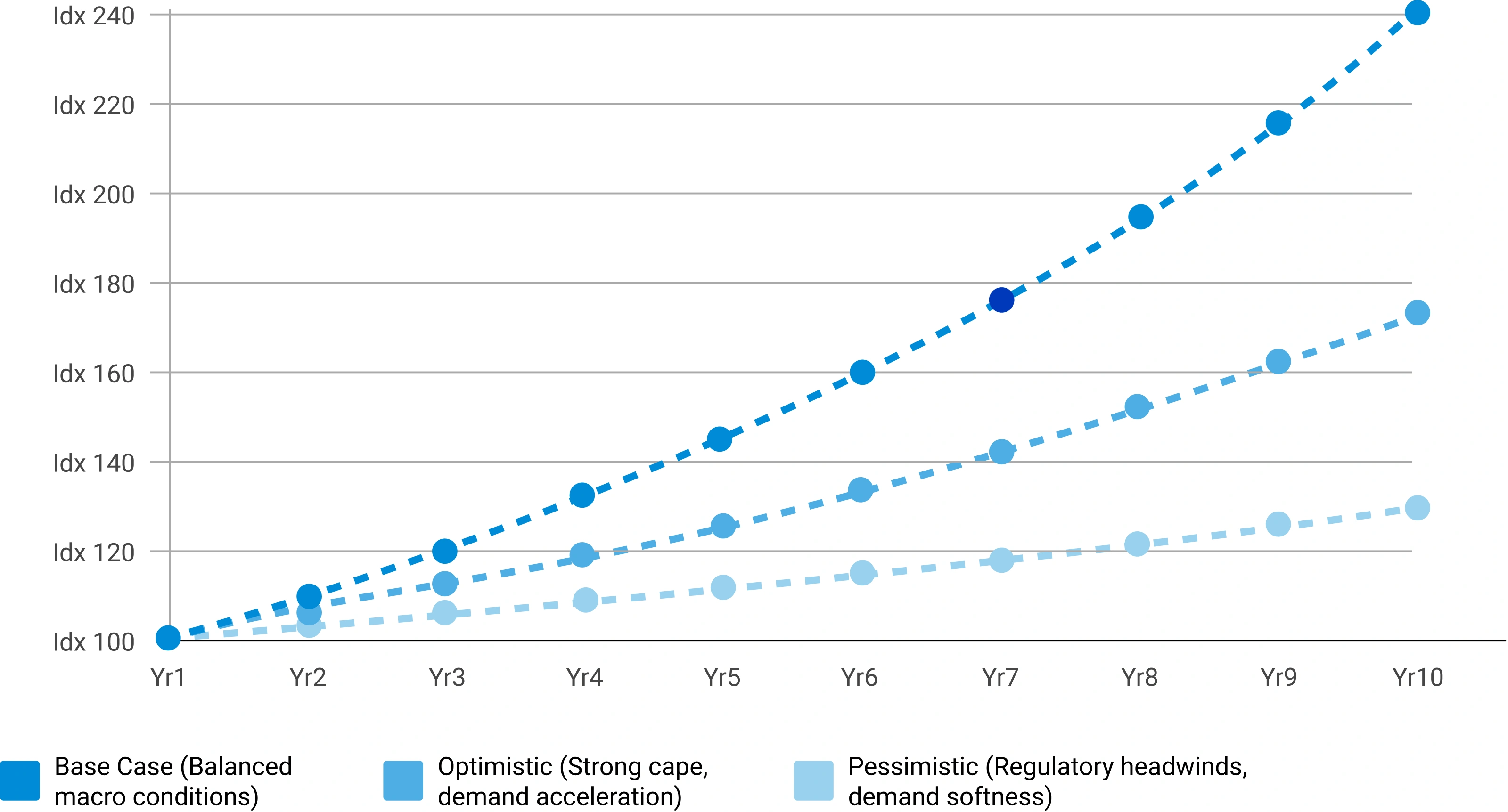
Scenario Forecast Range — Indexed Market Growth (Year 1–10)
Illustrative indexed growth trajectories across Base, Optimistic, and Pessimistic scenarios over a 10-year forecast horizon
Forecast Drivers — Relative Impact Score by Category
Impact score (0–100) of each driver type on chemicals & materials market forecast



Comments
Share your thoughts, ask a question, or provide feedback about this report.