Content


What is the Asia Pacific anti-fouling system market size and share?
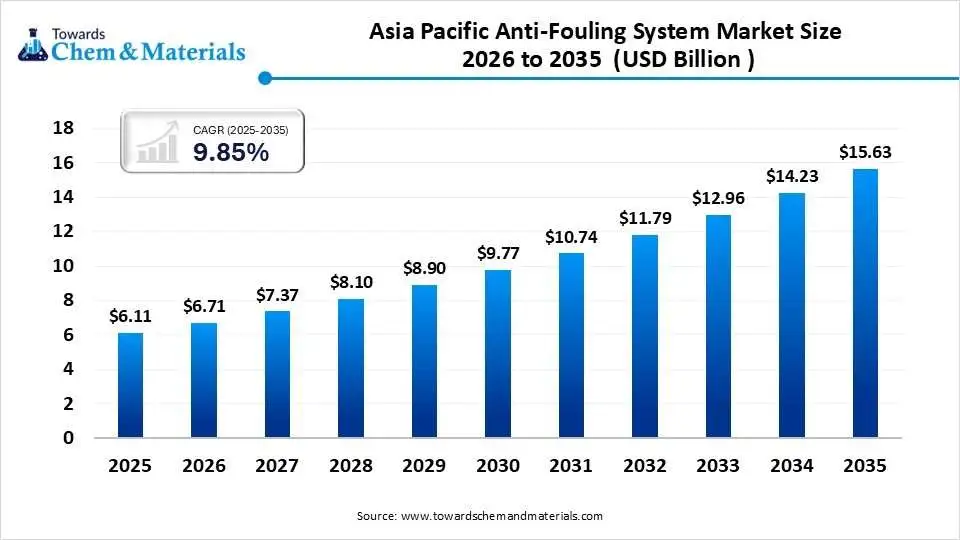
The Asia Pacific anti-fouling system market size was valued at USD 6.11 billion in 2025, is estimated to reach USD 6.71 billion in 2026, and is projected to reach USD 15.63 billion by 2035, exhibiting a compound annual growth rate (CAGR) of 9.85% over the forecast period from 2026 to 2035. A wide range of shipbuilding, commercial shipping, offshore project, and fleet maintenance activities provide support for regional market expansion. Environmental requirements are pushing manufacturers towards the use of biocide-free and low-toxicity formulations.
The anti-fouling system market in Asia Pacific is driven by the large scale of shipbuilding, commercial shipping, marine infrastructure, and offshore activities. China, South Korea, and Japan are key ship-making hubs, and India and Southeast Asia offer rising new opportunities in shipping. As the density of growing vessels increases, the hull protection, maintenance, and repainting needs will increase as well. Environmental requirements also drive cleaner formulations and technology innovations to enhance hydrodynamic performance and minimize harmful chemicals reaching marine environments.
Market Highlights
- China dominated the Asia Pacific anti-fouling system market by holding a 39% share in 2025 and is expected to grow at a CAGR of 9.99% during the forecast period.
India held a 7% market share in 2025 and is expected to grow at the fastest rate, with a CAGR of 7.8% during the forecast period. - By type, the coatings segment dominated the market with the largest share of 64.5% in 2025 and is expected to grow at a CAGR of 5.8% during the forecast period.
- By type, the ultrasonic anti-fouling systems segment held 18.3% market share in 2025 and is expected to grow at the fastest CAGR of 7.4% over the forecast period.
- By application, the marine shipping segment dominated the market with the largest share of 58.2% in 2025 and is expected to grow at a CAGR of 6% during the forecast period.
- By application, the aquaculture segment held 7.1% market share in 2025 and is expected to grow at the fastest CAGR of 8.1% over the forecast period.
- By vessel type, the cargo ships segment dominated the market with the largest share of 52.8% in 2025 and is expected to grow at a CAGR of 6% during the forecast period.
- By vessel type, the recreational vessels segment held 9.3% market share in 2025 and is expected to grow at the fastest CAGR of 8.2% over the forecast period.
- By distribution channel, the direct sales segment dominated the market with the largest share of 61.5% in 2025 and is expected to grow at a CAGR of 5.9% during the forecast period.
- By distribution channel, the service-based sales segment held 11.2% market share in 2025 and is expected to grow at the fastest CAGR of 8% over the forecast period.
Global Investment Movement for the Asia Pacific Anti-Fouling System Market
As maritime sustainability demands and environmental expectations evolve, investments are turning toward foul-release silicone, biocide-free, and low-toxicity formulations. Silica and silica nanoparticles are the subject of greater research to create durable, surface-smoothing, and longer-lasting coating solutions for harsh tropical sea conditions. Investment continues to flow into existing shipbuilding locations and is growing into India and Southeast Asia, where maritime activity and vessel maintenance are rising. To maximize hull monitoring, maintenance planning, and dry-docking decision-making, industry participants are looking to spend on the integration of IoT, AI, and digital-twin technologies.
Report Scope
| Report Attributes | Details |
| Market Size in 2026 | USD 6.71 Billion |
| Expected Size in 2035 | USD 15.63 Billion |
| Growth Rate | CAGR of 9.85% |
| Base Year of Estimation | 2025 |
| Forecast Period | 2025-2035 |
| Segment Covered | By Type, By Application, By Vessel Type, By Distribution Channel |
| Key Companies Profiled | AkzoNobel N.V., PPG Industries Inc., Jotun A/S, Hempel A/S, Chugoku Marine Paints, Ltd., Nippon Paint Marine Coatings Co., Ltd., Kansai Paint Marine Co., Ltd., KCC Corporation, BASF SE |
Market Trends
- Copper-based formulations are still being used broadly due to their proven anti-fouling effectiveness and their familiarity in traditional marine coating uses.
- Increasing awareness of environmental issues and the regulations imposed on chemical leaching are bringing the biocide-free and foul-release technologies to the fore.
- Many manufacturers are looking into graphene, silica nanoparticles, and hybrid matrices to enhance surface qualities, minimize wear, enhance durability, and possibly increase maintenance time.
Key Technological Shifts and AI in the Asia Pacific Anti-Fouling System Market
Asia Pacific has a large shipbuilding industry and is characterized by a variety of marine environments, which leads to biofouling management needs. Physical, smart, and predictive technologies complement advanced coating formulations in the industry. AI plays a vital role in facilitating this shift by enabling manufacturers to assess combinations of formulations, predict coating degradation, and optimize maintenance programs under different marine conditions. AI-powered predictive analytics can speed up the formulation process by screening polymer matrices and combinations of nanomaterials.
Supply Chain Analysis of the Asia Pacific Anti-Fouling System Market
Feedstock Procurement
- Feedstock procurement includes the procurement of copper compounds, specialized biocides, resin bases, and other raw materials for marine protective systems.
- If you can count on the availability of your feedstocks, coating production can be more consistent and easier for your producers to handle the formulation quality and requirements.
- Dow Inc. is a supplier of chemical biocides and controlled-release active ingredients, including Sea-Nine, to regional coating manufacturers.
- Other Key Players: BASF SE, Evonik Industries AG, Wacker Chemie AG.
Chemical Synthesis and Processing
- The purpose of this stage is to transform the raw feedstocks into polymers, self-polishing copolymers, and more complex active agents for the anti-fouling systems in the coating formulations.
- Chemical processing is pivotal to the formulation characteristics such as performance, durability, polishing characteristics, and compatibility with marine operating conditions.
- Chugoku Marine Paints combines high-tech polymer matrix technologies and self-polishing resin solutions for the most challenging marine environments.
- Other Key Players: KCC Corporation, Kansai Paint Marine Co., Ltd., Nippon Paint Marine Coatings Co., Ltd.
Compound Formulation and Blending
- Formulation is the process of accurately adjusting the proportions of polymer, additives, biocides, and pigments in order to manufacture commercial antifouling paints and systems.
- Blending is crucial to a coatings consistency, application performance, fouling protection, and compatibility with various operating conditions of the vessels.
- AkzoNobel makes a range of tailored biocidal and foul-release compounds for marine applications, which are then combined to formulate a commercial International Micron product.
- Other Key Players: Jotun A/S, Hempel A/S, PPG Industries Inc.
Sustainability Analysis:
Anti-fouling systems play a role in maritime sustainability by minimizing the growth of marine organisms, hydrodynamic resistance, fuel usage, and related greenhouse-gas emissions. The traditional copper-based products, however, may create environmental issues through continuous leaching of metals. The addition of booster biocides can cause further environmental stress in sensitive marine areas. The industry is therefore shifting towards technology that is less harmful to people, animals, and the environment, such as biocide-free, foul release, silicone, etc.
What is an Anti-Fouling System?
A protective marine technology used to exclude the attachment and accumulation of organisms on the surface of submerged vessels. Examples of such systems are coatings and ultrasonic technologies to keep hulls cleaner, lower hydrodynamic drag, and enable operational efficiency and lower maintenance needs in marine applications.
Uses of the Asia Pacific Anti-Fouling System
- Anti-fouling systems keep marine organisms off the hulls of commercial vessels, which helps keep the vessels surfaces smooth and aids in efficient maritime operations over vast maritime routes.
- The anti-fouling technologies benefit aquaculture equipment by helping to maintain a clean fish operational environment and enhance aquaculture maintenance conditions for the booming aquaculture activities occurring in the region.
- Protection of cargo vessels is essential due to the fact that marine growth can cause resistance and has a negative impact on the efficiency of the vessels when operating.
- Antifouling technologies that delay organism attachment, maintain a fouling-free surface, and promote predictable performance when repeatedly exposed to the marine environment are beneficial to recreational vessels.
Pricing Analysis for the Asia Pacific Anti-Fouling System Market
The cost of anti-fouling systems varies according to the active ingredients, formulation complexity, technology requirements, research costs, logistics, and environmental compliance. The development difficulty for advanced silicone and foul-release products is higher. The basic formulations are still subject to competition and raw material prices. Value-based, competitive, and volume pricing can all be used by manufacturers with performance-based technologies, conventional products, and large commercial fleet contracts, respectively.
Asia Pacific Anti-Fouling System Market: Global Trade Analysis
The Asia Pacific anti-fouling system market is benefiting from a high level of maritime trade, high shipbuilding activity, thick shipping lanes, and frequent maintenance of ships. Original-equipment demand is driven by China, South Korea, and Japan, with the help of shipbuilding. After-market cleaning and repainting needs are generated during regional port traffic. Advanced coatings that minimize hydrodynamic drag and promote lower operating emissions are also promoted by fuel-efficiency goals.
Segmental Insights
Type Insights
The coatings segment dominated the market with the largest share of 64.5% in 2025 and is expected to grow at a CAGR of 5.8% over the forecast period, as it will directly protect the hull from the attachment of marine organisms. There are coating technologies available for application on commercial vessels, offshore structures, and maintenance. Environmental demands have driven formulation innovation, such as low-toxicity and foul-release and silicone alternatives, as well as biocide-free formulations.
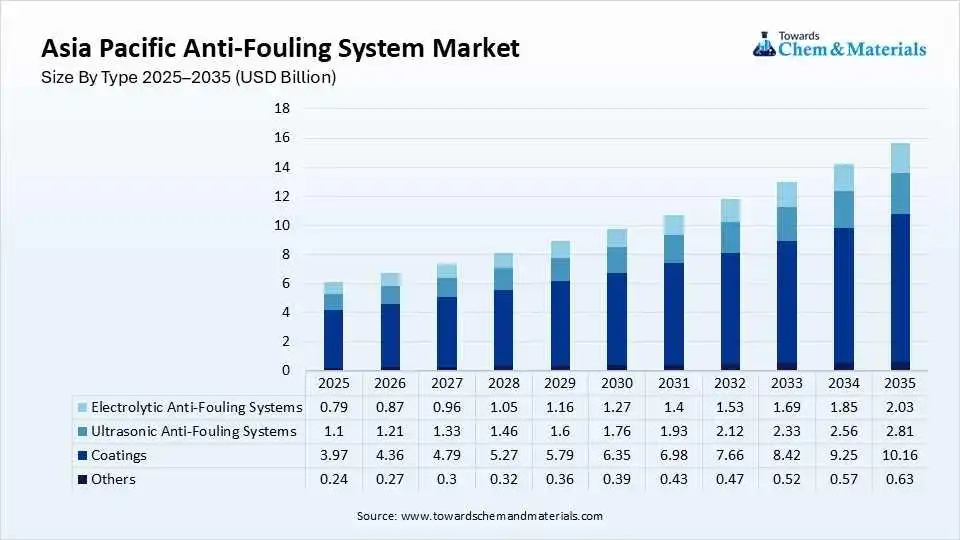
The ultrasonic anti-fouling systems segment held an 18.3% market share in 2025 and is expected to grow at the fastest CAGR of 7.4% over the forecast period. The use of ultrasonic systems is catching the eye as a non-chemical solution that can assist fouling control efforts for marine assets. They are operated mechanically with technology that is an alternative to the traditional chemical coating process. Interest in environmentally conscious maintenance methods and the use of technology-based vessel management enables their use in selected marine, industrial, and offshore applications.
- For instance, in April 2025, Alfa Laval finalized the acquisition of NRG Marine, which further enhances the companys antifouling technology portfolio for marine, oil-and-gas, and other industrial applications. (Source: www.alfalaval.com)
Asia Pacific Anti-Fouling System Market Share, By Type, 2025 (%)
| By Type | Market Share (%) |
| Coatings | 65% |
| Ultrasonic Anti-Fouling Systems | 18% |
| Electrolytic Anti-Fouling Systems | 13% |
| Others | 4% |
Application Insights
The marine shipping segment dominated the market with the largest share of 58.2% in 2025 and is expected to grow at a CAGR of 6% over the forecast period. A significant antifouling application is marine shipping, as ships are exposed to a wide range of marine environments for extended periods of time. The hull protection, hull cleaning, hull maintenance, and hull repainting needs are recurring needs in the commercial shipping industry. Increased activity for the ships at the regional ports continues to bolster the demand for products that support hull performance and meet environmental and operational needs.
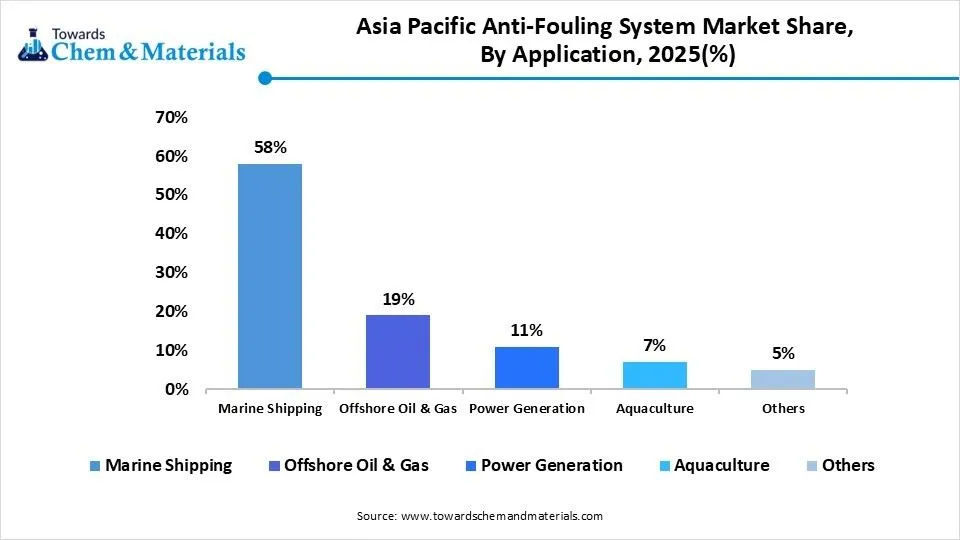
The aquaculture segment held a 7.1% market share in 2025 and is expected to grow at the fastest CAGR of 8.1% over the forecast period. The application of antifouling is becoming more and more relevant given the increasing development of marine farming and the need to manage unwanted biological accumulation. Antifouling technologies can help in maintaining cleaner operating conditions around equipment and infrastructure.
- For instance, in September 2026, the fisheries and aquaculture sector was recognized as a significant economic activity that serves as a driver for livelihoods, employment, exports, food security, and the development of the blue economy. (Source: www.pib.gov.in)
Asia Pacific Anti-Fouling System Market Share, By Application, 2025 (%)
| By Application | Market Share (%) |
| Marine Shipping | 58% |
| Offshore Oil & Gas | 19% |
| Power Generation | 11% |
| Aquaculture | 7% |
| Others | 5% |
Vessel Type Insights
The cargo ships segment dominated the market with the largest share of 52.8% in 2025 and is expected to grow at a CAGR of 6% over the forecast period. Hull protection is necessary on a continuous basis as the very extensive operating routes create different fouling conditions for cargo ships. Antifouling technologies contribute to maintaining smooth water surfaces and to operational efficiency. Asia Pacifics maritime transportation volume is set to rise, driving demand for a reliable hull protection and maintenance solution and advanced coating technologies.
The recreational vessels segment held a 9.3% market share in 2025 and is expected to grow at the fastest CAGR of 8.2% over the forecast period. To prevent fouling on the underwater portion of a recreational vessel, it is necessary to provide some type of antifouling protection to these vessels when they are exposed to the sea repeatedly. Interest in specialized, simple-to-use, and durable products is fueling product demand. Chemical performance-based antifouling products can offer practical protection and meet performance requirements in challenging recreational marine applications.
Asia Pacific Anti-Fouling System Market Share, By Vessel Type, 2025 (%)
| By Vessel Type | Market Share (%) |
| Cargo Ships | 53% |
| Passenger Ships | 19% |
| Naval Ships | 14% |
| Recreational Vessels | 9% |
| Specialized Vessels | 6% |
Distribution Channel Insights
The direct sales segment dominated the market with the largest share of 61.5% in 2025 and is expected to grow at a CAGR of 5.9% over the forecast period. Direct sales offer manufacturers the opportunity to establish more direct connections with shipyards, ship operators, maintenance companies, and other professional customers. The channel includes technical consultation, product selection, application advice, and contract sales. Strong shipbuilding and maintenance activities across the Asia Pacific reinforce the importance of direct commercial relationships.
The service-based sales segment held an 11.2% market share in 2025 and is expected to grow at the fastest CAGR of 8% over the forecast period. Growing demand for specialized maintenance, inspection, cleaning, and coating-related services enables service-based sales. Customers are more interested in integrated solutions instead of standalone products. This method can enhance the maintenance planning process while simultaneously boosting the application of product performance monitoring and lifecycle management within commercial maritime operations.
Asia Pacific Anti-Fouling System Market Share, By Distribution Channel, 2025 (%)
| By Distribution Channel | Market Share (%) |
| Direct Sales | 62% |
| Indirect Sales | 27% |
| Service-Based Sales | 11% |
Regional Insights
How Did China Dominate the Asia Pacific Anti-Fouling System Market in 2025?
Chinas anti-fouling system market size was estimated at USD 2.38 billion in 2025 and is projected to reach USD 6.17 billion by 2035, growing at a CAGR of 9.99% from 2026 to 2035. China dominated the market with the largest share of 39% in 2025 and is expected to grow at a CAGR of 6.6% during the forecast period.
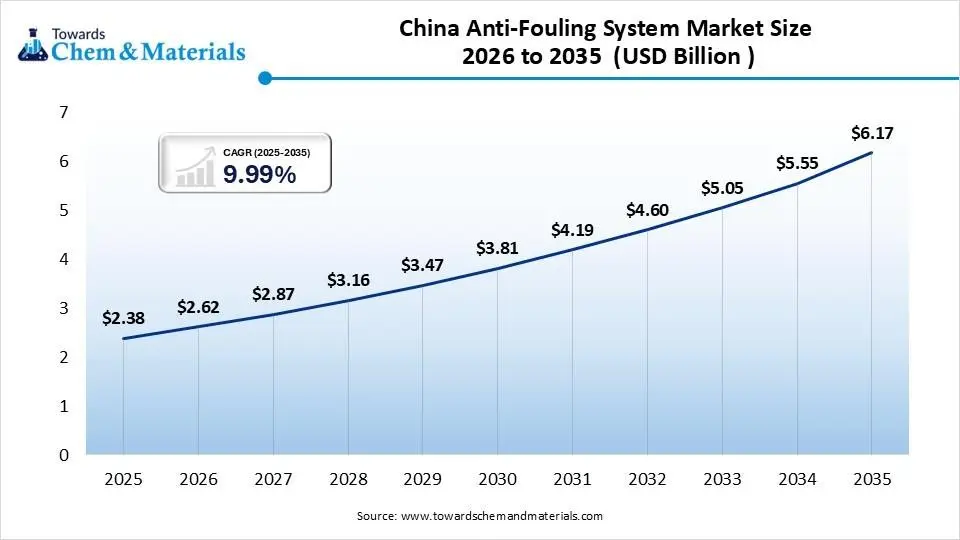
The anti-fouling market in the China region is huge due to the presence of shipbuilding industries, commercial vessel activities, and marine coating manufacturing industries in the country. New build and maintenance needs are high and consistent, resulting in the continued demand for hull-protection technologies.
- For instance, in July 2026, a new marine antifouling coating developed by South China University of Technology (SCUT) was put into practical use at the shipbuilding, maintenance, wave-energy platform, undersea data center, and marine ranch on a large scale. (Source: www.chinadaily.com.cn)
The India anti-fouling system market size was estimated at USD 0.43 billion in 2025 and is projected to reach USD 1.17 billion by 2035, growing at a CAGR of 10.53% from 2026 to 2035. India held a 7% market share in 2025 and is expected to grow at the fastest CAGR of 7.8% during the forecast period. India is emerging as an important potential growth market enabled by growing shipbuilding, coastal shipping, port infrastructure, offshore operations, and aquaculture development. The growth of maritime infrastructure and increased activity on fleets are opening up opportunities for antifouling systems on new vessels and maintenance applications.
The Japan anti-fouling system market size was estimated at USD 0.89 billion in 2025 and is projected to reach USD 2.27 billion by 2035, growing at a CAGR of 9.82% from 2026 to 2035. Japan held a 14.5% market share in 2025 and is expected to grow at a CAGR of 5.4% over the forecast period. The Japanese shipbuilding sector, its well-developed maritime ecosystem, and its advanced marine coating technologies are key strengths for Japan. The nation focuses on high-performance products such as products using foul-release and ultrasonic technology, and manufacturers are still creating eco-friendly products.
- For instance, in April 2026, Seagate (K.K.) Corporation introduced a new tug, which is equipped with a biofuel blender and ultrasonic hull anti-fouling system, to reinforce the use of alternative technologies in Japan. (Source: www.bairdmaritime.com)
South Koreas anti-fouling system market size was estimated at USD 1.13 billion in 2025 and is projected to reach USD 2.90 billion by 2035, growing at a CAGR of 9.88% from 2026 to 2035. South Korea held an 18.5% market share in 2025 and is expected to grow at a CAGR of 6.2% over the forecast period. There is an ongoing demand for anti-fouling systems in South Korea, which is one of the major shipbuilding and marine technology hubs of the region. Advanced hull coatings can be used in major shipyards and ship construction in addition to marine maintenance. Environmental considerations and vessel efficiency are leading the market to lower-impact, higher-performing products as manufacturers and shipowners respond.
The Singapore anti-fouling system market size was estimated at USD 0.52 billion in 2025 and is projected to reach USD 1.34 billion by 2035, growing at a CAGR of 9.93% from 2026 to 2035. Singapore held an 8.5% market share in 2025 and is expected to grow at a CAGR of 7.5% over the forecast period. Singapore is also a key player in the maritime services and ship-repair industry, driving the need for hull coatings, maintenance, inspections, and antifouling technologies. Its geographical location on key shipping routes adds to its aftermarket prospects. The marine repair industry and distribution capabilities of vessels in the region are also viewed as enabling the adoption of advanced coating systems.
Recent Developments
- In February 2026, GIT Coatings introduced a hard fouling release coating, XGIT-FORCE™, which is comprised of graphene, in February 2026 with a view to enabling a new paradigm in hull protection beyond biocide-based antifouling coatings. (Source: gitcoatings.com)
- In February 2025, Hull Shield exhibited its antifouling technology solutions at the Miami International Boat Show, helping to raise awareness of technology-based antifouling products. (Source: www.hullshield.net)
Competitive Analysis
Performing coating, sustainability, product innovations, and suitability of application are the major factors that drive competition in the Asia Pacific anti-fouling system market. Major players are growing their environmentally oriented technology and enhancing product offerings in their region. Fuel efficiency, extended maintenance periods, and better hull performance are also key aspects that companies highlight in their marketing of advanced antifouling technologies.
- For instance, in August 2026, AkzoNobel launched International Micron 350 in Asia Pacific to meet the need for consistent multi-season antifouling performance in harsh, high-fouling conditions. (Source: superyacht-australia.com)
- In March 2026, Nippon Paint Marine unveiled the new AQUATERRAS 1100 self-polishing hull coating for major shipbuilding/repair centers in the region, which is biocide-free and has low VOC content.
(Source: www.nipponpaint-marine.com) - In June 2025, Hempel introduced Hempaguard NB, a new silicone hull coating for newbuilds, further expanding fuel-saving and fouling protection solutions to the building phase.
(Source: www.hempel.com)
Top Players in the Market & Their Offerings
| Company | Company Type/Position | Major Headquarters | Geographic Presence | Asia Pacific Anti-Fouling System Offerings | Key Strength |
| Nippon Paint Marine | Global Leader | Tokyo, Japan | Global | AQUATERRAS (Biocide-free) | Home-ground dominance with unmatched supply networks |
| Chugoku Marine Paints (CMP) | Specialized Marine Leader | Tokyo, Japan | Global | SEAFLO NEO series | Deeply integrated commercial networks in Asian ports |
Other Key Players
- AkzoNobel N.V.
- PPG Industries Inc.
- Jotun A/S
- Hempel A/S
- Chugoku Marine Paints, Ltd.
- Nippon Paint Marine Coatings Co., Ltd.
- Kansai Paint Marine Co., Ltd.
- KCC Corporation
- BASF SE
Segment Covered in the Report
By Type
- Coatings
- Copper-Based Coatings
- Self-Polishing Copolymer (SPC) Coatings
- Silicone/Foul-Release Coatings
- Hybrid & Nano-Hybrid Coatings
- Bio-Based & Biocide-Free Coatings
- Ultrasonic Anti-Fouling Systems
- Transducer-Based Systems
- Multi-Transducer Systems
- Digital/Automated Ultrasonic Systems
- Electrolytic Anti-Fouling Systems
- Copper-Ion Systems
- Aluminum-Anode Systems
- Copper-Aluminum Systems
- Impressed-Current Systems
- Others
- Hydrodynamic Anti-Fouling Systems
- Mechanical Anti-Fouling Systems
- Hybrid Anti-Fouling Systems
By Application
- Marine Shipping
- Commercial Shipping
- Recreational Marine
- Naval & Defense
- Passenger & Cruise
- Offshore Oil & Gas
- Offshore Platforms
- FPSOs
- Offshore Support Vessels
- Subsea Infrastructure
- Power Generation
- Cooling-Water Intakes
- Heat Exchangers
- Condensers
- Aquaculture
- Fish Farms
- Aquaculture Cages
- Water-Intake Systems
- Others
- Desalination
- Marine Research
- Ports & Harbor Infrastructure
By Vessel Type
- Cargo Ships
- Container Ships
- Bulk Carriers
- Tankers
- General Cargo Ships
- LNG/LPG Carriers
- Passenger Ships
- Cruise Ships
- Ferries
- Ro-Ro Passenger Vessels
- Naval Ships
- Frigates
- Destroyers
- Patrol Vessels
- Submarines
- Recreational Vessels
- Yachts
- Motorboats
- Sailing Boats
- Specialized Vessels
- Offshore Support Vessels
- Research Vessels
- Fishing Vessels
- Workboats
By Distribution Channel
- Direct Sales
- Shipyards
- Fleet Operators
- Offshore Operators
- Government & Defense Procurement
- Indirect Sales
- Marine Distributors
- Authorized Dealers
- Marine Equipment Integrators
- Specialty Coating Distributors
- Service-Based Sales
- Retrofit & Installation Services
- Dry-Dock Services
- Inspection & Maintenance Services
By Country
- India
- China
- Japan
- South Korea
- Taiwan
- Indonesia
- Vietnam
- Thailand
- Philippines
- Malaysia
- Singapore
- Australia
FAQ's




Select User License to Buy
Figures (4)








 sales@towardschemandmaterials.com
 Download Sample
 Schedule a Meeting