 Request Consultation
Content
Polymers: A Forte in the Playing Field of Physics
Specialty polymers are high-performance polymers engineered to provide desired mechanical, thermal, electrical, optical, or chemical characteristics that cannot be obtained from traditional polymers. Commodity polymers are produced in large quantities to meet consumer demands for use in everyday applications, whereas specialty polymers are formulated for use in applications where reliability, precision, and durability are critical, and high performance is desirable.
They can resist extreme temperatures, strong chemicals, ultraviolet rays, mechanical action, and long service life cycles without much change in these materials. They are used in a range of sectors including aerospace and automotive, electronics, the health industry, renewable energy, telecoms, defense, and high-tech manufacturing sectors. Specialty polymers are an example of high-performance thermoplastics; engineering plastics; conductive polymers; fluoropolymers; biocompatible polymers; and smart polymers that are stimuli-responsive. The continuous innovation of materials has helped manufacturers to substitute metals, ceramics, and glass for highly efficient polymer materials with reduced maintenance issues and weight.
They are also well suited for advanced manufacturing processes and can be miniaturized in electronic components for making complex medical components. A strong focus on sustainability has spurred the development of specialty polymers that are recyclable, bio-based, and low-emission compatible with the goals of sustainability. Specialty polymers remain essential to technological innovation, product novelty, and industrial competitiveness in today's worldwide markets as a key enabler for materials that are lightweight, durable, and multifunctional.
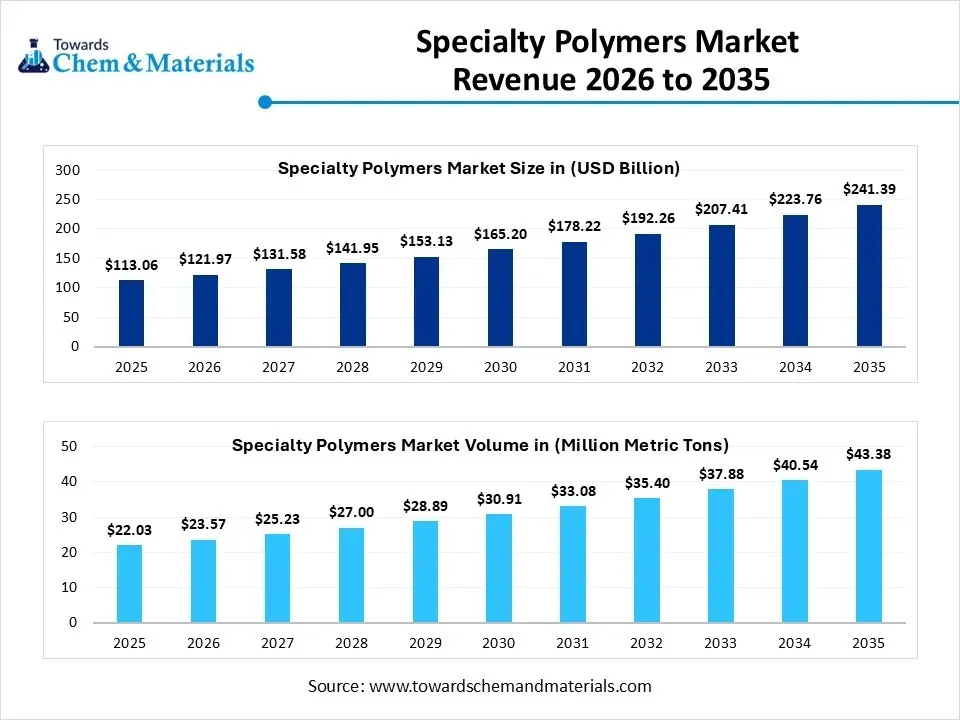
According to Towards Chemicals And Materials Analytics and Consulting, the global specialty polymers market is projected to grow from USD 121.97 billion in 2026 to USD 241.39 billion by 2035, registering an impressive CAGR of 7.88% during the forecast period.
Get Full Access of Report | Immediate Delivery@ https://www.towardschemandmaterials.com/checkout/5678
History of Specialty Polymers
Specialty polymers emerged early in the 20th century when researchers identified the necessity for polymers that could be engineered to do more than naturally occurring polymers and plastics. This drove the industrial development of polymers, as early synthetic polymers were mostly used in general consumer applications, but also for more stringent, stronger, higher-temperature, and more chemically-resistant polymers. In the 1930s and 40s, breakthroughs in polymer chemistry resulted in the creation of polymers with the ability to handle high-demand operating conditions, such as fluoropolymers, silicones, and engineering plastics. During the Second World War, work was pushed to focus on new materials for novel applications in communication, aviation, and military technology, greatly increasing the field of polymer science.
Polymer research was pursued on a dedicated basis in the post-war period, which saw the development of a range of specialized polymer products including polyimides, polyether ether ketone (PEEK), polyphenylene sulphone (PPS) and liquid crystal polymers (LCPs) in the aerospace, electronics and automotive sectors. With the advent of semiconductor manufacturing and modern medicinal applications in the late 1980s and 90s, the demand for high purity, biocompatible and electrically functional polymers has grown. In the 21st century, specialty polymer development was transformed by the emergence of nanotechnology and the appearance of a new process – additive manufacturing – and a new class of materials – smart materials. Scientists started to add nanoparticles, conductive fillers, and responsive molecular structures to improve functionality. Technology for specialty polymers is still progressing today with sustainable manufacturing, sustainable feedstock sources, recyclable formulations, and digital material design to enable next-generation technologies in a range of industrial sectors.
Industrial Revolution of Specialty Polymers Over the Years.
The specialty polymers have been transformed through a series of technological advances and manufacturing innovations. In the first phase, the specialty polymers were used to a great extent to replace metals and traditional materials in all the applications where lightweight and corrosion resistance are key requirements. In the latter part of the twentieth century, polymer processing methods became more sophisticated as a way of improving the quality of the products manufactured and creating new product designs, including such precision processes as high-performance compounding, extrusion, and precision injection molding. Demand for polymers with properties that were superior for their dielectric, thermal stability, and dimensional stability in terms of the electronics revolution has encouraged innovations in the packaging and electronic component industry for semiconductors.
Advances in renewable energy led to an additional boost in polymer development, including the creation of blades for wind turbines, PV cells, battery and hydrogen technologies. Digital manufacturing, artificial intelligence and predictive material modelling were added to the concept of Industry 4.0, and these new tools mean researchers can now optimize polymer formulations much more efficiently than with the traditional trial-and-error approach. Improved opportunities for the production of customized parts made from high-performance specialty polymers for applications in aerospace, healthcare, and defense via additive manufacturing. At the same time, sustainability has come into focus, moving the manufacturer towards emission reduction, recycling, and circular production processes.
Manufacturing of these materials accounts for more than 80% of the polymer consumption and will continue to play a major role in industrial innovation in the future, as specialization and precision manufacturing are implemented by modern industrial facilities through the integration of automation, robotics, advanced quality control, and process optimisation based on data.
Government Initiatives
All governments worldwide have enacted policies and strategic programmes to boost specialty polymer research, high-tech manufacturing, and sustainable sizable development.
A major advantage of collaborative research is support from several countries provided through grants, tax incentives, and innovation funds for joint research projects between universities, research institutes, and private industry. There are national manufacturing strategies that promote the production at home of high-performing materials in order to improve the competitiveness of the manufacturing sector and reduce reliance on external technologies. Stricter waste management, emissions, and resource efficiency standards have encouraged the creation of recyclable polymers, bio-based polymers, and low-carbon production methods for environmental regulations. Specialty polymers are used in specialty areas such as aerospace, defense, healthcare, electronics, clean energy, and so on, and advanced materials research centers exist in several governments whose interest is devoted to these materials.
Lightweight and sustainable materials are increasingly promoted for use in infrastructure, transportation, and renewable energy projects through public procurement policies. International cooperation facilitates sharing among experts, technology transfer, and harmonized standards on polymer safety, quality, and environmental performance. Digital manufacturing, advanced recycling technologies, and profitable circular economy projects are also encouraged through funding programs, which extend material lifecycles and minimize waste from industry.
Also, workforce development programs will deliver targeted training that covers polymer sciences, material engineering, and advanced manufacturing technologies, as well as meeting future skill needs. All these efforts promote innovation, reinforce industrial preparedness, incentivize responsible industrial production, and propel specialty polymers as important materials for long-term economic development and technological progress both locally and globally.
Types of Specialty Polymers
- High-Performance Thermoplastics: The polymers are strong and stable at high temperatures and under harsh chemical conditions. They are extensively applied in the electronics, medical, automotive, and aerospace industries.
- Engineering Polymers: The mechanical strength, impact resistance, and dimensional stability of engineering polymers are excellent. They are often found in structural elements, bearings, gears, and parts in industrial machinery.
- Fluoropolymers: Fluoroplastics have excellent chemical resistance, low friction, high electrical resistance, and protection against weather. They are incorporated into medical equipment, electric insulators, and chemical processing equipment.
- Conductive Polymers: Such polymers are actually electric conductors yet as light as plastic. They have increasingly found applications such as flexible electronics, sensors, batteries, wearable electronics, and electromagnetic shielding.
- Biocompatible Polymers: These materials are highly applicable in medical implants, surgical instruments, drug delivery devices, and fabrications for tissue engineering due to their compatibility with living tissues.
- Smart Polymers: Smart polymers change their physical or chemical properties in response to external stimuli like temperature changes, light, pH, pressure, or moisture changes. They are applied to high-tech products such as healthcare, robotics, and intelligent packaging.
- Thermosetting Specialty Polymers: These polymers have a high degree of heat resistance, great mechanical properties during the curing process, and good service life. They are widely used as ingredients in coatings, adhesives, composites, and electrical insulation.
- Elastomeric Specialty Polymers: These highly elastic polymers are flexible and resistant to chemicals, weathering, and fatigue. They are typically employed in seals and gaskets, vibration dampers, and medical products.
Workforce Requirements
The specialty polymer industry requires a multi-disciplinary team to assist with research, production, quality control, and commercialization. A pipeline of polymer scientists and materials engineers represents the backbone of the industry, since they create new materials with improved mechanical, thermal, chemical, and other properties. Chemical engineers monitor and regulate manufacturing processes, optimize industrial efficiency, and provide a safe environment for the operation of manufacturing equipment. Mechanical and automation engineers help develop high-tech manufacturing methods by incorporating robots, digital monitoring systems, and quality machines into manufacturing processes.
Quality assurance encompasses testing and monitoring to guarantee that products meet business standards, administrative guidelines, and client needs. Waste management, emissions, and sustainability programs are monitored by environmental experts, and they ensure compliance with environmental legislation. Research and development groups always look for new formulations, biomaterials, and multifunctional polymers to satisfy the changing market demands.
Supply chain workers plan sourcing raw materials from suppliers, oversee logistics, manage inventories, and manage global supply chains. The sales, technical support, and application engineers closely interact with customers to find an appropriate polymer solution for special applications. Advanced software tools are now being used by data analysts and digital manufacturing specialists to support predictive maintenance, optimization of the manufacturing process, and material simulation.
Ongoing Professional Development (CPD) is still very much needed with the fast-changing technology in manufacturing. An improved workforce, focused on innovation and quality products through the application of state-of-the-art technologies such as automation, artificial intelligence, sustainability, advanced processing technologies, and regulatory compliance, contributes to keeping them competitive.
Ideas and actions towards sustainability in the Specialty Polymer Industry
The specialty polymer sector has put sustainability at the center of the strategy table to make an impact on the environment, striving for low impact and preserving the characteristics of its materials. Decreasing reliance on fossil based raw materials and greenhouse gas emissions is one of the most important, to increase the used amount of renewable or bio-based which is derived from renewable sources in the raw material. They are also testing and testing to see alternatives to polymers that can be recycled, and whose re-processing does not destroy their functional properties, thus aiding a circular economy.
Manufacturing plants are enhancing their energy efficiency by implementing their latest processing technologies, waste heat recovery solutions, digital monitoring, and automation that reduces energy waste. The water conservation measures that are implemented, such as recycling the cooling water and improving the wastewater treatment facilities, lessen the amount of freshwater consumed and minimize environmental discharge.
In many production processes that factories are attempting to close, there is a reuse of production waste for reprocessing it into the cycle. The use of advanced sorting technologies helps to achieve a higher recycling efficiency by correctly sorting the various types of polymer, and allows for high-quality sorting and recovery. Eco-design has become trendier in the design of products, enabling their easier disassembly, reuse, and recycling during end-of-life.
The industry is also minimizing the amount of harmful chemicals used, with the introduction of greener additives, eco-friendly solvents, and safer processing methods. Light and recyclable packaging materials with sustainable packaging solutions will contribute to less transportation emissions and packaging waste.
Artificial Intelligence, process simulation, predictive maintenance, and digital technologies leverage manufacturing processes to minimize material waste, reduce machine downtimes, and use fewer resources. Transparent processes allow manufacturers to track and optimize compliant procurement across the supply chain.
To develop innovative recycling technologies, partnerships amongst manufacturers, research institutions, governments, and recycling organizations can be established to support standards on sustainable materials. Training initiatives increase employee awareness, promote best practices on manufacturing-related issues, and are a cornerstone of all levels of operations. These efforts combine for an industry that is more resource efficient, able to innovate technologically while simultaneously addressing the many demands for higher-specification specialty polymer solutions via environmental stewardship.
Specialty Polymer Industry: The Role of Artificial Intelligence in the Field
AI technologies break the time circuit and transform the specialty polymer industry by facilitating faster material discovery, more precise manufacturing, and better product quality. Using machine learning algorithms, predictive models can be built with the help of large amounts of data collected from laboratory testing, which in turn can help break relationships between polymer composition and material properties to shorten the time it takes to develop new formulas.
Using predictive models powered by AI helps researchers determine which additives and processing parameters to use prior to testing, thus reducing development costs. In manufacturing facilities, AI systems maintain automatic oversight of production parameters, including temperature, pressure, mixing speed, and viscosity, ensuring product quality and reducing defects throughout the manufacturing process.
A predictive maintenance system will monitor the working of the equipment and will alert the manufacturer to foresee equipment failure and minimize unexpected downtimes. AI also enhances quality control by employing computer vision systems to ensure that the final products meet specific quality standards, eliminating the need for manual inspection. AI in supply chain management enhances demand forecasting, logistics optimization, and raw material procurement, among various other advantages. AI helps in research and development by prioritizing material combinations for lab testing and validating only the most promising options.
In the field of research and development, AI assists by whittling down a list of material combinations to the ones that have the potential for lab testing. Furthermore, AI can support sustainability efforts by identifying potential energy and resource savings, as well as production waste, throughout the process. While AI can be used to great effect in enhancing efficiency and decision-making processes, it is ultimately a tool to assist scientific advice and decisions made by skilled polymer scientists and engineers.
The Development of Technology in the Specialty Polymer Industry
The specialty polymer industry has come a long way with the development of technology that now provides its manufacturers with more efficiency, performance, and reliability. Polymer processing technologies, such as innovations in advanced injection molding, extrusion, compression molding and precision compounding, enable component manufacture to close tolerances and deliver consistent quality.
Three-dimensional printing has created new possibilities for developing customized parts with complex geometry and has reduced the amount of material waste, helped to shorten development cycles, etc. Nanotechnology has been used to increase the properties of specialty polymers by adding nanoscopic fillers to give enhanced mechanical properties, thermal performance, electrical and barrier performance. Automated manufacturing systems with robotics have improved the production rate, lowered human error, and maintained product consistency.
Nowadays, the use of advanced analytical instruments enables molecular structures, thermal properties, chemical composition, and mechanical properties to be analyzed with unprecedented precision, which helps speed up research and quality control. The current recycling technology advances the recovery and reprocessing of high-performance polymers, thus making more sustainable manufacturing possible.
Smart manufacturing systems provide an integrated solution that combines sensors, digital monitoring, and real-time process control to maximize production efficiency and reduce resource usage. Innovation in polymer-based composites has led to the development of lightweight and highly durable materials used in a variety of sectors such as aerospace, automotive, renewable energy, and medical applications. All these technological advances are continuing to provide greater functionality for specialty polymers, and contribute to higher productivity, enhanced sustainability, and greater industrial uptake.
The Specialty Polymer Industry AI
While AI technology has many benefits, there are key aspects in the specialty polymer market that are better suited to the expertise of human workers. Confirming product safety, product conformity to regulations, and material certification: decisions by AI should never be made without the review of qualified professionals, given the scientific judgement, moral responsibility, and accountability. AI can assist in formulating recommendations for promising recipes in R&D, but ultimately, experimental data needs to be verified by knowledgeable scientists, as the performance of the formulation over extended periods of use or formation of unexpected chemical interactions cannot be fully predicted in an algorithm.
While it can streamline the development of various types of products, AI should never give the final stamp of approval for those considered safety-sensitive, such as medical, aerospace and defence, where human rapid prototyping, evaluation and testing processes remain vital. AI should not be used independently to make investment decisions, prioritize research, or determine ownership, as these will still be decided primarily by experienced leadership.
When emergencies occur, like hazardous materials incidents, equipment failures, and chemical leaks, trained personnel must have total control; otherwise, human judgment will need to be used to safely react to the changing conditions. AI should also not be used to replace experienced technicians who need to tackle the more difficult manufacturing problems, understand less normal production characteristic behavior, and perform adequate safety measures at the worksite. AI should be used as a tool to enhance human capabilities and not replace humanity, especially at a time like this, as it maintains both innovativeness and responsibility in industry.
Contact:
- Towards Chemicals and Materials Analytics and Consulting
- USA: +1 804 441 9344
- APAC: +61 485 981 310 or +91 87933 22019
- Europe: +44 7383 092 044
- Email: sales@towardschemandmaterials.com
About the Experts

Aditi Shivarkar
Aditi serves as Vice President at Towards Chemical and Material and brings over 15 years of experience in research, strategy, and industry analysis. She focuses on sectors such as specialty chemicals, advanced materials, and sustainable solutions. She studies how regulations, raw materials, and industrial demand shape the market, and she uses that understanding to guide businesses in the right direction. Aditi helps companies stay prepared for change, improve their market position, and make well-informed decisions.



Aman Singh
Aman Singh has more than 13 years of experience in research and consulting, with a strong focus on the global chemicals and materials space. He tracks developments in areas like green chemistry, high-performance materials, and industrial innovation. At Towards Chemical and Material, he leads the research team and ensures every report is clear, accurate, and useful. Aman breaks down complex industry changes and helps businesses understand what they mean in practical terms.