Find the Right Market Report
Search thousands of industry reports, market insights, and research studies in one place.
Not sure where to start? Try one of these:
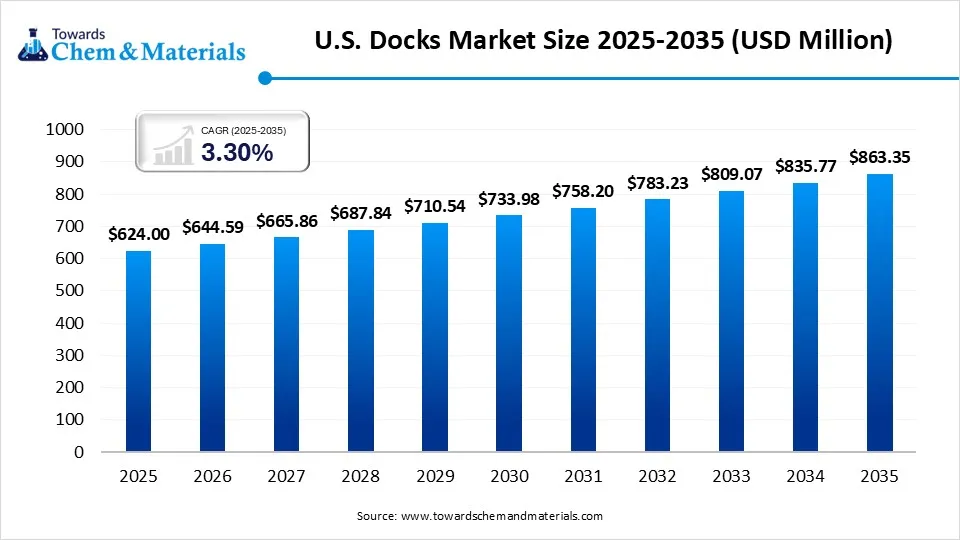
The U.S. docks market is estimated at USD 644.59 million in 2026 and is projected to reach USD 863.35 million by 2035, expanding at a CAGR of 3.30% from 2026 to 2035. The U.S. docks market was valued at USD 624.00 million in 2025, the base year. The U.S. docks market includes floating and stationary (fixed) docks, as well as related systems, which are being sold and installed in the U.S., including private lake and waterfront docks, marina dock systems and wave attenuators, hospitality and public access docks, and military and government docks made of wood, aluminum, composites, concrete, and high-density polyethylene, along with gangways, pilings, and installation services. Floating docks made up the largest type share in 2025, which was 54.60% of the market, due to the fact that such docks adapt to fluctuating water levels, are flexible in design, require minimal maintenance, and, therefore, are the preferred option for marinas and many residences.
Sources: Expert interviews, secondary sources, the Towards Chemical and Materials database, and Towards Chemical and Materials analysts.
In 2025, 41.60% of the revenue was attributable to the South region, backed by the number of boaters in Florida and the Gulf Coast region, along with Texas and the southeastern lakes and hurricane reconstruction. Factors supporting the growth of demand include recreational boating participation, building and upgrading of waterfront residences, marina expansion and redevelopment, replacement of old and storm-damaged docks, and investments in naval and Coast Guard facilities.
The U.S. docks market is expected to increase from USD 624.00 million in 2025 to USD 863.35 million in 2035 due to the presence of millions of recreational boats and waterfront properties in the USA, modernization of marinas' aged facilities, and the frequent occurrence of storms that cause the need for rebuilding of the docks. Marinas' redevelopment, storm-proof construction, waterfront housing, and regular investments in naval infrastructure will drive modest growth, propelling the market to USD 863.35 million by 2035 and maintaining a CAGR of 3.30% from 2026 to 2035.
Analyst View: We calculated the projection by estimating new and replacement dock installations by type, materials, applications, and geographical location, multiplied by the average cost per linear foot or system. The installations corresponded to participation in boating activities, housing, marina development, and storm damage. The result was compared with the revenue in the U.S. docks market of leading manufacturers and builders of marinas and against the estimates in the literature. It turned out that the estimated revenue was slightly higher than the maximum comparable number.
Note: 2025 is the base year.
Sources: Expert interviews, secondary sources, the Towards Chemical and Materials database, and Towards Chemical and Materials analysts.
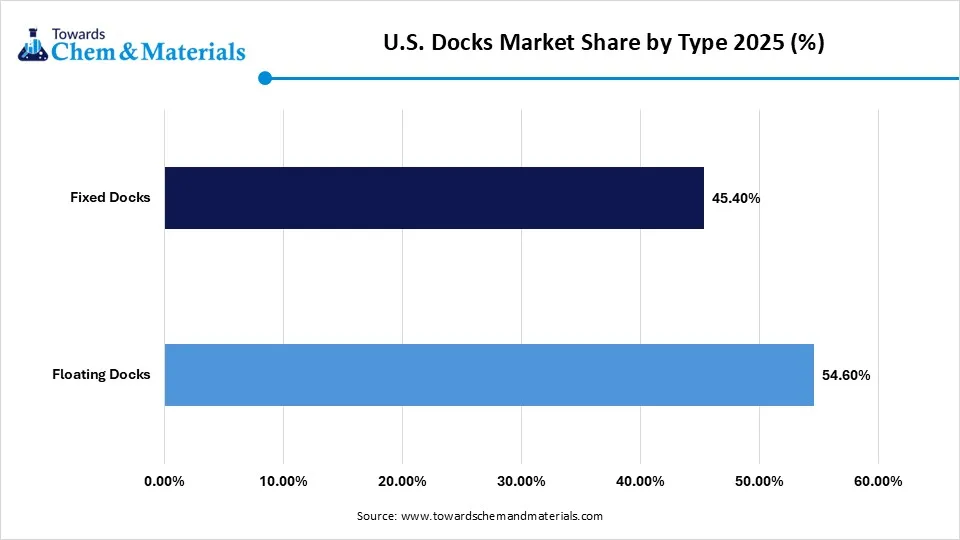
The floating dock segment had a share of 54.60% (USD 340.70 million) in 2025 due to the ability of these docks to adjust to changing water levels, flexibility, and the prevalence of these docks in marinas. The fixed dock segment held 45.40% (USD 283.30 million).
Note: 2025 is the base year.
Sources: Expert interviews, secondary sources, the Towards Chemical and Materials database, and Towards Chemical and Materials analysts.
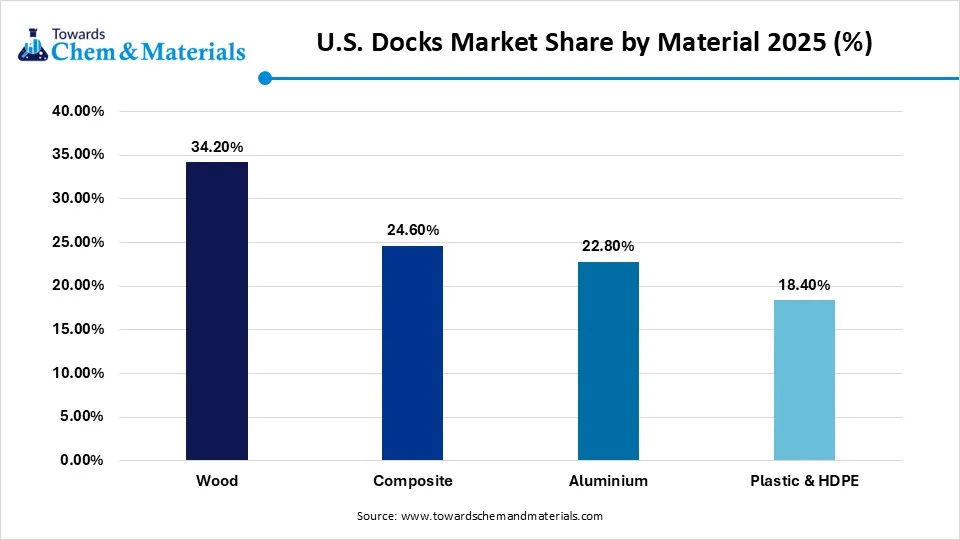
Wood was 34.20% (USD 213.41 million) in 2025 since treated wood continues to be widely used for residential and stationary docks. Composite decking was 24.60% (USD 153.50 million) and grew at a faster rate than any other due to its low maintenance. Aluminum represented 22.80% (USD 142.27 million), and plastic/HDPE represented 18.40% (USD 114.82 million), which is mostly used in modular floating dock systems.
Note: 2025 is the base year.
Sources: Expert interviews, secondary sources, the Towards Chemical and Materials database, and Towards Chemical and Materials analysts.
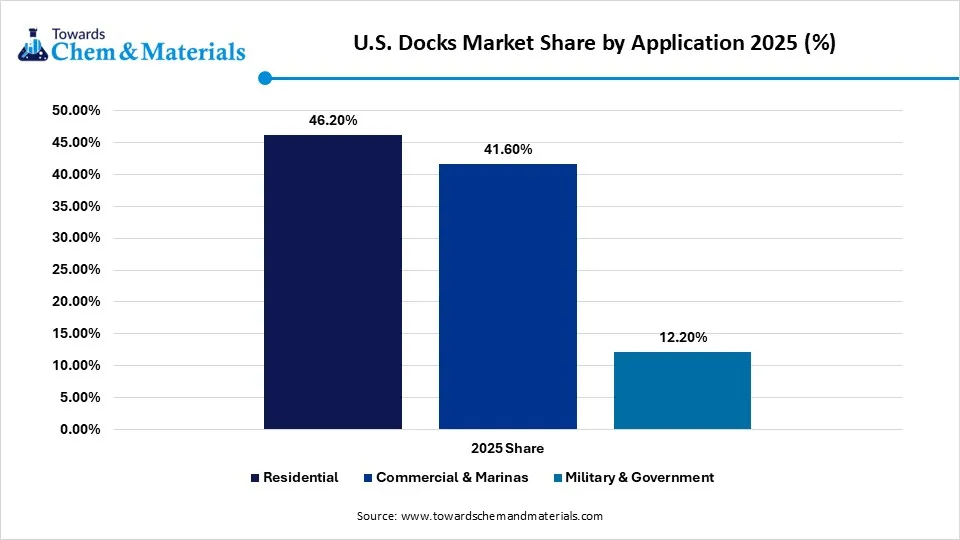
Residential applications represented 46.20% (USD 288.29 million) in 2025 due to the installation and replacement of private docks for lakeside and waterfront homes. Commercial & marina applications made up 41.60% (USD 259.58 million), consisting of marina docks and hospitality/public access docks, while military/government applications represent 12.20% (USD 76.13 million).
Analyst View: The segmentation of values was determined through matching installations and pricing to type, material, and application based on industry and manufacturer statistics and marina projects. Floating docks, wood, and residential usage dominate due to a high number of private waterfront property owners. We expect composite and HDPE materials and marina modernizations to capture a greater share.
| Region | 2025 Share | 2025 Market Value |
| South | 41.60% | USD 259.58 million |
| Midwest | 21.40% | USD 133.54 million |
| West | 18.80% | USD 117.31 million |
| Northeast | 18.20% | USD 113.57 million |
Note: 2025 is the base year.
Sources: Expert interviews, secondary sources, the Towards Chemical and Materials database, and Towards Chemical and Materials analysts.
The South region of the U.S. captured 41.60% (USD 259.58 million); this share is based on the high number of boaters and marinas in Florida, as well as numerous hurricane restorations, along with other coastal areas in the Gulf Coast and Atlantic and lakes in Texas, Tennessee, and the Carolinas; this segment is the fastest-growing. Midwest: 21.40% (USD 133.54 million); this share is based on the presence of the Great Lakes and thousands of lakes in Minnesota, Wisconsin, and Michigan. West: 18.80% (USD 117.31 million) – this segment is based on California and Pacific Northwest marinas and lakes. Northeast: 18.20% (USD 113.57 million); this segment includes coastal and lake markets in New England, New York, and New Jersey.
Analyst View: Regional shares were built from installations and prices in each region. The South leads because of boating populations and storm rebuilding. We assign it the highest growth premium because population growth and rebuilding needs are greatest there.
| Rank | Company Name | Market-Specific Revenue (USD Million) | 2025 Share | Key Products / Business |
| 1 | Bellingham Marine | 58 | 9.29% | Unifloat concrete floating dock systems |
| 2 | EZ Dock | 34 | 5.45% | Modular polyethylene floating docks |
| 3 | ShoreMaster | 30 | 4.81% | Residential and commercial docks |
| 4 | Meeco Sullivan | 22 | 3.53% | Commercial marina docks |
| 5 | Wahoo Docks | 16 | 2.56% | Aluminum docks and lifts |
| 6 | AccuDock | 14 | 2.24% | Modular floating docks |
| 7 | Poralu Marine | 12 | 1.92% | Aluminum marina docks |
| 8 | Golden Boat Lifts | 12 | 1.92% | Boat lifts and docks. |
| 9 | Jet Dock | 10 | 1.60% | Drive-on floating docks |
| 10 | Connect-A-Dock | 8 | 1.28% | Modular floating docks |
Note: Company revenues and shares are 2025 estimates.
Sources: Company press releases, expert interviews, secondary sources, the Towards Chemical and Materials database, and Towards Chemical and Materials analysts.
Bellingham Marine led the U.S. docks market with an estimated 9.29% (USD 58.00 million) of 2025 revenue, followed by EZ Dock at 5.45% (USD 34.00 million) and ShoreMaster at 4.81% (USD 30.00 million). Bellingham Marine dominates in the design-build marina projects and Unifloat concrete floating docks that can be seen in large marinas. EZ Dock deals in modular polyethylene floating docks for private, commercial, and government clients, whereas ShoreMaster offers residential and commercial docks and lifts via dealerships. Meeco Sullivan, Wahoo Docks, AccuDock, Poralu Marine, Golden Boat Lifts, Jet Dock, and Connect-A-Dock participate in the industry by providing marina systems, aluminum docks, modular floatations, drive-on docks, and lift & dock systems.
The top 10 firms together commanded 34.62% (USD 216.00 million) of 2025 revenues, while the remaining 65.38% (USD 408.00 million) was divided amongst regional dock builders, marine contractors, and wood deck suppliers. The market of US docks is fragmented, with lots of local builders providing residential products, while specialized firms are dominating in marina construction projects. Competition revolves around durability, storm resistance, maintenance requirements, design-build capabilities, permitting assistance, dealership network, and pricing.
The U.S. docks ecosystem links material suppliers with dock manufacturers, dealers and marine contractors, marina owners and developers, regulators and boat owners.
| Ecosystem Stage | Role in the Market | Key Companies |
| Materials | Supply timber, composites, aluminium, concrete and HDPE | Lumber suppliers, Trex and composite makers, aluminium extruders |
| Manufacturers | Build floating and fixed dock systems | Bellingham Marine, EZ Dock, ShoreMaster, Meeco Sullivan, Wahoo Docks |
| Dealers & Contractors | Sell, permit and install docks | Dock dealers, marine contractors, pile drivers |
| Owners & Developers | Commission docks and marinas | Homeowners, marina operators, hospitality firms, municipalities, Navy |
| Regulators | Permit waterfront structures | U.S. Army Corps of Engineers, state agencies, local authorities |
Sources: Company press releases, expert interviews, secondary sources, Towards Chemical and Materials database and Towards Chemical and Materials analysts.
Quadrant from Towards Chemical and Materials Companies positions the important players in the U.S. docks market on the basis of the strength of the market, which is based on the size of revenue, market share, and geographical presence, as well as the innovation and growth strategy of the company, which is based on the size of the product portfolio, intensity of R&D, and collaboration.
By Type
By Material
By Application
By Country
The U.S. docks market was described as floating and fixed docks, along with associated systems for residential, commercial, marina, and government uses in the United States. The 2025 base year was bottom-up developed using information on the number and type of new and replacement dock installations by type, material, application, and region, and average installed prices, while being top-down validated against the dock revenues of the leading manufacturers and marina builders in the United States. Segment, regional, and company valuations were derived based on types, materials, applications, and regional demand.
Main calculations were verified through cross-checking the company disclosures, regulatory and industry data, and independent third-party valuations, while all inputs that could not be reconciled were eliminated. All segment, regional, and company valuations were recalculated and aligned to the 2025 base year, while the forecast for 2026-2035 with a constant CAGR from the 2025 base was recalculated and validated.
The U.S. docks market is mature and expands through replacement, upgrades in marinas, and reconstruction following storms. The demand estimates we use depend on installations and pricing, and the forecast will be guided by boating participation, waterfront construction, and storms. The key positive catalysts are renovations in marinas and resilient rebuilding, while key negatives are pricing and permit timing.
Reliable market intelligence and data-driven insights across the global chemicals and materials industry, helping businesses understand trends, competition, pricing, and emerging opportunities.
Schedule a Demo