Content
Toluene Diisocyanate Market Size and Forecast 2026 to 2035
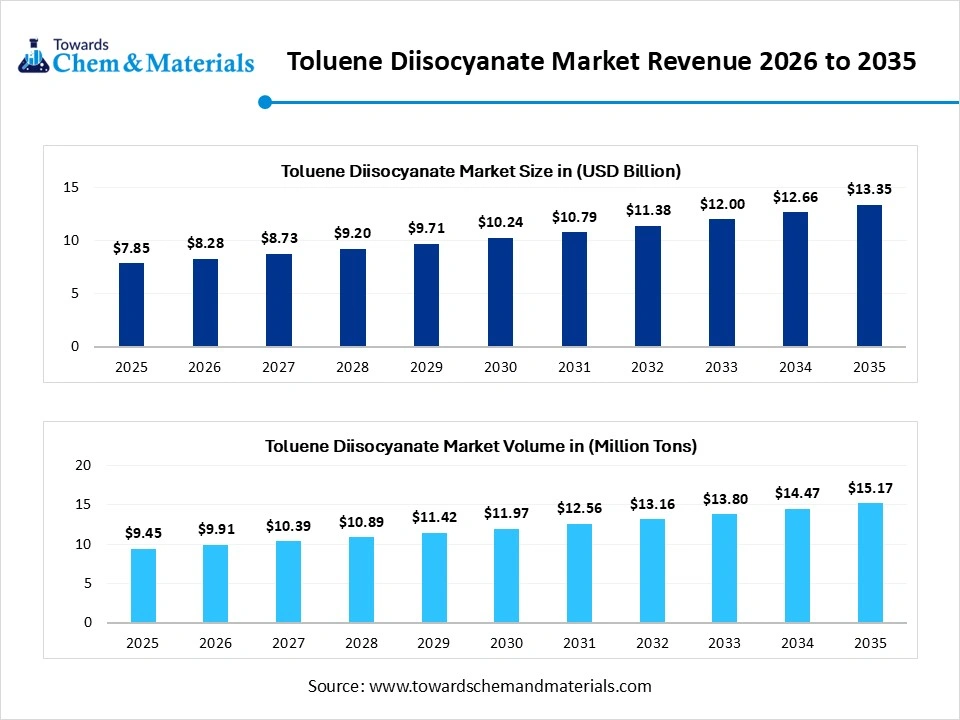
The global toluene diisocyanate market was valued at USD 7.85 billion in 2025, is estimated to reach USD 8.28 billion in 2026, and is projected to reach USD 13.35 billion by 2035, growing at a CAGR of 5.45% from 2026 to 2035. In terms of volume, the toluene diisocyanate market is projected to grow from 9.45 million tons in 2025 to 15.17 million tons by 2035. growing at a CAGR of 4.85% from 2026 to 2035. Growing demand for durable and lightweight insulating materials in construction is the key factor driving market growth. Also, a surge in disposable incomes coupled with the ongoing urbanisation in emerging regions can fuel market growth further.
Key Takeaways
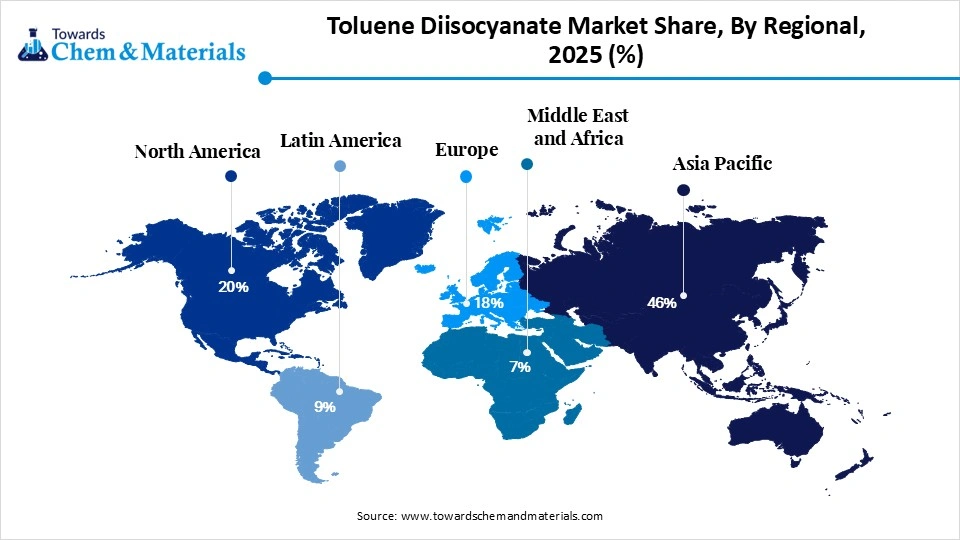
- By region, Asia Pacific dominated the market with the largest share of 46% in 2025 and is expected to grow at the fastest CAGR of 6.1% over the forecast period.
- By region, North America held the market share of 20% in 2025.
- By product type, the TDI 80/20 segment dominated the market with the largest share of 58% in 2025.
- By product type, the modified TDI segment is expected to grow at the fastest CAGR of 5.8% over the forecast period.
- By application, the flexible polyurethane foam segment dominated the market with the largest share of 64% in 2025.
- By application, the elastomers segment is expected to grow at the fastest CAGR of 5.7% over the forecast period.
- By end-use industry, the furniture & bedding segment dominated the market with the largest share of 36% in 2025.
- By end-use industry, the automotive segment is expected to grow at the fastest CAGR of 5.6% over the forecast period.
- By distribution channel, the direct sales segment dominated the market with the largest share of 72% in 2025.
- By distribution channel, the distributors segment is expected to grow at the fastest CAGR of 5.7% in 2025.
- By production process, the phosgenation process segment dominated the market with the largest share of 92% in 2025.
- By production process, the non-phosgene routes segment is expected to grow at the fastest CAGR of 6.4% over the projected period.
Market Size and Volume Forecast
- Market Estimated Size (2025): USD 7.85 Billion | CAGR (2026–2035): 5.45%
- Market Projected Size (2035): USD 13.35 Billion
- Market Volume (2025): 9.45 Million Tons (MT) | Volume CAGR (2026–2035): 4.85%
- Market Projected Volume (2035): 15.17 Million Tons (MT)
- Market Pricing (2025):
- Average Manufacturing Price: USD 1,656/ton
- Average Selling Price: USD 2,156/ton
- Pricing CAGR (2025–2035): 3.15%
What is Toluene Diisocyanate Market?
The market involves the manufacturing and sale of an aromatic diisocyanate (TDI 80/20 or 65/35) mainly used to manufacture flexible polyurethane foams for automotive seating, furniture, and bedding. The ongoing transition towards safer handling, phosgene-free manufacturing routes, and a surge in demand for high-performance and sustainable foams can fuel market expansion shortly.
Toluene Diisocyanate Market Trends
- The market is experiencing a rapid shift towards sustainability, which is the latest trend in the market, shaping positive market growth. This trend is mainly driven by consumer demand for greener products and regulatory pressures. Also, market players are increasingly exploring sustainable alternatives and optimizing manufacturing processes to reduce environmental impact.
- Toluene diisocyanates are crucial in manufacturing polyurethane foams, which are extensively used in insulation materials and coatings. Rapid urbanisation in emerging economies increases the demand for energy-efficient and durable building materials.
- Rapid innovations in the manufacturing of TDI are helping minimize emissions and enhance yields, which is another major trend in the market. New advancements in TDI production processes and formulations can enhance foam properties, leading to market expansion soon.
Report Scope
| Report Attribute | Details |
| Market Size and Volume in 2026 | USD 8.28 Billion / 9.91 Million Tons |
| Expected Size and Volume by 2035 | USD 13.35 Billion / 15.17 Million Tons |
| Growth Rate from 2026 to 2035 | CAGR 5.45% |
| Forecast Period | 2026 - 2035 |
| Dominant Region | Asia-Pacific |
| Segment Covered | By Product Type, By Application, By End-Use Industry, By Distribution Channel, By Production Process and By Region |
| Key companies profiled | Tosoh Corporation (Japan), Wanhua Chemical Group Co., Ltd. (China), Yantai Juli Fine Chemical Co., Ltd. (China), Vencorex Holding SAS (France), Overseas Polymers Pvt. Ltd. (India), GNFC Limited (India), OCI Company Ltd. (South Korea), Hanwha Group (South Korea), LANXESS (Germany), Covestro AG (Germany), China National Bluestar (Group) Co., Ltd. (China) |
How Cutting-Edge Technologies Are Revolutionizing the Toluene Diisocyanate Market?
Advanced technologies are transforming the market by growing manufacturing efficiency, fuelling sustainability, and facilitating high-performance applications, particularly within the polyurethane foam sector. Furthermore, DI-based flexible polyurethane foams are crucial for producing headrests, seats, and soundproofing, improving range and fuel efficiency in electric vehicles.
Supply Chain Analysis of the Toluene Diisocyanate Market
Feedstock Procurement
It refers to the strategic sourcing and acquisition of essential materials, mainly nitric acid, toluene, and chlorine, necessary to produce TDI.
- Major Players: BASF SE, Covestro AG
Chemical Synthesis and Processing
It refers to the industrial multi-step sequence utilized to convert toluene into RDI. This process is capital-intensive and includes handling of harmful chemicals such as phosgene.
- Major Players: Covestro AG, Dow Inc.
Packaging and Labelling
It refers to the strict regulatory standards and physical containment techniques needed to safely handle, transport, and identify this hazardous chemical.
- Major Players: Mitsui Chemicals, Inc., Hanwha Solutions
Regulatory Compliance and Safety Monitoring
It refers to the stringent adherence to health, environmental, and safety (EHS) standards and governmental regulations, designed to reduce the hazards related to producing, handling, and transporting TDI.
Toluene Diisocyanate Market's Regulatory Landscape: Global Regulations
| Country/Region | Key Regulations |
| European Union (EU) | Worker Protection: New rules published in March 2024 established stricter exposure limits for diisocyanates to prevent occupational asthma and respiratory diseases. |
| United States | The EPA uses the Toxic Substances Control Act (TSCA) to manage TDI risks. A proposed Significant New Use Rule (SNUR) would require notification for consumer uses at concentrations above 0.1% in coatings, adhesives, and sealants. |
| China | The new Hazardous Chemicals Safety Law, effective May 1, 2026, strengthens lifecycle risk management for production, storage, and transportation. |
Market Dynamics
Driver
Increasing Demand for Insulation Materials
With growing focus on energy efficiency, polyurethane foams created from TDI are in great demand, particularly for refrigeration, building insulation, and automotive applications. Also, governments across the globe are enforcing stringent environmental regulations to reduce greenhouse gas emissions.
Restraint
Stringent Health and Safety Regulations
TDI is classified as a harmful material and a potent respiratory sensitizer, which is the major factor hindering the market growth. Agencies such as OSHA have set fixed occupational exposure limits (0.02 ppm TWA), impelling market players to invest directly in specialized ventilation.
Opportunity
Innovations in Polyurethane Technology
The market is also witnessing innovations in polyurethane formulations, mainly fuelled by advancements that enhance the overall functionality and performance of polyurethane foams. The demand for polyurethane foams with enhanced durability, thermal performance, and fire resistance can create lucrative opportunities in the market.
Segmental Insights
Product Type Insights
The TDI 80/20 Segment Dominated the Market with 58% of Market Share in 2025
The TDI 80/20 segment dominated the market with the largest share of 58% in 2025. The dominance of the segment can be attributed to the increasing product demand from the furniture and bedding sector, along with extensive use in flexible foam manufacturing across several industries. Cost-effective formulation promotes large-scale adoption.
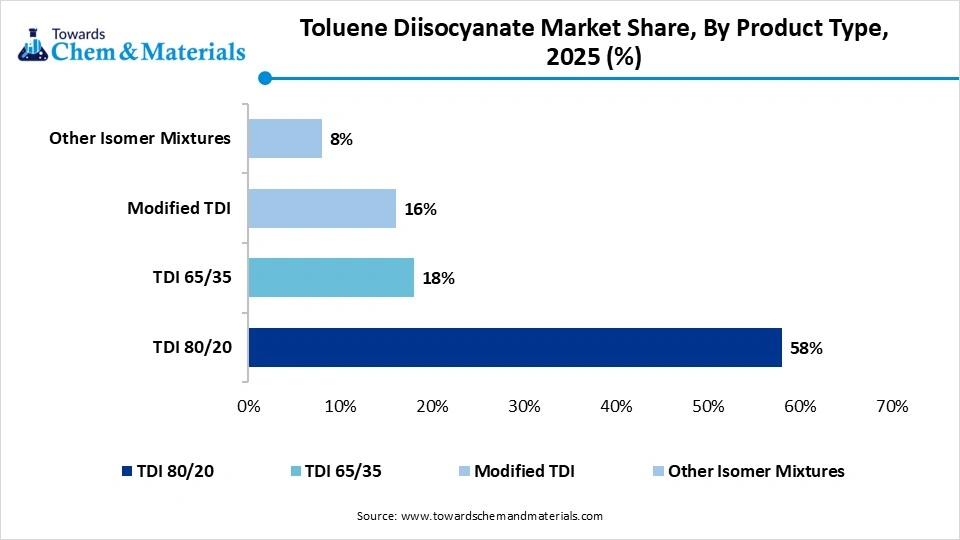
The modified TDI segment held the market share of 16% in 2025 and is expected to grow at the fastest CAGR of 5.8% over the forecast period. The growth of the segment can be credited to its growing use in specialty polyurethane applications and improved performance properties. Advancements in formulations increase the application further.
The TDI 65/35 segment held the market share of 18% in 2025. The growth of the segment can be driven by its increasing use in high-resiliency foam applications and the expansion of the automotive and premium bedding segments. However, its limited adoption can restrain segment growth soon.
Application Insights
The Flexible Segment Dominated the Market with 64% of Market Share in 2025
The flexible polyurethane foam segment dominated the market with the largest share of 64% in 2025. The dominance of the segment can be linked to the rapid urbanisation and increasing consumer preference for foam. Its wide use in bedding, furniture, and automotive seating drives demand shortly.
Toluene Diisocyanate Market Share, By Application, 2025 (%)
| By Application | Revenue Share, 2025 (%) |
| Flexible Polyurethane Foam | 64% |
| Coatings | 10% |
| Adhesives & Sealants | 9% |
| Elastomers | 11% |
| Others | 6% |
The elastomers segment held the market share of 11% in 2025 and is expected to grow at the fastest CAGR of 5.7% over the forecast period. The growth of the segment is due to the growing demand for high-performance elastomers in automotive and industrial uses and the growing demand for TPUs.It enhances durability and flexibility, improving the application scope.
The coatings segment held the market share of 10% in 2025. The growth of the segment is due to its durability and growing demand in industrial coatings. Protective coatings adoption in infrastructure further supports segment growth.
End-Use Industry Insights
The Furniture & Bedding Segment Dominated the Market with 36% of Market Share in 2025
The furniture & bedding segment dominated the market with the largest share of 36% in 2025. The dominance of the segment can be attributed to the ongoing urbanisation and surge in demand for cushions and mattresses. Also, increasing living standards fuel comfort product demand.
Toluene Diisocyanate Market Share, By End-Use Industry, 2025 (%)
| By End-Use Industry | Revenue Share, 2025 (%) |
| Furniture & Bedding | 36% |
| Automotive | 24% |
| Construction | 18% |
| Packaging | 12% |
| Others | 10% |
The automotive segment held the market share of 24% in 2025 and is expected to grow at the fastest CAGR of 5.6% over the forecast period. The growth of the segment can be credited to the increasing vehicle manufacturing and growing demand for lightweight materials. Enhanced comfort requirements drive segment expansion further.
The construction segment held the market share of 18% in 2025. The growth of the segment can be linked to the increasing demand for sealants and coatings in infrastructure development and rapid urbanisation in emerging economies. Insulation materials support energy efficiency goals.
Distribution Channel Insights
The Direct Sales Segment Dominated the Market with 72% of Market Share in 2025
The direct sales segment dominated the market with the largest share of 72% in 2025. The dominance of the segment can be driven by robust supplier relationships and consumer preference for bulk purchasing to reduce costs. Large manufacturers heavily rely on long-term contracts for a stable supply.
Toluene Diisocyanate Market Share, By Distribution Channel, 2025 (%)
| By Distribution Channel | Revenue Share, 2025 (%) |
| Direct Sales | 72% |
| Distributors | 28% |
The distributors segment held the market share of 28% in 2025 and was expected to grow at the fastest CAGR of 5.7% in 2025. The growth of the segment is owing to a surge in distribution network accessibility and growth in flexible purchasing options.SME depend more on distributors for procurement.
Production Process Insights
The Phosgenation Process Segment Dominated the Market with 92% of Market Share in 2025
The phosgenation process segment dominated the market with the largest share of 92% in 2025. The dominance of the segment is due to the presence of established industrial processes to ensure high efficiency and yield, and heavy-scale production supports. The development of existing infrastructure will drive segment growth soon.
Toluene Diisocyanate Market Share, By Production Process, 2025 (%)
| By Production Process | Revenue Share, 2025 (%) |
| Phosgenation Process | 92% |
| Non-Phosgene Routes | 8% |
The non-phosgene routes segment held the market share of 8% in 2025 and is expected to grow at the fastest CAGR of 6.4% over the projected period. The growth of the segment can be attributed to the ongoing emergence of new technologies and regulatory pressure. Environmental concerns boost the development of green alternatives.
Regional Insights
How did Asia Pacific Dominate the Toluene Diisocyanate Market in 2025?
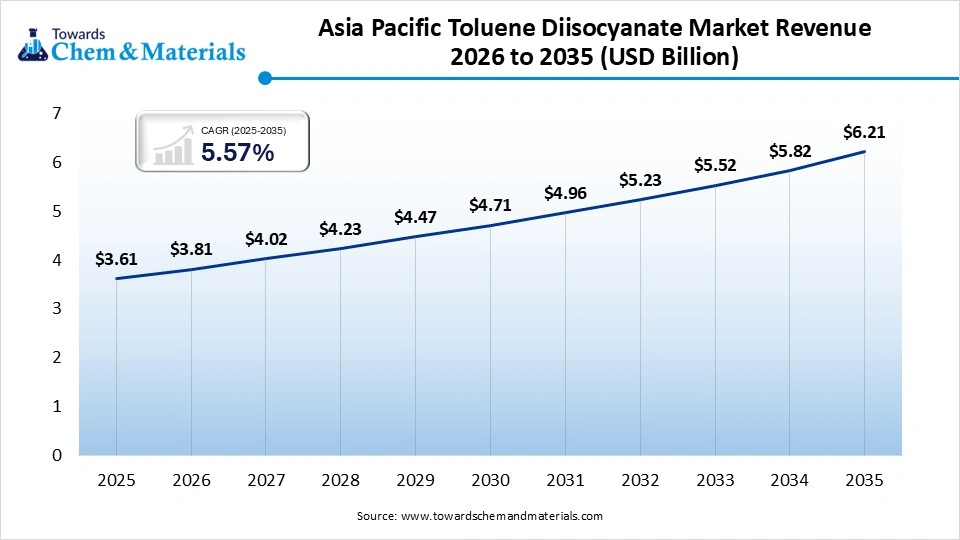
The Asia Pacific toluene diisocyanate market size was estimated at USD 3.61 billion in 2025 and is projected to reach USD 6.21 billion by 2035, growing at a CAGR of 5.57% from 2026 to 2035 The growth of the region can be attributed to the increasing demand for flexible polyurethane foams in bedding, furniture, and automotive seating, along with the ongoing urbanisation in emerging economies. In addition, increasing emphasis on sustainable production processes is driving regional growth soon.
China Toluene Diisocyanate Market Trends
In the Asia Pacific, China dominated the market owing to the extensive capacity growth by major market players and technological innovations in TDI production processes. Also, ongoing urbanisation and an increasing emphasis on energy-efficient "green" buildings are increasing the need for TDI-based rigid foam insulation.
North America held the market share of 20% in 2025. The growth of the region is attributed due to the rise in vehicle production necessitating lightweight materials and the growing need for comfortable bedding. Furthermore, the growing demand for durable coatings, sealants, and insulation materials in commercial and residential construction projects can fuel market growth soon.
U.S. Toluene Diisocyanate Market Trends
The growth of the market in the country is due to growing demand for flexible polyurethane foams in the furniture, automotive, and construction sectors, along with the ongoing transition towards high-performance, sustainable materials. Moreover, the surge of e-commerce has raised demand for protective packaging, where polyurethane foam acts as a crucial component.
Recent Development
- In February 2026, Covestro announced the successful completion of a significant debottlenecking project at its toluene diisocyanate (TDI) manufacturing site in Shanghai, China. By increasing annual production capacity from 310,000 to 370,000 metric tons, this expansion substantially bolsters the company's strategic position within the Asia Pacific TDI market.
Toluene Diisocyanate (TDI) Market Competitive Landscape Analysis
Tier 1 Companies
|
Rank
|
Company Name | Headquarters | Country | Why Relevant to This Market | Key Products / Material Portfolio |
| 1 | BASF SE | Ludwigshafen, Rhineland-Palatinate | Germany | One of the world's largest TDI producers with integrated polyurethane operations | TDI, MDI, polyurethane systems, specialty isocyanates |
| 2 | Covestro AG | Leverkusen, North Rhine-Westphalia | Germany | Global leader in polyurethane raw materials and TDI manufacturing | Desmodur® TDI, MDI, polyurethane raw materials |
| 3 | Wanhua Chemical Group Co., Ltd. | Yantai, Shandong | China | World's largest isocyanate producer with significant global TDI capacity | TDI, MDI, TPU, polyurethane chemicals |
| 4 | Tosoh Corporation | Tokyo | Japan | Major producer supplying TDI to Asia-Pacific polyurethane markets | TDI, MDI, polyurethane intermediates |
| 5 | Huntsman Corporation | The Woodlands, Texas | United States | Leading global supplier of polyurethane raw materials and specialty isocyanates | TDI, MDI, polyurethane systems, adhesives |
Tier 2 Companies
|
Rank
|
Company Name | Headquarters | Country | Why Relevant to This Market | Key Products / Material Portfolio |
| 1 | OCI Company Ltd. | Seoul | South Korea | Major Asian producer with integrated TDI production facilities | TDI, polyurethane intermediates |
| 2 | Cangzhou Dahua Group Co., Ltd. | Cangzhou, Hebei | China | Important Chinese supplier of TDI and polyurethane feedstocks | TDI, MDI, chlor-alkali products |
| 3 | Sadara Chemical Company | Jubail, Eastern Province | Saudi Arabia | Large-scale integrated petrochemical producer serving polyurethane markets | TDI, polyurethane intermediates, specialty chemicals |
| 4 | GNFC Limited | Bharuch, Gujarat | India | One of India's major isocyanate producers serving domestic demand | TDI, methanol, industrial chemicals |
Tier 3 Companies
|
Rank
|
Company Name | Headquarters | Country | Why Relevant to This Market | Key Products / Material Portfolio |
| 1 | BorsodChem Zrt. | Kazincbarcika, Borsod-Abaúj-Zemplén | Hungary | Major European isocyanate producer and part of the Wanhua group | TDI, MDI, polyurethane raw materials |
| 2 | KPX Chemical Co., Ltd. | Seoul | South Korea | Active supplier in polyurethane raw material markets | TDI derivatives, polyurethane chemicals |
| 3 | Mitsui Chemicals, Inc. | Tokyo | Japan | Participant in polyurethane and specialty isocyanate markets | Polyurethane intermediates, specialty chemicals |
| 4 | Shandong INOV Polyurethane Co., Ltd. | Zibo, Shandong | China | Growing supplier within the polyurethane value chain | TDI-based polyurethane systems |
| 5 | Vencorex Holding SAS | Saint-Priest, Auvergne-Rhône-Alpes | France | Specialist supplier of isocyanates for coatings and industrial applications | Aromatic isocyanates, polyurethane raw materials |
Toluene Diisocyanate Market Company
- BASF SE: BASF SE is a global leader in the Toluene Diisocyanates (TDI) market, primarily focusing on producing high-performance Lupranate® TDI for flexible polyurethane foams used in automotive seating, furniture, and bedding.
- Dow: Dow is a top-tier global player in the highly concentrated, growing Toluene Diisocyanate (TDI) market, primarily producing the VORANATE™ T-80 Type I TDI for flexible polyurethane foam.
Other Companies in the Toluene Diisocyanate Market
- Tosoh Corporation (Japan)
- Wanhua Chemical Group Co., Ltd. (China)
- Yantai Juli Fine Chemical Co., Ltd. (China)
- Vencorex Holding SAS (France)
- OVERSEAS POLYMERS PVT. LTD. (India)
- GNFC Limited (India)
- OCI Company Ltd. (South Korea)
- Hanwha Group (South Korea)
- LANXESS (Germany)
- Covestro AG (Germany)
- China National Bluestar (Group) Co., Ltd. (China)
Toluene Diisocyanate Market Segments Covered in the Report
By Product Type
- TDI 80/20
- Flexible Foam Grade
- General Purpose Grade
- TDI 65/35
- High Resilience Foam Grade
- Specialty Applications
- Modified TDI
- Prepolymers
- Blends with Polyols
- Other Isomer Mixtures
- Customized Ratios
- Low Emission Grades
By Application
- Flexible Polyurethane Foam
- Bedding & Mattresses
- Furniture Upholstery
- Automotive Seating
- Coatings
- Industrial Coatings
- Protective Coatings
- Adhesives & Sealants
- Construction Adhesives
- Industrial Sealants
- Elastomers
- Cast Elastomers
- Thermoplastic Polyurethanes (TPU)
- Others
- Insulation Materials
- Specialty Products
By End-Use Industry
- Furniture & Bedding
- Mattresses
- Cushions
- Automotive
- Seating Systems
- Interior Components
- Construction
- Sealants & Coatings
- Insulation
- Packaging
- Flexible Packaging Foams
- Protective Packaging
- Others
- Footwear
- Electronics
By Distribution Channel
- Direct Sales
- Long-term Contracts
- Bulk Supply Agreements
- Distributors
- Regional Distributors
- Specialty Chemical Suppliers
By Production Process
- Phosgenation Process
- Continuous Phosgenation
- Batch Phosgenation
- Non-Phosgene Routes (Emerging)
- Green Chemistry Methods
- Catalytic Alternatives
By Region
- North America:
- U.S.
- Canada
- Mexico
- Rest of North America
- Latin America:
- Brazil
- Argentina
- Rest of Latin America
- Europe:
- Western Europe 
- Germany
- Italy
- France
- Netherlands
- Spain
- Portugal
- Belgium
- Ireland
- UK
- Iceland
- Switzerland
- Poland
- Rest of Western Europe
- Eastern Europe
- Austria
- Russia & Belarus
- Türkiye
- Albania
- Rest of Eastern Europe
-  Asia Pacific:
- China
- Taiwan
- India
- Japan
- Australia and New Zealand,
- ASEAN Countries (Singapore, Malaysia)
- South Korea
- Rest of APAC
- MEA:
- GCC Countries
- Saudi Arabia
- United Arab Emirates (UAE)
- Qatar
- Kuwait
- Oman
- Bahrain
- South Africa
- Egypt
- Rest of MEA
- GCC Countries
FAQ's




Select User License to Buy
Figures (4)






 sales@towardschemandmaterials.com
 Download Sample
 Schedule a Meeting