Content
Silicone in Personal Care Market Size Analysis Report 2035
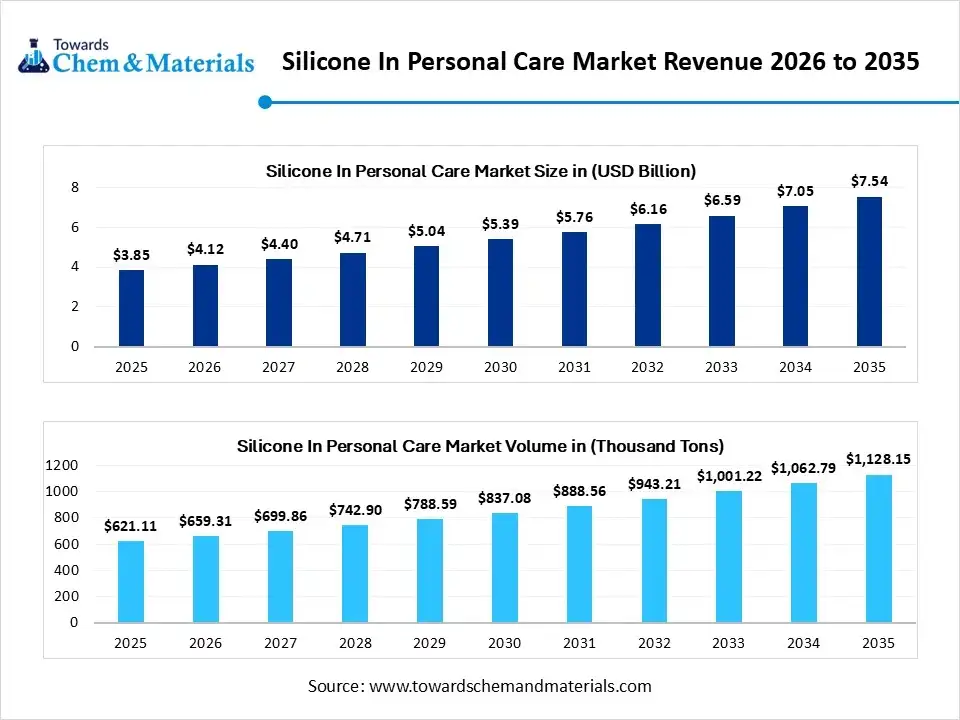
The global Silicone in Personal Care market size was estimated at USD 3.85 billion in 2025 and is expected to be worth around USD 7.54 billion by 2035, growing at a CAGR of 6.95% from 2026 to 2035. In terms of volume, the Silicone in Personal Care market is projected to grow from 621.11 thousand tons in 2025 to 1,128.15 thousand tons by 2035. growing at a CAGR of 6.15% from 2026 to 2035. The growth of the market is driven by the demand for superior, long-lasting performance in skincare and hair care products, including enhanced spreadability, moisture retention, and sensory feel.
Market Highlights
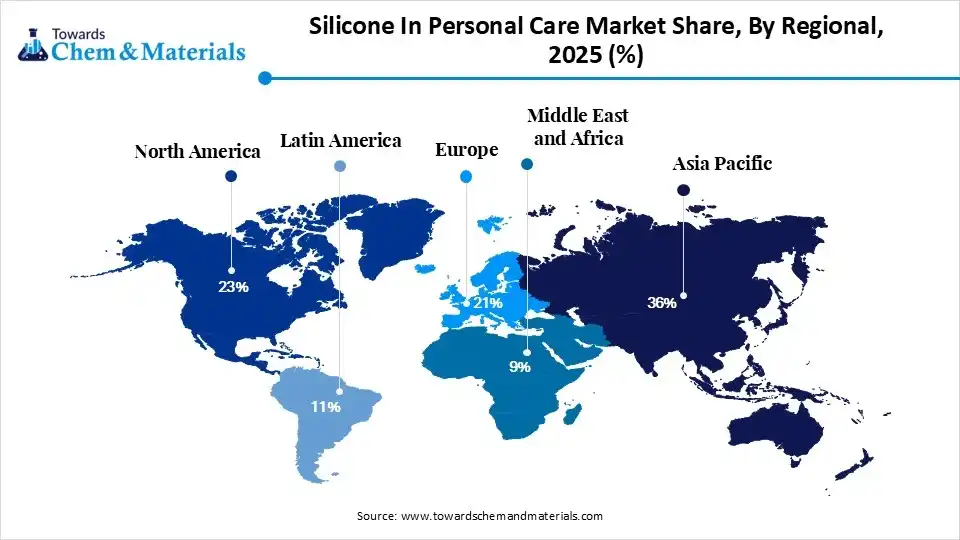
- By region, Asia Pacific dominated the market with a share of 36% in 2025 and is expected to sustain its position while growing with a CAGR of 8.20% in the forecast period.
- By region, North America held the market share of 23% in 2025.
- By product type, the elastomers segment dominated the market with 34% share in 2025.
- By product type, the resins segment held 14% market share in 2025 and is expected to have the fastest growth with a CAGR of 7.80% in the forecast period.
- By function, the conditioning agents segment dominated the market with 28% share in 2025.
- By function, the film formers segment held 17% market share in 2025 and is expected to have the fastest growth with a CAGR of 7.90% in the forecast period.
- By application, the hair care segment dominated the market with 38% share in 2025.
- By application, the color cosmetics segment held 19% market share in 2025 and is expected to have the fastest growth with a CAGR of 7.90% in the forecast period.
- By end-user, the mass market segment dominated the market with 52% share in 2025.
- By end-user, the premium/luxury segment held 31% market share in 2025 and is expected to have the fastest growth with a CAGR of 7.80% in the forecast period.
- By distribution channel, the offline retail segment dominated the market with 63% share in 2025.
- By distribution channel, the online segment held 37% market share in 2025 and is expected to have the fastest growth with a CAGR of 8.30% in the forecast period.
Silicone In Personal Care Market Size and Volume Forecast
- Market Estimated Size (2025): USD 3.85 Billion | CAGR (2026–2035): 6.95%
- Market Projected Size (2035): USD 7.54 Billion
- Market Volume (2025): 621.11 Thousand Tons | Volume CAGR (2026–2035): 6.15%
- Market Projected Volume (2035): 1,128.15 Thousand Tons
- Market Pricing (2025):
- Average Manufacturing Price: USD 3.95 per kg
- Average Selling Price: USD 7.25 per kg
- Pricing CAGR (2025–2035): 3.12%
Market Overview
What Is The Significance Of The Silicone In Personal Care Market?
Silicones are essential in the personal care market, because they act as superior sensory enhancers, providing a silky, non-greasy feel and long-lasting performance. They offer key benefits like excellent spreadability, water resistance, and breathable moisture barriers. Silicones are critical for elevating texture and efficacy in skincare, hair care, and color cosmetics. Silicones are becoming increasingly popular due to their ability to provide both immediate aesthetic improvements and long-term protection.
Recent Market Growth Trends:
- High-Performance Beauty Demand: Consumers increasingly favor products that offer long-lasting, water-resistant, and lightweight textures, boosting the use of silicone in foundations, sunscreens, and hair care.
- Sustainability & "Clean Beauty": While silicone is popular, there is a strong shift toward sustainable, biodegradable silicones and silicone alternatives to meet eco-conscious demands.
- Hybrid & Functional Products: The market is driven by the rise of "skincare-makeup" hybrids that offer both aesthetic enhancement and nourishing benefits, often relying on silicone for texture and delivery.
Report Scope
| Report Attribute | Details |
| Market Size and Volume in 2026 | USD 4.12 Billion / 659.31 Thousand Tons |
| Revenue Size and Volume Forecast in 2035 | USD 7.54 Billion / 1,128.15 Thousand Tons |
| Growth Rate | CAGR 6.95% |
| Forecast Period | 2026 - 2035 |
| Base Year | 2025 |
| Dominant Region | Asia Pacific |
| Segment Covered | By Product Type, By Function, By Application, By End-User, By Distribution Channel, By Region |
| Key companies profiled | Dow Inc, Wacker Chemie AG, Shin-Etsu Chemical Co., Ltd., Elkem ASA, BRB International BV, Apple Rubber, ARCO Silicone, Avantor, Bio-Plexus, Dongguan City Betterly New Materials, DuPont, Dynatex, Evonik Industries AG, Extreme Molding, Gelest Inc., Hemlock Semiconductor Corporation, Innospec Inc., KCC Corporation, LAUFENBERG GmbH, Momentive Performance Materials Inc., Nusil Technology LLC, Primasil Silicones, Shintech Inc., Siliconature S.P.A., Siltech Corporation, SIMCOA Operations, SIMTEC Silicone Parts, SiSiB SILICONES, Specialty Silicone Products Inc., Stockwell Elastomerics, ani Trelleborg AB. |
Key Technological Shifts In The Silicone In Personal Care Market:
The silicone in personal care market is undergoing a significant transformation driven by the need for sustainability, regulatory compliance, and enhanced sensory performance. Key technological shifts include a move toward bio-based feedstocks, the development of recycled silicone polymers, and the rise of hybrid silicones that combine organic and inorganic properties to meet "clean beauty" standards.
Supply Chain Analysis of Silicone In Personal Care Market:
Chemical Production & Formulation
- Silicon-based ingredients such as silicones (e.g., dimethicone, cyclopentasiloxane) are produced through synthesis of siloxane polymers and are formulated into personal care products for conditioning, emulsifying, and texture-enhancing properties.
- Key players: Dow, Wacker Chemie, Shin-Etsu Chemical, Momentive Performance Materials
Quality Testing and Certification
- Silicon-based ingredients must meet cosmetic safety standards, dermatological testing requirements, and regulatory compliance for use in personal care products.
- Key players: U.S. Food and Drug Administration, European Chemicals Agency, International Organization for Standardization, Bureau of Indian Standards.
Distribution to Industrial Users
- Silicon ingredients are supplied to cosmetics manufacturers, skincare and haircare brands, personal hygiene product companies, and specialty formulation industries.
- Key players: Dow, Wacker Chemie, Shin-Etsu Chemical.
Silicone In Personal Care Regulatory Landscape: Global Regulations
| Country / Region | Regulatory Body | Key Regulations | Focus Areas | Notable Notes |
| United States | Food and Drug Administration (FDA); Environmental Protection Agency (EPA) | Federal Food, Drug & Cosmetic Act; Toxic Substances Control Act (TSCA) | Cosmetic ingredient safety, chemical risk assessment | Silicone ingredients (e.g., dimethicone, cyclomethicone) are generally considered safe for cosmetic use, with safety evaluated by expert panels such as the Cosmetic Ingredient Review (CIR). |
| European Union | European Commission; European Chemicals Agency (ECHA) | REACH Regulation; EU Cosmetics Regulation (EC No. 1223/2009) | Environmental persistence, bioaccumulation, chemical restrictions | The EU imposes strict restrictions on cyclic silicones (D4, D5, D6), including limits of 0.1% concentration and broader bans effective from 2026–2027 due to environmental concerns. |
| China | National Medical Products Administration (NMPA); Ministry of Ecology and Environment (MEE) | Cosmetic Supervision and Administration Regulation (CSAR) | Cosmetic safety, ingredient registration | China regulates silicone use in cosmetics through ingredient safety assessments and product registration requirements. |
| India | Central Drugs Standard Control Organization (CDSCO); Bureau of Indian Standards (BIS) | Drugs and Cosmetics Act; BIS Cosmetic Standards | Product safety, labeling, ingredient compliance | India allows silicone use in personal care products but requires compliance with cosmetic safety and labeling norms. |
| Japan | Ministry of Health, Labour and Welfare (MHLW) | Pharmaceutical and Medical Device Act (PMD Act) | Cosmetic safety, ingredient standards | Japan permits silicones in cosmetics under strict safety and quality regulations. |
| Canada | Environment and Climate Change Canada (ECCC); Health Canada | Canadian Environmental Protection Act (CEPA) | Environmental risk, chemical restrictions | Canada is increasing scrutiny on siloxanes, imposing conditions on manufacture/import due to environmental persistence concerns. |
Market Dynamics
Drivers
What are the Key Growth Drivers of the Silicone In Personal Care Market?
Key growth drivers for silicone in personal care market include rising demand for high-performance, multifunctional cosmetics (haircare/skincare) with better sensory textures, along with increasing urbanization, rising disposable income, and a consumer shift towards premium, long-lasting products. Key trends driving innovation include sustainable, bio-based formulations. The demand for efficiency in personal care routines has led to products that offer multiple benefits, which silicones facilitate.
Restrains
What are the Key Growth Restraints of the Silicone In Personal Care Market?
Key growth restraints for silicone in personal care market include strict environmental regulations like EU restrictions on D4, D5, D6 silicones, high raw material price volatility (silicon metal, methanol), and rising demand for "clean beauty" alternatives. Challenges also include complex, costly regulatory compliance and high production costs. Increasing consumer demand for natural, eco-friendly, and silicone-free products reduces demand for traditional silicone-heavy formulations.
Opportunities
What are the Key Growth Opportunities of the Silicone In Personal Care Market?
Key growth opportunities in the market include developing bio-based silicones from renewable biomass, creating multifunctional, long-wear, and water-resistant cosmetics, and expanding into sustainable, eco-friendly formulations. Demand is further driven by rising interest in antimicrobial silicone scrubbers and the need for premium, high-performance skincare. A major trend is the development of bio-based silicone alternatives made from renewable sources to meet "clean beauty" demands.
Segmental Insights
Product Type Insights
The Elastomers Segment Dominated The Market With 34% Market Share In 2025
The elastomers segment dominated the market with 34% share in 2025, driven by demand for superior sensory experiences, including lightweight, non-greasy textures and smooth application in skincare and color cosmetics. Growth is accelerated by rising consumer preference for premium, high-performance, and sustainable beauty products. The market is shifting towards sustainable and eco-friendly products, leading to the development of new, innovative silicone gel formulations.
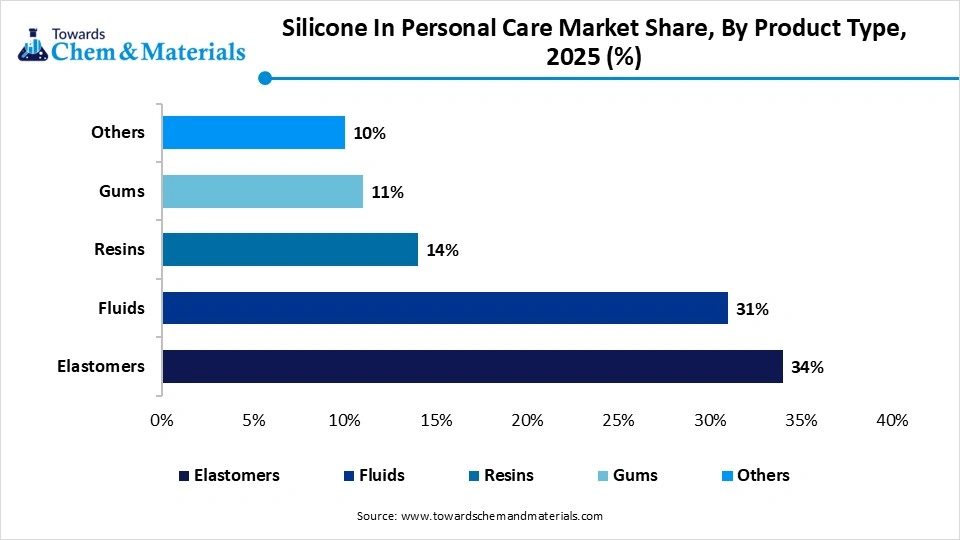
The fluids segment held 31% market share in 2025, expected to grow significantly due to high demand for premium, long-lasting products. Fluids are favored for enhancing texture, offering a non-greasy, silky feel, and improving spreadability in skin/hair care. They provide water resistance, high spreadability, and stability to creams, lotions, and sun care, often used in up to 18% concentration in premium cosmetics. Rising demand for lightweight, "clean beauty" formulations and long-wear, smudge-proof makeup.
The resins segment held 14% market share in 2025 and is expected to grow the fastest, with a CAGR of 7.80% over the forecast period, driven primarily by increasing demand for high-performance, long-lasting, and waterproof color cosmetics and advanced skincare formulation. Silicone resins are highly valued for their ability to form durable, water-resistant, and breathable films. This makes them essential in long-wear makeup products such as lipsticks, eyeliners, and mascaras, ensuring they remain transfer-resistant and smudge-proof.
Silicone In Personal Care Market Share, By Product Type, 2025 (%)
| By Product Type | Revenue Share, 2025 (%) |
| Elastomers | 34% |
| Fluids | 31% |
| Resins | 14% |
| Gums | 11% |
| Others | 10% |
Function Insights
The Conditioning Agents Segment Dominated The Market With 28% Market Share In 2025
The conditioning agents segment dominated the market with 28% share in 2025, driven by rising demand for multifunctional, high-performance hair and skin care. Growth is further fueled by the "premiumization" of cosmetic products and the rapid expansion of the hair care sector, especially with innovative formulations for frizz control, damage repair, and shine. Silicones are increasingly used for their ability to deliver shine, mend split ends, and control frizz in modern conditioners and styling products.
The emollients segment held 22% market share in 2025, due to rising demand for premium, multifunctional ingredients that provide superior hydration, sensory benefits, and stability in skin/hair care. Silicone-based emollients are favored for their film-forming, water-resistant properties in long-lasting products (e.g., primers, sunscreen), with innovations driving growth in hybrids that balance performance and sustainability.
The film formers segment held 17% market share in 2025 and is expected to grow the fastest, with a 7.90% CAGR over the forecast period, due to surging demand for long-lasting, smudge-proof, and waterproof cosmetic formulations that provide high-performance, comfortable, and breathable barrier protection. This growth is driven by consumer desire for "12-hour wear" products, alongside innovation in bio-based hybrids and regulatory pressure shifting formulations toward lower volatility and higher sustainability.
Application Insights
The Hair Care Segment Dominated The Silicone In Personal Care Market With 38% Market Share In 2025
The hair care segment dominated the market with 38% share in 2025, driven by demand for salon-quality, high-performance products offering superior conditioning, shine, anti-frizz, and heat protection. Silicones are essential in products targeting specific concerns, such as hair strengthening, frizz control, deep conditioning, and heat protection during styling. The surge in men's grooming products, particularly styling pomades and beard oils, has increased the consumption of silicones for texture control.
The skin care segment held 26% market share in 2025, due to rising demand for premium, multifunctional, and sensory-rich products that offer superior texture, spreadability, and long-lasting, non-greasy finishes. The shift toward long-lasting and transfer-resistant makeup and skincare has boosted usage. Silicone oils in foundations and lipsticks help with water resistance, while advanced cross-linked silicones are increasingly used for improved, breathable, and durable skin barrier protection.
The color cosmetics segment held 19% market share in 2025 and is expected to grow the fastest, with a CAGR of 7.90% over the forecast period, by demanding high-performance, long-wear, and sensory-enhancing ingredients. Silicones offer unmatched spreadability and water resistance for products like foundations and lipsticks, with specialized silicone-based makeup primers improving longevity for users. The demand for long-wear makeup drives the use of specialized silicones that form a durable pigment film on the skin.
End-User Insights
The Mass Market Segment Dominated The Market With 52% Market Share In 2025
The mass market segment dominated the market with 52% share in 2025, driven by high consumer demand for affordable, multifunctional products and the rising purchasing power of working professionals in emerging economies like China and India. Rising cost-sensitivity has shifted consumer preference towards accessible, effective products, driving expansion in skincare and haircare.
The premium/luxury segment held 31% market share in 2025 and is expected to grow the fastest, with a CAGR of 7.80% over the forecast period. This growth is propelled by a demand for superior sensory experiences, high-performance multifunctionality, and the need for long-lasting effects in luxury skincare, hair care, and color cosmetics. Consumers are seeking products that offer a "silky," "lightweight," and "non-greasy" feel, which is directly achieved through high-quality silicone fluids and gums.
The professional/salon use segment held 17% market share in 2025, driven by high demand for superior performance products like hair serums and styling oils that offer smooth textures, shine, and frizz control. Increased disposable income in emerging economies especially in the Asia-Pacific region is leading to higher spending on professional salon services. high-viscosity silicone fluid usage, is growing due to increased demand for long-lasting, premium, and damage-reducing treatments in salons.
Distribution Channel Insights
The Offline Retail Segment Dominated The Market With 63% Market Share In 2025
The offline retail segment dominated the market with 63% share in 2025, by offering tangible, sensory-driven experiences that online channels cannot match, particularly for high-performance and premium products. Consumers are increasingly spending on premium, high-performance formulations that offer better sensory experiences and long-lasting effects. These products are often launched and marketed through brick-and-mortar stores to establish trust and quality.
The online retail segment held 37% market share in 2025 and is expected to grow the fastest, with a CAGR of 8.30% over the forecast period, due to increased consumer preference for "premiumization" high-quality, multifunctional, and, sustainable products, alongside accelerated digital marketing, targeted social media influencing, results in rapid growth in quick commerce. Brands use data analytics to understand consumer preferences and deliver targeted ads, encouraging online purchases of tailored, high-performance skincare products.
Regional Insights
How did Asia Pacific Dominate the Silicone In Personal Care Market in 2025?
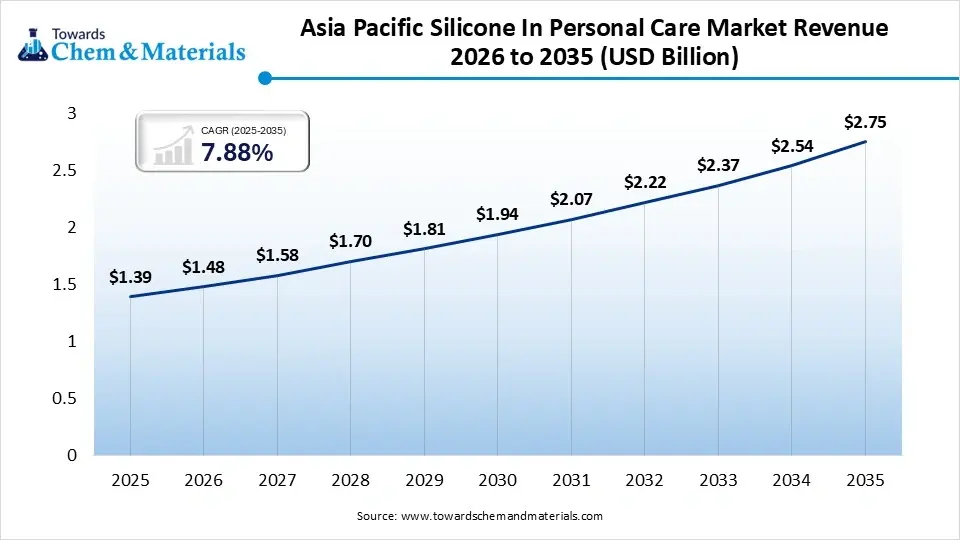
The Asia Pacific Silicone in Personal Care market size was estimated at USD 1.39 billion in 2025 and is projected to reach USD 2.75 billion by 2035, growing at a CAGR of 7.88% from 2026 to 2035. Asia Pacific dominated the market with a share of 36% in 2025 and is expected to sustain its position while growing with a CAGR of 8.20% in the forecast period, driven by surging demand for premium skincare, high-volume production in China, rising cosmetic adoption among young consumers, and a shift towards premium, high-quality beauty products. Rapid economic development in India and China increased purchasing power, shifting consumer trends toward high-quality skincare and beauty products.
India Silicone In Personal Care Market Growth Factor
The Indian silicone in personal care market is driven by rising demand for high-performance, long-lasting, and multifunctional beauty products. The industry is moving toward innovative, multifunctional, and hybrid products, increasing the use of specialized silicone additives. The rise of D2C (Direct-to-Consumer) and online marketplaces makes a wide range of specialized personal care products accessible, stimulating market growth.
North America Silicone In Personal Care Market Growth Factor
North America held the market share of 23% in 2025, driven by high demand for premium, multifunctional beauty products, including skincare, hair care, and color cosmetics that offer superior texture, durability, and sensory appeal. The boom in the cosmetic sector drives the demand for ingredients that provide unique texture and performance. Silicone oils and gels are key components in the booming skin and hair care industry.
U.S. Silicone In Personal Care Market Growth Factor
The U.S. silicone in personal care market is experiencing high growth, driven by increasing demand for premium, high-performance, and long-lasting cosmetics, skincare, and hair care products. Key drivers include rising consumer demand for multifunctional products, the influence of social media on beauty trends, and the need for improved texture and durability. Innovation in silicone chemistry allows for superior performance, such as enhanced emulsification, foam stabilization in shampoos, and improved texture in lotions, which boosts market demand.
Silicone In Personal Care Market Share, By Regional, 2025 (%)
| Regional | Revenue Share, 2025 (%) |
| North America | 23% |
| Europe | 21% |
| Asia-Pacific | 36% |
| Latin America | 11% |
| Middle East & Africa | 9% |
Recent Developments
- In June 2025, Dow launched its first carbon-neutral silicone elastomer blends under the Decarbia™ platform, produced via a decarbonized silicon metal process. The expansion includes DOWSIL™ MQ resins for water-resistant cosmetics, the bio-fermented DEXCARE™ CD-2 polymer for biodegradable conditioning, and the ProtecTress 2.0 heat protection program.(Source: www.chemanalyst.com)
- In August 2025, KCC Silicone and LG Household & Health Care (LG H&H) signed a memorandum of understanding to co-develop next-generation UV protection materials, combining KCC’s silicone polymer technology with LG H&H’s sun care formulations. The partnership aims to launch globally competitive beauty products, focusing on superior UV-blocking efficiency and enhanced sensory performance.(Source: www.cosmeticsandtoiletries.com)
Top players in the Silicone In Personal Care Market & Their Offerings:
- Dow Inc.: Dow is a global leader in silicone-based ingredients for personal care, offering products like dimethicone, elastomers, and emulsifiers used in skincare, haircare, and color cosmetics. The company focuses on sensory enhancement and multifunctional formulations.
- Wacker Chemie AG: Wacker produces a wide range of silicone fluids, resins, and elastomers for personal care applications. Its products are widely used for smooth texture, conditioning, and long-lasting cosmetic performance.
- Shin-Etsu Chemical Co., Ltd.: Shin-Etsu is a key manufacturer of high-purity silicone materials used in skincare and cosmetics, offering advanced formulations that improve spreadability and skin feel.
- Elkem ASA: Elkem supplies silicone solutions for personal care, including eco-friendly and biodegradable silicone alternatives. The company emphasizes sustainable innovation.
BRB International BV: BRB International supplies specialty silicones used in personal care, including emulsifiers and conditioning agents.
Other Top Players Are
- Apple Rubber
- ARCO Silicone
- Avantor
- Bio-Plexus
- Dongguan City Betterly New Materials
- DuPont
- Dynatex
- Evonik Industries AG
- Extreme Molding
- Gelest Inc.
- Hemlock Semiconductor Corporation
- Innospec Inc.
- KCC Corporation
- LAUFENBERG GmbH
- Momentive Performance Materials Inc.
- Nusil Technology LLC
- Primasil Silicones
- Shintech Inc.
- Siliconature S.P.A.
- Siltech Corporation
- SIMCOA Operations
- SIMTEC Silicone Parts
- SiSiB SILICONES
- Specialty Silicone Products Inc.
- Stockwell Elastomerics
- Trelleborg AB
Segments Covered:
By Product Type
- Elastomers
- Dimethicone Elastomers
- Crosspolymer Elastomers
- Fluids
- Dimethicone
- Cyclomethicone
- Phenyl Trimethicone
- Resins
- MQ Resins
- Silicone Film Formers
- Gums
- High Molecular Weight Silicones
- Others
By Function
- Conditioning Agents
- Emollients
- Emulsifiers
- Surfactants
- Film Formers
- Others
By Application
- Hair Care
- Shampoos
- Conditioners
- Hair Serums & Oils
- Skin Care
- Moisturizers
- Anti-aging Creams
- Sunscreens
- Color Cosmetics
- Foundations
- Lipsticks
- Eye Makeup
- Personal Hygiene
- Deodorants
- Body Wash
- Others
By End-User
- Mass Market
- Premium/Luxury Segment
- Professional/Salon Use
By Distribution Channel
- Offline Retail
- Supermarkets & Hypermarkets
- Specialty Stores
- Pharmacies
- Online Retail
- E-commerce Platforms
- Brand Websites
By Regions
- North America
- U.S.
- Canada
- Mexico
- Europe
- Germany
- UK
- France
- Italy
- Spain
- Asia Pacific
- China
- India
- Japan
- South Korea
- Latin America
- Brazil
- Argentina
- Middle East & Africa
- Saudi Arabia
- South Africa
FAQ's




Select User License to Buy
Figures (4)








 sales@towardschemandmaterials.com
 Download Sample
 Schedule a Meeting