
Renewable Fuel Market Size Analysis Report 2035
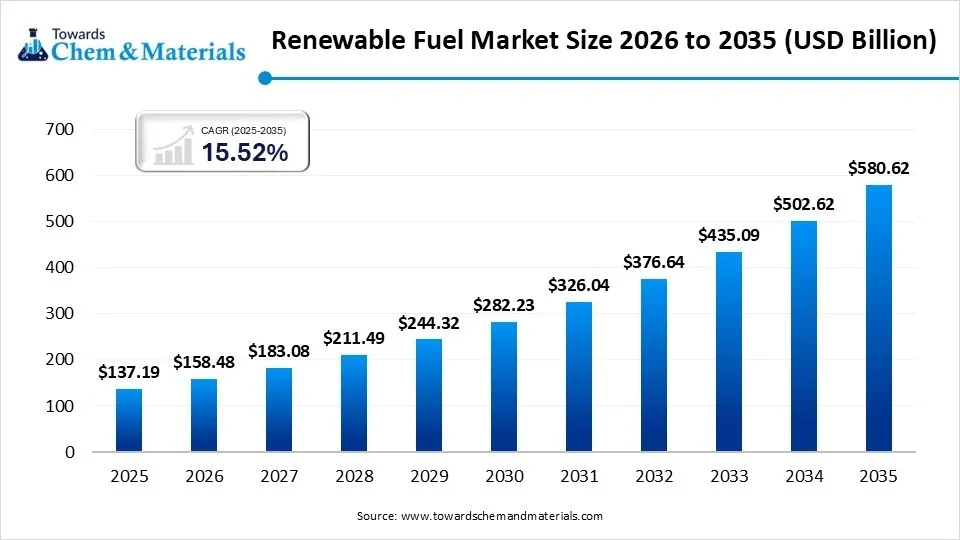
The renewable fuel market size was estimated at USD 137.19 billion in 2025 and is predicted to increase from USD 158.48 billion in 2026 to approximately USD 580.62 billion by 2035, expanding at a CAGR of 15.52% from 2026 to 2035. The greater shift towards the reduction of dependence on traditional fossil fuels has accelerated the industrys growth in recent years.
Market Highlights
- The Asia Pacific dominated renewable fuel market with the largest revenue share of 45.00% in 2025, due to the region combining large energy demand, fast industrial growth, and strong government-led energy planning.
- By region, LAMEA is anticipated to capture a greater portion of the market with a significant CAGR in the future due to its strong natural energy resources that are still underused.
- By type, the hydropower segment dominated the market and accounted for the largest revenue share of 37.00% in 2025, owing to it was developed earlier than many modern renewable technologies and can generate large amounts of stable electricity continuously.
- By type, the wind segment is expected to grow during the forecast period, due to its scale growing faster than many traditional renewable systems.
- By application, the power segment led the market with the largest revenue share of 42.00% in 2025, owing to electricity generation was the first major area where renewable resources could replace fossil fuels on a large scale.
- By application, the transportation segment is expected to grow during the forecast period, due to transport is one of the hardest sectors to fully decarbonize.
Cleaner Energy Solutions for Future Manufacturing
The fuel, which is primarily made from natural ingredients in a shorter time than traditional fossil fuels, is known as a renewable fuel. Moreover, by reducing the dependence on petroleum while eliminating carbon emissions, the renewable fuel is expected to support the long-term expansion of manufacturing operations during the forecast period. Also, fuel such as biodiesel, bioethanol, and green hydrogen has gained industry attention in recent years.
Trade Analysis of the Renewable Fuel Market:
Import, Export, Consumption, and Production Statistics
- The world has been seen in a sophisticated export of renewable diesel via 88 exporters and 86 buyers with the 617 shipments from June 2024 to May 2025, as per the published report.
- Malaysia has been observed as a leading biodiesel exporter with 481 shipments, while Germany (119 shipments) and the Bahamas (178 shipments) are following in the current period.
- The United States emerged as the heavy importer of biodiesel with 602 shipments, and Malaysia is following the United States with 550 shipments as per the recent observation.
Types of renewable fuels
1. Biofuels
- Ethanol: Typically made from crops like corn, sugarcane, or cellulose, ethanol is one of the most common biofuels. It is primarily used as an additive to gasoline (e.g., E10, E15, E85) or as a standalone fuel in flexible-fuel vehicles (FFVs).
- Biodiesel: Derived from vegetable oils (such as soybean oil), animal fats, or used cooking oils, biodiesel is used as an alternative to traditional diesel fuel in diesel engines. It can be used pure (B100) or blended with petroleum diesel (e.g., B20, B5).
- Biogas: Produced through the anaerobic digestion of organic waste, such as agricultural waste, sewage, or landfills, biogas primarily consists of methane and can be used as a renewable natural gas alternative for heating, electricity generation, and vehicle fuel.
- Butanol: A less common biofuel, butanol is made from fermenting plant sugars or agricultural waste. It can be used as an alternative to gasoline and has a higher energy content than ethanol.
- Green Diesel (Hydrotreated Vegetable Oil - HVO): A cleaner alternative to biodiesel, green diesel is produced by hydrotreating vegetable oils, animal fats, or algae. It is chemically similar to petroleum diesel and can be used directly in existing diesel engines.
2. Hydrogen
- Green Hydrogen: Produced using renewable energy (like wind or solar) through the process of electrolysis (splitting water into hydrogen and oxygen). Green hydrogen is considered a clean fuel and can be used in fuel cells to generate electricity, power vehicles, or serve as a feedstock for industrial processes.
- Blue Hydrogen: Similar to green hydrogen, but produced from natural gas with carbon capture and storage (CCS) to mitigate COâ‚‚ emissions. Though not entirely renewable, it offers a lower-carbon alternative to traditional hydrogen production methods.
3. Renewable Natural Gas (RNG)
- RNG is produced by capturing methane from organic waste sources (like landfills, sewage treatment plants, or agricultural operations) and refining it to produce a gas similar to conventional natural gas. It can be used in natural gas-powered vehicles, heating, and electricity generation.
4. Algae-Based Fuels
- Algae Biofuel: Algae can produce oils that can be converted into biodiesel or other renewable fuels. Algae-based biofuels are considered promising because algae can grow rapidly and do not compete with food crops for land. These fuels are being researched for use in aviation and other sectors.
5. Synthetic Fuels (E-Fuels)
- Synthetic Ethanol and Methanol (Power-to-X): E-fuels are produced using renewable electricity (often from wind or solar) to convert carbon dioxide (COâ‚‚) or carbon monoxide (CO) into fuels like synthetic ethanol or methanol. These fuels are chemically similar to conventional fuels and can be used in existing internal combustion engines.
- Synthetic Diesel and Gasoline: Similar to synthetic ethanol, these fuels are made by using renewable electricity to synthesize liquid fuels from COâ‚‚ or CO. They can be used in existing infrastructure and vehicles, offering a way to decarbonize the transportation sector.
6. Wood and Biomass Fuels
- Wood Pellets and Wood Chips: Wood-based fuels, such as wood pellets and chips, are used for heating and electricity generation. They can be burned directly or used in biomass power plants to produce steam that drives turbines to generate electricity.
- Pelletized Biomass: Made from compressed organic material, pelletized biomass is used for heating in residential or industrial settings. It’s a renewable option for heating systems as an alternative to fossil fuels like coal or oil.
- Biochar: A carbon-rich material made by heating organic materials in low-oxygen conditions. Biochar can be used as a soil amendment, and it also has potential in carbon sequestration as a way of storing carbon long-term.
7. Waste-to-Energy Fuels
- Municipal Solid Waste (MSW) to Biofuels: Certain types of municipal waste can be converted into renewable fuels through various technologies like gasification or pyrolysis. These processes break down organic waste into biofuels like synthetic natural gas, ethanol, or biodiesel.
- Waste Cooking Oil: Used cooking oils can be processed into biodiesel, reducing waste while providing an alternative fuel source for vehicles and industrial processes.
Market Trends:
- The integration of renewable fuel into the larger energy systems, such as electricity, industrial energy work, and fuel, has offered substantial growth prospects for the manufacturing firms in recent years. Also, the larger firms are not only viewing renewable fuel as a substitute for diesel or petrol, as per the recent observation.
- The search for local raw materials by several countries for the making of renewable fuels has opened profitable avenues for manufacturers in recent years. Moreover, several countries are observed in the production of the raw material locally to reduce dependence on imports from other nations.
- The trend towards energy security and industrial competitiveness is set to enable high-return ventures for the manufacturers in the coming years. Also, by offering more control, renewable fuels are slowly becoming the international power, while countries are trying to produce locally nowadays.
Report Scope
| Report Attribute | Details |
| Market Size in 2026 | USD 158.48 Billion |
| Revenue Forecast in 2035 | USD 580.62 Billion |
| Growth Rate | CAGR 15.52% |
| Forecast Period | 2026 - 2035 |
| Base Year | 2025 |
| Dominant Region | Asia Pacific |
| Segment Covered | By Type, By Application, By Region |
| Key companies profiled | LanzaJet, SkyNRG, Plug Power, Bloom Energy, Neste, World Energy, Air Products, Lhyfe, Clean Energy Fuels Corp, Archaea Energy, Montauk Renewables |
Next Generation Fuels from Waste Biomass
The industry is actively moving from simple first- generation fuel production toward flexible conversion technologies. In recent years, renewable fuels have mostly come from food crops such as corn or sugar-based feedstock. New technologies now allow fuel production from waste biomass, industrial residues, algae, and captured carbon combined with hydrogen. This shift is important because it reduces competition between food and fuel production.
Supply Chain Analysis of the Renewable Fuel Market:
Distribution to Industrial Users
- Distribution to industrial users involves supplying renewable fuels like green hydrogen, renewable diesel, or biomethane to decarbonize high-heat processes and heavy manufacturing.
This transition often requires specialized infrastructure, such as dedicated pipelines or retrofitted storage, and is frequently driven by statutory mandates or carbon reduction targets. - By replacing fossil fuels, industries like steel, cement, and chemicals can significantly lower their Scope 1 emissions while stabilizing long-term energy costs.
Chemical Synthesis and Processing
- The chemical synthesis and processing of renewable fuels involve converting biomass, waste, or hydrogen into high-density energy carriers like sustainable aviation fuel (SAF) or green methanol.
- Utilizing advanced catalytic conversion and thermochemical pathways, this market focuses on scaling drop-in fuels that integrate seamlessly into existing industrial and transport infrastructure.
Regulatory Compliance and Safety Monitoring
- Regulatory compliance ensures renewable fuels meet strict carbon-intensity and quality standards, such as the RFS or RED III.
- Simultaneously, safety monitoring utilizes advanced sensors and leak detection to manage high-pressure storage and chemical stability, mitigating risks during the production, transport, and industrial handling of these volatile energy carriers
Renewable Fuel Market Regulatory Landscape: Global Regulations
| Country Region | Regulatory Body | Key Regulations | Focus Areas |
| United States | Environmental Protection Agency (EPA) | Renewable Fuel Standard (RFS) Program (authorized under the Energy Policy Act of 2005 and the Energy Independence and Security Act of 2007). | Volume Mandates: Setting annual targets for cellulosic biofuel, biomass-based diesel, and advanced biofuels. |
| European Union | European Commission | Renewable Energy Directive (RED III) (Directive (EU) 2023/2413) | RFNBOs: Heavily incentivizing green hydrogen and synthetic fuels for hard-to-abate sectors. |
| China | National Energy Administration (NEA) | 14th Five-Year Plan for Renewable Energy Development (and the upcoming 15th Five-Year Plan framework for 2026+). |
Energy Security: Prioritizing self-sufficiency and large-scale infrastructure to reduce reliance on energy imports. |
Segmental Insights
Type Insights
How did the Hydropower Segment Dominate the Renewable Fuel Market in 2025?
The hydropower segment dominated the market share 37.00% in 2025, due to it was developed earlier than many modern renewable technologies and can generate large amounts of stable electricity continuously. Unlike solar and wind, hydro power can produce energy day and night if water flow is available. Large dams also allow electricity storage through water control, which gives hydropower a strong operational advantage. Many countries built hydropower systems decades ago, so the infrastructure is already established as per the observation.
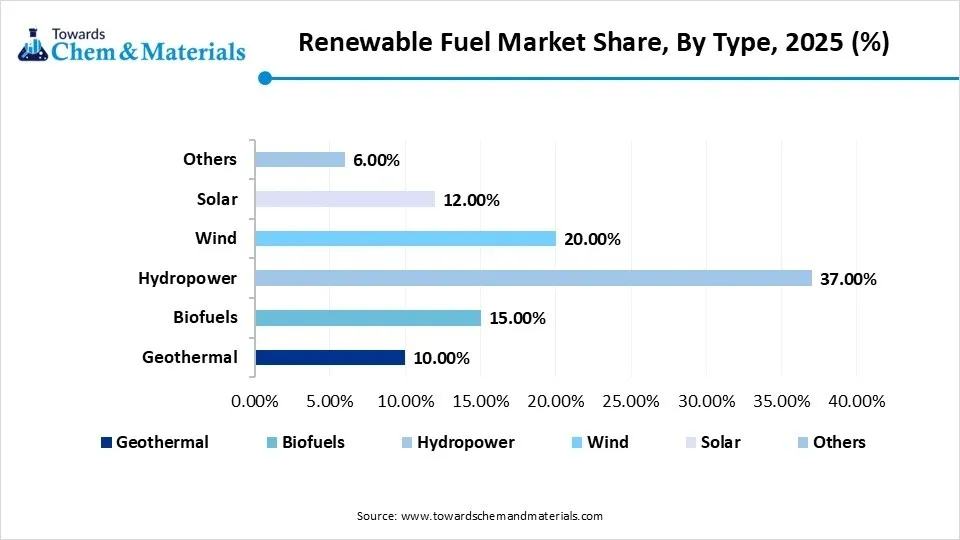
The wind segment is expected to grow with a rapid CAGR, owing to it scales faster than many traditional renewable systems. Moreover, building a new wind farm usually requires less time than constructing large hydro infrastructure, and land use can often continue under wind installations. Wind also benefits from improving turbine efficiency, meaning newer turbines produce far more electricity than older ones using the same wind conditions. Offshore wind adds another advantage because coastal areas often provide stronger and more stable wind.
Renewable Fuel Market Share, By Type , 2025 (%)
| By Type | Revenue Share, 2025 (%) |
| Geothermal | 10.00% |
| Biofuels | 15.00% |
| Hydropower | 37.00% |
| Wind | 20.00% |
| Solar | 12.00% |
| Others | 6.00% |
- Hydropower – Dominating with a 37.00% share, established infrastructure, large-scale electricity generation capacity, and reliability make it the leading renewable energy source.
- Wind – With a 20.00% share, increasing investments, technological advancements, and expansion of onshore and offshore projects are driving strong growth.
- Biofuels – Holding a 15.00% share, rising demand for cleaner transportation fuels and supportive government policies sustain steady market adoption.
- Solar – With a 12.00% share, declining installation costs and growing adoption of rooftop and utility-scale solar projects are accelerating its expansion.
- Geothermal – Holding a 10.00% share, consistent baseload energy generation supports its use, but geographic limitations restrict wider deployment.
- Others – Making up 6.00% of the market, niche renewable sources contribute minimally due to limited scalability and lower adoption rates.
Application Insights
How did the Power Sector Segment Dominate the Renewable Fuel Market in 2025?
The power sector segment dominated the market share 42.00% in 2025, due to electricity generation was the first major area where renewable resources could replace fossil fuels on a large scale. Also, it is easier to integrate renewable energy into electricity systems than directly replacing fuel in heavy industries or transport. Power grids can connect hydropower, solar, wind, and biomass plants into one system, allowing renewable energy to grow step by step.
The transportation segment is expected to grow with a rapid CAGR, owing to transport is one of the hardest sectors to fully decarbonize. Heavy trucks, ships, aviation, and long-distance freight still need high-energy fuels that batteries alone cannot fully replace in many cases. This creates strong future demand for biofuels, green hydrogen, synthetic fuels, and renewable liquid fuels. As regulations tighten on transport emissions, fuel suppliers will need more renewable alternatives.
Renewable Fuel Market Share, By Application, 2025 (%)
| By Application | Revenue Share, 2025 (%) |
| Cooling and Heating Sector | 22.00% |
| Power Sector | 42.00% |
| Transportation Sector | 25.00% |
| Others | 11.00% |
- Power Sector – Dominating with a 42.00% share, large-scale integration of renewable energy into electricity generation and grid systems drives the highest consumption.
- Transportation Sector – With a 25.00% share, increasing adoption of biofuels and alternative fuels to reduce emissions is fueling strong demand growth.
- Cooling and Heating Sector – Holding a 22.00% share, rising use of renewable sources for residential and industrial heating supports steady market expansion.
- Others – Making up 11.00% of the market, smaller and niche applications contribute limited demand due to lower scale and adoption levels.
- Regional Insights
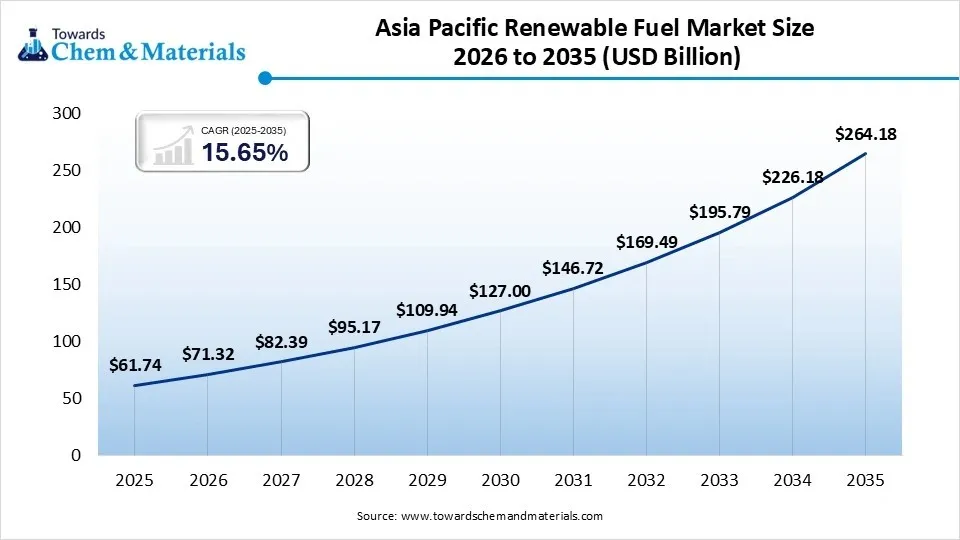
The Asia Pacific renewable fuel market size was valued at USD 61.74 billion in 2025 and is expected to be worth around USD 264.18 billion by 2035, exhibiting at a compound annual growth rate (CAGR) of 15.65% over the forecast period from 2026 to 2035. Asia Pacific dominated the renewable fuel market share 45.00% in 2025, due to the region combining large energy demand, fast industrial growth, and strong government-led energy planning. Moreover, the countries in this region have seen a heavy need for electricity and fuel to support cities, factories, transport, and manufacturing. Renewable fuel became important because they help to reduce fuel imports while supporting economic growth. The region also has wide natural resource diversity, including sunlight, water, biomass, and agricultural residues.
China’s Industrial Strategy for Clean Energy
China maintained its dominance in the market, owing to the country is treating energy transition as an industrial strategy rather than only an environmental policy nowadays. Also, the country invests heavily in renewable infrastructure because cleaner energy also supports manufacturing competitiveness, export growth, and long-term energy independence. China uses large-scale hydropower, solar, biomass, and renewable electricity systems together.
Renewable Fuel Market Evaluation in LAMEA
Latin America and the Middle East & Africa are expecting the fastest growth in the market during the forecast period, due to their robust natural energy resources that are still underused as per recent regional observation. Moreover, Latin America has biomass and hydropower potential, the Middle East has heavy solar intensity, and Africa has both sunlight and large, undeveloped renewable land resources. As global energy markets shift, these regions can produce renewable fuel not only for local use but also for export.
Biomass Powering Brazil’s Renewable Future
Brazil is expected to emerge as a prominent country for the renewable fuel market in the coming years, due to its having already developed a strong agricultural energy model over many years. The country has long experience which is turning agricultural production into fuel systems, especially through biomass and crop-based energy. Moreover, Brazil also benefits from strong hydropower infrastructure and favorable climate conditions for energy crops.
Europe Renewable Fuel Market Examination
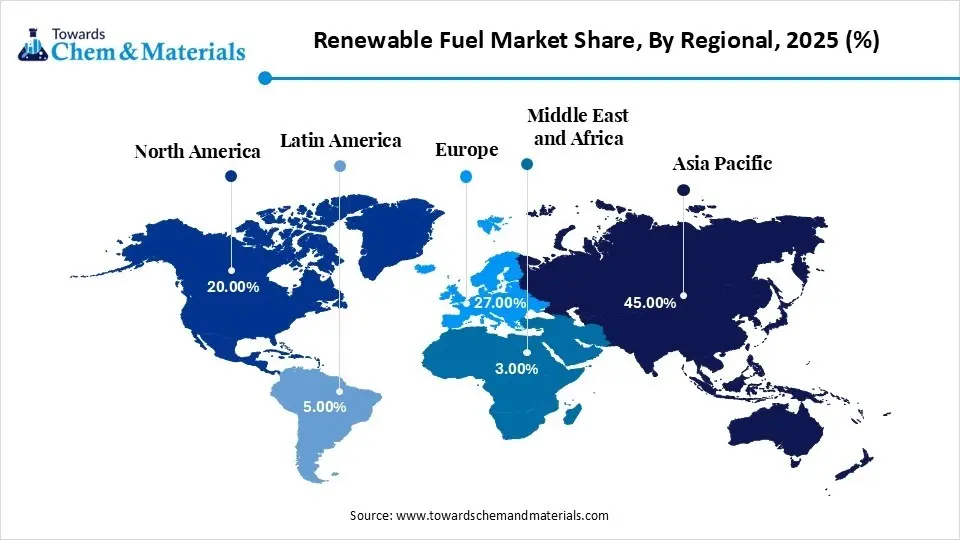
Europe market segment accounted for the major revenue share of 27.00% in 2025. Europe is notably growing in industry, owing to renewable fuel in Europe is driven by strict industrial transition targets. Instead of only expanding renewable energy capacity, the country is actively focusing on changing how industries, transport, and buildings consume fuel. Moreover, this creates a broader demand for advanced renewable fuels. Europe also invests heavily in technology quality, system efficiency, and cross-border energy integration, as per the recent observation.
Germany Leading Future Low-Carbon Manufacturing
Germany is expected to gain a significant industry share owing to its approach to renewable fuel as part of industrial restructuring. Moreover, the country uses renewable fuel development not only for environmental goals but also to protect manufacturing competitiveness in future low-carbon trade systems. Also, Germany strongly supports advanced fuels for transport, industrial heat, and chemical production.
Renewable Fuel Market Share, By Regional, 2025 (%)
| Regional | Revenue Share, 2025 (%) |
| North America | 20.00% |
| Europe | 27.00% |
| Asia Pacific | 45.00% |
| Latin America | 5.00% |
| Middle East & Africa | 3.00% |
- Asia Pacific – Dominating with a 45.00% share, rapid industrialization, rising energy demand, and strong investments in renewable infrastructure drive large-scale adoption.
- Europe – With a 27.00% share, stringent environmental regulations, aggressive decarbonization targets, and strong policy support sustain high renewable fuel usage.
- North America – Holding a 20.00% share, established renewable energy projects and supportive government initiatives maintain steady market growth.
- Latin America – With a 5.00% share, growing biofuel production and renewable investments contribute to gradual market expansion but remain limited in scale.
- Middle East & Africa – Making up 3.00% of the market, emerging renewable initiatives and lower adoption rates restrict overall market contribution.
Recent Developments
- In January 2026, Topsoe created a partnership with Tangshan Jinlihai. Also, in these strategic collaborations, Topsoe is likely to provide its Hydroflex technology and its related services to Tangshan Jinlihai’s industrial hub while processing 300000 tons of renewable fuel feedstock yearly, as per the published report.(Source: www.indianchemicalnews.com)
- In October 2025, Montana Renewables introduced its latest sustainable aviation fuel blend called MaxSAF™ blended. Also, these newly launched blends of renewable fuel have been certified under the ASTM D1655 and ASTM D7566 specifications as per the companys claim.(Source: www.prnewswire.com)
Top Vendors in the Renewable Fuel Market & Their Offerings:
- LanzaJet: LanzaJet is a leading sustainable fuels technology provider headquartered in Illinois. It specializes in patented Alcohol-to-Jet (ATJ) technology, which converts low-carbon ethanol into sustainable aviation fuel (SAF) and renewable diesel. In 2025, it opened the worlds first commercial-scale ethanol-to-SAF plant, Freedom Pines Fuels, in Georgia.
- SkyNRG: Based in Amsterdam, SkyNRG is a pioneer in the global SAF market, having supplied over 30 airlines worldwide. The company is transitioning from a fuel distributor to a producer, recently reaching financial close on its first dedicated SAF facility in the Netherlands. It is B Corp certified and maintains an independent sustainability board.
- Plug Power: Plug Power is building an end-to-end green hydrogen ecosystem, covering production, storage, and delivery. It is the worlds largest buyer of liquid hydrogen and has deployed over 72,000 fuel cell systems for markets like material handling and e-mobility. The company aims to operate a "hydrogen highway" across North America and Europe.
- Bloom Energy: Bloom Energy provides high-efficiency solid oxide fuel cell (SOFC) technology for onsite power generation. Its "Energy Servers" are fuel-flexible, utilizing natural gas, biogas, or hydrogen to provide 24/7 electricity without combustion. In 2025, it secured a major $5 billion partnership with Brookfield to power AI data center infrastructure.
- Neste
- World Energy
- Air Products
- Lhyfe
- Clean Energy Fuels Corp
- Archaea Energy
- Montauk Renewables
Segments Covered in the Report
By Type
- Geothermal
- Biofuels
- Hydropower
- Wind
- Solar
- Others
By Application
- Cooling and Heating Sector
- Power Sector
- Transportation Sector
- Others
By Region
- North America
- U.S.
- Canada
- Mexico
- Europe
- Germany
- UK
- France
- Italy
- Spain
- Asia Pacific
- China
- India
- Japan
- South Korea
- Latin America
- Brazil
- Argentina
- Middle East & Africa
- Saudi Arabia
- South Africa



Comments
Share your thoughts, ask a question, or provide feedback about this report.