Content
Ethylene Glycol Market Size Analysis Report 2035
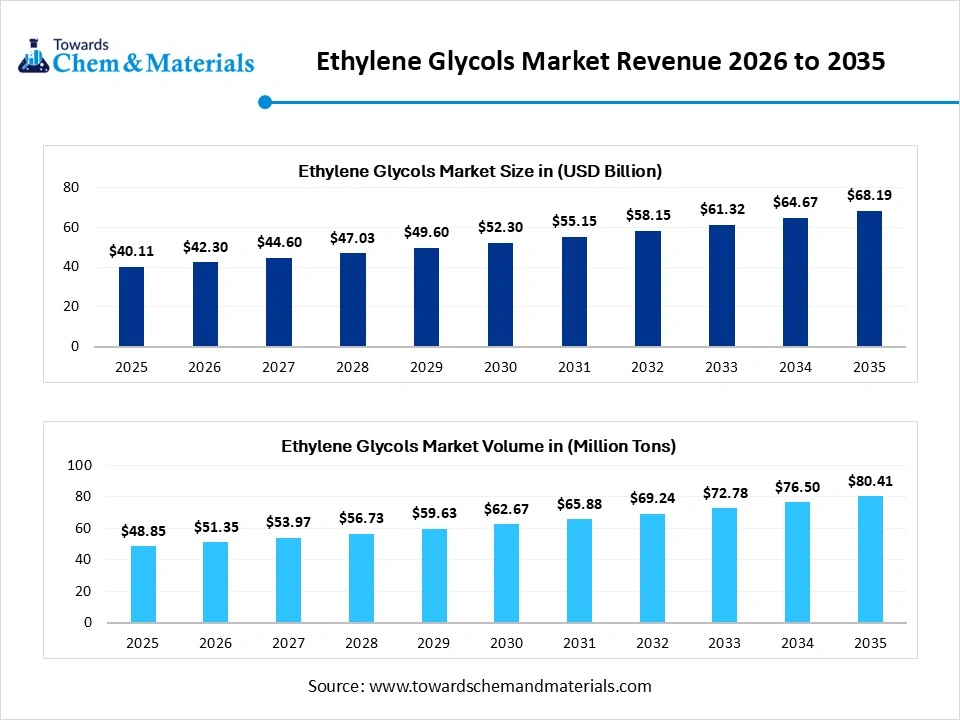
The global ethylene glycol market was valued at USD 40.11 billion in 2025, is estimated to reach USD 42.3 billion in 2026, and is projected to reach USD 68.19 billion by 2035, growing at a CAGR of 5.45% from 2026 to 2035. In terms of volume, the ethylene glycol market is projected to grow from 48.85 million tons in 2025 to 80.41 million tons by 2035. growing at a CAGR of 5.11% from 2026 to 2035.
Key Takeaways
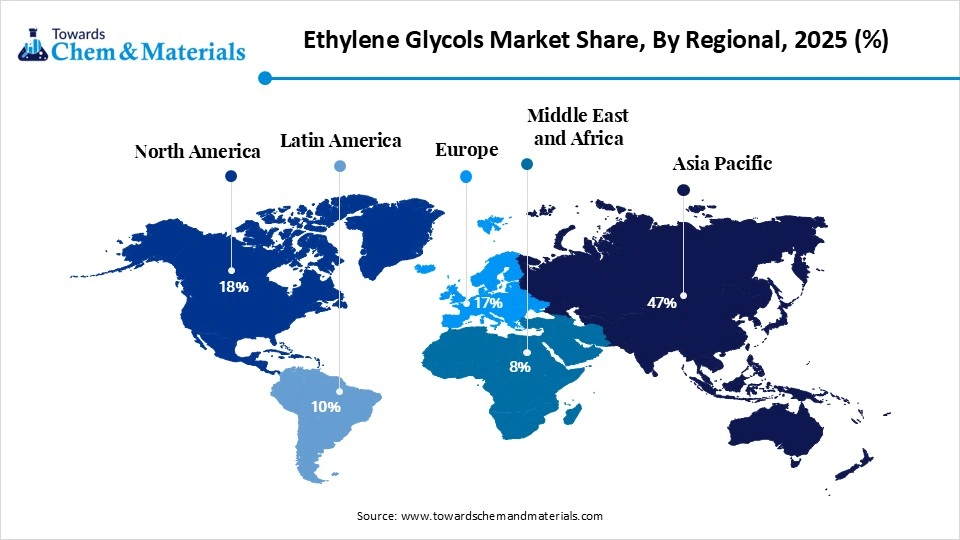
- By region, Asia Pacific dominated the market with a share of 47% in 2025 and is expected to sustain its position while growing with a CAGR of 6.1% in the forecast period.
- By region, North America held the market share of 18% in 2025.
- By product type, the monoethylene glycol (MEG) segment dominated the market with 71% share in 2025 and is expected to have the fastest growth with a CAGR of 5.6 % in the forecast period.
- By application, the polyester fiber segment dominated the market with 36% share in 2025.
- By application, the polyethylene terephthalate (PET) segment held 29% market share in 2025 and is expected to have the fastest growth with a CAGR of 5.8% in the forecast period.
- By end-use industry, the textile industry segment dominated the market with 34% share in 2025.
- By end-use industry, the packaging industry segment held 26% market share in 2025 and is expected to have the fastest growth with a CAGR of 5.9% in the forecast period.
- By production process, the ethylene oxide hydration segment dominated the market with 62% share in 2025.
- By production process, the OMEGA process segment held 28% market share in 2025 and is expected to have the fastest growth with a CAGR of 6.1% in the forecast period.
- By distribution channel, the direct sales (B2B) segment dominated the market with 68% share in 2025.
- By distribution channel, the retail / small-scale supply segment held 8% market share in 2025 and is expected to have the fastest growth with a CAGR of 5.8% in the forecast period.
- By purity level, the high purity (≥99%) segment dominated the market with 57% share in 2025 and is expected to have the fastest growth with a CAGR of 5.7% in the forecast period.
At a glance
- Market Estimated Size (2025): USD 40.11 Billion | CAGR (2026–2035): 5.45%
- Market Projected Size (2035): USD 68.19 Billion
- Market Volume (2025): 48.85 Million Tons | Volume CAGR (2026–2035): 5.11%
- Market Projected Volume (2035): 80.41 Million Tons
- Market Pricing (2025):
- Average Manufacturing Price (2025): USD 630 per ton
- Average Selling Price (2025): USD 790 per ton
- Pricing CAGR (2025–2035): 3.25%
Market Overview
What is the Significance of the Ethylene Glycol Market?
The ethylene glycol market is highly significant due to its critical role as a raw material in manufacturing polyester fibers and polyethylene terephthalate (PET) resins, which are foundational to the global textile and packaging industries. The market is driven by immense demand for plastic bottles, container packaging, and automobile antifreeze/coolant applications. The market remains essential to global manufacturing, with its growth directly tied to the expansion of consumer goods and the automotive sector.
Ethylene Glycol Market Growth Trends:
- Sustainability and Bio-based Trends: Growing environmental regulations are pushing manufacturers toward greener, bio-based ethylene glycol production, with the factor expected to experience high growth rates.
- Production Shifts: The industry is focusing on feedstock diversification and improving efficiency, with a rise in chemical recycling technologies impacting long-term growth forecasts.
- Automotive and EV Coolants: Ethylene glycol's role as a key ingredient in antifreeze and coolants is bolstered by the automotive sector, including specialized coolants for electric vehicle (EV) thermal management.
Key Technological Shifts In The Ethylene Glycol Market:
The ethylene glycol market is undergoing a significant transition toward sustainability, driven by the need to reduce carbon footprints. Key technological shifts focus on advancing coal-to-EG (CTEG) processes for cost competitiveness, adopting energy-efficient catalysts, and increasing circular economy initiatives, such as advanced PET recycling, to meet rising demand from polyester fibers and PET packaging. Technological focus is shifting toward chemical recycling of PET, allowing contaminated or mixed plastics to be broken down back into monomers like MEG for reuse in PET synthesis.
Supply Chain Analysis of Ethylene Glycol Market:
Chemical Production and Processing
Ethylene glycol is produced through oxidation of ethylene to ethylene oxide, followed by hydration, and is further purified for use in antifreeze, polyester fibers, and PET resin production.
- Key players: Dow, SABIC, Reliance Industries, Shell
Quality Testing and Certification
Ethylene glycol must meet standards for purity, toxicity control, and environmental compliance for safe industrial and commercial applications.
- Key players: International Organization for Standardization, ASTM International, U.S. Environmental Protection Agency, European Chemicals Agency
Distribution to Industrial Users
Ethylene glycol is supplied to automotive antifreeze manufacturers, polyester fiber producers, PET packaging companies, chemical processing industries, and heat transfer fluid applications.
- Key players: Dow, SABIC, Reliance Industries.
Ethylene Glycol Regulatory Landscape: Global Regulations
| Country / Region | Regulatory Body | Key Regulations | Focus Areas | Notable Notes |
| United States | Environmental Protection Agency (EPA); Occupational Safety and Health Administration (OSHA); Food and Drug Administration (FDA) | Toxic Substances Control Act (TSCA); Clean Air Act; OSHA Hazard Communication Standard | Chemical safety, emissions control, and worker exposure | Ethylene glycol is regulated due to toxicity risks, especially in industrial handling, antifreeze applications, and emissions control. |
| European Union | European Chemicals Agency (ECHA); European Commission | REACH Regulation; CLP Regulation; Industrial Emissions Directive (IED) | Chemical registration, hazard classification, and environmental compliance | The EU enforces strict labeling, handling, and environmental standards due to health and environmental concerns. |
| China | Ministry of Ecology and Environment (MEE); National Development and Reform Commission (NDRC) | Environmental Protection Law; Chemical Industry Regulations | Emissions control, industrial production compliance | China regulates large-scale glycol production, especially coal-to-glycol processes, with increasing environmental scrutiny. |
| India | Ministry of Environment, Forest and Climate Change (MoEFCC); Central Pollution Control Board (CPCB) | Environment Protection Act; Hazardous Chemicals Rules | Industrial safety, chemical handling, emissions monitoring | India regulates ethylene glycol under hazardous chemical frameworks, focusing on safe storage, transport, and disposal. |
| Japan | Ministry of Economy, Trade and Industry (METI); Ministry of Health, Labour and Welfare (MHLW) | Chemical Substances Control Law (CSCL); Industrial Safety and Health Act | Chemical risk management, occupational safety | Japan imposes strict exposure limits and chemical management regulations due to toxicity concerns. |
| South Korea | Ministry of Environment (MoE); Ministry of Trade, Industry and Energy (MOTIE) | K-REACH; Chemicals Control Act | Chemical registration, environmental safety | South Korea regulates ethylene glycol through comprehensive chemical safety and registration systems. |
Market Dynamics
Drivers
What are the Key Growth Drivers of the Ethylene Glycol Market?
The market is primarily driven by surging demand for polyethylene terephthalate (PET) packaging, rapidly expanding polyester fiber production in the textile industry, and the increasing need for automotive antifreeze and coolants. Rapid urbanization in Asia-Pacific and the shift toward sustainable, bio-based glycol production are also accelerating market growth, with the industry projected to expand significantly.
Restrains
What are the Key Growth Restraints of the Ethylene Glycol Market?
Key growth restraints for the market include intense volatility in raw material (petrochemical) prices, stringent environmental regulations on production, and health hazards associated with handling. Additionally, the shift toward electric vehicles (EVs) may reduce long-term demand for traditional antifreeze, while the high cost of producing bio-based alternatives limits their market penetration.
Opportunities
What are the Key Growth Opportunities of the Ethylene Glycol Market?
The ethylene glycol market, expected to grow from roughly, is primarily driven by surging demand for PET resins in packaging, polyester fibers in textiles, and antifreeze in the automotive sector. Key growth opportunities include the expansion of sustainable bio-based glycol production, specialized coolants for electric vehicle (EV) batteries, and increased PET usage in emerging economies.
Segmental Insights
Product Type Insights
The Monoethylene Glycol (MEG) Segment Dominated The Market
The monoethylene glycol (MEG) segment dominated the market with a 71% share in 2025 and is expected to grow the fastest, with a CAGR of 5.6% over the forecast period, driven by surging demand for polyethylene terephthalate (PET) resins in packaging, polyester fibers in textiles, and its critical role in automotive antifreeze/coolant and emerging electric vehicle (EV) thermal management systems. A shift toward gas-based MEG technology, which offers lower feedstock costs and a lower carbon footprint, is improving profitability and competitiveness.
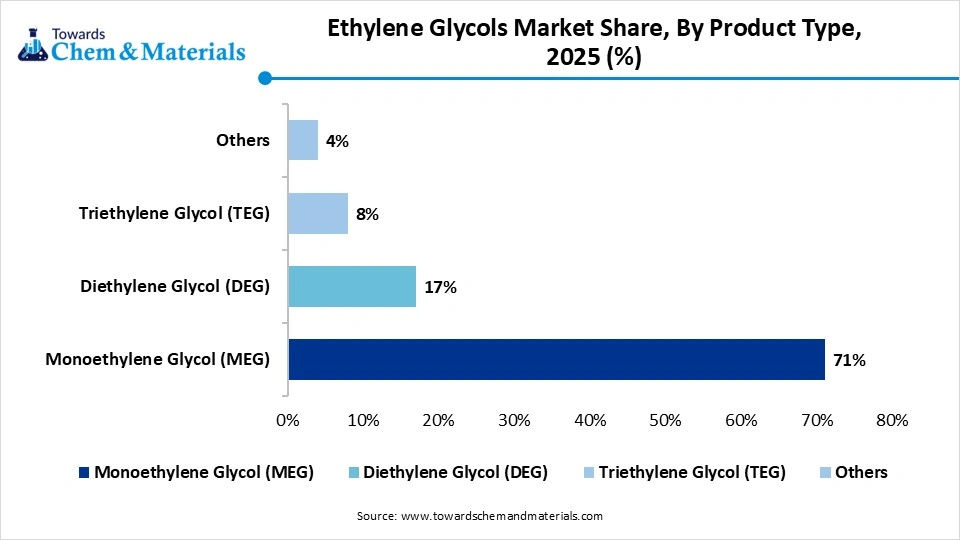
The diethylene glycol (DEG) segment held 17% market share in 2025, driven primarily by its widespread industrial use as a key raw material for unsaturated polyester resins, polyurethanes, and plasticizers. Increasing demand from the construction, automobile, and infrastructure sectors, particularly for lightweight composites and high-performance insulation, is accelerating its market expansion. Growing use of DEG in the production of plasticizers for paper, cork, and synthetic sponges is strengthening its market position.
The triethylene glycol (TEG) segment held 8% market share in 2025, driven primarily by its essential role in natural gas dehydration, increasing demand in plasticizer production, and high-demand applications in the automotive and textile sectors. Its superior low volatility and high boiling point make it the preferred choice for industrial moisture control. Due to its low volatility, high boiling point, and hygroscopic nature, it is widely used as a solvent in pharmaceutical and cosmetic manufacturing.
Application Insights
The Polyester Fiber Segment Dominated The Market With 36% Market Share In 2025
The polyester fiber segment dominated the market with 36% share in 2025, driven by booming demand for textiles, apparel, and industrial fabrics, particularly in the Asia-Pacific. As a primary feedstock for polyethylene terephthalate (PET) fibers, MEG consumption is surging due to the material's cost-effectiveness, durability, and superior performance compared to natural fibers. Polyester fibers are increasingly used in technical textiles, such as safety belts and industrial conveyor belts, widening their market reach beyond clothing.
The polyethylene terephthalate (PET) segment held 29% market share in 2025 and is expected to have the fastest growth with a CAGR of 5.8% in the forecast period, primarily driven by surging demand for sustainable packaging, polyester fibers, and high-performance resins. PET's popularity is driven by its lightweight, durable, and recyclable nature, making it the preferred material for water, carbonated, and ready-to-drink beverage bottles.
Ethylene Glycols Market Share, By Application, 2025 (%)
| By Application | Revenue Share, 2025 (%) |
| Polyester Fiber | 36% |
| Polyethylene Terephthalate (PET) | 29% |
| Antifreeze & Coolants | 14% |
| Chemical Intermediates | 9% |
| Dehydration Agent | 6% |
| Solvents | 4% |
| Others | 2% |
The antifreeze & coolants segment held 14% market share in 2025, driven by soaring automotive production, rising vehicle ownership in emerging economies (Asia-Pacific), and the critical need for thermal management in both traditional and electric vehicles (EVs). Ethylene glycol (EG) acts as the primary, cost-effective, high-performance base fluid for these applications. Increased adoption of electric vehicles boosts demand for EG-based coolants, which are crucial for EV battery thermal management systems.
End-Use Industry Insights
The Textile Industry Segment Dominated The Ethylene Glycol Market With 34% Market Share In 2025
The textile industry segment dominated the market with 34% share in 2025, due to the surging global demand for polyester fibers, which rely heavily on Monoethylene Glycol (MEG) as a primary raw material. Over 47% of global MEG output is utilized for polyester production, encompassing apparel, home textiles, and industrial applications due to its durability, cost-effectiveness, and versatility. The cost-effectiveness of polyester compared to natural fibers keeps demand high in the apparel industry.
Ethylene Glycols Market Share, By End-Use Industry, 2025 (%)
| By End-Use Industry | Revenue Share, 2025 (%) |
| Textile Industry | 34% |
| Packaging Industry | 26% |
| Automotive Industry | 12% |
| Oil & Gas | 9% |
| Chemical Industry | 11% |
| Construction | 5% |
| Others | 3% |
The packaging industry segment held 26% market share in 2025 and is expected to have the fastest growth with a CAGR of 5.9% in the forecast period, primarily through high demand for polyethylene terephthalate (PET) resins. This growth is fueled by rising consumption of packaged beverages, food products, and personal care items, alongside the need for lightweight, durable packaging solutions in emerging economies.
The automotive industry segment held 12% market share in 2025, increasing demand for coolants and antifreeze, propelled by rising vehicle production and the expansion of electric vehicle (EV) technologies. The expansion of the automotive sector in developing nations directly increases the consumption of MEG. Increased manufacturing and sales of passenger/commercial vehicles, especially in Asia-Pacific, boost demand for engine coolants.
Production Process Insights
The Ethylene Oxide Hydration Segment Dominated The Market With 62% Market Share In 2025
The ethylene oxide hydration segment dominated the market with 62% share in 2025, driven by the surging demand for Monoethylene Glycol in polyester fibers and PET resin production. The primary driver is the manufacturing of PET resins for plastic bottles and polyester fibers for textiles, driven by urbanization and rising consumer demand in the Asia-Pacific region. The direct hydration of ethylene oxide is the primary, efficient route for producing monoethylene glycol, driven by the massive scale of the polyester industry.
The OMEGA process segment held 28% market share in 2025 and is expected to have the fastest growth with a CAGR of 6.1% in the forecast period, due to its unmatched efficiency, achieving over 99% selectivity for mono-ethylene glycol while reducing waste and lowering operating costs compared to conventional methods. It is becoming preferred for new, large-scale projects, particularly in Asia, as demand for MEG in PET plastics and polyester grows.
Ethylene Glycols Market Share, By Production Process, 2025 (%)
| By Production Process | Revenue Share, 2025 (%) |
| Ethylene Oxide Hydration | 62% |
| OMEGA Process | 28% |
| Coal-based Production | 10% |
The coal-based production segment held 10% market share in 2025, by offering a cost-effective alternative to traditional oil-based methods, driven by abundant coal reserves and technological advancements in syngas conversion. Strong, growing demand for polyester fibers (PET) and plastics is driving overall ethylene glycol production, providing ample market capacity for coal-based manufacturers to grow, particularly to serve the textiles industry.
Distribution Channel Insights
The Direct Sales (B2B) Segment Dominated The Market With 68% Market Share In 2025
The direct sales (B2B) segment dominated the market with 68% share in 2025, due to the need for secure, high-volume supply chains for large-scale PET and polyester production, bypassing intermediaries to ensure cost-efficiency and consistent quality. Major producers like SABIC, Dow, and ExxonMobil are strengthening direct relationships with manufacturers, particularly in the booming textile and automotive sectors in the Asia-Pacific.
The distributors & traders segment held 24% market share in 2025, due to the need for localized, just-in-time delivery for downstream industries, navigating high spot market volatility, and managing complex logistics in Asia Pacific and the GCC. As major producers, such as SABIC, Dow, and Shell, focus on large-scale production, traders bridge the gap to small-and medium-sized enterprises (SMEs) by offering specialized inventory management and hedging services.
Ethylene Glycols Market Share, By Distribution Channel, 2025 (%)
| By Distribution Channel | Revenue Share, 2025 (%) |
| Direct Sales (B2B) | 68% |
| Distributors & Traders | 24% |
| Retail / Small-scale Supply | 8% |
The retail/small-scale supply segment held 8% market share in 2025 and is expected to have the fastest growth with a CAGR of 5.8% in the forecast period. It is growing through specialized, high-purity, and smaller-volume distribution, driven by the rapid expansion of localized automotive aftermarket services, specialized chemical formulation, and regional, specialized manufacturing. This segment provides essential, flexible sourcing options for specialized applications, such as specialized cooling systems and antifreeze, complementing the bulk-heavy market.
Purity Level Insights
The High Purity (≥99%) Segment Dominated The Market With 70% Market Share In 2025
The high purity (≥99%) segment dominated the market with 57% share in 2025 and is expected to grow the fastest, with a CAGR of 5.7% over the forecast period, due to booming demand for fiber-grade MEG in PET packaging and polyester textiles, alongside stringent purity standards for automotive coolants and industrial cleaning. Manufacturers are focusing on purification improvements to meet stricter standards for electronics and pharmaceutical manufacturing, with high-purity specialized grades experiencing faster growth than lower-grade products.
The medium purity (95–99%) segment held a 29% market share in 2025, driven by its cost-effectiveness in industrial applications, such as antifreeze, coolants, and specific chemical intermediates, that do not require high-purity standards. This growth is propelled by rising demand in the automotive and construction sectors. Improved manufacturing processes in China, such as the coal-based route and specialized DMO techniques, are enabling cost-efficient production of medium-grade glycol, meeting high regional demand.
Ethylene Glycols Market Share, By Purity Level, 2025 (%)
| By Purity Level | Revenue Share, 2025 (%) |
| High Purity (≥99%) | 57% |
| Medium Purity (95–99%) | 29% |
| Low Purity (<95%) | 14% |
The low-purity (<95%) segment held 14% market share in 2025, driven by its cost-efficiency in non-fiber applications like automotive coolants, chemical intermediates, and specialized resins. As high-purity (fiber-grade) demand becomes saturated, this segment benefits from rising industrial demand for resins, coatings, and solvents, alongside rapid growth in automotive fluid consumption. The automotive coolant segment is a major driver, with over 1.5 million tons of MEG used annually for engine coolants and antifreeze, requiring high volumes where ultra-high purity is less critical.
Regional Insights
How did Asia Pacific Dominate the Ethylene Glycol Market in 2025?
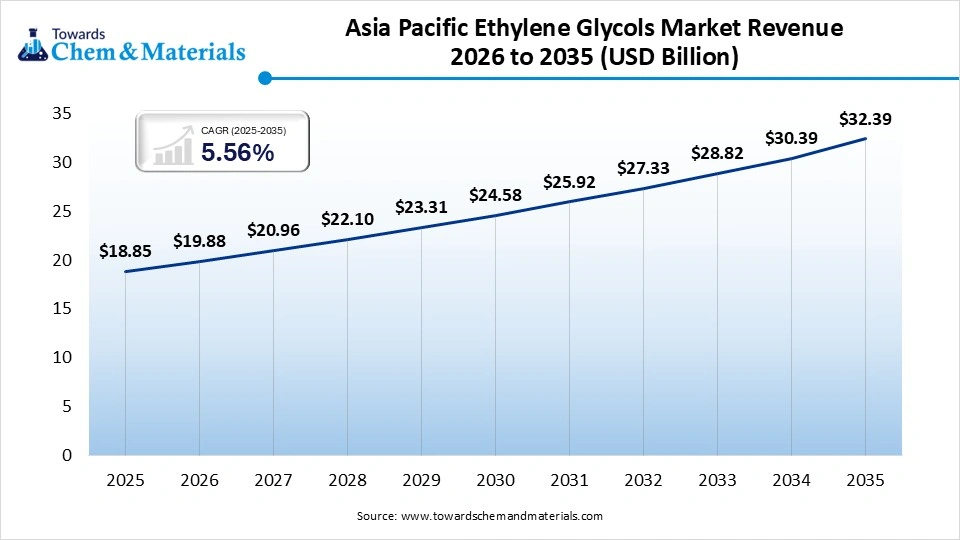
The Asia Pacific ethylene glycol market size was estimated at USD 18.85 billion in 2025 and is projected to reach USD 32.39 billion by 2035, growing at a CAGR of 5.56% from 2026 to 2035, driven primarily by massive polyester/PET production in China and India, alongside rapid automotive and industrial growth. High consumption of textiles, PET packaging, and antifreeze fueled this leadership. High consumption of monoethylene glycol in synthetic fabric production and increasing PET bottle use for beverages drove demand.
India Ethylene Glycol Market Growth Factor
The Indian market is driven by surging demand for polyester fibers in textiles, rapid expansion of the PET packaging sector, and robust growth in automotive, pharmaceutical, and construction industries. Increased domestic production, driven by "Make in India" initiatives, is reducing import reliance. Rising demand for polyester fibers in apparel, home textiles, and industrial applications is accelerating ethylene glycol consumption.
North America Ethylene Glycol Market Growth Factor
North America held the market share of 18% in 2025, which is primarily driven by high demand from the PET resin packaging, automotive antifreeze, and polyester fiber industries. The market is bolstered by the shale gas boom, lowering production costs and a strong shift toward sustainable, bio-based ethylene glycol production. Growing environmental concerns and regulations are accelerating the adoption of bio-based ethylene glycol, supported by partnerships like the one between New Energy Chemicals and Dow.
US Ethylene Glycol Market Growth Factor
The U.S. ethylene glycol market is growing, driven by high demand for polyethylene terephthalate (PET) plastics, polyester fibers, and automotive antifreeze. Increasing demand for durable, affordable synthetic textiles in clothing and home furnishings boosts demand. The U.S. enjoys a competitive advantage due to ample, low-cost ethane, enabling cheaper monoethylene glycol production. Significant use of ethylene glycol in antifreeze, coolants, and brake fluids for the expanding U.S. automotive market.
Recent Developments
- In October 2025, Arteco expanded its Freecor® EV line with new low-conductivity, ethylene glycol-based coolants designed to enhance safety in high-voltage battery electric vehicles. These new, sustainable ECO coolants utilize bio-based or recycled feedstocks to reduce the product carbon footprint while meeting international standards for performance and electrical conductivity.
- In January 2026, BASF opened its Zhanjiang Verbund site in South China, which hosts a large-scale steam cracker with a yearly ethylene capacity of 1 million metric tons. As the company’s third-largest site worldwide, it is the first to supply main compressors entirely with renewable electricity and features newly operational ethylene glycol and oxide facilities.
Ethylene Glycol Market Competitive Landscape Analysis
Tier 1 Companies
| Rank | Company Name | Headquarters | Country | Why Relevant to This Market | Key Products / Material Portfolio |
| 1 | SABIC | Riyadh | Saudi Arabia | One of the world's largest petrochemical producers with major monoethylene glycol (MEG) production capacity | Monoethylene glycol (MEG), diethylene glycol (DEG), triethylene glycol (TEG), ethylene oxide |
| 2 | Dow Inc. | Midland, Michigan | United States | Global leader in ethylene oxide and glycol technologies with extensive production assets | MEG, DEG, TEG, ethylene oxide derivatives |
| 3 | Shell plc | London, England | United Kingdom | Major integrated energy and chemicals company with large glycol manufacturing operations | Ethylene glycol, ethylene oxide, performance chemicals |
| 4 | Reliance Industries Limited | Mumbai, Maharashtra | India | One of the largest integrated polyester and petrochemical producers globally | MEG, polyester intermediates, PET feedstocks |
| 5 | Sinopec Corp. | Beijing | China | Leading Chinese petrochemical producer with significant glycol production capacity | MEG, DEG, TEG, ethylene oxide products |
Tier 2 Companies
| Rank | Company Name | Headquarters | Country | Why Relevant to This Market | Key Products / Material Portfolio |
| 1 | LyondellBasell Industries N.V. | Houston, Texas | United States | Major producer of ethylene oxide and glycol products serving global industrial markets | MEG, DEG, TEG, ethylene oxide |
| 2 | Indorama Ventures Public Company Limited | Bangkok | Thailand | Global polyester leader with substantial glycol consumption and production integration | MEG, PET resins, polyester intermediates |
| 3 | PetroChina Company Limited | Beijing | China | Major integrated petrochemical producer with growing glycol manufacturing operations | Ethylene glycol, petrochemical intermediates |
| 4 | Formosa Plastics Corporation | Kaohsiung | Taiwan | Significant producer supplying polyester and industrial chemical markets | MEG, ethylene oxide, petrochemical derivatives |
| 5 | EQUATE Petrochemical Company | Kuwait City | Kuwait | One of the largest MEG exporters globally with world-scale production facilities | MEG, DEG, TEG, ethylene derivatives |
Tier 3 Companies
| Rank | Company Name | Headquarters | Country | Why Relevant to This Market | Key Products / Material Portfolio |
|---|---|---|---|---|---|
| 1 | India Glycols Limited | Noida, Uttar Pradesh | India | Leading producer of bio-based and conventional glycols serving diverse industrial applications | Ethylene glycol, specialty glycols, industrial chemicals |
| 2 | LOTTE Chemical Corporation | Seoul | South Korea | Important Asian petrochemical producer with glycol manufacturing capabilities | MEG, petrochemical intermediates, polymers |
| 3 | Oriental Union Chemical Corporation (OUCC) | Taipei | Taiwan | Established producer of ethylene oxide and glycol products in Asia-Pacific | MEG, DEG, TEG, ethylene oxide |
| 4 | Nan Ya Plastics Corporation | Taipei | Taiwan | Integrated polyester and petrochemical company with glycol production operations | MEG, polyester raw materials, plastics |
| 5 | PTT Global Chemical Public Company Limited | Bangkok | Thailand | Expanding petrochemical producer serving Southeast Asian polyester markets | Ethylene glycol, olefins, petrochemical intermediates |
Top players in the Ethylene Glycol Market & Their Offerings:
- Exxon Mobil Corporation: ExxonMobil is a major global producer of ethylene glycol (EG), supplying monoethylene glycol (MEG) and other derivatives for polyester, PET resins, and automotive applications. The company benefits from strong upstream integration and large-scale petrochemical operations.
- Dow Inc.: Dow manufactures high-purity ethylene glycol used in packaging, textiles, and industrial applications. The company focuses on advanced process technologies and sustainable production methods.
- SABIC: SABIC produces ethylene glycol as part of its petrochemical portfolio, supplying key raw materials for plastics, fibers, and industrial applications across global markets.
- China Petrochemical Corporation (Sinopec): Sinopec is one of the largest producers of ethylene glycol globally, with strong production capacity serving Asia Pacific’s growing demand for PET and polyester.
- Shell plc: Shell produces ethylene glycol through its chemicals division, focusing on integrated production and supply for packaging, automotive, and industrial sectors.
Ethylene Glycol Market Top Players
- Reliance Industries Limited
- LyondellBasell Industries N.V.
- Huntsman Corporation
- LOTTE Chemical Corporation
- Kuwait Petroleum Corporation
- Mitsubishi Chemical Corporation
- LG Chem
- INEOS
- Indorama Ventures
- EQUATE Petrochemical
Ethylene Glycol Market Segments Covered:
By Product Type
- Monoethylene Glycol (MEG)
- Fiber Grade MEG
- Industrial Grade MEG
- Diethylene Glycol (DEG)
- Polyester Grade DEG
- Solvent Grade DEG
- Triethylene Glycol (TEG
- Natural Gas Dehydration Grade
- Plasticizer Grade
- Others
- Polyethylene Glycol (PEG)
- Ethylene Glycol Ethers
By Application
- Polyester Fiber
- Apparel Fiber
- Industrial Fiber
- Polyethylene Terephthalate (PET)
- Bottles
- Films
- Packaging Materials
- Antifreeze & Coolants
- Automotive Coolants
- Industrial Coolants
- Chemical Intermediates
- Resins
- Plasticizers
- Dehydration Agent
- Natural Gas Processing
- Solvents
- Others
By End-Use Industry
- Textile Industry
- Packaging Industry
- Automotive Industry
- Oil & Gas
- Chemical Industry
- Construction
- Others
By Production Process
- Ethylene Oxide Hydration
- Non-Catalytic Hydration
- Catalytic Hydration
- OMEGA Process
- Coal-based Production
By Distribution Channel
- Direct Sales (B2B)
- Distributors & Traders
- Retail / Small-scale Supply
By Purity Level
- High Purity (≥99%)
- Medium Purity (95–99%)
- Low Purity (<95%)
By Regions
- North America:
- U.S.
- Canada
- Mexico
- Rest of North America
- Latin America:
- Brazil
- Argentina
- Rest of Latin America
- Europe:
- Western Europe
- Germany
- Italy
- France
- Netherlands
- Spain
- Portugal
- Belgium
- Ireland
- UK
- Iceland
- Switzerland
- Poland
- Rest of Western Europe
- Eastern Europe
- Austria
- Russia & Belarus
- Türkiye
- Albania
- Rest of Eastern Europe
- Asia Pacific:
- China
- Taiwan
- India
- Japan
- Australia and New Zealand,
- ASEAN Countries (Singapore, Malaysia)
- South Korea
- Rest of APAC
- MEA:
- GCC Countries
- Saudi Arabia
- United Arab Emirates (UAE)
- Qatar
- Kuwait
- Oman
- Bahrain
- South Africa
- Egypt
- Rest of MEA
- MEA:
FAQ's




Select User License to Buy
Figures (4)






 sales@towardschemandmaterials.com
 Download Sample
 Schedule a Meeting