Content
What is Recycled Thermoplastics Market Size and Share?
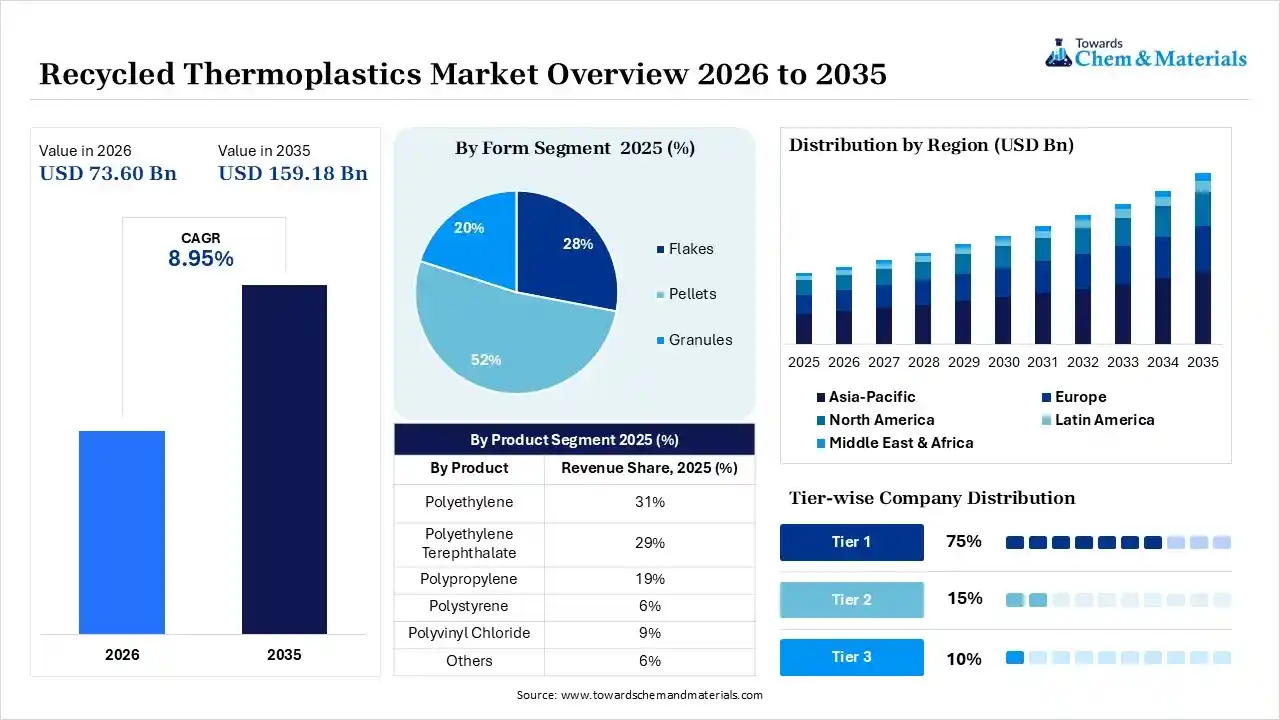
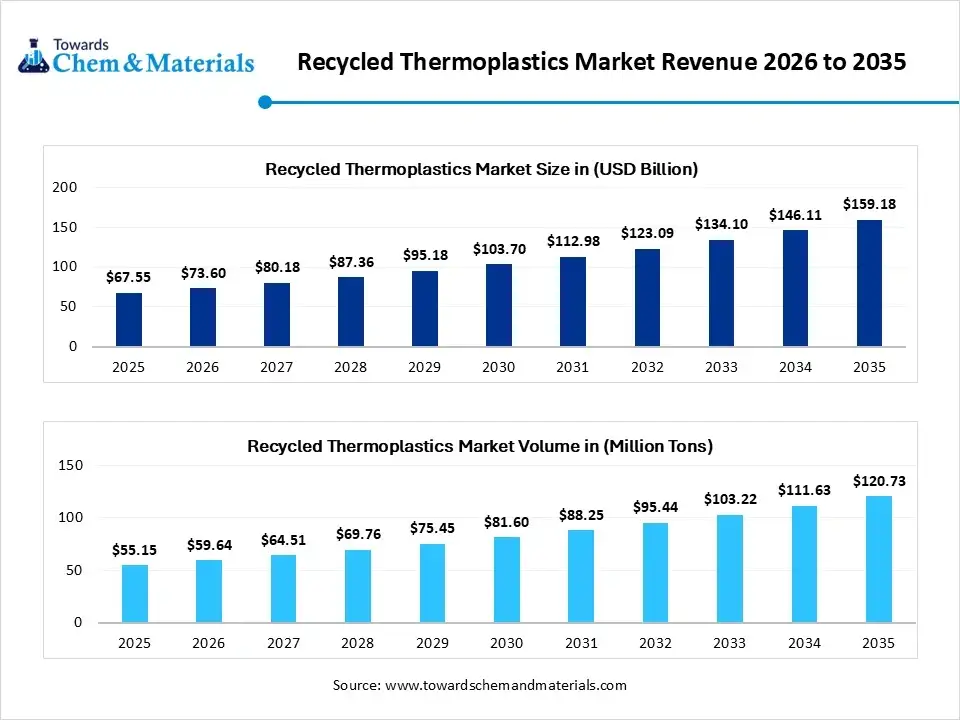
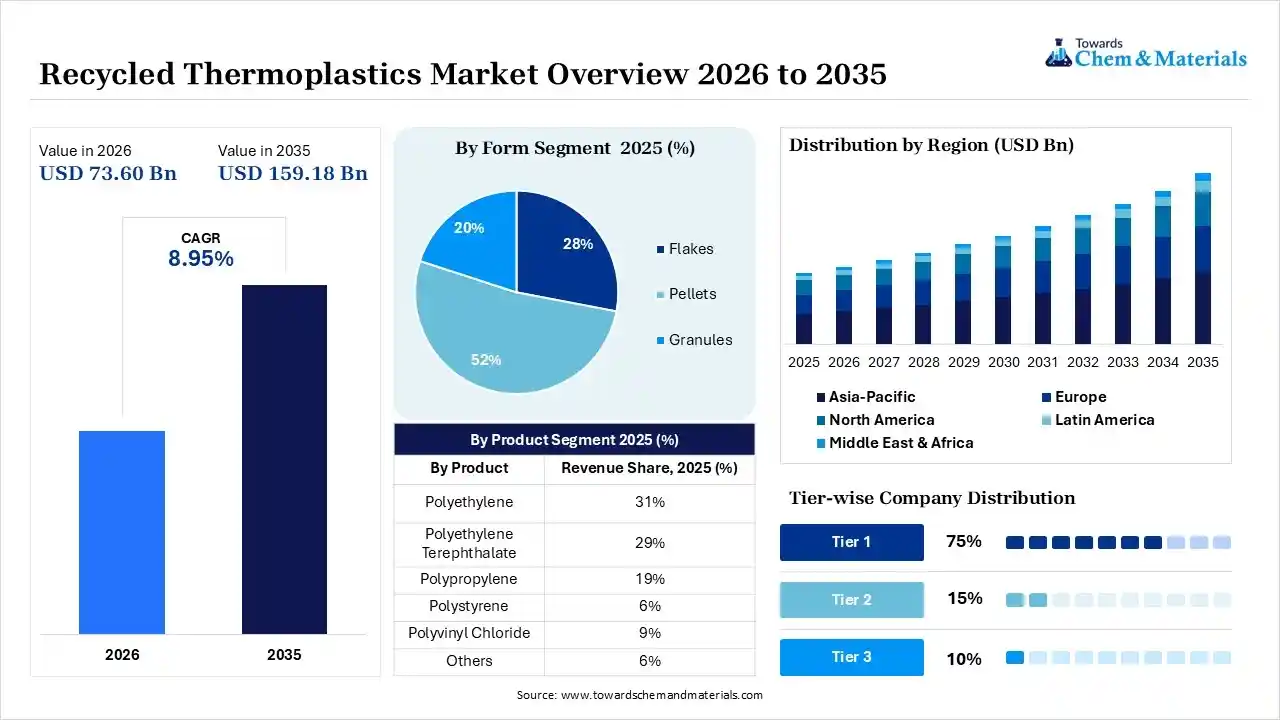
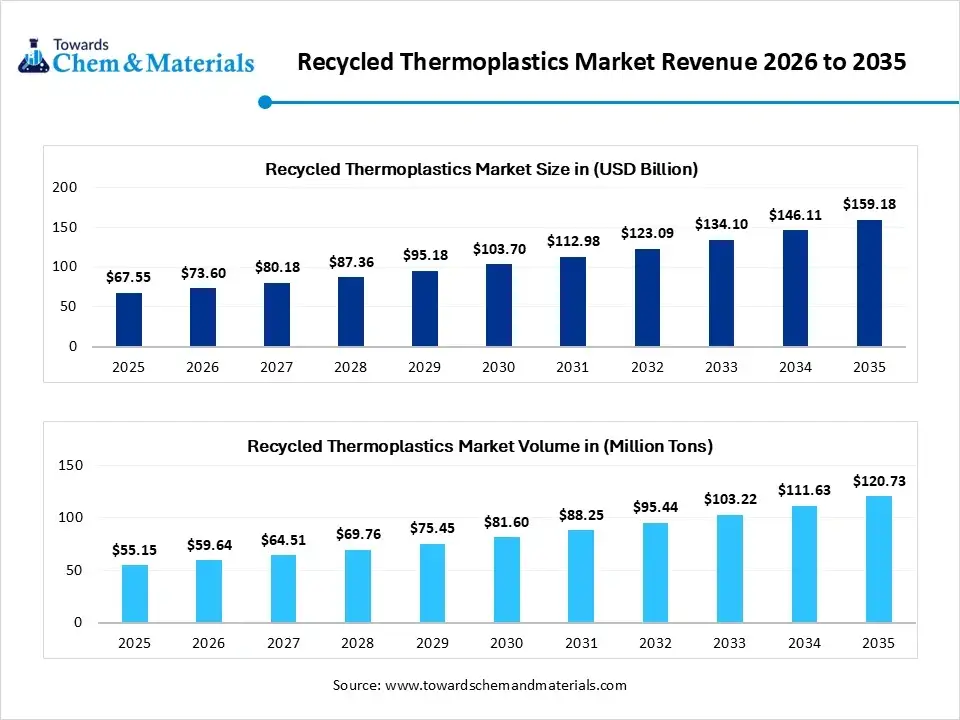
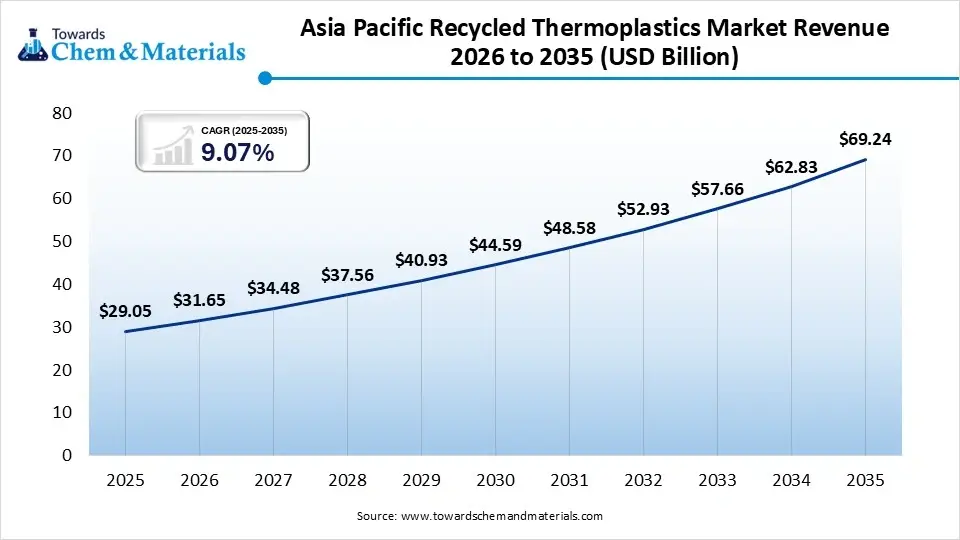
The recycled thermoplastics market size was valued at USD 67.55 billion in 2025, is estimated to reach USD 73.60 billion in 2026, and is projected to reach USD 159.18 billion by 2035, exhibiting a compound annual growth rate (CAGR) of 8.95% over the forecast period from 2026 to 2035.Asia Pacific dominated the recycled thermoplastics market with the largest revenue share of 43% in 2025 and is expected to grow at the fastest CAGR of 9.07% during the forecast period. In terms of volume, the recycled thermoplastics market is projected to grow from 55.15 million tons in 2025 to 120.73 million tons by 2035, growing at a CAGR of 8.15% from 2026 to 2035. The market is growing because of the increased focus on circular economy activities, the growing demand for sustainable materials, and the growing regulatory support for plastic recycling. The sector is growing because of improvements in sorting and recycling technology as well as the growing usage of recycled thermoplastics in consumer products, automotive, construction, packaging, and electrical and electronics applications.
Market Highlights
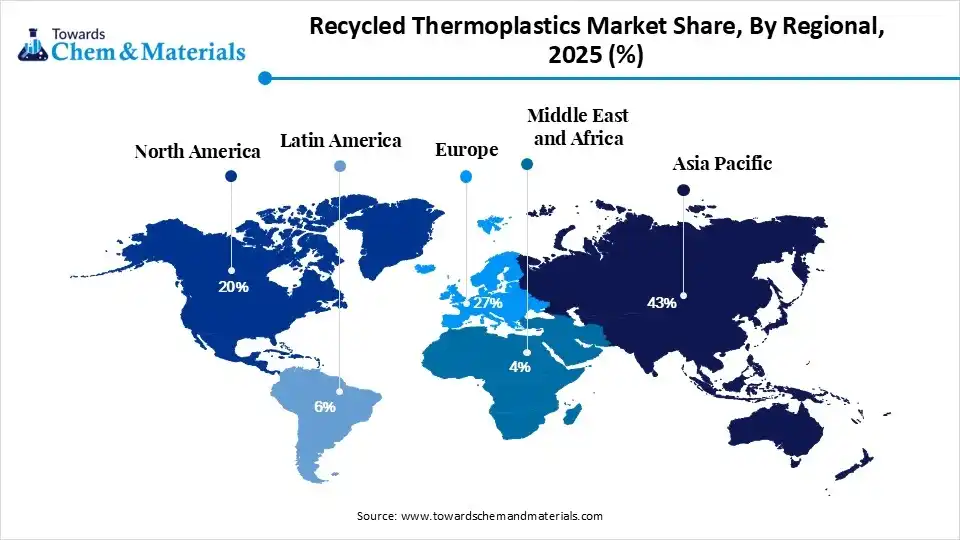
- By region, Asia Pacific dominated the market with a share of 43% in 2025 and is expected to be the fastest-growing region with a CAGR of 10.0% during the forecast period, driven by strong recycling activities and growing industrial demand.
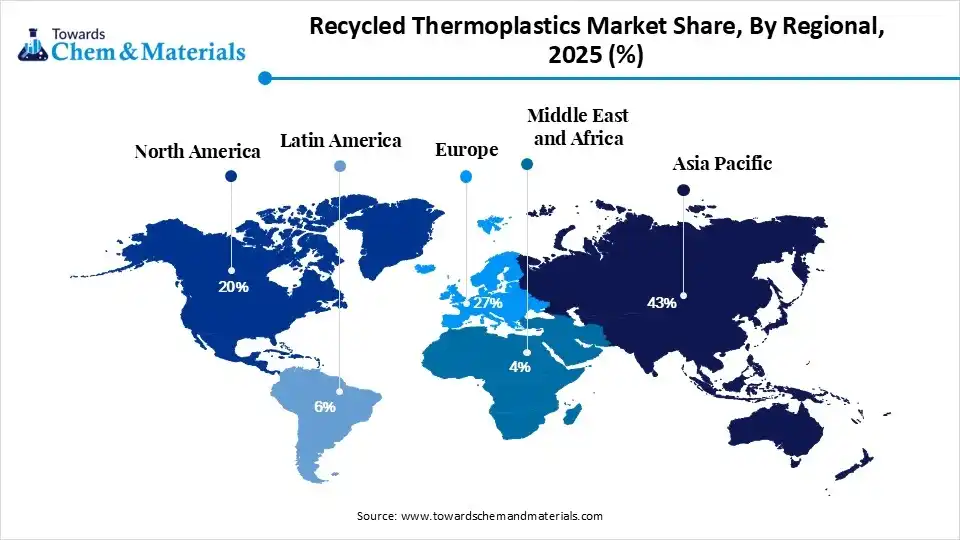
- By region, Europe held a 27% market share in 2025, owing to its stringent recycling regulations and circular economy initiatives.
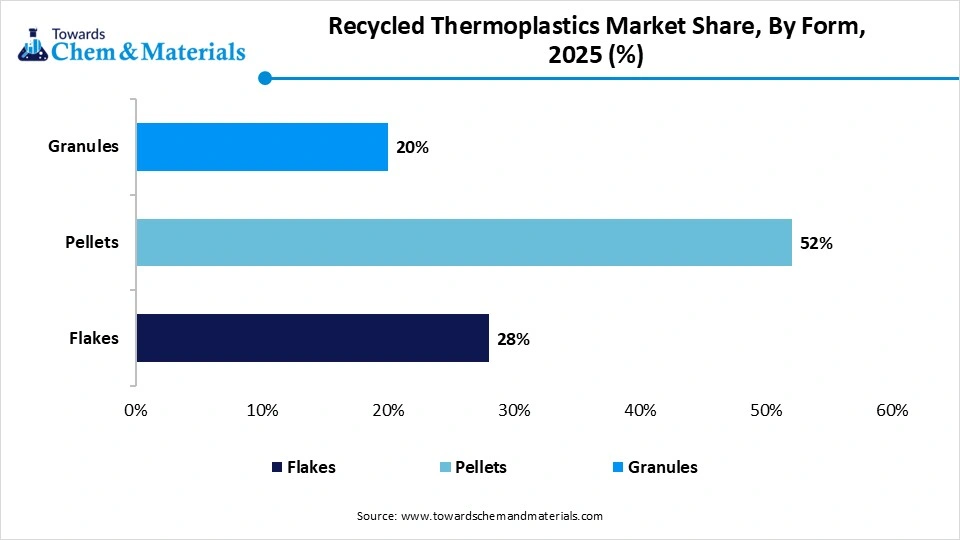
- By form, the pellets segment dominated the market with 52% share in 2025 and expected to be the fastest growing in the market with the CAGR of 9.4% during the forecast period, owing to its wide industrial usage and ease of processing.
- By technology, the extrusion segment dominated the market with 39% share in 2025, as it is the most established and efficient processing method.
- By technology, the injection molding segment held the 31% market share in 2025 and is expected to be the fastest-growing, with a CAGR of 9.2% during the forecast period, owing to rising demand for complex molded plastic components.
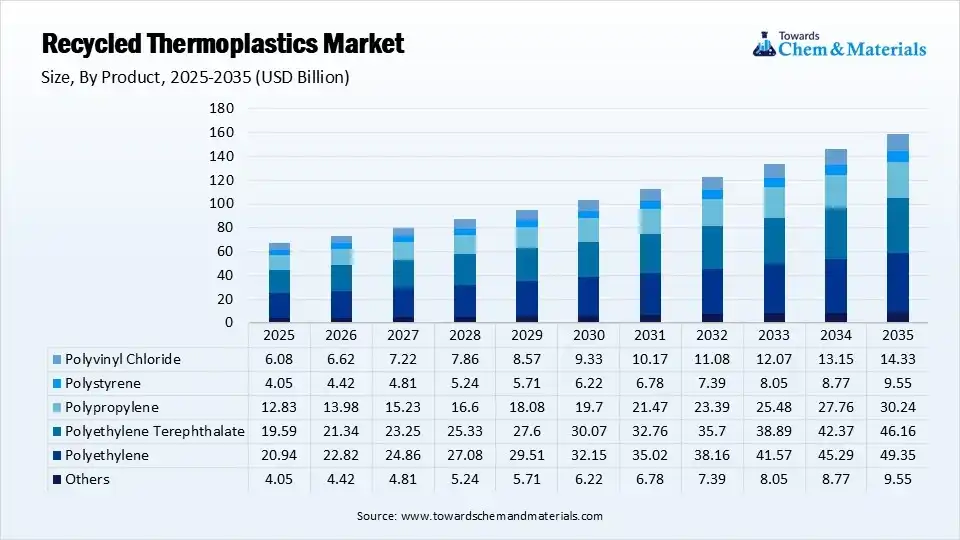
- By product, the polyethylene segment dominated the market with 31% share in 2025, as it represents the most widely recycled plastic material.
- By product, the polyethylene terephthalate segment held the 29% market share in 2025 and is expected to be the fastest-growing, with a CAGR of 10.1% during the forecast period, due to increasing demand for recycled packaging and beverage containers.
- By application, the packaging segment dominated the market with 42% share in 2025, as recycled plastics are extensively used in sustainable packaging solutions.
- By application, the automotive segment held the 15% market share in 2025 and is expected to be the fastest-growing, with a CAGR of 9.80% during the forecast period, owing to increasing use of lightweight and sustainable vehicle components.
Quick Stats at a Glance
- Market in Size 2025: USD 67.55 Billion | CAGR (2026–2035): 8.95%
- Market Estimated Size in 2026: USD 73.60 Billion
- Market Projected Size by 2035: USD 159.18 Billion
- Asia Pacific: largest Regional Market Revenue Share of 43% in 2025 | USD 29.05 Billion
- Europe: Fastest-growing Regional Market Revenue Share of 27% in 2025 | USD 18.24 Billion
- By country: The China held the largest Market share of 51% in 2025
- Market Volume in 2025: 55.15 Million Tons | Volume CAGR (2026–2035): 8.15%
- Market Estimated Volume in 2026: 59.64 Million Tons
- Market Projected Volume by 2035: 120.73 Million Tons
- Market Pricing (2025):
- Average Manufacturing Price: USD 997/Ton
- Average Selling Price: USD 1,290/Ton
- Pricing CAGR (2026–2035): 1.75%
The recycled thermoplastic industry now offers a lot of potential thanks to the growing focus on cutting down on plastic waste, enhancing resource efficiency, and encouraging circular economy activities. Recycled thermoplastics are becoming increasingly popular in the packaging, automotive construction, consumer goods, and electronics industries because they provide environmental advantages such as lower carbon emissions, lower energy usage, and less reliance on the manufacturing of virgin plastics. Additionally, favorable conditions for market expansion are being created by increasing investments in waste management and recycling infrastructure.
To enhance material quality, operational effectiveness, and product consistency, manufacturers are also focusing on implementing sustainable production methods and cutting-edge recycling technology. Due to the growing demand for sustainable materials from makers of consumer products, automobiles, and packaging, the market is expected to expand in the future years. Additionally, companies are being encouraged to include recycled thermoplastics in their product portfolios by growing regulatory pressure surrounding the reduction of plastic waste and requirements for recycled content. Growing corporate sustainability pledges and rising consumer demand for ecologically friendly products also contribute to the industry's long-term success.
For Instance, in July 2025, Veolia announced a £70 million investment to develop the United Kingdom's first closed-loop PET tray recycling facility, designed to convert post-consumer plastic trays into food-grade recycled materials. The facility is expected to become operational in early 2026 and supports the growing demand for high-quality recycled plastics from the packaging industry. This investment reflects the increasing industry's focus on strengthening recycling infrastructure and expanding circular economy capabilities.
- The project is anticipated to improve plastic recovery rates while reducing reliance on virgin plastic materials. Furthermore, the facility is expected to enhance the availability of food-grade recycled polymers and support sustainability goals across the packaging value chain. Such investments are encouraging broader adoption of recycled thermoplastics and creating favorable growth opportunities for market participants worldwide.(Source: www.reuters.com)
Additionally, the increasing demand for high-quality recycled plastics is pushing businesses to invest in advanced recycling technologies, such as chemical recycling, automated sorting systems, and high-efficiency material recovery facilities. A growing focus on sustainability, regulatory compliance, resource efficiency, and circular material flows is expected to create more growth prospects for market participants throughout the course of the projected period. Increasing cooperation between recyclers, packaging firms, and consumer goods producers is also anticipated to boost long-term industry growth and fortify the supply chain for recovered plastics.
Global Investment Flow for Recycled Thermoplastics Market 2026
Investments in plastic recycling infrastructure and advanced material recovery technologies are increasing steadily as demand for sustainable materials expands globally.
Major recycling companies are focusing on capacity expansions, technological upgrades, and process optimization initiatives to strengthen their market positions. Increasing environmental awareness and circular economy initiatives across Asia Pacific, Europe, and North America are encouraging additional investments in recycling facilities and recycled polymer production.
- Governments in several countries are supporting plastic waste reduction and resource efficiency programs, creating favorable opportunities for market participants.
- Companies are increasingly allocating capital toward advanced sorting technologies, chemical recycling processes, and automated material recovery systems to improve operational efficiency and product quality.
- Strategic partnerships between recyclers, packaging manufacturers, consumer goods companies, and automotive producers are also contributing to new investment opportunities throughout the value chain.
- For instance, in recent years, several recycling and waste management companies have announced investments in plastic recycling capacity expansion projects and advanced recycling technologies to improve material recovery rates and meet increasing demand for recycled plastics from packaging, automotive, and consumer goods industries.
- It is anticipated that the continuous development of recycling infrastructure and advanced processing technologies will increase the availability of recycled thermoplastics and bolster supply chain resilience. Additionally, long-term market competitiveness is probably going to be improved by investment activities that prioritize sustainability, circular economy objectives, and resource efficiency.(Source:www.plasticseurope.org)
Market Trends
- The strong demand for sustainable materials and circular economy solutions has presented businesses with high return prospects in recent years. Additionally, due to their advantages for the environment, affordability, and capacity to lessen reliance on virgin plastic materials, recycled thermoplastics are growing in popularity in industries like packaging, automotive, construction, consumer products, and electrical & electronics.
- Today's market players have profitable potential thanks to recycled thermoplastic producers' growing partnerships with consumer goods brands, automakers, packaging manufacturers, and recycling organizations. End-use industries are actively searching for reliable sources of recycled materials through long-term supply agreements and strategic alliances to ensure ongoing production and consistent material quality.
- The increasing use of recycled plastics in eco-friendly packaging, lightweight car parts, building supplies, and household goods is anticipated to create new revenue streams for manufacturers. Long-term global market expansion is also expected to be supported by growing demand for premium recycled thermoplastic grades with better mechanical qualities and higher performance attributes.
Report Scope
| Report Attributes | Details |
| Market Size and Volume in 2026 | USD 73.60 Billion/ 59.64 Million Tons |
| Revenue Forecast in 2035 | USD 159.18 Billion/ 120.73 Million Tons |
| Growth Rate | CAGR 8.95% |
| Base Year of Estimation | 2025 |
| Forecast Period | 2025 - 2035 |
| High Impact Region | Asia Pacific |
| Segment Covered | By Form, By Technology, By Product, By Application, By Region |
| Key Companies Profiled | Veolia, Indorama Ventures, Borealis Group, TOMRA, Republic Services, Suez, KW Plastics, Plastipak Holdings, Custom Polymers, MBA Polymers, Biffa, Envision Plastics, B&B Plastics, Fresh Pak Corporation, Loop Industries, Alpek, Far Eastern New Century, Dow Chemical, LyondellBasell, SABIC |
Advanced Recycling Technologies Expanding Recycled Thermoplastic Potential
The industry is progressively shifting to move advanced recycling methods that enhance product quality, operational performance, and material recovery efficiency.
These developments allow manufacturers to optimize recycling procedures while meeting sustainability and environmental rules. High-quality recycled thermoplastics that are appropriate for a variety of commercial and industrial uses can also be produced thanks to improved recycling methods. This shift is anticipated to enable sustainable industry growth and improve long-term market competitiveness during the predicted period.
Due to improvements in sorting technologies, automated recycling systems, and quality control producers, manufacturers are also lowering material losses and increasing operational reliability. Adopting contemporary recycling technologies puts businesses in a better position to adjust to shifting consumer demands and legal requirements.
- For instance, in October 2025, Borealis Group upgraded its Integra Plastics facility in Bulgaria with its proprietary Borcycle M advanced mechanical recycling technology to produce premium recycled polypropylene (rPP). The upgrade increased production capacity and enabled the manufacture of higher-value recycled polypropylene grades for packaging, consumer goods, and industrial applications.
The development reflects the growing industry focus on improving the quality and performance of recycled thermoplastics to meet increasingly stringent customer requirements. Furthermore, investments in advanced mechanical recycling technologies are enabling manufacturers to expand the use of recycled polymers in high-value applications that traditionally relied on virgin plastics. Such initiatives are expected to strengthen the competitiveness of recycled thermoplastics while supporting circular economy objectives across multiple end-use industries.(Source:www.borealisgroup.com)
Supply Chain Analysis of the Recycled Thermoplastic Market
Collection and Distribution to Recycled Plastic Feedstock
Feedstock management has become an essential part of the value chain as recycling companies supply recycled thermoplastics to manufacturers of consumer goods, electronics, automobiles, packaging, and construction through vast networks of collection and distribution. Reliable feedstock supply and consistent material quality are becoming more and more important as the demand for sustainable materials across industrial applications grows.
To ensure continuous availability of recycled thermoplastic grades suitable for various end-use applications, major recyclers and material suppliers maintain collection centers, processing facilities, regional warehouses, and logistics networks across key markets.
- Veolia: Veolia supplies recycled plastic materials to packaging, automotive, and industrial manufacturers worldwide through its integrated collection, recycling, and distribution network.
- Other Key Players: Republic Services, Waste Management Inc., Remondis, and SUEZ.
Plastic Recycling and Material Processing
Post-consumer and post-industrial plastic trash must be gathered, sorted, cleaned, shredded, processed, and transformed into reusable resin pellets under strictly regulated circumstances to generate recycled thermoplastics.
Cutting-edge recycling technologies assist producers in achieving the mechanical performance, consistency, purity, and material qualities needed for consumer goods, automotive parts, packaging, and building materials.
- TOMRA Systems: TOMRA utilizes advanced sensor-based sorting technologies and automated material recovery systems to improve plastic separation efficiency and enhance the quality of recycled thermoplastic feedstocks.
- Other Key Players: Borealis Group, Indorama Ventures, MBA Polymers, and KW Plastics.
Regulatory Compliance and Sustainability Monitoring
The recycled thermoplastics are utilized in consumer goods, food packaging, automotive applications, and building materials; quality control and regulatory compliance are essential to the collecting processes. To guarantee the performance and safety of their products, manufacturers follow strict quality standards and environmental restrictions.
Regulatory agencies set standards for waste management, product safety, recycled content, environmental preservation, and circular economy projects. Maintaining product quality and regulatory compliance throughout the value chain is aided by routine inspections, certification programs, and compliance audits.
- European Chemicals Agency (ECHA): ECHA establishes regulatory requirements governing the safe use of recycled plastic materials and supports circular economy objectives throughout the European market.
- Other Key Agencies: U.S. Environmental Protection Agency (EPA), European Commission, United Nations Environment Programme, and Organisation for Economic Co-operation and Development.
Recycled Thermoplastics Market: Regulations
| Country/Region | Regulatory Body | Key Regulations/Policies | Focus Area |
| United States | U.S. Environmental Protection Agency | National Recycling Strategy, Resource Conservation and Recovery Act (RCRA) | Recycling infrastructure development, waste management, sustainable materials usage |
| China | Ministry of Ecology and Environment | Plastic Pollution Control Action Plan, Circular Economy Promotion Law | Plastic recycling, waste reduction, resource efficiency |
| India | Central Pollution Control Board | Plastic Waste Management Rules, Extended Producer Responsibility (EPR) Guidelines | Plastic collection, recycling targets, producer responsibility |
| Japan | Ministry of the Environment | Plastic Resource Circulation Act | Plastic resource recovery, recycling promotion, sustainable material management |
| United Kingdom | Department for Environment, Food & Rural Affairs | Plastic Packaging Tax, Resources and Waste Strategy | Recycled content promotion, packaging sustainability, waste reduction |
| Canada | Environment and Climate Change Canada | Zero Plastic Waste Agenda, Canadian Environmental Protection Act | Plastic waste reduction, circular economy, recycling targets |
Recycled Thermoplastics Market
Driver
Rising Demand for Sustainable and Circular Economy Materials Driving Market Growth
The market for recycled thermoplastics is largely driven by the growing focus on sustainability efforts to reduce plastic waste and circular economy initiatives. To lower carbon emissions and increase resource efficiency, governments, producers, and consumers are actively looking for environmentally friendly substitutes for virgin plastics. Furthermore, companies are being encouraged to use recycled thermoplastics in their products by regulations pertaining to recycled content in consumer goods, automotive components, and packaging. Over the course of the forecast period, market expansion is anticipated to be greatly aided by the increasing use of sustainable materials in a variety of end-use industries.
Restraint
Feedstock Quality Variability and Collection Challenges Limiting Market Expansion
The availability of consistent and high-quality plastic waste feedstock remains a significant challenge for the recycled thermoplastic industry. Variations in plastic types, contamination levels, collection systems, and sorting efficiency can negatively affect the quality and performance of recycled materials. Additionally, an inadequate recycling infrastructure in several developing regions and fluctuating waste collection rates create supply chain uncertainties for manufacturers. These factors may limit production efficiency and hinder the widespread adoption of recycled thermoplastics in high-performance applications.
Opportunity
Advanced Recycling Technologies Creating New Growth Prospects
Significant opportunities are being created for market participants by the growing development and uptake of advanced recycling technologies, such as chemical recycling, AI-powered sorting systems, and automated material recovery solutions. These methods improve material quality and recovery rates while processing complicated and challenging to recycle plastic waste streams. Additionally, the manufacturing of high-performance recycled thermoplastics appropriate for packaging, automotive, electronics, and construction applications is being supported by increasing investments in recycling infrastructure and innovation. It is anticipated that the ongoing development of recycling technology will improve long-term market growth and open new revenue streams.
Segmental Insights
Form Insights
The pellets segment dominated the market with a 52% market share in 2025 and is expected to be the fastest growing in the market with a CAGR of 9.4% in the forecast period, driven by its extensive use in the consumer products, construction, automotive, and packaging sectors. For large-scale industrial applications, recycled plastic pellets are the preferred form due to their improved handling, transportation efficiency, and compatibility with a variety of manufacturing processes. Growing investments in cutting-edge pelletizing technologies and rising demand for standardized recycled materials also aided in the segment's expansion. For producers looking for dependable production performance, the category also benefits from its capacity to maintain stable material qualities.
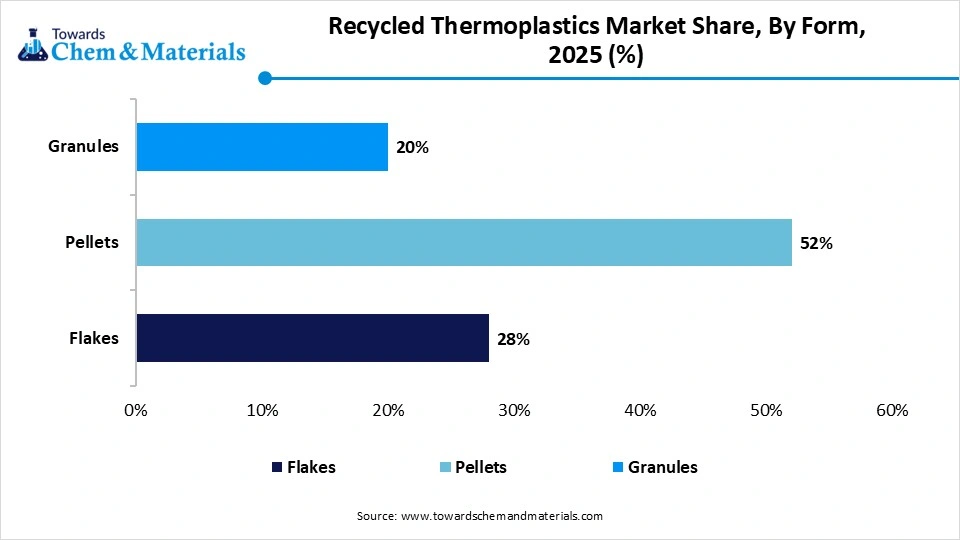 The flakes segment held 28% market share in 2025. Its cost effectiveness and widespread use as a feedstock for manufacturing recycled plastic items are advantageous to the segment. Steady growth is anticipated due to increased recycling efforts and investments in circular economy projects. Furthermore, because flakes are simple to carry and store, they are frequently used in reprocessing facilities. The demand for recycled flakes is expected to be sustained by increasing initiatives to increase plastic trash collection and recycling rates.
Recycled Thermoplastics Market Share,By Form, 2025 (%)
| By Form | Revenue Share, 2025 (%) |
| Flakes | 28% |
| Pellets | 52% |
| Granules | 20% |
Technology Insights
The extrusion segment dominated the market with 39% market share in 2025, motivated by its widespread application in the manufacturing of recycled plastic sheets, films, pipelines, profiles, and packaging materials. The technology is a favored manufacturing technique for recycled thermoplastic applications because of its high processing efficiency, continuous production capabilities, and affordability. Additionally, segment expansion was aided by the rising demand for environmentally friendly building materials and packaging. Extrusion technology is widely used because it can process a variety of recycled polymer grades.
The injection molding segment held the 31% market share in 2025 and is expected to be the fastest growing in the market with a CAGR of 9.2% in the forecast period, driven by the growing use of recycled plastics in consumer goods, industrial uses, electrical equipment, and automobile components. Over the course of the forecast period the segment expansion is anticipated to be further supported by injection molding technology's capacity to produce intricate and highly precise items. Positive growth prospects for the market are also being created by the growing demand for sustainable and lightweight plastic components.
Recycled Thermoplastics Market Share,By Technology, 2025 (%)
| By Technology | Revenue Share, 2025 (%) |
| Extrusion | 39% |
| Injection Molding | 31% |
| Blow Molding | 18% |
| Others (Thermoforming, 3D Printing) | 12% |
Product Insights
The polyethylene segment dominated the market with a 31% market share in 2025, motivated by its widespread use in industrial items, bottles, pipes, containers, and packaging films. The materials' extensive availability through recycling streams, chemical resistance, durability, and flexibility have all greatly contributed to its market supremacy. Additionally, the market is expanding thanks to the growing use of recycled polyethylene in eco-friendly packaging options.
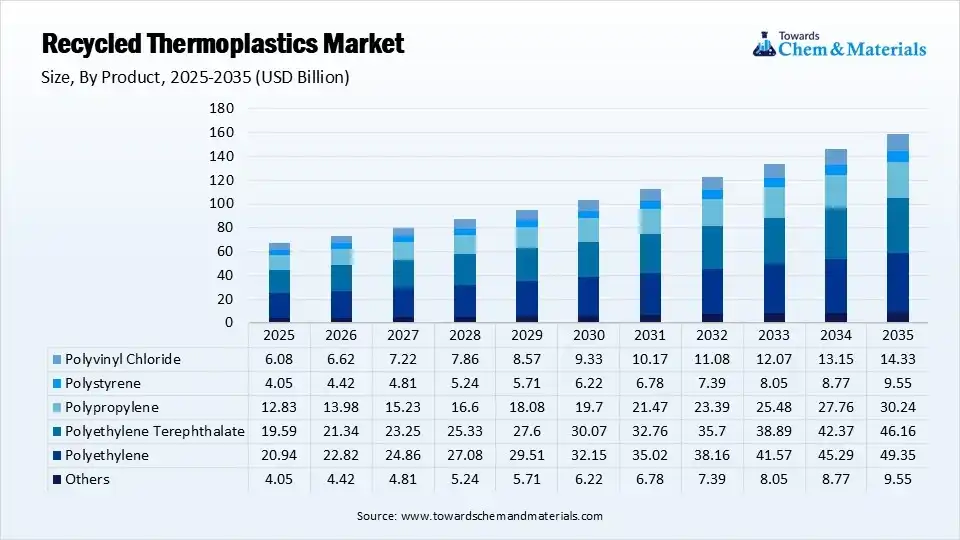 The polyethylene terephthalate segment held the 29% market share in 2025 and is expected to be the fastest growing in the market with a CAGR of 10.1% in the forecast period, motivated by the need for recycled PET in consumer goods, food packaging, textiles, and beverage bottles. Segment expansion is anticipated to be accelerated by growing regulatory requirements for recycled content in packaging and rising investments in PET recycling infrastructure. Global businesses' strong pledges to include more recycled content in their packaging portfolios are also helping the market.
Recycled Thermoplastics Market Share,By Product, 2025 (%)
| By Product | Revenue Share, 2025 (%) |
| Polyethylene | 31% |
| Polyethylene Terephthalate | 29% |
| Polypropylene | 19% |
| Polystyrene | 6% |
| Polyvinyl Chloride | 9% |
| Others | 6% |
Application Insights
The packaging segment dominated the market with 42% market share in 2025, driven by strict environmental rules, expanding promises from international firms to include recycled content in packaging products, and rising demand for sustainable packaging materials. The industry expanded due to the growing use of recycled thermoplastics in flexible packaging options, food containers, bottles, and films. Additionally, manufacturers are being encouraged to use more recycled materials due to consumer preferences for eco-friendly packaging. The packaging industry's need for recycled thermoplastics is anticipated to increase the adoption of recycled content regulations in a number of nations.
The automotive segment held the 15% market share in 2025 and is expected to be the fastest growing in the market with a CAGR of 9.80% in the forecast period, driven by the automotive industry's growth environmental goals and the growing need for lightweight vehicle components and the growing use of recycled plastics under the hood and in exterior and interior applications to lower vehicle weight and enhance environmental efficiency. Automakers are also increasingly using recycled materials. Demand for lightweight, environmentally friendly materials that improve energy efficiency is being increased by the shift to electric vehicles.
Recycled Thermoplastics Market Share,By Application, 2025 (%)
| By Application | Revenue Share, 2025 (%) |
| Packaging | 42% |
| Automotive | 15% |
| Consumer Goods | 14% |
| Medical | 4% |
| Building & Construction | 11% |
| Electrical and Electronics | 9% |
| Others | 5% |
Regional Analysis
How Will Asia Pacific Dominate the Recycled Thermoplastics Market in 2025?
The Asia Pacific recycled thermoplastics market size was estimated at USD 29.05 billion in 2025 and is projected to reach USD 69.24 billion by 2035, growing at a CAGR of 9.07% from 2026 to 2035.Asia Pacific dominates the market with a share of 43% in 2025 and expected to be the fastest growing in the market with the CAGR of 10.0% during the forecast period, due to increased plastic usage, expanding recycling infrastructure, and growing government measures supporting circular economy principles. Due to the availability of substantial amounts of plastic waste, affordable processing capabilities, and growing demand for sustainable materials across the packaging, automotive, construction, and consumer goods industries, the region has become a key hub for the manufacture of recycled thermoplastics.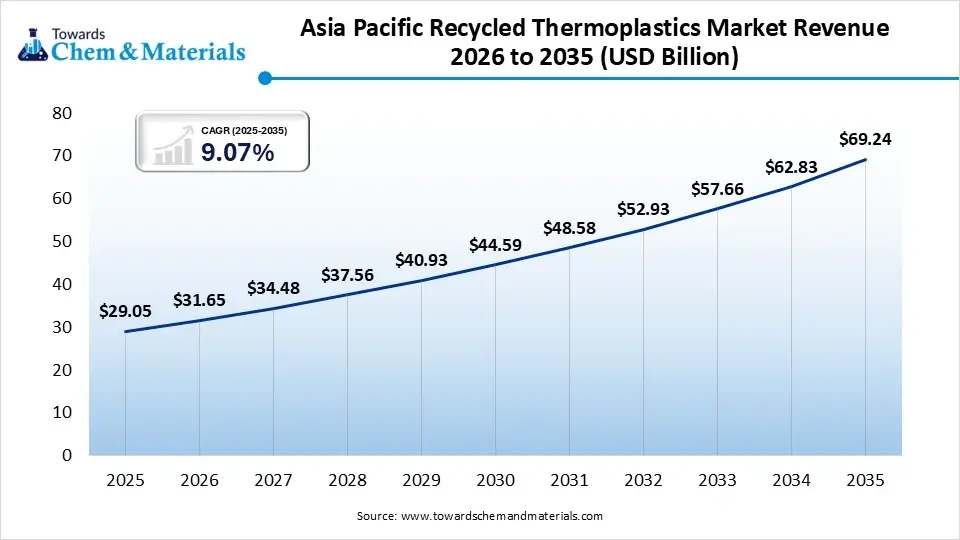
China
- China benefits from a large-scale manufacturing ecosystem, extensive plastic recycling infrastructure, and significant investments in circular economy initiatives that support recycled thermoplastic production.
- The country's expanding packaging, automotive, electronics, and consumer goods industries, combined with stringent regulations on plastic waste management and recycled content utilization, are driving demand for recycled thermoplastic materials.
India
- India is witnessing growing demand for recycled thermoplastics from packaging, construction, automotive, and consumer goods industries due to rapid urbanization, industrialization, and increasing environmental awareness.
- Rising government initiatives supporting plastic waste management, extended producer responsibility (EPR) regulations, and investments in recycling infrastructure are expected to create substantial opportunities for recycled thermoplastic manufacturers in the coming years.
The Europe recycled thermoplastics market size was estimated at USD 18.24 billion in 2025 and is projected to reach USD 43.77 billion by 2035, growing at a CAGR of 9.15% from 2026 to 2035.Europe held the 27% market share in 2025, due to its strict adherence to circular economy ideas, aggressive recycling goals, and strict environmental restrictions. While concentrating on lowering plastic waste and enhancing resource efficiency, the region continues to see rising demand for sustainable materials throughout the consumer goods, automotive, packaging, and construction sectors; market expansion is also being supported by ongoing investments in waste management infrastructure and cutting-edge recycling technologies.
Germany
- Germany's strong automotive, packaging, and industrial manufacturing sectors continue to generate substantial demand for recycled thermoplastic materials.
- The presence of advanced recycling facilities, favorable regulatory frameworks, and increasing investments in sustainable manufacturing technologies support the country's position as a key market within Europe.
France
- France maintains a strong position in sustainable packaging, consumer goods, and circular economy initiatives that extensively utilize recycled thermoplastic materials.
- Growing government support for recycling programs, increasing recycled content requirements, and rising demand for environmentally responsible products are expected to contribute significantly to market expansion.
Recycled Thermoplastics in North America
The North America recycled thermoplastics market size was estimated at USD 13.51 billion in 2025 and is projected to reach USD 32.63 billion by 2035, growing at a CAGR of 9.22% from 2026 to 2035.North America held a 20.00% market share in 2025, due to growing legislative support for circular economy projects, robust recycling infrastructure, and rising acceptance of sustainable materials. The need for recycled plastics in the consumer products, construction, automobile, and packaging sectors is still growing in the area. Additionally, investments in cutting-edge recycling technologies and growing corporate sustainability pledges are driving market expansion.
United States
- The United States benefits from a well-established recycling industry, increasing investments in advanced material recovery facilities, and growing demand for recycled plastics from packaging and consumer goods manufacturers.
- Rising state-level recycled content mandates, corporate sustainability goals, and growing adoption of circular economy practices are supporting the demand for recycled thermoplastic materials throughout the country.
Canada
- Canada is experiencing increasing utilization of recycled thermoplastics due to its focus on plastic waste reduction, sustainable packaging, and circular economy development.
- Government initiatives supporting recycling infrastructure improvements and growing demand for environmentally friendly materials across multiple industries are expected to contribute to market expansion.
Recycled Thermoplastics Market Expansion in Latin America
The Latin America recycled thermoplastics market size was estimated at USD 4.05 billion in 2025 and is projected to reach USD 10.35 billion by 2035, growing at a CAGR of 9.84% from 2026 to 2035.Latin America held the 6.00% market share in 2025, due to increasing environmental awareness, expanding recycling activities, and growing demand for sustainable materials across the packaging and consumer products industries.The region is also benefiting from government initiatives aimed at improving waste management systems and reducing plastic pollution.
Recycled Thermoplastics Market Share, By Regional, 2025 (%)
| Regional | Revenue Share, 2025 (%) |
| Asia-Pacific | 43% |
| Europe | 27% |
| North America | 20% |
| Latin America | 6% |
| Middle East & Africa | 4% |
Brazil
- Brazil represents one of the largest recycling markets in Latin America, supported by its extensive plastic consumption and growing investments in recycling infrastructure.
- Increasing demand for recycled packaging materials, consumer goods, and industrial products is driving the adoption of recycled thermoplastics across the country.
Argentina
- Argentina is witnessing rising interest in recycled plastic materials due to increasing sustainability initiatives and efforts to strengthen domestic recycling capabilities.
- Growing awareness regarding plastic waste management and increasing demand for cost-effective sustainable materials are expected to support market growth in the coming years.
Recycled Thermoplastics Market Development in the Middle East & Africa (MEA)
The Middle East & Africa recycled thermoplastics market size was estimated at USD 2.70 billion in 2025 and is projected to reach USD 7.16 billion by 2035, growing at a CAGR of 10.24% from 2026 to 2035.The Middle East & Africa held the 4.00% market share in 2025, due to increasing sustainability initiatives, waste management investments, and growing focus on circular economy development. Rising demand for sustainable materials from the packaging, construction, and consumer goods sectors is further contributing to market expansion.
Saudi Arabia
- Saudi Arabia is actively investing in waste management, recycling infrastructure, and sustainability initiatives under its long-term economic diversification programs.
- Increasing efforts to reduce landfill waste and promote resource efficiency are expected to support the adoption of recycled thermoplastic materials across various industries.
UAE
- The UAE is witnessing growing demand for recycled plastics due to increasing environmental regulations, sustainability goals, and circular economy initiatives.
- Government support for recycling programs, coupled with rising demand for sustainable packaging and construction materials, is expected to create favorable opportunities for recycled thermoplastic manufacturers in the country.
Recent Developments
- In June 2026, Mondi launched re/loop FlowWrap, a mono-polypropylene (PP) packaging solution for wet wipes containing 35% post-consumer recycled (PCR) content. The recyclable packaging is designed to replace non-recyclable laminates while maintaining high performance and product protection. Internal testing and customer trials demonstrated performance comparable to virgin-plastic alternatives.(Source: mondigroup)
- In June 2026, PureCycle Technologies and StackTeck successfully produced a living-hinge cap using up to 100% PureFive recycled polypropylene resin. The development demonstrated that recycled polypropylene can meet the demanding mechanical performance requirements of caps and closures applications. The caps successfully passed customer-related performance tests, including living-hinge fatigue testing.(Source: recyclingtoday.com)
- In February 2026, PureCycle Technologies and TOPPAN established a partnership to develop sustainable flexible films and thermoformed packaging solutions using recycled polypropylene content. The companies successfully developed a snack bar wrapper containing more than 30% recycled content. The collaboration addresses growing demand for high-quality recycled materials that meet regulatory and sustainability requirements.(Source:purecycle.com)
Competitive Analysis
The main areas of competition in the recycled thermoplastics market include boosting recycling capacity, enhancing material quality, fortifying collection and processing infrastructure, and guaranteeing adherence to sustainability and environmental requirements. Manufacturers are investing in cutting-edge recycling technology, automated sorting systems, and process optimization projects to improve operational efficiency and satisfy the increasing demand from packaging, automotive, construction, consumer goods, and electronics sectors.
- In March 2026, Clariant, Borealis, and SINTEF successfully demonstrated an advanced pyrolysis oil upgrading technology for circular plastics. The project converted plastic waste-derived pyrolysis oil into cracker-grade feedstock suitable for producing high-quality virgin polyolefins. The demonstration validates a closed-loop pathway for transforming plastic waste into valuable raw materials for new plastic production.(Source: clariant.com)
Top Vendors in Recycled Thermoplastics Market & Their Offerings in the Market
| Company | Company Type | Major Headquarters | Geographics Presence | Recycled Thermoplastic Offerings | Key Offering/Strength |
| Veolia | Public Company | Paris, France | Europe, North America, Asia Pacific, Middle East & Africa | Recycled PET, HDPE, LDPE, PP, Plastic Recovery Solutions | Strong collection network, integrated recycling operations, advanced plastic recovery infrastructure |
| Indorama Ventures | Public Company | Bangkok, Thailand | Asia Pacific, Europe, North America, South America | Recycled PET (rPET), Food-Grade Recycled Resins | Global recycling footprint, large-scale PET recycling capacity, circular packaging solutions |
| Borealis Group | Private Company | Vienna, Austria | Europe, Asia Pacific, North America | Recycled Polypropylene (rPP), Recycled Polyethylene (rPE), Borcycle™ Solutions | Advanced mechanical recycling technologies, high-quality recycled polyolefins |
| TOMRA Systems | Public Company | Asker, Norway | Europe, North America, Asia Pacific, Latin America | AI-Based Sorting Systems, Material Recovery Technologies | Advanced sensor-based sorting solutions, improved recycling efficiency |
Other Key Players
- Republic Services
- Suez
- KW Plastics
- Plastipak Holdings
- Custom Polymers
- MBA Polymers
- Biffa
- Envision Plastics
- B&B Plastics
- Fresh Pak Corporation
- Loop Industries
- Alpek
- Far Eastern New Century
- Dow Chemical
- LyondellBasell
- SABIC
Segments Covered
By Form
- Flakes
- Post-Consumer Flakes
- Post-Industrial Flakes
- Pellets
- Injection Grade Pellets
- Extrusion Grade Pellets
- Blow Molding Grade Pellets
- Granules
- Standard Granules
- Customized Compound Granules
By Technology
- Extrusion
- Single-Screw Extrusion
- Twin-Screw Extrusion
- Injection Molding
- Standard Injection Molding
- Precision Injection Molding
- Blow Molding
- Extrusion Blow Molding
- Injection Blow Molding
- Others
- Thermoforming
- Additive Manufacturing (3D Printing)
By Product
- Polyethylene
- HDPE
- LDPE
- LLDPE
- Polyethylene Terephthalate
- Bottle Grade rPET
- Fiber Grade rPET
- Sheet Grade rPET
- Polypropylene
- Homopolymer PP
- Copolymer PP
- Polystyrene
- GPPS
- HIPS
- Polyvinyl Chloride
- Rigid PVC
- Flexible PVC
- Others
- ABS
- Polycarbonate
- Nylon
- Engineering Thermoplastics
By Application
- Packaging
- Food & Beverage Packaging
- Non-Food Packaging
- Industrial Packaging
- Automotive
- Interior Components
- Exterior Components
- Under-the-Hood Components
- Consumer Goods
- Household Products
- Consumer Appliances
- Furniture
- Medical
- Non-Critical Medical Products
- Medical Packaging
- Building & Construction
- Pipes & Fittings
- Flooring
- Insulation Materials
- Electrical and Electronics
- Consumer Electronics
- Electrical Components
- Cable Applications
- Others
- Agriculture
- Textiles
- Industrial Uses
By Region
- North America
- U.S.
- Canada
- Europe
- Germany
- UK
- France
- Italy
- Spain
- Sweden
- Denmark
- Norway
- Asia Pacific
- China
- Japan
- India
- South Korea
- Thailand
- Latin America
- Brazil
- Mexico
- Argentina
- Middle East and Africa (MEA)
- South Africa
- UAE
- Saudi Arabia
- Kuwait
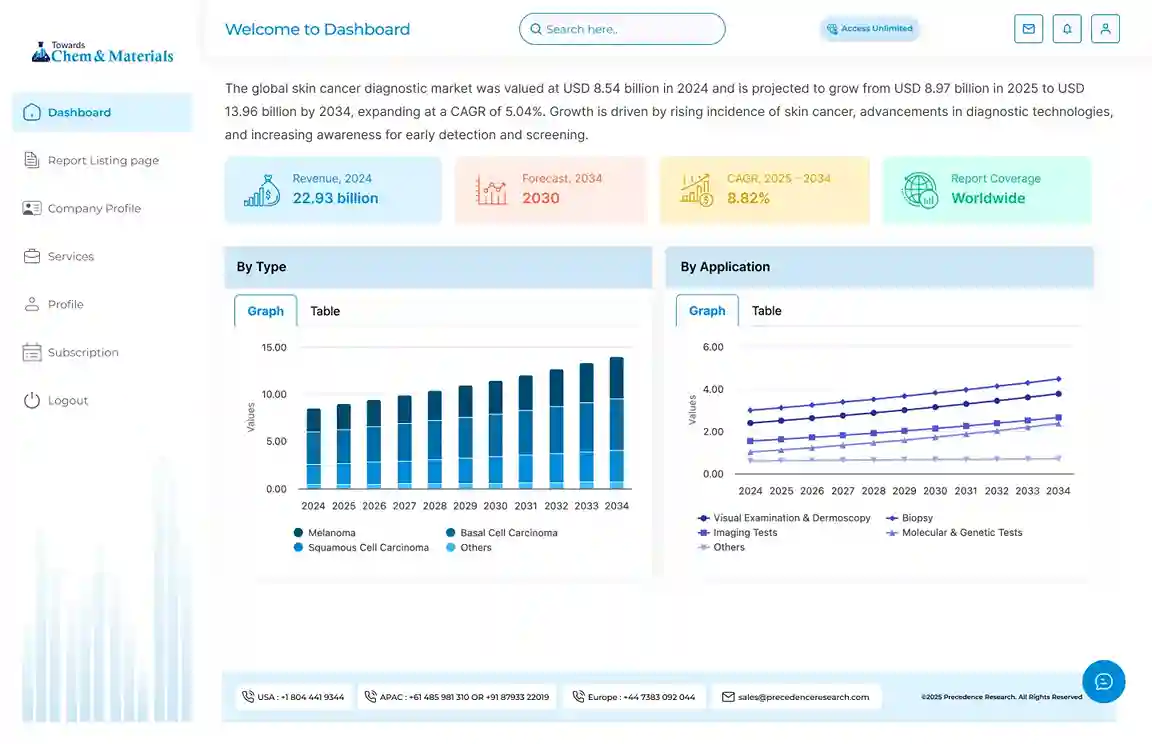
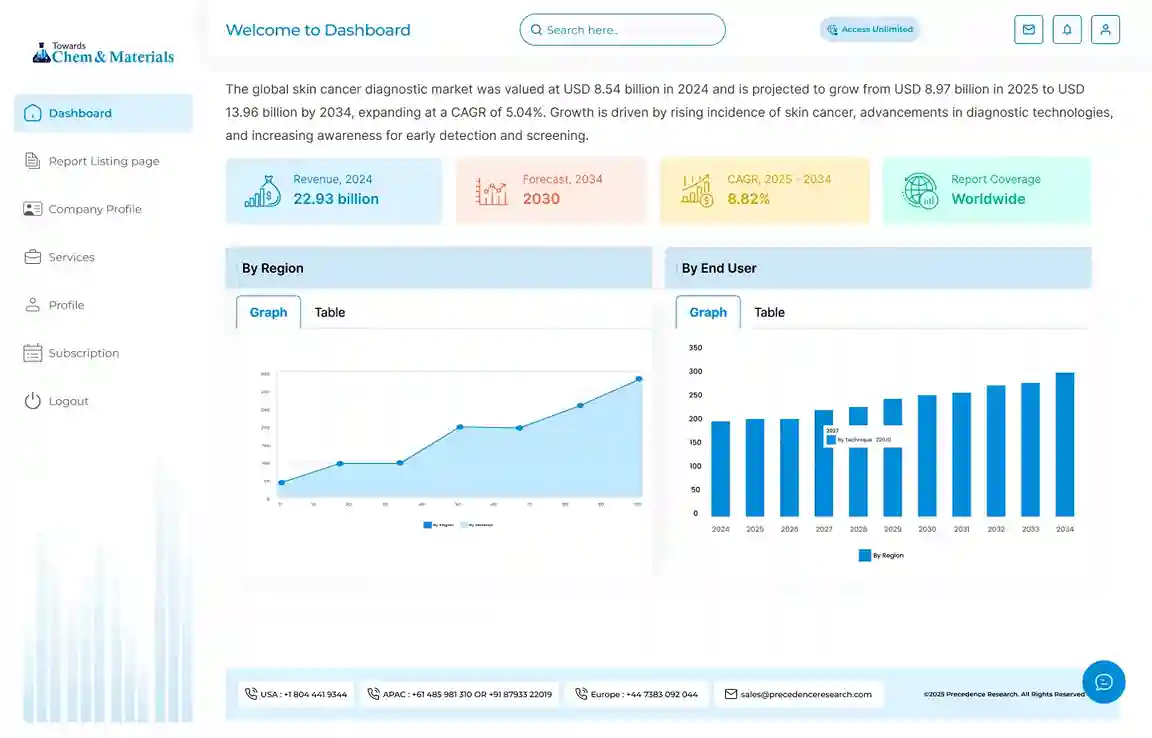
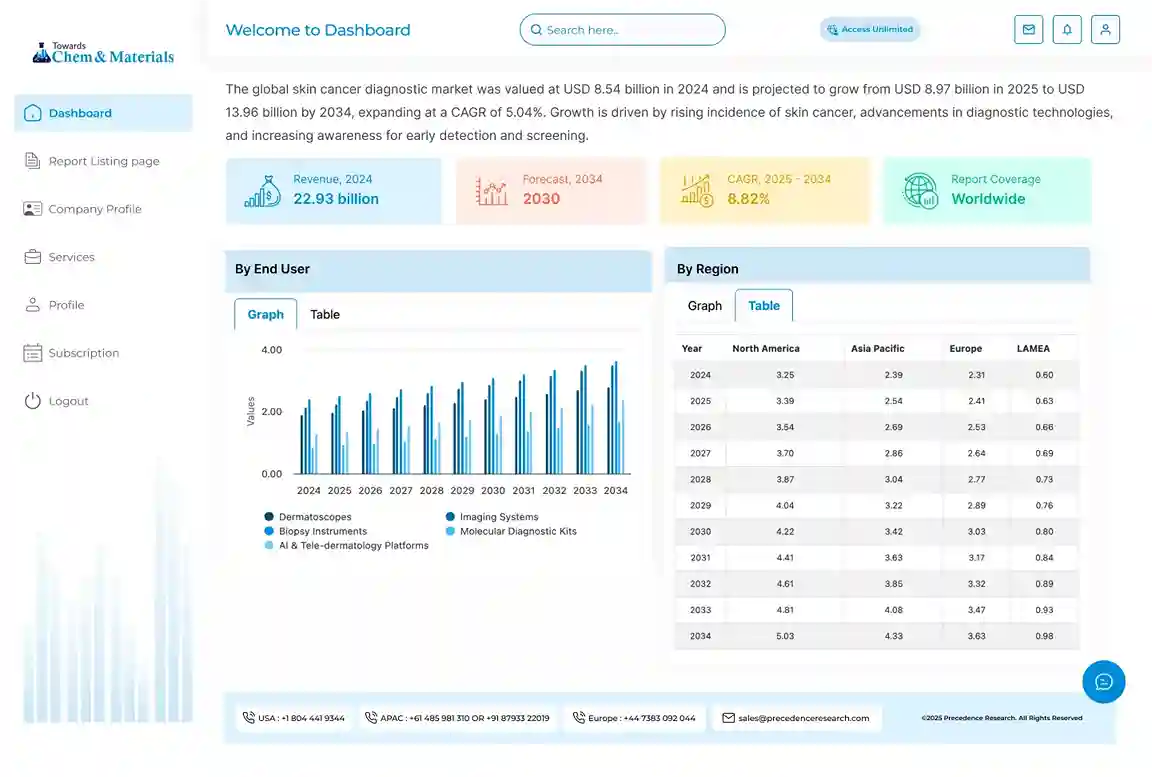
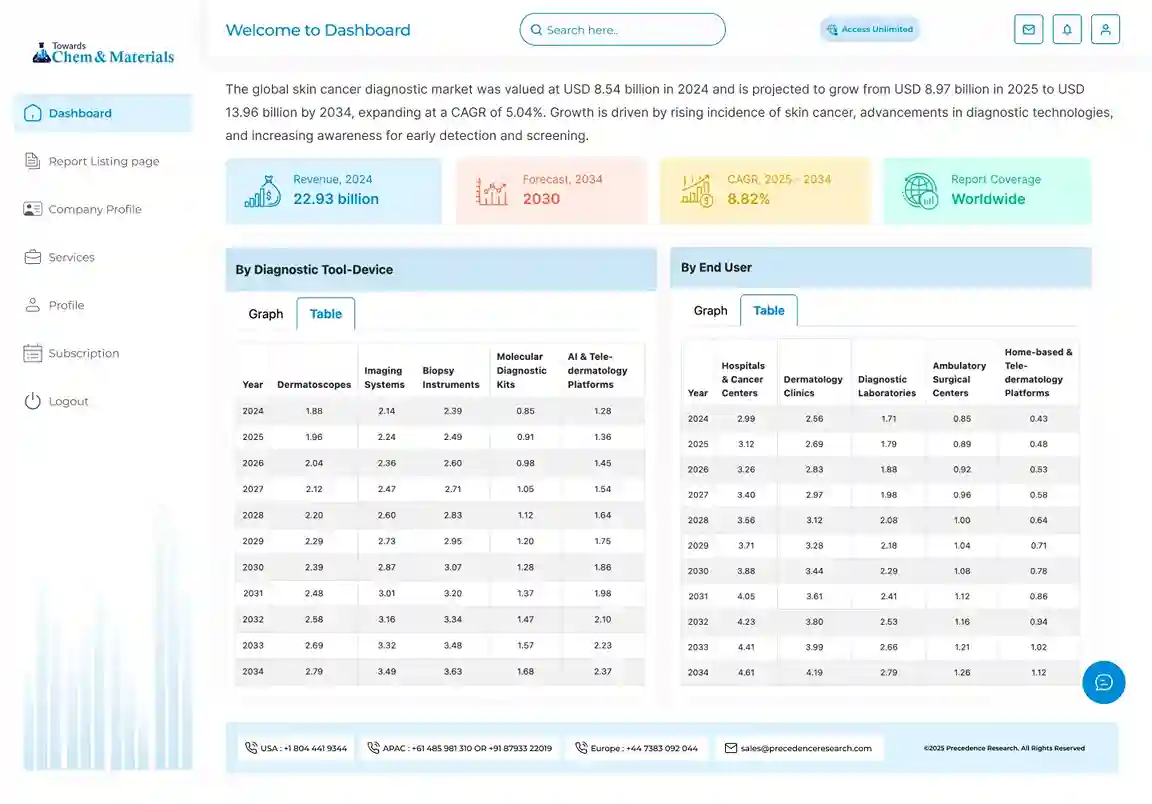
Report Dashboard
Our Chemicals & Materials Research Solutions
- Comprehensive chemicals & materials market analysis
- Competitive landscape intelligence dashboard
- Material innovation & sustainability development tracker
- Market sizing & demand forecasting tools
- Chemicals & materials trend intelligence reports
- Customer application behavior insights
- Customized chemicals & materials research solutions
Chemical Supplier Solutions
- Supplier identification & capability mapping
- Production capacity & geographic footprint analysis
- Quality & performance monitoring
- Compliance & regulatory insights
- Commercial readiness assessment
- Supplier network relationship mapping
Category Intelligence Solutions
- Chemical category overview & segmentation
- End-use demand patterns & application insights
- Raw material pricing & cost structure analysis
- Industry dynamics & competitive structure
- Supply chain & distribution mapping
- Manufacturing benchmarks & industry standards
- Key reports & strategic deliverables
Customer Insights Analytics
- Buyer profile & overview
- Spend analysis & scope
- Procurement strategy & model
- Vendor criteria & expectations
- Contract terms & policies
- Market entry & engagement strategy
- Pain points & buying triggers
- Research outputs & insights
Pricing Intelligence Solutions
- Chemical price benchmarking & comparisons
- Raw material trends & cost insights
- Indexation models & price adjustment analysis
- Total material cost evaluation
- Commercial agreements & contract terms
Brand Intelligence Solutions
- Brand positioning within markets
- Market share & competitive presence
- Customer perception & brand performance
- Go-to-market effectiveness strategy
- Digital presence & industry reputation
- Performance indicators & growth gaps
FAQ's




Select User License to Buy
Figures (7)




 sales@towardschemandmaterials.com
 +1 804-441-9344
 Download Sample
 Schedule a Meeting