
Polyethylene Terephthalate Films Market Size Analysis Report 2035
The global polyethylene terephthalate films market size was estimated at USD 52.86 billion in 2025 and is expected to be worth around USD 110.48 billion by 2035, growing at a CAGR of 7.65% from 2026 to 2035. In terms of volume, the polyethylene terephthalate films market is projected to grow from 14.55 million tons in 2025 to 28.49 million tons by 2035. growing at a CAGR of 6.95% from 2026 to 2035. The expansion driven by the circular economy targets a stringent regulatory framework, advancement in recycling technology and industrial demand.
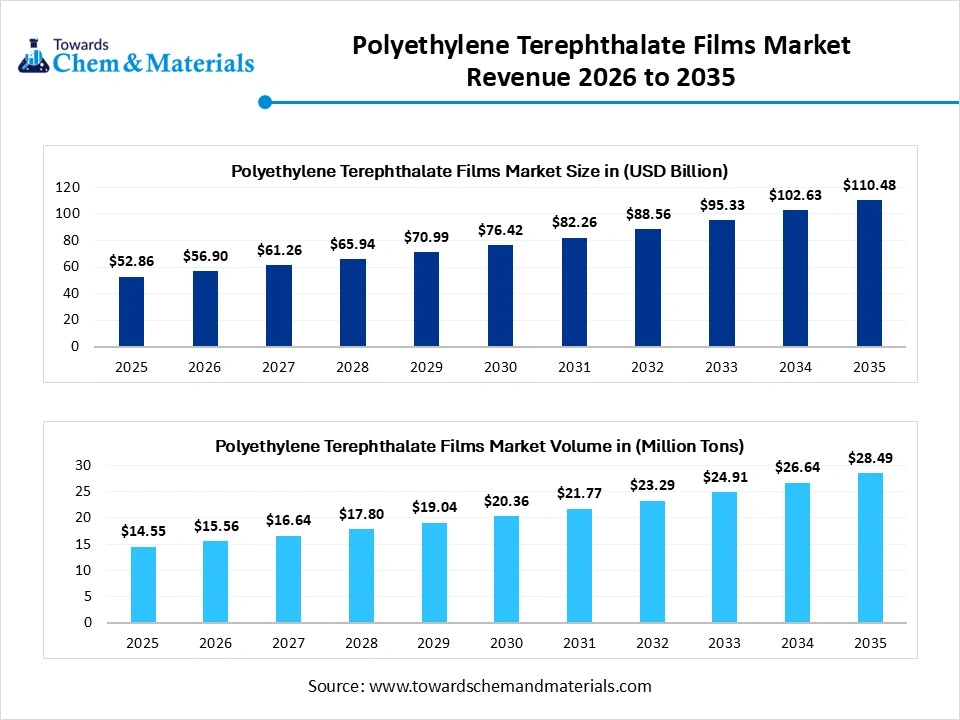
Key Takeaways
- By region, Asia Pacific dominated the polyethylene terephthalate films market by holding 47% share in 2025 and is expected to grow fastest with a CAGR of 7.4% during the forecast period due to its rapid industrialization and lead in manufacturing capacity with strong demand in the packaging industry.
- By region, Europe held the second largest share of 19% in 2025, and is expected to experience notable growth in the market with 6.20% CAGR during the forecast period driven by sustainability regulation and advancement in manufacturing, boosting rPET implementation.
- By type, the BOPET films segment held the largest 68% share in the market in 2025 due to its high tensile strength and demand for durable films in versatile applications.
- By type, the rPET films segment held second largest share of 18% in 2025, and is expects he fastest growth in the market with 7.80% CAGR during the forecast period due to rising adoption of recycled material and manufacturer shift towards eco-friendly packaging to promote circular economy targets.
- By thickness, the thin films (<12 microns) segment dominated the market with 38% share in 2025 is expected to grow fastest with a CAGR of 6.8% during the forecast period, driven by its cost-efficiency and demand for flexible and lightweight packaging.
- By thickness, the medium films (12-50 microns) segment held the second largest share of 34% in 2025 due to its performance stability and flexibility in diversified applications.
- By application, the packaging segment dominated with a held 52% share in the market in 2025 due to consumer demand for flexible packaging and food demand for high-barrier film.
- By application, the electrical & electronics segment held the second largest share of 18% in 2025 and expects the fastest growth in the market with 6.9% CAGR during the forecast period, fueled by insulation demand and dielectric properties to improve performance.
- By end-use industry, the food & beverage segment dominated the market with 44% share in 2025 due to rising demand for packaged food and shelf-life extension.
- By end-use industry, the electrical & electronics segment held the second largest share of 20% in 2025 and expects the fastest growth in the market with 7.10% CAGR during the forecast period, driven by growth in consumer electronics and advancement in high-performance materials that drive insulation film consumption.
- By processing technology, the extrusion segment dominated the market with 46% share in 2025 due to its cost-efficiency and demand in large-scale manufacturing.
- By processing technology, the orientation technology segment held the second largest share of 54% in 2025 and is expected to grow fastest with a CAGR of 7.20% during the forecast period due to demand for biaxial orientation to enhance film strength and technological shift to improve efficiency.
Market Size and Volume Forecast
- Market Estimated Size (2025): USD 2.85 Billion | CAGR (2026–2035): 11.55%
- Market Projected Size (2035): USD 8.50 Billion
- Market Volume (2025): 210.85 Thousand Tons | Volume CAGR (2026–2035): 9.95%
- Market Projected Volume (2035): 544.41 Thousand Tons
- Market Pricing (2025):
- Average Manufacturing Price: USD 4,210 per Ton
- Average Selling Price: USD 5,180 per Ton
- Pricing CAGR (2025–2035): 4.25%
Market Overview
The polyethylene terephthalate films is valued for their tensile strength, optical transparency and chemical stability as a high-performance polymer. The shift towards flexible and lightweight packaging, PET film is crucial for product longevity, as it uses its moisture and gas barriers. The rising adoption of BOPET is necessary for advanced applications like flexible electronics, automotive insulation and solar panels.
The manufacturer focuses on sustainability and innovation in recycled-content films to meet circular economy targets, driving the growth of the market. The PET acts as a raw material precursor, driving the substantial investment for the economic infrastructure, while this material is a key component in the high-tech industrial sector and consumer goods
Polyethylene Terephthalate Films Market Trends
- Focus on Sustainability: The rising consumer base encourages market players to implement recycled-PET content to meet the circular economy and zero waste through advanced recycling, lowering the environmental footprint.
- Development in Emerging Applications: Beyond packaging, the polyethylene terephthalate films are gaining application in other sectors such as automotive, electrical & electronics, textiles, and construction due to their mechanical reliability and sustainability benefits.
- Government Initiatives and collaboration: The strong government supports and substantially invests in advanced recycling technologies for polyethylene terephthalate films. The strategic alliance between manufacturers, recyclers, and consumer brands enables market growth.
Report Scope
| Report Attributes | Details |
| Market Size in 2026 | USD 56.90 Billion |
| Projected Market Size in 2035 | USD 110.48 Billion |
| CAGR (2026 - 2035) | 7.65% |
| Leading Region | Asia Pacific |
| Market Segmentation | By Type, By Thickness, By Application, By End-Use Industry, By Processing Technology and By Regions |
| Top Key Players | Toray Industries, Mitsubishi Chemical Group, Polyplex, UFlex, Jindal Poly Films, Amcor, Berry Global |
Key Technological Shifts and AI in the Polyethylene Terephthalate Films Market
The PET film market is transforming through Industry 4.0 integration, where AI-driven autonomous manufacturing boosts material performance and operational efficiency. The technological shift aligns with molecular modeling accelerate the discovery of novel co-polymers and functional films that offer enhanced barrier properties. The digital twin combines advanced chemical recycling automation by achieving circularity.
The machine learning optimize molecular orientation and thermal stability in real-time with the manufacturing of ultra-thin films with near-zero-gauge deviation. Additionally, an automated optical inspection system ensures quality and precision for flexible electronics and medical-grade applications.
Trade Analysis of the Polyethylene Terephthalate Films Market: Import and Export Statistics
- China exported 24,496 shipments of polyethylene terephthalate films.
- Vietnam exported 21,308 shipments of polyethylene terephthalate films.
- South Korea exported 16,526 shipments of polyethylene terephthalate films.
- From July 2024 to June 2025, the world exported 34,419 shipments of polyethylene terephthalate films.
Supply Chain Analysis of Polyethylene Terephthalate Films Market
Raw Material Synthesis:
The process of extraction of crude oil, natural gas and synthesis of purified terephthalic acid and monoethylene glycol into PET resin pellets and rPET flakes.
- Key Players: Reliance Industries, Indorama Ventures and SABIC
Film Conversion and Processing:
The stage of specialized manufacturer where resin pellets are utilize extrusion technology to melt raw PET into thick base sheets and film through extrusion and biaxial orientation.
- Key Players: Toray Industries, Mitsubishi Chemical Group, Polyplex Corporation, Uflex and Jindal Poly Films
End-Use Integration:
The stage of processed PET is transformed into finished products. The stage involves printing, laminating and cutting them for the end-user industry and then collecting them for recycling.
- Key Players: Amcor, Berry Global and Huhtamaki
Regulatory Framework: Polyethylene Terephthalate Films Market
| Region | Key Regulation | Regulatory Focus |
| Global | IEC and ASTM standards | Focus on industrial specification is crucial for the electrical and thermal performance of PET films. |
| European Union | Packaging and Packaging Waste Regulation | Mandates rPET percentages in food-contact films and recycling for multi-layer laminates. |
| United States | FDA Standards and CFR regulation | Strict thresholds for chemical migration from PET films in food and pharmaceutical BOPET grades. |
| China | GB Standards and New Green Standards | Stringent harmonization and align domestic food- safety standards with international norms for reduced thickness (down-gauging) in logistics films |
| India | PWM Rules and FSSAI Amendments | Banned and permitted for food-grade rPET films to meet strict decontamination and EPR targets supported by closed-loop integration. |
Segmental Insights
Type Insights
BOPET Films Segment Dominated the Polyethylene Terephthalate Films Market with 68% of Market Share in 2025
The BOPET films segment dominated the market with 68% share in 2025 due to its superior thermal stability and tensile strength, represented by its dual-axis stretching process. The transition towards recycled-content BOPET integrated with circular economy targets by balancing dielectric strength and superior protection against moisture and light. The BOPET films are key for flexible electronics and high-speed industrial packaging, ensuring thin-gauge efficiency and durability.
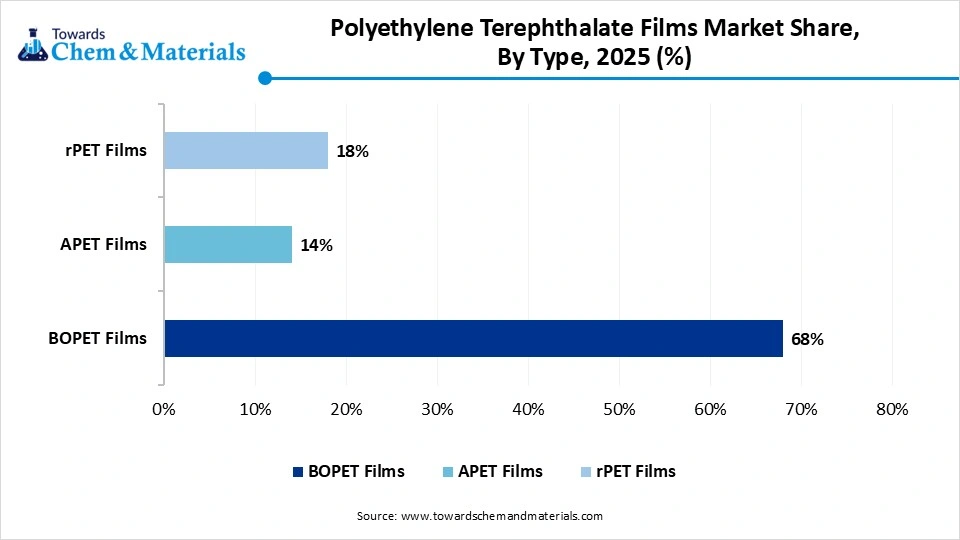
The rPET films segment held the second largest share of 18% in 2025 and is expected to grow at the fastest CAGR of 7.80% during the forecast period. It serves as a sustainability-driven revolution where rPET films engineered by post-industrial and post-consumer waste are utilised in industrial applications. The film offers a lower carbon footprint by balancing tensile strength and barrier efficiency. Additionally, the advancement in decontamination technologies and circular economy mandates are driving the adoption of rPET films.
APET films segment held the third largest share of 14% in 2025, driven by their optical clarity and superior finishing for high-visibility retail packaging and rigid packaging. The APET films are known for their natural BPA-free composition as a multi-layer structure with anti-fog and PE-sealable coating, meeting strict safety and moisture barrier requirements, especially in the medical and fresh-food sectors.
Thickness Insights
Polyethylene Terephthalate Films Market Share, By Thickness, 2025 (%)
| By Thickness | Revenue Share, 2025 (%) |
| Thin Films (<12 Microns) | 38% |
| Medium Films (12–50 Microns) | 34% |
| Thick Films (>50 Microns) | 28% |
Thin films (<12 microns) segment dominated the market with 38% share in 2025 and is expected to grow at the fastest CAGR of 6.8% during the forecast period, due to industrial shift towards rapid miniaturization and resource efficiency by ensuring precision and operational efficiency during manufacturing. The thin films offer lightweight functional barriers, high-strength and tensile integrity in micro-electronics, down-gauging in flexible packaging and energy industries. Overall, the segment is a key pillar of sustainable industrial design.
Medium films (12-50 microns) segment held the second largest share of 34% in 2025, functioning as a standard for electrical insulation, high-speed lamination and flexible packaging. The medium films maintain a balance of puncture resistance, superior moisture barrier and optical precision crucial for consumer and technical sectors. The segment set a standard for utility, dimensional stability and performance for retail and high-tech sectors.
Thick films (>50 microns) segment held the third largest share of 28% in 2025 due to its ability to provide structural heavyweights for weather-resistant backsheets, medical trays, industrial transformers and protective shielding. The thick films are key dielectric insulators and high-performance engineering by ensuring mechanical firmness, dimensional stability and electrical resistance.
Application Insights
Polyethylene Terephthalate Films Market Share, By Application, 2025 (%)
| By Application | Revenue Share, 2025 (%) |
| Packaging | 52% |
| Electrical & Electronics | 18% |
| Industrial | 12% |
| Solar & Energy | 10% |
| Medical | 8% |
Packaging segment dominated the market with 52% share in 2025 due to rising demand for food-based and non-food packaging by offering material efficiency, tensile strength and light protection. The PET films are key for multi-layer laminates and shift toward rPET content to meet the circular economy target by preserving safety and performance. Additionally, the emerging transition towards ultra-thin gauges enables the formation of flexible and rigid packaging.
Electrical & electronics segment held the second largest share of 18% in 2025 and is expected to grow at the fastest CAGR of 6.9% during the forecast period because PET films offer thermal stability, structural integrity and electrical breakdown strength. In flexible printed circuits, automotive electronics and micro-capacitors, it maintains chemical resistance and electrical optimization by setting standards for consumer electronics to industrial power transformers, providing safety performance.
Industrial segment held the third largest share of 12% in 2025, represented by high-performance release liners in adhesive production and weather-resistant backsheets by offering mechanical reliability, dimensional stability and chemical inertness. PET films are key for heavy-duty operations like automotive, aerospace and renewable energy infrastructure by resisting tearing and chemical degradation.
Solar & energy segment held the fourth largest share of 10% in 2025, accelerated by its superior hydrolytic stability and dielectric protection, ensuring that solar cells are a safe and efficient material for photovoltaic modules and weather-resistant backsheet. The modification towards greener energy and fluoropolymer-free formulation, integrating with modern sustainability standards, is driving the market energy transition.
End-Use Industry Insights
Polyethylene Terephthalate Films Market Share, By End-Use Industry, 2025 (%)
| By End-Use Industry | Revenue Share, 2025 (%) |
| Food & Beverage | 44% |
| Electrical & Electronics | 20% |
| Automotive | 10% |
| Healthcare | 12% |
| Industrial Manufacturing | 8% |
| Renewable Energy | 6% |
Food & beverage segment dominated the market with 44% share in 2025, driven by demand for high-performance flexible packaging that offers moisture, freshness and oxygen barriers for food longevity. The manufacturer shifted towards food-safe rPET films and preferred ultra-thin BOPET grades with high-speed processing efficiency in coffee, food and liquid pouches to meet circular economy goals by maintaining consumer safety and hygiene standards.
Electrical & electronics segment held the second largest share of 20% in 2025 and is expected to grow at the fastest CAGR of 7.10% during the forecast period. The PET film is a combination of arc resistance and mechanical resilience for capacitors, circuits and smartphones. The electrical and electronics industry focuses on ultra-thin and heat-alleviated grades that balance security and durability. The rising focus on miniaturization and the shift towards electric vehicles are driving the adoption of PET film in the market
Healthcare segment held the third largest share of 12% in 2025, serving as a sterile barrier that balances life-saving device integrity and critical medication. PET films offer optical transparency, microbial resistance and structural stability, making them indispensable for surgical equipment, diagnostic kits, swelling packaging and additionally in the sterilization process for healthcare storage. The rising research focus on medical-grade rPET and anti-fog coatings makes it standard for patient care and therapies.
Automotive segment held the fourth largest share of 10% in 2025, driven by industry push for vehicle lightweighting and demand for battery management of modern vehicles, where PET films offer chemical resistance, long-term safety and dielectric insulation. The rising focus on flame-retardant accelerate its adoption of high-density automotive hardware.
Processing Technology Insights
Polyethylene Terephthalate Films Market Share, By Processing Technology, 2025 (%)
| By Processing Technology | Revenue Share, 2025 (%) |
| Extrusion | 46% |
| Orientation Technology | 54% |
Extrusion segment dominated the market with 46% share in 2025. The process is characterized into flat film and blown film extrusion, where molten polymer is liquified and melted into continuous and high-quality base sheets by maintaining molecular uniformity, visual purity and surface finish. Advancement focuses on multi-layer co-extrusion by integrating recycled rPET by ensuring consistency, precision in packaging and electronic applications.
Orientation technology segment held the second largest share of 54% in 2025 and is expected to grow at the fastest CAGR of 7.20% during the forecast period, driven by its dual-axis alignment that enhances thermal resistance, tensile strength and optical excellence. It acts as a transformative process that stretches the film and calibrates the stretching ratio and heat-setting temperature for flexible electronic and high-speed packaging. The technology is divided into sequential biaxial orientation and simultaneous biaxial orientation by setting a standard in the market.
Regional Insights
How Did The Asia Pacific Dominated The Polyethylene Terephthalate Films Market?
The Asia Pacific polyethylene terephthalate films market size was estimated at USD 24.84 billion in 2025 and is projected to reach USD 52.48 billion by 2035, growing at a CAGR of 7.77% from 2026 to 2035. The region focuses on innovation and technical film development, which makes it important in BOPET yield. The strong government support and stringent regulatory framework enable advanced circularity with substantial investment in recycled PET facilities and domestic sustainable supply targets.
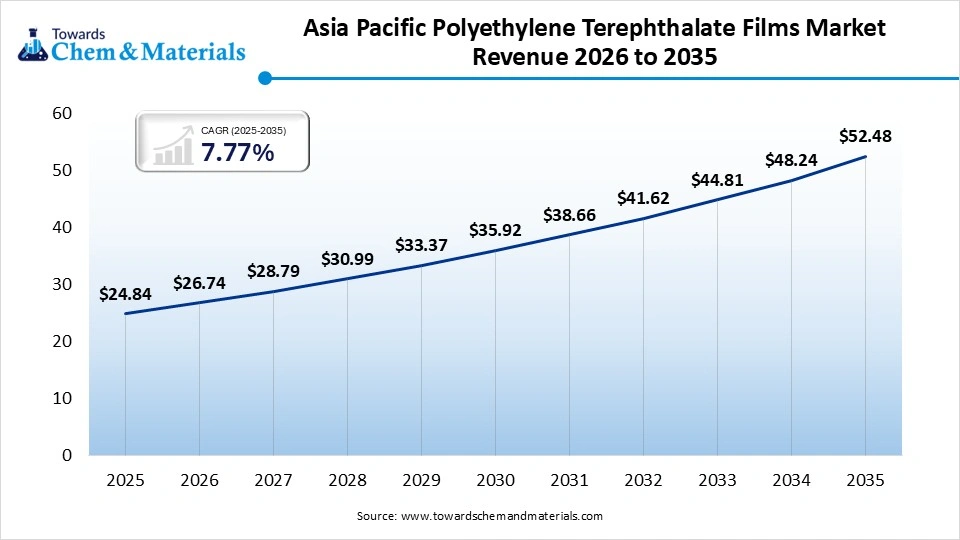
China Polyethylene Terephthalate Films Market Growth Trends
China market is maintaining its dominance, representing a key consumption and manufacturing hub. The regional industry is shifting towards high-value specialty films, aligning with the focus on vertical integration that supplies the automotive and electronics sectors. China is leading in rPET infrastructure with a supportive government to meet environmental compliance.
Europe held the second largest share of 19% in 2025, and is expected to experience notable growth in the market with 6.20% CAGR during the forecast period, accelerated by region sustainability-driven revolution and strict regulatory compliance for PET that focuses on circularity. The region implementing chemically recycled films and high-value technical rPET films is driving domestic expansion. The local manufacturer focuses on premium quality and environmental transparency to meet green packaging and carbon-neutral standards.
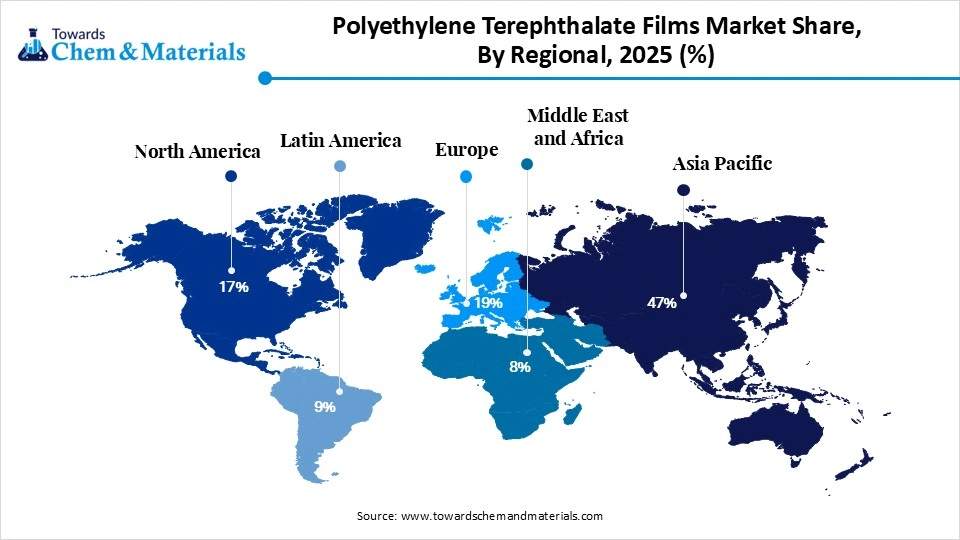
Germany Polyethylene Terephthalate Films Market Growth Trends
Germany market is a key pillar of close-loop system that integrating post-consumer and post-industrial content into high-performance applications. The region focuses on sustainability and resource efficiency, making it a hub for advanced automotive and medical engineering that is driven by stringent German recycling mandates.
Recent Developments
- In February 2026, UFlex Limited introduced F-HSS, a high-seal strength biaxially oriented transparent polyester film at PLASTINDIA 2026. It is a mono-material PET film designed to replace mixed-material laminates for faster recycling and advanced sustainable packaging.
- In January 2025, Polyplex Corporation approved a new BOPET film plant in India with an investment of ₹558 crore (approximately $65 million). The new polyester film facility focuses on enhancing the production capacity by 52,400 MTPA.
Polyethylene Terephthalate (PET) Films Market Competitive Landscape Analysis
Tier 1 Companies
|
Rank
|
Company Name | Headquarters | Country | Why Relevant to This Market | Key Products / Material Portfolio |
| 1 | Toray Industries, Inc. | Tokyo | Japan | Global leader in polyester films with extensive production capacity and advanced specialty film technologies | Lumirror® BOPET films, electrical insulation films, industrial polyester films |
| 2 | Mitsubishi Polyester Film GmbH | Wiesbaden, Hesse | Germany | One of the world's leading producers of high-performance PET films | Hostaphan® PET films, release liners, electrical films |
| 3 | Polyplex Corporation Limited | Noida, Uttar Pradesh | India | Major global producer of PET films with manufacturing facilities across multiple continents | BOPET films, coated films, metallized films |
| 4 | SRF Limited | Gurugram, Haryana | India | Leading global supplier of BOPET films for packaging and industrial applications | BOPET films, metallized PET films, specialty polyester films |
| 5 | Terphane LLC | Bloomfield, New York | United States | Recognized global producer specializing in high-value PET film applications | BOPET films, packaging films, specialty coated films |
Tier 2 Companies
|
Rank
|
Company Name | Headquarters | Country | Why Relevant to This Market | Key Products / Material Portfolio |
| 1 | Jindal Poly Films Limited | New Delhi | India | One of the largest producers of PET and packaging films globally | BOPET films, metallized films, packaging films |
| 2 | UFlex Limited | Noida, Uttar Pradesh | India | Major integrated packaging company with significant PET film production capacity | PET films, specialty packaging films, coated films |
| 3 | DuPont Teijin Films U.S. Limited Partnership | Hopewell, Virginia | United States | Established supplier of specialty PET films for industrial and electrical applications | Mylar® polyester films, industrial PET films |
| 4 | Kolon Industries, Inc. | Seoul | South Korea | Important supplier of high-performance polyester films for electronics and industrial uses | PET films, optical films, industrial films |
| 5 | SKC Co., Ltd. | Suwon, Gyeonggi-do | South Korea | Strong position in specialty PET and functional films for electronics and packaging | PET films, optical films, packaging materials |
Tier 3 Companies
|
Rank
|
Company Name | Headquarters | Country | Why Relevant to This Market | Key Products / Material Portfolio |
| 1 | Cosmo First Limited | New Delhi | India | Growing producer of specialty polyester films and packaging materials | BOPET films, coated films, label films |
| 2 | Futamura Chemical Co., Ltd. | Nagoya, Aichi Prefecture | Japan | Supplier of specialty polyester and sustainable film solutions | PET films, specialty packaging films |
| 3 | Oben Holding Group | Lima | Peru | Expanding global producer of PET and flexible packaging films | BOPET films, packaging films, specialty films |
| 4 | Garware Hi-Tech Films Limited | Mumbai, Maharashtra | India | Specialized producer of polyester films for industrial and automotive applications | PET films, solar control films, specialty polyester films |
| 5 | JBF Industries Limited | Mumbai, Maharashtra | India | Established participant in polyester film production and downstream applications | BOPET films, polyester chips, industrial films |
Top Companies in the Polyethylene Terephthalate Films Market
- Bleher Folientechnik GmbH
- Shenzhen KHJ Technology Co., Ltd
- Jiangsu Yuxing Film Technology Company
- Nuroll SpA.
- Qingdao Kingchuan Packaging
- Mitsubishi Chemical Group
- GLS Group
- Polyplex
- TORAY INDUSTRIES, INC.
- COVINIL S.A.
Polyethylene Terephthalate Films Market Segment Covered in the Report
By Type
- Biaxially Oriented PET
- Plain Film
- Heat Stabilized Film
- Coated Film
- Amorphous PET (APET)
- Recycled PET (rPET) Films
- Post-Consumer Recycled
- Post-Industrial Recycled
By Thickness
- Thin Films (<12 Microns)
- Medium Films (12-50 Microns)
- Thick Films (>50 Microns)
By Application
- Packaging
- Food Packaging
- Flexible Packaging
- Vaccum Packaging
- Non-Food Packaging
- Industrial Packaging
- Consumer Good Packaging
- Electrical & Electronics
- Insulation Films
- Capacitor Films
- Industrial
- Release Liners
- Imaging & Graphics
- Solar & Energy
- Backsheets
- Insulation Films
- Medical
- Pharmaceutical Packaging
- Diagnostic Films
By End-Use Industry
- Food & Beverage
- Electrical & Electronics
- Automotive
- Healthcare
- Industrial Manufacturing
- Renewable Energy
By Processing Technology
- Extrusion
- Flat Film Extrusion
- Blown Film Extrusion
- Orientation Technology
- Sequential Biaxial Orientation
- Simultaneous Biaxial Orientation
By Regions
- North America:
- U.S.
- Canada
- Mexico
- Rest of North America
- Latin America:
- Brazil
- Argentina
- Rest of Latin America
- Europe:
- Western Europe
- Germany
- Italy
- France
- Netherlands
- Spain
- Portugal
- Belgium
- Ireland
- UK
- Iceland
- Switzerland
- Poland
- Rest of Western Europe
- Eastern Europe 
- Austria
- Russia & Belarus
- Türkiye
- Albania
- Rest of Eastern Europe
-  Asia Pacific:
- China
- Taiwan
- India
- Japan
- Australia and New Zealand,
- ASEAN Countries (Singapore, Malaysia)
- South Korea
- Rest of APAC
- MEA:
- GCC Countries
- Saudi Arabia
- United Arab Emirates (UAE)
- Qatar
- Kuwait
- Oman
- Bahrain
- South Africa
- Egypt
- Rest of MEA
- GCC Countries
A Seven-Phase Framework
Our methodology is designed to be universally applicable across commodity chemicals, specialty chemicals, petrochemicals, construction chemicals, coatings, electronic chemicals, industrial gases, agrochemicals, water treatment chemicals, and performance materials. Each phase builds upon the last, creating a layered validation structure that minimizes estimation error and maximizes analytical confidence.
The framework ensures comprehensive market coverage, robust cross-validation, and reliable long-term forecasting — producing market estimates that withstand scrutiny from investors, regulators, and corporate strategy teams.

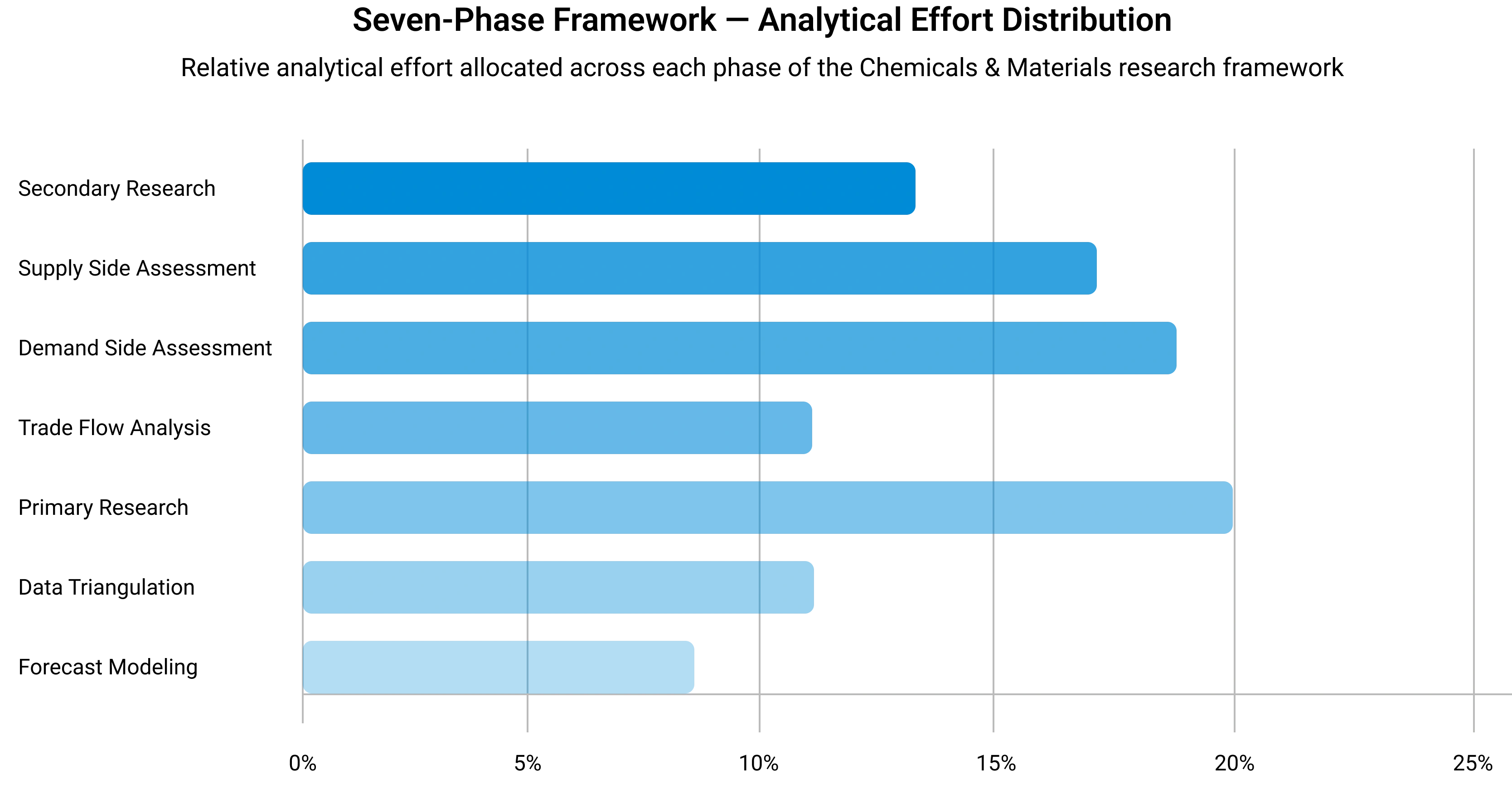
Seven-Phase Framework — Analytical Effort Distribution
Relative analytical effort allocated across each phase of the Chemicals & Materials research framework
Phase 1 - Secondary Research: Establishing the Foundation
Secondary research collects and evaluates publicly available information from authoritative sources, establishing the foundational understanding of market structure, value chain dynamics, competitive landscape, and end-use demand patterns. Every source is evaluated for credibility, recency, geographic relevance, and methodological soundness before inclusion.
Industry Associations
Sources include ACC, CEFIC, ICCA, JCIA, CPCIF, and SOCMA providing production volumes, consumption trends, capacity developments, and sustainability initiatives.
Company Disclosures
Annual reports, investor presentations, earnings transcripts, and regulatory filings reveal product portfolios, manufacturing footprints, capacity expansions, and revenue segmentation.
Government Databases
National statistical offices, customs authorities, environmental agencies, and industrial production databases provide verified statistics on output, trade flows, and regulatory compliance.
Trade Databases
UN Comtrade, ITC, Eurostat, and national customs authorities enable assessment of global product movement, import dependency, and export competitiveness across regions.
Our Secondary Research Sources
- Ministry of Chemicals and Fertilizers
- European Chemicals Agency
- United States Department of Energy
- Ministry of Industry and Information Technology
- Ministry of Economy Trade and Industry
- Ministry of Trade Industry and Energy
- National Institute of Standards and Technology
- Council of Scientific and Industrial Research
- Fraunhofer Society
- National Institute for Materials Science
Phase 2 — Supply-Side Assessment: Mapping Production Capabilities
Production Capacity Analysis
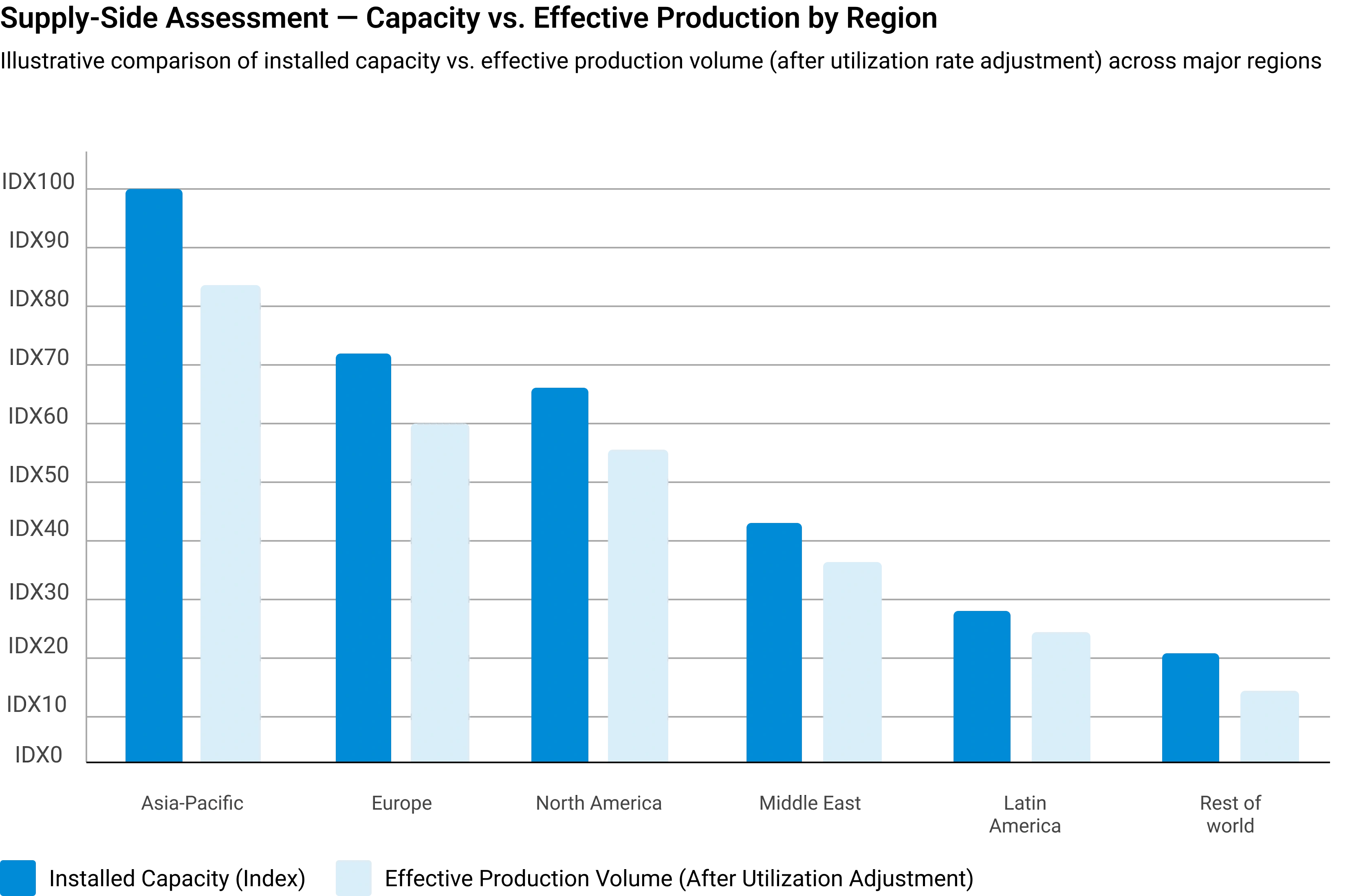
All major manufacturers are assessed for existing installed capacity, planned additions, expansions, new plant announcements, and technology adoption — mapped at global, regional, and country levels.
Capacity Utilization Adjustment
Installed capacity is adjusted using utilization rates based on demand conditions, feedstock availability, plant operating rates, maintenance schedules, and regulatory restrictions.
Manufacturer Revenue Analysis
Product-specific revenues, segment-level performance, regional distribution, average selling prices, and margin trends are evaluated to establish market value estimates.
Supply-Side Assessment — Capacity vs. Effective Production by Region
Illustrative comparison of installed capacity vs. effective production volume (after utilization rate adjustment) across major regions
Phase 3 — Demand-Side Assessment: Quantifying Chemical Consumption
Demand-side analysis quantifies chemical consumption across industries, applications, and geographies — identifying where and how chemicals are consumed throughout the value chain with precision.
End-Use Industry Analysis
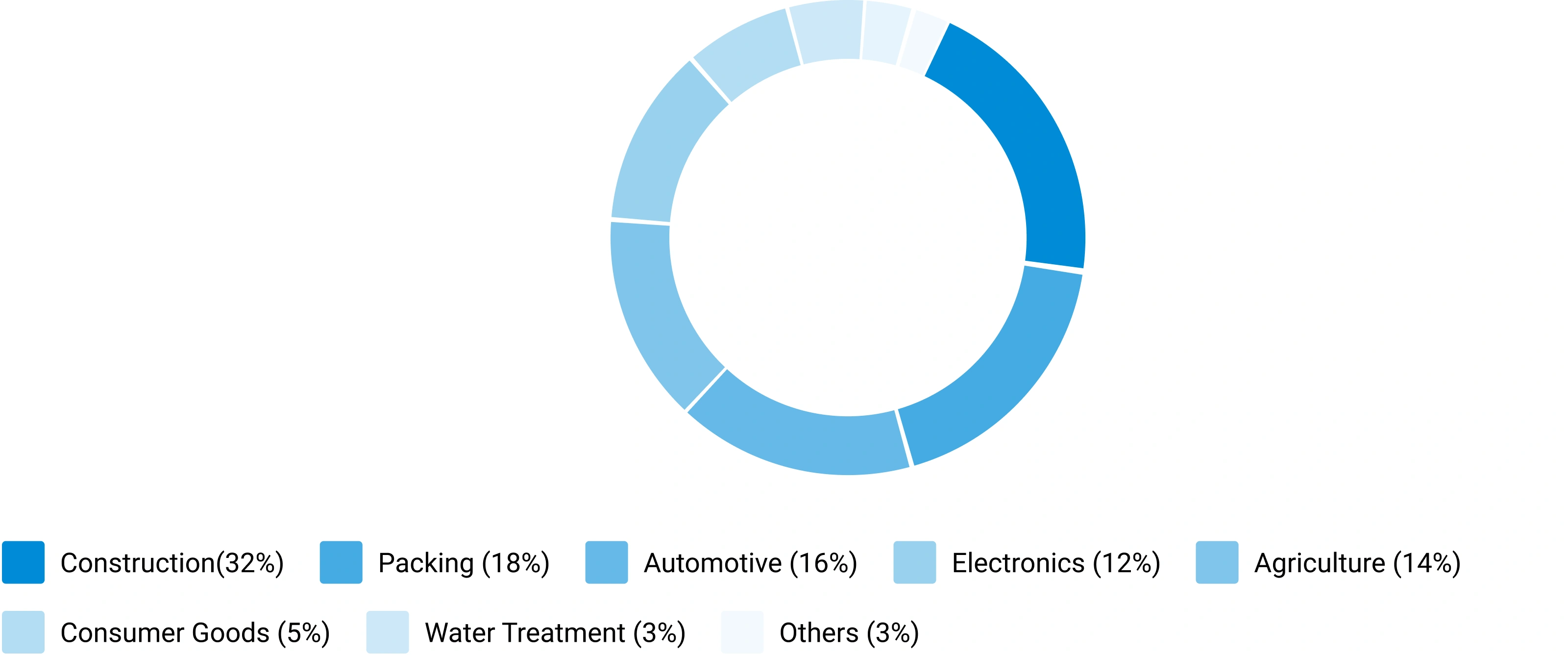
Chemical demand is evaluated across automotive, construction, packaging, electronics, agriculture, healthcare, consumer goods, industrial manufacturing, energy and utilities, and water treatment. Industry output, production trends, and consumption intensity are analyzed to determine demand patterns.
Consumption Modeling
Demand is estimated using measurable indicators: kilograms per vehicle, kilograms per square meter of construction, dosage per cubic meter of water treated, kilograms per hectare of agricultural land, and kilograms per ton of manufactured products. Consumption factors are validated through industry publications and primary interviews.
Application Analysis
The market is segmented by application area to understand product performance requirements, formulation trends, technology adoption, customer preferences, and regulatory requirements improving demand accuracy and segmentation granularity.
Demand-Side Assessment — End-Use Industry Demand Distribution
Illustrative distribution of chemical & materials demand across key end-use industries
Phase 4 - Trade Flow Analysis: Balancing Regional Supply and Demand
Trade flow analysis reconciles regional supply and demand estimates through import and export data, identifying net supply positions, regional dependencies, and market imbalances. It serves as an independent validation layer that tests the consistency of supply-side and demand-side estimates.
Import Analysis
Import data is evaluated to determine volumes, source countries, product dependency, regional supply gaps, and pricing trends — identifying markets that rely heavily on external supply and where domestic production is insufficient to meet demand.
Export Analysis
Export assessments reveal production surplus, export competitiveness, regional manufacturing strength, and global market participation. Export patterns also help validate domestic production estimates and identify net exporting regions.
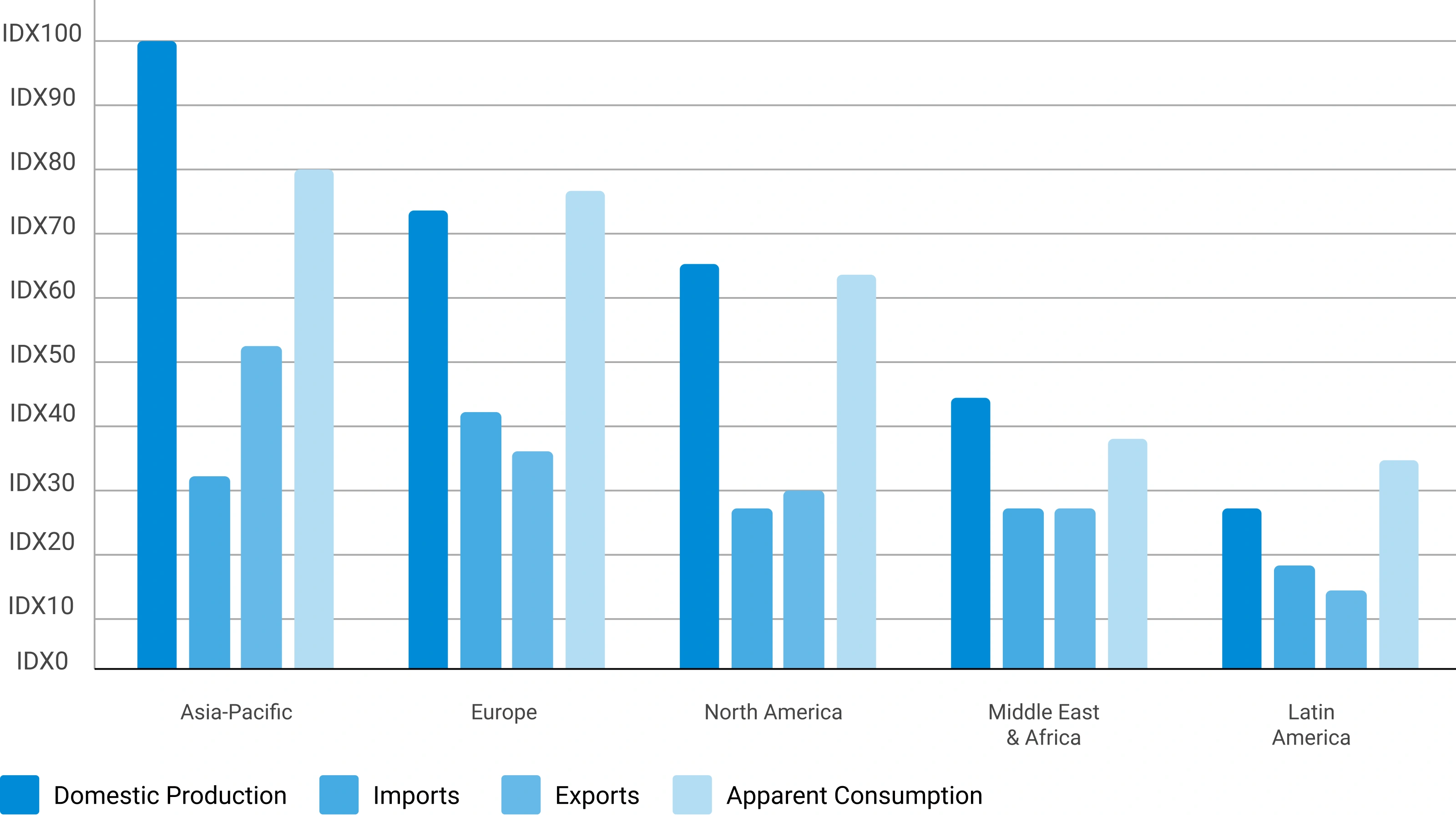
Apparent Consumption Model
Regional consumption is assessed using the standard apparent consumption formula:
Results identify net importing regions, net exporting regions, regional deficits, and surpluses — serving as an independent validation of supply and demand estimates.
Trade Flow Analysis — Net Supply Position by Region
Illustrative apparent consumption vs. domestic production across major regions — positive gap indicates net import dependency
Phase 5 — Primary Research: The Critical Validation Layer
Primary research tests and refines findings from secondary research through direct engagement with industry participants across the supply chain, demand side, and expert community. It captures intelligence that no database or published report can provide — the real-world experience of manufacturers, buyers, and specialists operating in the market.

Supply-Side Interviews
Conversations with chemical manufacturers, raw material suppliers, contract manufacturers, technology providers, and plant operators cover production trends, capacity utilization, pricing developments, technology shifts, and competitive dynamics.

Demand-Side Interviews
Engagement with OEMs, industrial consumers, procurement managers, distributors, formulators, and end-use manufacturers focuses on consumption trends, purchasing behavior, product substitution, demand outlook, and emerging applications.

Industry Expert Consultations
Additional interviews with industry consultants, independent experts, regulatory specialists, technical professionals, and research institutions provide deeper market context and validate key analytical assumptions.
Focus Areas of Primary Research:
Market Size & Forecast Validation
Revenue estimates, volume consumption, growth rates, forecast assumptions, regional demand.Supply Chain & Value Chain Assessment
Raw material sourcing, supply chain challenges, distribution networks, procurement practices.Production & Capacity Analysis
Manufacturing capacity, utilization rates, expansion projects, plant investments.Pricing & Cost Structure Analysis
Product pricing trends, feedstock costs, energy costs, margin pressures, pricing outlook.Competitive Landscape Assessment
Volume and value estimates confirmed to be fully consistent with one another before publicationInterview Volume by Market Scope
| Study Scope | Number of Interviews |
|---|---|
| Niche Market | 20 – 30 |
| Mid-Sized Market | 30 – 50 |
| Global Market | 50 – 80 |
| Highly Fragmented Market | 80 – 120 |
Interview Details:
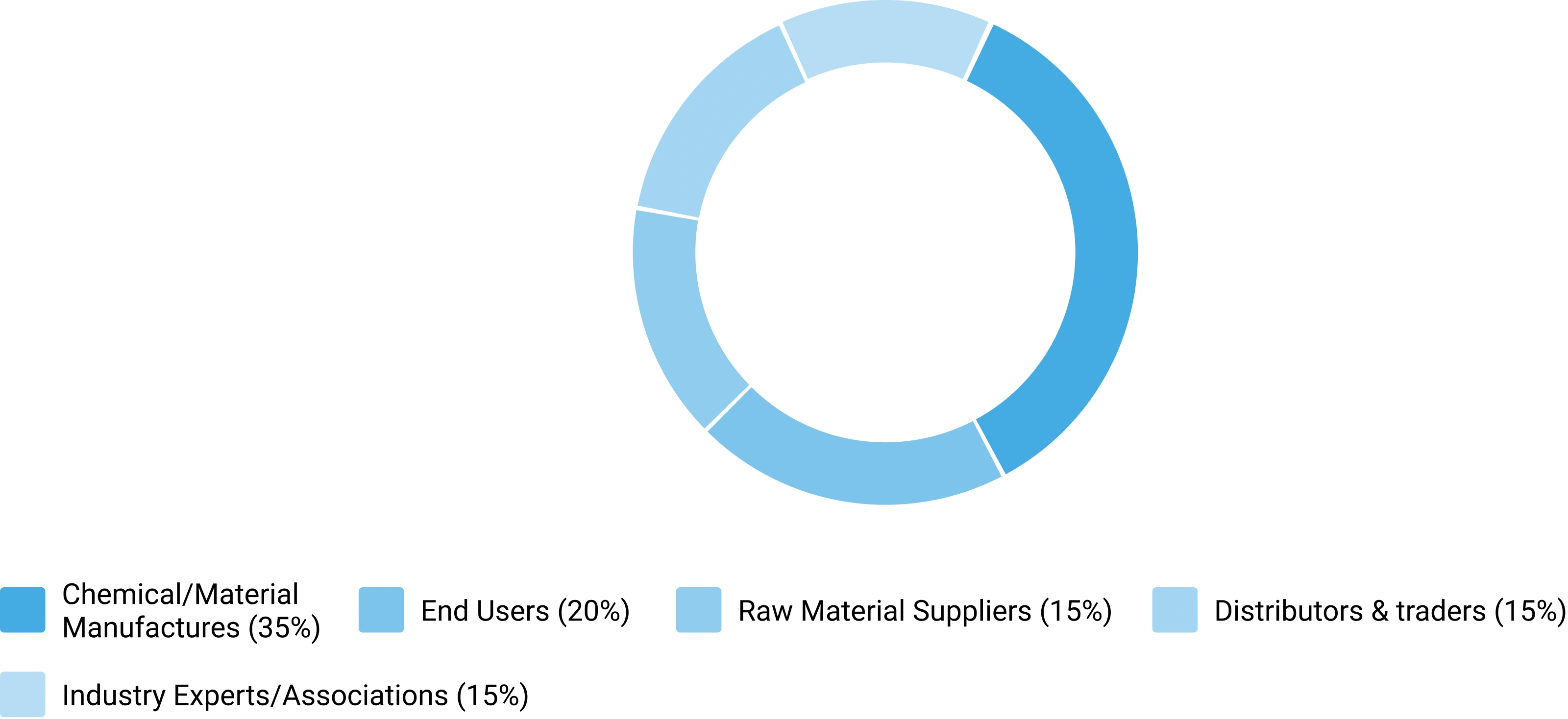
Category : Manufacturers, Suppliers, Distributors, End Users, Experts/Associations
Average Duration : 30–60 Minutes
Interview Mode : Video calls, telephonic interviews, expert consultations
Interview Format : Structured / Semi-Structured questionnaire
Focus Areas of Primary Research:
Market Size & Forecast Validation :
Revenue estimates, volume consumption, growth rates, forecast assumptions, regional demand.
Supply Chain & Value Chain Assessment :
Raw material sourcing, supply chain challenges, distribution networks, procurement practices.
Production & Capacity Analysis :
Manufacturing capacity, utilization rates, expansion projects, plant investments.
Pricing & Cost Structure Analysis :
Product pricing trends, feedstock costs, energy costs, margin pressures, pricing outlook.
Competitive Landscape Assessment :
Market share, competitor positioning, strategic initiatives, partnerships, acquisitions.
Primary Research — Stakeholder Coverage by Category
Distribution of interview respondents across stakeholder categories (% share from PPT data)
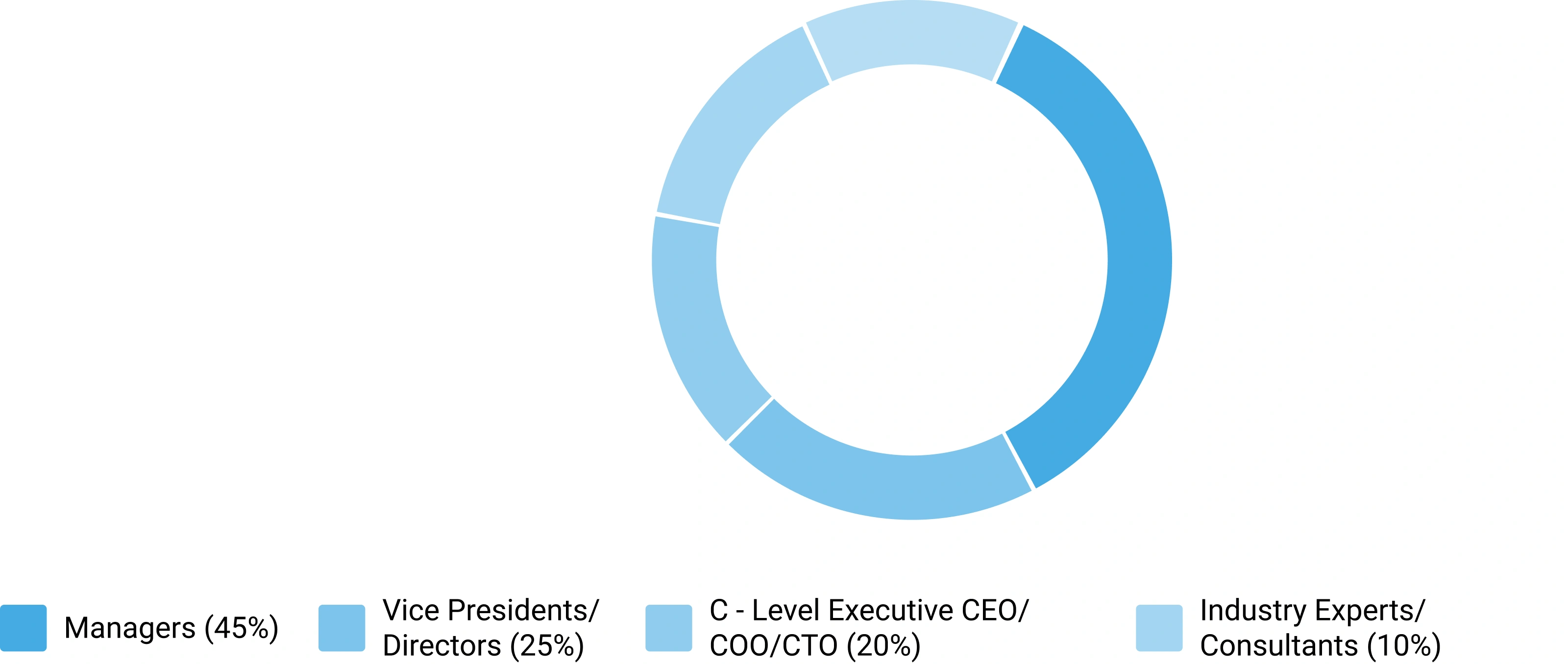
Primary Research — Respondent Designation Profile
Seniority breakdown of interview respondents (% share from PPT data)
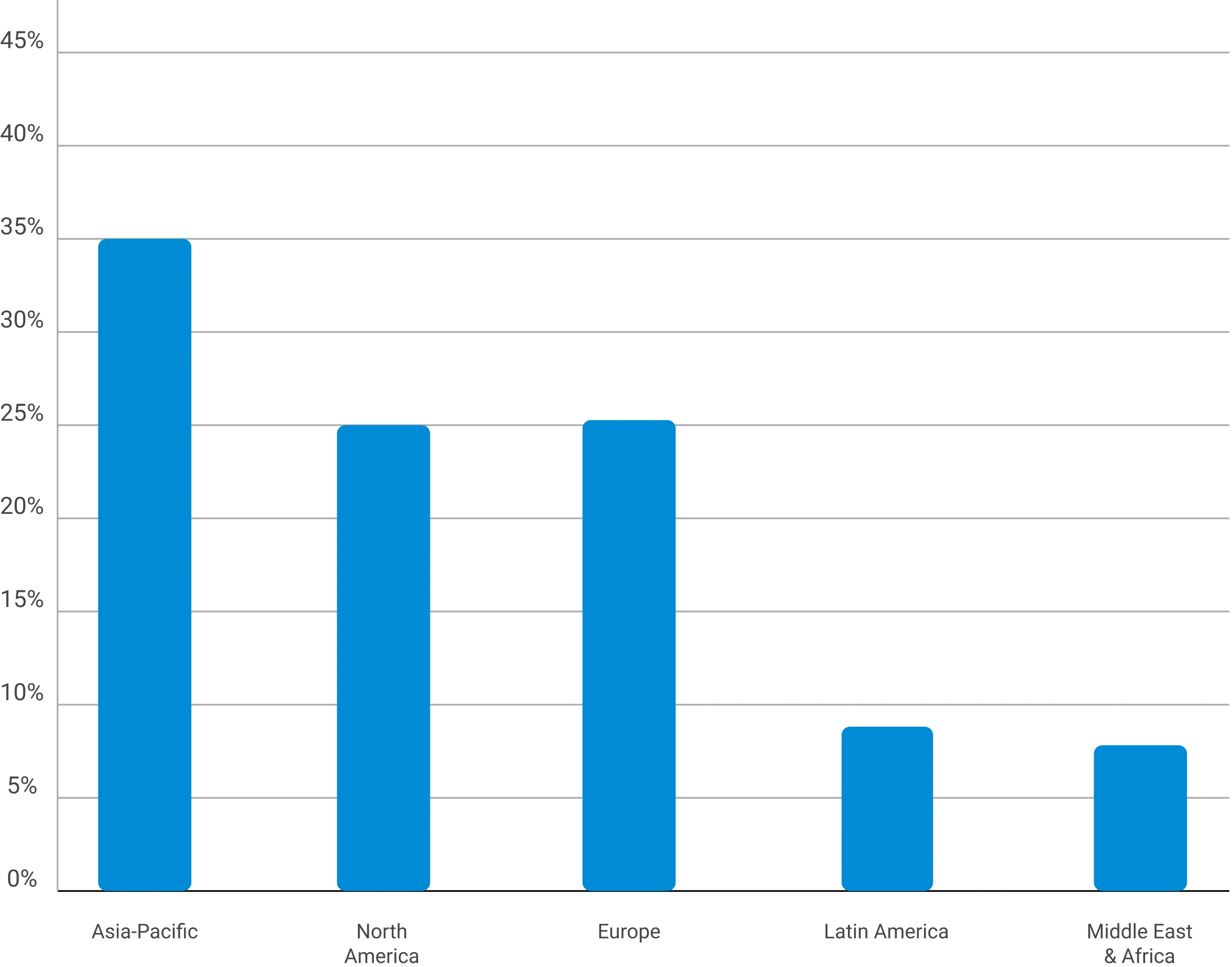
Primary Research — Geographic Coverage of Interviews
Regional distribution of primary research engagement (% share from PPT data)
Phase 6 — Data Triangulation and Market Validation
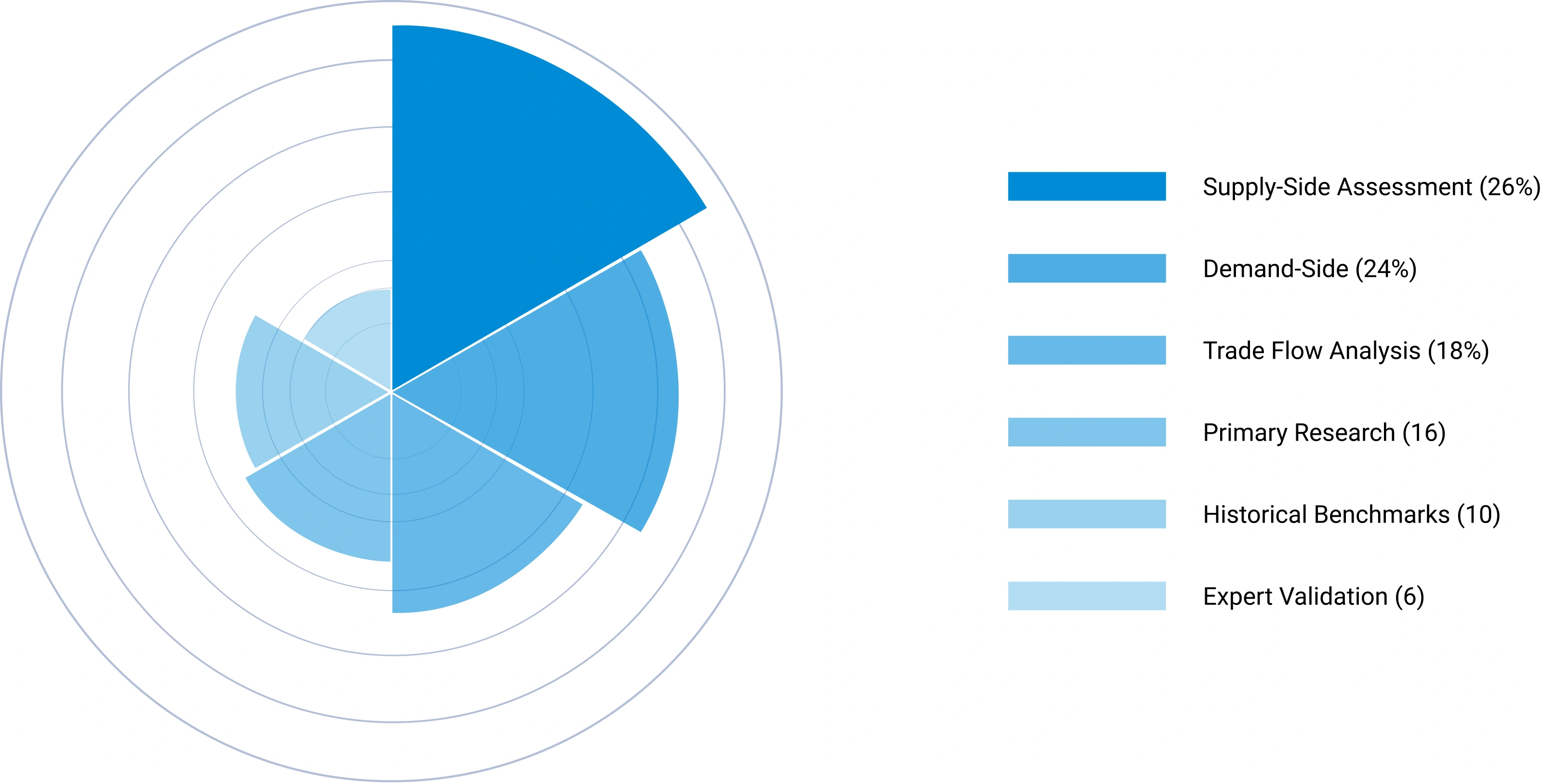
No single methodology is relied upon in isolation. Multiple independent estimation approaches are combined and reconciled to ensure consistency, accuracy, and analytical defensibility. Any material deviations between approaches are investigated and adjusted through additional validation cycles.
The final market size is derived through weighted triangulation of all validated methodologies. Any material deviations between approaches are investigated and adjusted through additional validation cycles. The outcome represents the most realistic assessment of the market based on available evidence and expert confirmation ensuring that volume and value estimates are fully consistent with one another.
Triangulation Framework — Input Contribution Weight
Relative weight each sizing input contributes to the final reconciled market estimate
Phase 7 — Forecast Modeling: Projecting Future Market Evolution
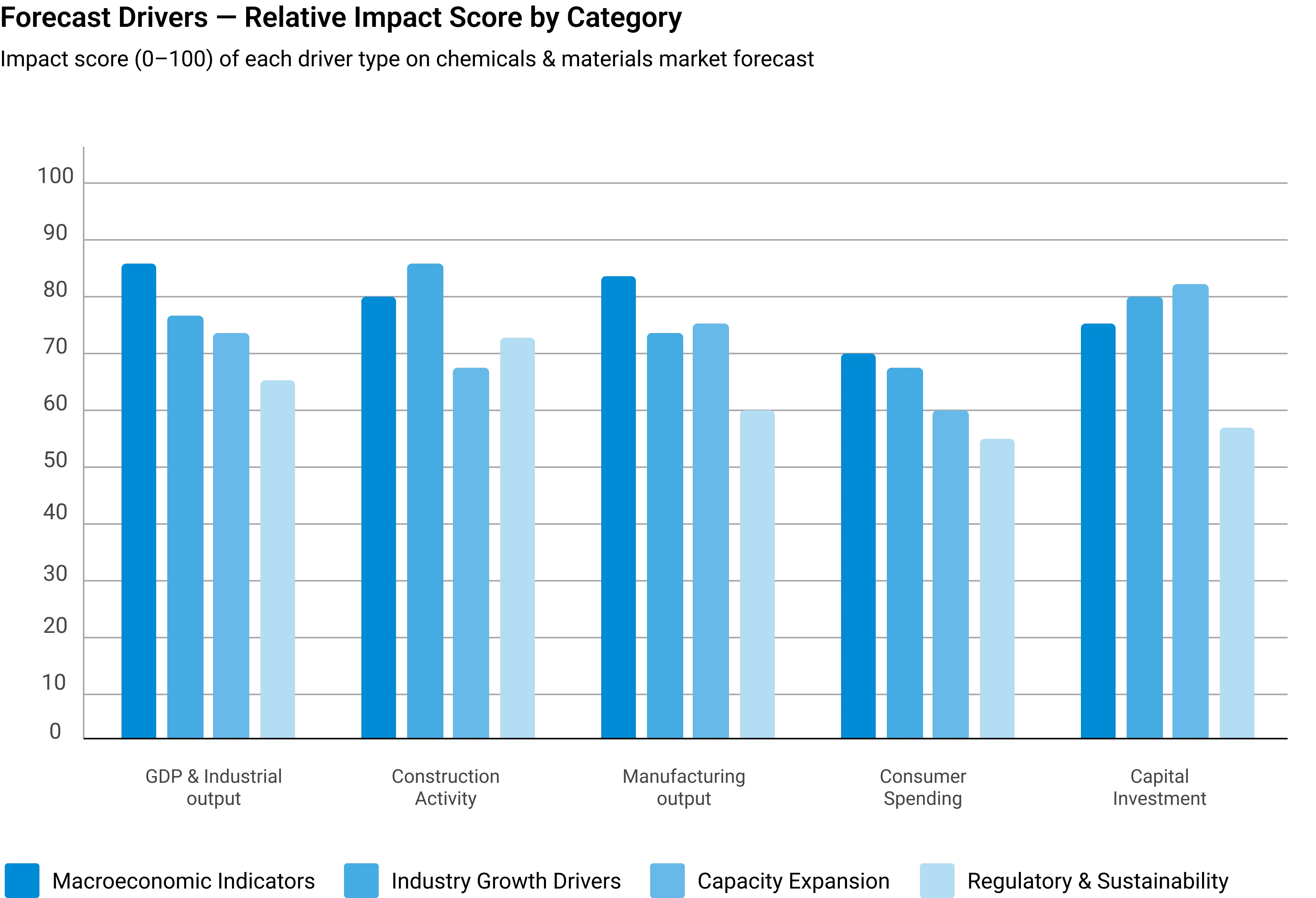
Forecasting evaluates the future trajectory of the market using a combination of quantitative indicators and qualitative assessments across economic, industry, and regulatory dimensions. Rather than simple extrapolation, each driver is independently modeled and integrated into a composite forecast.
Macroeconomic Indicators
GDP growth, industrial production, manufacturing output, construction activity, consumer spending, and capital investment form the quantitative foundation of long-term demand projections. These are applied at country, regional, and global levels.
Industry Growth Drivers
Urbanization, infrastructure development, industrialization, technological innovation, sustainability initiatives, and evolving product performance requirements are assessed at regional and industry levels — capturing both structural and cyclical demand drivers.
Capacity Expansion Analysis
Announced plant expansions, new manufacturing facilities, technology upgrades, and strategic investments are evaluated to determine future supply-demand dynamics and potential market tightness or oversupply situations.
Regulatory & Sustainability
Environmental regulations, chemical safety standards, emission reduction targets, circular economy initiatives, and sustainability requirements are incorporated as they often influence product adoption rates and market growth trajectories.
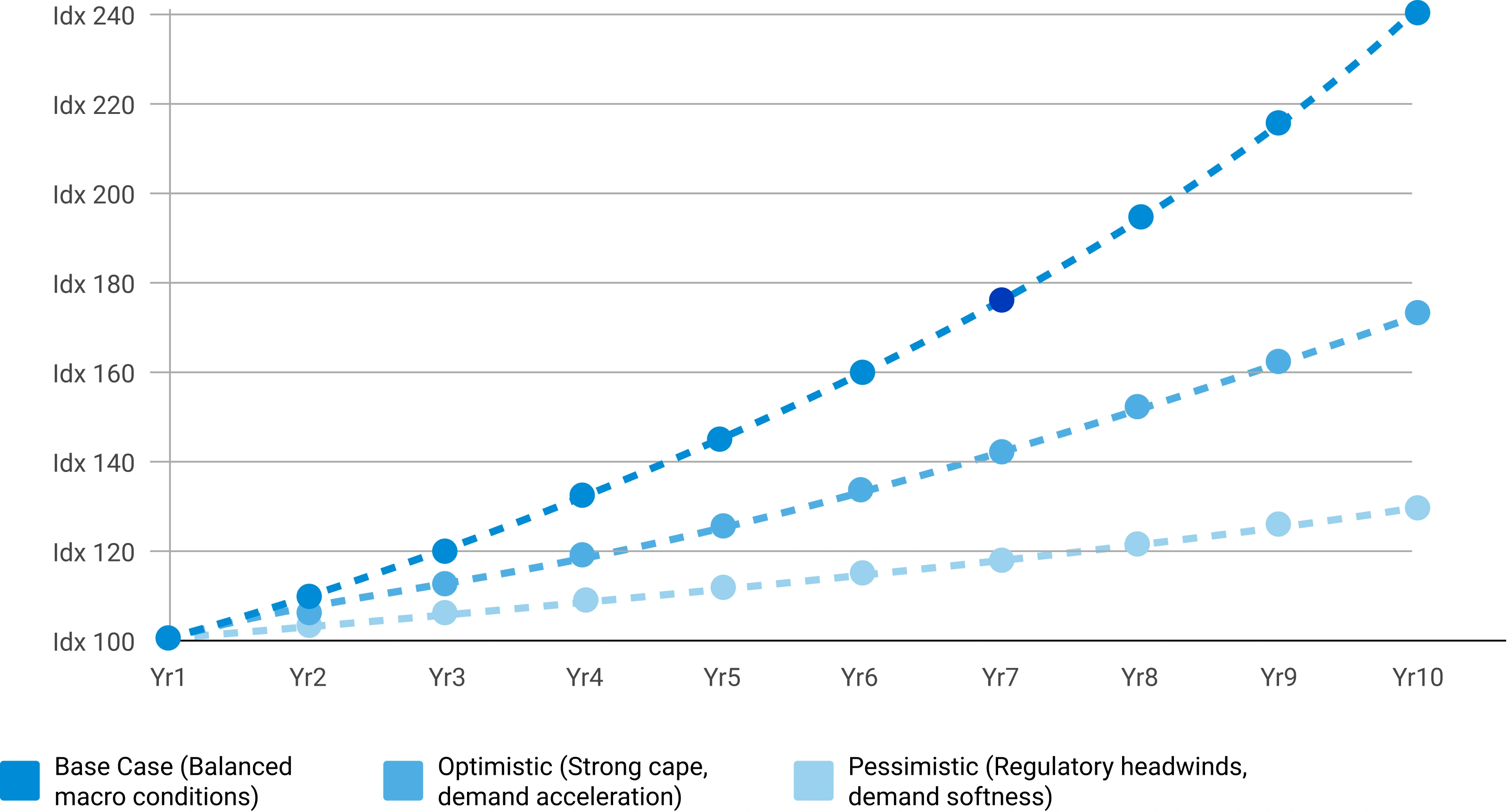
Scenario Forecast Range — Indexed Market Growth (Year 1–10)
Illustrative indexed growth trajectories across Base, Optimistic, and Pessimistic scenarios over a 10-year forecast horizon
Forecast Drivers — Relative Impact Score by Category
Impact score (0–100) of each driver type on chemicals & materials market forecast



Comments
Share your thoughts, ask a question, or provide feedback about this report.