Content


Polyacrylic Acid (PAA) Market Size Analysis Report 2035
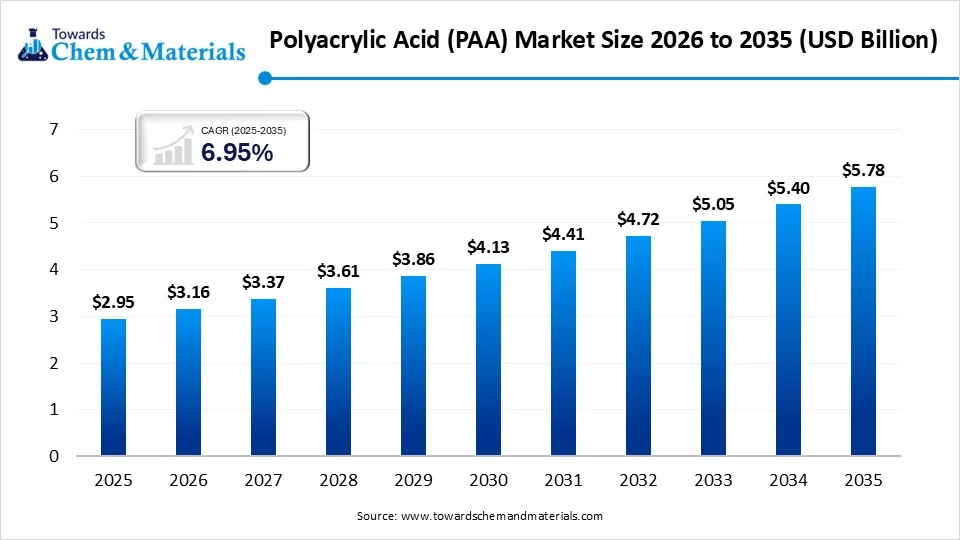
The global polyacrylic acid (PAA) market size was estimated at USD 2.95 billion in 2025 and is expected to increase from USD 3.16 billion in 2026 to USD 5.78 billion by 2035, growing at a CAGR of 6.95% from 2026 to 2035. Asia Pacific dominated the polyacrylic acid (PAA) market with the largest revenue share of 45.00% in 2025.The greater shift towards better wastewater management and sustainability has fueled market growth in recent years. The synthetic polymers, which are primarily made from the acrylic acid monomer called polyacrylic acid. Moreover, the major industries have been seen using it as the binder, thickener, dispersant, and anti-scale agent, which is also creating profitable pathways for the polyacrylic acid manufacturers in the current period. Also, having the ability to absorb water while preventing scale formation and improving viscosity, polyacrylic acid has gained attention from the water treatment and detergents industry nowadays.
Market Highlights
- By region, Asia Pacific dominated the polyacrylic acid (PAA) market with approximately 45% share in 2025, due to rapid industrialization and a large manufacturing base.
- By grade, the industrial grade segment dominated the market with approximately 46% share in 2025, owing to it is widely used in water treatment, detergents, textiles, and construction chemicals.
- By grade, the pharmaceutical grade is expected to grow during the forecast period, due to rising healthcare demand and stricter quality standards.
- By application, the superabsorbent polymers segment dominated the market with approximately 35% share in 2025, akin to polyacrylic acid being a key raw material in hygiene products like diapers and sanitary pads.
- By application, the water treatment segment is expected to grow at a rapid CAGR during the forecast period, due to increasing water scarcity and strict environmental regulations.
- By physical state, the liquid segment dominated the market with approximately 58% share in 2025, owing to its easy handling and mixing in industrial processes.
- By physical state, the powder is expected to grow during the forecast period, due to better storage stability and longer shelf life.
- By type, the homopolymers segment dominated the market with approximately 52% share in 2025, akin to its simplicity in structure and cost-effectiveness to produce.
- By type, the copolymer and terpolymers segment is expected to grow at a rapid CAGR during the forecast period, due to industries need for more specialized performance.
Cleaner Production, Stronger Profit Potential
The development of bio-based and environmentally friendly grades is expected to enable high-return ventures for manufacturers in the coming years. Moreover, Traditional production methods depend on petrochemical raw materials. Now, companies are researching renewable feedstock options to reduce environmental impact. Improved polymerization techniques are increasing product efficiency and reducing waste.
Trade Analysis of the Polyacrylic Acid (PAA) Market:
Import, Export, Consumption, and Production Statistics
- According to global data the world exports significant Polyacrylic Acid with 1,103 shipments via 242 exporters and 294 buyers.
- Between June 2024 to May 2025, the buyers globally imported 143 polyacrylic acid shipments via 143 exporters and 191 buyers.
- Vietnam, India, and Brazil are the leading importing countries.
- China with 248 shipments, Italy with 230 shipments, and the United States with the 197 shipments emerged as the leading exporting countries.
Recent Market Trends:
- The heavy integration into the advanced water treatment and recycling industries has seen in improving financial performance and industry scalability in recent years. Also, this polyacrylic has been used as a dispersant and scale inhibitor in different sections of water treatment.
- The increasing demand for personal care and hygiene products has positively impacted the revenue potential of the market in the current period. Moreover, the manufacturers are using polyacrylic acid, which has been heavily used in sanitary products, diapers, and other products.
- The emergence of advanced cleaning and detergent products is likely to open profitable avenues for polyacrylic acid manufacturers during the forecast period, as the polyacrylic acid has been observed to improved cleaning efficiency.
Report Scope
| Report Attribute | Details |
| Market Size in 2026 | USD 3.16 Billion |
| Revenue Forecast in 2035 | USD 5.78 Billion |
| Growth Rate | CAGR 6.95% |
| Forecast Period | 2026 - 2035 |
| Base Year | 2025 |
| Dominant Region | Asia Pacific |
| Segment Covered | By Grade, By Application, By Physical State, By Type, By Region |
| Key companies profiled | Arkema S.A., Nippon Shokubai Co., Ltd., Dow Inc., LG Chem Ltd., Evonik Industries AG, Ashland Inc., Kemira Oyj, The Lubrizol Corporation, Sumitomo Seika Chemicals Co., Ltd., Zhejiang Satellite Chemical Co., Ltd., San-Dia Polymers (SDP Global), Mitsubishi Chemical Group, Chemical, BASF SE |
Value Chain Analysis of the Polyacrylic Acid (PAA) Market:
Distribution to Industrial Users
- Industrial distribution of polyacrylic acid reaches users in water treatment, construction, and textiles primarily through direct sales and specialized distributors. Global leaders BASF SE, Dow, and Arkema leverage extensive networks to supply large-scale manufacturing hubs.
- Other key players include Nippon Shokubai, Evonik, Lubrizol, and Ashland, which focus on high-performance applications like scale inhibitors and binders.
Chemical Synthesis and Processing
- Polyacrylic acid (PAA) is primarily synthesized via free-radical polymerization of acrylic acid monomers in aqueous or organic solvents. Processors use initiators like ammonium persulfate and redox systems to trigger chain growth, often incorporating cross-linking agents for hydrogel variants.
- Key global manufacturers driving this synthesis include BASF SE, Dow, and Arkema, alongside specialty producers like Lubrizol, Nippon Shokubai, and Evonik, focusing on scalable, high-purity production for hygiene and industrial applications.
Regulatory Compliance and Safety Monitoring
- Regulatory compliance for polyacrylic acid (PAA) is governed by REACH in Europe and FDA 21 CFR (Parts 175-178) for indirect food contact in the U.S. While often classified as non-hazardous, concentrated forms can cause serious eye damage and respiratory irritation. Safety monitoring involves rigorous SDS management and workplace exposure assessments (e.g., EN 689).
Polyacrylic Acid (PAA) Market Regulatory Landscape: Global Regulations
| Country Region | Regulatory Body | Key Regulations | Focus Areas |
| United States | Environmental Protection Agency (EPA) | 21 CFR Parts 175-178 (Indirect Food Additives); TSCA (Chemical Inventory); Clean Water Act (CWA) | Safe use in food-contact coatings, biodegradability in water treatment, and drug delivery excipients. |
| European Union | ECHA | REACH (Regulation (EC) No 1907/2006); Regulation (EU) No 10/2011; CLP Regulation | Environmental protection (REACH), migration limits in plastics (Food Contact), and restrictions on microplastics. |
| China | SAMR, NHC | GB 9685-2016 (Additives for FCM); GB 4806.15-2024 (Adhesives) | Compliance for food-contact materials, stringent SML (Specific Migration Limits), and updated GB 4806 series for polymers and resins. |
Segmental Insights
Grade Insights
How did the Industrial Grade Segment Dominate the Polyacrylic Acid (PAA) Market in 2025?
The industrial grade segment dominated the market with approximately 46% share in 2025, due to it is widely used in water treatment, detergents, textiles, and construction chemicals. Also, it is cost-effective and available in large quantities. Most industries need bulk chemicals for daily operations, so industrial-grade fits their requirement. It performs well in scale control, dispersing, and cleaning applications.
The pharmaceutical grade segment is expected to grow with a rapid CAGR, owing to rising healthcare demand and stricter quality standards. This grade offers higher purity and controlled composition. It is used in drug delivery systems, tablets, gels, and medical formulations. As global healthcare spending increases, demand for safe and reliable ingredients grows.
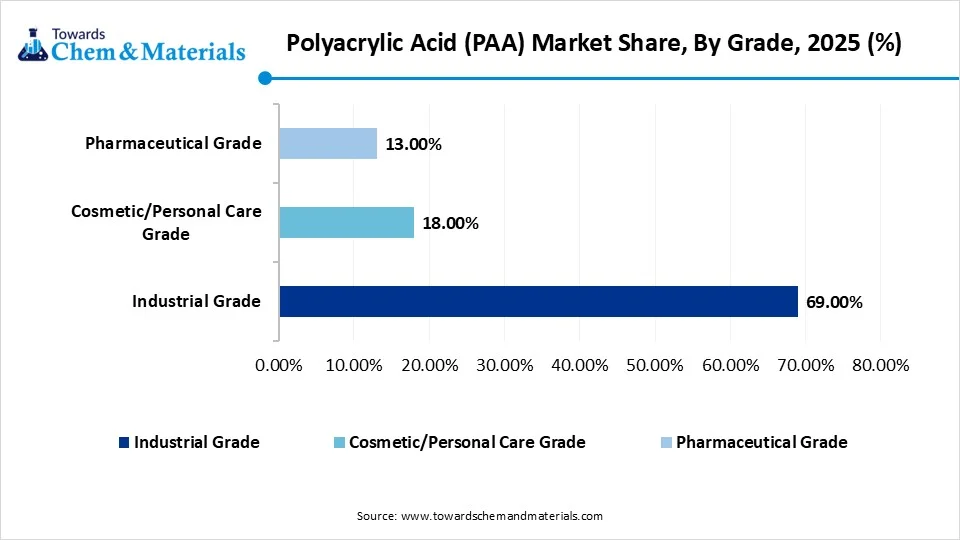
Polyacrylic Acid (PAA) Market Share, By Grade , 2025 (%)
| By Grade | Revenue Share, 2025 (%) |
| Industrial Grade | 69.00% |
| Cosmetic/Personal Care Grade | 18.00% |
| Pharmaceutical Grade | 13.00% |
Application Insights
How did the Superabsorbent Polymers Dominate the Polyacrylic Acid (PAA) Market in 2025?
The superabsorbent polymers segment dominated the market with approximately 35% share in 2025, due to polyacrylic acid being a key raw material in hygiene products like diapers and sanitary pads. It can absorb large amounts of liquid and retain it effectively. A growing population and hygiene awareness increased product demand. Baby care and adult incontinence products require high absorption performance.
The water treatment segment is expected to grow, akin to increasing water scarcity and strict environmental regulations. Moreover, industries and cities are investing more in wastewater recycling and purification systems. Polyacrylic acid helps prevent scale formation and improves water system efficiency. Governments are enforcing stricter pollution control rules, which increases chemical demand. Rapid industrialization in developing countries supports a new water treatment plant.
Polyacrylic Acid (PAA) Market Share, By Application , 2025 (%)
| By Application | Revenue Share, 2025 (%) |
| Superabsorbent Polymers (SAPs) | 35.00% |
| Water & Wastewater Treatment | 25.00% |
| Thickeners & Emulsifiers | 15.00% |
| Anti-scaling & Dispersants | 10.00% |
| Others (Adhesives, Textiles) | 15.00% |
Physical State Insights
How did the Liquid Segment Dominate the Polyacrylic Acid (PAA) Market in 2025?
The liquid segment dominated the market with approximately 58% share in 2025, due to its easy handling and mixing in industrial processes. Also, many production systems are designed for liquid chemicals. It dissolves quickly and provides uniform performance. Storage and transportation of liquid forms are convenient for bulk users. Industries prefer liquid products for direct dosing in water treatment and cleaning systems.
The powder segment is expected to grow with a rapid CAGR, owing to better storage stability and longer shelf life. Also, powder form reduces transportation cost and leakage risk it is easier to export and store in different climate conditions. Many industries prefer powder for precise formulation control. Growing demand from pharmaceutical and specialty applications supports powder growth.
Polyacrylic Acid (PAA) Market Share, By Physical State , 2025 (%)
| By Physical State | Revenue Share, 2025 (%) |
| Liquid | 58.00% |
| Powder/Granule | 42.00% |
Type Insights
How did the Homopolymers Dominate the Polyacrylic Acid (PAA) Market in 2025?
The homopolymer segment dominated the market with approximately 52% share in 2025, due to its simplicity in structure and cost-effectiveness to produce. They provide reliable performance in dispersing and scale inhibition applications. Many industrial processes do not require complex polymer structures. Homopolymers meet general industrial needs at affordable pricing. They are widely used in detergents, water treatment, and textiles.
The copolymer and terpolymers segment is expected to grow, akin to industries need more specialized performance. These polymers combine different monomers to improve strength, flexibility, and resistance. Advanced applications require better chemical stability and multifunctional properties. Water treatment systems with complex conditions demand higher-efficiency materials.
Polyacrylic Acid (PAA) Market Share, By Type , 2025 (%)
| By Type | Revenue Share, 2025 (%) |
| Homopolymer | 52.00% |
| Copolymer & Terpolymer | 48.00% |
Regional Insights
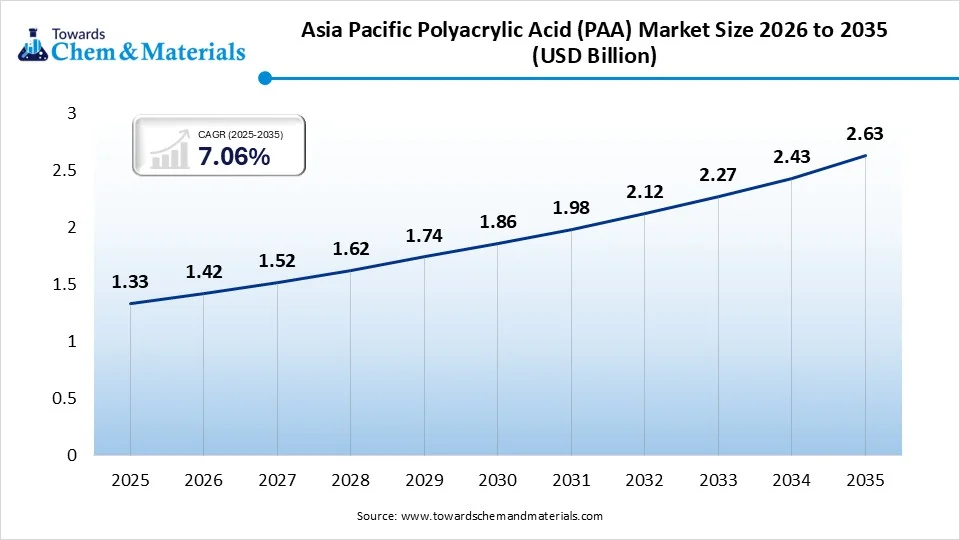
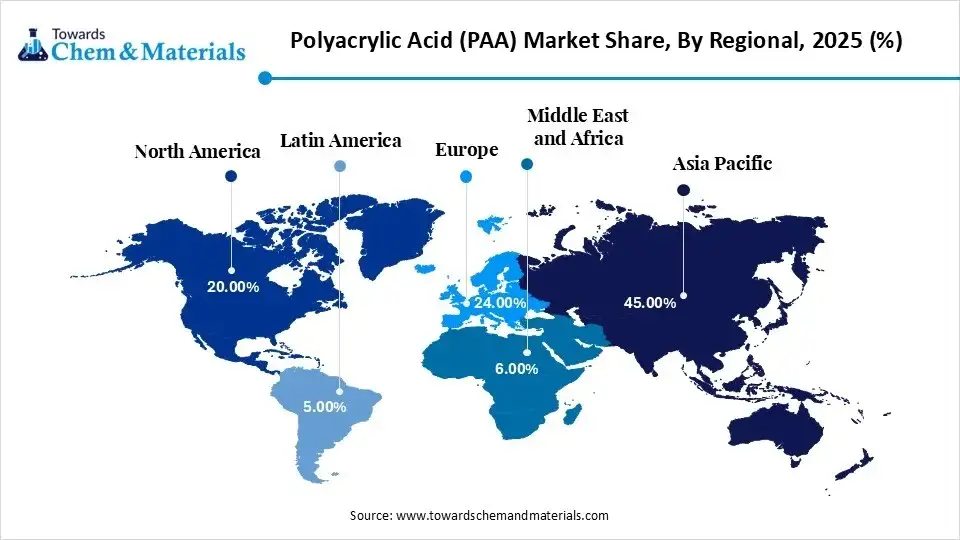
The Asia Pacific polyacrylic acid (PAA) market size was valued at USD 1.33 billion in 2025 and is expected to be worth around USD 2.63 billion by 2035, exhibiting at a compound annual growth rate (CAGR) of 7.06% over the forecast period from 2026 to 2035.Asia Pacific dominated the polyacrylic acid (PAA) market with approximately 45% share in 2025, due to rapid industrialization and a large manufacturing base. Moreover, region has strong textile, detergent, water treatment, and hygiene industries. A growing population increases demand for hygiene products. Construction and infrastructure development also support chemical consumption. Availability of raw materials and lower production costs benefit the manufacturer.
Urbanization Fuels Domestic Market Expansion in China
China maintained its dominance in the market, owing to it has large- scale manufacturing for textiles, detergents, and hygiene products. Also, government investment in infrastructure increases water treatment chemical demand. China also exports finished hygiene and cleaning products globally. Rapid urbanization and rising income support domestic consumption.
Polyacrylic Acid (PAA) Market Evaluation in North America
North America is expected to capture a major share 20.00% of the polyacrylic acid (PAA) market with a rapid CAGR in 2025, owing to strong technological innovation and high-value applications. Also, the region focuses on advanced healthcare and specialty chemical industries. Strict environmental regulations increase demand for efficient water treatment solutions. Research and development investment supports the development of high-performance polymers. Industries prefer premium and specialized materials. A stable economy and high consumer awareness strengthen hygiene product demand.
United States Lead Future PAA Growth
The United States is expected to emerge as a prominent country for the polyacrylic acid (PAA) market in the coming years, due to its advanced pharmaceutical, water treatment, and personal care industries. Strong research institutions support polymer innovation. Government regulations encourage safer and environmentally friendly chemicals. High healthcare spending increases pharmaceutical-grade demand. Industrial modernization supports advanced polymer usage.
Europe Polyacrylic Acid (PAA) Market Examination
Europe is notably growing in the market share 24.00% in 2025, owing to strong environmental policies and sustainable chemical practices. The region focuses on green chemistry and strict wastewater regulations. Hygiene awareness remains high. Industrial modernization increases demand for efficient polymers.
Polyacrylic Acid (PAA) Market Share, By Regional, 2025 (%)
| Regional | Revenue Share, 2025 (%) |
| North America | 20.00% |
| Europe | 24.00% |
| Asia Pacific | 45.00% |
| Latin America | 5.00% |
| Middle East & Africa | 6.00% |
Germany’s Chemical Industry Driving Growth
Germany is expected to gain a significant industry share owing to its stronger chemical manufacturing and engineering industries. Moreover, the water treatment and industrial cleaning sectors are well developed. The country focuses on technological advancement and environmental protection. German companies invest heavily in research and product innovation. Strong export performance supports production capacity.
Recent Development
- In February 2025, LG Chem is likely to launch its latest bio acrylic. Also, the company is expected to boost production capacity of these newly launch bio-acrylic around 100 metric tons annually as per the published report.(Source: www.alchempro.com)
- In September 2024, a scientist from the University of Electronic Science and Technology conducted a study and developed a lithium sulfur battery, which can offer better stability and exceptional safety standards. Moreover, in this development, scientists have used polyacrylic acid. Polyethylene oxide and polyacrylamide, as per the published report.(Source: www.ess-news.com)
Top Vendors in the Polyacrylic Acid (PAA) Market & Their Offerings:
- Arkema S.A.: Based in France, Arkema is a leader in specialty materials. Its subsidiary, Coatex, is a primary driver of its polyacrylic acid portfolio, specializing in water-based rheology additives. Arkema focuses on high-growth sectors like construction (concrete admixtures), paper, and cosmetics.
- Nippon Shokubai Co., Ltd.: This Japanese giant is a global leader in the acrylic acid value chain. It holds a significant market share in Superabsorbent Polymers (SAP), which are cross-linked polyacrylic acids used in hygiene products.
- Dow Inc.: A major American materials science company, Dow provides an extensive range of PAA-based polymers through its Consumer Solutions and Industrial Intermediates divisions. Dow’s ACUSOL™ and TAMOL™ brands are industry standards for detergents, scale control, and dispersants.
- LG Chem Ltd.
- Evonik Industries AG
- Ashland Inc.
- Kemira Oyj
- The Lubrizol Corporation
- Sumitomo Seika Chemicals Co., Ltd.
- Formosa Plastics Corporation
- Zhejiang Satellite Chemical Co., Ltd.
- San-Dia Polymers (SDP Global)
- Mitsubishi Chemical Group
- Wanhua Chemical Group
- BASF SE
Segments Covered in the Report
By Grade
- Industrial Grade
- Cosmetic/Personal Care Grade
- Pharmaceutical Grade
By Application
- Superabsorbent Polymers (SAPs)
- Water & Wastewater Treatment
- Thickeners & Emulsifiers
- Anti-scaling & Dispersants
- Others (Adhesives, Textiles)
By Physical State
- Liquid
- Powder/Granule
By Type
- Homopolymer
- Copolymer & Terpolymer
By Region
- North America
- U.S.
- Canada
- Mexico
- Europe
- Germany
- UK
- France
- Italy
- Spain
- Asia Pacific
- China
- India
- Japan
- South Korea
- Latin America
- Brazil
- Argentina
- Middle East & Africa
- Saudi Arabia
- South Africa
FAQ's




Select User License to Buy
Figures (4)








 sales@towardschemandmaterials.com
 Download Sample
 Schedule a Meeting