Content


Piezoelectric Polymers Market Size, Competitive Landscape Analysis Report 2035
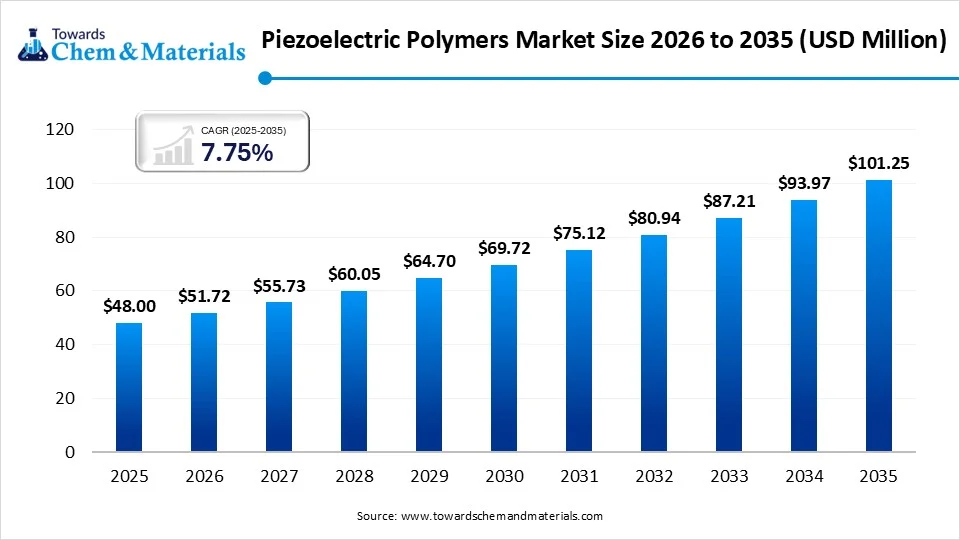
The global piezoelectric polymers market size was estimated at USD 1.85 billion in 2025 and is expected to increase from USD 1.93 billion in 2026 to USD 2.89 billion by 2035, growing at a CAGR of 4.55% from 2026 to 2035. Asia Pacific dominated the piezoelectric polymers market with the largest revenue share 45.00% in 2025.The growth of the market is driven by the rising demand for flexible, lightweight, and biocompatible materials in sensors, actuators, and wearables. The piezoelectric polymers market is significant for enabling flexible, lightweight, and versatile sensor/actuator technologies that traditional, brittle ceramics cannot support, which increases the demand for the product, which fuels the growth of the market. The other factors that fuel the growth of the market are the demand for wearable electronics, medical devices, and IoT-enabled smart infrastructure. These polymers offer superior mechanical flexibility, chemical resistance, and ease of processing.
Market Highlights
- Asia Pacific dominated the piezoelectric polymers market with the largest revenue share 45.00% in 2025.
- By product, the ceramics product segment dominated the market and accounted for the largest revenue share of 45.00% in 2025. Piezoelectric ceramics are highly favored for their low manufacturing costs
- By product, the composites product segment is projected to grow at the fastest CAGR between 2026 and 2035, due to significant investments in R&D for advanced material formulations.
- By end-use, the consumer goods segment led the market with the largest revenue share of 39.10% in 2025. The rise of flexible, bendable displays and touch-sensitive interfaces
- By end-use, the automotive segment is projected to grow at the fastest CAGR between 2026 and 2035, Growing use in battery management, motor control, and regenerative braking systems.
- By application, the actuators segment dominated the market and accounted for the largest revenue share of 35.20% in 2025. High demand in prosthetics, diagnostics, and medical devices
- By application, the sensors segment is projected to grow at the fastest CAGR between 2026 and 2035, due to the rise in demand for precision sensors.
Trade Analysis Of Piezoelectric Polymers Market: Import & Export Statistics
- According to Global Export Data, the world exported 20,636 Piezo shipments between July 2024 and June 2025 (TTM) through 1,285 verified exporters and 1,217 buyers.
- India, Mexico, and the United States are the top importers of Piezo, while China with 34,634 shipments, Japan with 7,874, and Malaysia with 3,285, rank as the largest global Piezo exporters.
Top-performing Global Piezo Exporters by volume:
- HUAQIN TELECOM HONG KONG LTD: 8,616 shipments (41%)
- VERDANT CREST TECHNOLOGY DMCC: 2,666 shipments (13%)
- ROSY AURORA INTERNATIONAL DMCC: 1,980 shipments (9%)
Market Growth Trends:
- Technical Advancements: Key players are focusing on enhancing ferroelectric stability, improving piezoelectric coefficients, and developing thinner films and coatings to suit advanced microelectronic applications.
- Energy Harvesting Innovations: Growing interest in self-powered devices and IoT systems is driving research into piezoelectric polymer materials that can efficiently convert environmental mechanical energy into electrical energy.
- Automotive Electrification: Increased adoption of EVs has spiked demand for piezoelectric sensors and actuators in advanced driver-assistance systems (ADAS) and battery management systems.
Report Scope
| Report Attribute | Details |
| Market Size in 2026 | USD 51.72 Billion |
| Revenue Forecast in 2035 | USD 101.25 Billion |
| Growth Rate | CAGR 7.75% |
| Forecast Period | 2026 - 2035 |
| Base Year | 2025 |
| Dominant Region | Asia Pacific |
| Segment Covered | By Product, By End-Use, By Application, By Regions |
| Key companies profiled | Arkema S.A., Solvay S.A., Kureha Corporation, Toray Industries, Inc., Daikin Industries, Ltd., PI Ceramic GMBH, APC International, Ltd., Harris Corporation, CTS Corporation, Peizosystem Jena GmbH, CeramTec, Sparkler Ceramics, Noliac A/S, Piezomechanik Dr. Lutz Pickelmann GmbH, Mad City Labs, Inc. |
Key Technological Shifts in the Piezoelectric Polymers Market:
Key technological shifts in the piezoelectric polymers market are primarily driven by the need for flexible, lightweight, and energy-efficient alternatives to traditional rigid ceramics, particularly for use in wearables, medical devices, and IoT sensors. Research is shifting towards bio-based and biodegradable piezoelectric polymers for transient medical implants and eco-friendly consumer electronics.
Piezoelectric Polymers Market -- Supply Chain Analysis
Polymer Production & Processing
- Piezoelectric polymers are produced through polymerization and processing of materials such as polyvinylidene fluoride (PVDF) and its copolymers, followed by stretching and electrical poling to induce piezoelectric properties for sensing and energy harvesting applications.
- Key players: Arkema, Solvay, Kureha Corporation, Daikin Industries.
Quality Testing and Certification
- Piezoelectric polymers must meet standards related to dielectric strength, mechanical durability, piezoelectric coefficient performance, and electronic component safety compliance.
- Key players: International Organization for Standardization, International Electrotechnical Commission, ASTM International, Underwriters Laboratories.
Distribution to Industrial Users
- Piezoelectric polymers are supplied to electronics manufacturers, medical device companies, aerospace manufacturers, automotive sensor producers, and wearable technology developers.
- Key players: Arkema, Solvay, Daikin Industries.
Piezoelectric Polymers Regulatory Landscape: Global Regulations
| Country / Region | Regulatory Body | Key Regulations | Focus Areas | Notable Notes |
| US | Environmental Protection Agency (EPA); Food and Drug Administration (FDA); Federal Communications Commission (FCC) | Toxic Substances Control Act (TSCA); FDA Medical Device Regulations; FCC Electronic Device Standards | Chemical safety, medical device approval, and electronic component compliance | Piezoelectric polymers used in sensors, wearable devices, and medical equipment must meet chemical safety and electronic product compliance standards. |
| Europe | European Chemicals Agency (ECHA); European Commission | REACH Regulation; RoHS Directive; Medical Device Regulation (MDR) | Chemical registration, restriction of hazardous substances, and medical device safety | The EU regulates piezoelectric polymers for electronics and healthcare applications with strict rules on hazardous materials and device safety. |
| China | Ministry of Industry and Information Technology (MIIT); Ministry of Ecology and Environment (MEE) | China RoHS; Environmental Protection Law | Electronic component standards, hazardous substance control, and environmental compliance | China requires compliance with hazardous substance restrictions and electronic product regulations for piezoelectric polymer components. |
| Japan | Ministry of Economy, Trade and Industry (METI); Ministry of the Environment | Chemical Substances Control Law (CSCL); Electrical Appliance and Material Safety Law | Chemical safety, electronic device standards | Japan enforces strict chemical management and safety standards for electronic materials, including piezoelectric polymers. |
| India | Ministry of Electronics and Information Technology (MeitY); Central Pollution Control Board (CPCB) | E-Waste Management Rules; Environment Protection Act | Electronic waste management, environmental safety | Piezoelectric polymers used in electronic devices must comply with Indias e-waste management and environmental safety regulations. |
| South Korea | Ministry of Environment (MoE); Ministry of Trade, Industry and Energy (MOTIE) | K-REACH; Electrical Appliance Safety Control Act | Chemical registration, electronic product safety | South Korea regulates materials used in electronics through chemical registration and safety standards for electrical equipment. |
Segmental Insights
Product Insights
Which Product Segment Dominated the Piezoelectric Polymers Market in 2025?
The ceramics product segment dominated the market share 45.00% in 2025, driven by the widespread adoption of lead zirconate titanate (PZT) in sensors, actuators, and transducers, which fuels the growth of the market. Its high sensitivity, superior performance, cost-efficiency, and versatility, facilitated by doping to create tailored, high-output materials, cemented its dominant position in electronics and automotive applications, further fueling the growth of the market.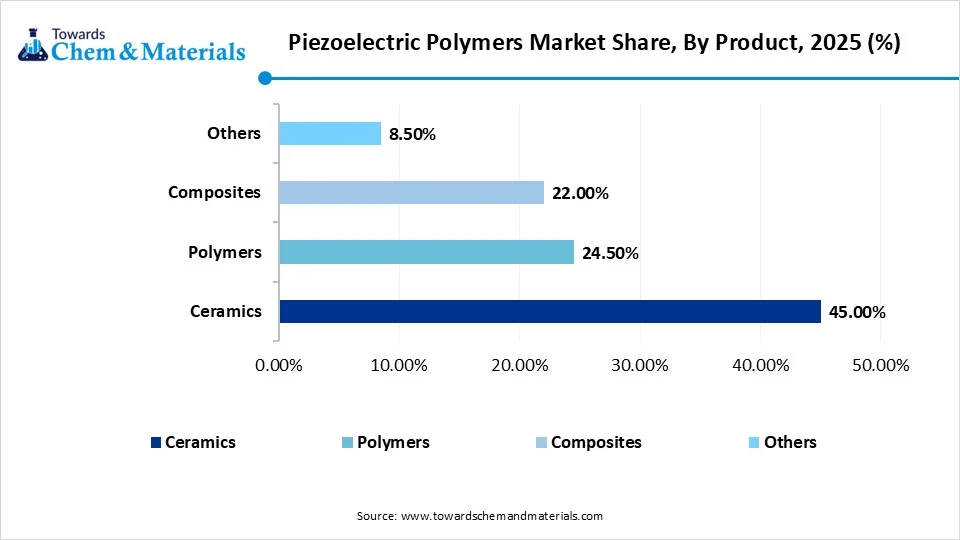
The composites product segment is projected to grow at the fastest CAGR between 2026 and 2035 in the market, driven by increasing demand for lightweight, flexible, and durable materials in applications like wearable electronics, smart infrastructure, and medical devices, which fuels the growth of the market. Rising demand for advanced sensors and actuators in automotive, consumer electronics, and healthcare further fuels the growth of the market.
Piezoelectric Polymers Market Share, By Product , 2025 (%)
| By Product Type | Revenue Share, 2025 (%) |
| Ceramics | 45.00% |
| Polymers | 24.50% |
| Composites | 22.00% |
| Others | 8.50% |
- Ceramics – Dominating with a 45.00% share, high piezoelectric efficiency, strong performance in sensors and actuators, and widespread industrial adoption drive leading market presence.
- Polymers – With a 24.50% share, flexibility, lightweight properties, and growing use in wearable electronics and flexible devices support steady growth.
- Composites – Holding a 22.00% share, combined material advantages such as enhanced durability and tunable properties drive increasing adoption in advanced applications.
- Others – With an 8.50% share, niche and emerging materials contribute limited demand due to lower commercialization and specialized use cases.
Application Insights
Which Application Dominated the Piezoelectric Polymers Market in 2025?
The actuators segment dominated the market share 35.20% in 2025, driven by intense demand for lightweight, flexible, and high-precision motion control in consumer electronics, automotive ADAS, and medical devices, which fuels the growth of the market. Their ability to provide rapid response times in compact, wearable, and soft robotics applications, coupled with advancements in film processing and multilayer designs, solidified their leading position, further supporting the growth of the market.
The sensors segment is projected to grow at the fastest CAGR between 2026 and 2035 in the market. Driven by widespread demand in the aerospace sector, satellite control, and fuel preservation, as well as increasing adoption in automotive, healthcare, and consumer electronics applications. Driven by the need for advanced sensors and energy harvesting, the broader piezoelectric market is experiencing significant growth. The rise in demand for precision sensors, coupled with the increasing need for energy harvesting, underpins the rapid growth of the sensors segment in the market.
Piezoelectric Polymers Market Share, By Application, 2025 (%)
| By Application | Revenue Share, 2025 (%) |
| Actuators | 35.20% |
| Sensors | 32.00% |
| Transducers | 12.50% |
| Motors | 7.40% |
| Acoustic Devices | 5.10% |
| SONAR | 3.80% |
| Generators | 2.20% |
| Others | 1.80% |
-
Actuators – Dominating with a 35.20% share, strong demand for precise motion control in robotics, automotive systems, and industrial automation drives leading market usage.
-
Sensors – With a 32.00% share, widespread adoption in pressure sensing, vibration monitoring, and wearable electronics supports strong and steady demand.
-
Transducers – Holding a 12.50% share, critical role in converting mechanical and electrical energy in medical and industrial devices sustains consistent usage.
-
Motors – With a 7.40% share, emerging use in miniaturized and high-precision motion systems supports moderate growth.
-
Acoustic Devices – With a 5.10% share, applications in sound generation and detection contribute niche but stable demand.
-
SONAR – Holding a 3.80% share, specialized use in underwater navigation and defense systems limits overall market size but ensures steady requirement.
-
Generators – With a 2.20% share, energy harvesting applications remain limited due to lower efficiency and early-stage commercialization.
-
Others – With a 1.80% share, fragmented and experimental applications contribute minimal demand due to limited adoption scale.
End-Use Insights
How did the Consumer Goods Segment Dominate the Piezoelectric Polymers Market in 2025?
The consumer goods segment dominated the market share 39.10% in 2025, driven by high demand for flexible, lightweight, and smart components in wearables, smartphones, and IoT devices, which fuels the growth of the market. The rise of flexible, bendable displays and touch-sensitive interfaces for smarter user experiences. The market saw increased investment in energy-harvesting applications for self-powered devices, with the overall segment supported by rapid urbanization and rising consumer electronics demand.
The automotive segment is projected to grow at the fastest CAGR between 2026 and 2035 in the market, driven by demand for advanced sensors (ADAS), fuel injection actuators, and electric vehicle (EV) battery management systems, further fueling the growth of the market. Increased demand for sensors in lane departure warnings and adaptive cruise control further fuels the growth of the market. The broader automotive piezoelectric devices market is projected for significant growth, fueled by the shift toward electrification and smart, energy-efficient, and lightweight materials.
Piezoelectric Polymers Market Share, By End-Use , 2025 (%)
| By End-Use | Revenue Share, 2025 (%) |
| Automotive | 18.50% |
| Healthcare | 15.20% |
| Information & Telecom | 10.10% |
| Consumer Goods | 39.10% |
| Aerospace & Defense | 14.30% |
| Others | 2.80% |
- Consumer Goods – Dominating with a 39.10% share, rising adoption in smart wearables, touch-sensitive devices, and advanced electronics drives strong market leadership.
- Automotive – With an 18.50% share, increasing integration of sensors, vibration monitoring systems, and smart components supports steady growth.
- Healthcare – Holding a 15.20% share, expanding use in medical imaging, wearable health monitors, and diagnostic devices contributes to stable demand.
- Aerospace & Defense – With a 14.30% share, demand for high-performance sensing and actuation systems in critical applications supports consistent adoption.
- Information & Telecom – With a 10.10% share, use in communication devices and signal processing applications drives moderate market expansion.
- Others – With a 2.80% share, niche and emerging applications contribute minimal demand due to limited commercialization.
Regional Insights
The Asia Pacific piezoelectric polymers market size was valued at USD 0.83 billion in 2025 and is expected to be worth around USD 1.31 billion by 2035, exhibiting at a compound annual growth rate (CAGR) of 4.67% over the forecast period from 2026 to 2035. Asia Pacific dominated the market share 45.00% in 2025, driven by its position as a global manufacturing hub for electronics and automotive components in the region. Rapid urbanization, increased consumer spending on smart devices, and high demand for flexible, lightweight, and energy-efficient materials in sensors and actuators fueled this dominance. The presence of major manufacturers and innovators provides a strong, localized supply chain for advanced PVDF-TrFE and other polymer materials, further fueling the growth of the market in the region.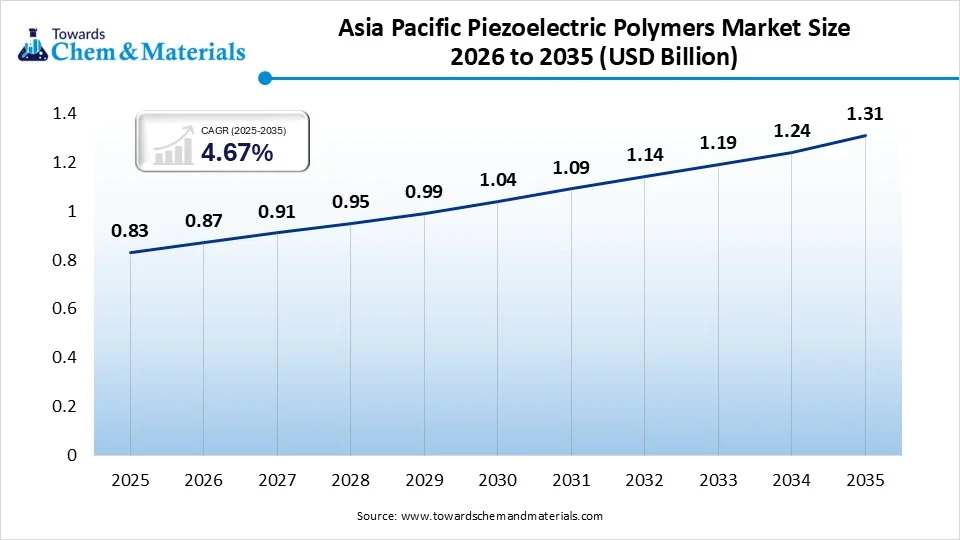
China Piezoelectric Polymers Market Growth Factor
The Chinese piezoelectric polymers market is driven by rapid growth in wearable electronics, medical devices, and smart infrastructure, with high demand for lightweight, flexible materials, which fuels the growth of the market in the country. Advances in energy harvesting, IoT applications, and the need for precision sensing in the automotive sector are also the major drivers of the market in the country. The Chinese market is highly competitive, with significant investment in research to improve piezoelectric coefficients and ferroelectric stability.
North America Piezoelectric Polymers Market Growth Factor
North America piezoelectric polymers market segment accounted for the major revenue share 21.00% in 2025. North America is expected to have the fastest growth in the market in the forecast period, driven by high demand for flexible, lightweight, and efficient materials in healthcare (wearable monitors), aerospace, and consumer electronics, fueling growth. The major factor that fuels growth is rising R&D investments in smart materials, the adoption of IoT, and the need for advanced sensors/actuators in North America. The region is also experiencing growth due to the need for eco-friendly, energy-efficient solutions for powering small devices.
U.S. Piezoelectric Polymers Market Growth Factor
The U.S. piezoelectric polymers market is driven by rising demand for lightweight, flexible, and energy-efficient components in medical devices, wearables, and sensors, fueling the growth of the market. High investment in R&D for smart materials by major players and universities in the U.S. is fostering innovation. Continued R&D into enhancing piezoelectric coefficients and ferroelectric stability in polymers further fuels the growth and expansion in the country.
Europe Piezoelectric Polymers Market Growth Factor
Europe piezoelectric polymers market segment accounted for the major revenue share 25.00% in 2025. The European piezoelectric polymers market is driven by increasing demand for flexible, lightweight, and energy-efficient components in automotive, healthcare, and smart device sectors. Growth is accelerated by strict environmental regulations promoting lead-free materials, alongside high adoption of wearable electronics and energy-harvesting sensors. Innovation in thin-film and nanocomposite polymers, along with 3D printing, is enhancing performance and reducing production costs.
Germany Piezoelectric Polymers Market Growth Factor
The German piezoelectric polymers market is driven by high demand for lightweight, flexible, and energy-efficient components in the automotive, medical, and consumer electronics sectors. Key growth factors include the expansion of wearable electronics, advanced sensor adoption in Industry 4.0, and the shift towards lead-free, sustainable piezoelectric materials. Environmental regulations in Europe are accelerating the transition from traditional lead zirconate titanate (PZT) to more sustainable piezoelectric polymers.
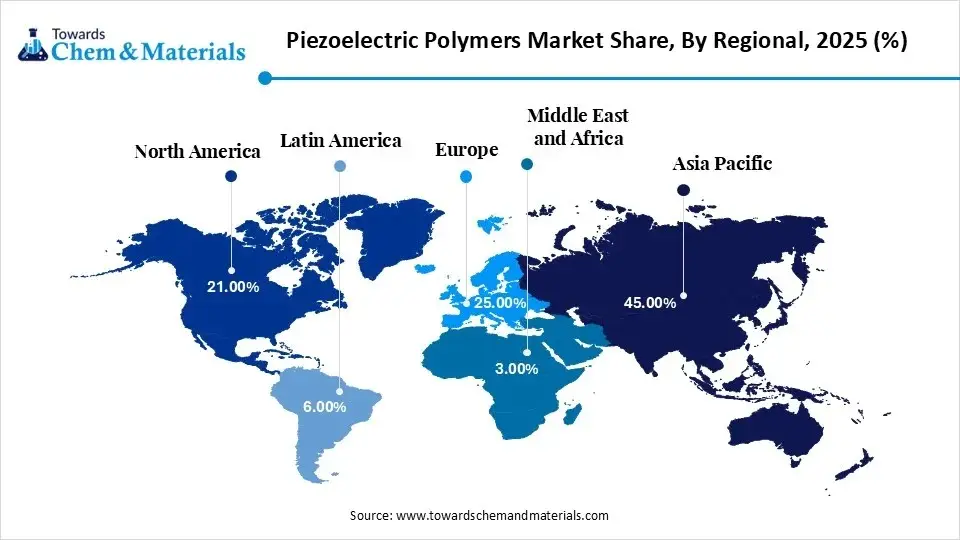
Piezoelectric Polymers Market Share, By Regional, 2025 (%)
| Regional | Revenue Share, 2025 (%) |
| North America | 21.00% |
| Europe | 25.00% |
| Asia Pacific | 45.00% |
| Latin America | 6.00% |
| Middle East & Africa | 3.00% |
- Asia Pacific – Dominating with a 45.00% share, strong electronics manufacturing base, rapid industrial automation, and rising demand for smart devices and sensors drive market leadership.
- Europe – With a 25.00% share, advanced R&D capabilities, strong automotive and healthcare sectors, and growing adoption of smart materials support steady demand.
- North America – Holding a 21.00% share, high investment in aerospace, defense, and medical technologies sustains consistent market adoption.
- Latin America – With a 6.00% share, gradual industrial development and emerging electronics adoption contribute to modest growth.
- Middle East & Africa – Making up 3.00% of the market, limited advanced manufacturing base and lower technology penetration restrict overall market contribution.
Recent Developments
- In June 2025, OQ introduced 17 new Luban-brand polypropylene (PP) and polyethylene (PE) grades aimed at advancing applications in packaging, infrastructure, and sustainability. Debuted at K 2025, the portfolio includes impact copolymers for rigid packaging, random copolymers for food containers, and LLDPE for water storage, addressing global megatrends.(Source: interplasinsights.com)
- In June 2025, Syensqo expanded its Tecnoflon® FFKM portfolio with the markets first perfluoroelastomers produced via proprietary Non-Fluorosurfactant (NFS) technology. Developed for high-purity semiconductor and extreme-temperature applications, this expanded line-up includes new peroxide-curable and high-temperature grades capable of operating up to 320°C.(Source: interplasinsights.com)
- In November 2025, Piersica launched PIRION, a patented polymer technology designed to act as both an electrode binder and solid electrolyte to enhance lithium-ion battery performance and safety. Utilizing a piezoelectric effect, this material enables energy densities exceeding 600 Wh/kg and maintains stability at temperatures above 300°C.(Source: chargedevs.com)
Top Players In The Piezoelectric Polymers Market & Their Offerings:
- Arkema S.A.: Arkema is a leading supplier of piezoelectric polymers through its subsidiary Piezotech, which produces PVDF and P(VDF-TrFE) copolymers used in sensors, actuators, energy harvesting devices, and flexible electronics. These materials are available as powders, inks, and films and are widely used in consumer electronics, medical devices, and automotive applications.
- Solvay S.A.: Solvay develops high-performance PVDF-based polymers for piezoelectric applications such as vibration sensors, aerospace monitoring systems, and medical diagnostic equipment. The company focuses on advanced material formulations that enhance electromechanical performance and sustainability.
- Kureha Corporation: Kureha manufactures piezoelectric polymer films such as KF Piezo Film based on PVDF technology. These materials are used in acoustic sensors, industrial transducers, wearable electronics, and energy harvesting devices, supported by the company’s vertically integrated polymer production capabilities.
- Toray Industries, Inc.: Toray develops advanced functional polymers and composite materials, including piezoelectric polymers used in sensors, actuators, and electronic components. The company leverages expertise in polymer chemistry and nanotechnology to supply high-performance materials for electronics, automotive, and industrial automation sectors.
- Daikin Industries, Ltd.: Daikin produces fluoropolymer materials, including PVDF-based compounds used in piezoelectric polymer applications. These materials provide strong chemical resistance, flexibility, and electrical properties required for advanced sensors and electronic devices.
- PI Ceramic GMBH
- APC International, Ltd.
- Harris Corporation
- CTS Corporation
- Peizosystem Jena GmbH
- CeramTec
- Sparkler Ceramics
- Noliac A/S
- Piezomechanik Dr. Lutz Pickelmann GmbH
- Mad City Labs, Inc.
Segments Covered:
By Product
- Ceramics
- Polymers
- Composites
- Others
By End-Use
- Automotive
- Healthcare
- Information & Telecom
- Consumer Goods
- Aerospace & Defense
- Others
By Application
- Actuators
- Sensors
- Motors
- Acoustic devices
- Generators
- SONAR
- Transducers
- Others
By Regions
- North America
- U.S.
- Canada
- Mexico
- Europe
- Germany
- UK
- France
- Italy
- Spain
- Asia Pacific
- China
- India
- Japan
- South Korea
- Latin America
- Brazil
- Argentina
- Middle East & Africa
- Saudi Arabia
- South Africa
FAQ's




Select User License to Buy
Figures (4)








 sales@towardschemandmaterials.com
 Download Sample
 Schedule a Meeting