Find the Right Market Report
Search thousands of industry reports, market insights, and research studies in one place.
Not sure where to start? Try one of these:
The North America aerospace plastics market size was valued at USD 4.86 billion in 2025 and is expected to reach USD 9.74 billion by 2035, growing at a CAGR of 7.20% during the forecast period of 2026-2035. The North America aerospace plastics market covers plastics and polymer composites used in aircraft and spacecraft in the United States, Canada and Mexico, including high-performance thermoplastics such as PEEK, PEKK, PEI and PPS, engineering plastics such as polycarbonate and PMMA, thermoset resins, and thermoplastic composite tapes and laminates, used in cabin interiors, structural components, engine and propulsion parts, windows and canopies, and electrical systems for commercial aircraft, military aircraft, business and general aviation, rotorcraft and space.
PEEK & PEKK accounted for the largest polymer type share in 2025, at 24.00%, because seats, panels, bins and galleys use flame-retardant plastics. U.S. accounted for 84.00% of revenue in 2025, supported by Boeing, major engine makers, defense programmes and space companies. Demand is driven by aircraft production, lightweighting, cabin refurbishment, defense and space growth. Suppliers are adding capacity, with Syensqo expanding U.S. aerospace composites production in July 2026.
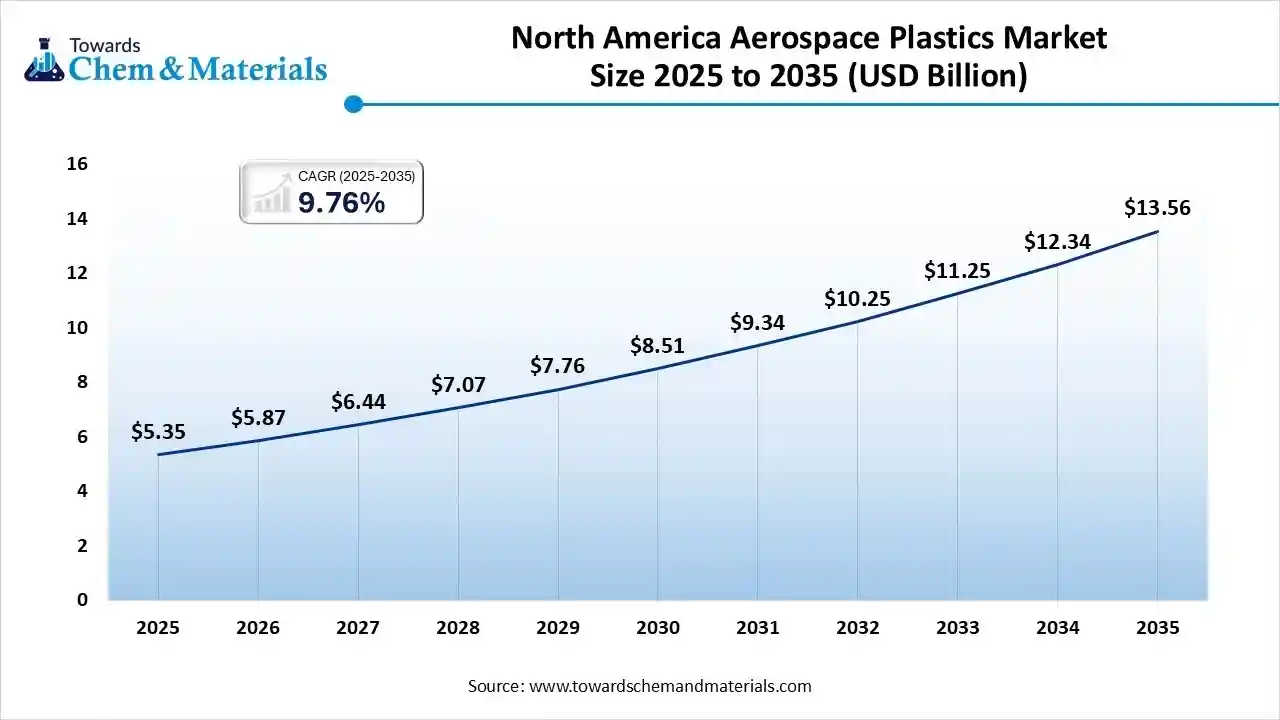
Note: 2025 is the base year; 2026-2035 values are forecasts.
Sources: Expert interviews, secondary sources, Towards Chemical and Materials database and Towards Chemical and Materials analysts.
The North America aerospace plastics market is projected to grow from USD 4.86 billion in 2025 to USD 9.74 billion by 2035 because aircraft makers use plastics to cut weight and meet fire safety rules, and North America builds a large share of the world's aircraft and engines. Aircraft production, lightweighting, cabin refurbishment, defense and space growth support solid growth, lifting the market to USD 6.88 billion by 2030 and sustaining a CAGR of 7.20% by 2035. Polypropylene compounds and polyolefin parts serve lower-temperature cabin uses.
Analyst View: We built the estimate from aircraft builds, plastic content per aircraft and average material prices by country, cross-checked against aerospace revenues of leading polymer and composite suppliers. Our value sits above published comparable estimates because it includes thermoplastic composites.
Rising aircraft production, fleet expansion, and lightweighting initiatives are increasing demand for aerospace plastics across structural components and cabin interiors. Growing defense spending, aircraft refurbishment and commercial space activities further support market growth.
Long qualification cycles, high material costs, and aircraft production delays restrict market expansion. Supply-chain constraints and limited availability of specialized polymers also increase procurement costs and manufacturing lead times.
Thermoplastic structures, 3D printing, and expanding space and eVTOL programmes create new growth avenues. Aerospace manufacturing expansion in Mexico and rising demand for sustainable aviation materials further strengthen market opportunities.
Market Drivers - Impact & CAGR Contribution (2026-2035)
| Driver | Impact | ≈ CAGR Contribution | Time Horizon | Key Regions |
| Aircraft production rises | High | +2.81 pp | Short to long term | North America-wide, strongest in U.S. |
| Lightweighting saves fuel | Medium | +2.37 pp | Medium to long term | North America-wide, fastest uptake in Mexico |
| Cabin refurbishment grows | Medium | +2.02 pp | Short to medium term | North America-wide |
| Defence spending | Low | +1.58 pp | Long term | U.S. and Mexico |
Note: Contributions are indicative estimates of each factor's effect on annual growth.
Sources: Expert interviews, secondary sources, Towards Chemical and Materials database and Towards Chemical and Materials analysts.
Taken together, these drivers add about 8.78 percentage points to the annual growth of the North America aerospace plastics market, with aircraft production rises having the largest effect. Their influence is strongest in the U.S., while uptake grows fastest in Mexico.
Market Restraints - Impact & Negative CAGR Contribution (2026-2035)
| Restraint | Impact | ≈ Negative CAGR Contribution | Time Horizon | Key Regions |
| Long qualification cycles | High | -0.71 pp | Short to medium term | North America-wide |
| High material costs | High | -0.52 pp | Medium term | Smaller and price-sensitive markets |
| Aircraft production delays | Medium | -0.35 pp | Short term | U.S. and other mature markets |
Note: Contributions are indicative estimates of each factor's effect on annual growth.
Sources: Expert interviews, secondary sources, Towards Chemical and Materials database and Towards Chemical and Materials analysts.
These restraints are expected to reduce annual growth of the North America aerospace plastics market by about 1.58 percentage points, led by long qualification cycles. Their effect eases over the forecast period as suppliers, buyers, and regulators adapt, leaving a net CAGR of 7.20% from 2026 to 2035.
| Segments | 2025 Share | 2035 Share | CAGR 2026-2035 |
| PEEK & PEKK | 24.00% | 26.08% | 8.10% |
| PEI | 18.00% | 17.45% | 6.90% |
| Polycarbonate & PMMA | 15.00% | 14.58% | 6.90% |
| PPS | 10.00% | 9.75% | 6.90% |
| Thermoset Resins | 21.00% | 20.43% | 6.90% |
| Others | 12.00% | 11.70% | 6.90% |
Note: 2025 is the base year; 2035 shares and CAGRs are forecasts.
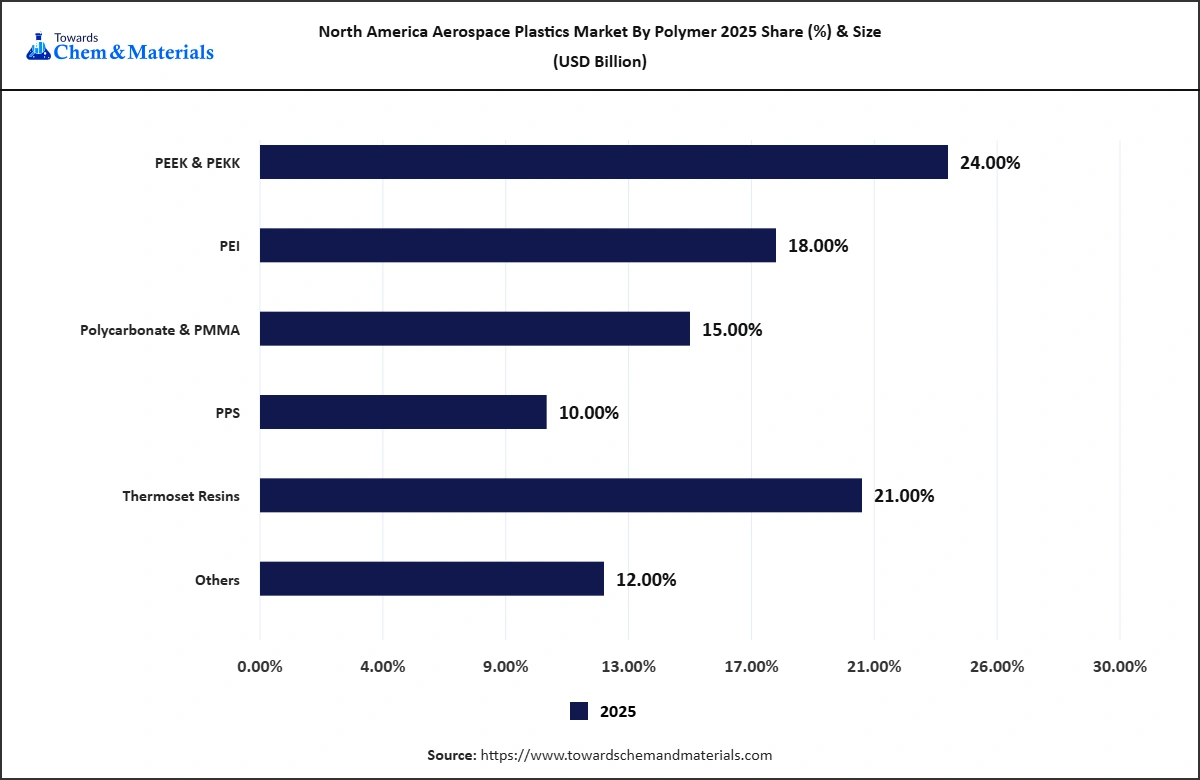
Sources: Expert interviews, secondary sources, Towards Chemical and Materials database, and Towards Chemical and Materials analysts.
PEEK & PEKK accounted for 24.00% in 2025, PEI for 18.00%, Polycarbonate & PMMA for 15.00%, PPS for 10.00%, Thermoset Resins for 21.00%, and Others for 12.00%. PEEK & PEKK lead and are also growing the fastest.
PEEK & PEKK: Holding a 24.00% share of the North America aerospace plastics market in 2025, this segment is projected to expand at a CAGR of 8.10% by 2035. PEEK and PEKK lead in value due to their high heat resistance and mechanical strength, making them suitable for structural and engine components. Demand is expected to grow faster than the overall market over the forecast period.
PEI: This segment accounted for 18.00% of the North America aerospace plastics market in 2025 and is projected to expand at a CAGR of 6.90% from 2026 to 2035. PEI is widely used in cabin interior parts for flame resistance. The PEI segment is expected to grow broadly in line with the overall market over the forecast period.
Polycarbonate & PMMA: With a 15.00% market share in 2025, this segment is projected to expand at a CAGR of 6.90% by 2035. Polycarbonate and PMMA are widely used in aircraft windows, transparencies, and lighting components due to their optical clarity and lightweight properties. Growth is expected to remain broadly in line with the overall market.
PPS: This segment accounted for 10.00% of the North America aerospace plastics market in 2025 and is projected to expand at a CAGR of 6.90% from 2026 to 2035. PPS is used in clips, brackets, and composites. The PPS segment is expected to grow broadly in line with the overall market over the forecast period.
Thermoset Resins: Contributing 21.00% to the market in 2025, this segment is projected to expand at a CAGR of 6.90% from 2026 to 2035. Thermoset resins play an important role in aerospace composite structures due to their strength, durability, and resistance to demanding operating conditions. Growth is expected to remain broadly in line with the overall market.
Others: This segment accounted for 12.00% of the North America aerospace plastics market in 2025 and is projected to expand at a CAGR of 6.90% by 2035. Other plastics include PTFE and polyamides. The others segment is expected to grow broadly in line with the overall market over the forecast period.
Segment Outlook: PEEK & PEKK remains the largest polymer type segment through 2035, holding about 26.08% of the market in 2035, and also records the highest CAGR of 8.10% from 2026 to 2035, strengthening its lead in the North America aerospace plastics market.
| Segments | 2025 Share | 2035 Share | CAGR 2026-2035 |
| Cabin Interiors | 38.00% | 35.63% | 6.52% |
| Structural Components | 27.00% | 30.29% | 8.42% |
| Engine & Propulsion | 14.00% | 13.66% | 6.92% |
| Windows & Canopies | 9.00% | 8.73% | 6.92% |
| Electrical & Others | 12.00% | 11.70% | 6.92% |
Note: 2025 is the base year; 2035 shares and CAGRs are forecasts.
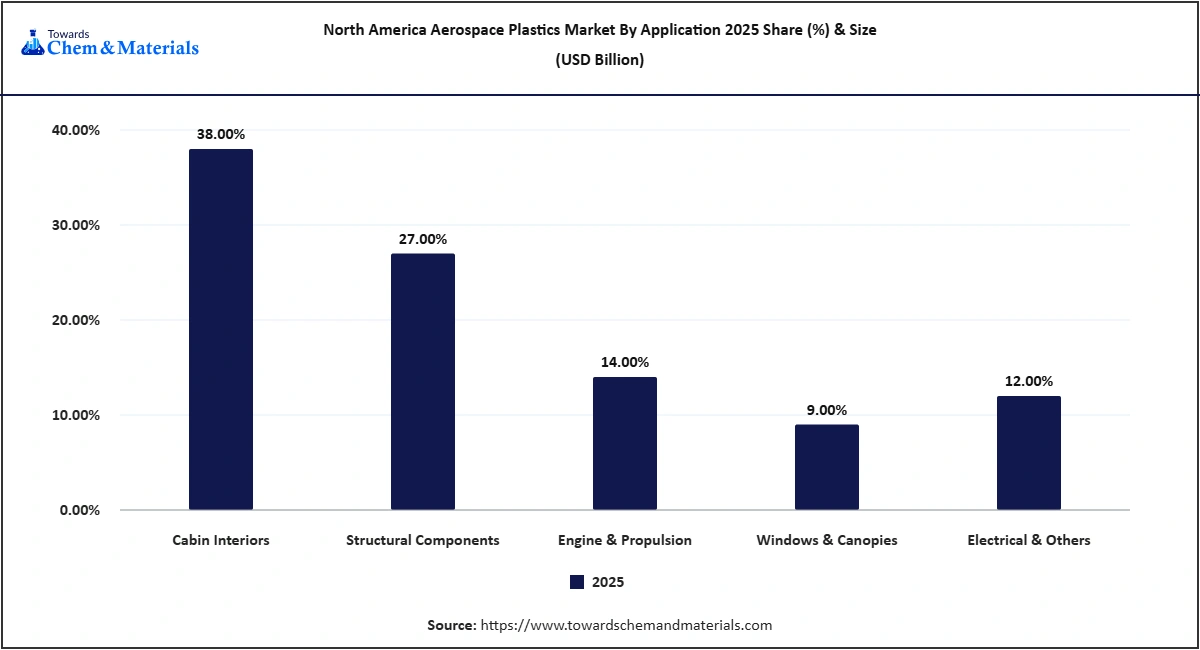
Sources: Expert interviews, secondary sources, Towards Chemical and Materials database, and Towards Chemical and Materials analysts.
Cabin Interiors accounted for 38.00% in 2025, Structural Components for 27.00%, Engine & Propulsion for 14.00%, Windows & Canopies for 9.00%, and Electrical & Others for 12.00%. Cabin Interiors leads, while Structural Components is growing the fastest.
Cabin Interiors: Holding a 38.00% share of the North America aerospace plastics market in 2025, this segment is projected to expand at a CAGR of 6.52% by 2035. Aircraft seats, panels, overhead bins, and galleys use flame-retardant plastics to meet safety requirements and reduce cabin weight. Growth is expected to remain slower than the overall market over the forecast period.
Structural Components: This segment accounted for 27.00% of the North America aerospace plastics market in 2025 and is projected to expand at a CAGR of 8.42% from 2026 to 2035. Structural components grow fastest as thermoplastic composites replace metal brackets and clips. The structural components segment is expected to grow faster than the overall market over the forecast period.
Engine & Propulsion: With a 14.00% market share in 2025, this segment is projected to expand at a CAGR of 6.92% by 2035. High-performance polymers are used in engine and propulsion components that require heat resistance, durability, and dimensional stability. Growth is expected to remain broadly in line with the overall market.
Windows & Canopies: This segment accounted for 9.00% of the North America aerospace plastics market in 2025 and is projected to expand at a CAGR of 6.92% from 2026 to 2035. Windows and canopies use polycarbonate and acrylic. The windows & canopies segment is expected to grow broadly in line with the overall market over the forecast period.
Electrical & Others: Making up 12.00% of the market in 2025, this segment is projected to expand at a CAGR of 6.92% by 2035. Applications include wire insulation, electrical housings, connectors, and other aircraft components requiring thermal stability and electrical insulation. Growth is expected to remain broadly in line with the overall market.
Segment Outlook: Cabin Interiors is projected to retain its position as the largest application segment through 2035, accounting for approximately 35.63% of the market. Meanwhile, Structural Components is expected to register the fastest growth, with a CAGR of 8.42% from 2026 to 2035. Windows & Canopies remains the smallest application segment, catering to specialized aerospace requirements across North America.
| Segments | 2025 Share | 2035 Share | CAGR 2026-2035 |
| Commercial Aircraft | 56.00% | 54.00% | 6.80% |
| Military Aircraft | 22.00% | 21.97% | 7.20% |
| Business & General Aviation | 12.00% | 12.01% | 7.20% |
| Rotorcraft & Space | 10.00% | 12.01% | 9.20% |
Note: 2025 is the base year; 2035 shares and CAGRs are forecasts.
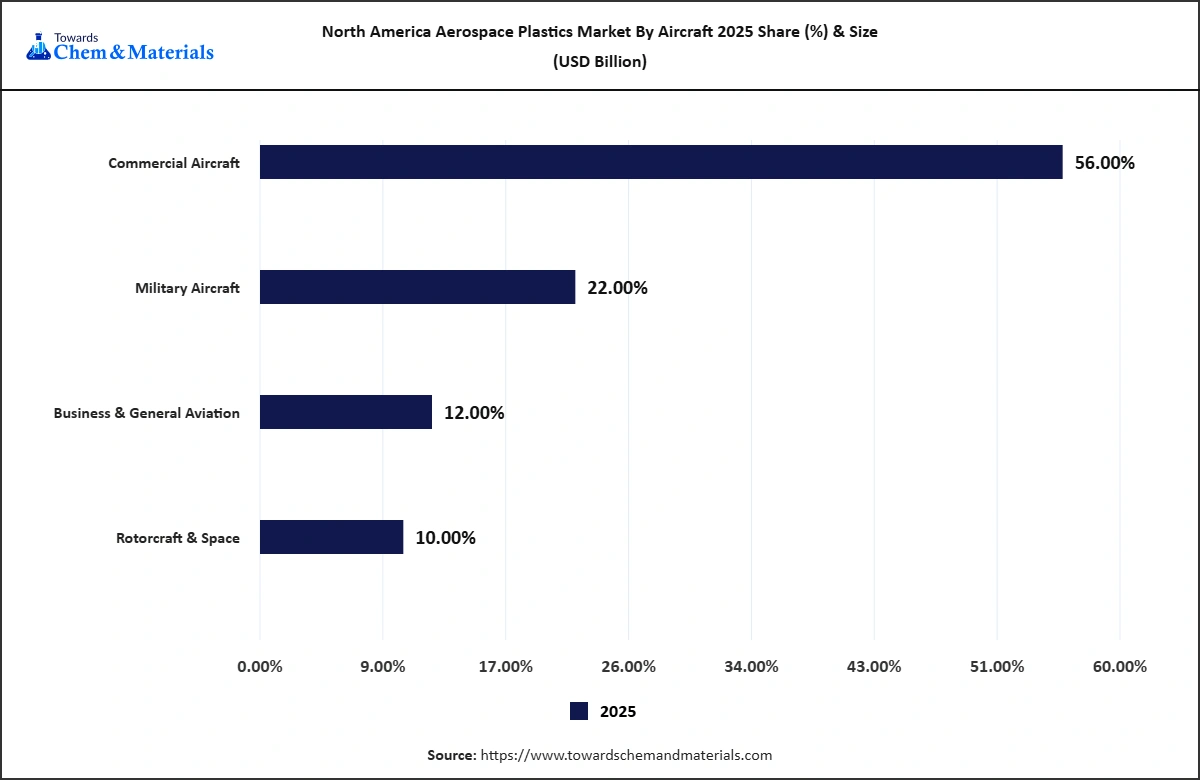
Sources: Expert interviews, secondary sources, Towards Chemical and Materials database and Towards Chemical and Materials analysts.
Commercial Aircraft accounted for 56.00% in 2025, Military Aircraft for 22.00%, Business & General Aviation for 12.00% and Rotorcraft & Space for 10.00%. Commercial Aircraft leads, while Rotorcraft & Space is growing the fastest.
Commercial Aircraft: Holding a 56.00% share of the North America aerospace plastics market in 2025, this segment is projected to expand at a CAGR of 6.80% from 2026 to 2035. Its leading position is supported by aircraft manufacturing and refurbishment activities involving major manufacturers such as Boeing and Airbus and their supply chains. Growth is expected to remain slower than the overall market over the forecast period.
Military Aircraft: Representing 22.00% of the market in 2025, this segment is projected to expand at a CAGR of 7.20% by 2035. Military aircraft manufacturers use advanced polymers in structural components, interiors, and other applications requiring high strength, durability, and thermal resistance. Growth is expected to remain broadly in line with the overall market.
Business & General Aviation: With a 12.00% market share in 2025, this segment is projected to expand at a CAGR of 7.20% from 2026 to 2035. Demand is supported by the use of lightweight plastics in aircraft interiors, seating, panels, and other components that improve durability and passenger comfort. Growth is expected to remain broadly in line with the overall market.
Rotorcraft & Space: Making up 10.00% of the market in 2025, this segment is projected to expand at a CAGR of 9.20% from 2026 to 2035. Increasing investments in launch vehicles, commercial space programmes and eVTOL aircraft are driving demand for lightweight, durable and high-performance polymer materials. Growth is expected to exceed the overall market over the forecast period.
Segment Outlook: Commercial Aircraft is expected to retain its position as the largest aircraft type segment through 2035, accounting for approximately 54.00% of the market. Meanwhile, Rotorcraft & Space is projected to record the fastest growth, with a CAGR of 9.20% by 2035. Despite its smaller initial market share, this segment is gaining momentum through expanding space and next-generation aircraft programmes.
Analyst View: Segment shares were allocated from demand, product portfolios and pricing in each category. PEEK & PEKK, Cabin Interiors and Commercial Aircraft lead their categories because they meet the core needs of today's buyers. We expect Structural Components and Rotorcraft & Space to gain share as newer technologies, users and applications grow faster.
| Country | 2025 Share | 2035 Share | CAGR 2026-2035 |
| U.S. | 84.00% | 82.85% | 7.06% |
| Canada | 10.00% | 10.27% | 7.46% |
| Mexico | 6.00% | 6.88% | 8.66% |
Note: 2025 is the base year; 2035 shares and CAGRs are forecasts.
Sources: Expert interviews, secondary sources, Towards Chemical and Materials database and Towards Chemical and Materials analysts.
U.S. accounted for 84.00% in 2025, Canada for 10.00%, and Mexico for 6.00%. U.S. leads, while Mexico is growing fastest.
U.S.: Holding an 84.00% share of the North America aerospace plastics market in 2025, the country is projected to expand at a CAGR of 7.06% from 2026 to 2035. Its leading position is supported by the presence of Boeing, major engine manufacturers, defence programmes, space companies and key aerospace plastics suppliers. Growth is expected to remain broadly in line with the overall market over the forecast period.
Canada: Representing 10.00% of the regional market in 2025, Canada is projected to expand at a CAGR of 7.46% from 2026 to 2035. Its aerospace industry benefits from the presence of Bombardier, Airbus Canada, and several engine and rotorcraft manufacturers concentrated in Quebec and Ontario. Growth is expected to remain broadly in line with the overall market.
Mexico: With a 6.00% market share in 2025, Mexico is projected to register a CAGR of 8.66% by 2035. Expanding aerospace component manufacturing facilities in Querétaro, Chihuahua, and Baja California are strengthening the country's position as a regional production hub. Growth is expected to exceed the overall market over the forecast period.
Analyst View: Regional shares were built from demand, installed base, spending, and supplier presence in each country. U.S. leads because of its mature demand base and strong suppliers. We assign Mexico the highest growth premium because investment, adoption, and capacity are expanding fastest there.
| Rank | Company Name | 2025 Share (%) | Key Products / Business | Headquarters |
| 1 | Syensqo | PEEK, PEKK, PPSU and aerospace composites | Belgium | |
| 2 | Victrex | PEEK polymers and composite tapes | United Kingdom | |
| 3 | Hexcel | Composite prepregs and HexPEKK | United States | |
| 4 | SABIC | ULTEM PEI and polycarbonate | Saudi Arabia | |
| 5 | Toray Advanced Composites | Thermoplastic composites | United States | |
| 6 | Arkema | Kepstan PEKK and polyamides | France | |
| 7 | Evonik | 82.30% | VESTAKEEP PEEK and foams | Germany |
| 8 | Ensinger | 82.30% | Engineering plastic stock shapes | Germany |
| 9 | Covestro | 82.30% | Polycarbonate sheets and films | Germany |
| 10 | Celanese | 61.73% | Engineering polymers | United States |
Note: Company shares are 2025 estimates.
Sources: Company press releases, expert interviews, secondary sources, Towards Chemical and Materials database and Towards Chemical and Materials analysts.
Syensqo led the North America aerospace plastics market with an estimated largest share of 2025 revenue, followed by Victrex and Hexcel. Syensqo leads with PEEK, PEKK, PPSU and aerospace composites, Victrex competes with PEEK polymers and composite tapes, and Hexcel offers composite prepregs and HexPEKK. SABIC, Toray Advanced Composites, Arkema, Evonik, Ensinger, Covestro and Celanese compete through ULTEM PEI and polycarbonate, thermoplastic composites, kepstan PEKK and polyamides, VESTAKEEP PEEK and foams, engineering plastic stock shapes, polycarbonate sheets and films and engineering polymers.
The top 10 companies accounted for an impressive revenue of 2025, while the remaining was shared among many converters, compounders, and machining firms. The North America aerospace plastics market is moderately concentrated, and competition centers on flammability certification, OEM qualification, high-temperature performance, lightweighting, supply reliability, and long-term contracts.
Syensqo: Headquartered in Belgium, Syensqo held an estimated 267.49% share of the North America aerospace plastics market in 2025. Its portfolio includes PEEK, PEKK, PPSU and aerospace composites. Towards Chemical and Materials positions the company as a Leader in its Companies Quadrant.
Victrex: Based in the United Kingdom, Victrex recorded an estimated 185.19% market share in 2025. The company specializes in PEEK polymers and composite tapes for advanced aerospace applications. It is classified as a Leader in the Towards Chemical and Materials Companies Quadrant.
Hexcel: Headquartered in the United States, Hexcel held an estimated 185.19% share of the regional market in 2025. Its key offerings include composite prepregs and HexPEKK materials. Towards Chemical and Materials identifies the company as a Leader in its Companies Quadrant.
SABIC: With headquarters in Saudi Arabia, SABIC captured an estimated 164.61% share of the North America aerospace plastics market in 2025. Its portfolio includes ULTEM PEI and polycarbonate materials for aerospace applications. The company holds a Leader position in the Towards Chemical and Materials Companies Quadrant.
Toray Advanced Composites: Based in the United States, Toray Advanced Composites represented an estimated 144.03% of the regional market in 2025. Its product portfolio focuses on thermoplastic composites used in advanced aerospace structures. Towards Chemical and Materials classifies the company as a Leader in its Companies Quadrant.
Arkema: Headquartered in France, Arkema held an estimated 102.88% market share in 2025. Its aerospace materials portfolio includes Kepstan PEKK and polyamides, supporting applications that require high-performance polymers. The company is positioned as a Leader in the Towards Chemical and Materials Companies Quadrant.
Evonik: Based in Germany, Evonik recorded an estimated 82.30% share of the regional market in 2025. Its key offerings include VESTAKEEP PEEK and specialty foams for demanding industrial and aerospace applications. Towards Chemical and Materials positions the company as an Innovator in its Companies Quadrant.
Ensinger: Headquartered in Germany, Ensinger held an estimated 82.30% market share in 2025. The company specializes in engineering plastic stock shapes that support precision manufacturing and aerospace component production. It is classified as an Innovator in the Towards Chemical and Materials Companies Quadrant.
Covestro: With headquarters in Germany, Covestro represented an estimated 82.30% of the regional market in 2025. Its portfolio includes polycarbonate sheets and films used in lightweight aerospace applications. Towards Chemical and Materials identifies the company as an Innovator in its Companies Quadrant.
Celanese: Headquartered in the United States, Celanese captured an estimated 61.73% share of the market in 2025. Its engineering polymers serve aerospace applications requiring strength, durability and performance under demanding operating conditions. The company holds an Innovator position in the Towards Chemical and Materials Companies Quadrant.
The North America aerospace plastics ecosystem links polymer producers, composite & semi-finished makers, part makers, aircraft oems and regulators, with each stage adding value before products reach end users. Material informatics speeds up qualification of new aerospace grades.
| Ecosystem Stage | Role in the Market | Key Companies |
| Polymer Producers | Make high-performance resins | Syensqo, Victrex, SABIC, Arkema, Evonik |
| Composite & Semi-Finished Makers | Make tapes, prepregs and shapes | Hexcel, Toray Advanced Composites, Ensinger |
| Part Makers | Mould, machine and form parts | Interior and component suppliers |
| Aircraft OEMs | Build aircraft | Boeing, Bombardier, Lockheed Martin, Gulfstream |
| Regulators | Certify materials | FAA, Transport Canada, AFAC |
Sources: Company press releases, expert interviews, secondary sources, Towards Chemical and Materials database and Towards Chemical and Materials analysts.
Polymer Producers: Make high-performance resins. Key participants include Syensqo, Victrex, SABIC, Arkema, Evonik.
Composite & Semi-Finished Makers: Make tapes, prepregs and shapes. Key participants include Hexcel, Toray Advanced Composites, Ensinger.
Part Makers: Mould, machine and form parts. Key participants include Interior and component suppliers.
Aircraft OEMs: Build aircraft. Key participants include Boeing, Bombardier, Lockheed Martin, Gulfstream.
Regulators: Certify materials. Key participants include FAA, Transport Canada, AFAC.
Value in the North America aerospace plastics market flows from upstream material and technology suppliers to manufacturers and service providers, then through distribution partners to end users. Companies that integrate several stages or build long-term relationships with end users capture a larger share of this value.
The Towards Chemical and Materials Companies Quadrant positions key participants in the North America aerospace plastics market by market strength, reflecting revenue scale, market share and geographic reach, and by innovation and growth strategy, reflecting product portfolio breadth, R&D intensity and partnerships. Positions reflect each company's estimated 2025 share of the North America aerospace plastics market and our assessment of its product innovation, portfolio breadth and partnerships.
Sources: Company press releases, expert interviews, secondary sources, Towards Chemical and Materials database and Towards Chemical and Materials analysts.
Leaders: Syensqo, Victrex, Hexcel, SABIC, Toray Advanced Composites and Arkema combine high market share with broad portfolios and strong innovation.
Innovators: Evonik, Ensinger, Covestro and Celanese bring newer technologies and specialised products.
By Polymer Type
By Application
By Aircraft Type
By Country
The North America aerospace plastics market was defined as plastics and polymer composites used in aircraft and spacecraft in the United States, Canada and Mexico, including high-performance thermoplastics such as PEEK, PEKK, PEI and PPS, engineering plastics such as polycarbonate and PMMA, thermoset resins, and thermoplastic composite tapes and laminates, used in cabin interiors, structural components, engine and propulsion parts, windows and canopies, and electrical systems for commercial aircraft, military aircraft, business and general aviation, rotorcraft and space. The 2025 base year was built bottom-up from demand volumes and average prices by polymer type, application and aircraft type and region, and checked top-down against the market-specific revenues of leading companies and published estimates. Segment, country and company values were allocated from polymer type, application and aircraft type and country demand. Key estimates were verified by cross-checking company disclosures, regulatory and industry data and published third-party estimates, and inputs that could not be reconciled were excluded. All segment, regional and company figures were reconciled to the same 2025 base year, and the 2026-2035 forecast, which applies a constant CAGR from the 2025 base, was recalculated and validated.
The North America aerospace plastics market is set for steady expansion as aircraft production and related demand keep growing. Our estimate links value to underlying demand, installed base, and pricing, so the forecast follows real adoption rather than headline hype. The main upside comes from thermoplastic structures and space programmes, while the main risks are long qualification cycles and production delays.
Reliable market intelligence and data-driven insights across the global chemicals and materials industry, helping businesses understand trends, competition, pricing, and emerging opportunities.
Schedule a Demo