Find the Right Market Report
Search thousands of industry reports, market insights, and research studies in one place.
Not sure where to start? Try one of these:
The global nickel acetate market size was valued at USD 142 million in 2025 and is expected to reach USD 244.87 million by 2035, growing at a CAGR of 5.60% during the forecast period of 2026-2035. The nickel acetate market covers nickel (II) acetate tetrahydrate crystals and solutions in industrial, battery, and reagent grades, used in anodized aluminum sealing and electroplating, catalyst preparation, battery cathode precursors, textile dyeing mordants, and laboratory uses. Crystals (Tetrahydrate) accounted for the largest form share in 2025, at 62.00%, because they are stable and easy to ship.
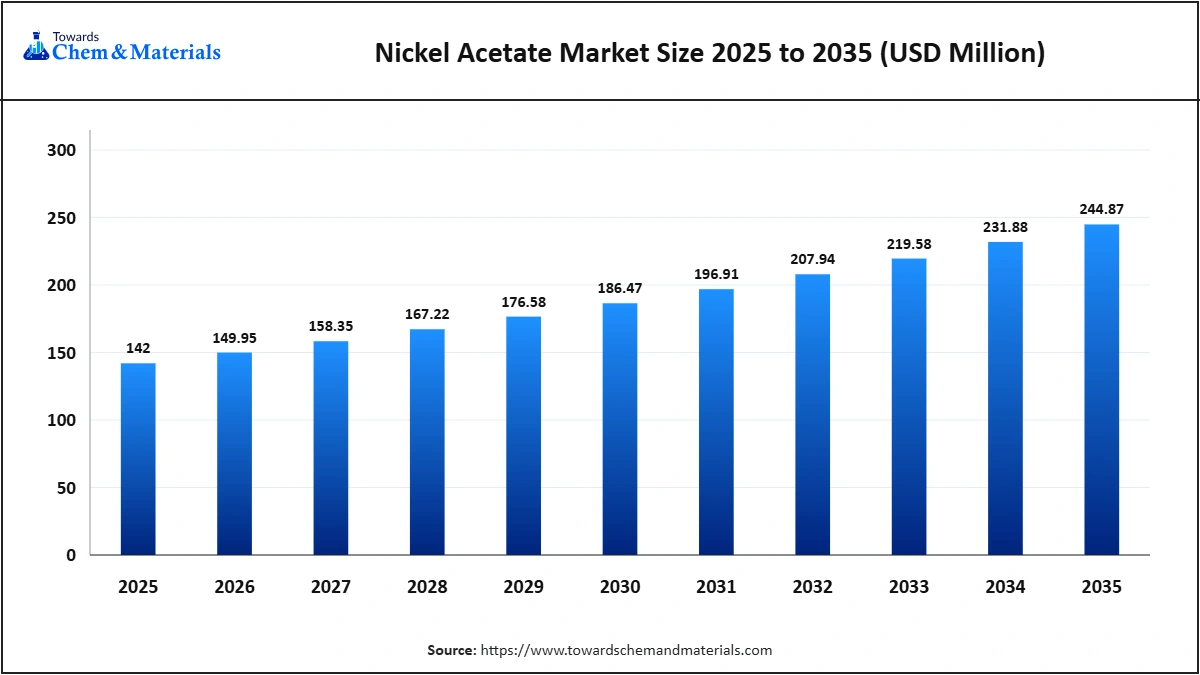
Note: 2025 is the base year; 2026-2035 values are forecasts.
Sources: Expert interviews, secondary sources, Towards Chemical and Materials database, and Towards Chemical and Materials analysts.
Based on regional analysis, Asia Pacific accounted for 55.00% of revenue in 2025, supported by China's dominance in nickel salts, anodized aluminum, and battery materials. Demand for anodized aluminum, catalysts, and battery research, along with industrial expansion across Asia, drives market growth. Nickel supply is expanding, with Ji En Nickel commissioning a 5,000-tonne-a-year line in June 2026.
The nickel acetate market is projected to grow from USD 142.00 million in 2025 to USD 244.87 million by 2035 because nickel acetate is the standard nickel salt for sealing anodized aluminum and a precursor for catalysts. Anodized aluminum demand, catalysts, battery research, and Asian industrial growth support steady growth, lifting the market to USD 186.47 million by 2030 and sustaining a CAGR of 5.60% from 2026 to 2035.
Analyst View: We built the estimate from nickel acetate consumption by application and region and nickel-linked prices, cross-checked against producer activities and trade data. Published estimates are limited, so our value is evidence-based.
Growing anodized aluminum production across automotive, construction, and electronics industries is supporting nickel acetate demand in sealing applications. Increasing use of nickel-based catalysts, expanding battery research, and continued applications in textile dyeing are further supporting consumption. Additionally, rapid industrialization and specialty chemical manufacturing across Asia are strengthening regional market growth.
Stringent regulations governing nickel compounds, particularly occupational exposure, environmental discharge, and chemical handling, are increasing compliance costs. Fluctuations in international nickel prices create procurement uncertainty and pressure manufacturers' margins. Furthermore, growing adoption of nickel-free sealing technologies in anodized aluminum processing and relatively specialized application volumes are limiting market expansion.
Growing investments in battery research are creating opportunities for high-purity nickel acetate grades. Increasing adoption of recycled nickel feedstock offers potential for sustainable production and reduced raw material dependence. Additionally, expanding Asian anodizing industries, rising demand for nickel-based catalyst precursors, and growing preference for ready-to-use solutions present opportunities for manufacturers.
Market Drivers - Impact & CAGR Contribution (2026-2035)
| Driver | Impact | ≈ CAGR Contribution | Time Horizon | Key Regions |
| Anodized aluminum grows | High | +2.19 pp | Short to long term | Global, strongest in Asia Pacific |
| Catalysts need nickel | Medium | +1.84 pp | Medium to long term | Global, fastest uptake in Asia Pacific |
| Battery research uses salts | Medium | +1.57 pp | Short to medium term | Global |
| Textiles use mordants | Low | +1.23 pp | Long term | Developed and emerging markets |
Note: Contributions are indicative estimates of each factor's effect on annual growth.
Sources: Expert interviews, secondary sources, Towards Chemical and Materials database and Towards Chemical and Materials analysts.
Taken together, these drivers add about 6.83 percentage points to the annual growth of the nickel acetate market, with anodized aluminium grows having the largest effect. Their influence is strongest in Asia Pacific, while uptake grows fastest in Asia Pacific.
Market Restraints - Impact & Negative CAGR Contribution (2026-2035)
| Restraint | Impact | ≈ Negative CAGR Contribution | Time Horizon | Key Regions |
| Nickel compounds are regulated | High | -0.55 pp | Short to medium term | Global |
| Nickel prices swing | High | -0.41 pp | Medium term | Price-sensitive and emerging markets |
| Nickel-free sealants compete | Medium | -0.27 pp | Short term | Asia Pacific and other mature markets |
Note: Contributions are indicative estimates of each factor's effect on annual growth.
Sources: Expert interviews, secondary sources, Towards Chemical and Materials database, and Towards Chemical and Materials analysts.
These restraints are expected to reduce annual growth of the nickel acetate market by about 1.23 percentage points, led by nickel compounds being regulated. Their effect eases over the forecast period as suppliers, buyers, and regulators adapt, leaving a net CAGR of 5.60% during the forecast period.
| Segments | 2025 Share | 2035 Share | CAGR 2026-2035 |
| Crystals (Tetrahydrate) | 62.00% | 59.75% | 5.21% |
| Solution | 38.00% | 40.25% | 6.21% |
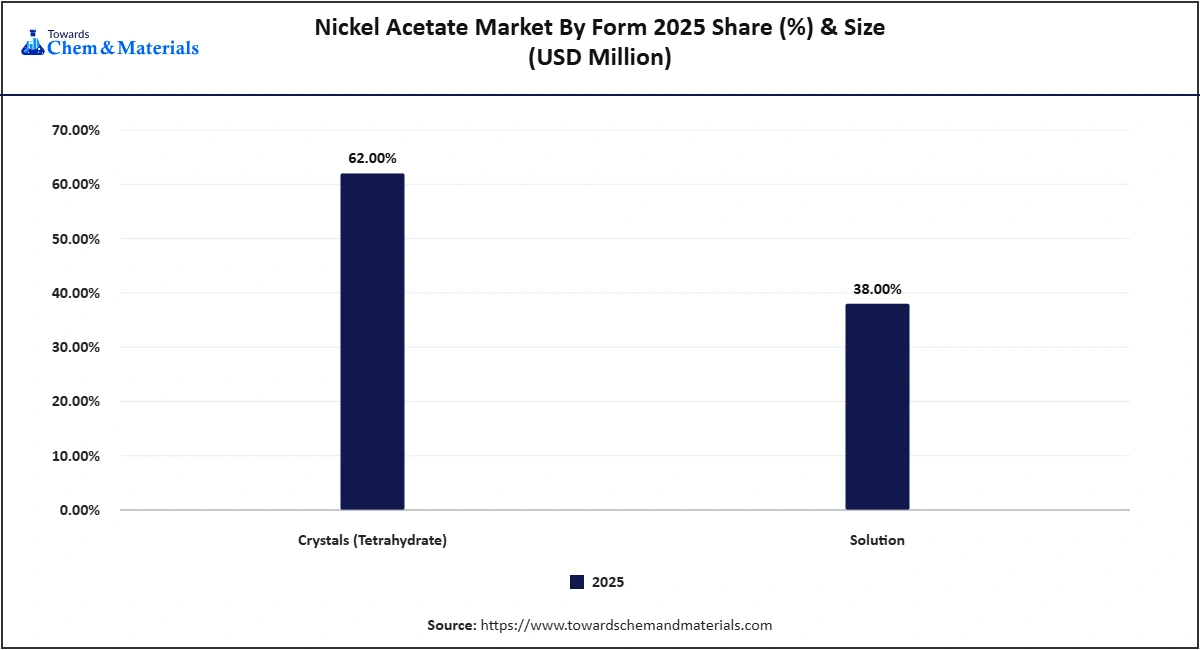
Note: 2025 is the base year; 2035 shares and CAGRs are forecasts.
Sources: Expert interviews, secondary sources, Towards Chemical and Materials database, and Towards Chemical and Materials analysts.
Crystals (Tetrahydrate) accounted for 62.00% in 2025, and Solution for 38.00%. Crystals (Tetrahydrate) leads, while Solution is growing fastest.
Crystals (Tetrahydrate): Holding a 62.00% share of the nickel acetate market in 2025, this segment is projected to expand at a CAGR of 5.21% from 2026 to 2035. Tetrahydrate crystals maintain their leading position due to their stability and ease of storage and transportation. However, the segment is expected to grow slower than the overall market over the forecast period.
Solution: This segment accounted for 38.00% of the nickel acetate market in 2025 and is projected to expand at a CAGR of 6.21% during the forecast period. Solutions grow faster for plating lines. The solution segment is expected to grow faster than the overall market over the forecast period.
Segment Outlook: Crystals (Tetrahydrate) is expected to retain its position as the leading form segment through 2035, accounting for approximately 59.75% of the market. Meanwhile, Solution is projected to register the fastest growth, with a CAGR of 6.21% during 2026-2035. Despite its smaller initial market share, the stronger growth of the Solution segment reflects increasing demand for liquid formulations in the nickel acetate market.
| Segments | 2025 Share | 2035 Share | CAGR 2026-2035 |
| Industrial Grade | 60.00% | 57.13% | 5.08% |
| Battery Grade | 22.00% | 25.06% | 6.98% |
| Reagent Grade | 18.00% | 17.81% | 5.48% |
Note: 2025 is the base year; 2035 shares and CAGRs are forecasts.
Sources: Expert interviews, secondary sources, Towards Chemical and Materials database, and Towards Chemical and Materials analysts.
Industrial Grade accounted for 60.00% in 2025, Battery Grade for 22.00%, and Reagent Grade for 18.00%. Industrial Grade leads, while Battery Grade is growing the fastest.
Industrial Grade: Holding a 60.00% share of the nickel acetate market in 2025, this segment is projected to expand at a CAGR of 5.08% from 2026 to 2035. Industrial-grade nickel acetate maintains its leading position due to its widespread use in electroplating and anodizing sealing applications. However, the segment is expected to grow slower than the overall market over the forecast period.
Battery Grade: This segment accounted for 22.00% of the nickel acetate market in 2025 and is projected to expand at a CAGR of 6.98% during the forecast period. Battery grade grows fastest for specialty precursors. The battery grade segment is expected to grow faster than the overall market over the forecast period.
Reagent Grade: With an 18.00% market share in 2025, this segment is projected to grow at a CAGR of 5.48% from 2026 to 2035. Demand is primarily supported by laboratory research, analytical testing, and specialized chemical applications requiring consistent purity and quality. The segment is expected to grow broadly in line with the overall market over the forecast period.
Segment Outlook: Industrial Grade is expected to maintain its leading position through 2035, capturing approximately 57.13% of the market. Meanwhile, Battery Grade is projected to register the fastest growth, with a CAGR of 6.98% during 2026-2035. Reagent Grade retains the smallest market share, reflecting its focus on specialized laboratory and research applications within the nickel acetate market.
| Segments | 2025 Share | 2035 Share | CAGR 2026-2035 |
| Electroplating & Anodising Sealing | 42.00% | 40.03% | 5.09% |
| Catalysts | 21.00% | 20.79% | 5.49% |
| Battery Materials | 17.00% | 19.38% | 6.99% |
| Textile Dyeing | 10.00% | 9.90% | 5.49% |
| Laboratory & Others | 10.00% | 9.90% | 5.49% |
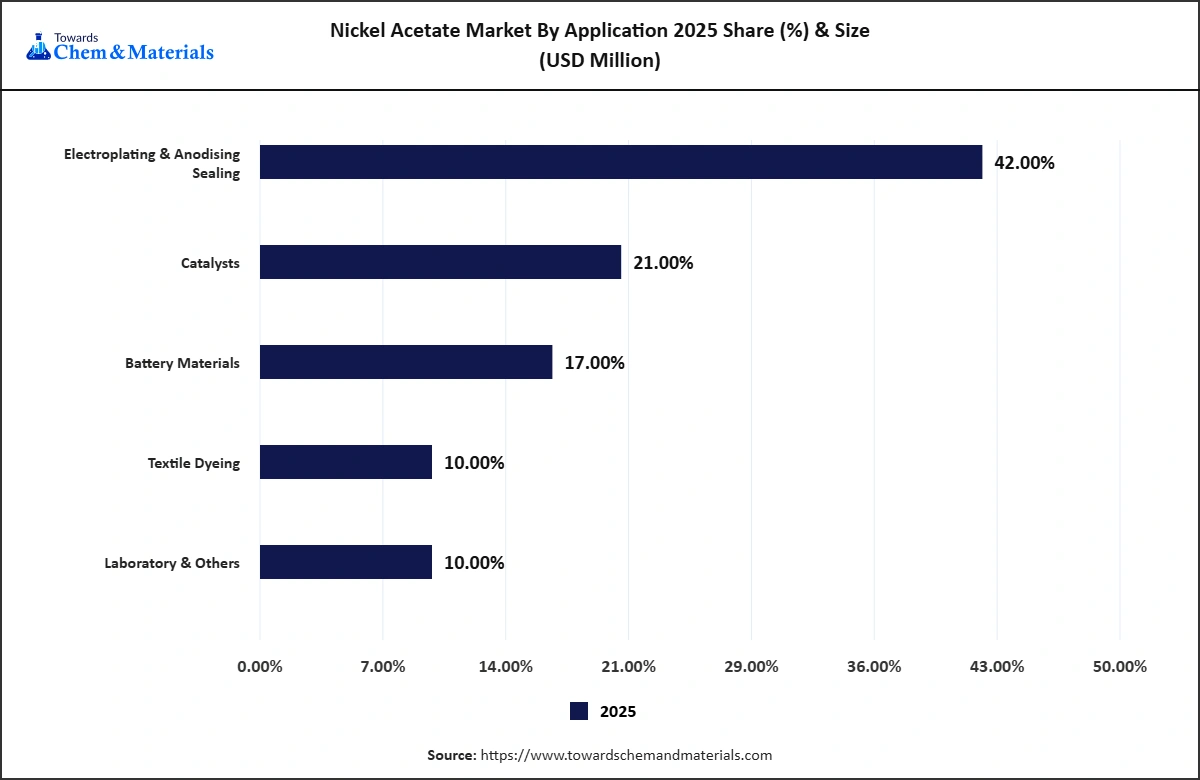
Note: 2025 is the base year; 2035 shares and CAGRs are forecasts.
Sources: Expert interviews, secondary sources, Towards Chemical and Materials database, and Towards Chemical and Materials analysts.
Electroplating & Anodizing Sealing accounted for 42.00% in 2025, Catalysts for 21.00%, Battery Materials for 17.00%, Textile Dyeing for 10.00%, and Laboratory & Others for 10.00%. Electroplating & Anodizing Sealing leads, while Battery Materials is growing fastest.
Electroplating & Anodizing Sealing: Holding a 42.00% share of the nickel acetate market in 2025, this segment is projected to expand at a CAGR of 5.09% from 2026 to 2035. Electroplating and anodizing sealing represent the leading applications, as nickel acetate is used to seal anodized aluminum surfaces across automotive, architectural, and electronics applications. However, the segment is expected to grow slower than the overall market over the forecast period.
Catalysts: This segment accounted for 21.00% of the nickel acetate market in 2025 and is projected to expand at a CAGR of 5.49% during the forecast period. Catalysts use nickel acetate as a precursor. The catalysts segment is expected to grow broadly in line with the overall market over the forecast period.
Battery Materials: With a 17.00% market share in 2025, this segment is projected to record the highest CAGR of 6.99% from 2026 to 2035. Growing battery research activities and increasing demand for specialty nickel compounds in advanced energy storage materials are supporting its expansion. The segment is expected to grow faster than the overall market over the forecast period.
Textile Dyeing: Accounting for 10.00% of the nickel acetate market in 2025, this segment is projected to expand at a CAGR of 5.49% from 2026 to 2035. Nickel acetate continues to serve as a mordant in specialized textile dyeing processes, supporting dye fixation and colour development. The segment is expected to grow broadly in line with the overall market over the forecast period.
Laboratory & Others: This segment accounted for 10.00% of the nickel acetate market in 2025 and is projected to expand at a CAGR of 5.49% during the forecast period. Laboratory and other uses complete demand. The laboratory & others segment is expected to grow broadly in line with the overall market over the forecast period.
Segment Outlook: Electroplating & Anodizing Sealing is expected to retain its position as the leading application segment through 2035, capturing approximately 40.03% of the market. Meanwhile, Battery Materials is projected to register the fastest growth, with a CAGR of 6.99% during 2026-2035. Textile Dyeing maintains a relatively smaller market share, reflecting its more specialized role in the nickel acetate market.
Analyst View: Segment shares were allocated from demand, product portfolios, and pricing in each category. Crystals (Tetrahydrate), Industrial Grade, and Electroplating & Anodizing Sealing lead their categories because they meet the core needs of today's buyers. We expect Solution, Battery Grade, and Battery Materials to gain share as newer technologies, users, and applications grow faster.
| Region | 2025 Share | 2035 Share | CAGR 2026-2035 |
| Asia Pacific | 55.00% | 57.79% | 6.12% |
| Europe | 21.00% | 19.70% | 4.92% |
| North America | 17.00% | 15.94% | 4.92% |
| Middle East & Africa | 4.00% | 3.75% | 4.92% |
| Latin America | 3.00% | 2.81% | 4.92% |
Note: 2025 is the base year; 2035 shares and CAGRs are forecasts.
Sources: Expert interviews, secondary sources, Towards Chemical and Materials database, and Towards Chemical and Materials analysts.
Asia Pacific accounted for 55.00% in 2025, Europe for 21.00%, North America for 17.00%, Middle East & Africa for 4.00%, and Latin America for 3.00%. Asia Pacific leads and is also growing the fastest.
Asia Pacific: Holding a dominant 55.00% share of the nickel acetate market in 2025, Asia Pacific is projected to register the highest regional CAGR of 6.12% during the forecast period. The region's leadership is supported by China's strong position in nickel salt production, anodized aluminum manufacturing, and battery materials. Asia Pacific is expected to grow faster than the overall market between 2026 and 2035.
Europe: Representing 21.00% of the global nickel acetate market in 2025, Europe is projected to expand at a CAGR of 4.92% during the forecast period. Regional demand is supported by established anodizing industries and specialty chemical manufacturers serving diverse industrial applications. Europe is expected to grow slower than the overall market over the forecast period.
North America: With a 17.00% market share in 2025, North America is projected to register a CAGR of 4.92% from 2026 to 2035. Demand is primarily driven by electroplating activities and the use of nickel-based compounds in catalyst manufacturing. North America is expected to grow slower than the overall market between 2026 and 2035.
Middle East & Africa: Capturing a 4.00% share of the nickel acetate market in 2025, the Middle East & Africa region is projected to grow at a CAGR of 4.92% during the forecast period. Demand is supported by architectural aluminum applications and the increasing use of anodized aluminum in construction and infrastructure projects. The region is expected to grow slower than the overall market over the forecast period.
Latin America: This region accounted for 3.00% of the nickel acetate market in 2025 and is projected to expand at a CAGR of 4.92% during the forecast period. Latin America has limited demand. Latin America is expected to grow slower than the overall market between 2026 and 2035.
Analyst View: Regional shares were built from demand, installed base, spending, and supplier presence in each region. Asia Pacific leads because of its mature demand base and strong suppliers. We assign Asia Pacific the highest growth premium because investment, adoption, and capacity are expanding fastest there.
| Rank | Company Name | 2025 Share (%) | Key Products / Business | Headquarters |
| 1 | Jinchuan Group | 9.86% | Nickel salts | China |
| 2 | Umicore | 7.04% | Nickel and cobalt specialty chemicals | Belgium |
| 3 | Shepherd Chemical | 5.63% | Metal carboxylates incl. nickel acetate | United States |
| 4 | American Elements | 4.23% | Nickel acetate in multiple grades | United States |
| 5 | Hunan Jiayu Chemical | 4.23% | Nickel acetate and salts | China |
| 6 | GEM Co. | 4.23% | Nickel salts and recycled nickel | China |
| 7 | Merck KGaA | 3.52% | Reagent nickel acetate | Germany |
| 8 | Atotech (MKS) | 3.52% | Anodising and plating chemistry | Germany |
| 9 | Thermo Fisher Scientific | 2.82% | Laboratory nickel acetate | United States |
| 10 | Jilin Ji En Nickel | 2.82% | Nickel products | China |
Note: Company shares are 2025 estimates.
Sources: Company press releases, expert interviews, secondary sources, Towards Chemical and Materials database and Towards Chemical and Materials analysts.
Jinchuan Group led the nickel acetate market with an estimated 9.86% share of 2025 revenue, followed by Umicore at 7.04% share and Shepherd Chemical at 5.63% share. Jinchuan Group leads with nickel salts, Umicore competes with nickel and cobalt specialty chemicals, and Shepherd Chemical offers metal carboxylates incl. nickel acetate. American Elements, Hunan Jiayu Chemical, GEM Co., Merck KGaA, Atotech (MKS), Thermo Fisher Scientific and Jilin Ji En Nickel compete through nickel acetate in multiple grades, nickel acetate and salts, nickel salts and recycled nickel, reagent nickel acetate, anodizing and plating chemistry, laboratory nickel acetate and nickel products.
The top 10 companies accounted for an estimated 47.89% of 2025 revenue, while the remaining 52.11% was shared among many Chinese nickel salt producers and distributors. The nickel acetate market is fragmented and concentrated in China, and competition centers on nickel cost, purity, consistency, sealing performance, regulatory compliance for nickel compounds, and price.
Jinchuan Group: Headquartered in China, Jinchuan Group held an estimated 9.86% share of the nickel acetate market in 2025. The company leverages its strong presence in the nickel industry to supply a range of nickel salts for industrial applications. In the Towards Chemical and Materials Companies Quadrant, it is classified as a Leader.
Umicore: Based in Belgium, Umicore captured an estimated 7.04% of the nickel acetate market in 2025. Its portfolio focuses on nickel and cobalt specialty chemicals, catering to various industrial and advanced material applications. The company is positioned as a Leader in the Towards Chemical and Materials Companies Quadrant.
Shepherd Chemical: Shepherd Chemical, part of The Shepherd Chemical Company, is headquartered in the United States and represented an estimated 5.63% of the market in 2025. Its product portfolio includes metal carboxylates, including nickel acetate, serving specialty chemical and industrial customers. It holds a Leader position in the Towards Chemical and Materials Companies Quadrant.
American Elements: Operating from the United States, American Elements secured an estimated 4.23% share of the nickel acetate market in 2025. The company offers nickel acetate in multiple grades to address diverse industrial, research, and specialty chemical requirements. It is recognized as a Leader in the Towards Chemical and Materials Companies Quadrant.
Hunan Jiayu Chemical: Hunan Jiayu Chemical is headquartered in China. It held an estimated 4.23% share of the nickel acetate market in 2025. Its offering centres on Nickel acetate and salts. In the Towards Chemical and Materials Companies Quadrant it is positioned as a Leader.
GEM Co.: With its headquarters in China, GEM Co. represented approximately 4.23% of the nickel acetate market in 2025. Its portfolio encompasses nickel salts and recycled nickel materials, reflecting its focus on nickel resource recovery and specialty chemical production. The company is classified as a Leader in the Towards Chemical and Materials Companies Quadrant.
Merck KGaA: Germany-based Merck KGaA accounted for an estimated 3.52% of the market in 2025. Its offering includes reagent-grade nickel acetate, primarily serving laboratory research, analytical testing, and specialized chemical applications. The company occupies an Innovator position in the Towards Chemical and Materials Companies Quadrant.
Atotech (MKS): Atotech (MKS) is headquartered in Germany. It held an estimated 3.52% share of the nickel acetate market in 2025. Its offering centres on Anodising and plating chemistry. In the Towards Chemical and Materials Companies Quadrant it is positioned as an Innovator.
Thermo Fisher Scientific: Based in the United States, Thermo Fisher Scientific secured an estimated 2.82% market share in 2025. Its portfolio includes laboratory-grade nickel acetate for scientific research, analytical testing, and specialized laboratory applications. The company is positioned as an Innovator in the Towards Chemical and Materials Companies Quadrant.
Jilin Ji En Nickel: Jilin Ji En Nickel is headquartered in China. It held an estimated 2.82% share of the nickel acetate market in 2025. Its offering centres on Nickel products. In the Towards Chemical and Materials Companies Quadrant it is positioned as an Innovator.
The nickel acetate ecosystem links nickel suppliers, salt producers, plating chemistry firms, end users and regulators, with each stage adding value before products reach end users. AI in chemicals and material informatics tools help optimise plating baths and catalyst recipes.
| Ecosystem Stage | Role in the Market | Key Companies |
| Nickel Suppliers | Supply nickel metal and intermediates | Jinchuan, Ji En Nickel, Indonesian producers |
| Salt Producers | Make nickel acetate | Jinchuan, Shepherd, Hunan Jiayu |
| Plating Chemistry Firms | Formulate sealing baths | Atotech, plating suppliers |
| End Users | Seal, plate and make catalysts | Anodisers, catalyst and battery makers |
| Regulators | Restrict nickel compounds | REACH, EPA, OSHA |
Sources: Company press releases, expert interviews, secondary sources, Towards Chemical and Materials database and Towards Chemical and Materials analysts.
Nickel Suppliers: Supply nickel metal and intermediates. Key participants include Jinchuan, Ji En Nickel, and Indonesian producers.
Salt Producers: Make nickel acetate. Key participants include Jinchuan, Shepherd, Hunan Jiayu.
Plating Chemistry Firms: Formulate sealing baths. Key participants include Atotech, plating suppliers.
End Users: Seal, plate, and make catalysts. Key participants include Anodisers, catalyst and battery makers.
Regulators: Restrict nickel compounds. Key participants include REACH, EPA, OSHA.
Value in the nickel acetate market flows from upstream material and technology suppliers to manufacturers and service providers, then through distribution partners to end users. Companies that integrate several stages or build long-term relationships with end users capture a larger share of this value.
The Towards Chemical and Materials Companies Quadrant evaluates key participants in the nickel acetate market based on market strength and innovation and growth strategies. Market strength considers revenue scale, market share, and geographic reach, while innovation and growth strategies assess product portfolio breadth, R&D intensity, and partnerships. Company positions are determined by estimated 2025 market shares and our assessment of their product innovation, portfolio diversity, and strategic partnerships.
Sources: Company press releases, expert interviews, secondary sources, Towards Chemical and Materials database, and Towards Chemical and Materials analysts.
Leaders: Jinchuan Group, Umicore, Shepherd Chemical, American Elements, Hunan Jiayu Chemical and GEM Co. combine high market share with broad portfolios and strong innovation.
Innovators: Merck, Atotech (MKS), Thermo Fisher Scientific and Jilin Ji En Nickel bring newer technologies and specialised products.
By Form
By Grade
By Application
By Region
The nickel acetate market was defined as nickel (II) acetate tetrahydrate crystals and solutions in industrial, battery and reagent grades, used in anodized aluminum sealing and electroplating, catalyst preparation, battery cathode precursors, textile dyeing mordants and laboratory uses. The 2025 base year was built bottom-up from demand volumes and average prices by form, grade and application and region, and checked top-down against the market-specific revenues of leading companies and published estimates. We allocated segment, regional, and company values from form, grade, application, and regional demand. Key estimates were verified by cross-checking company disclosures, regulatory and industry data, and published third-party estimates, and inputs that could not be reconciled were excluded. All segment, regional and company figures were reconciled to the same 2025 base year, and the 2026-2035 forecast, which applies a constant CAGR from the 2025 base, was recalculated and validated.
The nickel acetate market is set for steady expansion as anodized aluminum demand and related demand keep growing. Our estimate links value to underlying demand, installed base, and pricing, so the forecast follows real adoption rather than headline hype. The main upside comes from battery-grade salts and recycled nickel, while the main risks are nickel compound regulation.
Reliable market intelligence and data-driven insights across the global chemicals and materials industry, helping businesses understand trends, competition, pricing, and emerging opportunities.
Schedule a Demo