Find the Right Market Report
Search thousands of industry reports, market insights, and research studies in one place.
Not sure where to start? Try one of these:
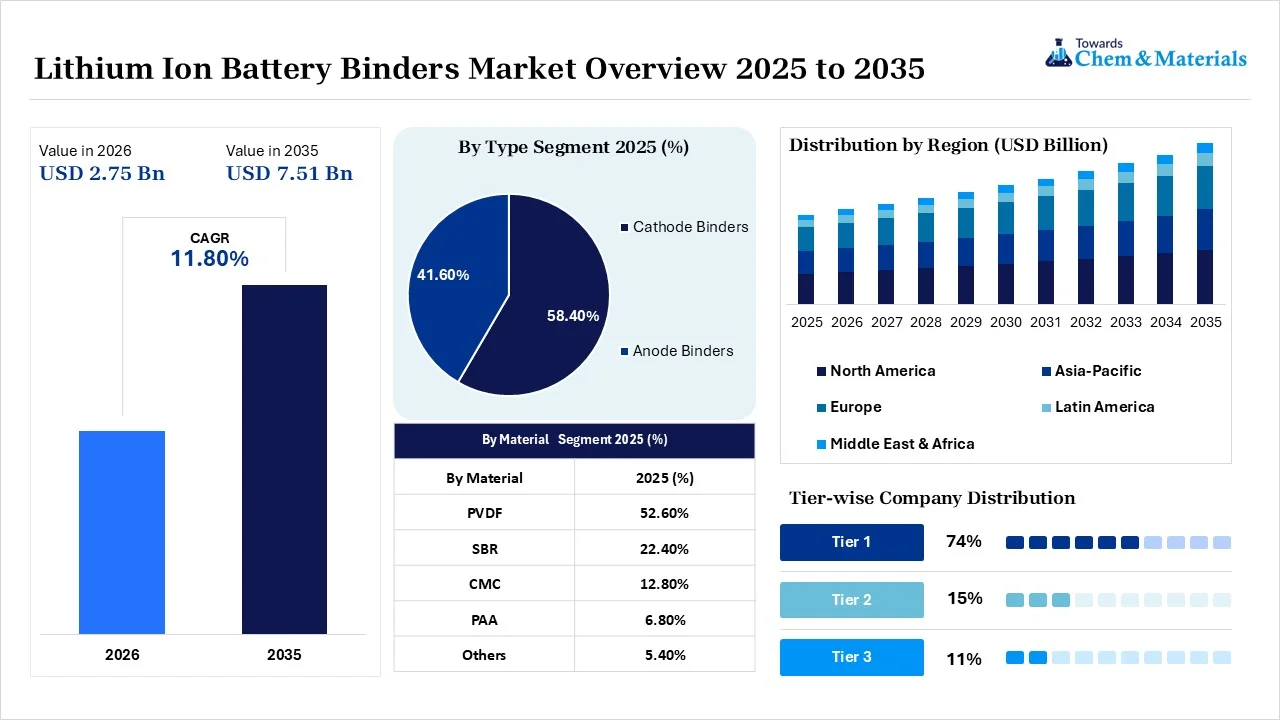
The lithium ion battery binders market is expected to grow from USD 2.75 billion in 2026 to USD 7.51 billion by 2035. The market is forecast to grow at a CAGR of 11.80% from 2026 to 2035. In 2025, the market was valued at USD 2.46 billion, which is the base year for this report.
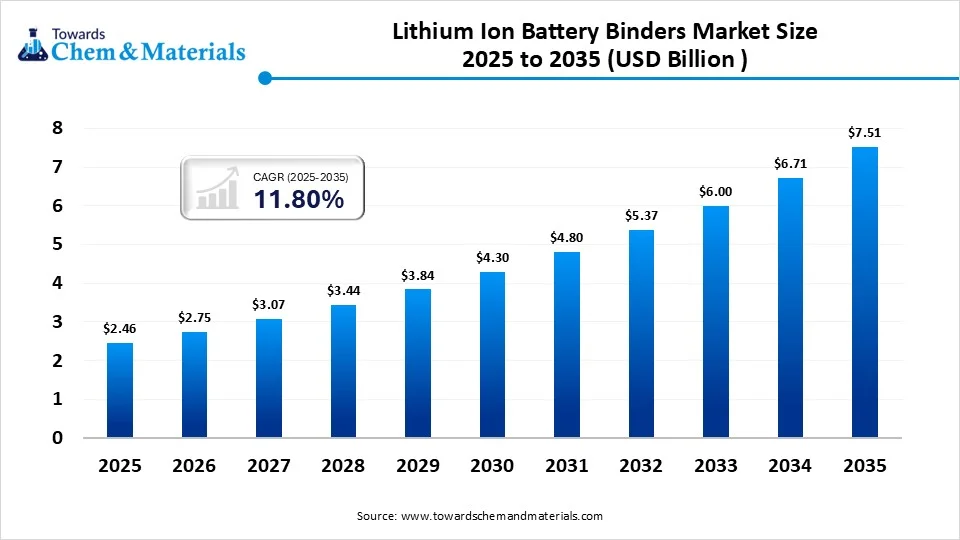
Note: 2025 is the base year, while the figures from 2026 to 2035 are forecasts.
Sources: Expert interviews, secondary sources, the Towards Chemicals and Materials database, and Towards Chemicals and Materials analysts.
Battery binders are materials that hold the different parts of a battery electrode together. They also help attach these materials to the current collector. Common binders include PVDF for cathodes and SBR, CMC, and polyacrylic acid (PAA) for anodes. Binders are also used in some battery separator coatings. Cathode binders held the largest share of the market in 2025, accounting for 58.40%. PVDF is widely used in NMC and LFP battery cathodes because it works well at high voltages. It also usually costs more than water-based binders used in anodes. Asia Pacific led the market in 2025, accounting for 82.40% of total revenue. China, South Korea, and Japan are major producers of battery electrodes and binder materials.
The market is growing because more electric vehicle and energy storage batteries are being produced. Battery makers are also looking for better binders that can improve battery performance while using less material. Silicon-based anodes need stronger binders because silicon changes in size during charging and discharging. New dry electrode production methods are also creating demand for different types of binders. At the same time, companies are increasing PVDF production capacity in North America and Europe. They are also signing long-term supply agreements with automakers and battery manufacturers.
Analyst View: The market estimate was prepared by looking at cathode and anode production for different battery types. The amount of binder used for each tonne of active material was then considered, along with the types and average prices of binders, including PVDF, SBR, CMC, PAA, and other materials.
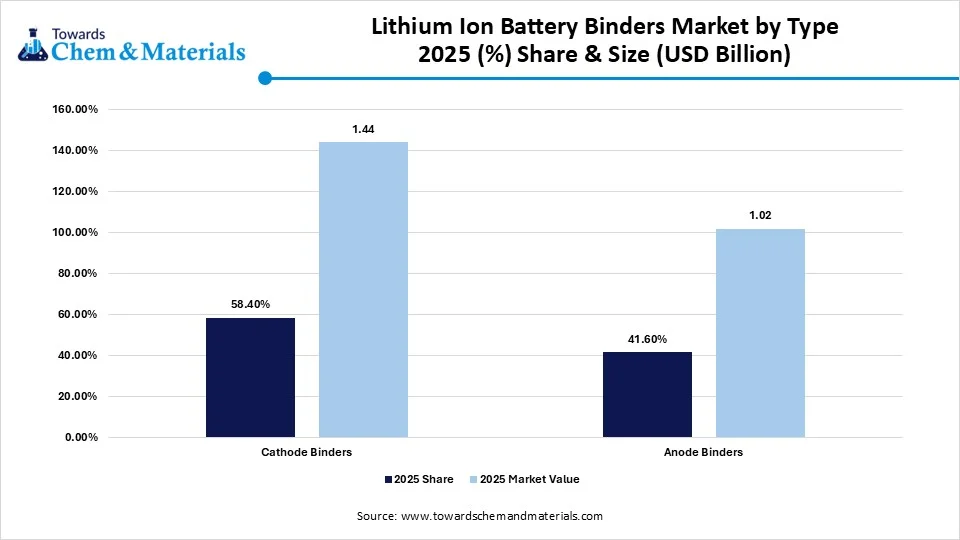
Note: 2025 is the base year.
Sources: Expert interviews, secondary sources, the Towards Chemicals and Materials database, and Towards Chemicals and Materials analysts.
Cathode binders accounted for 58.40% of the market in 2025, worth USD 1.44 billion. This was mainly because PVDF is widely used in NMC and LFP cathodes. It remains a popular choice because it is stable at the high voltages used in these batteries. Anode binders accounted for 41.60% of the market, worth USD 1.02 billion. Most graphite anodes use water-based binder systems made from SBR and CMC. PAA and other specialized binders are gaining attention because they help hold silicon particles together as they expand during charging.
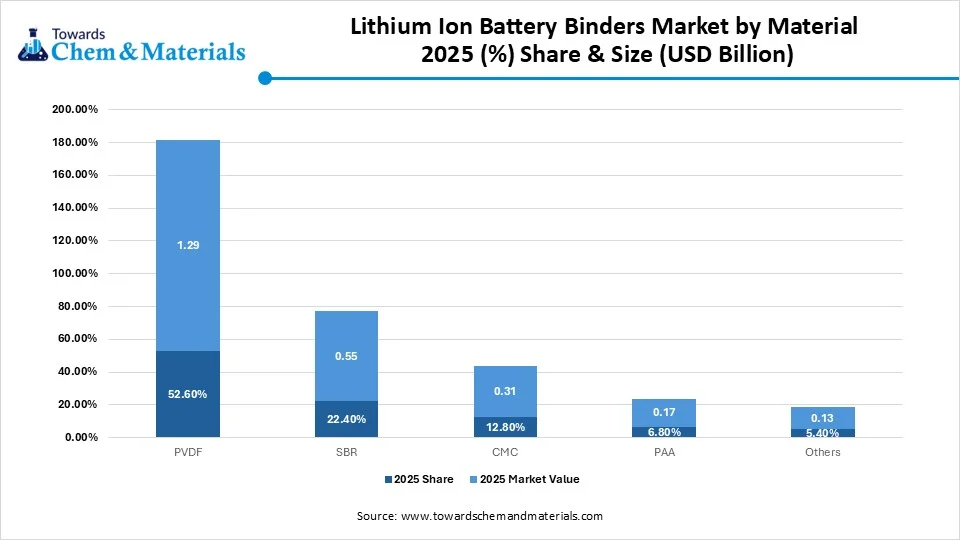
Note: 2025 is the base year.
Sources: Expert interviews, secondary sources, the Towards Chemicals and Materials database, and Towards Chemicals and Materials analysts.
PVDF held the largest share of the market in 2025, accounting for 52.60%, or USD 1.29 billion. It is mainly used in cathodes and some battery separator coatings. SBR accounted for 22.40% of the market, worth USD 0.55 billion, while CMC accounted for 12.80%, worth USD 0.31 billion. Both are widely used as water-based binders in anodes. PAA accounted for 6.80% of the market, worth USD 0.17 billion. It is one of the fastest-growing binder materials because it helps keep silicon particles together as they expand and shrink during battery use. Other binders, including acrylics and polyimides, accounted for the remaining 5.40% of the market, worth USD 0.13 billion.
Note: 2025 is the base year.
Sources: Expert interviews, secondary sources, the Towards Chemicals and Materials database, and Towards Chemicals and Materials analysts.
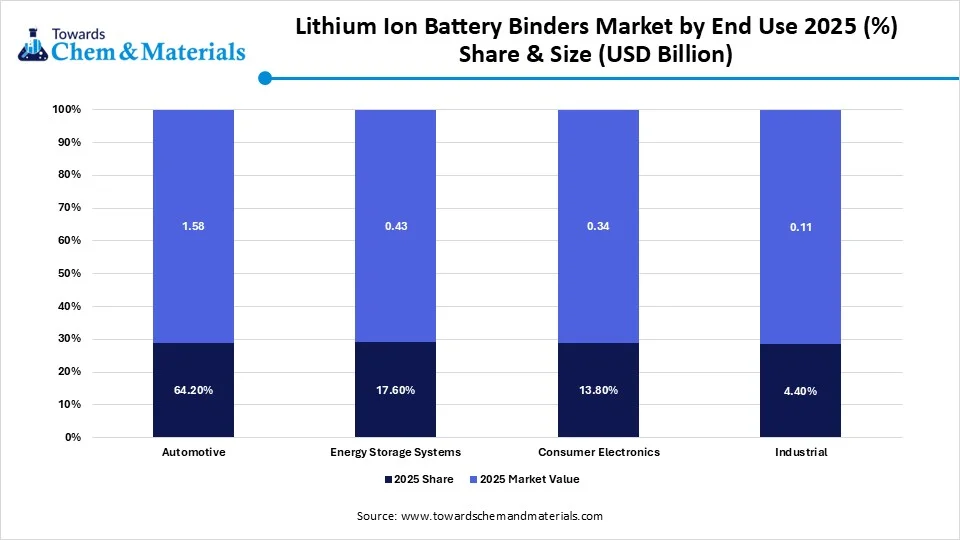
The automotive segment accounted for 64.20% of the market in 2025, worth USD 1.58 billion. Demand mainly comes from battery electric vehicles and plug-in hybrid vehicles. Energy storage systems accounted for 17.60% of the market, worth USD 0.43 billion. This segment is expected to grow quickly as more LFP batteries are used in energy storage applications. Consumer electronics accounted for 13.80% of the market, worth USD 0.34 billion. Industrial applications made up the remaining 4.40%, worth USD 0.11 billion.
Analyst View: The value of each market segment was estimated by looking at electrode production for different battery types and end uses. The amount and type of binder used, along with current material prices, were also considered. Cathode binders account for a larger share of market value because PVDF generally costs more than water-based binders used in anodes. In the coming years, PAA and other binders designed for silicon anodes are expected to gain share. Energy storage applications are also expected to grow, while PVDF demand will continue to be supported by LFP and NMC cathodes.
Note: 2025 is the base year.
Sources: Expert interviews, secondary sources, the Towards Chemicals and Materials database, and Towards Chemicals and Materials analysts.
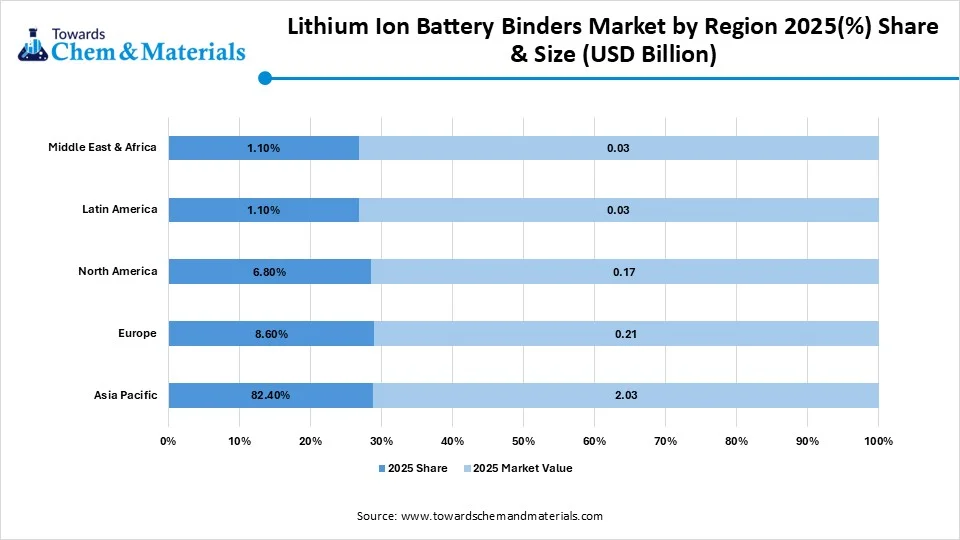
Analyst View: Regional market shares were estimated by looking at electrode production in each region, the amount of binder used, and the prices of different binder materials. Asia Pacific leads because it has most of the world's battery electrode production capacity. North America is expected to grow the fastest because new battery plants and local binder production facilities are being developed from a relatively small starting point.
Kureha led the lithium ion battery binders market in 2025, with an estimated market share of 10.57% and revenue of USD 0.26 billion. Arkema ranked second, with a 9.76% share and revenue of USD 0.24 billion. Syensqo ranked third, with an 8.94% share and revenue of USD 0.22 billion. Kureha, Arkema, and Syensqo are major suppliers of PVDF cathode binders. Their products have been used by battery manufacturers for many years, and the companies have production facilities in different markets.
The top 10 companies together accounted for an estimated 62.20% of the market in 2025, equal to USD 1.53 billion. The remaining 37.80%, or USD 0.93 billion, was shared by Chinese PVDF producers, SBR and CMC suppliers, and companies developing new binders for silicon anodes. The market is moderately concentrated, with several major companies competing for customers. Competition mainly depends on how well a binder holds electrode materials together, how much binder is needed, how stable it remains inside a battery, how easily it can be used during production, and whether it can be supplied locally. Fluoropolymer manufacturers, latex producers and specialty polymer companies all play a role in this market.
| Rank | Company Name | Market-Specific Revenue (USD Billion) | 2025 Share | Key Products / Business | Headquarters |
| 1 | Kureha | 0.26 | 10.57% | KF Polymer PVDF binders | Japan |
| 2 | Arkema | 0.24 | 9.76% | Kynar PVDF and Incellion binders | France |
| 3 | Syensqo | 0.22 | 8.94% | Solef PVDF binders | Belgium |
| 4 | Zeon | 0.2 | 8.13% | SBR and acrylic binders | Japan |
| 5 | Dongyue Group | 0.16 | 6.50% | PVDF binders | China |
| 6 | LG Chem | 0.12 | 4.88% | Anode and cathode binders | South Korea |
| 7 | ENEOS Materials | 0.1 | 4.07% | SBR and water-based binders | Japan |
| 8 | Daikin | 0.09 | 3.66% | PVDF and fluoropolymer binders | Japan |
| 9 | Nippon A&L | 0.08 | 3.25% | SBR latex anode binders | Japan |
| 10 | Ashland | 0.06 | 2.44% | CMC anode binders | United States |
Note: Company revenues and market shares are estimates for 2025.
Sources: Company press releases, expert interviews, secondary sources, Towards Chemicals And Materials database and Towards Chemicals And Materials analysts.
By Type
By Material
By End Use
By Region
This report covers binders used in lithium-ion battery cathodes, anodes and separator coatings. The materials included are PVDF, SBR, CMC, PAA and other polymers. The market is measured at the producer level and covers global sales. The 2025 market estimate was prepared by looking at cathode and anode production, the amount of binder used for each tonne of active material, and the prices of different binder materials. The estimate was then compared with battery binder revenue reported by major fluoropolymer and specialty polymer producers.
Market values for different binder types, materials, end uses, regions and companies were estimated using information about binder demand and regional electrode production. The main estimates were checked against company announcements, government and industry information, and published third-party research. Figures that could not be matched with the available information were excluded. All segment, regional and company figures were aligned with the same 2025 base year. The forecast for 2026–2035 was then recalculated using the stated growth rate and checked for consistency.
The lithium ion battery binders market is expected to grow as more battery electrodes are produced and battery makers use specialised binders for LFP batteries, silicon anodes and dry electrode processes. The market estimate links demand to electrode production, the amount of binder used and the prices of different materials. This helps connect the forecast with growth in battery production and changes in electrode design.The main growth opportunities come from silicon-based anodes, dry electrode production and the development of local binder suppliers. However, falling PVDF prices and possible changes in PFAS-related regulations remain important challenges for the market.
Reliable market intelligence and data-driven insights across the global chemicals and materials industry, helping businesses understand trends, competition, pricing, and emerging opportunities.
Schedule a Demo