Find the Right Market Report
Search thousands of industry reports, market insights, and research studies in one place.
Not sure where to start? Try one of these:
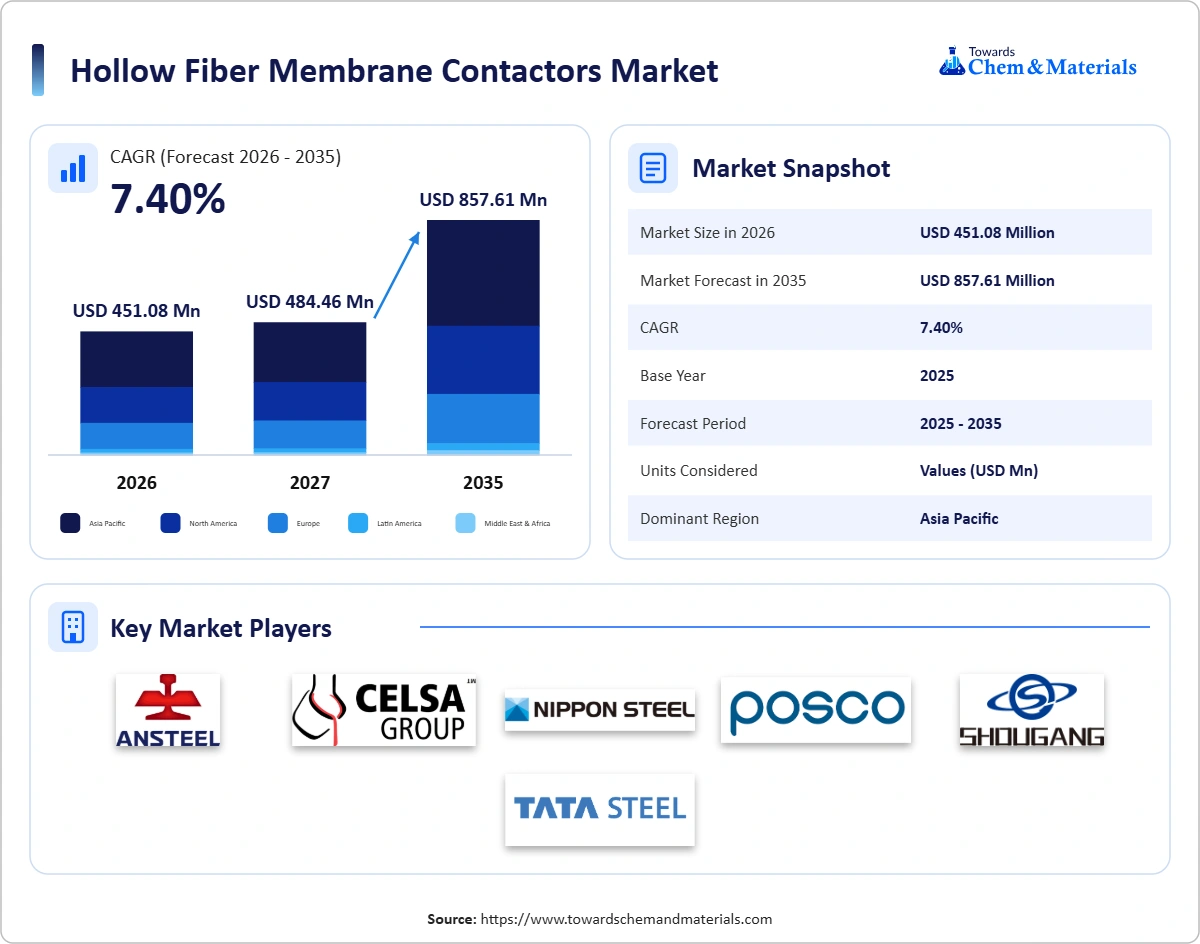
The hollow fiber membrane contactors market size is valued at USD 451.08 million in 2026 and is projected to reach USD 857.61 million by 2035, expanding at a CAGR of 7.40% from 2026 to 2035. The market covers hollow fiber membrane contactors, which are used to transfer gases to or from liquids, including microporous polypropylene and non-porous polyolefin and PTFE fiber contactors for degassing, carbonation, nitrogenation, gas absorption, and liquid-liquid extraction. These products are used in ultrapure water systems for semiconductor and pharmaceutical production, boiler feedwater, beverages, inks, and coatings, as well as emerging carbon capture applications.
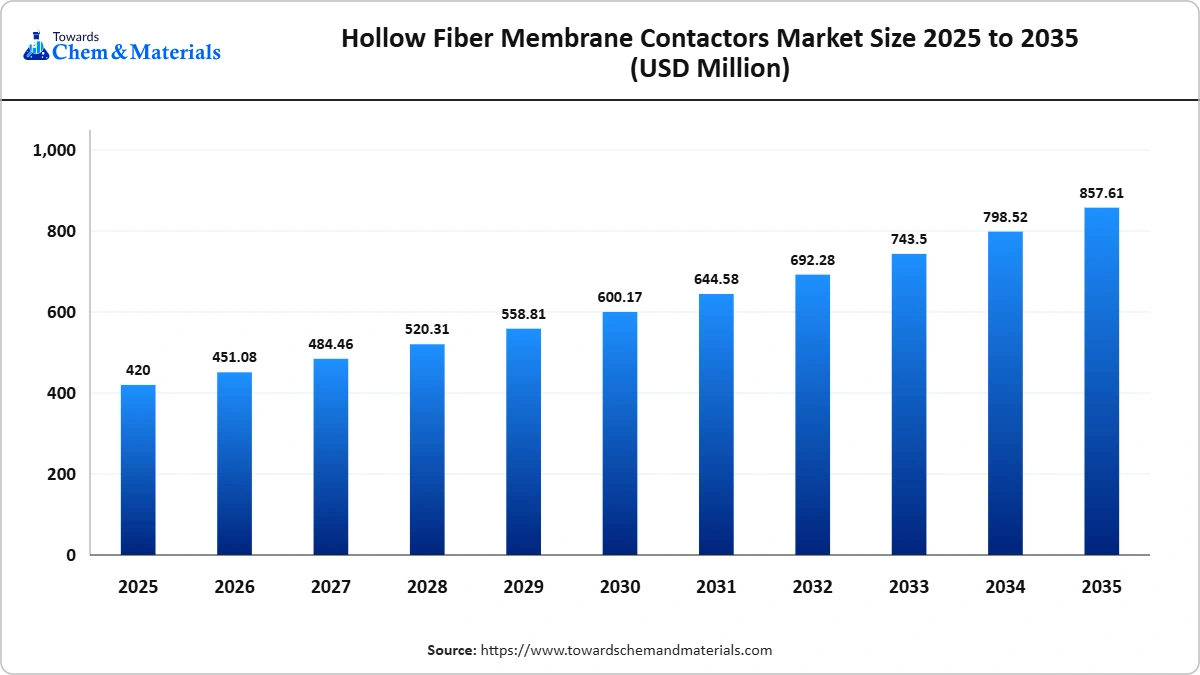
Note: 2025 is the base year; 2026-2035 values are forecasts.
Sources: Expert interviews, secondary sources, the Towards Chemical and Materials database, and Towards Chemical and Materials analysts.
Degassing accounted for the largest function share of 68.00% in 2025, as ultrapure water systems rely on these contactors to remove dissolved oxygen and carbon dioxide. Asia Pacific represented 45.00% of the market in the base year, supported by its large base of semiconductor fabs that require extensive ultrapure water systems. The demand for hollow fiber membrane contactors is growing with new semiconductor fab projects, rising ultrapure water requirements, pharmaceutical water treatment, beverage carbonation, and carbon capture applications. The competitive landscape is experiencing significant changes, with Thermo Fisher completing its acquisition of the Liqui-Cel business in September 2025.
The market is expected to expand from USD 420.00 million in 2025 to USD 857.61 million by the end of the forecast period. The establishment of new semiconductor fabs and pharmaceutical plants is increasing the need for ultrapure water, while hollow fiber membrane contactors are gaining ground as an alternative to chemical degassing. Rising semiconductor fab construction and demand for ultrapure water are expected to drive market growth to USD 600.17 million by 2030, with the market recording a CAGR of 7.40% from 2026 to 2035.
Analyst View: We built the estimate from UPW system capacity additions, contactor replacement cycles, and module prices, cross-checked against supplier information.
The market is growing due to significant demand for ultrapure water with low dissolved gas levels from semiconductor and pharmaceutical plants. New semiconductor fabs in the U.S., Japan, and Taiwan are fueling the demand for these systems. Carbon capture also offers future growth potential as research expands into the use of membrane contactors for CO₂ capture and separation.
Market Drivers—Impact & CAGR Contribution (2026-2035)
| Driver | Impact | ≈ CAGR Contribution | Time Horizon | Key Regions |
| Semiconductor investment | High | +2.89 pp | Short- to long-term | Global, strongest in Asia Pacific |
| Pharma water | Medium | +2.44 pp | Medium- to long-term | Global, the fastest uptake in Asia Pacific |
| Power plants | Medium | +2.08 pp | Short- to medium-term | Global |
| Beverages | Low | +1.63 pp | Long-term | Developed and emerging markets |
Note: Contributions are indicative estimates of each factor's effect on annual growth.
Sources: Expert interviews, secondary sources, the Towards Chemical and Materials database, and Towards Chemical and Materials analysts.
Semiconductor investment, pharma, and water and power plants are the strongest market growth drivers.
Market Restraints—Impact & Negative CAGR Contribution (2026-2035)
| Restraint | Impact | ≈ Negative CAGR Contribution | Time Horizon | Key Regions |
| Fibre fouling | High | -0.73 pp | Short- to medium-term | Global |
| Concentrated supply | High | -0.54 pp | Medium term | Price-sensitive and emerging markets |
| PFAS rules | Medium | -0.36 pp | Short term | Asia Pacific and other mature markets |
Note: Contributions are indicative estimates of each factor's effect on annual growth.
Sources: Expert interviews, secondary sources, the Towards Chemical and Materials database, and Towards Chemical and Materials analysts.
Fibre fouling has the largest negative CAGR contribution of 0.73 percentage points, followed by concentrated supply and PFAS rules at 0.54 and 0.36 percentage points, respectively.
Hollow Fiber Membrane Contactors Market by Function, 2025 Share (%)
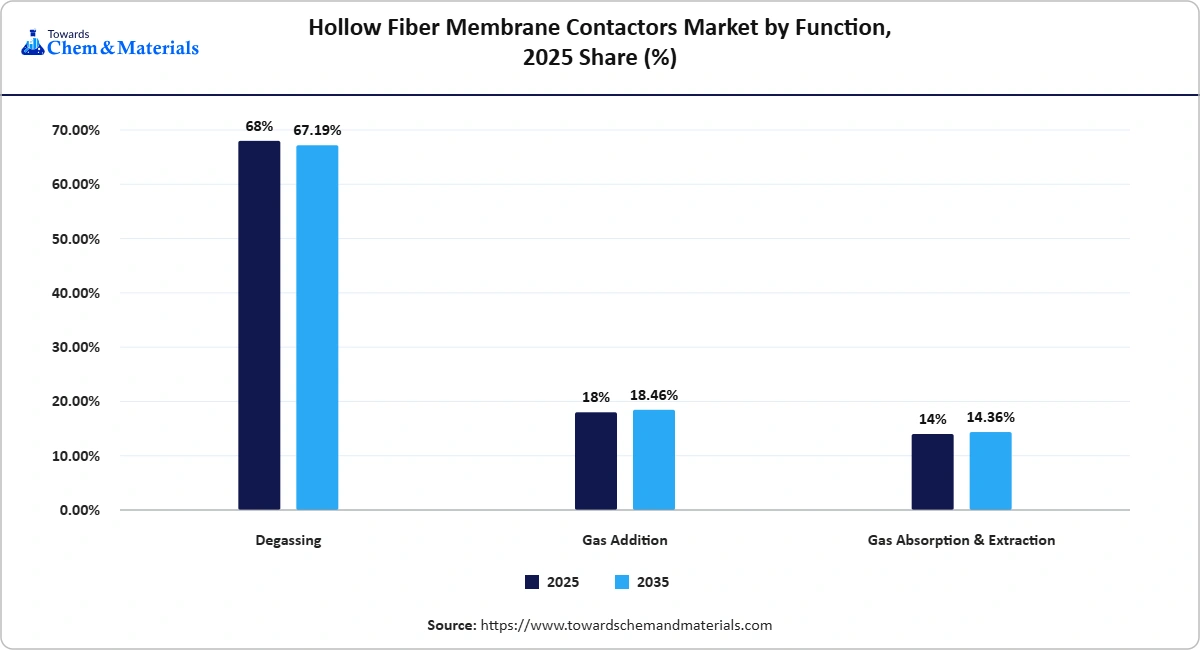
Note: 2025 is the base year; 2035 shares and CAGRs are forecasts.
Sources: Expert interviews, secondary sources, the Towards Chemical and Materials database, and Towards Chemical and Materials analysts.
In 2025, degassing led the market, as ultrapure water systems require the removal of dissolved oxygen and carbon dioxide. Gas absorption is expected to exhibit the highest growth rate during 2026-2035, as the research on the use of membrane contactors for carbon capture and gas separation is expanding.
Hollow Fiber Membrane Contactors Market by Material, 2025 Share (%)
| Segments | 2025 Share | 2035 Share | CAGR 2026-2035 |
| Polypropylene | 70.00% | 66.79% | 6.90% |
| PTFE & Others | 30.00% | 33.21% | 8.50% |
Note: 2025 is the base year; 2035 shares and CAGRs are forecasts.
Sources: Expert interviews, secondary sources, the Towards Chemical and Materials database, and Towards Chemical and Materials analysts.
Polypropylene accounted for the largest share in the material segment in the base year because it is affordable and has been widely adopted in membrane contactors. PTFE and other fibers grow at a faster rate than polypropylene because they offer comparatively better resistance to harsh chemicals and high temperatures.
Polypropylene: Polypropylene captured a market share of 70.00% in 2025, owing to its low cost, excellent chemical resistance, and widespread use in membrane contactors.
PTFE & Others: PTFE and other fibers are forecast to expand at a rate of 8.50% between 2026 and 2035. This growth can be attributed to increasing demand for materials that can withstand high temperatures and aggressive chemicals.
Hollow Fiber Membrane Contactors Market by End Use, 2025 Share (%)
| Segments | 2025 Share | 2035 Share | CAGR 2026-2035 |
| Semiconductors & Electronics | 38.00% | 36.23% | 6.89% |
| Power & Industrial Water | 22.00% | 21.77% | 7.29% |
| Pharma & Biotech | 14.00% | 13.86% | 7.29% |
| Food & Beverage | 14.00% | 13.86% | 7.29% |
| Carbon Capture & Others | 12.00% | 14.29% | 9.29% |
Note: 2025 is the base year; 2035 shares and CAGRs are forecasts.
Sources: Expert interviews, secondary sources, the Towards Chemical and Materials database, and Towards Chemical and Materials analysts.
Semiconductors and electronics led the market in 2025 because semiconductor fabs require extensive ultrapure water (UPW) systems. Carbon capture is expected to grow at the highest rate during 2026-2035 as research and pilot projects increasingly explore the use of membrane contactors for CO₂ capture and separation.
Analyst View: Gas absorption, PTFE and carbon capture are expected to record the fastest growth rate over the forecast period, owing to ongoing research into CO₂ separation and rising demand for fibres suited to harsh operating conditions. Degassing, polypropylene and semiconductors will continue to hold the largest market shares, reflecting their established use in water treatment and the extensive use of membrane contactors in semiconductor fabs.
Hollow Fiber Membrane Contactors Market by Region, 2025 Share (%)
| Region | 2025 Share | 2035 Share | CAGR 2026-2035 |
| Asia Pacific | 45.00% | 47.78% | 8.05% |
| North America | 29.00% | 27.54% | 6.85% |
| Europe | 21.00% | 19.94% | 6.85% |
| Latin America | 3.00% | 2.85% | 6.85% |
| Middle East & Africa | 2.00% | 1.90% | 6.85% |
Note: 2025 is the base year; 2035 shares and CAGRs are forecasts.
Sources: Expert interviews, secondary sources, Towards Chemical and Materials database and Towards Chemical and Materials analysts.
Asia Pacific held the largest market share because of the presence of a major proportion of semiconductor fabs in the region, which require extensive ultrapure water systems. This region is projected to grow at a faster rate than any other region across the world because of new fab construction.
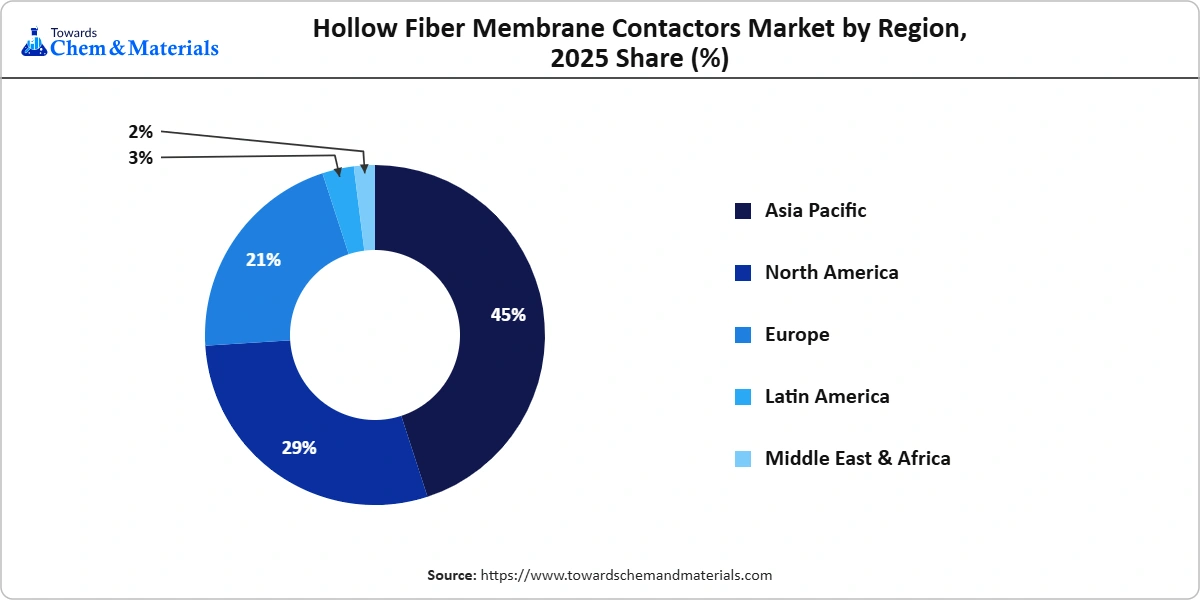
Analyst View: Asia Pacific is expected to retain its leading market position and record the fastest growth during the forecast period, driven by continued semiconductor fab construction and rising demand for ultrapure water systems.
| Rank | Company Name | 2025 Share (%) | Key Products / Business | Headquarters |
| 1 | Thermo Fisher (Liqui-Cel) | 38.00% | Liqui-Cel membrane contactors | United States |
| 2 | DIC Corporation | 8.00% | SEPAREL contactors | Japan |
| 3 | Entegris | 7.00% | degassing modules | United States |
| 4 | Asahi Kasei | 5.00% | hollow fibre membranes | Japan |
| 5 | Mitsubishi Chemical | 5.00% | hollow fibre modules | Japan |
| 6 | Pall (Danaher) | 4.00% | contactors | United States |
| 7 | Evonik | 3.00% | membranes | Germany |
| 8 | Medarray | 2.00% | silicone hollow fibre | United States |
| 9 | Compact Membrane Systems | 2.00% | gas separation | United States |
| 10 | PermSelect | 2.00% | silicone contactors | United States |
Note: Company shares are 2025 estimates.
Sources: Company press releases, expert interviews, secondary sources, Towards Chemical and Materials database and Towards Chemical and Materials analysts.
Thermo Fisher (Liqui-Cel) led the market with a 38.00% share of 2025 revenue, followed by DIC Corporation at 8.00% share and Entegris at 7.00% share. Thermo Fisher (Liqui-Cel) leads with Liqui-Cel membrane contactors, DIC Corporation competes with SEPAREL contactors, and Entegris offers degassing modules. Asahi Kasei, Mitsubishi Chemical, Pall (Danaher), Evonik, Medarray, Compact Membrane Systems and PermSelect compete through hollow fibre membranes, hollow fibre modules, contactors, membranes, silicone hollow fibre, gas separation and silicone contactors.
The top 10 companies captured 76.00% of revenue in the base year, while the remaining 24.00% was shared among regional membrane module manufacturers. The market is concentrated, and competition centres on fibre performance, module design, purity for UPW, chemical compatibility and service.
The hollow fiber membrane contactors ecosystem connects fibre producers, module manufacturers, system integrators, end users and regulators, with each stage adding value before products reach end users. Contactor fibres are polyolefin-based, and suppliers use material informatics to design new fibres.
| Ecosystem Stage | Role in the Market | Key Companies |
| Fibre Producers | Make hollow fibres | Thermo Fisher, Asahi Kasei |
| Module Makers | Build contactors | Thermo Fisher, DIC, Entegris |
| System Integrators | Design UPW systems | Veolia, Kurita, Ovivo |
| End Users | Operate systems | Chip fabs, power plants, beverage makers |
| Regulators | Set standards | SEMI, pharma standards |
Sources: Company press releases, expert interviews, secondary sources, Towards Chemical and Materials database and Towards Chemical and Materials analysts.
The Towards Chemical and Materials Companies Quadrant evaluates key participants in the market based on market strength and innovation and growth strategy. Market strength considers revenue scale, estimated market share and geographic reach, while innovation and growth strategy assess product portfolio breadth, investment in research and development, and partnerships. Company positions are based on estimated 2025 market shares and our assessment of their product innovation, portfolio breadth, and strategic collaborations.
Sources: Company press releases, expert interviews, secondary sources, Towards Chemical and Materials database and Towards Chemical and Materials analysts.
Leaders: Thermo Fisher (Liqui-Cel), DIC, Entegris, Asahi Kasei, Mitsubishi Chemical and Pall (Danaher) combine high market share with broad portfolios and strong innovation pipelines.
Innovators: Evonik, Medarray, Compact Membrane Systems and PermSelect bring newer technologies and specialised products.
By Function
By Material
By End Use
By Region
The hollow fiber membrane contactors market covers products used to transfer gases to or from liquids. These include microporous polypropylene and non-porous polyolefin and PTFE fibre contactors used for degassing (oxygen and carbon dioxide removal), carbonation, nitrogenation, gas absorption and liquid-liquid extraction. Key applications include ultrapure water systems for semiconductor and pharmaceutical manufacturing, boiler feedwater, beverages, inks and coatings, and emerging carbon capture processes. The 2025 market estimate was developed using a bottom-up approach based on demand volumes and average selling prices across functions, materials, end uses and regions. The results were cross-checked using a top-down assessment of market-specific revenues of leading companies and publicly available industry data. Segment, regional and company values were allocated based on demand across these categories. Key estimates were verified against company disclosures, regulatory records, industry data and published third-party research. Inputs that could not be verified or reconciled were excluded. All segment, regional and company estimates were aligned with the 2025 base year. The 2026-2035 forecast was calculated by applying a constant CAGR to the 2025 base-year estimate and then checked against the overall market projections.
We expect the hollow fiber membrane contactors market to grow at a significant pace owing to active investment in semiconductor manufacturing. Carbon capture offers long-term growth potential if ongoing pilot projects demonstrate commercial viability and progress to large-scale deployment.
Reliable market intelligence and data-driven insights across the global chemicals and materials industry, helping businesses understand trends, competition, pricing, and emerging opportunities.
Schedule a Demo