
Asia Pacific Bunker Fuel Market Size Analysis Report 2035
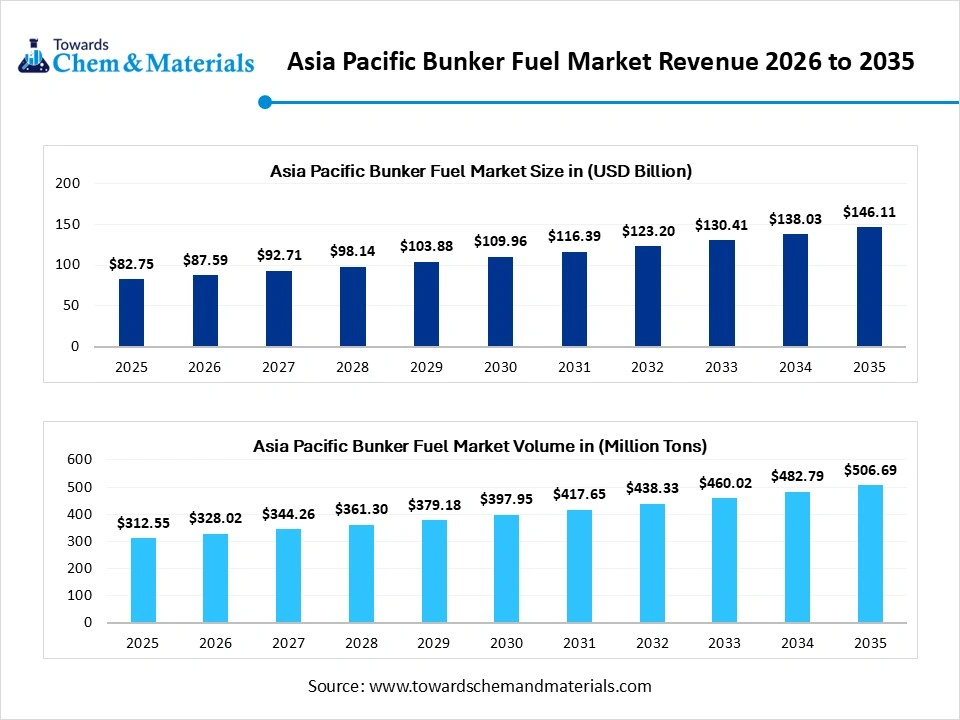
The Asia Pacific bunker fuel market size was estimated at USD 82.75 billion in 2025 and is expected to be worth around USD 146.11 billion by 2035, exhibiting a compound annual growth rate (CAGR) of 5.85% over the forecast period from 2026 to 2035.In terms of volume the Asia Pacific bunker fuel market is projected to grow from 312.55 million tons in 2025 to 506.69 million tons by 2035. growing at a CAGR of 4.95% from 2026 to 2035. The report provides detailed market size analysis, along with segment-wise data by fuel type, vessel type, and application. It also includes regional insights across key Asia Pacific countries, in-depth company profiles, competitive landscape analysis, value chain evaluation, and trade data, along with comprehensive manufacturers and suppliers information.
Key Takeaways
- By fuel type, theVLSFO segment held the largest 42% share in the market in 2025 due to its high energy density and minor environmental impact as a zero-carbon alternative.
- By fuel type, the HSFO segment held the second largest share of 28% in 2025 due to its operational margins and its cost-saving grade for international trade routes.
- By application, the container ships segment dominated the market with 34% share in 2025, driven by export-based economies and its fixed-loop schedules infrastructure.
- By application, the bulk carriers segment held the second largest share of 22% in 2025 due to its heavy-tonnage operations and cost-effective procurement for stable fuel demand.
- By seller type, the oil majors segment dominated with a held 36% share in the market in 2025 due to their creditworthiness, financial stability, and end-to-end quality assurance.
- By seller type, the NOCs segment held the second largest share of 28% in 2025 due to its geographical leadership for state-based refinery and domestic supply.
- By port type, the major ports segment held the largest 68% share in the market in 2025, acting as a key hub for maritime refuelling and setting a standard for volumetric precision.
- By port type, the minor ports segment held the second largest share of 20% in 2025 due to their domestic supply chain, storage solution and specialized niche operations.
- By bunkering method, the ship-to-ship (STS) segment held the largest 54% share in the market in 2025 due to its superior flexibility and volumetric precision in large-scale maritime operations.
- By bunkering method, the truck-to-ship (TTS) segment held the second largest share of 26% in 2025 due to its low infrastructure barriers and key method for early adoption of alternative fuels.
Market Overview
The Asia Pacific bunker fuel market represents the key hub for maritime energy infrastructure and a key pillar for international seaborne trade. The region is a strategic asset for maritime trade, port operations and shipbuilding framework. Asia Pacific is transforming towards a multi-fuel ecosystem promoted by decarbonization standards and digital transparency.
The stringent IMO sulfur regulation for maintaining fleet operation and boosting the LNG and bio-blended fuels implementation. Additionally, the regions revolution towards smart bunkering, integrating mass flow meter technology and blockchain-based fuel tracking, enables reliable global commerce, superior operational efficiency and value chain integrity for bulk carriers and container fleets.
Asia Pacific Bunker Fuel Market Trends
- Complex Decarbonization Pathways: Asia Pacific shift towards a diversified fuel ecosystem, which is supported by substantial investment into green ammonia, methanol and hydrogen bunkering infrastructure.
- Infrastructure-Driven LNG Scaling: The trend driven by a surge in dual-fuel newbuilds and rapid expansion of cryogenic bunkering assets. The Asia Pacific hub is deploying LNG bunker vessels to enable STS transfers.
- Integration of Bio-Fuel Blending: The trend is reshaped by bio-VLSFO and bio-MGO blending to meet carbon intensity indicator compliance, to reduce carbon footprint and speed up the production of synthetic e-fuels.
Key Technological Shifts and AI in the Asia Pacific Bunker Fuel Market
The technological transformation activates the central intelligence layer for maritime energy in the Asia Pacific bunker fuel market. The integration of AI-driven data analytics and machine learning enables optimization of fuel procurement and price forecasting by maintaining schedules for drain intervals. The mass flow meter with blockchain-based tracking offers precision and transparency in the domestic supply chain.
The Predictive AI enable electronic bunker delivery notes, boosted by operational liquidity to meet CII compliance using real-time emission monitoring. Overall, the data-driven ecosystem in the Asia Pacific refuelling efficiency and automated dosing system across the biosphere’s demanding shipping lanes.
Asia Pacific Bunker Fuel Market: Supply Chain Analysis
- Feedstock Procurement: The stage of exploration and extraction of crude oil and primary raw material for marine fuels using enhanced oil recovery, deepwater and offshore drilling.
- Key Players: ExxonMobil, Shell, PetroChina, Petronas, Pertamina, ONGC, BP and Chevron
- Processing and Storage: The stage of refining crude oil into VLSFO, HSFO and MGO using specified pipeline operations, tanker transportation and terminal storage.
- Key Players: Sinopec, SK Energy, Neste, Vopak, Sembcorp Marine, Trafigura and Glencore
- Refining and Bunkering: The stage of bunkering where fuel is transferred from barges and pipelines to commercial vessels using barge operations, bunker brokerage and digitalized fleet management.
- Key Players: World Kinect Corporation, Dan-Bunkering, Chimbusco, KPI OceanConnect, Bunker Holding, Peninsula Petroleum and Adani Bunkering
Regulatory Framework: Asia Pacific Bunker Fuel Market
| Country | Key Authority and Regulation | Regulatory Focus |
| International | IMO Standards | Strict sulfur limits and adoption of carbon intensity indicator ratings for vessel efficiency. |
| China | MOT and MSA- Domestic Emission Control Areas | Sulfur limits in coastal and inland waters to reduce domestic air pollution. |
| Singapore | MPA-TR 48and SS | Mandatory use of mass flow meters and electronic bunker delivery notes for precision and fraud prevention. |
| Japan | MLIT-Roadmap for Carbon Neutrality | Safety and technical standards for ammonia and hydrogen bunkering for modern fuel transition. |
| South Korea | MOF- Eco-friendly Ship Act | Subsidies for LNG bunkering vessels and expansion of green shipping corridors with ports. |
| Hong Kong | MARDEP-Green Marine Fuel Scheme | Financial incentives and infrastructure support to convert the port into a high-quality, clean fuel bunkering hub. |
| India | DG Shipping-Sagarmala Programme | Texs rationalisation to improve the competitiveness of Indias bunker ports |
Segmental Insights
Fuel Type Insights
VLSFO Segment Dominated the Asia Pacific Bunker Fuel Market with 42% of Market Share in 2025
VLSFO Segment dominated the market with 42% share in 2025, driven by the regulatory framework for the industrial IMO agreement to replace high-sulfur content alternative for the global fleet. The VLSFO offers high-energy density and reduces environmental impact. The rising regional focus on operational liquidity is driving the VLSFO implementation for maritime energy transformation as a net-zero carbon alternative.
HSFO segment held the second largest share of 28% in 2025, defined by its ability to provide heavy-tonnage international trade routes and global consumption of exhaust gas cleaning systems. HFSO is a cost-saving grade for ultra-large container vessels, and VLCCs align with abatement technology and IMO compliance. The segment offers domestic vessel operators the benefit of price and operational margin that make them a key segment of the Asia Pacific maritime energy transition.
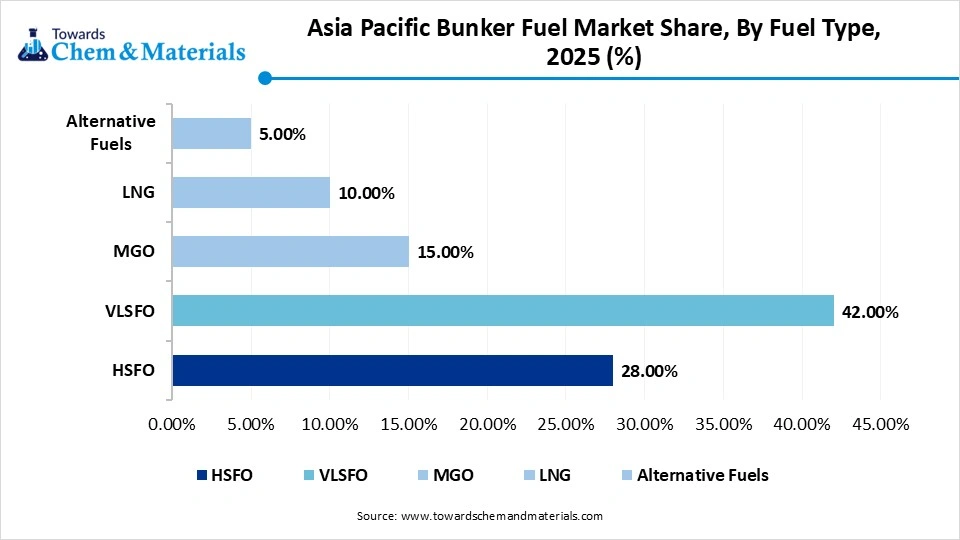
MGO segment held the third largest share of 15% in 2025, representing its superior fuel quality and low viscosity for auxiliary engine operations and emission control areas as a premium distillate segment to meet sulfur compliance. The regional hub called MGO is a strategic fallback fuel and low-emission alternative for container fleets and vessels due to its operational reliability and energy security, which align with strict environmental mandates.
LNG segment held the fourth largest share of 10% in 2025. It acts as a key transitional fuel for Asia Pacific decarbonization commitments. The LNG offers a radical decrease in nitrogen oxides and sulfur oxides. The regional strict IMO greenhouse gas goals and expansion of bunkering infrastructure make its LNG ideal for dual-fuel newbuilds as a high-efficiency cryogenic fuel. Additionally, the integration of bio-LNG and synthetic e-LNG in the maritime energy mix makes it key for the supply chain framework.
Asia Pacific Bunker Fuel Market Share, By Fuel Type, 2025 (%)
| By Fuel Type | Revenue Share, 2025 (%) |
| HSFO | 28.00% |
| VLSFO | 42.00% |
| MGO | 15.00% |
| LNG | 10.00% |
| Alternative Fuels | 5.00% |
Application Insights
Container Ships Segment Dominated the Asia Pacific Bunker Fuel Market with 34% of Market Share in 2025
Container ships segment dominated the market with 34% share in 2025, functioning on fixed-loop schedules and high velocity operation. Asia Pacific serves as a transhipment capital where container shipping is a catalyst for bunkering liquidity. The segment fueling the consumption of VLSFO, LNG and methanol by integrating with export-driven economies to bolster maritime evolution and digital bunkering standards.
Bulk carriers segment held the second largest share of 22% in 2025, due to its heavy-tonnage operation and cost-effective sourcing. The segment is a key driver for consistent fuel demand for transit coal, iron ore and grain. The bulk carriers are crucial for major and secondary bunkering hubs by maintaining operational liquidity. Additionally, in emerging economies, the segment boosts the use of wind-based propulsion and bio-blended fuel to achieve CII compliance in the maritime supply chain.
Oil tankers segment held the third largest share of 18% in 2025, serving as a key bridge in the global energy security chain. The segment is a key driver of bunkering demand in chokepoints and operating as very large crude carriers. The domestic industry has shifted towards digital transformation, where oil tankers are leading supporters of mass flow meter integration and electronic bunker delivery notes by providing precision and auditability in the Asia Pacific petroleum trade.
General cargo ships segment held the fourth largest share of 10% in 2025 due to its ability to transport breakbulk, industrial material and project cargo. The segment acts as a secondary and coastal trade path for regional trade by offering flexible calling patterns and mid-sized profiles for VLSFO and MGO. The stringent emission regulation aligns with the development of emerging economies, making general cargo ships a key implementer of the digital fuel monitoring system.
Asia Pacific Bunker Fuel Market Share, By Application, 2025 (%)
| By Application | Revenue Share, 2025 (%) |
| Container Ships | 34.00% |
| Bulk Carriers | 22.00% |
| Oil Tankers | 18.00% |
| General Cargo Ships | 10.00% |
| Cruise Ships | 8.00% |
| Others | 8.00% |
Seller Type Insights
Oil Majors Segment Dominated the Asia Pacific Bunker Fuel Market with 36% of Market Share in 2025
Oil majors segment dominated the market with 36% share in 2025, representing a key segment of regional energy security that leverages the refinery network and upstream to downstream value chain by maintaining creditworthiness and end-user quality assurance. The oil majors are key drivers of market transformation, fueled by a shift towards decarbonization using significant investment in LNG bunkering infrastructure, green methanol and bio-blended fuel. The segment acts as an energy partner that ensures financial stability and technical expertise for sustainability goals in container lines and fleets.
NOCs segment held the second largest share of 28% in 2025, acting as state-backed refinery assets and domestic supply control for Asia Pacific export economies. The segment leverages tax incentives and integrated infrastructure to maintain market liquidity to meet national decarbonization commitments. The NOCs move towards high-volume LNG bunkering and VLSFO manufacturing, positioning them as market makers for the regional maritime framework.
Independent suppliers segment held the third largest share of 24% in 2025 value for their commercial flexibility and source of market liquidity that links refinery output and vessel demand in Asia Pacific hubs. The Independent suppliers are logistical experts that offer credit solutions and a multi-port value chain, and focus on fuel blending and scaling the distribution of MGO and bio-based VLSFO by maintaining efficiency and price volatility in the shipping fleet.
Small distributors segment held the fourth largest share of 12% in 2025. The segment functions as an operational support for Asia Pacific secondary and coastal ports. Their high agility and domestic specialization make them crucial physical bunkerers by ensuring regional market liquidity. The segment is experiencing a shift toward premium distillates and MGO to meet regulatory standards across the distributed coastal trade network.
Asia Pacific Bunker Fuel Market Share, By Seller Type, 2025 (%)
| By Seller Type | Revenue Share, 2025 (%) |
| Oil Majors | 36.00% |
| NOCs | 28.00% |
| Independent Suppliers | 24.00% |
| Small Distributors | 12.00% |
Port Type Insights
Major Ports Segment Dominated the Asia Pacific Bunker Fuel Market with 68% of Market Share in 2025
Major parts segment dominated the market with 68% share in 2025, driven by their strategic geographic location in busy shipping lanes, valued for their market liquidity and volumetric precision. The major ports are implementing advanced infrastructure to ensure operational efficiency by using MFM and digital bunkering compliance. The segment is reinforcing maritime decarbonization that driving the transition towards LNG bunkering and green shipping for container fleets.
Minor ports segment held the second largest share of 20% in 2025, driven by its specialized operation in general cargo shipments, offshore support and fleets as a regulating link for regional and domestic maritime trade. The segment key provider of MGO, distillate fuel in the countryside, by offering lower individual volumes and maritime connectivity to meet IMO standards. The minor ports ensure fuel quality and maintain supply chain integrity for smaller shipping operators.
Offshore bunkering segment held the third largest share of 12% in 2025, representing the high mobility port segment and an alternative for land-based terminals. Offshore bunkering is ideal for tankers and bulk carriers to lower deviation time near major maritime chokepoints by maintaining operational resilience. Additionally, the segment provides a supply layer by ensuring stringent safety and environmental compliance of fixed port infrastructure.
Asia Pacific Bunker Fuel Market Share, By Port Type, 2025 (%)
| By Port Type | Revenue Share, 2025 (%) |
| Major Ports | 68.00% |
| Minor Ports | 20.00% |
| Offshore Bunkering | 12.00% |
Bunkering Method Insights
Ship-to-Ship (STS) Segment Dominated the Asia Pacific Bunker Fuel Market with 54% of Market Share in 2025
Ship-to-ship (STS) segment dominated the market with 54% share in 2025 due to its superior flexibility and high-efficiency operational standard and precision that allows ULCVs and VLCCs to receive fuel at designated ports. The segment integrates mass flow meter and digital bunkering technology by balancing accuracy and environmental safety across Asia Pacific shipping lanes.
Truck-to-ship (TTS) segment held the second largest share of 26% in 2025. This method provides a primary refuelling mechanism and acts as a low infrastructure barrier for fleets, offshore support vessels and cargo ships. The TTS is a key delivery system for early implementation of alternative fuels for initial LNG and bio-blended fuels in the emerging maritime sector. The segment uses specialized ISO trucks and focuses on fuel quality and operational reliability by providing energy distribution for regional trade.
Pipeline segment held the third largest share of 20% in 2025, known for direct-to-berth connectivity and operational flexibility that allows tankers and container ships to collect fuel directly from shore-based terminals by eliminating barge congestion and berthing delays. The pipeline is a stable and cost-effective delivery system for VLSFO and MGO in Asia Pacific energy hubs by offering precision, safety, and fuel integrity for maritime operators.
Asia Pacific Bunker Fuel Market Share, By Bunkering Method, 2025 (%)
| By Bunkering Method | Revenue Share, 2025 (%) |
| Ship-to-Ship (STS) | 54.00% |
| Truck-to-Ship (TTS) | 26.00% |
| Pipeline | 20.00% |
Recent Developments
- In November 2025, the Maritime and Port Authority of Singapore (MPA) and DNV renewed their MoU to strengthen their partnership to accelerate the adoption of sustainable maritime fuels and advance smart-ship systems. The MoU commitment to advance the maritime and port sectors in Singapore.
- In February 2025, Asia Pacifics first LNG bunkering for cruise ships was completed at the Singapore Cruise Centre. With TotalEnergies delivering fuel to the Silversea’s Silver Nova through the bunker vessel Brassavola, owned by Mitsui O.S.K. lines and managed by V.Ships.
Asia Pacific Bunker Fuel Market Competitive Landscape Analysis
Tier 1 Companies
|
Rank
|
Company Name | Headquarters | Country | Why Relevant to This Market | Key Products / Material Portfolio |
| 1 | Shell plc | London, England | United Kingdom | Global leader in marine fuel supply with a strong bunkering network across Singapore and major Asia-Pacific ports | VLSFO, HSFO, MGO, LNG bunker fuel, marine biofuels |
| 2 | BP p.l.c. | London, England | United Kingdom | Major supplier of marine fuels with expanding low-carbon bunker fuel offerings in Asia-Pacific | Marine fuel oil, LNG bunker fuel, biofuel blends, marine lubricants |
| 3 | Chevron Corporation | San Ramon, California | United States | Significant supplier of bunker fuels through strategic terminals and marine fuel distribution networks | Marine gas oil, VLSFO, marine diesel fuel |
| 4 | Sinopec Fuel Oil Sales Co., Ltd. | Beijing | China | One of Chinas largest bunker fuel suppliers serving domestic and international shipping | VLSFO, HSFO, MGO, bonded bunker fuel |
| 5 | PetroChina Company Limited | Beijing | China | Leading marine fuel supplier supporting Chinas expanding port and shipping infrastructure | Marine fuel oil, VLSFO, MGO, LNG marine fuel |
Tier 2 Companies
|
Rank
|
Company Name | Headquarters | Country | Why Relevant to This Market | Key Products / Material Portfolio |
| 1 | Exxon Mobil Corporation | Spring, Texas | United States | Major supplier of marine fuels and lubricants across key Asia-Pacific bunkering ports | VLSFO, MGO, marine lubricants, low-sulfur marine fuels |
| 2 | TotalEnergies SE | Courbevoie, Île-de-France | France | Strong presence in Singapore and other regional bunkering hubs with conventional and alternative marine fuels | VLSFO, LNG bunker fuel, marine biofuels |
| 3 | Vitol B.V. | Rotterdam | Netherlands | One of the worlds largest independent bunker fuel suppliers with extensive operations in Asia | Marine fuel oil, VLSFO, MGO, biofuel blends |
| 4 | Bunker Holding A/S | Middelfart | Denmark | Global bunker supplier with comprehensive marine fuel distribution across Asia-Pacific | Marine fuel oil, LNG bunker fuel, VLSFO |
| 5 | Indian Oil Corporation Limited | New Delhi | India | Major bunker fuel supplier serving Indian ports and expanding regional marine fuel operations | Marine fuel oil, VLSFO, MGO, marine lubricants |
Tier 3 Companies
|
Rank
|
Company Name | Headquarters | Country | Why Relevant to This Market | Key Products / Material Portfolio |
| 1 | Petronas Dagangan Berhad | Kuala Lumpur | Malaysia | Leading bunker fuel supplier in Malaysia with expanding low-carbon marine fuel offerings | Marine fuel oil, VLSFO, LNG bunker fuel |
| 2 | SK Energy Co., Ltd. | Seoul | South Korea | Supplies marine fuels through South Koreas major ports and refining network | VLSFO, MGO, marine fuel oil |
| 3 | ENEOS Corporation | Tokyo | Japan | Major supplier of marine fuels supporting Japans shipping industry | Marine diesel oil, VLSFO, marine lubricants |
| 4 | PTT Public Company Limited | Bangkok | Thailand | Regional supplier of marine fuels and LNG for Southeast Asian shipping markets | Marine fuel oil, LNG bunker fuel, MGO |
| 5 | Hindustan Petroleum Corporation Limited | Mumbai, Maharashtra | India | Important supplier of bunker fuels across major Indian ports | VLSFO, marine diesel oil, marine lubricants |
Top Companies in the Market
- BP
- Brightoil Petroleum
- Chemoil Energy Limited
- Cheniere Energy
- Chevron Corporation
- China Marine Bunker (PetroChina) Co., Ltd.
- Exxon Mobil Corporation
- Hindustan Petroleum Corporation Limited
- Innospec
- Indian Oil Corporation
- KOREA LNG BUNKERING
- Minerva Bunkering
- PetroChina Company Limited
- Petroliam Nasional Berhad (PETRONAS)
- Repsol
- Sempra Energy
- Shell
- TFG Marine Pte. Ltd.
- TotalEnergies
- Vitol Bunkers
Asia Pacific Bunker Fuel Market Segment List
By Fuel Type
- High Sulfur Fuel Oil (HFSO)
- Very Low Sulfur Fuel (VLSFO)
- Marine Gas Oil (MGO)
- Liquefied Natural Gas (LNG)
- Alternative Fuels
By Application
- Container Ships
- Bulk Carriers
- Oil Tankers
- General Cargo Ships
- Cruise Ships
- Others
By Seller Type
- Oil Majors
- National Oil Companies (NOCs)
- Independent Suppliers
- Small Regional Distributors
By Port Type
- Major Ports
- Minor Ports
- Offshore Bunkering
By Bunkering Method
- Ship-to-Ship (STS)
- Truck-to-Ship (TTS)
- Pipeline
A Seven-Phase Framework
Our methodology is designed to be universally applicable across commodity chemicals, specialty chemicals, petrochemicals, construction chemicals, coatings, electronic chemicals, industrial gases, agrochemicals, water treatment chemicals, and performance materials. Each phase builds upon the last, creating a layered validation structure that minimizes estimation error and maximizes analytical confidence.
The framework ensures comprehensive market coverage, robust cross-validation, and reliable long-term forecasting — producing market estimates that withstand scrutiny from investors, regulators, and corporate strategy teams.

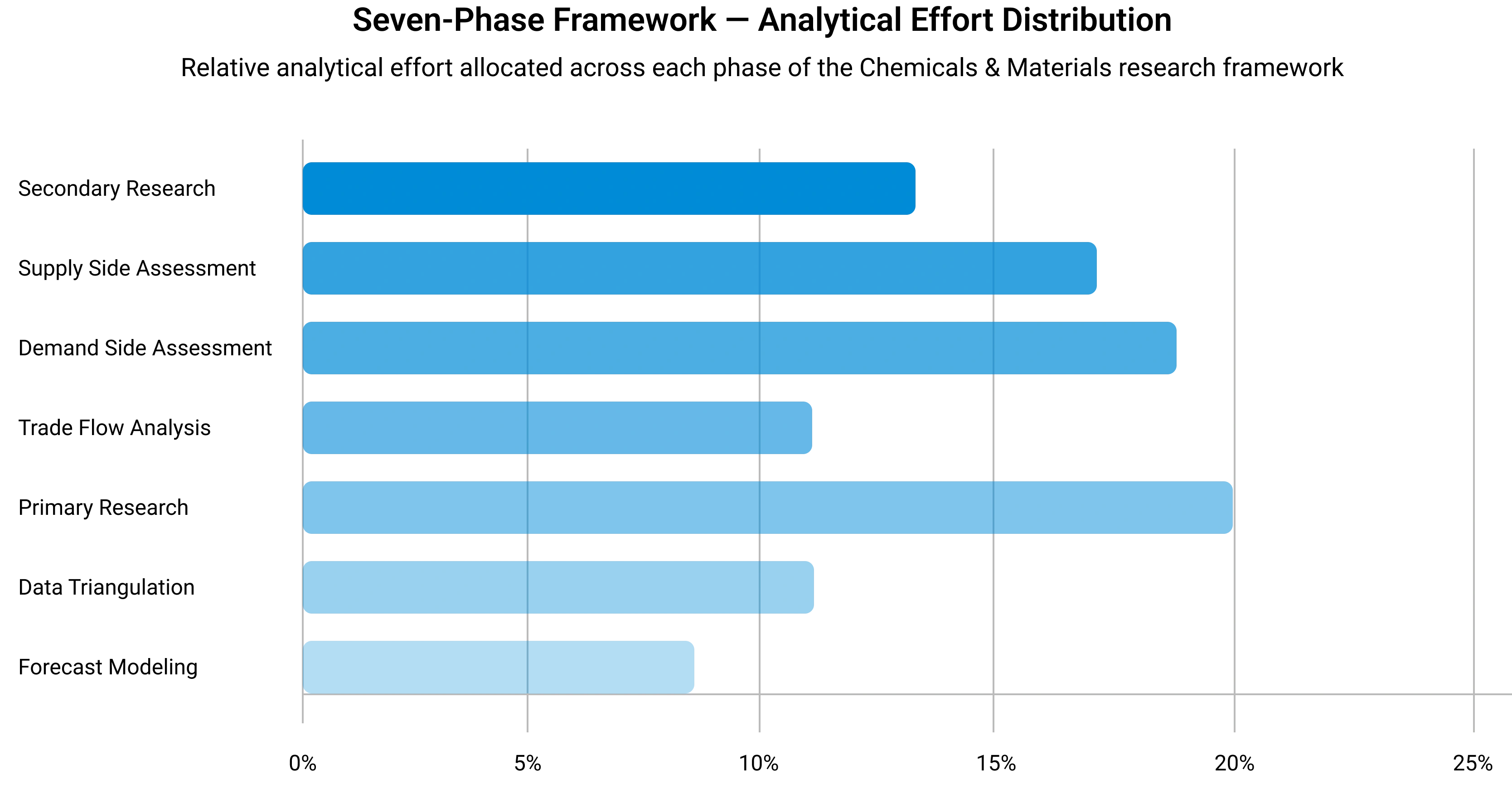
Seven-Phase Framework — Analytical Effort Distribution
Relative analytical effort allocated across each phase of the Chemicals & Materials research framework
Phase 1 - Secondary Research: Establishing the Foundation
Secondary research collects and evaluates publicly available information from authoritative sources, establishing the foundational understanding of market structure, value chain dynamics, competitive landscape, and end-use demand patterns. Every source is evaluated for credibility, recency, geographic relevance, and methodological soundness before inclusion.
Industry Associations
Sources include ACC, CEFIC, ICCA, JCIA, CPCIF, and SOCMA providing production volumes, consumption trends, capacity developments, and sustainability initiatives.
Company Disclosures
Annual reports, investor presentations, earnings transcripts, and regulatory filings reveal product portfolios, manufacturing footprints, capacity expansions, and revenue segmentation.
Government Databases
National statistical offices, customs authorities, environmental agencies, and industrial production databases provide verified statistics on output, trade flows, and regulatory compliance.
Trade Databases
UN Comtrade, ITC, Eurostat, and national customs authorities enable assessment of global product movement, import dependency, and export competitiveness across regions.
Our Secondary Research Sources
- Ministry of Chemicals and Fertilizers
- European Chemicals Agency
- United States Department of Energy
- Ministry of Industry and Information Technology
- Ministry of Economy Trade and Industry
- Ministry of Trade Industry and Energy
- National Institute of Standards and Technology
- Council of Scientific and Industrial Research
- Fraunhofer Society
- National Institute for Materials Science
Phase 2 — Supply-Side Assessment: Mapping Production Capabilities
Production Capacity Analysis
All major manufacturers are assessed for existing installed capacity, planned additions, expansions, new plant announcements, and technology adoption — mapped at global, regional, and country levels.
Capacity Utilization Adjustment
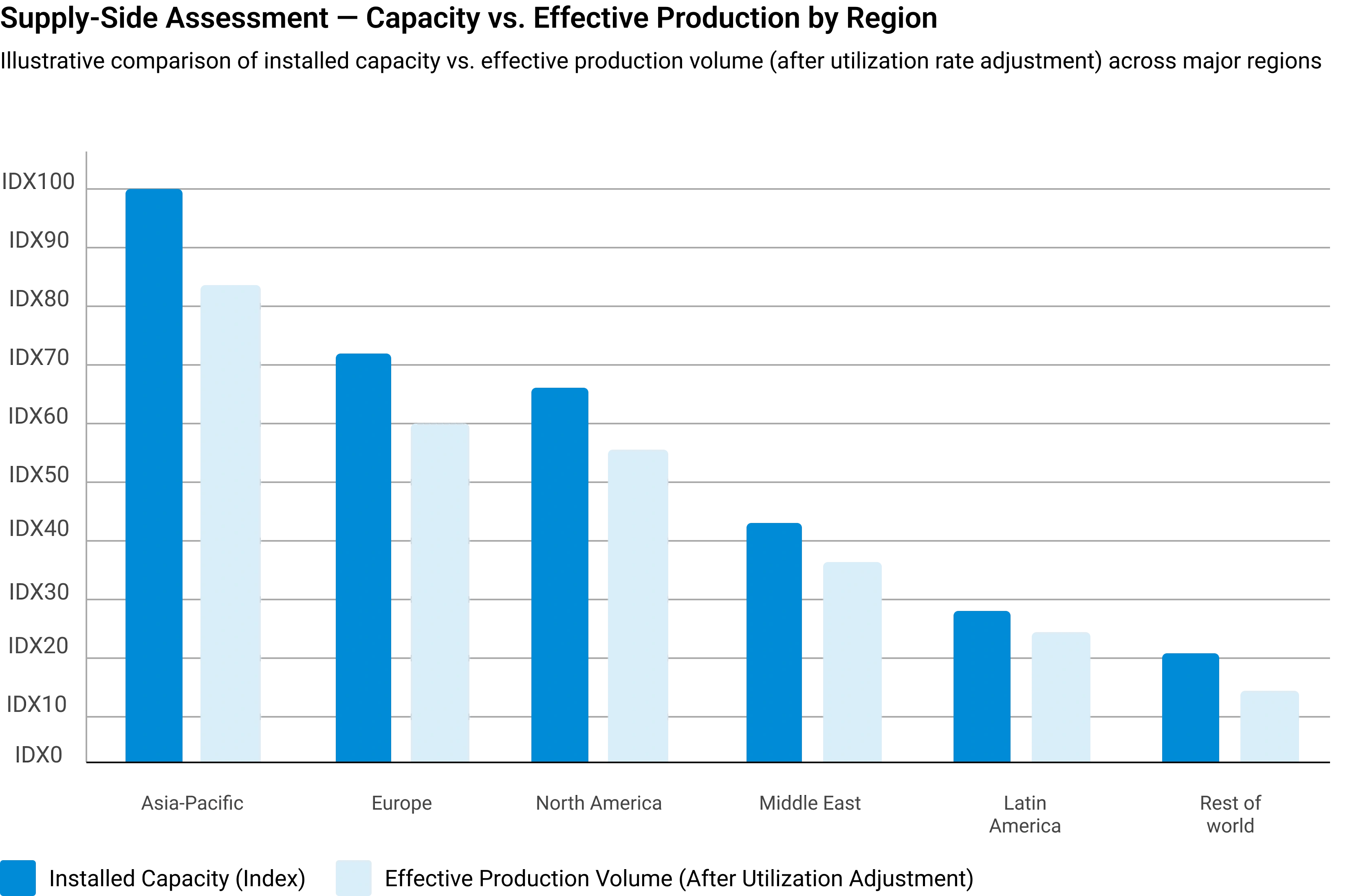
Installed capacity is adjusted using utilization rates based on demand conditions, feedstock availability, plant operating rates, maintenance schedules, and regulatory restrictions.
Manufacturer Revenue Analysis
Product-specific revenues, segment-level performance, regional distribution, average selling prices, and margin trends are evaluated to establish market value estimates.
Supply-Side Assessment — Capacity vs. Effective Production by Region
Illustrative comparison of installed capacity vs. effective production volume (after utilization rate adjustment) across major regions
Phase 3 — Demand-Side Assessment: Quantifying Chemical Consumption
Demand-side analysis quantifies chemical consumption across industries, applications, and geographies — identifying where and how chemicals are consumed throughout the value chain with precision.
End-Use Industry Analysis
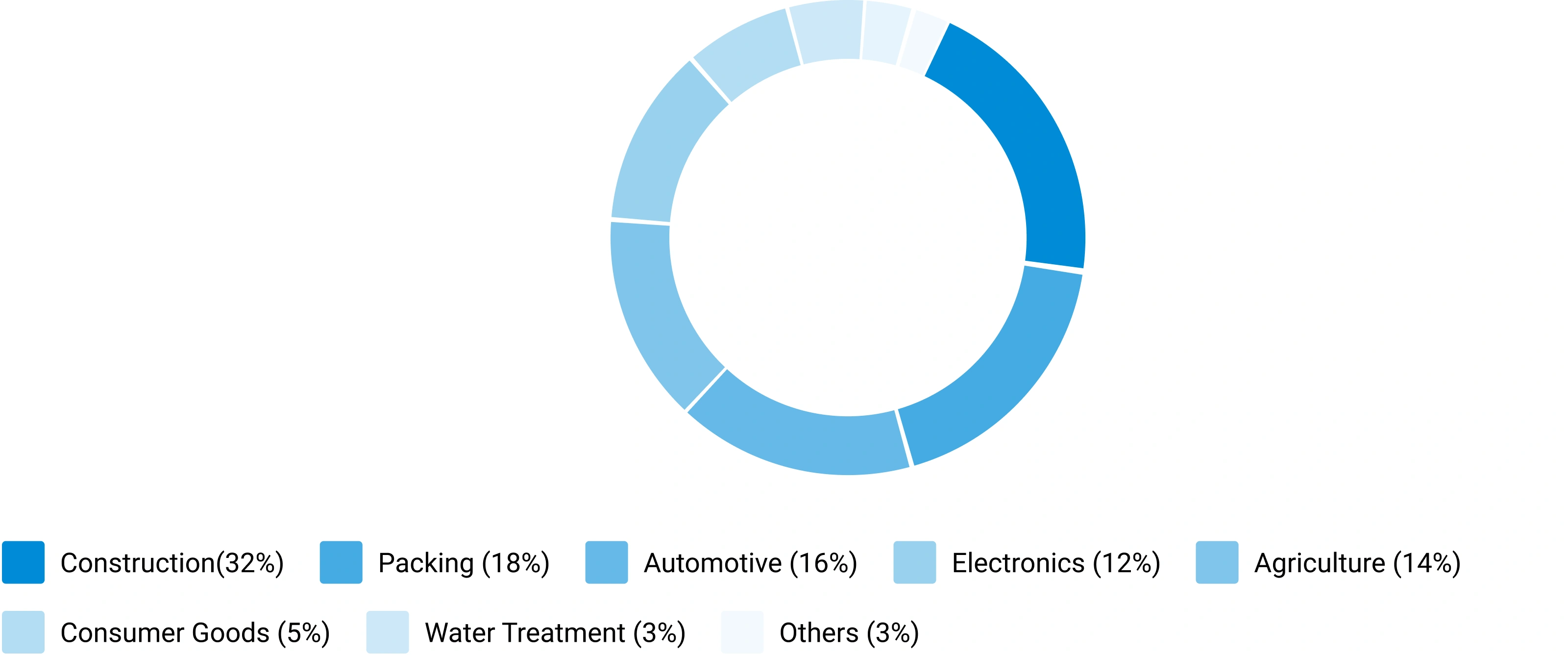
Chemical demand is evaluated across automotive, construction, packaging, electronics, agriculture, healthcare, consumer goods, industrial manufacturing, energy and utilities, and water treatment. Industry output, production trends, and consumption intensity are analyzed to determine demand patterns.
Consumption Modeling
Demand is estimated using measurable indicators: kilograms per vehicle, kilograms per square meter of construction, dosage per cubic meter of water treated, kilograms per hectare of agricultural land, and kilograms per ton of manufactured products. Consumption factors are validated through industry publications and primary interviews.
Application Analysis
The market is segmented by application area to understand product performance requirements, formulation trends, technology adoption, customer preferences, and regulatory requirements improving demand accuracy and segmentation granularity.
Demand-Side Assessment — End-Use Industry Demand Distribution
Illustrative distribution of chemical & materials demand across key end-use industries
Phase 4 - Trade Flow Analysis: Balancing Regional Supply and Demand
Trade flow analysis reconciles regional supply and demand estimates through import and export data, identifying net supply positions, regional dependencies, and market imbalances. It serves as an independent validation layer that tests the consistency of supply-side and demand-side estimates.
Import Analysis
Import data is evaluated to determine volumes, source countries, product dependency, regional supply gaps, and pricing trends — identifying markets that rely heavily on external supply and where domestic production is insufficient to meet demand.
Export Analysis
Export assessments reveal production surplus, export competitiveness, regional manufacturing strength, and global market participation. Export patterns also help validate domestic production estimates and identify net exporting regions.
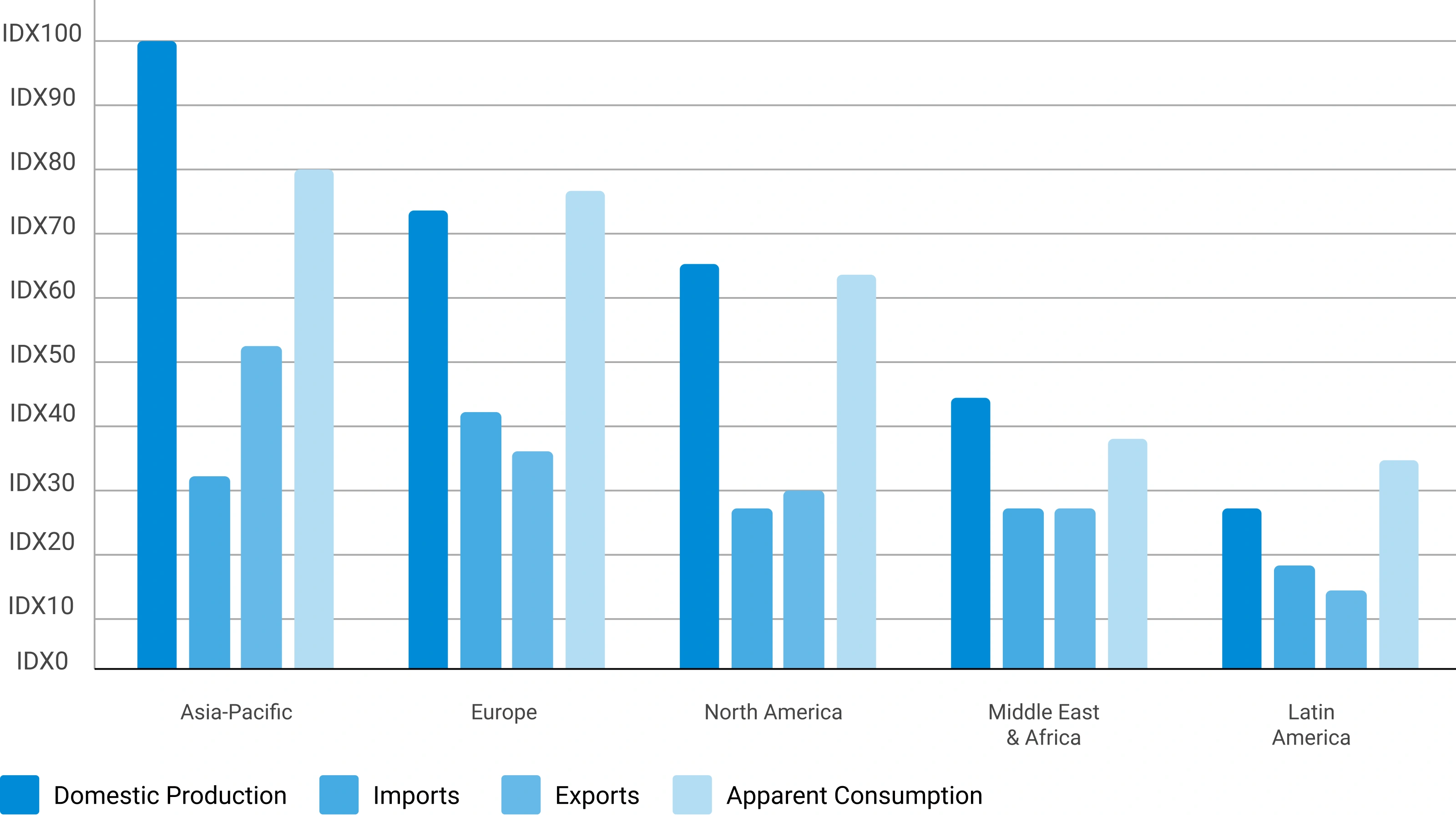
Apparent Consumption Model
Regional consumption is assessed using the standard apparent consumption formula:
Results identify net importing regions, net exporting regions, regional deficits, and surpluses — serving as an independent validation of supply and demand estimates.
Trade Flow Analysis — Net Supply Position by Region
Illustrative apparent consumption vs. domestic production across major regions — positive gap indicates net import dependency
Phase 5 — Primary Research: The Critical Validation Layer
Primary research tests and refines findings from secondary research through direct engagement with industry participants across the supply chain, demand side, and expert community. It captures intelligence that no database or published report can provide — the real-world experience of manufacturers, buyers, and specialists operating in the market.

Supply-Side Interviews
Conversations with chemical manufacturers, raw material suppliers, contract manufacturers, technology providers, and plant operators cover production trends, capacity utilization, pricing developments, technology shifts, and competitive dynamics.

Demand-Side Interviews
Engagement with OEMs, industrial consumers, procurement managers, distributors, formulators, and end-use manufacturers focuses on consumption trends, purchasing behavior, product substitution, demand outlook, and emerging applications.

Industry Expert Consultations
Additional interviews with industry consultants, independent experts, regulatory specialists, technical professionals, and research institutions provide deeper market context and validate key analytical assumptions.
Focus Areas of Primary Research:
Market Size & Forecast Validation
Revenue estimates, volume consumption, growth rates, forecast assumptions, regional demand.Supply Chain & Value Chain Assessment
Raw material sourcing, supply chain challenges, distribution networks, procurement practices.Production & Capacity Analysis
Manufacturing capacity, utilization rates, expansion projects, plant investments.Pricing & Cost Structure Analysis
Product pricing trends, feedstock costs, energy costs, margin pressures, pricing outlook.Competitive Landscape Assessment
Volume and value estimates confirmed to be fully consistent with one another before publicationInterview Volume by Market Scope
| Study Scope | Number of Interviews |
|---|---|
| Niche Market | 20 – 30 |
| Mid-Sized Market | 30 – 50 |
| Global Market | 50 – 80 |
| Highly Fragmented Market | 80 – 120 |
Interview Details:
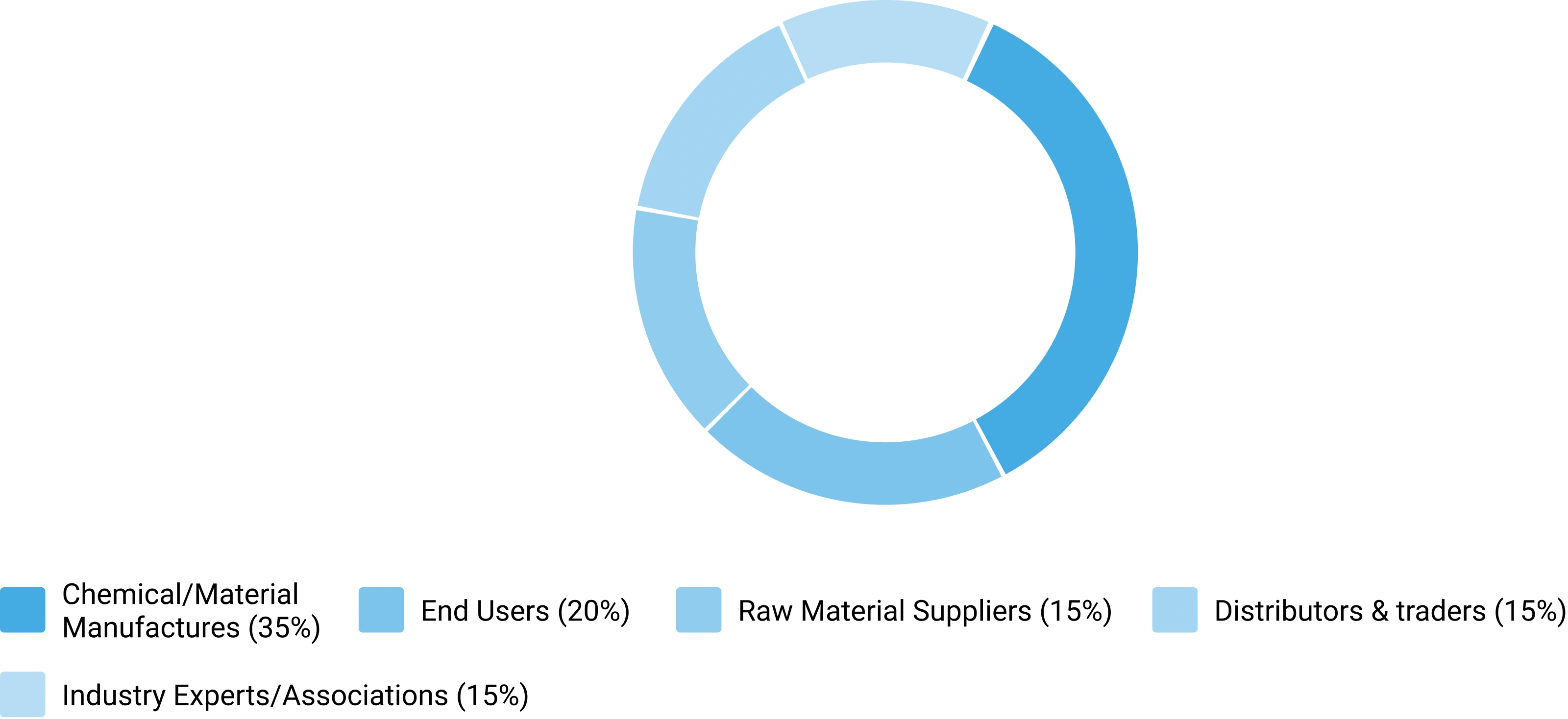
Category : Manufacturers, Suppliers, Distributors, End Users, Experts/Associations
Average Duration : 30–60 Minutes
Interview Mode : Video calls, telephonic interviews, expert consultations
Interview Format : Structured / Semi-Structured questionnaire
Focus Areas of Primary Research:
Market Size & Forecast Validation :
Revenue estimates, volume consumption, growth rates, forecast assumptions, regional demand.
Supply Chain & Value Chain Assessment :
Raw material sourcing, supply chain challenges, distribution networks, procurement practices.
Production & Capacity Analysis :
Manufacturing capacity, utilization rates, expansion projects, plant investments.
Pricing & Cost Structure Analysis :
Product pricing trends, feedstock costs, energy costs, margin pressures, pricing outlook.
Competitive Landscape Assessment :
Market share, competitor positioning, strategic initiatives, partnerships, acquisitions.
Primary Research — Stakeholder Coverage by Category
Distribution of interview respondents across stakeholder categories (% share from PPT data)
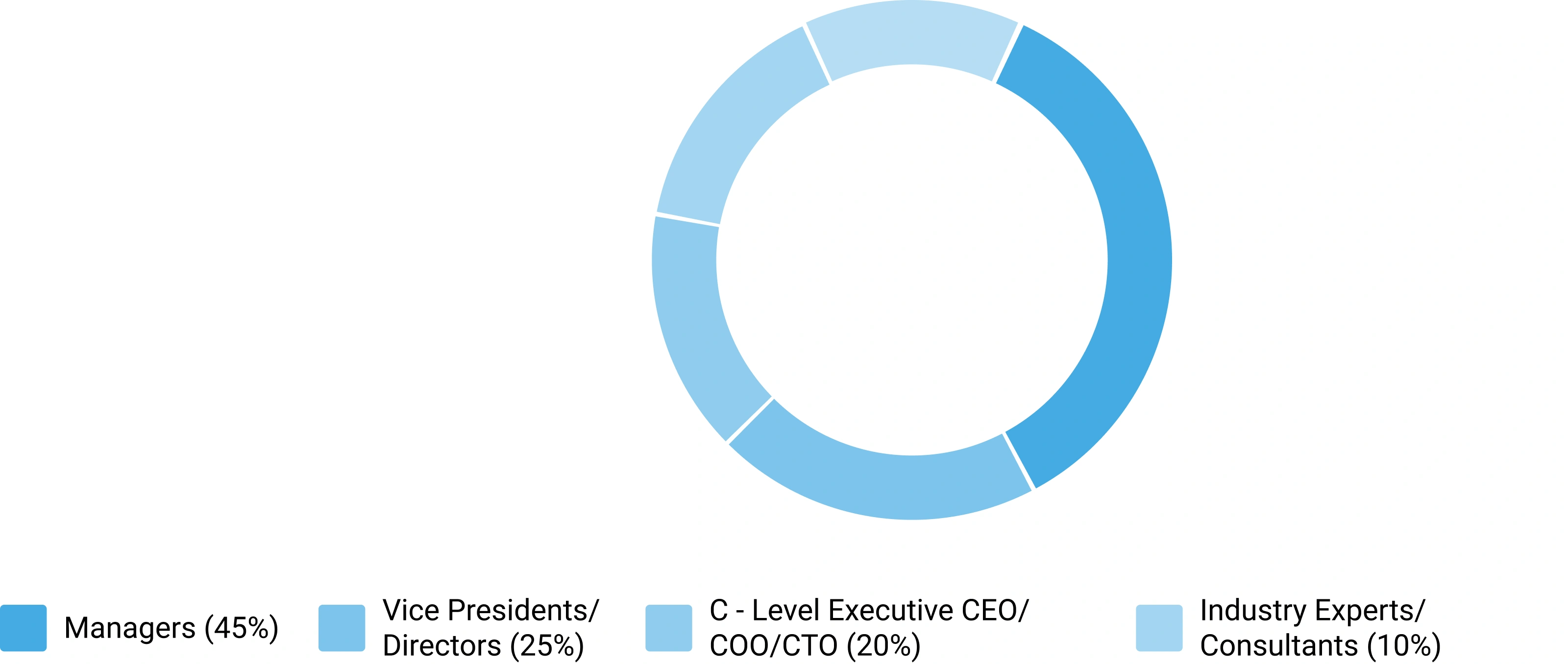
Primary Research — Respondent Designation Profile
Seniority breakdown of interview respondents (% share from PPT data)
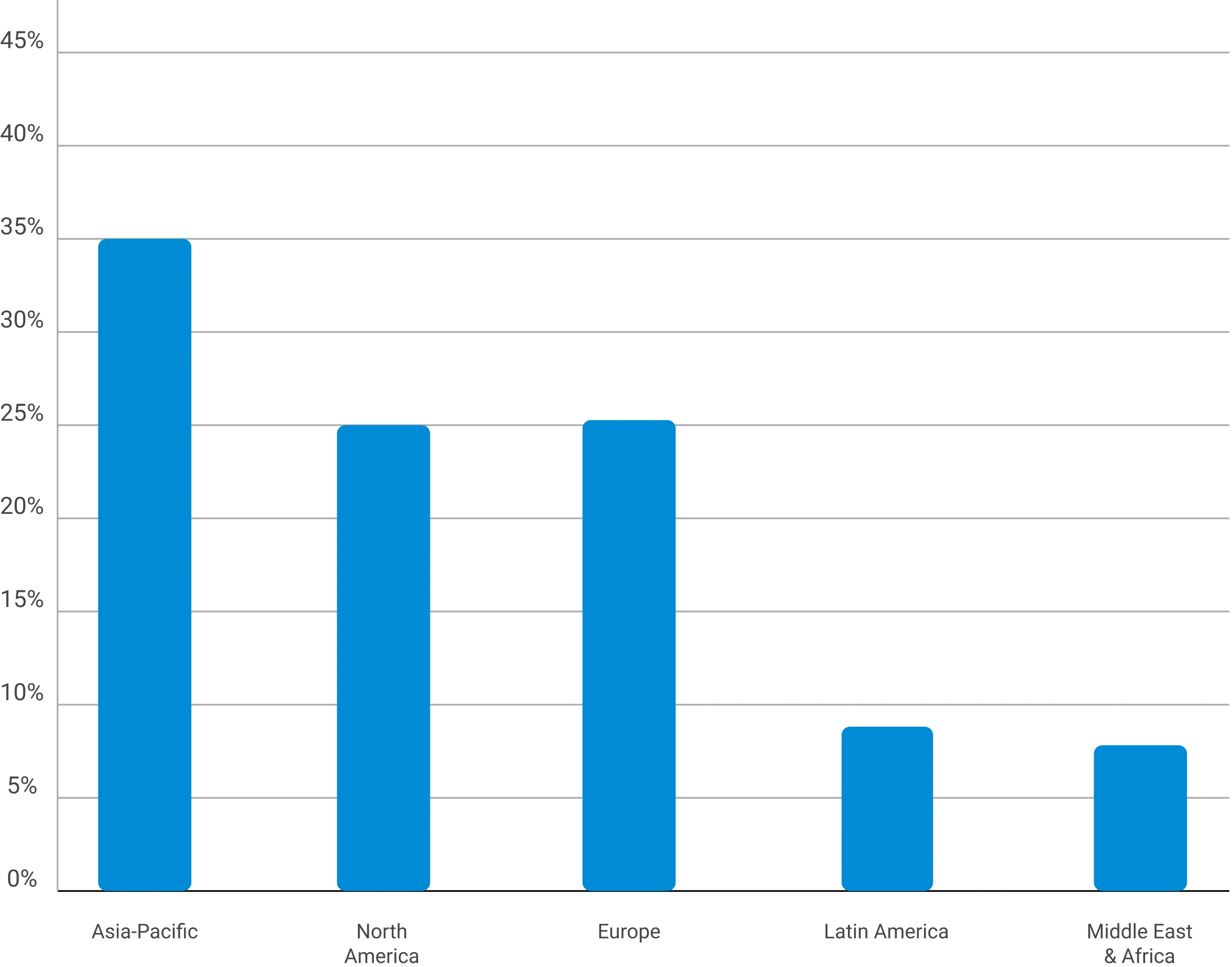
Primary Research — Geographic Coverage of Interviews
Regional distribution of primary research engagement (% share from PPT data)
Phase 6 — Data Triangulation and Market Validation
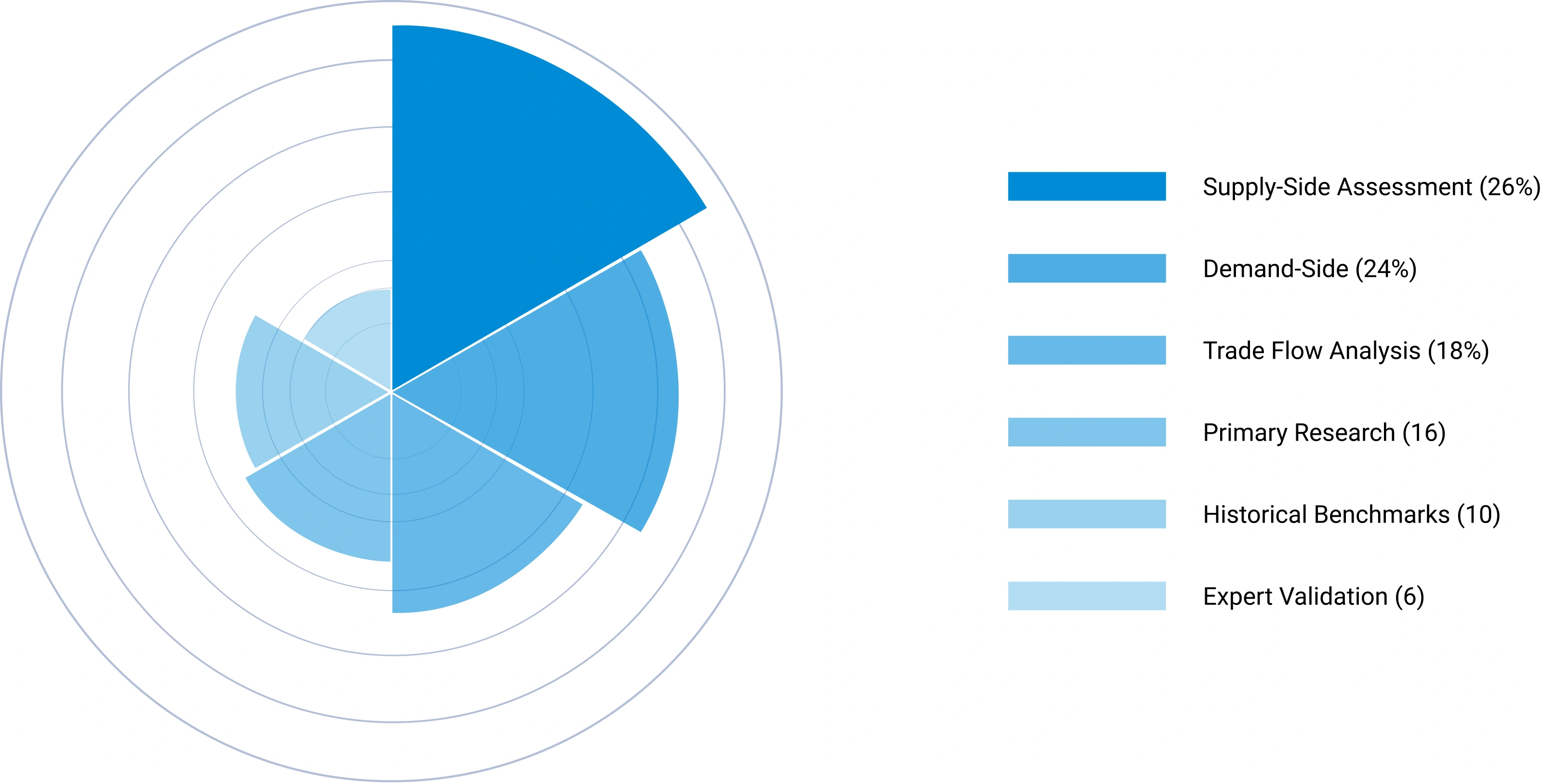
No single methodology is relied upon in isolation. Multiple independent estimation approaches are combined and reconciled to ensure consistency, accuracy, and analytical defensibility. Any material deviations between approaches are investigated and adjusted through additional validation cycles.
The final market size is derived through weighted triangulation of all validated methodologies. Any material deviations between approaches are investigated and adjusted through additional validation cycles. The outcome represents the most realistic assessment of the market based on available evidence and expert confirmation ensuring that volume and value estimates are fully consistent with one another.
Triangulation Framework — Input Contribution Weight
Relative weight each sizing input contributes to the final reconciled market estimate
Phase 7 — Forecast Modeling: Projecting Future Market Evolution
Forecasting evaluates the future trajectory of the market using a combination of quantitative indicators and qualitative assessments across economic, industry, and regulatory dimensions. Rather than simple extrapolation, each driver is independently modeled and integrated into a composite forecast.
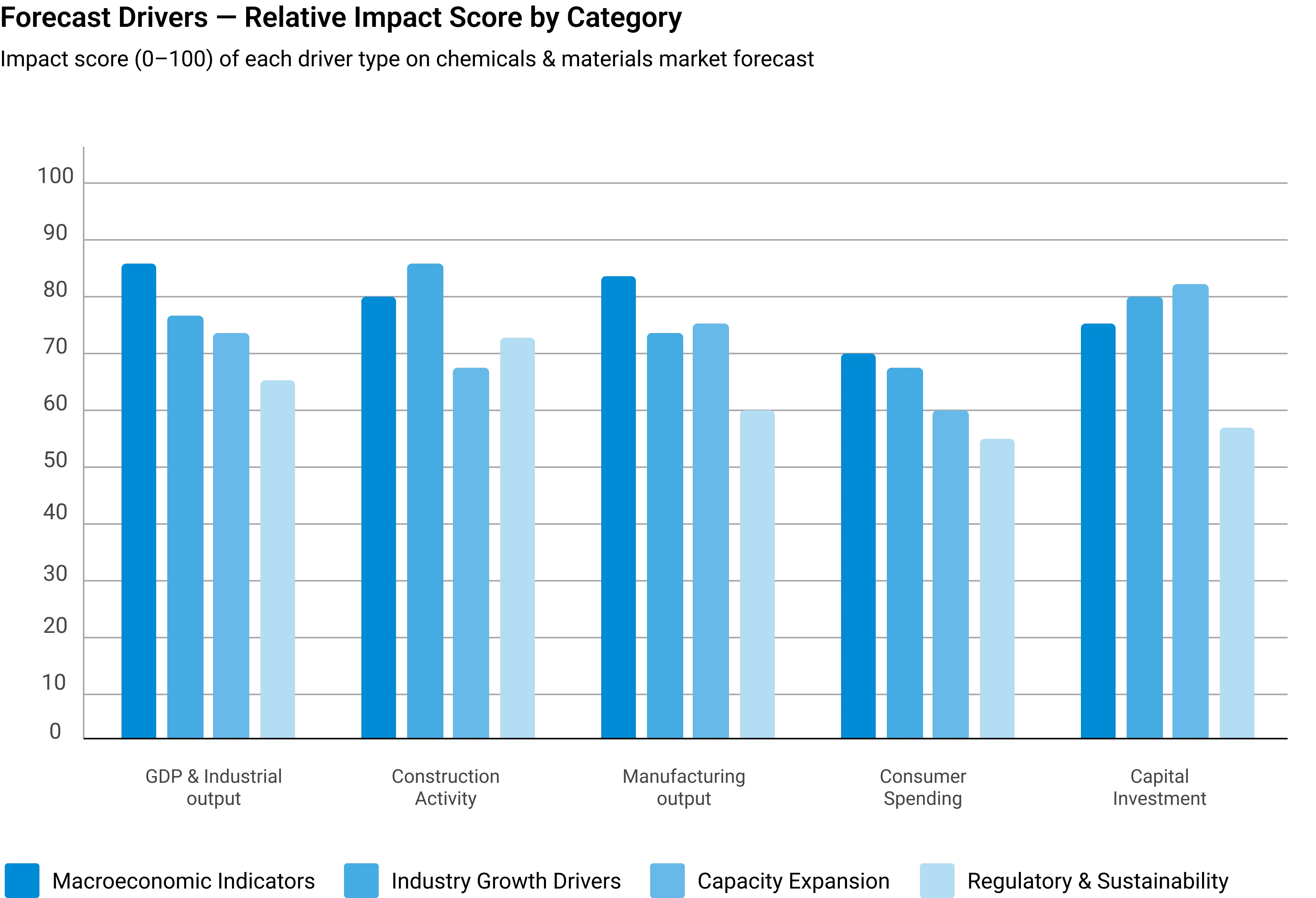
Macroeconomic Indicators
GDP growth, industrial production, manufacturing output, construction activity, consumer spending, and capital investment form the quantitative foundation of long-term demand projections. These are applied at country, regional, and global levels.
Industry Growth Drivers
Urbanization, infrastructure development, industrialization, technological innovation, sustainability initiatives, and evolving product performance requirements are assessed at regional and industry levels — capturing both structural and cyclical demand drivers.
Capacity Expansion Analysis
Announced plant expansions, new manufacturing facilities, technology upgrades, and strategic investments are evaluated to determine future supply-demand dynamics and potential market tightness or oversupply situations.
Regulatory & Sustainability
Environmental regulations, chemical safety standards, emission reduction targets, circular economy initiatives, and sustainability requirements are incorporated as they often influence product adoption rates and market growth trajectories.
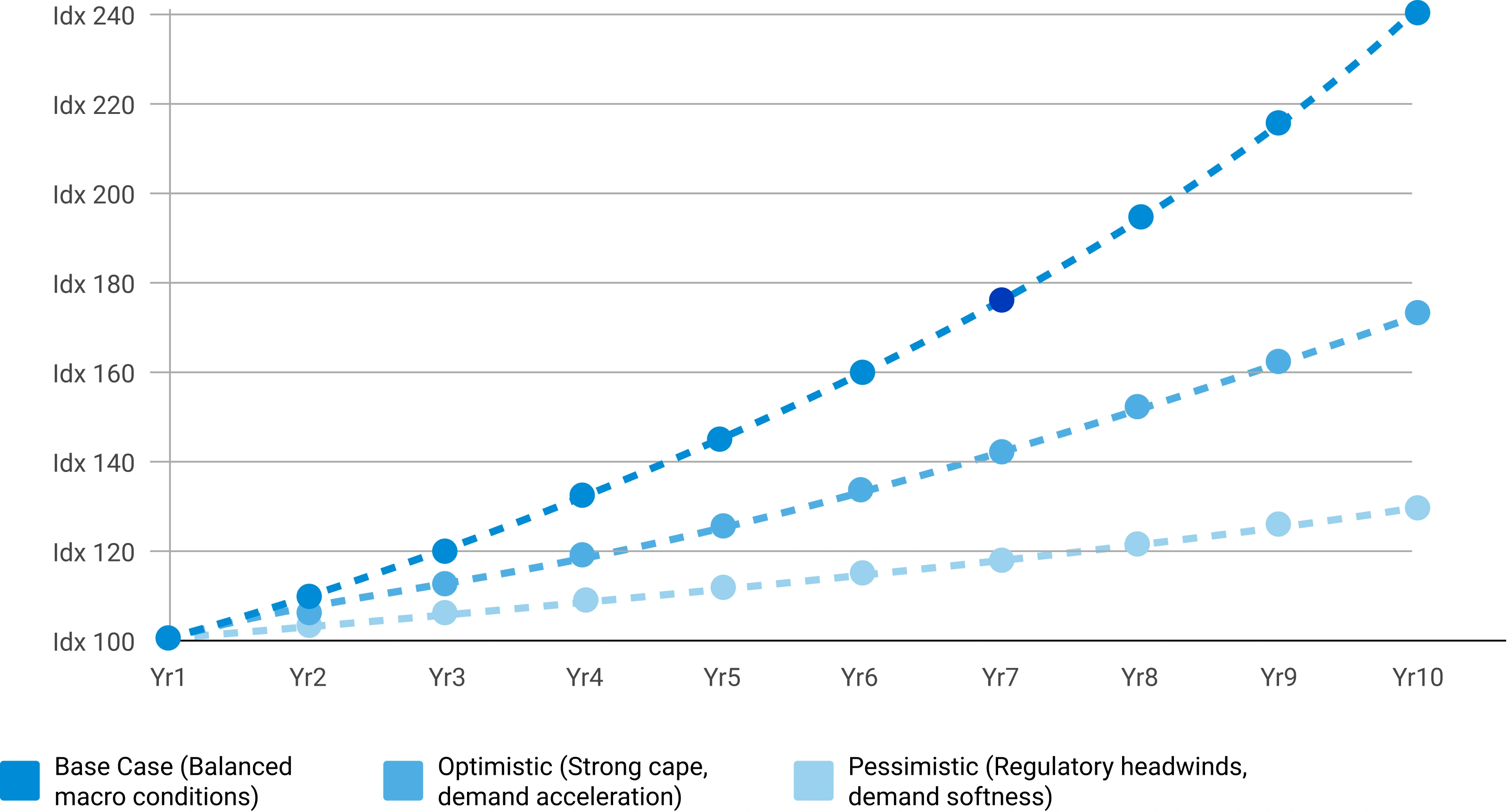
Scenario Forecast Range — Indexed Market Growth (Year 1–10)
Illustrative indexed growth trajectories across Base, Optimistic, and Pessimistic scenarios over a 10-year forecast horizon
Forecast Drivers — Relative Impact Score by Category
Impact score (0–100) of each driver type on chemicals & materials market forecast



Comments
Share your thoughts, ask a question, or provide feedback about this report.