Content
Aviation Fuel Additives Market Size Analysis Report 2035
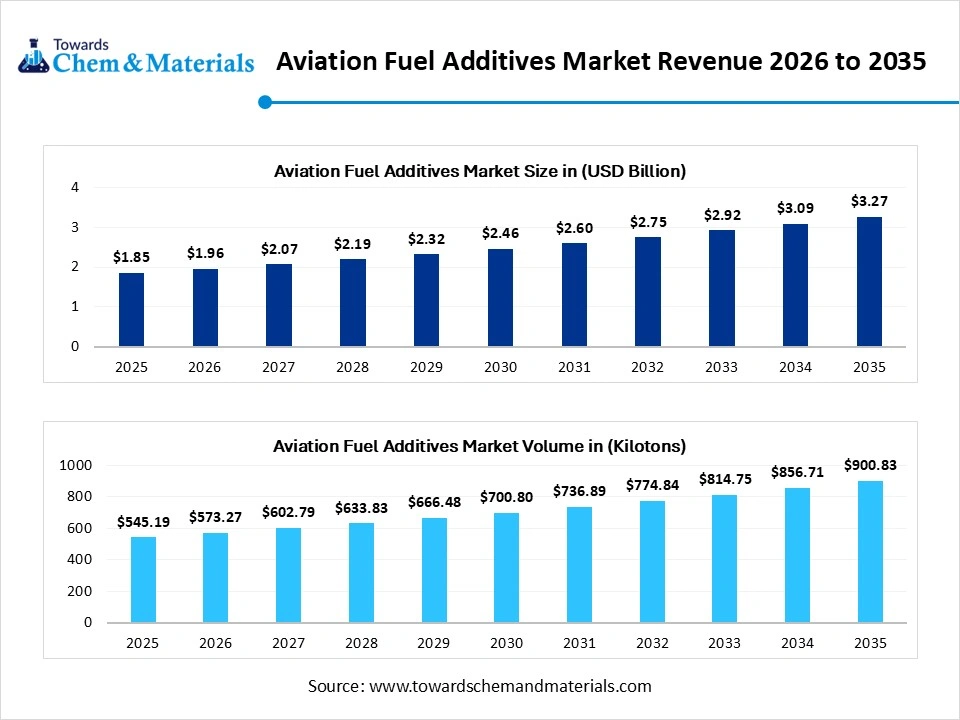
The global aviation fuel additives market was valued at USD 1.85 billion in 2025, is estimated to reach USD 1.96 billion in 2026, and is projected to reach USD 3.27 billion by 2035, growing at a CAGR of 5.85% from 2026 to 2035. In terms of volume, the aviation fuel additives market is projected to grow from 545.19 kilo tons in 2025 to 900.83 kilo tons by 2035. growing at a CAGR of 5.15% from 2026 to 2035.
Key Takeaways
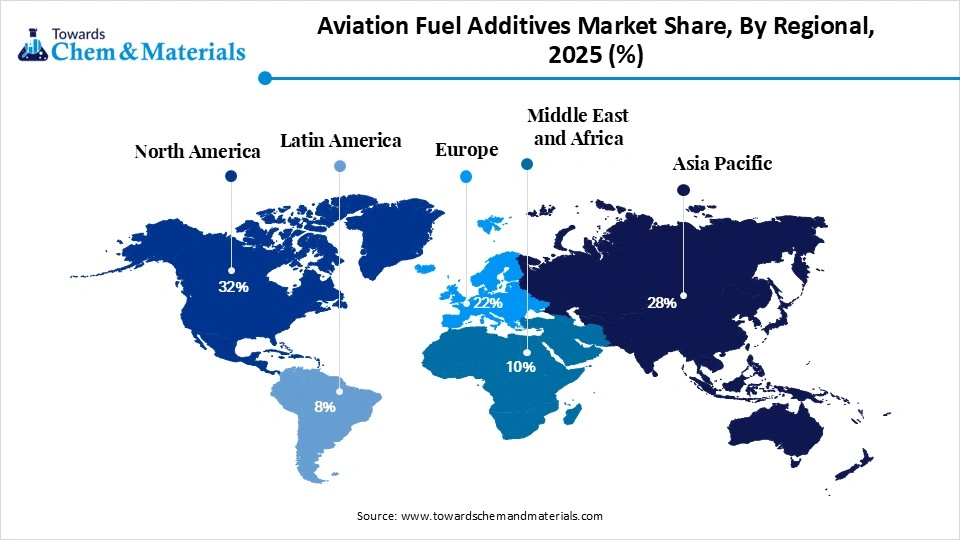
- By region, North America dominated the market with 32% share in 2025.
- By region, Asia Pacific held the 28% market share in 2025 and is expected to be the fastest-growing region in the market, with a CAGR of 6.8% in the forecast period.
- By additive type, the antioxidants segment dominated the market with 24% share in 2025.
- By additive type, the Fuel System Icing Inhibitors (FSII) segment held the 18% market share in 2025 and is expected to be the fastest-growing in the market, with a CAGR of 6.4% in the forecast period.
- By fuel type, the Jet A-1 segment dominated the market with 42% share in 2025.
- By fuel type, the Sustainable Aviation Fuel (SAF) segment held the 14% market share in 2025 and is expected to be the fastest-growing in the market, with a CAGR of 7.8% in the forecast period.
- By application, the commercial aviation segment dominated the market with 56% share in 2025.
- By application, the general aviation segment held the 18% market share in 2025 and is expected to be the fastest-growing in the market, with a CAGR of 6.2% in the forecast period.
- By function, the stability improvement segment dominated the market with 26% share in 2025.
- By function, the anti-icing segment held the 19% market share in 2025 and is expected to be the fastest-growing in the market, with a CAGR of 6.5% in the forecast period in 2025.
- By end-use industry, the civil aviation segment dominated the market with 52% share in 2025.
- By end-use industry, MRO (Maintenance, Repair, Overhaul) segment held the 10% market share in 2025 and is expected to be the fastest-growing in the market, with a CAGR of 6.3% in the forecast period.
- By distribution channel, direct supply to airlines segment dominated the market with 48% share in 2025
- By distribution channel, the OEM partnerships segment held the 20% market share in 2025 and is expected to be the fastest-growing in the market, with a CAGR of 6.4% in the forecast period.
Market Size and Volume Forecast
- Market Estimated Size (2025): USD 1.85 Billion | CAGR (2026–2035): 5.85%
- Market Projected Size (2035): USD 3.27 Billion
- Market Volume (2025): 545.19 Kilotons | Volume CAGR (2026–2035): 5.15%
- Market Projected Volume (2035): 900.83 Kilotons
- Market Pricing (2025):
- Average Manufacturing Price: USD 2.95/kg
- Average Selling Price: USD 4.45/kg
- Pricing CAGR (2025–2035): 2.65%
Fuel Additives Deliver Big Aviation Benefits
The specialized chemicals, which are mixed in small amounts with aircraft fuel to improve safety and performance is known as the aviation fuel additive. Also, by helping to work effectively under different conditions, such as extremely cold temperatures and higher altitudes, the fuel additive has established its presence in the aviation fuel industry in the current period.
Aviation Fuel Additives Market Trends:
- The heavy demand for the improvement of engine health and risk-free flights has translated into favourable financial prospects for the producers in recent years. Moreover, these additives have been seen in preventing engine damage.
- The greater shift towards sustainable and ecofriendly fuel is driving sustainable financial gains in the manufacturing sector nowadays. The major manufacturers increased their R&D programs, which can further sales as per expectations.
- The trend towards digitalization and technological improvements is expected to elevate earning potential for producers in the coming years. Also, the manufacturers have been seen investing heavily in the development of smarter additives in recent years.
Report Scope
| Report Attribute | Details |
| Market Size and Volume in 2026 | USD 1.96 Billion / 573.27 Kilotons |
| Expected Size and Volume by 2035 | USD 3.27 Billion / 900.83 Kilotons |
| Growth Rate from 2026 to 2035 | CAGR 5.85% |
| Forecast Period | 2026 - 2035 |
| Dominant Region | North America |
| Segment Covered | By Additive Type, By Fuel Type, By Application, By Function, By End-Use Industry, By Distribution Channel and By Region |
| Key companies profiled | BASF SE, Innospec Inc., Baker Hughes, Clariant AG, Dorf Ketal Chemicals, Shell PLC, TotalEnergies SE, Neste Oyj |
Modern Technology Powers Additives Development
The industry is actively shifting towards more advanced chemical formulation and testing methods. Also, scientists carefully design additives at the molecular level to ensure they mix well with fuel and perform specific tasks. Furthermore, the modern labs use simulation tools to test how additives behave in real flight conditions.
Supply Chain Analysis of the Aviation Fuel Additives Market:
Distribution to Industrial Users
- Distributing aviation fuel additives to industrial users requires strict adherence to safety and quality standards. Suppliers utilize specialized logistics networks to deliver high-performance chemicals, like anti-icing and biocidal agents, directly to refineries or airports.
- This ensures fuel integrity and engine efficiency, maintaining rigorous compliance with global aerospace regulations and certifications.
Chemical Synthesis and Processing
- Chemical synthesis of aviation fuel additives involves complex molecular engineering to produce antioxidants, de-icers, and corrosion inhibitors. The processing phase employs high-pressure reactors and catalytic purification to ensure extreme purity.
- These specialized chemical blends are rigorously tested to meet stringent aerospace standards, enhancing fuel stability and performance in flight.
Regulatory Compliance and Safety Monitoring
- Regulatory compliance for aviation fuel additives involves strict adherence to ASTM and DEF STAN specifications. Safety monitoring ensures chemical stability and prevents system contamination through continuous testing.
- Regulatory bodies mandate rigorous documentation and quality audits, ensuring every additive meets global safety standards to maintain aircraft performance and passenger security during flight.
Aviation Fuel Additives Market Regulatory Landscape: Regulations
| Country Region | Regulatory Body | Key Regulations | Focus Areas |
| United States | Environmental Protection Agency (EPA) | 49 U.S.C. § 44714 (Aviation Fuel Standards). | Emissions Control: Controlling chemical properties to eliminate emissions that endanger public health. |
| Europe | European Union Aviation Safety Agency (EASA) | Regulation (EU) 2023/2405 (ReFuelEU Aviation). | Traceability: Using the Union Database (under the Renewable Energy Directive) to track additives and raw materials from origin to market. |
| China | Civil Aviation Administration of China (CAAC). | CCAR-21 (Certification Procedures for Products and Parts) and CCAR-37. | Direct Supervision: Unlike the US/EU "indirect" model, the CAAC uses a direct supervision model, requiring administrative licenses for every supplier and laboratory. |
Market Dynamics
Driver
Rising Passenger Traffic Boosts Market Demand
Air travel is increasing every years is, creating profitable pathways for the industry in the current period. Also, more flights mean more fuel use, and this increases the need for additives to keep engines safe and efficient.
Restraint
Expensive Additives Limit Industrial Expansion
The high cost of advanced additives is expected to hinder the industry's growth in the coming years. Also, the small airlines or operators may avoid using expensive additives to save money. Moreover, strict approval and testing processes take a long time and delay product launches. Some additives may also create compatibility issues with newer fuels, especially sustainable aviation fuel.
Opportunity
Sustainable Fuel Growth Unlocks New Opportunities
The fast growth of sustainable aviation fuel is expected to create lucrative opportunities during the forecast period. Also, these fuels need new types of additives, creating space for innovation. Another opportunity is the rise of low-cost airlines and regional aviation, especially in developing countries, which increases fuel demand.
Segmental Insights
Additive Type Insights
The Antioxidants Segment Dominated the Aviation Fuel Additives Market with 24% Market Share in 2025
The antioxidants segment dominated the market with 24% share in 2025, owing to fuel stability is very important in aviation. Aviation fuel is often stored for long periods, and without antioxidants, it can break down and form harmful deposits. These deposits can damage engines and reduce performance. Antioxidants prevent this chemical breakdown and keep fuel fresh for longer time.
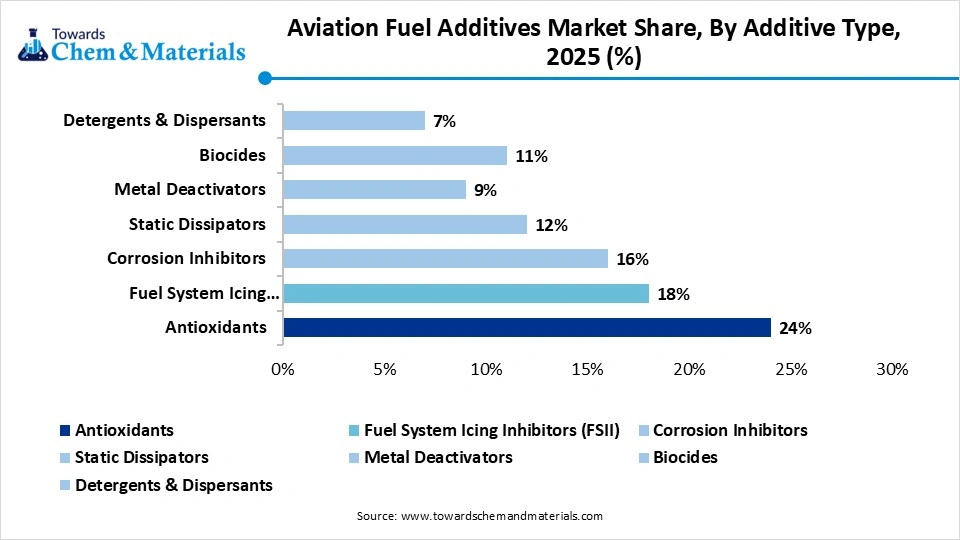
The Fuel System Icing Inhibitors (FSII) segment held the 18% market share in 2025 and is expected to be the fastest-growing in the market, with a CAGR of 6.4% in the forecast period, due to aircraft often fly at very high altitudes where temperatures are extremely low. At these temperatures, water in fuel can freeze and block fuel lines, which is dangerous. These inhibitors prevent ice formation and ensure smooth fuel flow.
Fuel Type Insights
The Jet A-1 Segment Dominated the Market with 42% Market Share in 2025
The Jet A-1 segment dominated the market with 42% share in 2025 due to it is the most commonly used aviation fuel worldwide. It is suitable for most commercial aircraft and works well in different climates. This fuel has a low freezing point, making it ideal for high-altitude flights. Because it is widely used, the demand for additives used with Jet A-1 is also very high.
Aviation Fuel Additives Market Share, By Fuel Type, 2025 (%)
| By Fuel Type | Revenue Share, 2025 (%) |
| Jet A-1 | 42% |
| Jet A | 20% |
| JP-8 | 14% |
| JP-5 | 10% |
| Sustainable Aviation Fuel (SAF) | 14% |
The Sustainable Aviation Fuel (SAF) segment held the 14% market share in 2025 and is expected to be the fastest-growing in the market, with a CAGR of 7.8% in the forecast period, owing to the aviation industry is under pressure to reduce carbon emissions. Governments and airlines are setting targets to become more eco-friendly. SAF is made from renewable sources and produces less pollution compared to traditional fuels. However, it needs advanced additives to match performance standards.
Application Insights
The Commercial Aviation Segment Dominated the Aviation Fuel Additives Market with 56% Market Share in 2025
The commercial aviation segment dominated the market with 56% share in 2025, owing to it includes large airlines that operate thousands of flights daily. These flights consume huge amounts of fuel, increasing the demand for additives. Passenger travel has grown rapidly, especially before and after global disruptions, leading to more aircraft usage.
Aviation Fuel Additives Market Share, By Application, 2025 (%)
| By Application | Revenue Share, 2025 (%) |
| Commercial Aviation | 56% |
| Military Aviation | 26% |
| General Aviation | 18% |
The general aviation segment held the 18% market share in 2025 and is expected to be the fastest-growing in the market, with a CAGR of 6.2% in the forecast period, due to the increasing use of private jets, air taxis, and small aircraft. Urban air mobility and regional connectivity are expanding, especially in developing countries. These aircraft still require high-quality fuel and additives for safety and efficiency.
Function Insights
The Stability Improvement Segment Dominated the Market with 26% Market Share in 2025
The stability improvement segment dominated the market with 26% share in 2025 owing to maintaining fuel quality over time is very important in aviation. Fuel can degrade due to heat, oxygen, and storage conditions, leading to engine problems. Stability additives help prevent this degradation and keep fuel in good condition.
Aviation Fuel Additives Market Share, By Function, 2025 (%)
| By Function | Revenue Share, 2025 (%) |
| Stability Improvement | 26% |
| Anti-Icing | 19% |
| Corrosion Protection | 16% |
| Static Control | 15% |
| Microbial Control | 14% |
| Deposit Control | 10% |
The anti-icing segment held the 19% market share in 2025 and is expected to be the fastest-growing in the market, with a CAGR of 6.5% in the forecast period in 2025, owing to the increasing high-altitude and long-distance flights. As aircraft fly in colder regions, the risk of ice formation in fuel systems becomes higher. Anti-icing additives ensure smooth operation by preventing blockages.
End-Use Industry Insights
The Civil Aviation Segment Dominated the Market with 52% Market Share in 2025
The civil aviation segment dominated the market with 52% share in 2025, owing to increasing high-altitude and long-distance flights. As aircraft fly in colder regions, the risk of ice formation in fuel systems becomes higher. Anti-icing additives ensure smooth operation by preventing blockages.
Aviation Fuel Additives Market Share, By End-Use Industry, 2025 (%)
| By End-Use Industry | Revenue Share, 2025 (%) |
| Civil Aviation | 52% |
| Defense Aviation | 24% |
| Aviation Fuel Suppliers | 14% |
| MRO (Maintenance, Repair & Overhaul) | 10% |
The MRO (Maintenance, Repair, Overhaul) segment held the 10% market share in 2025 and is expected to be the fastest-growing in the market, with a CAGR of 6.3% in the forecast period, owing to aircraft maintenance is becoming more important as fleets grow older. Airlines want to extend the life of their aircraft and reduce unexpected failures. Additives play a key role in keeping fuel systems clean and engines in good condition. MRO companies are focusing on preventive maintenance, which increases the use of additives.
Distribution Channel Insights
The Direct Supply to Airlines Segment Dominated the Market with 48% Market Share in 2025
The direct supply to airlines segment dominated the market with a 48% share in 2025, owing to airlines' preference to purchase additives directly from manufacturers or suppliers. This ensures consistent quality, better pricing, and reliable supply. Airlines operate on a large scale, so they need bulk quantities and long-term contracts. Direct supply also helps maintain strict safety and quality standards
Aviation Fuel Additives Market Share, By Distribution Channel, 2025 (%)
| By Distribution Channel | Revenue Share, 2025 (%) |
| Direct Supply to Airlines | 48% |
| Fuel Distributors | 32% |
| OEM Partnerships | 20% |
The OEM partnerships segment held the 20% market share in 2025 and is expected to be the fastest-growing in the market, with a CAGR of 6.4% in the forecast period. As aircraft manufacturers are increasingly working with additive companies. These partnerships help develop additives that are specially designed for new engines and fuel systems. As aviation technology becomes more advanced, customized solutions are needed. OEMs recommend specific additives to airlines, increasing their adoption. This creates strong long-term demand.
Regional Insights
How will North America Dominate the Aviation Fuel Additives Market in 2025?
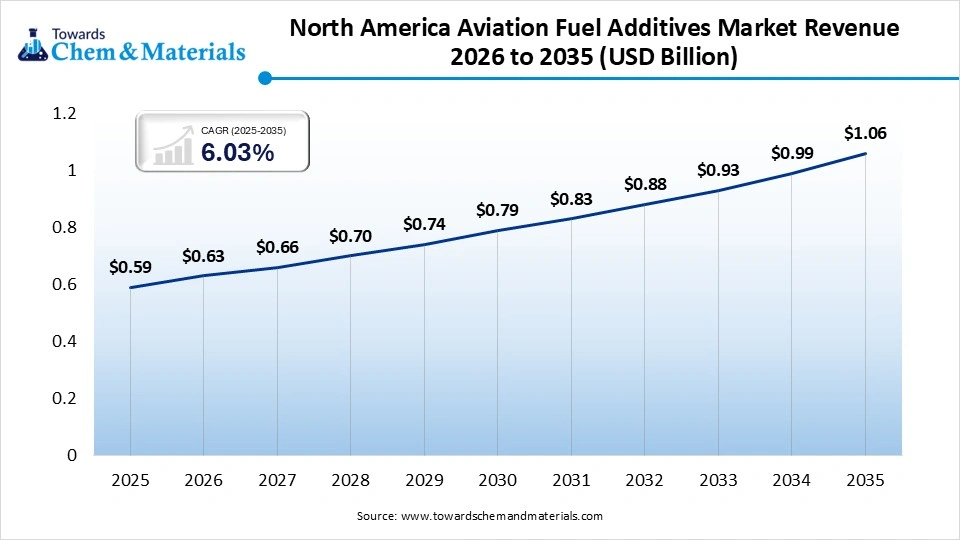
The North America aviation fuel additives market size was estimated at USD 0.59 billion in 2025 and is projected to reach USD 1.06 billion by 2035, growing at a CAGR of 6.03% from 2026 to 2035. The region has high air traffic and strong demand for fuel efficiency and safety. Strict government regulations also require the use of high-quality additives. Many leading additive manufacturers are based here, which supports innovation and supply.
Advanced Innovation Keeps the United States as an Industry Leader
The United States maintained its dominance in the market, owing to its large number of aircraft and busy air travel network. It has many major airlines and one of the highest fuel consumption rates globally. The country focuses heavily on safety, efficiency, and environmental standards. There is strong investment in research and development of advanced additives and sustainable aviation fuel.
Aviation Fuel Additives Market Evaluation in North America
Asia Pacific held the 28% market share in 2025 and is expected to be the fastest-growing region in the market, with a CAGR of 6.8% in the forecast period, owing to rapid growth in air travel and expanding airline networks. Countries like China and India are seeing a rise in the middle-class population, leading to more passengers. New airports and airlines are being developed quickly. This increases fuel demand and the need for additives.
China Expanding Aviation Fuel Additives Market
China is expected to emerge as a prominent country for the aviation fuel additives market in the coming years, due to its fast-growing aviation industry. The country is building new airports and expanding airline fleets to meet rising passenger demand. It is also investing heavily in sustainable aviation fuel and advanced technologies. Domestic production of additives is increasing, reducing dependence on imports.
Recent Development
- In November 2025, LanzaJet unveiled its latest commercial-scale jet fuel, which is made from ethanol and supports the renewable fuel initiative. Also, this fuel is the world's first non-oil-based renewable fuel and is compatible with existing aircraft, as per the published report.
Aviation Fuel Additives Market – Competitive Landscape Analysis
Tier 1 Companies
| Rank | Company Name | Headquarters | Country | Why Relevant to This Market | Key Products / Material Portfolio |
|---|---|---|---|---|---|
| 1 | Afton Chemical Corporation | Richmond, Virginia | USA | Recognized market leader in aviation fuel additive technologies with strong presence in fuel stability, cleanliness, and performance enhancement solutions. | Fuel system additives, thermal stability additives, corrosion inhibitors, aviation fuel treatment packages |
| 2 | BASF SE | Ludwigshafen, Rhineland-Palatinate | Germany | Leading supplier of specialty additive chemistries including anti-icing, antioxidant, and fuel treatment solutions for aviation fuels. | Anti-icing additives, antioxidants, deposit control additives, fuel stabilizers |
| 3 | Innospec Inc. | Englewood, Colorado | USA | Major aviation fuel additive supplier with expertise in fuel treatment systems, anti-corrosion technologies, and fuel markers. | Fuel additives, anti-corrosion agents, anti-icing additives, fuel marker technologies |
| 4 | The Lubrizol Corporation | Wickliffe, Ohio | USA | Global leader in performance additives with strong aviation fuel treatment capabilities and extensive fuel chemistry expertise. | Fuel stabilizers, corrosion inhibitors, antioxidant packages, performance additives |
| 5 | Chevron Oronite Company LLC | San Ramon, California | USA | Leading developer of multifunctional fuel additive technologies supporting jet fuel stability, deposit control, and operational reliability. | Deposit control additives, fuel stabilizers, multifunctional additive packages, lubricity improvers |
Tier 2 Companies
| Rank | Company Name | Headquarters | Country | Why Relevant to This Market | Key Products / Material Portfolio |
|---|---|---|---|---|---|
| 1 | Nalco Water (An Ecolab Company) | Naperville, Illinois | USA | Important supplier of fuel treatment and contamination control solutions for aviation fuel systems. | Fuel conditioning additives, contamination control solutions, fuel quality management products |
| 2 | LANXESS AG | Cologne, North Rhine-Westphalia | Germany | Specialty chemical producer with expertise in fuel additives and performance chemicals applicable to aviation fuels. | Antioxidants, fuel stabilizers, specialty additive chemistries |
| 3 | Shell plc | London, England | United Kingdom | Integrated fuel supplier developing proprietary additive packages for aviation fuel performance and handling. | Jet fuel additive packages, fuel performance enhancers, SAF-compatible additives |
| 4 | TotalEnergies SE | Paris, Île-de-France | France | Major aviation fuel supplier investing in advanced fuel treatment and sustainable aviation fuel compatibility technologies. | Aviation fuel treatment solutions, stability improvers, SAF-related additive systems |
| 5 | Dorf Ketal Chemicals India Pvt. Ltd. | Mumbai, Maharashtra | India | Established specialty chemical manufacturer with growing presence in fuel additive technologies and refinery additives. | Fuel performance additives, corrosion inhibitors, specialty fuel treatment chemicals |
Tier 3 Companies
| Rank | Company Name | Headquarters | Country | Why Relevant to This Market | Key Products / Material Portfolio |
|---|---|---|---|---|---|
| 1 | Biobor Fuel Additives | Houston, Texas | USA | Specialized aviation fuel additive company widely recognized for fuel biocide and fuel maintenance solutions. | Fuel biocides, anti-microbial additives, fuel system protection products |
| 2 | Callington Haven Pty Ltd | Sydney, New South Wales | Australia | Aviation-focused specialty chemicals company supplying fuel additives and aircraft maintenance products globally. | Fuel biocides, aviation fuel treatment chemicals, aircraft maintenance fluids |
| 3 | A. S. Harrison & Co. Pty Ltd | Melbourne, Victoria | Australia | Long-established aviation chemical supplier with specialized aviation fuel additive offerings. | Fuel icing inhibitor additives, aviation specialty chemicals, fuel treatment products |
| 4 | Meridian Fuels Inc. | San Antonio, Texas | USA | Niche aviation fuel services provider supporting fuel quality enhancement and additive treatment programs. | Aviation fuel treatment solutions, fuel management services, additive blending solutions |
| 5 | Eastman Chemical Company | Kingsport, Tennessee | USA | Emerging participant leveraging specialty chemicals expertise for advanced fuel performance solutions. | Specialty additives, performance chemicals, fuel treatment intermediates |
Top Vendors in the Aviation Fuel Additives Market & Their Offerings:
- ASF SE (BASF SE): BASF is a global chemical leader providing high-performance aviation fuel additives like antioxidants and metal deactivators. Their solutions focus on enhancing fuel stability and preventing engine deposits. By investing in sustainable chemistry, BASF supports the transition to cleaner fuels while ensuring compliance with stringent international aerospace safety and quality standards.
- Innospec Inc.: Innospec is a specialty chemical company and a major player in the aviation fuel market. They manufacture critical additives, including Fuel System Icing Inhibitors (FSII) and static dissipators. Their products are vital for maintaining flight safety in extreme conditions and improving the operational efficiency of both commercial and military aircraft.
- Baker Hughes: Baker Hughes provides advanced chemical technology solutions for the aviation fuel supply chain. Their portfolio includes corrosion inhibitors and biocides that protect fuel infrastructure and maintain fuel purity. By leveraging deep energy expertise, they help refineries and distributors optimize fuel performance and ensure long-term stability during storage and transport.
Aviation Fuel Additives Market Key Players
- Clariant AG
- Dorf Ketal Chemicals
- Shell PLC
- TotalEnergies SE
- Neste Oyj
Aviation Fuel Additives Market Segments Covered in the Report
By Additive Type
- Antioxidants
- Phenolic Antioxidants
- Aminic Antioxidants
- Metal Deactivators
- Corrosion Inhibitors
- Oil-Soluble Inhibitors
- Water-Displacing Inhibitors
- Static Dissipators
- Fuel System Icing Inhibitors (FSII)
- Diethylene Glycol Monomethyl Ether (DiEGME)
- Ethylene Glycol Monomethyl Ether
- Biocides
- Detergents & Dispersants
By Fuel Type
- Jet A
- Jet A-1
- JP-5
- JP-8
- Sustainable Aviation Fuel (SAF)
- Bio-based SAF
- Synthetic SAF
By Application
- Commercial Aviation
- Passenger Aircraft
- Cargo Aircraft
- Military Aviation
- Fighter Jets
- Transport Aircraft
- General Aviation
- Private Jets
- Helicopters
By Function
- Stability Improvement
- Anti-Icing
- Corrosion Protection
- Static Control
- Microbial Control
- Deposit Control
By End-Use Industry
- Civil Aviation
- Defense Aviation
- Aviation Fuel Suppliers
- Maintenance, Repair & Overhaul (MRO)
By Distribution Channel
- Direct Supply to Airlines
- Fuel Distributors
- OEM Partnerships
By Region
- North America:
- U.S.
- Canada
- Mexico
- Rest of North America
- Latin America:
- Brazil
- Argentina
- Rest of Latin America
- Europe:
- Western Europe 
- Germany
- Italy
- France
- Netherlands
- Spain
- Portugal
- Belgium
- Ireland
- UK
- Iceland
- Switzerland
- Poland
- Rest of Western Europe
- Eastern Europe
- Austria
- Russia & Belarus
- Türkiye
- Albania
- Rest of Eastern Europe
-  Asia Pacific:
- China
- Taiwan
- India
- Japan
- Australia and New Zealand,
- ASEAN Countries (Singapore, Malaysia)
- South Korea
- Rest of APAC
- MEA:
- GCC Countries
- Saudi Arabia
- United Arab Emirates (UAE)
- Qatar
- Kuwait
- Oman
- Bahrain
- South Africa
- Egypt
- Rest of MEA
- GCC Countries
FAQ's




Select User License to Buy
Figures (4)






 sales@towardschemandmaterials.com
 Download Sample
 Schedule a Meeting