Find the Right Market Report
Search thousands of industry reports, market insights, and research studies in one place.
Not sure where to start? Try one of these:
The Europe polyolefin market size was estimated at USD 62.80 billion in 2025 and is predicted to increase from USD 66.25 billion in 2026 to approximately USD 107.30 billion by 2035 and is expected to grow at a CAGR of 5.50% during 2025-2035, driven by growing demand from sectors for flexible packaging and lightweight materials and components for vehicles aligning with sustainability. The presence of key players such as ExxonMobil Chemical Company, Dow Chemical Company, LyondellBasell Industries Holdings B.V., Sabic, and INEOS Group Limited makes it a major factor for market expansion.
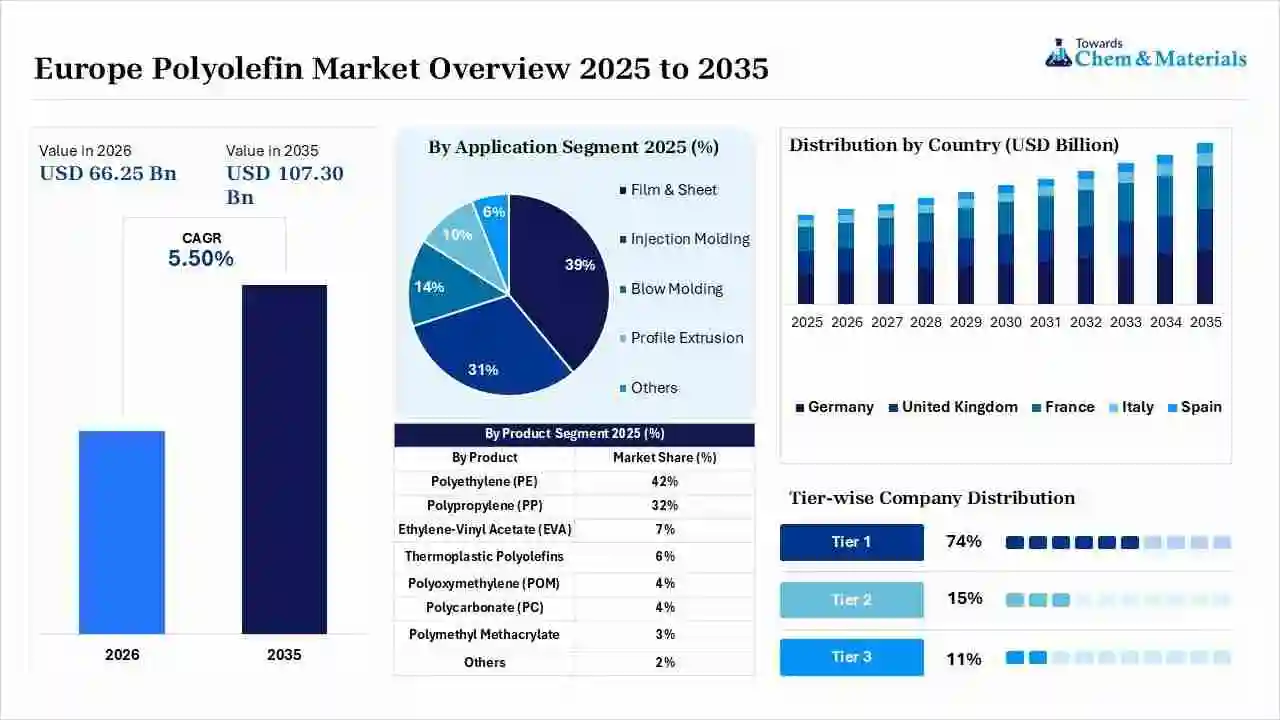
According to Towards Chemicals and Materials Analytics and Consulting, the Europe polyolefin market volume was valued at 56.60 million tons in 2025 and is expected to surpass around 74.60 million tons by 2035, accelerating a compound annual growth rate (CAGR) of 2.80% over the forecast period from 2026 to 2035.
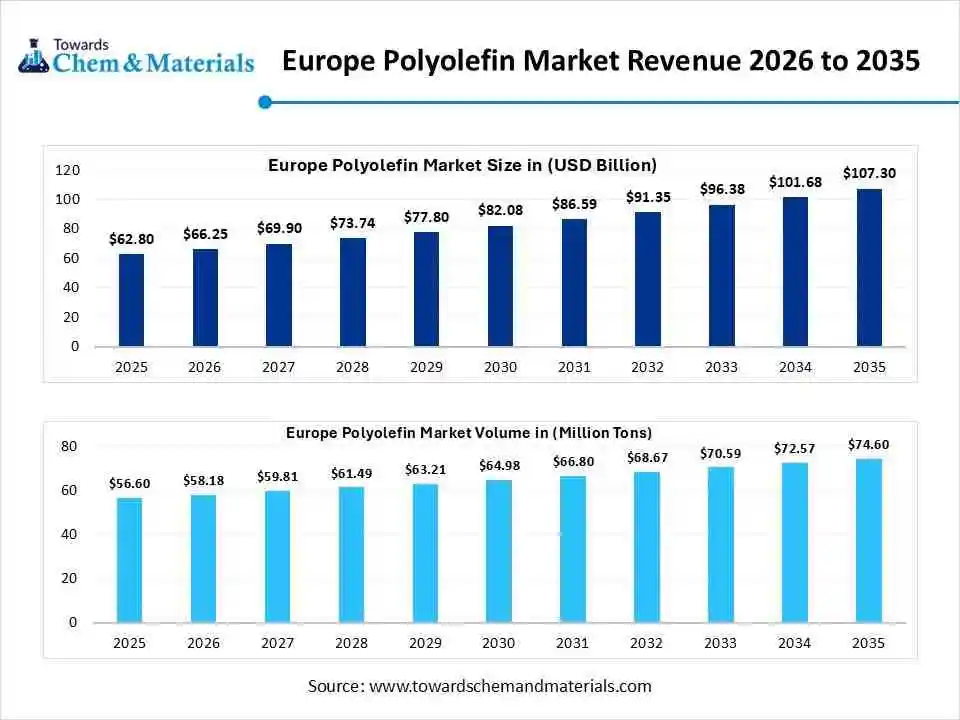
The Europe polyolefin market is a massive market, with expansion at a steady growth rate, which is driven by the increased demand for packaging and automotive lightweighting. The need for durable piping and building materials due to increased construction needs drives demand for polyolefins for their properties and applications. The high rise in adoption of electric vehicles, as there is a shift towards electrification, drives demand for automotive lightweighting, which increases the use of polyolefins, which helps reduce vehicle weight and supports improving fuel efficiency.These factors and applications in various fields increase production and use, supporting expansion of the market.
The major players presence, which helps in the management of the supply chain and infrastructure development investment, helps build the growth of the market. The major players that contribute to the growth are Borealis AG, LyondellBasell, SABIC, INEOS, Arkema, and Braskem. The partnership for waste management, where major manufacturers and producers partner with major sorting and recycling firms, helps create a high-quality stream of PCR, supporting growth. The joint ventures in recycling infrastructure and investment in advanced chemical and mechanical recycling facilities further support growth in Europe.
The market also experienced heavy investment from major players in regional hubs like Germany, France, the U.K., Italy, and the Netherlands, by players like Borealis AG, INEOS Olefins & Polymers Europe, LyondellBasell Industries, Genesis Polymers Europe S.A., Lucobit AG, SABIC, and ExxonMobil Chemical Company, which are major contributors to the expansion of the market.
Companies are investing in functionalized polyolefins, thermoplastic polyolefins for the automotive sector, and lightweight construction materials to secure higher-margin returns.
| Report Attributes | Details |
| Market Size in 2026 | USD 66.25 Billion/107.30 Million Tons |
| Expected Size in 2035 | USD 56.60 Billion/74.60 Million Tons |
| Growth Rate | CAGR of 5.50% |
| Base Year of Estimation | 2025 |
| Forecast Period | 2025-2035 |
| Segment Covered | By Product, By Application, By End-Use Industry |
| Key Companies Profiled | TotalEnergies SE, Dow Chemical Company, Repsol S.A., Versalis S.p.A. (Eni SpA), Arkema S.A., BASF SE, MOL Group, PKN Orlen, Ducor Petrochemicals, Ravago Group, Braskem S.A. (Europe operations), Chevron Phillips Chemical Company, Mitsui Chemicals Europe GmbH, Clariant AG, RadiciGroup |
The European polyolefin market is growing and shifting towards innovation and modernization with the integration of AI in manufacturing and processing. The integration of AI in advanced computer vision and machine learning helps with sorting and feedstock consistency. Companies like Tomra use AI optical sorting systems, which help with classification and brand packaging, supporting market growth. The other major key technological shifts are the acceleration of advanced chemical processing through AI models, transforming material discovery and formulation generation. Companies like Premix use an AI system that helps convert the virtual formulation into automated production through a sensor system.
The strict regulatory measures, sustainability regulations, and circular economy mandates heavily push manufacturers and producers towards the adoption of advanced recycling technologies. The waste reduction initiatives and domestic processing and adoption of sustainable polymers align with sustainability initiatives amid rising environmental complications. The transition towards electric vehicles and flexible packaging, which is easily recyclable, helps meet the eco-design mandates, aligning with the sustainability analysis of the European polyolefin market.
Polyolefins are lightweight and durable plastics that are made by linking small hydrocarbon molecules, which are olefins, resulting in long-chain polymers. The common types of polyolefins are polyethylene and polypropylene, which are used in plastic bags, bottles, films, food containers, car parts, and fibers. Their key properties make it exceptional and widely adopted, like flexibility, strength, water and chemical resistance, and its easy-to-shape property. They are used in packaging, household goods, and textiles.
The premium price of polyolefins depends on rising energy and carbon use penalties, facing upward cost pressure. Recycled polyolefins hold a notable price premium over virgin products; fluctuations in availability also affect the price of the product. The growing application in various sectors and continued processing aligns with the consumption and cost price of the final product. The reduced import volumes and increased domestic production help reduce the cost of the product and will help in expansion in coming decades.
The carbon levies and related taxes increase cash production costs for European polyolefins, lowering profit margins compared to tax-lighter regions. A fiscal levy of €0.80 per kilogram applies to non-recycled plastic packaging waste, raising overall compliance costs. Carbon pricing lifts operating expenses for domestic producers. Countries apply the rules differently, such as Spain enforcing a direct €0.45 per kilogram tax on non-reusable packaging. (Source: www.opis.com)
| Country / Region | Regulatory Body | Key Regulations | Focus Areas | Notable Notes |
| European Union | European Commission, ECHA | REACH, CLP, Packaging and Packaging Waste Regulation 2025/40, EU Plastics Strategy | Chemical safety, recyclability, recycled content, sustainable plastics | PPWR generally applies increasing requirements for recyclable packaging and recycled plastic content. |
| Germany | Federal Environment Agency, Federal Ministry for the Environment | REACH, VerpackG, Circular Economy Act, PPWR | Packaging recycling, circular economy, waste management | Germany maintains strong recycling and EPR requirements, supporting demand for recycled PE and PP. |
| France | Ministry for Ecological Transition, ADEME | REACH, Anti-Waste for Circular Economy Law, PPWR | Plastic reduction, recycling, eco-design, EPR | National circular-economy measures complement EU requirements and encourage recycled-content use. |
| Italy | Ministry of Environment and Energy Security, ISPRA | REACH, Environmental Code, PPWR | Plastic waste management, recycling, packaging sustainability | Packaging producers and users are subject to EPR and recycling obligations alongside EU requirements. |
| Spain | Ministry for Ecological Transition | REACH, Waste and Contaminated Soils Law, Packaging and Packaging Waste regulations, PPWR | Recycling, packaging waste reduction, circular materials | Regulations encourage recycled plastics and improved packaging recyclability. |
| United Kingdom | Environment Agency, Health and Safety Executive | UK REACH, Environmental Protection Act, Plastic Packaging Tax | Chemical safety, recycled content, plastic waste | UK requirements are separate from EU REACH/PPWR following Brexit, while recycled-content requirements support recycled polyolefin demand. |
Europe Polyolefin: Growing Sectoral Demand
The key growth drivers that support the growth of the market are the growing automotive industry, which has demand for lightweight materials resulting in increasing fuel efficiency, and EV applications due to the growing demand. The increased use in medical applications is driven by its properties, like non-toxicity and sterile nature, which help in producing syringes, drug delivery devices, and other biomedical devices. The use of polyolefin in packaging sectors for the production of films and containers and the increased use of recycled products in building and construction and infrastructure development drive growth.
Europe Polyolefin: Raw Material Price Volatility
The key challenges that hinder the growth of the market are raw material price volatility, such as the high price of crude oil and natural gas, which increases the cost of the final product and also affects and disrupts the supply chain, affecting the accessibility and production of polyolefins, which restricts the growth of the market. The other key challenges are environmental regulation and plastic waste, increasing regulatory pressure and plastic pollution awareness, recycling costs, and greenwashing scrutiny, which contribute highly to limiting the growth of the market.
Europe Polyolefin: Technological Advancement
The key growth opportunities that support the growth of the market are the growing industrial and manufacturing base in the region, which fuels the growth of the market. Industries like automotive, electrical, packaging, and consumer goods increasingly use polyolefins in the production of their materials due to their applications and properties, fueling market growth. The increased adoption and innovation in products and product materials through research and development, which helps in developing high-performance formulations and customized products that align with growing sustainability and regulatory requirements, especially the circular economy, creates massive opportunities for growth and expansion of the market.
The polyethylene segment dominated the market with a 42% share in 2025 and is expected to grow at a CAGR of 5.20% over the forecast period, driven by its growing application in films, packaging, and healthcare, especially due to its properties like flexibility, ease of processing, and chemical resistance, which make it a preferred choice for many players. The increasing demand from the packaging sector, especially in food, medical, and industrial packaging, as polyethylene is used for its properties like sterility and flexibility, offering high performance. Its major role in cables, protective films, and pipes is due to its safety, recyclability, and durability in manufacturing, driving the adoption and growth of the market.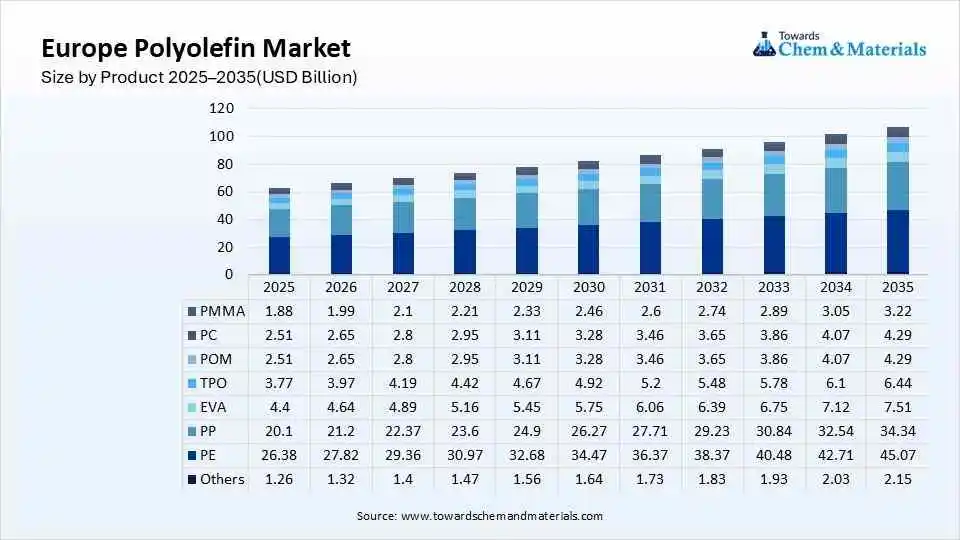
The polypropylene segment held a 32% market share in 2025 and is expected to have the fastest growth with a CAGR of 6.10% in the forecast period, driven by growing adoption due to its versatility, cost efficiency, and balance of mechanical and thermal properties, making it a choice for many industries supporting growth. These products offer key benefits like durability and lightweight nature, which are in demand from industries such as packaging, automotive, and consumer goods, supporting further growth. Innovation in polypropylene for enhancing performance, including impact-modified and glass fiber-reinforced grade components, is a preferred choice by industries due to key requirements like strength, recyclability, and processability, supporting expansion of the market.
Europe Polyolefin Market Share, By Product, 2025 (%)
| By Product | Market Share (%) |
| Polyethylene (PE) | 42% |
| Polypropylene (PP) | 32% |
| Ethylene-Vinyl Acetate (EVA) | 7% |
| Thermoplastic Polyolefins (TPO) | 6% |
| Polyoxymethylene (POM) | 4% |
| Polycarbonate (PC) | 4% |
| Polymethyl Methacrylate (PMMA) | 3% |
| Others | 2% |
The film and sheet segment dominated the market with a 38% share in 2025 and is expected to grow at a CAGR of 5.20% over the forecast period, driven by the increased demand for lightweight, cost-effective packaging, which helps increase the shelf life of the product, supporting growth. Increased need for protective layers and secondary shipping and stretch films leads to e-commerce growth, supporting the expansion. Barrier properties adoption surges demand for high-barrier multilayer films for dairy products, pharmaceutical products, and food products, which increases the demand for films and sheets for packaging, contributing to the growth of the market.
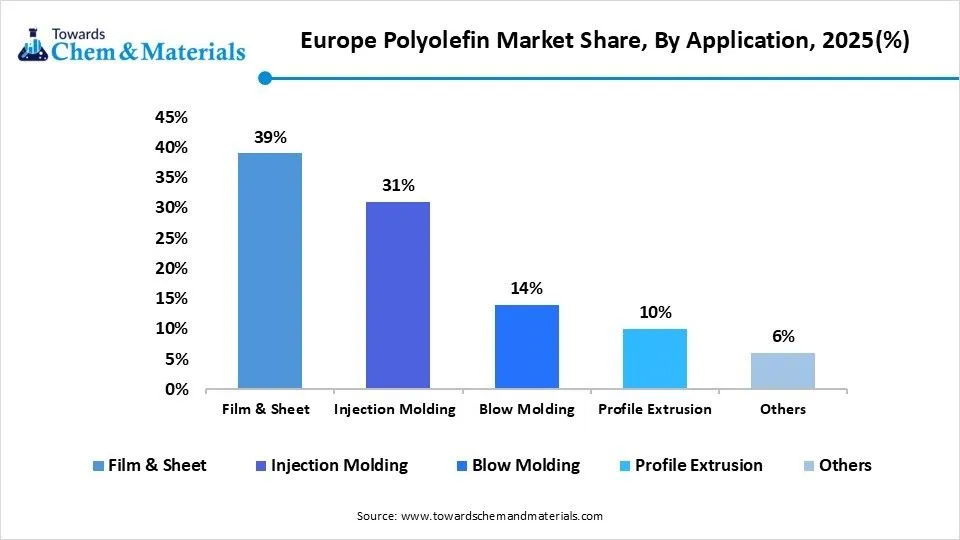
The injection molding segment held 17% market share in 2025 and is expected to have the fastest growth with a CAGR of 6.40% in the forecast period. It is a processing technique that is used in the application of polyolefin compounds, which is used in the production of complex and high-precision parts that are used in applications in automotive, packaging, and healthcare, supporting the growth. The versatility of the process and its cost efficiency allow for mass production and also help in maintaining consistency and performance of the product, allowing market expansion. With growing demand for lightweight, durable, and sustainable products, injection molding continues to expand, especially in producing medical devices, automotive components, and consumer goods.
Europe Polyolefin Market Share, By Application, 2025 (%)
| By Application | Market Share (%) |
| Film & Sheet | 39% |
| Injection Molding | 31% |
| Blow Molding | 14% |
| Profile Extrusion | 10% |
| Others | 6% |
The packaging segment dominated the market with a 38% share in 2025 and is expected to grow at a CAGR of 5.20% over the forecast period, driven by the growing demand for flexible and rigid solutions with key properties like durability and recyclability, which is a demand from the packaging sector that supports the growth. They are largely used in the healthcare sector for their chemical resistance, sterilization compatibility, and biocompatibility, which makes them ideal for use in syringes, medical devices, and pharmaceutical packaging solutions, supporting growth. Growing demand for sustainable packaging and safe solutions for high-performance plastics ensures continuous growth in the market.
The automotive segment held a 17% market share in 2025 and is expected to have the fastest growth with a CAGR of 6.40% in the forecast period, driven by the demand for lightweighting and increasing fuel efficiency, which supports growth. These compounds are used in bumpers, dashboards, door panels, and under-the-hood components. With the rise of electric vehicles, demand for flame-retardant and glass-fiber-reinforced compounds is growing, enabling manufacturers to meet safety regulations while ensuring performance, cost-effectiveness, and sustainability, supporting further growth.
Europe Polyolefin Market Share, By End-Use Insights, 2025 (%)
| By End-Use Industry | Market Share (%) |
| Packaging | 38% |
| Construction | 19% |
| Automotive | 17% |
| Electronics & Electricals | 12% |
| Pharmaceuticals | 7% |
| Others | 7% |
How Did Germany Dominate the Europe Polyolefin Market in 2025?
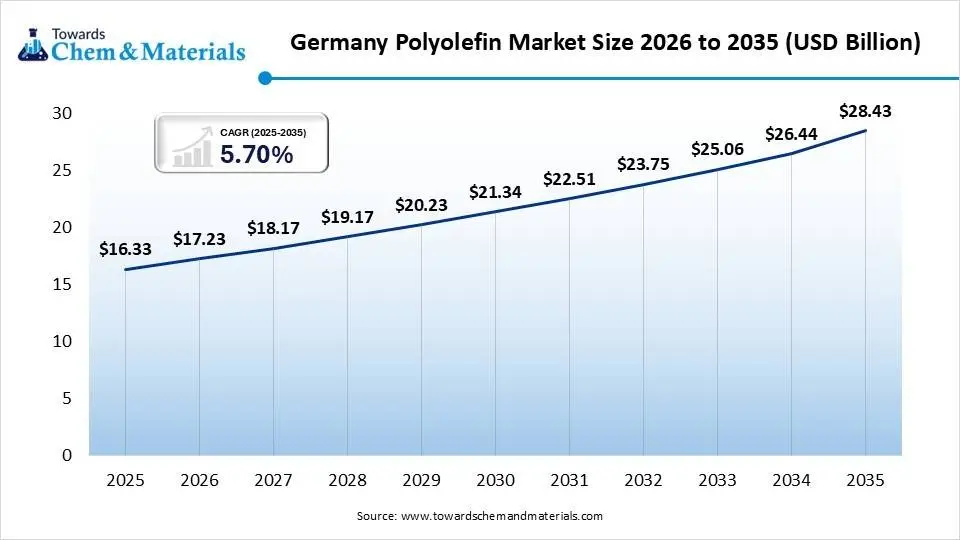
The Germany polyolefin market size was estimated at USD 62.80 billion in 2025 and is projected to reach USD 107.30 billion by 2035, growing at a CAGR of 5.50% from 2026 to 2035. Germany dominated the market with a share of 26% in 2025, driven by government initiatives in the region for the promotion and use of recycled and bio-based polyolefins, which increases demand in the market. The transformation of the automotive sector has also increased the use of EVs and demand for lightweight materials for vehicles to increase fuel efficiency and performance, driving the growth of the market. The key growth areas in the region are automotive, construction, packaging, and the healthcare sector, which fuel the growth and expansion of the market.
United Kingdom Polyolefin Market Growth Factor
The UK polyolefin market size was estimated at USD 11.30 billion in 2025 and is projected to reach USD 19.31 billion by 2035, growing at a CAGR of 5.80% from 2026 to 2035. The United Kingdom held an 18% share of the market in 2025. The polyolefin market in the United Kingdom is primarily driven by rising demand for recyclable packaging, automotive lightweighting for electric and fuel-efficient vehicles, and regulatory pushes for sustainable, bio-based materials. Stringent environmental policies and sustainability mandates are encouraging the shift toward recycled and bio-based polyolefin resins. Steady consumption of polyolefins in films, sheets, pipes, and multilayer adhesion compatibilizers further boosts the growth.
Italy Polyolefin Market Growth Factor
Italy polyolefin market size was estimated at USD 10.68 billion in 2025 and is projected to reach USD 18.78 billion by 2035, growing at a CAGR of 5.81% from 2026 to 2035. Italy held a 17% share of the market in 2025. Italys polyolefin market is expected to experience growth, driven by key industries like automotive and packaging that need lightweight, durable, and high-performance materials. Strict European Union rules and green initiatives push companies to adopt recyclable and bio-based plastics. Better manufacturing methods improve polymer performance and create new uses in healthcare and consumer goods, further supporting the expansion of the market. Italys position in Europe allows easy access to shared supply chains and cross-border manufacturing, which is a major growth factor.
France Polyolefin Market Growth Factor
The France polyolefin market size was estimated at USD 13.82 billion in 2025 and is projected to reach USD 24.14 billion by 2035, growing at a CAGR of 5.74% from 2026 to 2035. France held a 22% share of the market in 2025. The French polyolefin market grows primarily due to rising demand for lightweight automotive materials, flexible packaging, and strict alignment with EU eco-sustainability rules. E-commerce expansion and the food sector drive high usage of flexible films and mono-material packaging. French regulations follow EU green policies, pushing companies toward recyclable, bio-based polyolefin resins and advanced polymer modifications.
Spain Polyolefin Market Growth Factor
Spains polyolefin market size was estimated at USD 10.68 billion in 2025 and is projected to reach USD 18.78 billion by 2035, growing at a CAGR of 5.81% from 2026 to 2035. Spain held a 17% share of the market in 2025. Spains polyolefin market grows due to surging demand from key end-use sectors like packaging and automotive, alongside strict European Union sustainability mandates. Food and beverage packaging and e-commerce create steady baseline consumption for polyolefin shrink films and low-density polyethylene. EU regulations and local pushes toward sustainability accelerate the adoption of recycled polyolefins and bio-based resin innovations. Spains infrastructure and geographic location make it a central processing and innovation hub for advanced polymers within Europe.
| Company | Company Type/Position | Major Headquarters | Geographic Presence | Polyolefin Offerings | Key Offering/Strength |
| Borealis AG | Major European polyolefin producer | Vienna, Austria | Europe, the Middle East, Asia Pacific, North America | Polyethylene, polypropylene, polyolefin compounds, circular polyolefins | Strong European presence with advanced PE/PP technologies and circular polymer solutions |
| LyondellBasell Industries N.V. | Global polyolefin and chemicals producer | Houston, Texas, USA | Europe, North America, Asia Pacific, Latin America | Polyethylene, polypropylene, polyolefin elastomers, circular polymers | Broad PE and PP portfolio with strong European production and circular polymer capabilities |
| INEOS | Global petrochemicals and polyolefin manufacturer | London, UK | Europe, North America, Asia Pacific, Middle East | Polyethylene, polypropylene, olefins, and specialty polyolefins | Integrated European olefins and polymer operations with strong PP and PE capabilities |
| SABIC | Global chemicals and polyolefin producer | Riyadh, Saudi Arabia | Europe, Middle East, Asia Pacific, Americas | Polyethylene, polypropylene, specialty polyolefins, circular polymers | Strong portfolio of commodity and advanced polyolefins serving packaging, automotive, and industrial applications |
| ExxonMobil | Integrated energy and petrochemical company | Spring, Texas, USA | Europe, North America, Asia Pacific, Middle East | Polyethylene, polypropylene, specialty polyolefins | Strong technology base and integrated petrochemical operations serving packaging, automotive, and industrial markets |
By Product
By Application
By End-Use Industry
Reliable market intelligence and data-driven insights across the global chemicals and materials industry, helping businesses understand trends, competition, pricing, and emerging opportunities.
Schedule a Demo