Content
Electronic Waste Recycling Market Size and Forecast 2026 to 2035
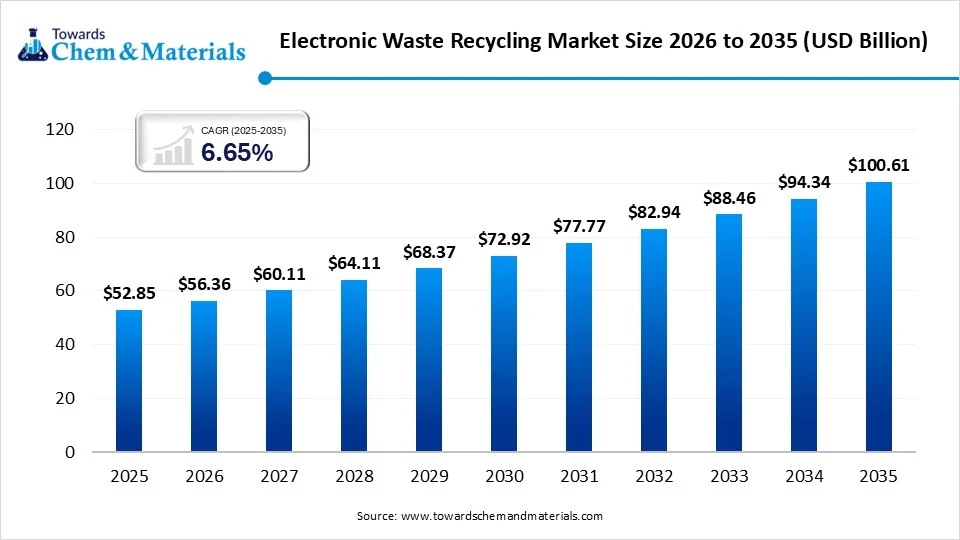
The global electronic waste recycling market size was estimated at USD 52.85 billion in 2025 and is expected to increase from USD 56.36 billion in 2026 to USD 100.61 billion by 2035, growing at a CAGR of 6.65% from 2026 to 2035. Europe dominated the electronic waste recycling market with the largest revenue share of 37.00% in 2025. The heavy shift towards electronic sustainability fueled the industry's growth in recent years.The process of collecting, dismantling, and recovering useful materials from discarded electronic products such as mobile phones, laptops, televisions, refrigerators, and other electrical devices is called electronic waste recycling. Also, these old or broken electronics contain valuable materials like metals, plastics, and glass that can be reused in new products.
Market Highlights
- By region, Europe dominated the electronic waste recycling market revenue share of 37.00% in 2025, due to strong environmental regulations and well-organized recycling systems.
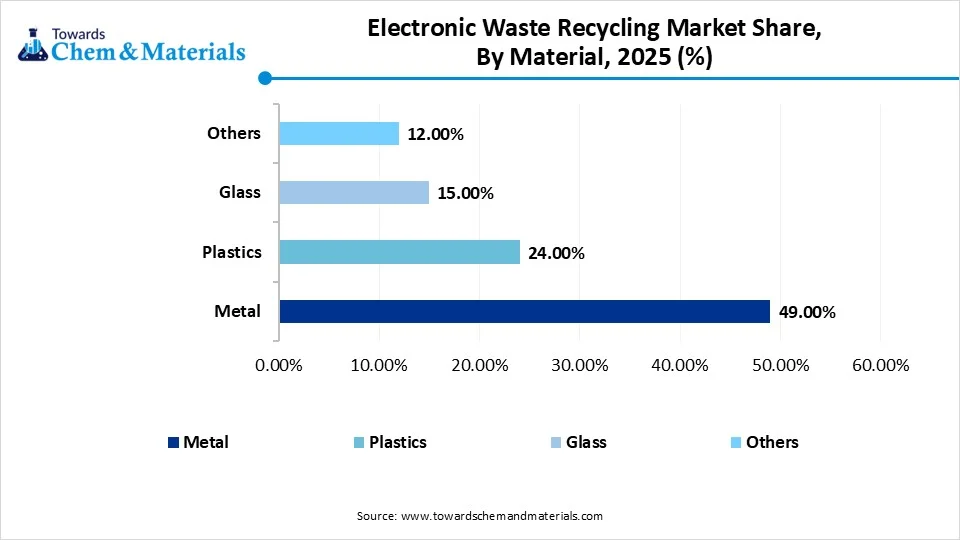
- By material, the metal segment dominated the market and accounted for the largest revenue share of 49.00% in 2025. owing to electronic devices containing significant amounts of valuable metals.
- By source, the household appliances segment dominated the market and accounted for the largest revenue share of 31.00% in 2025,owing to large products with long lifespans that eventually reach disposal stages in large numbers.
Future Recycling Powered by Smart Technology
The market has moved toward automated and advanced material recovery systems in recent years. Also, modern recycling plants now use robotics, artificial intelligence, and sensor-based sorting to separate different materials from electronic devices. Technologies such as hydrometallurgical and bio-based recovery processes are also being developed to extract metals more efficiently. These technologies improve recovery rates while reducing environmental impact.
Trade Analysis of the Electronic Waste Recycling Market:
Import, Export, Consumption, and Production Statistics
- The world has exported 570 shipments of electronic waste via 22 buyers and 54 exporters between June 2024 to May 2025, as per the recent observation.
- Also, the United States emerged as the leading electronic waste exporter with 932 shipments, and Mexico with 524 shipments and the Bahamas with 169 shipments are following the United States in the current period.
- Mexico itself has been identified as the leading importer of electronic waste with 439 shipments, while the United States is following with 355 shipments, as per the published report.
Recent Market Trends:
- The rapid increase in discarded smart devices has enabled high-return ventures for manufacturers in recent years. Also, smartphones, tablets, laptops, and wearable electronics are replaced more frequently as new models are launched every year. Many consumers upgrade devices even when the older ones still work.
- The emergence of urban mining has enhanced the market participation for producers in the current period. Instead of extracting metals from natural mines, companies are now recovering valuable materials from discarded electronics. Old electronic devices contain metals like copper, gold, aluminum, and rare elements that can be reused.
- Stronger regulations requiring manufacturers to take responsibility for electronic waste are likely to strengthen the foundation for future sector growth in the coming years. Also, many governments now require electronics companies to collect and recycle old products.
Report Scope
| Report Attribute | Details |
| Market Size in 2026 | USD 56.36 Billion |
| Revenue Forecast in 2035 | USD 100.61 Billion |
| Growth Rate | CAGR 6.65% |
| Forecast Period | 2026 - 2035 |
| Base Year | 2025 |
| Dominant Region | Europe |
| Segment Covered | By Material, By Source, By Region, |
| Key companies profiled | Aurubis AG, Boliden Group, Desco Electronic Recyclers, EcoCentric, Greentec, Kuusakoski, MRITECHNOLOGIES, Namo eWaste Management Ltd., Sims Limited, Umicore |
Supply Chain Analysis of the Electronic Waste Recycling Market:
Distribution to Industrial Users
- Recycling facilities distribute recovered materials such as copper, gold, and high-grade plastics back to industrial users to foster a circular economy.
- Manufacturers use these refined secondary raw materials to produce new electronics, automotive parts, and construction materials, significantly reducing reliance on virgin mining and lowering production costs.
Chemical Synthesis and Processing
- The chemical synthesis and processing segment of the e-waste recycling market is rapidly shifting towards hydrometallurgical and electrochemical methods.
- These processes use solvents, acids, and electric currents to selectively dissolve and recover high-purity metals like gold, copper, and lithium. Advanced "green" synthesis techniques also enable the production of value-added nanoparticles for industrial reuse.
Regulatory Compliance and Safety Monitoring
- The regulatory compliance and safety monitoring segment is driven by stringent Extended Producer Responsibility (EPR) mandates. Governments now require digital traceability via blockchain-linked portals to verify physical recycling events.
- This ensures adherence to RoHS standards for hazardous substances while mitigating occupational health risks through mandatory environmental audits and safety certifications.
Electronic Waste Recycling Market Regulatory Landscape: Global Regulations
| Country Region | Regulatory Body | Key Regulations | Focus Areas |
| United States | Environmental Protection Agency (EPA) | Resource Conservation and Recovery Act (RCRA) Subtitle C (Hazardous Waste) | Managing hazardous components (e.g., lead in CRTs), international export restrictions, and state-level mandatory take-back programs. |
| European Union | ECHA | WEEE Directive 2012/19/EU Article 5 (Collection) & Article 12 (Financing) | Separate collection targets (65% of EEE put on market), free consumer take-back, and strict recovery/recycling rate quotas. |
| China |
Ministry of Natural Resources (MNR) |
Regulation on the Management of WEEE Chapter II (Recovery/Disposal) & Chapter IV (Fund) |
Transitioning from informal to formal recycling, implementing a national WEEE disposal fund, and curbing illegal waste imports. |
Segmental Insights
Material Insights
How did the Metal Segment Dominate the Electronic Waste Recycling Market in 2025?
The metal segment dominated the market share 49.00% in 2025, due to electronic devices containing significant amounts of valuable metals. Materials such as copper, aluminum, gold, and silver are commonly found in circuit boards, wiring, and components. These metals have high economic value and can be recovered and reused in new products. Recycling companies prioritize metal recovery because it provides a strong financial return.
The plastics segment is expected to grow with a rapid CAGR, owing to modern electronics containing increasing amounts of plastic materials. Also, devices such as smartphones, laptops, and appliances use plastic casings, connectors, and internal components. As recycling technology improves, companies are developing better systems to separate and reuse these plastics. Governments are also pushing industries to reduce plastic waste and increase recycling rates.
Electronic Waste Recycling Market Share, By Material , 2025 (%)
| By Material | Revenue Share, 2025 (%) |
| Metal | 49.00% |
| Plastics | 24.00% |
| Glass | 15.00% |
| Others | 12.00% |
Source Insights
How did the Household Appliances Segment Dominate the Electronic Waste Recycling Market in 2025?
The household appliances segment dominated the market share 31.00% in 2025, due to they are large products with long lifespans that eventually reach disposal stages in large numbers. Refrigerators, washing machines, air conditioners, and microwave ovens contain significant amounts of metal and other recyclable materials. When households replace old appliances with new energy-efficient models, the older units enter recycling systems.
The consumer electronics segment is expected to grow with a rapid CAGR, owing to their rapid replacement cycles. Smartphones, laptops, headphones, gaming devices, and smart home products are upgraded frequently. Unlike large appliances that last many years, these devices are replaced more quickly due to technological improvements. As global digital adoption increases, the number of consumer electronic devices continues to grow.
Electronic Waste Recycling Market Share, By Source, 2025 (%)
| By Source | Revenue Share, 2025 (%) |
| Household Appliances | 31.00% |
| Consumer Electronics | 22.00% |
| Industrial & Commercial Equipment | 14.00% |
| IT & Telecommunication | 16.00% |
| Medical Equipments | 7.00% |
| Others | 10.00% |
Regional Insights
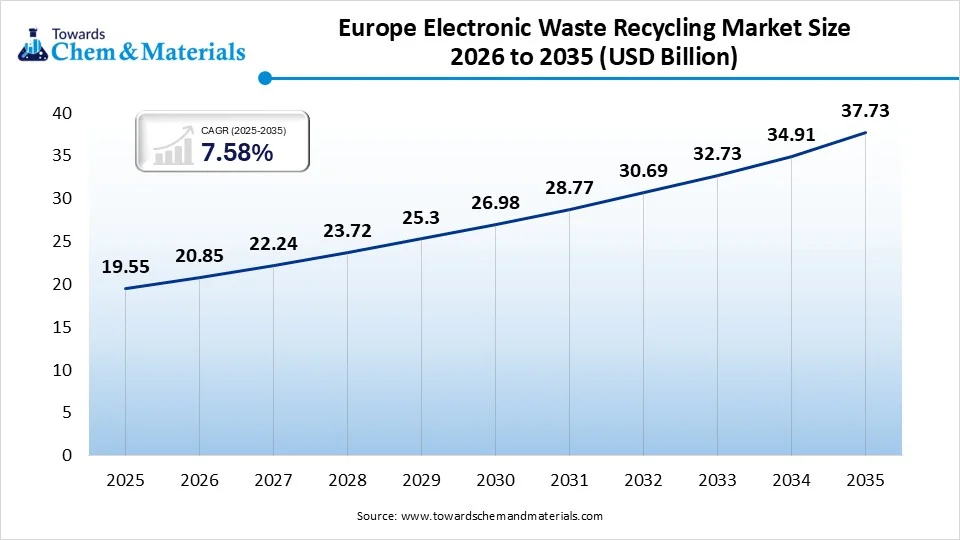
The Europe electronic waste recycling market size was valued at USD 19.55 billion in 2025 and is expected to be worth around USD 37.73 billion by 2035, exhibiting at a compound annual growth rate (CAGR) of 7.58% over the forecast period from 2026 to 2035.
Europe dominated the electronic waste recycling market in 2025, due to strong environmental regulations and well-organized recycling systems. Moreover, many European countries have strict laws that require proper collection and recycling of electronic waste. Governments promote recycling through public awareness campaigns and structured waste management infrastructure. Consumers in Europe are also more aware of environmental issues and often participate in recycling programs.
Innovative Recycling Plants Power Germany’s Leadership
Germany maintained its dominance in the market, owing to the country having a well-developed waste management system and strong environmental regulations. Germany also has advanced recycling facilities capable of processing large volumes of electronic waste. Many technology companies and recycling firms operate modern plants that recover metals and other materials from discarded electronics.
Electronic Waste Recycling Market Evaluation in the Asia Pacific
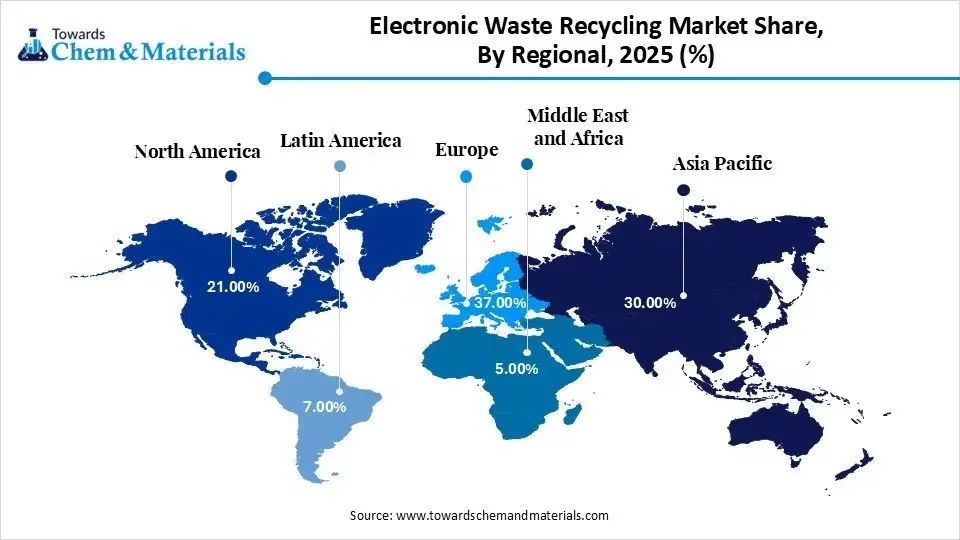
Asia Pacific electronic waste recycling market segment accounted for the major revenue share of 30.00% in 2025. Asia Pacific is expected to capture a major share of the electronic waste recycling market with a rapid CAGR, owing to its having the world's largest population and rapidly growing electronics consumption. Countries in this region produce and use huge numbers of smartphones, computers, and household appliances. As these products reach the end of their life cycles, the amount of electronic waste will increase significantly, as per the latest survey.
China’s Expanding Role in E-Waste Management
China is expected to emerge as a prominent country for the electronic waste recycling market in the coming years, due to its being one of the world's largest producers and consumers of electronic products. The country manufactures a huge volume of smartphones, computers, and home appliances. As a result, large amounts of electronic waste are generated every year. China has been expanding formal recycling systems and introducing regulations to manage this waste more efficiently.
North America Electronic Waste Recycling Market Examination
North America electronic waste recycling market segment accounted for the major revenue share of 21.00% in 2025. North America is growing in industry, owing to increasing environmental awareness and rising electronic consumption. Moreover, consumers in the region frequently upgrade devices such as smartphones, laptops, and smart home electronics. Governments and organizations are promoting responsible disposal and recycling programs to reduce environmental impact.
Electronic Waste Recycling Market Share, By Regional, 2025 (%)
| Regional | Revenue Share, 2025 (%) |
| North America | 21.00% |
| Europe | 37.00% |
| Asia Pacific | 30.00% |
| Latin America | 7.00% |
| Middle East & Africa | 5.00% |
Advanced Recycling Programs Growing in the United States
The United States is expected to gain a significant industry share owing to country generates a large amount of electronic waste because of high technology usage and frequent product upgrades. Also, many recycling companies operate specialized facilities to recover metals, plastics, and other materials from discarded electronics. Technology companies are also launching device trade-in and recycling programs to manage electronic waste responsibly.
Recent Developments
- In June 2025, Recyelkaro introduced the innovative Direct to Consumer platform called the Reloop. Also, the motive behind the launch of these platforms is to provide incentivise, democratize, and simplify recycling as per the published report.(Source : www.energetica-india.net)
- In October 2025, Eco Recycling unveiled its emerging campaign called Nationwide E Waste Collection Drive. Also, the campaign has been held to promote sustainability and awareness about e-waste disposal. Also, these campaigned is aligned with the Indian government campaign called Swachhta Hi Seva Campaign as per the published report.(Source: scanx.trade)
Top Vendors in the Electronic Waste Recycling Market & Their Offerings:
- Aurubis AG: Aurubis AG is a global leader in non-ferrous metal production and one of the world's largest copper recyclers. Headquartered in Hamburg, Germany, it processes approximately 1 million tons of recycling materials annually, including electronic scrap and printed circuit boards.
- Boliden Group: Boliden Group is a Swedish metals company specializing in mining and smelting. Its Rönnskär smelter is one of the world's largest facilities for recycling electronic scrap, with an annual capacity of 120,000 tonnes. Boliden focuses on recovering copper and precious metals like gold and silver from discarded computers and mobile phones.
- Desco Electronic Recyclers: Desco Electronic Recyclers, founded in 1992 and based in South Africa, provides accredited e-waste management and certified data destruction. It serves diverse sectors, including government and healthcare, by processing IT assets, medical machinery, and telecommunications equipment. Desco emphasizes Extended Producer Responsibility (EPR) and environmental compliance across the African continent.
- EcoCentric: EcoCentric Management, established in 2011, is a leading Indian e-waste asset management firm. Operating a state-of-the-art facility in Khopoli, Maharashtra, it offers end-to-end solutions for recycling, asset recovery, and secure data destruction. The company focuses on the "Reduce, Reuse, Recycle" mantra and is expanding into solar panel and lithium-ion battery recycling.
- Greentec
- Kuusakoski
- MRITECHNOLOGIES
- Namo eWaste Management Ltd.
- Sims Limited
- Umicore
Segments Covered in the Report
By Material
- Metal
- Plastics
- Glass
- Others
By Source
- Household Appliances
- Consumer Electronics
- Industrial & Commercial Equipment
- IT & Telecommunication
- Medical Equipments
- Others
By Region
- North America
- U.S.
- Canada
- Mexico
- Europe
- Germany
- UK
- France
- Italy
- Spain
- Asia Pacific
- China
- India
- Japan
- South Korea
- Latin America
- Brazil
- Argentina
- Middle East & Africa
- Saudi Arabia
- South Africa
FAQ's




Select User License to Buy
Figures (4)








 sales@towardschemandmaterials.com
 Download Sample
 Schedule a Meeting