
Commercial Green Construction Market Size and Forecast 2026 to 2035
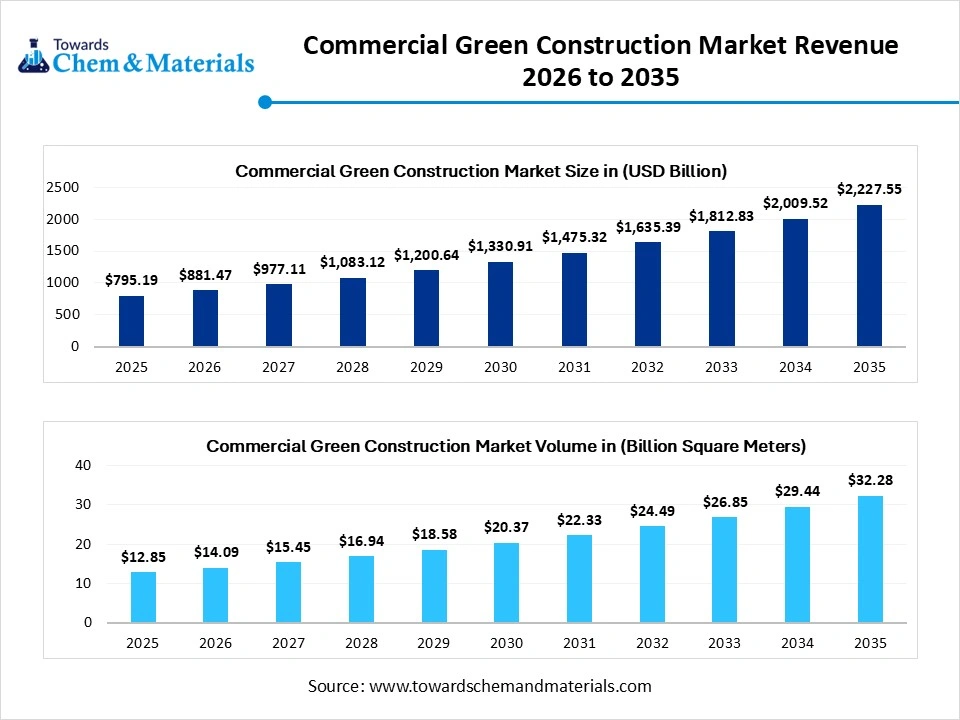
The global commercial green construction market size was estimated at USD 795.19 billion in 2025 and is expected to be worth around USD 2,227.55 billion by 2035, growing at a CAGR of 9.65% from 2026 to 2035. In terms of volume, the commercial green construction market is projected to grow from 12.85 Billion square meter in 2025 to 32.28 Billion square meter by 2035. growing at a CAGR of 10.85% from 2026 to 2035.
Key Takeaways
- By region, Asia Pacific dominated the commercial green construction market by holding a 31% share in 2025 and is expected to grow fastest with a CAGR of 12.4% during the forecast period due to rapid urbanization and governmental support for high construction activity.
- By region, North America held the second largest share of 28% in 2025, and is expected to experience notable growth in the market with 10.50% CAGR during the forecast period, driven by a stringent regulatory framework and adoption of advanced technologies in green construction.
- By construction type, the new construction segment held the largest of 62% share in the market in 2025 due to rapid urbanization and corporate investment in sustainable and energy-efficient design in new projects.
- By construction type, the renovation & retrofitting segment held the second largest share of 38% in 2025 and expected the fastest growth in the market with 10.1% CAGR during the forecast period due to government incentives for retrofitting and business upgradation in aging infrastructure.
- By building type, the office buildings segment dominated the market with 34% share in 2025, driven by demand for energy-efficient workplaces and corporate sustainability targets with integration of smart office.
- By building type, the hospitality segment held the fourth largest share of 17% in 2025 and expects the fastest growth in the market with 11.4% CAGR during the forecast period due to green certification to attract eco-conscious travellers and energy efficiency to improve profit in hospitality.
- By material type, the structural materials segment dominated with 29% share in the market in 2025 due to rising demand in large commercial projects and adoption of recycled steel and engineered wood for durability and structural sustainability.
- By material type, the insulation materials segment held the third largest share of 24% in 2025 and expects the fastest growth in the market with 11.1% CAGR during the forecast period due to rapid urban construction and energy codes mandates for advanced insulation solutions.
- By technology, the energy efficiency systems segment dominated with 46% share in the market in 2025 due to regulatory mandates with HVAC and lighting upgrades to reduce operational cost.
- By technology, the smart building technologies segment held the second largest share of 35% in 2025 and is expected the fastest growth in the market with 11.8% CAGR during the forecast period, driven by the integration of IoT for building performance and smart systems to enhance energy efficiency.
- By certification type, the LEED certification segment dominated with 48% share in the market in 2025 due to global recognition and corporate incentives encouraging certification advancement.
- By certification type, the WELL certification segment held the third largest share of 16% in 2025 and expected the fastest growth in the market with 11.6% CAGR during the forecast period due to rising focus on occupant health and wellness features to improve productivity and satisfaction.
- By end-user, the private sector segment dominated the market with 68% share in 2025, driven by corporate investment in green infrastructure and the adoption of eco-friendly design.
- By end-user, the public sector segment held the second largest share of 32% in 2025 and is expected the fastest growth in the market with 10.4% CAGR during the forecast period, due to governmental support for green building regulation and public infrastructure to support green construction initiatives.
Market Size and Volume Forecast
- Market Estimated Size (2025): USD 795.19 Billion | CAGR (2026–2035): 10.85%
- Market Projected Size (2035): USD 2,227.55 Billion
- Market Volume (2025): 12.85 Billion Square Meters| Volume CAGR (2026–2035): 9.65%
- Market Projected Volume (2035): 32.28 Billion Square Meters
- Market Pricing (2025):
- Average Manufacturing Price: USD 1,170 per Sq. Meter
- Average Selling Price: USD 1,490 per Sq. Meter
- Pricing CAGR (2025–2035): 4.8%
Market Overview
The commercial green construction is a key revolution towards high-performance building infrastructure that maintains environmental balance and economic viability. The rising focus on resource-efficient design and advancement in building automation aligns with the circular economy principle and accelerates growth. The construction sector adopts low-carbon concrete and recycled steel with lower environmental impact by enhancing asset valuation and operational resilience.
The strategic investment demand for transparency by integrating LEED, BREEM and WELL certification for the expansion of green buildings. Overall, the commercial green construction is a premium asset for sustainable corporate and modern commercialization.
Recent Market Trends
- Low-Embodied Carbon Concrete: The surge in mass timber construction and green concrete technologies in commercial buildings includes carbon injection to replace carbon-heavy concrete.
- Focus on Circular Economy and Net-Zero Energy: The new construction projects focus on the recovery and reuse of structural elements and buildings designed to create energy through building-integrated photovoltaics and on-site renewable energy storage.
Report Scope
| Report Attributes | Details |
| Market Size in 2026 | USD 881.47 Billion / 14.09 Billion Square Meters |
| Projected Market Size in 2035 | USD 2,227.55 Billion/ 32.28 Billion Square Meters |
| CAGR (2026 - 2035) | 9.65% |
| Leading Region | Asia Pacific |
| Market Segmentation | By Construction Type, By Building Type, By Material Type, By Technology, By Certification Type, By End-User and By Regions |
| Top Key Players | AECOM, Jacobs Engineering Group, Inc., Fluor Corporation, Galfar Engineering & Contracting SAOG, KIMLY Construction Pte. Ltd. |
Key Technological Shifts and AI in the Commercial Green Construction Market
The convergence of AL-driven construction and material science has enabled intelligent decarbonisation, transforming the green building from passive resources to data-driven construction solutions. AI integration is accelerating the discovery of carbon-neutral materials and bio- composites, reducing time from experimental lab to large-scale private and public sectors.
The emerging advancement in robotic fabrication and 3D printing minimise waste, while blockchain digital passports enable supply chain transparency, authenticating embodied carbon and recyclability in construction materials. Predictive analytics offers building designs with climate conditions, creating smart infrastructure that manages its energy footprint and supports global net- zero construction goals.
Supply Chain Analysis of Commercial Green Construction Market
Sustainable Sourcing and Generative Design:
The stage that focuses on lowering embodied carbon and production of green concrete through advanced chemistry and precision engineering.
- Key Players: Holcim, Gensler, Heidelberg Materials, Sika AG, Interface, SSAB, and Saint-Gobain
High-Efficiency Construction and Logistics:
The stage of industrialized and modular construction with electrified logistics using low-emission fleets and optimized routes to reduce the carbon footprint of the building site.
- Key Players: Skanska, Katerra, Turner Construction, Maersk, and DHL Supply Chain
Cognitive Operation and End-of-Life:
The stage focuses on operational carbon by using AI-driven building management and energy-as-a-service & renewables to support the local grid.
- Key Players: Tesla Energy, Madaster, SILA, Cimetrics, and Enel X
Regulatory Framework: Commercial Green Construction Market
| Region | Key Regulation | Regulatory Focus |
| Global | Net Zero Carbon Buildings Standard | Standards for the carbon budget for the commercial framework for net-zero commitments. |
| European Union | Corporate Sustainability Reporting Directive, EU Taxonomy Regulation | Focus on decarbonization and mandate zero-emission standards for new commercial buildings. classification and green finance |
| United States | Inflation Reduction Act and International Green Construction Code | Standards for exceeding energy efficiency and financial performance. Standardization that drives sustainability and material resource use. |
| Australia | NABERS (National Australian Built Environment Rating System) | Focus on operational reality to measure actual energy used, which pushes manufacturers to optimize building tuning post-construction. |
| China | Assessment Standard for Green Buildings and GB Standards | Mandatory scalable urbanization that focuses on industrialized construction to lower the on-site carbon footprint. |
| India | SEBI BRSR (Business Responsibility and Sustainability Reporting) and Income Tax Act | Focus on energy efficiency and fiscal incentives for green assets. |
Segmental Insights
Construction Type Insights
New Construction Segment Dominated the Commercial Green Construction Market with 62% of Market Share in 2025
New construction segment dominated the market with 62% share in 2025, driven by sustainability goals that focus on net-zero energy systems, low-carbon content in building materials in commercial offices, hospitality buildings and retail space. The new green build acts as a future-proof investment that offers climate safety, occupant well and operational efficiency through smart building technology and stringent building codes.
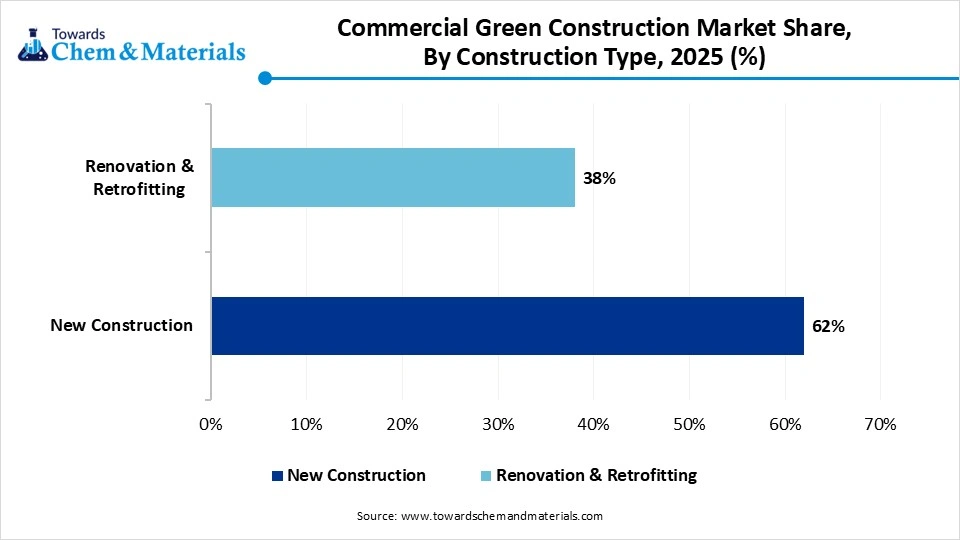
Renovation & retrofitting segment held the second largest share of 38% in 2025 and is expected to grow at the fastest CAGR of 10.1% during the forecast period, serving as a risk-mitigation strategy that integrates AI-driven HVAC, high-efficiency envelopes and smart climate controls for reducing operational carbon and cost. The strong ESG regulation and modern decarbonization standards make the segment a transformative legacy asset to secure green certification and premium tenants.
Commercial Green Construction Market Share, By Construction Type, 2025 (%)
| By Construction Type | Revenue Share, 2025 (%) |
| New Construction | 62% |
| Renovation & Retrofitting | 38% |
Building Type Insights
Office Buildings Segment Dominated the Commercial Green Construction Market with 34% of Market Share in 2025
Office buildings segment dominated the market with 34% share in 2025, representing a sustainable solution in corporate office and IT park, where high-performance design meets occupant-driven wellness. The segment is adopting advanced air filtration and natural light optimization to create a productive workspace. The stringent corporate ESG mandates make green building material a premium rental yield and a superior indoor asset, making the office a premium rental yield with future carbon taxation.
Healthcare facilities segment held the second largest share of 28% in 2025, driven by the requirement of clinical excellence to create a therapeutic, sustainable environment for patient recovery. The healthcare focuses on non-toxic materials, circadian lighting and advanced air filtration in clinics and hospitals to boost staff productivity. The stringent health compliance boosts material adoption by balancing environmental security and excellent medical outcomes in the healthcare real estate sector.
Retail buildings segment held the third largest share of 21% in 2025, leveraging smart lighting, low-carbon envelopes, as retailers preferred certified sustainable space to align with consumer requirements and accelerate brand trust. The shopping mall and standalone stress combine experimental design with resource efficiency that enables investment and makes retail building a high-performance brand asset.
Hospitality segment held the fourth largest share of 17% in 2025 and is expected to grow at the fastest CAGR of 11.4% during the forecast period due to a surge in eco-conscious tourism and ESG mandates, where contractors preferred green certification in hotels and resorts by maintaining high-end guest feedback and resource efficiency. The segment is a key strategic asset that attracts substantial investment and secures a premium average daily rate in modern luxury infrastructure.
Commercial Green Construction Market Share, By Building Type, 2025 (%)
| By Building Type | Revenue Share, 2025 (%) |
| Office Buildings | 34% |
| Retail Buildings | 21% |
| Hospitality | 17% |
| Healthcare Facilities | 28% |
Material Type Insights
The Structural Materials Segment Dominated the Commercial Green Construction Market with 29% of Market Share in 2025
Structural materials segment dominated the market with 29% share in 2025 because the construction sector is increasingly focusing on decarbonization and low-embodied carbon systems that enable the implementation of mass timber, recycled steel and engineered wood to meet life cycle assessment standards. The structural material functions as a risk-mitigation tool that provides long-term safety against future carbon taxation.
Finishing materials segment held the second largest share of 26% in 2025, functioning as a high-tough layer of sustainable interior that avoids toxic composition to meet circular resource management. The segment preferred low-VOC paints, coatings, and sustainable and recycled flooring by improving occupant functions. The finishing material focuses on innovation of bio-based finishes to enhance employee well-being and meet WELL and LLED standards by providing an aesthetic visual.
Insulation materials segment held the third largest share of 24% in 2025 and is expected to grow at the fastest CAGR of 11.1% during the forecast period. It is a high-performance thermal material that offers energy efficiency, superior thermal resistance, and non-toxic circularity as a biobased alternative, including mineral wool and foam boards to lower carbon footprint. The segment is fueled by stringent energy codes and net-zero certification by maximizing leasable floor area.
Roofing materials segment held the fourth largest share of 21% in 2025, driven by demand for green roof systems and reflective roofing to meet stormwater moderation. The stringent energy codes reinforce the adoption of recycled polymers and vegetative layers to enhance roof longevity. Overall, the shift towards green roofing strategic urban infrastructure aims to reduce operational carbon and maximise energy efficiency.
Commercial Green Construction Market Share, By Material Type, 2025 (%)
| By Material Type | Revenue Share, 2025 (%) |
| Structural Materials | 29% |
| Insulation Materials | 24% |
| Roofing Materials | 21% |
| Finishing Materials | 26% |
Technology Insights
Energy Efficiency Systems Segment Dominated the Commercial Green Construction Market with 46% of Market Share in 2025
The energy efficiency systems segment dominated the market with 46% share in 2025, driven by the integration of AI-driven building management systems and autonomous HVAC and lighting systems with real-time building monitoring. The technology acts as a financial and self-regulation catalyst that accelerates the decarbonization mandates by reducing utility overhead and improving smart-grid connectivity to meet regulatory compliance.
Smart building technologies segment held the second largest share of 35% in 2025 and is expected to grow at the fastest CAGR of 11.8% during the forecast period due to rising focus on the autonomous ecosystem. The smart building combines IoT-connected sensors and machine learning that transforms into a high-performance operation tool that reduces waste and improves occupant wellness. The segment is the future of modern digital solutions and future-proofing commercial portfolios.
Water efficiency systems segment held the third largest share of 19% in 2025, functioning as commercial assets of high-performance and self-driven aquatic ecosystem. The segment focuses on closed-loop recycling, smart plumbing and rainwater harvesting that reduce municipal reliance and utility overheads. The stringent regulatory compliance aligns with the water efficiency system, enabling sustainability in building and protection against water scarcity.
Commercial Green Construction Market Share, By Technology, 2025 (%)
| By Technology | Revenue Share, 2025 (%) |
| Automotive | 41% |
| Electronics | 28% |
| Energy & Power | 21% |
| Industrial | 10% |
Certification Type Insights
LEED Certification Segment Dominated the Commercial Green Construction Market with 48% of Market Share in 2025
LEED certification segment dominated the market with 48% share in 2025, serves as a valuation premium, transparent and key pillar of environmental security. The LEED framework is incentivizing constructors and developers to integrate renewable energy, water circularity and sourcing of sustainable materials such as silver, gold and platinum.
Additionally, this certification boosts operational quality, maintains carbon-neutral targets and protects capital investment.
BREEAM certification segment held the second largest share of 22% in 2025 due to the requirement of lifecycle assessment of construction material. The BREEAM certification offers general resilience of property that focuses on environmental preservation, social impact and resource circularity. The segment detects premium lease rates and enables capital investment that makes them a financial differentiator in the competitive landscape of commercial buildings.
WELL certification segment held the third largest share of 16% in 2025 and is expected to grow at the fastest CAGR of 11.6% during the forecast period, functioning as a human-driven real estate asset that focuses on biological health, employee wellness and productivity by creating pathogen-free air, thermal comfort in the workplace. The WELL certification allows owners to capture premium rental yields and higher occupancies that transform wellness into a strategic solution through partnership and acquisition.
Commercial Green Construction Market Share, By Certification Type, 2025 (%)
| By Certification Type | Revenue Share, 2025 (%) |
| LEED Certification | 48% |
| BREEAM Certification | 22% |
| WELL Certification | 16% |
| Others | 14% |
End-User Insights
Private Sector Segment Dominated the Commercial Green Construction Market with 68% of Market Share in 2025
The private sector segment dominated the market with 68% share in 2025. The growth is fueled by corporate investment and real estate development that adopts green certification to ensure preferential financing, sustainability, and profitability. The segment leadership is continued by the transformation of green infrastructure into a premium asset that offers long-term tenant retention and reduces operational volatility. By achieving energy performance and long-term resilience in innovative building technologies.
Public sector segment held the second largest share of 32% in 2025 and is expected to grow at the fastest CAGR of 10.4% during the forecast period, driven by government support in green building and R&D projects for sustainable construction materials. The adoption of green certification in the public sector enables green building scalability, market certainty and energy-efficient infrastructure maintenance leadership in decarbonization. The segment acts as a market de-risker that sets a standard for a low-carbon ecosystem.
Commercial Green Construction Market Share, By End-User, 2025 (%)
| By End-User | Revenue Share, 2025 (%) |
| Private Sector | 68% |
| Public Sector | 32% |
Regional Insights
How Did The Asia Pacific Dominated The Commercial Green Construction Market In 2025?
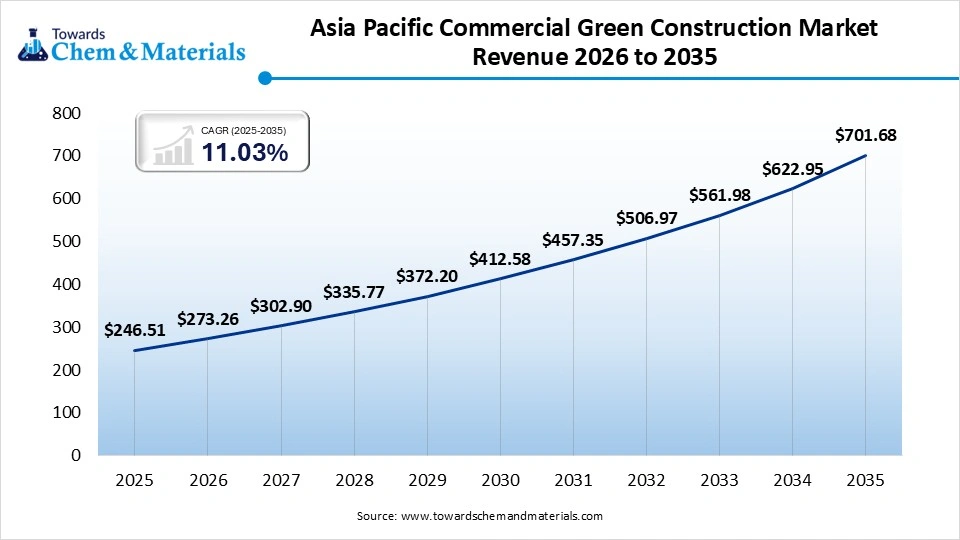
The Asia Pacific commercial green construction market size was estimated at USD 246.51 billion in 2025 and is projected to reach USD 701.68 billion by 2035, growing at a CAGR of 11.03% from 2026 to 2035 Asia Pacific functions as a major financial hub that functions as certified green offices aligned with ESG commitment. The region is implementing smart-city integration and focusing on retrofitting expansion on a domestic scale. The strong governmental support and institutional strategic partnership for innovation accelerate the regional growth.
China Commercial Green Construction Market Growth Trends
China market expansion is driven by the 15th five-year plan and regulatory-driven mandatory infrastructure to achieve green construction standards. China is integrating digital twins with AI-driven energy grids that protect the region from climate risk by maintaining operational reliability in the regional landscape.
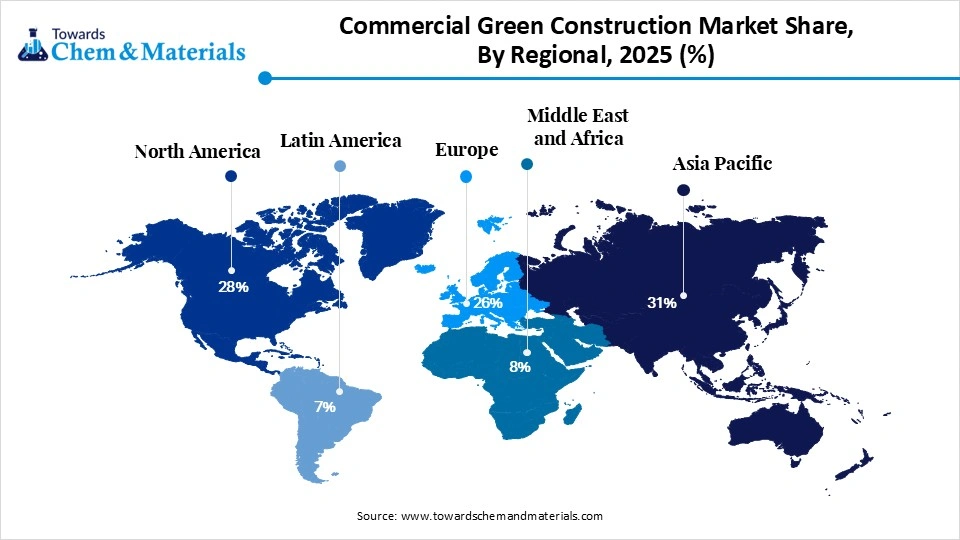
North America held the second largest share of 28% in 2025 and expects notable growth in the market with 10.50% CAGR during the forecast period, driven by a strict regulatory framework and domestic demand in private-sector ESG mandates for a green construction framework. The region focuses on green financing, security of occupants and workplace safety, aligning with LEED and WELL certification, which positions North America as a key pillar of future-driven commercial platforms and institutional capital.
U.S. Commercial Green Construction Market Growth Trends
The United States market shows significant growth that makes it a performance-driven leader by integrating ESG mandates and national incentives. The region focuses on decarbonization and incorporates demand for certified material by protecting the commercial platform. Additionally, North America is shifting towards advancement in building frameworks to improve efficiency.
Commercial Green Construction Market Share, By Regional, 2025 (%)
| Regional | Revenue Share, 2025 (%) |
| North America | 28% |
| Europe | 26% |
| Asia-Pacific | 31% |
| Latin America | 7% |
| Middle East & Africa | 8% |
Recent Developments
- In February 2026, JK Lakshmi Cement announced the launch of Green PRO LC3, one of India's first commercial-grade low-carbon cements, as limestone calcined clay cement. The cement offers up to 40% lower CO2 emissions, enhanced performance, water positivity and resource optimization.
- In June 2025, Confederation of Real Estate Developers Association of India (CREDAI) entered into a strategic alliance with Adani Cement to advance sustainable urban construction. The partnership promotes sustainable building practices and focuses on benefiting the organization and the construction industry.
Commercial Green Construction Market Competitive Landscape Analysis
Tier 1 Companies
|
Rank
|
Company Name | Headquarters | Country | Why Relevant to This Market | Key Products / Material Portfolio |
| 1 | Saint-Gobain S.A. | Courbevoie, Île-de-France | France | Global leader in sustainable building materials and energy-efficient construction solutions | Insulation materials, low-carbon glass, gypsum products, sustainable building systems |
| 2 | Holcim Ltd. | Zug | Switzerland | Leading supplier of low-carbon cement, concrete, and circular construction solutions | ECOPact concrete, ECOPlanet cement, sustainable roofing systems |
| 3 | Vinci S.A. | Nanterre, Île-de-France | France | Major participant in energy-efficient commercial building and infrastructure projects | Sustainable construction services, green building solutions |
| 4 | AECOM | Dallas, Texas | United States | Global leader in sustainable building design, engineering, and project management | Green building design, sustainable infrastructure solutions |
Tier 2 Companies
|
Rank
|
Company Name | Headquarters | Country | Why Relevant to This Market | Key Products / Material Portfolio |
| 1 | Turner Construction Company | New York, New York | United States | Leading builder of LEED-certified and sustainable commercial buildings | Green commercial construction services |
| 2 | Kingspan Group plc | Kingscourt, County Cavan | Ireland | Major supplier of high-performance insulation and energy-efficient building systems | Insulated panels, building envelope solutions, insulation products |
| 3 | Lendlease Corporation Limited | Sydney, New South Wales | Australia | Strong focus on carbon-neutral and sustainable commercial developments | Sustainable commercial developments, green construction services |
| 4 | Bouygues S.A. | Paris, Île-de-France | France | Major developer of low-carbon and smart commercial buildings | Sustainable building construction, energy-efficient infrastructure |
| 5 | Johnson Controls International plc | Cork | Ireland | Leading provider of energy management and building efficiency solutions | Smart building systems, HVAC controls, energy optimization technologies |
Tier 3 Companies
|
Rank
|
Company Name | Headquarters | Country | Why Relevant to This Market | Key Products / Material Portfolio |
| 1 | Interface, Inc. | Atlanta, Georgia | United States | Pioneer in carbon-neutral flooring and sustainable interior solutions | Low-carbon carpet tiles, sustainable flooring systems |
| 2 | DPR Construction | Redwood City, California | United States | Recognized leader in net-zero and sustainable commercial building projects | Green commercial construction services |
| 3 | Armstrong World Industries, Inc. | Lancaster, Pennsylvania | United States | Supplier of sustainable ceiling and interior building solutions | Acoustic ceilings, sustainable interior systems |
| 4 | CertainTeed LLC | Malvern, Pennsylvania | United States | Major provider of sustainable insulation and commercial construction materials | Insulation, gypsum products, roofing systems |
Top Companies in the Commercial Green Construction Market
- AECOM
- Jacobs Engineering Group, Inc.
- Fluor Corporation
- Galfar Engineering & Contracting SAOG (Galfar)
- KIMLY CONSTRUCTION PTE. LTD
- Soilbuild Construction Group Ltd.
- Lum Chang
- The Turner Corp.
- Clark Group
- DPR Construction
Commercial Green Construction Market Segment Covered in the Report
By Construction Type
- New Construction
- Commercial Offices
- Retail Spaces
- Hospitality Buildings
- Renovation & Retrofitting
- Energy Retrofit
- Structural Retrofit
- Interior Upgrade
By Building Type
- Office Buildings
- Corporate Offices
- IT Parks
- Retail Buildings
- Shopping Malls
- Standalone Stores
- Hospitality
- Hotels
- Resorts
- Healthcare Facilities
- Hospitals
- Clinic
By Material Type
- Structural Materials
- Recycled Steel
- Engineered Wood
- Insulation Materials
- Mineral Wool
- Foam Boards
- Roofing Materials
- Green Roof System
- Reflective Roofing
- Finishing Materials
- Low-VOC Paints
- Sustainable Flooring
By Technology
- Energy Efficiency Systems
- HVAC Systems
- Lighting Systems
- Water Efficiency Systems
- Rainwater Harvesting
- Smart Plumbing
- Smart Building Technologies
- IoT Sensors
- Building Management Systems
By Certification Type
- LEED Certification
- Certified
- Silver
- Gold
- Platinum
- BREEAM Certification
- WELL Certification
- Other
By End-User
- Private Sector
- Corporations
- Real Estate Developers
- Public Sector
- Government Buildings
- Institutional Projects
By Regions
- North America
- U.S.
- Canada
- Mexico
- Europe
- Germany
- UK
- France
- Italy
- Spain
- Asia Pacific
- China
- India
- Japan
- South Korea
- Latin America
- Brazil
- Argentina
- Middle East & Africa
- Saudi Arabia
- South Africa
A Seven-Phase Framework
Our methodology is designed to be universally applicable across commodity chemicals, specialty chemicals, petrochemicals, construction chemicals, coatings, electronic chemicals, industrial gases, agrochemicals, water treatment chemicals, and performance materials. Each phase builds upon the last, creating a layered validation structure that minimizes estimation error and maximizes analytical confidence.
The framework ensures comprehensive market coverage, robust cross-validation, and reliable long-term forecasting — producing market estimates that withstand scrutiny from investors, regulators, and corporate strategy teams.

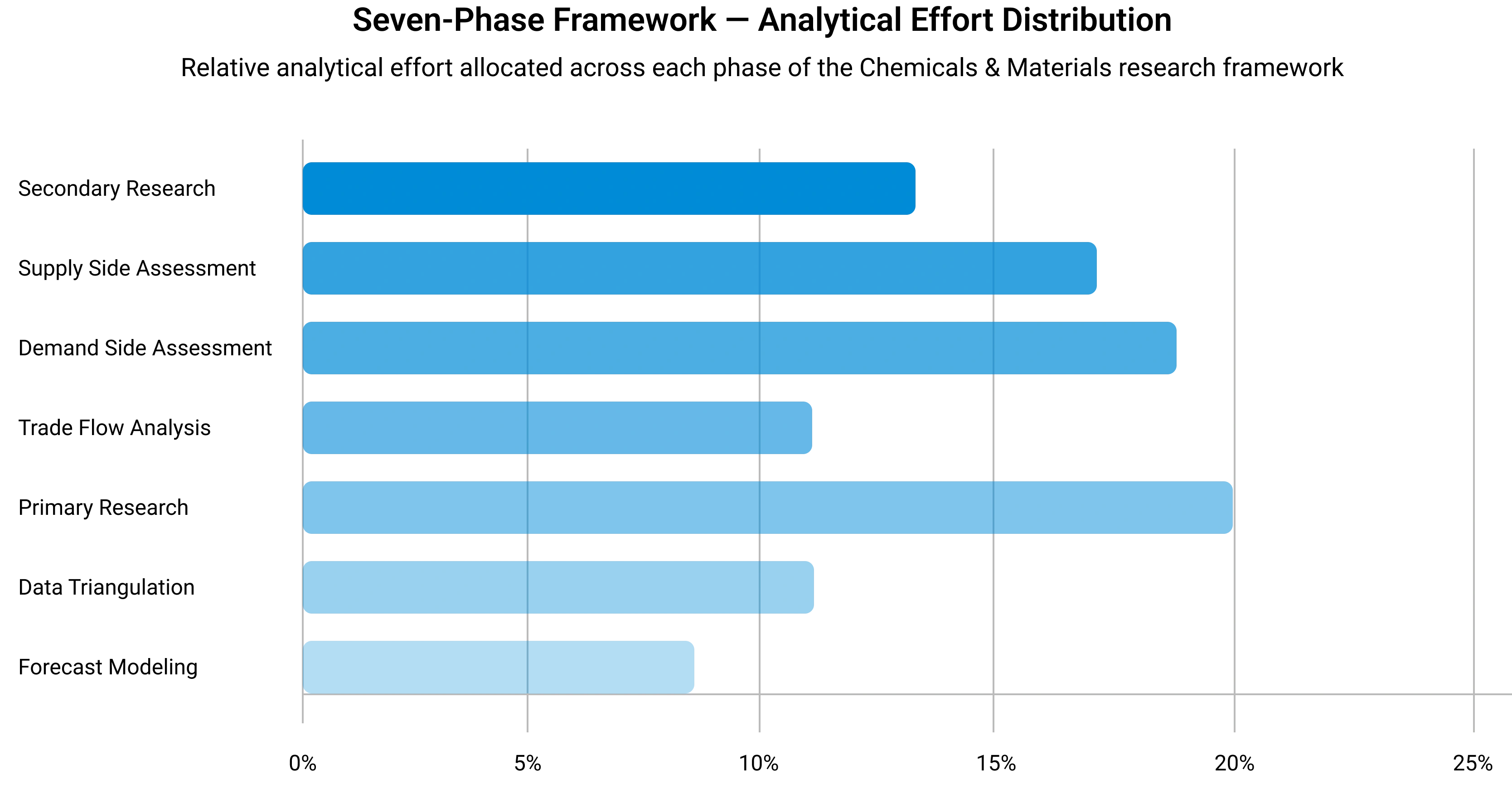
Seven-Phase Framework — Analytical Effort Distribution
Relative analytical effort allocated across each phase of the Chemicals & Materials research framework
Phase 1 - Secondary Research: Establishing the Foundation
Secondary research collects and evaluates publicly available information from authoritative sources, establishing the foundational understanding of market structure, value chain dynamics, competitive landscape, and end-use demand patterns. Every source is evaluated for credibility, recency, geographic relevance, and methodological soundness before inclusion.
Industry Associations
Sources include ACC, CEFIC, ICCA, JCIA, CPCIF, and SOCMA providing production volumes, consumption trends, capacity developments, and sustainability initiatives.
Company Disclosures
Annual reports, investor presentations, earnings transcripts, and regulatory filings reveal product portfolios, manufacturing footprints, capacity expansions, and revenue segmentation.
Government Databases
National statistical offices, customs authorities, environmental agencies, and industrial production databases provide verified statistics on output, trade flows, and regulatory compliance.
Trade Databases
UN Comtrade, ITC, Eurostat, and national customs authorities enable assessment of global product movement, import dependency, and export competitiveness across regions.
Our Secondary Research Sources
- Ministry of Chemicals and Fertilizers
- European Chemicals Agency
- United States Department of Energy
- Ministry of Industry and Information Technology
- Ministry of Economy Trade and Industry
- Ministry of Trade Industry and Energy
- National Institute of Standards and Technology
- Council of Scientific and Industrial Research
- Fraunhofer Society
- National Institute for Materials Science
Phase 2 — Supply-Side Assessment: Mapping Production Capabilities
Production Capacity Analysis
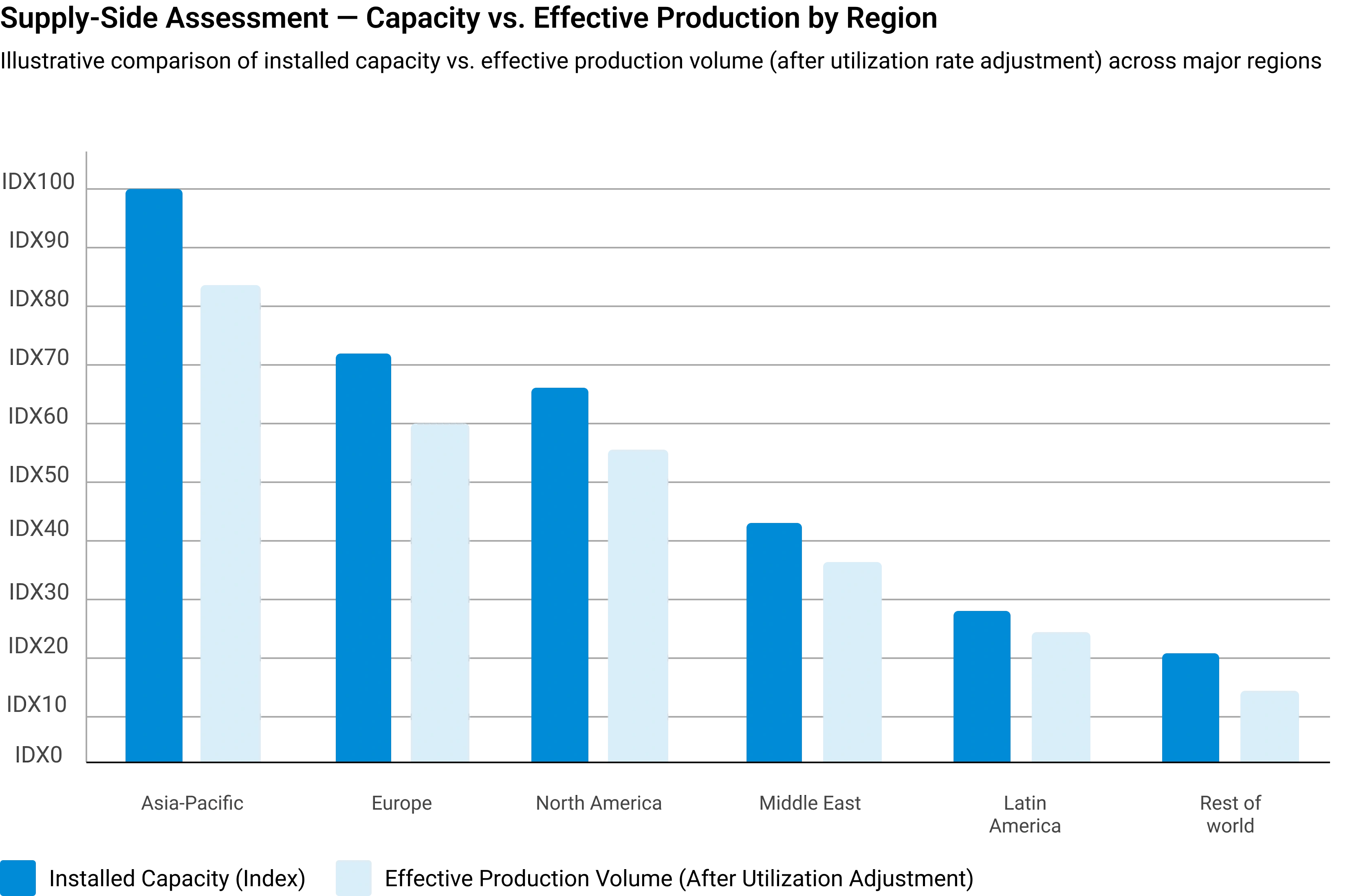
All major manufacturers are assessed for existing installed capacity, planned additions, expansions, new plant announcements, and technology adoption — mapped at global, regional, and country levels.
Capacity Utilization Adjustment
Installed capacity is adjusted using utilization rates based on demand conditions, feedstock availability, plant operating rates, maintenance schedules, and regulatory restrictions.
Manufacturer Revenue Analysis
Product-specific revenues, segment-level performance, regional distribution, average selling prices, and margin trends are evaluated to establish market value estimates.
Supply-Side Assessment — Capacity vs. Effective Production by Region
Illustrative comparison of installed capacity vs. effective production volume (after utilization rate adjustment) across major regions
Phase 3 — Demand-Side Assessment: Quantifying Chemical Consumption
Demand-side analysis quantifies chemical consumption across industries, applications, and geographies — identifying where and how chemicals are consumed throughout the value chain with precision.
End-Use Industry Analysis
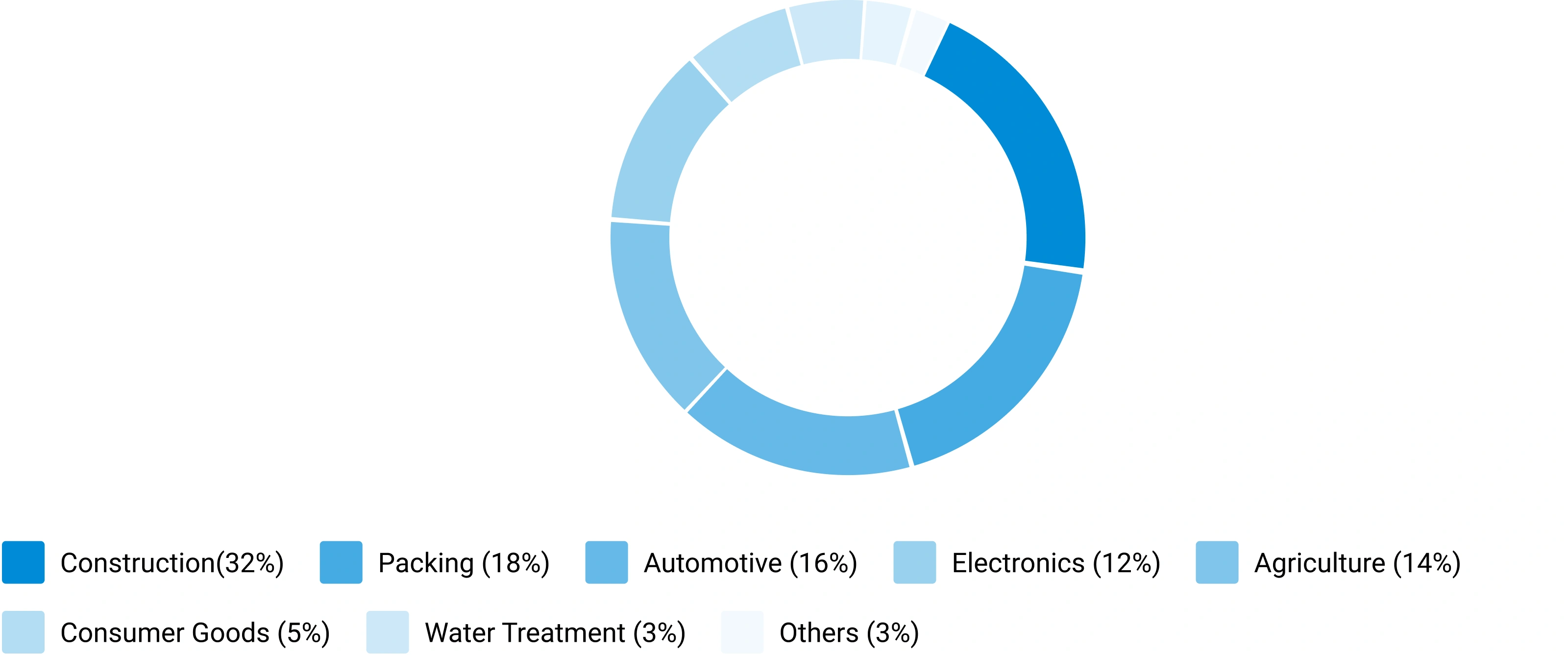
Chemical demand is evaluated across automotive, construction, packaging, electronics, agriculture, healthcare, consumer goods, industrial manufacturing, energy and utilities, and water treatment. Industry output, production trends, and consumption intensity are analyzed to determine demand patterns.
Consumption Modeling
Demand is estimated using measurable indicators: kilograms per vehicle, kilograms per square meter of construction, dosage per cubic meter of water treated, kilograms per hectare of agricultural land, and kilograms per ton of manufactured products. Consumption factors are validated through industry publications and primary interviews.
Application Analysis
The market is segmented by application area to understand product performance requirements, formulation trends, technology adoption, customer preferences, and regulatory requirements improving demand accuracy and segmentation granularity.
Demand-Side Assessment — End-Use Industry Demand Distribution
Illustrative distribution of chemical & materials demand across key end-use industries
Phase 4 - Trade Flow Analysis: Balancing Regional Supply and Demand
Trade flow analysis reconciles regional supply and demand estimates through import and export data, identifying net supply positions, regional dependencies, and market imbalances. It serves as an independent validation layer that tests the consistency of supply-side and demand-side estimates.
Import Analysis
Import data is evaluated to determine volumes, source countries, product dependency, regional supply gaps, and pricing trends — identifying markets that rely heavily on external supply and where domestic production is insufficient to meet demand.
Export Analysis
Export assessments reveal production surplus, export competitiveness, regional manufacturing strength, and global market participation. Export patterns also help validate domestic production estimates and identify net exporting regions.
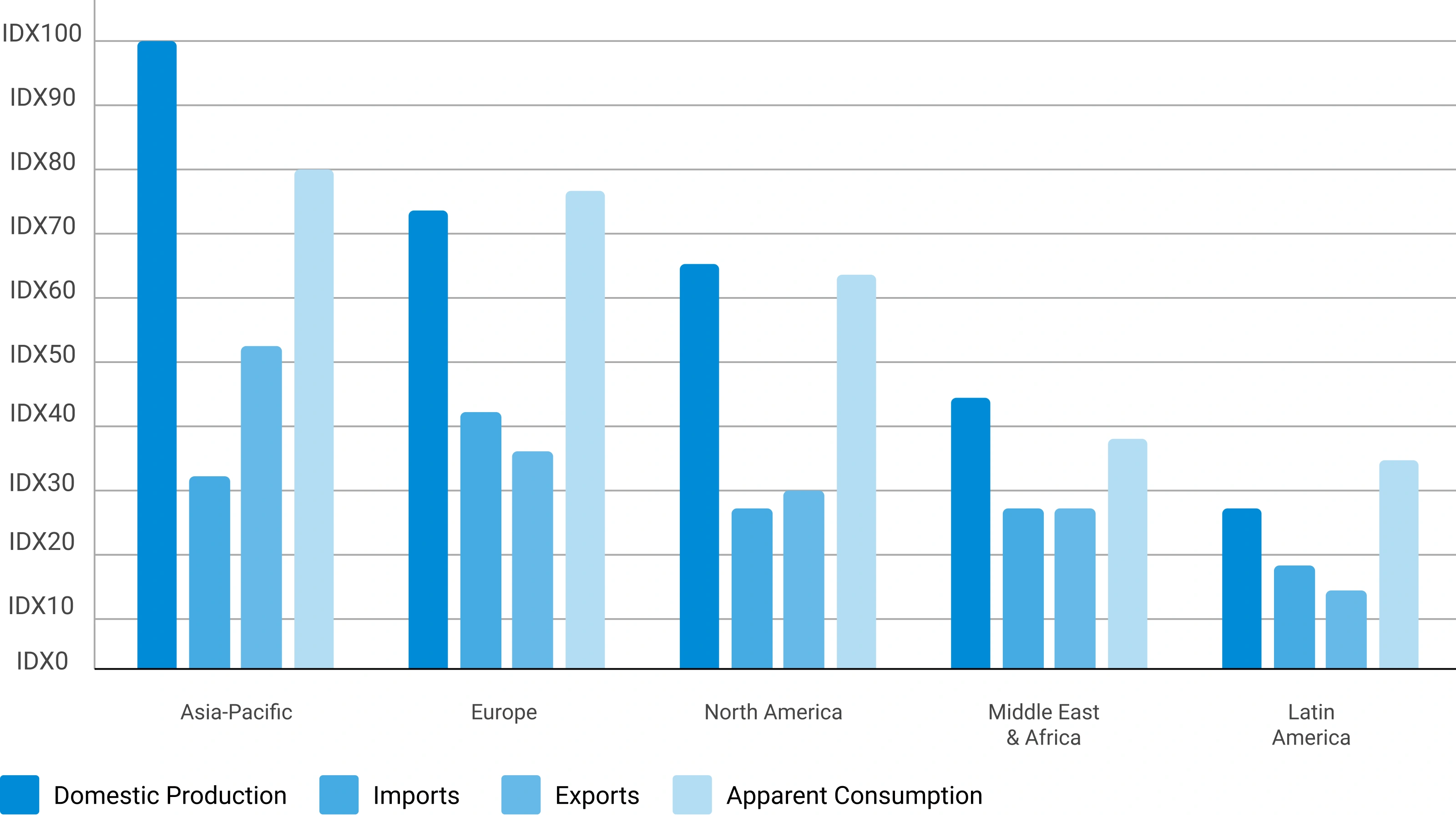
Apparent Consumption Model
Regional consumption is assessed using the standard apparent consumption formula:
Results identify net importing regions, net exporting regions, regional deficits, and surpluses — serving as an independent validation of supply and demand estimates.
Trade Flow Analysis — Net Supply Position by Region
Illustrative apparent consumption vs. domestic production across major regions — positive gap indicates net import dependency
Phase 5 — Primary Research: The Critical Validation Layer
Primary research tests and refines findings from secondary research through direct engagement with industry participants across the supply chain, demand side, and expert community. It captures intelligence that no database or published report can provide — the real-world experience of manufacturers, buyers, and specialists operating in the market.

Supply-Side Interviews
Conversations with chemical manufacturers, raw material suppliers, contract manufacturers, technology providers, and plant operators cover production trends, capacity utilization, pricing developments, technology shifts, and competitive dynamics.

Demand-Side Interviews
Engagement with OEMs, industrial consumers, procurement managers, distributors, formulators, and end-use manufacturers focuses on consumption trends, purchasing behavior, product substitution, demand outlook, and emerging applications.

Industry Expert Consultations
Additional interviews with industry consultants, independent experts, regulatory specialists, technical professionals, and research institutions provide deeper market context and validate key analytical assumptions.
Focus Areas of Primary Research:
Market Size & Forecast Validation
Revenue estimates, volume consumption, growth rates, forecast assumptions, regional demand.Supply Chain & Value Chain Assessment
Raw material sourcing, supply chain challenges, distribution networks, procurement practices.Production & Capacity Analysis
Manufacturing capacity, utilization rates, expansion projects, plant investments.Pricing & Cost Structure Analysis
Product pricing trends, feedstock costs, energy costs, margin pressures, pricing outlook.Competitive Landscape Assessment
Volume and value estimates confirmed to be fully consistent with one another before publicationInterview Volume by Market Scope
| Study Scope | Number of Interviews |
|---|---|
| Niche Market | 20 – 30 |
| Mid-Sized Market | 30 – 50 |
| Global Market | 50 – 80 |
| Highly Fragmented Market | 80 – 120 |
Interview Details:
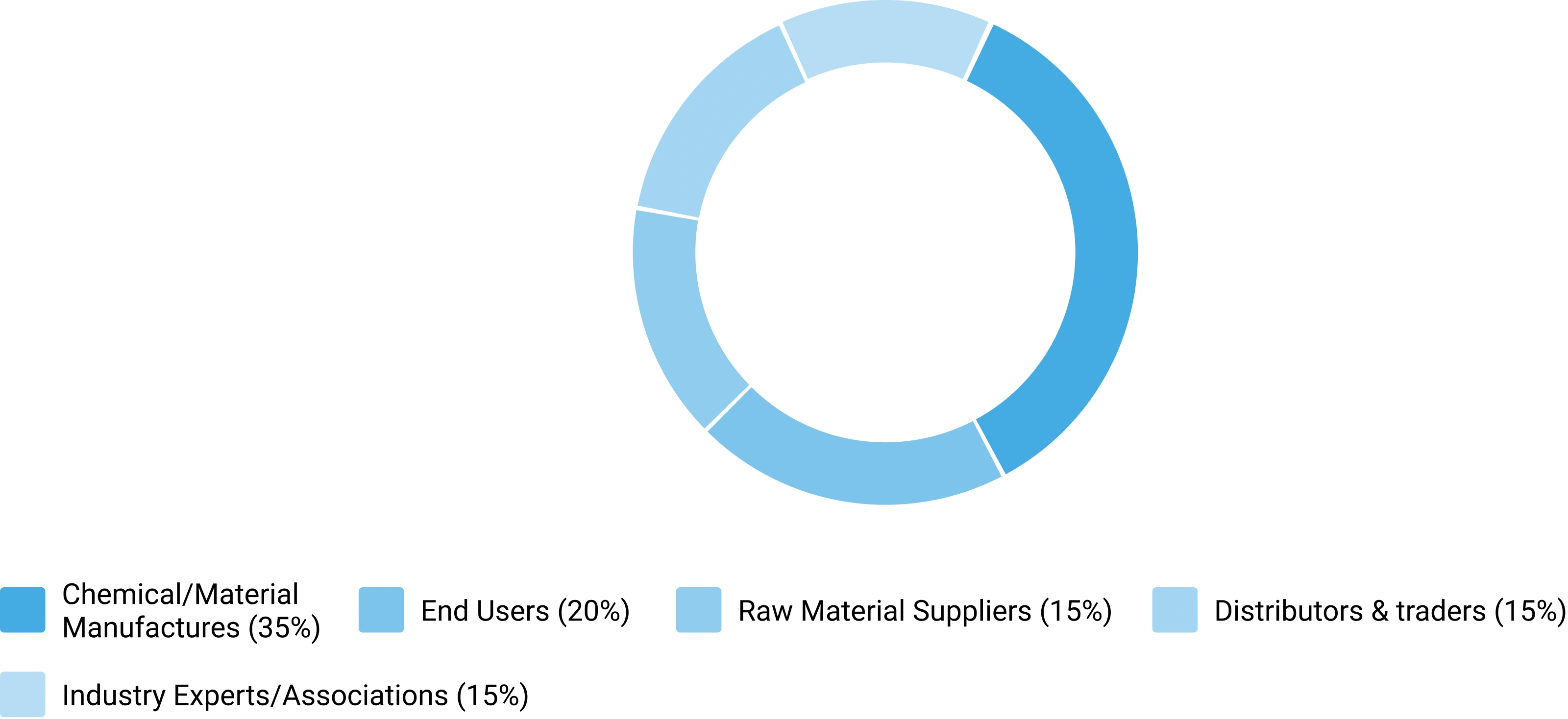
Category : Manufacturers, Suppliers, Distributors, End Users, Experts/Associations
Average Duration : 30–60 Minutes
Interview Mode : Video calls, telephonic interviews, expert consultations
Interview Format : Structured / Semi-Structured questionnaire
Focus Areas of Primary Research:
Market Size & Forecast Validation :
Revenue estimates, volume consumption, growth rates, forecast assumptions, regional demand.
Supply Chain & Value Chain Assessment :
Raw material sourcing, supply chain challenges, distribution networks, procurement practices.
Production & Capacity Analysis :
Manufacturing capacity, utilization rates, expansion projects, plant investments.
Pricing & Cost Structure Analysis :
Product pricing trends, feedstock costs, energy costs, margin pressures, pricing outlook.
Competitive Landscape Assessment :
Market share, competitor positioning, strategic initiatives, partnerships, acquisitions.
Primary Research — Stakeholder Coverage by Category
Distribution of interview respondents across stakeholder categories (% share from PPT data)
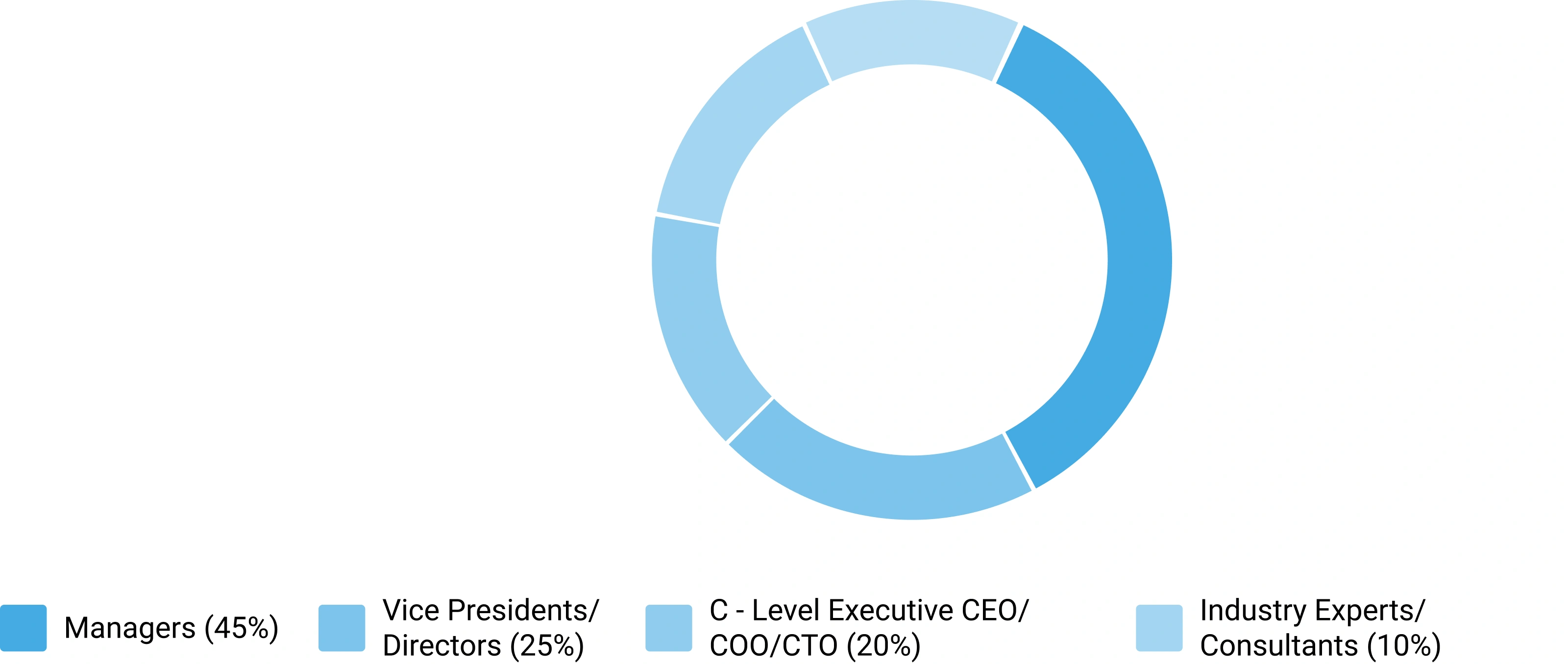
Primary Research — Respondent Designation Profile
Seniority breakdown of interview respondents (% share from PPT data)
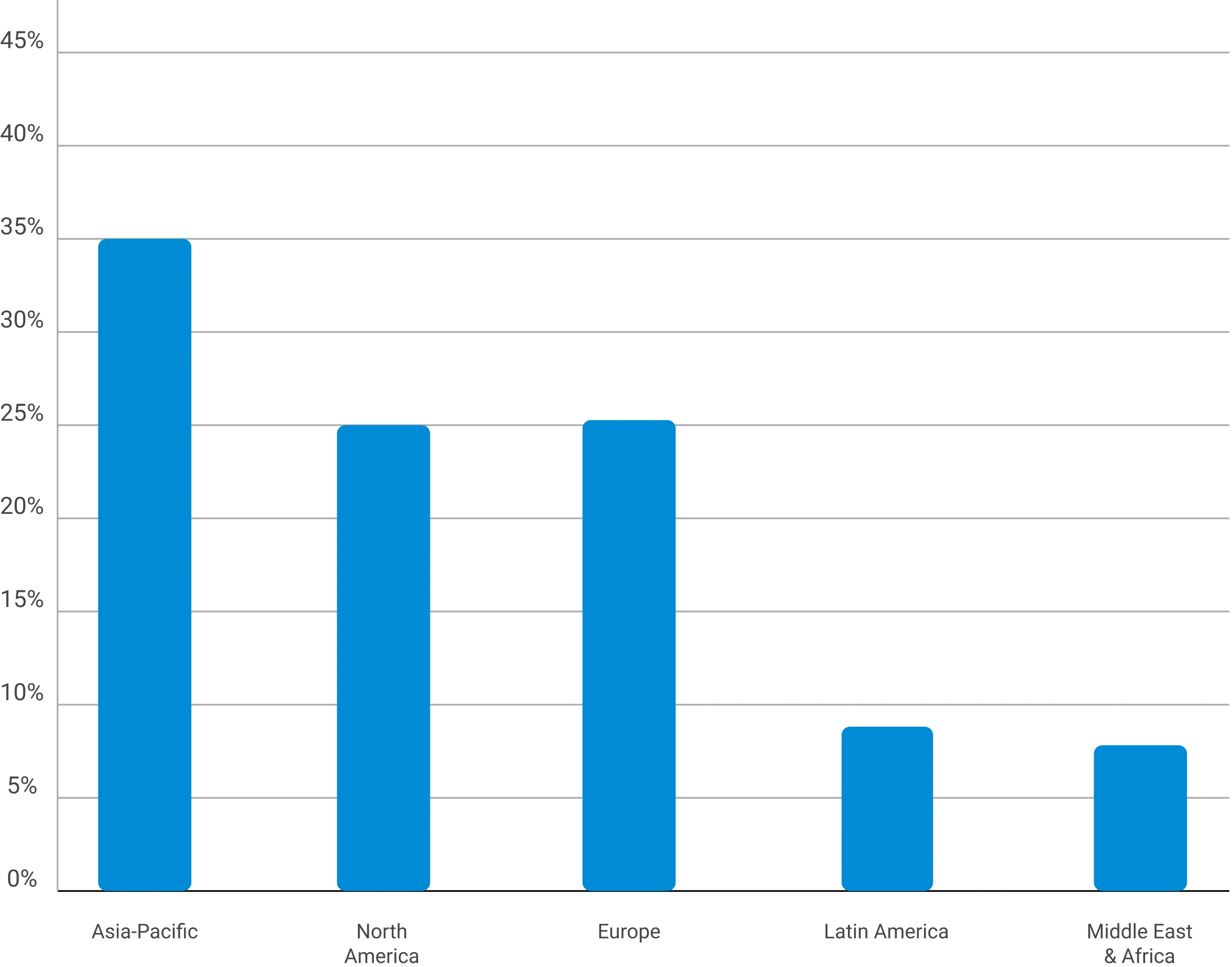
Primary Research — Geographic Coverage of Interviews
Regional distribution of primary research engagement (% share from PPT data)
Phase 6 — Data Triangulation and Market Validation
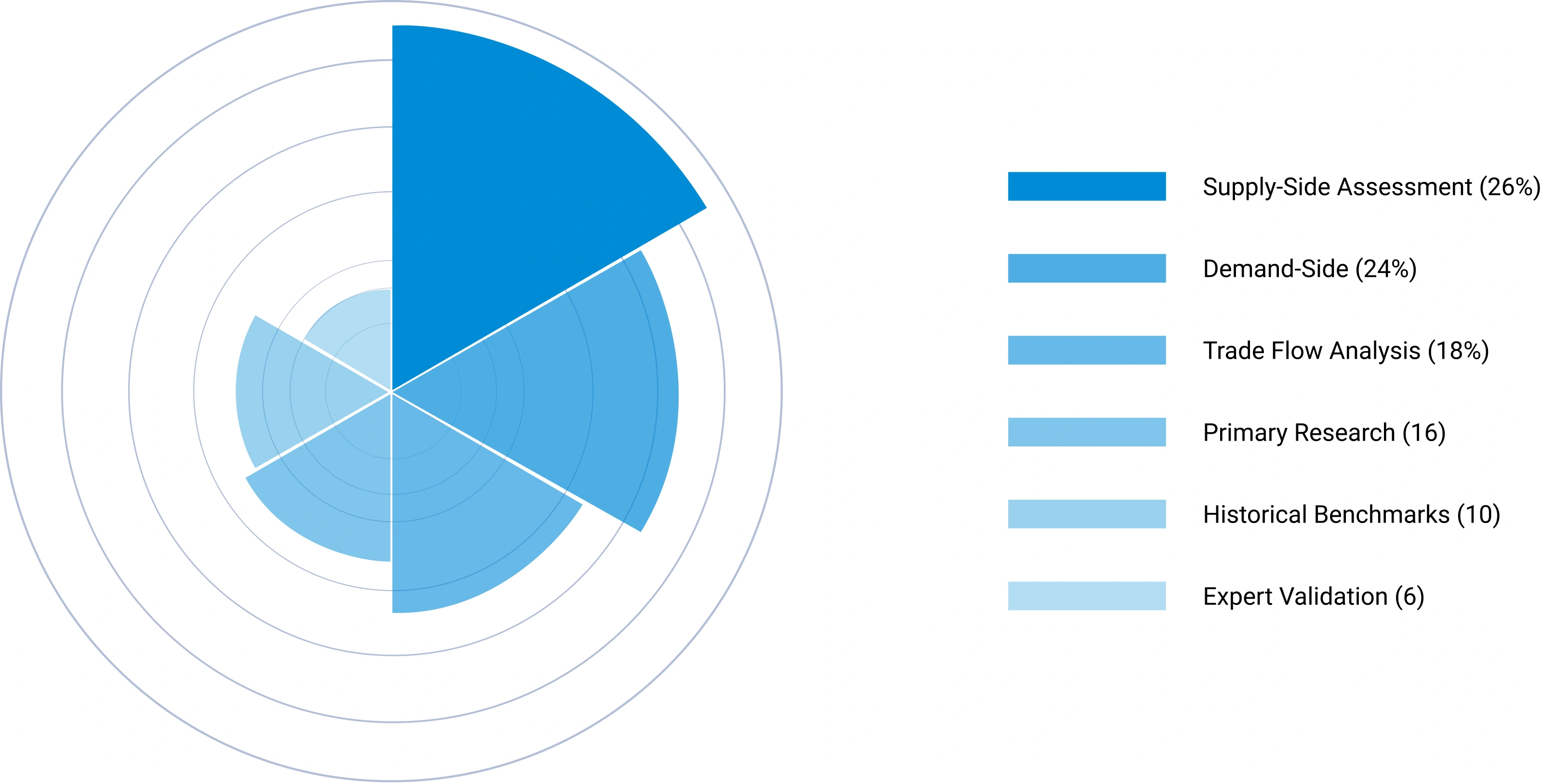
No single methodology is relied upon in isolation. Multiple independent estimation approaches are combined and reconciled to ensure consistency, accuracy, and analytical defensibility. Any material deviations between approaches are investigated and adjusted through additional validation cycles.
The final market size is derived through weighted triangulation of all validated methodologies. Any material deviations between approaches are investigated and adjusted through additional validation cycles. The outcome represents the most realistic assessment of the market based on available evidence and expert confirmation ensuring that volume and value estimates are fully consistent with one another.
Triangulation Framework — Input Contribution Weight
Relative weight each sizing input contributes to the final reconciled market estimate
Phase 7 — Forecast Modeling: Projecting Future Market Evolution
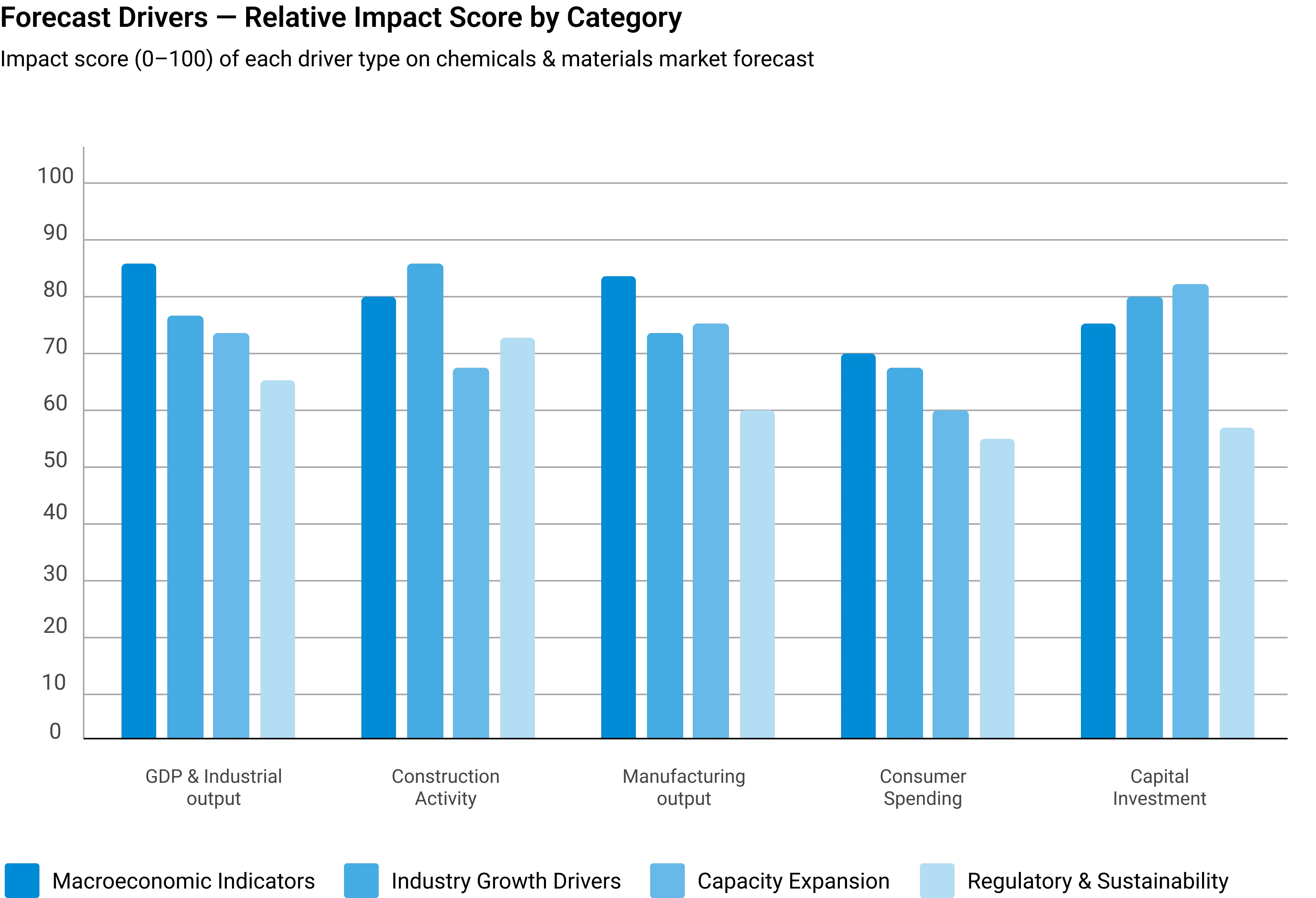
Forecasting evaluates the future trajectory of the market using a combination of quantitative indicators and qualitative assessments across economic, industry, and regulatory dimensions. Rather than simple extrapolation, each driver is independently modeled and integrated into a composite forecast.
Macroeconomic Indicators
GDP growth, industrial production, manufacturing output, construction activity, consumer spending, and capital investment form the quantitative foundation of long-term demand projections. These are applied at country, regional, and global levels.
Industry Growth Drivers
Urbanization, infrastructure development, industrialization, technological innovation, sustainability initiatives, and evolving product performance requirements are assessed at regional and industry levels — capturing both structural and cyclical demand drivers.
Capacity Expansion Analysis
Announced plant expansions, new manufacturing facilities, technology upgrades, and strategic investments are evaluated to determine future supply-demand dynamics and potential market tightness or oversupply situations.
Regulatory & Sustainability
Environmental regulations, chemical safety standards, emission reduction targets, circular economy initiatives, and sustainability requirements are incorporated as they often influence product adoption rates and market growth trajectories.
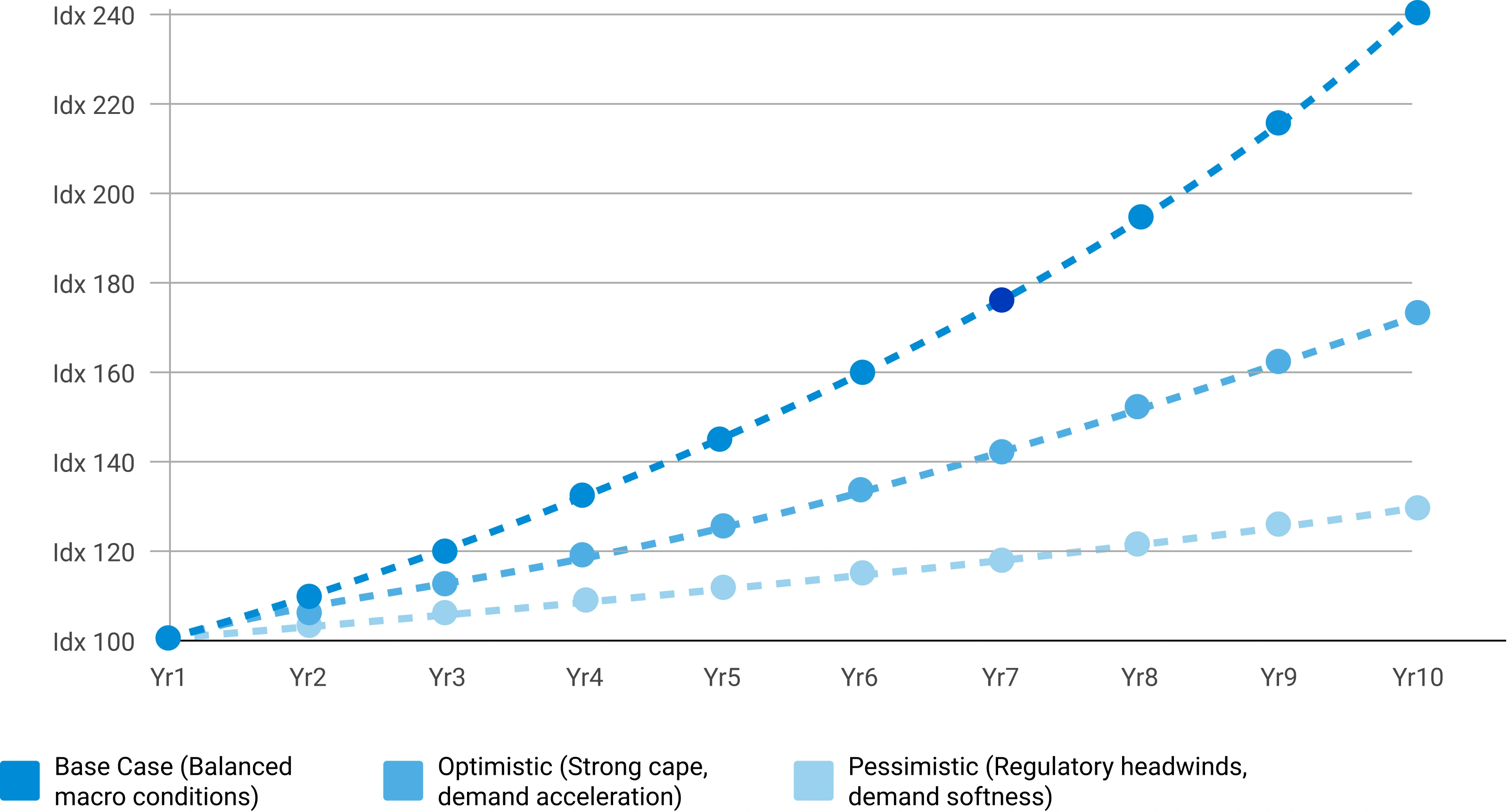
Scenario Forecast Range — Indexed Market Growth (Year 1–10)
Illustrative indexed growth trajectories across Base, Optimistic, and Pessimistic scenarios over a 10-year forecast horizon
Forecast Drivers — Relative Impact Score by Category
Impact score (0–100) of each driver type on chemicals & materials market forecast



Comments
Share your thoughts, ask a question, or provide feedback about this report.