
Construction Adhesives Market Size and Forecast 2026 to 2035
The global construction adhesives size was estimated at USD 11.85 billion in 2025 and is expected to increase from USD 12.39 billion in 2026 to USD 18.44 billion by 2035, growing at a CAGR of 4.52% from 2026 to 2035. Asia Pacific dominated the construction adhesives with the largest revenue share of 41.00% in 2025.The heavy shift towards the modern and time-saving infrastructure building has fueled the industry's growth in recent years.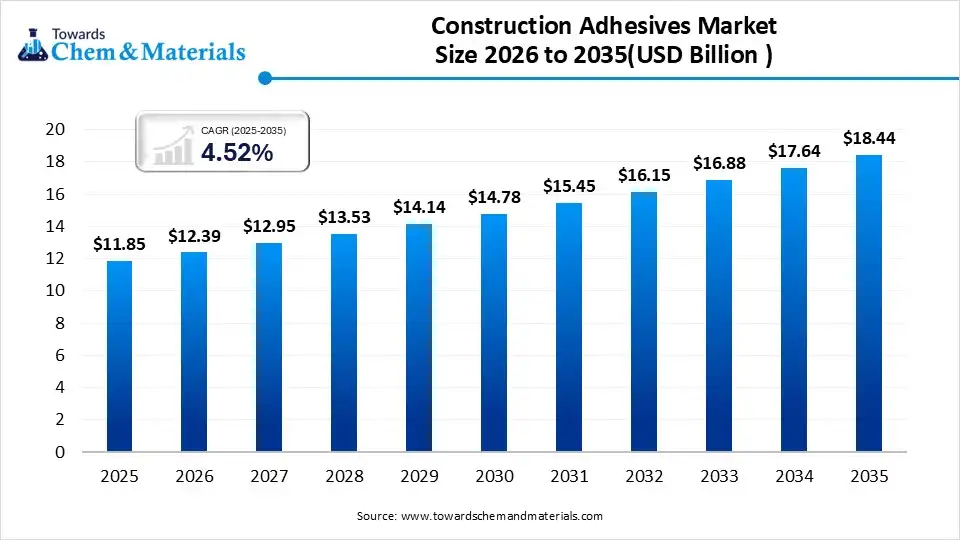
Market Highlights
- Asia Pacific dominated the market shaer 41.00% in 2025, due to its continuous construction across many sectors at the same time.
- By region, North America is anticipated to capture a greater portion of the market with a significant CAGR in the future due to many buildings now require upgrading rather than completely new construction.
- By resin type, the acrylic adhesive segment dominated the market share 45.00% in 2025, owing to it offers a strong balance between bonding strength, flexibility, and easy use.
- By resin type, the polyvinyl acetate adhesives segment is expected to grow during the forecast period, due to its easy-to-use, affordable, and works especially well in interior applications.
- By technology, the water-based adhesives segment dominated the market share 46.00% in 2025, owing to its simplicity to handle and its wide acceptance in daily construction work.
- By technology, the reactive and others segment is expected to grow during the forecast period, due to they give stronger long-term bonding in demanding applications.
- By application, the commercial segment dominated the market share 36.00% in 2025, owing to offices, malls, hotels, hospitals, and retail spaces that use large amounts of adhesive during interior and finishing work.
- By application, the industrial segment is expected to grow during the forecast period, due to its factories, warehouses, production units, and technical buildings that use adhesive in many important installation areas.
Power Glue for Every Construction Need
Construction adhesive is a strong bonding material used to join building materials such as wood, metal, concrete, tiles, plastic, and wall panels. Also, it works like a powerful glue made for construction work, where strength and long holding power are important. Builders use it when nails or screws alone are not enough or when smooth finishing is needed.
Market Trends:
- The increasing need for products that save time has translated into valuable financial prospects for adhesives producers in recent years. Earlier, more mechanical fixing methods were used, which needed drilling, alignment, and extra labor. Now, many contractors prefer adhesive because it joins materials quickly and reduces visible fixing marks.
- Surface appearance now matters more than before in many buildings, which is seen as a high-margin opportunity for manufacturers. In recent years, strength was often the first priority, but now people also want cleaner walls, smooth panel joints, and neat visible finishing.
- The trend toward mixing different materials is likely to elevate earning potential for producers in the coming years. The modern construction now mixes many different materials in one project. A single building may use metal, wood, glass, foam boards, plastic panels, and engineered boards together.
Report Scope
| Report Attribute | Details |
| Market Size in 2026 | USD 12.39 Billion |
| Revenue Forecast in 2035 | USD 18.44 Billion |
| Growth Rate | CAGR 4.52% |
| Forecast Period | 2026 - 2035 |
| Base Year | 2025 |
| Dominant Region | Asia Pacific |
| Segment Covered | By Resin Type, By Technology, By Application, By Region |
| Key companies profiled | H.B. Fuller, 3M Company, Sika AG, The Dow Chemical Company, Bostik SA (An Arkema Company), Henkel AG & Co. KGaA, Dap Products, Franklin International, Illinois Tool Works Incorporated, Avery Dennison Corporation |
Smarter Adhesives for Every Environment
The products are now designed for stronger performance under different weather and surface conditions, which is projected to support stronger cash flows for manufacturing enterprises during the forecast period. In recent times, many adhesives have worked well only in limited environments. Now builders want one adhesive that works in heat, moisture, indoor spaces, and outdoor use. Manufacturers are improving formula balance, so adhesives spread easily, cure faster, and hold better over time. Also, adhesive is moving from simple bonding toward smarter bonding that adapts to real building conditions.
Trade Analysis of the Construction Adhesives Market:
Import, Export, Consumption, and Production Statistics
- The construction adhesives emerged as one of the leading exporting products with 10,841 shipments globally via 2,390 buyers and 2,066 exporters between July 2024 and June 2025, as per the published report.
- China has seen a heavy export of construction adhesives with 17,946 shipments, while Vietnam (7,324 shipments) and Japan (3,696 shipments) are following.
- Vietnam has been observed in sophisticated import of construction adhesives with 23,568 shipments, while Russia (7,465 shipments) and Kazakhstan (2,093 shipments).
Supply Chain Analysis of the Construction Adhesives Market:
Distribution to Industrial Users
- Distribution to industrial users of construction adhesives typically occurs through direct sales from manufacturers like Henkel or 3M for large-scale projects, or via specialized industrial distributors like Fastenal and Grainger.
- These channels provide high-volume supply, technical support, and bulk dispensing solutions for infrastructure and manufacturing facilities.
Chemical Synthesis and Processing
- Chemical synthesis involves polymerizing raw materials like resins, hardeners, and solvents to create bonding agents. Processing utilizes high-shear mixers to blend these polymers with fillers and stabilizers, ensuring uniform viscosity and strength. Controlled heating and cooling cycles then stabilize the chemical structure before the adhesive is packaged for industrial use.
Regulatory Compliance and Safety Monitoring
- Regulatory compliance for construction adhesives involves adhering to REACH, RoHS, and VOC emission standards to ensure environmental and worker safety. Safety monitoring utilizes Material Safety Data Sheets (MSDS) and rigorous batch testing to track chemical exposure and fire hazards, maintaining high-performance reliability across diverse industrial applications.
Construction Adhesives Market Regulatory Landscape: Global Regulations
| Country Region | Regulatory Body | Key Regulations | Focus Areas |
| United States | Environmental Protection Agency (EPA) | 40 CFR Part 59: National VOC emission standards for consumer and commercial products | Reduction of ground-level ozone (smog), indoor air quality (LEED certification), and chemical labeling under the Federal Hazardous Substances Act (FHSA). |
| European Union | European Chemicals Agency (ECHA). | REACH (EC 1907/2006): Controls the registration, evaluation, and restriction of chemicals to protect human health and the environment | chemical transparency, circular economy (recyclability), and protecting indoor environments from toxic substances and radiation |
| China | Ministry of Ecology and Environment (MEE). |
GB 33372-2020: Limits of volatile organic compounds content in adhesives (mandatory national standard). |
Environmental impact reduction, mandatory safety labeling (Orange Label 2), and digital compliance tools like QR codes for product information. |
Segmental Insights
Resin Type Insights
How did the Acrylic Adhesive Segment Dominate the Construction Adhesives Market in 2025?
The acrylic adhesive segment dominated the market share 45.00% in 2025, due to its offering a strong balance between bonding strength, flexibility, and easy use. Builders prefer acrylic because it works well on many common surfaces, such as concrete, wood, tiles, and wall materials. Also, it handles small surface movement without breaking easily, which is useful in buildings where materials expand or contract slightly. Acrylic products also give good durability in indoor and outdoor applications.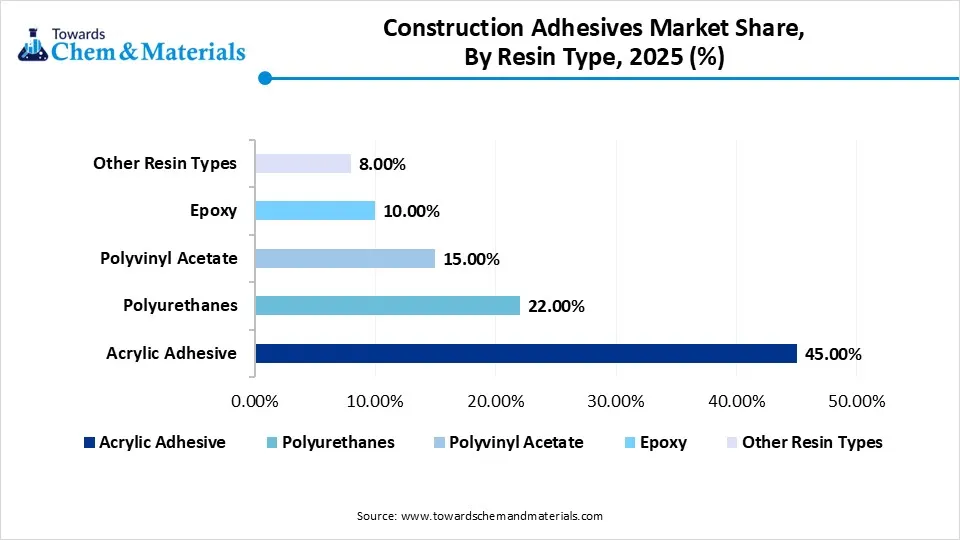
The polyvinyl acetate adhesives segment is expected to grow with a rapid CAGR, owing to its easy-to-use, affordable, and works especially well in interior applications. It is widely useful for wood panels, decorative laminates, furniture fittings, and light building materials. As more construction focuses on interiors, modular fittings, and fast finishing, this adhesive becomes attractive because workers already understand how to apply it easily. Also, it supports quick and clean indoor bonding without complicated handling. Future growth may come strongly from interior construction and light assembly work, where cost control and easy application matter more than heavy structural strength.
Construction Adhesives Market Share, By Resin Type , 2025 (%)
| By Resin Type | Revenue Share, 2025 (%) |
| Acrylic Adhesive | 45.00% |
| Polyurethanes | 22.00% |
| Polyvinyl Acetate | 15.00% |
| Epoxy | 10.00% |
| Other Resin Types | 8.00% |
- The acrylic adhesive segments' share of 45.00% in 2025 dominates due to their strong versatility, excellent bonding properties, and cost-effectiveness in a wide range of applications.
- The polyurethanes segments share 22.00% in 2025. Gaining momentum with increasing demand in automotive and construction applications for their durability and flexibility.
- The polyvinyl acetate segments share 15.00% in 2025, gaining momentum due to their high usage in packaging and paper products, driven by consumer demand for eco-friendly solutions.
- The epoxy segments share 10.00% in 2025, not dominating but growing due to its high performance in specialized applications like electronics and heavy-duty bonding.
- The other resin type segments share 8.00% in 2025, not dominating, representing a smaller share due to limited use in niche sectors compared to dominant resin types.
Technology Insights
How did the Water-Based Adhesives Segment Dominate the Construction Adhesives Market in 2025?
The water-based adhesives segment dominated the market share 46.00% in 2025, due to its simplicity to handle and its wide acceptance in daily construction work. It spreads easily, cleans more easily during application, and is commonly used in indoor projects where controlled application matters. Moreover, many workers already know how to use water-based products, so training needs are lower. It also fits many common materials used in walls, panels, flooring, and decorative work. As the builders trust it because it feels practical and familiar.
The reactive and others segment is expected to grow with a rapid CAGR, owing to they give stronger long-term bonding in demanding applications. Also, these adhesives react chemically after application and create a very strong attachment between difficult surfaces. They are useful where builders need stronger resistance against heat, stress, vibration, or heavy industrial use. Also, when projects become more demanding, stronger chemistry becomes more important. Future construction increasingly uses advanced materials and technical designs, so reactive systems are expected to grow.
Construction Adhesives Market Share, By Technology , 2025 (%)
| By Technology | Revenue Share, 2025 (%) |
| Water-based | 46.00% |
| Solvent-based | 28.00% |
| Reactive & Others | 26.00% |
- The water-based segments share 46.00% in 2025, dominating due to their eco-friendliness, low toxicity, and regulatory preferences, making them the top choice for industries prioritizing sustainability.
- The Solvent-based segments share 28.00% in 2025. Not dominating but still significant due to its fast-drying properties and effectiveness in heavy-duty applications, though losing favor in environmentally conscious sectors.
- The Reactive & Others segments share 26.00% in 2025, gaining momentum due to the increasing demand for high-performance adhesives in specialized applications like construction and automotive.
Application Insights
How did the Commercial Segment Dominate the Construction Adhesives Market in 2025?
The commercial segment dominated the market share 36.00% in 2025, due to offices, malls, hotels, hospitals, and retail spaces using large amounts of adhesive during interior and finishing work. These buildings often need panels, flooring, ceiling systems, decorative materials, and partitions installed quickly and neatly. Adhesive helps reduce visible fixing marks and improves appearance. Also, commercial projects often follow strict timelines, so faster bonding methods are preferred. Moreover, the adhesives became important because commercial construction needs both speed and clean finishing.
The industrial segment is expected to grow with a rapid CAGR, owing to its factories, warehouses, production units, and technical buildings that use adhesive in many important installation areas. Adhesives are used for fixing insulated panels, industrial flooring, wall sheets, machine-area coverings, and protective surface materials where strong bonding is required. Also, the industrial buildings often face vibration, load, and repeated mechanical movement, so traditional fixing alone is sometimes not enough, which leads to the need for stronger adhesion.
Construction Adhesives Market Share, By Application , 2025 (%)
| By Application | Revenue Share, 2025 (%) |
| Residential | 40.00% |
| Commercial | 36.00% |
| Industrial | 24.00% |
- The residential segments share 40% in 2025, dominated due to strong demand driven by home construction, renovations, and DIY projects, with growing investments in residential development.
- The commercial segments share 36.00% in 2025, not dominating but maintaining a strong presence due to the growth of commercial construction and infrastructure projects, including office buildings and retail spaces.
- The industrial segments share 24.00% in 2025, not dominating but gaining momentum due to increasing industrial applications in manufacturing, automotive, and heavy-duty industries, focusing on high-strength adhesives.
Regional Insights
The Asia Pacific construction adhesives market size was valued at USD 4.86 billion in 2025 and is expected to be worth around USD 7.65 billion by 2035, exhibiting at a compound annual growth rate (CAGR) of 4.64% over the forecast period from 2026 to 2035.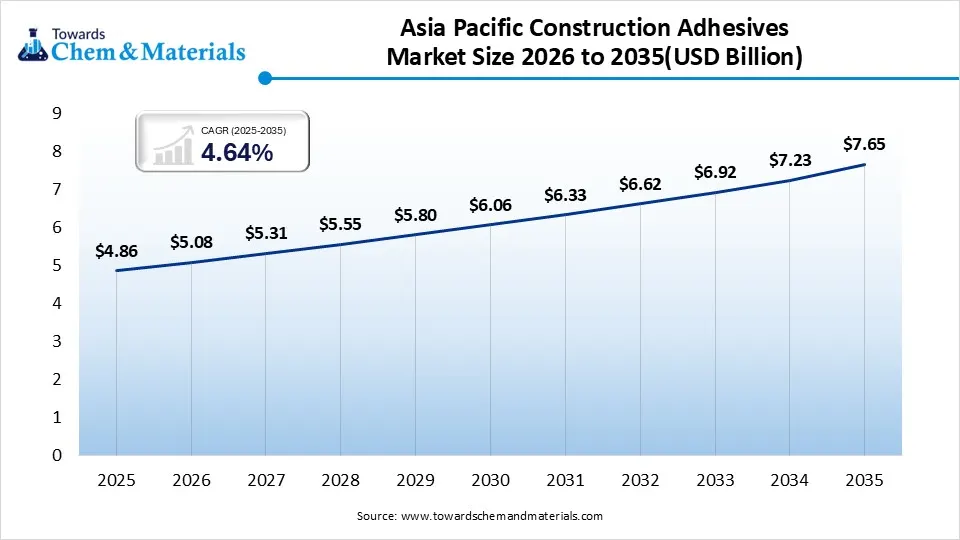
Asia Pacific dominated the construction adhesives market in 2025, due to its continuous construction across many sectors at the same time. Residential towers, office buildings, transport projects, shopping spaces, and industrial parks all create strong adhesive demand. Also, many buildings in this region now use lightweight panels, modular interiors, and pre-finished materials, where adhesive becomes very useful. As modern construction methods are increasing faster here than before. Since many countries in this region are expanding cities and infrastructure together, adhesive demand remains strong across daily building activity, which keeps the region ahead in the global market.
China Leads with Fast-Built Adhesive Demand
China maintained its dominance in the market, owing to large-scale building projects often moving quickly and using many factory-made materials that need adhesive during final installation. Moreover, the wall boards, insulation layers, decorative sheets, flooring systems, and ceiling structures all create strong demand. Also, the many commercial buildings and public facilities require clean finishing, where adhesive gives better visual results than visible fixing methods. Furthermore, China uses adhesive heavily because many modern projects depend on fast assembly.
Construction Adhesives Market Share, By Regional, 2025 (%)
| Regional | Revenue Share, 2025 (%) |
| North America | 19.00% |
| Europe | 25.00% |
| Asia Pacific | 41.00% |
| Latin America | 8.00% |
| Middle East & Africa | 7.00% |
- The Asia Pacific shares 41.00% in 2025, dominating due to rapid urbanization, growing construction activities, and increasing demand for affordable housing in developing economies.
- The North America shares 19.00% in 2025, not dominating but holding a significant share due to advanced infrastructure and strong demand in construction and automotive industries.
- The Europe shares 25.00% in 2025, gaining momentum with high demand for eco-friendly and innovative construction materials, supported by strong regulations and sustainable practices.
- The Latin America shares 8.00% in 2025. Not dominating, with limited share due to slower infrastructure development and lower demand in the construction sector compared to other regions.
- The Middle East & Africa 7.00% in 2025 Not dominating, with a smaller market share, driven by niche demand in construction projects and challenges in infrastructure development.
Construction Adhesives Market Evaluation in North America
North America construction adhesives market segment accounted for the major revenue share of 19.00% in 2025. North America is expected to capture a major share of the construction adhesives market with a rapid CAGR, owing to many buildings now require upgrading rather than completely new construction. Moreover, the old offices, commercial spaces, hospitals, warehouses, and public buildings are being improved with modern materials, which increases adhesive demand. Adhesives become important when surfaces must be renewed without damaging existing structures. Also, the builders increasingly prefer faster installation methods to reduce labor time.
Modern Building Fuels United States Adhesive Adoption
The United States is expected to emerge as a prominent country for the construction adhesives market in the coming years, due to many projects now using engineered boards, insulation panels, acoustic materials, and layered flooring systems that depend on adhesive during installation. Moreover, the builders often choose adhesive because it supports cleaner work and helps reduce visible fixing marks in finished spaces. Also, the industrial and logistics buildings are expanding, and these projects use strong bonding solutions in flooring and panel installation. Moreover, the adhesive demand stays strong because modern building methods increasingly depend on surface bonding instead of only mechanical fixing.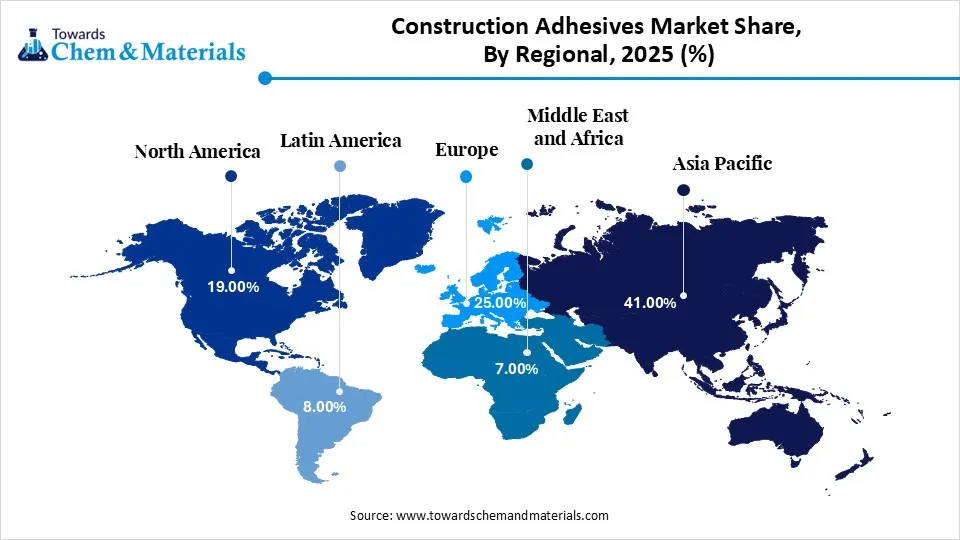
Europe Construction Adhesives Market Examination
Europe is growing in industry, owing to many building projects now focusing on interior modernization and energy-saving construction methods. Also, adhesives are used more when insulation materials, wall systems, and modern interior surfaces are installed carefully. Also, many buildings are upgraded instead of replaced, which creates steady demand for bonding materials during renovation. Also, the adhesives become important because modern improvement work often needs clean attachment methods that do not damage older structures.
Precision Bonding Drives Germany’s Construction Growth
Germany is expected to gain a significant industry share owing to many construction projects there that use precision installation where exact surface quality matters. Moreover, the adhesive is preferred when flooring, insulation boards, technical panels, and interior systems must stay aligned for long periods. Also, the country's industrial construction uses many bonded materials where stable performance matters more than quick fixing alone. Also, the German projects often choose materials carefully, and adhesive becomes important because it supports both strength and a neat finish.
Recent Developments
- In November 2025, Bostik introduced the latest production of construction sealant and adhesive. Also, these newly launched adhesives are specifically designed for the multi surface and are named OB1Multi-Surface Construction Sealant and Adhesive as per the published report.(Source: www.specialchem.com )
- In July 2025, Polyglass unveiled the eco-friendly adhesive solutions, which are specifically designed for the roofing of cold-applied systems. Moreover, the newly launched adhesives are known as PG 350 LV and PG SFA, as per the company's claim.(Source: www.azobuild.com)
Top Vendors in the Construction Adhesives Market & Their Offerings:
- H.B. Fuller: Founded in 1887 and headquartered in Minnesota, H.B. Fuller is a leading global provider of specialty adhesives, sealants, and chemical products. It serves diverse markets including electronics, hygiene, medical, transportation, and construction. The company focuses on innovation and sustainable solutions to improve products and manufacturing processes worldwide.
- 3M Company: Originally the Minnesota Mining and Manufacturing Company (founded 1902), 3M is a massive American multinational conglomerate. It produces over 60,000 products, including Scotch tape, Post-it notes, and N95 respirators. Operating in industry, safety, healthcare, and consumer goods, 3M is globally renowned for its immense patent portfolio and R&D-driven culture.
- Sika AG: Headquartered in Baar, Switzerland, Sika is a specialty chemicals giant established in 1910. It leads the market in systems for bonding, sealing, damping, reinforcing, and protecting in the building and automotive sectors. Sika is famous for its pioneering tunnel waterproofing solutions and has a massive global manufacturing presence across 100+ countries.
- The Dow Chemical Company: Founded in 1897 in Michigan, Dow is one of the world's largest chemical producers. It specializes in plastics, chemicals, and performance materials for packaging, infrastructure, and consumer care. After a high-profile merger and subsequent 2019 split from DuPont, Dow now focuses on high-value materials science and innovation in global industrial markets.
- Bostik SA (An Arkema Company)
- Henkel AG & Co. KGaA
- Dap Products
- Franklin International
- Illinois Tool Works Incorporated
- Avery Dennison Corporation
Segments Covered in the Report
By Resin Type
- Acrylic Adhesive
- Polyurethanes
- Polyvinyl Acetate
- Epoxy
- Other Resin Types
By Technology
- Water-based
- Solvent-based
- Reactive & Others
By Application
- Residential
- Ceramic Tiles
- Countertop Lamination
- Carpet Laying
- Floor Coverings
- Gypsum Boards
- Other Residential Applications
- Commercial
- Ceramic Tiles
- Countertop Lamination
- Carpet Laying
- Floor Coverings
- Gypsum Boards
- Other Commercial Applications
- Industrial
- Ceramic Tiles
- Countertop Lamination
- Carpet Laying
- Floor Coverings
- Gypsum Boards
- Other Industrial Applications
By Region
- North America
- U.S.
- Canada
- Mexico
- Europe
- Germany
- UK
- France
- Italy
- Spain
- Asia Pacific
- China
- India
- Japan
- South Korea
- Latin America
- Brazil
- Argentina
- Middle East & Africa
- Saudi Arabia
- South Africa
A Seven-Phase Framework
Our methodology is designed to be universally applicable across commodity chemicals, specialty chemicals, petrochemicals, construction chemicals, coatings, electronic chemicals, industrial gases, agrochemicals, water treatment chemicals, and performance materials. Each phase builds upon the last, creating a layered validation structure that minimizes estimation error and maximizes analytical confidence.
The framework ensures comprehensive market coverage, robust cross-validation, and reliable long-term forecasting — producing market estimates that withstand scrutiny from investors, regulators, and corporate strategy teams.

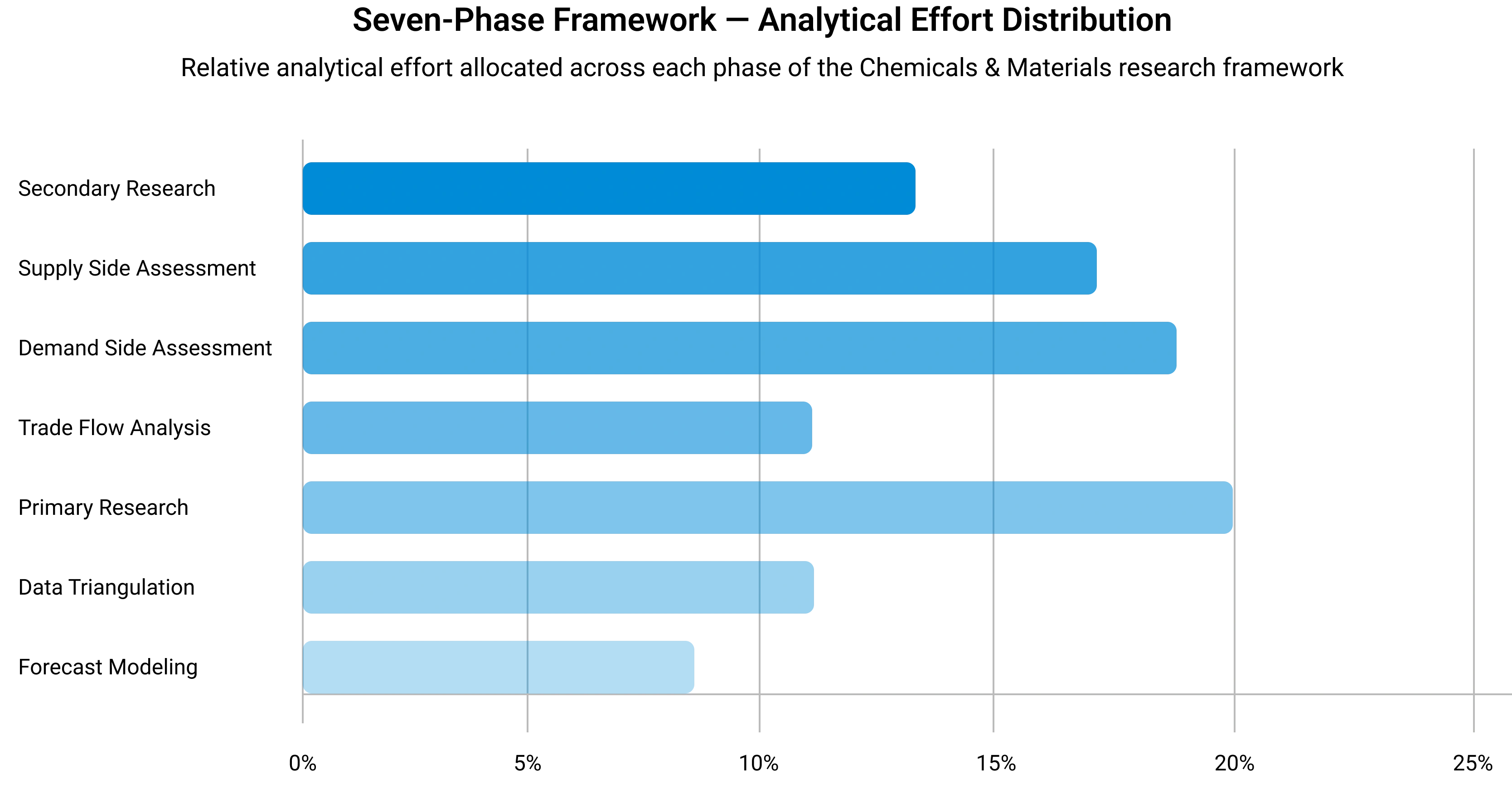
Seven-Phase Framework — Analytical Effort Distribution
Relative analytical effort allocated across each phase of the Chemicals & Materials research framework
Phase 1 - Secondary Research: Establishing the Foundation
Secondary research collects and evaluates publicly available information from authoritative sources, establishing the foundational understanding of market structure, value chain dynamics, competitive landscape, and end-use demand patterns. Every source is evaluated for credibility, recency, geographic relevance, and methodological soundness before inclusion.
Industry Associations
Sources include ACC, CEFIC, ICCA, JCIA, CPCIF, and SOCMA providing production volumes, consumption trends, capacity developments, and sustainability initiatives.
Company Disclosures
Annual reports, investor presentations, earnings transcripts, and regulatory filings reveal product portfolios, manufacturing footprints, capacity expansions, and revenue segmentation.
Government Databases
National statistical offices, customs authorities, environmental agencies, and industrial production databases provide verified statistics on output, trade flows, and regulatory compliance.
Trade Databases
UN Comtrade, ITC, Eurostat, and national customs authorities enable assessment of global product movement, import dependency, and export competitiveness across regions.
Our Secondary Research Sources
- Ministry of Chemicals and Fertilizers
- European Chemicals Agency
- United States Department of Energy
- Ministry of Industry and Information Technology
- Ministry of Economy Trade and Industry
- Ministry of Trade Industry and Energy
- National Institute of Standards and Technology
- Council of Scientific and Industrial Research
- Fraunhofer Society
- National Institute for Materials Science
Phase 2 — Supply-Side Assessment: Mapping Production Capabilities
Production Capacity Analysis
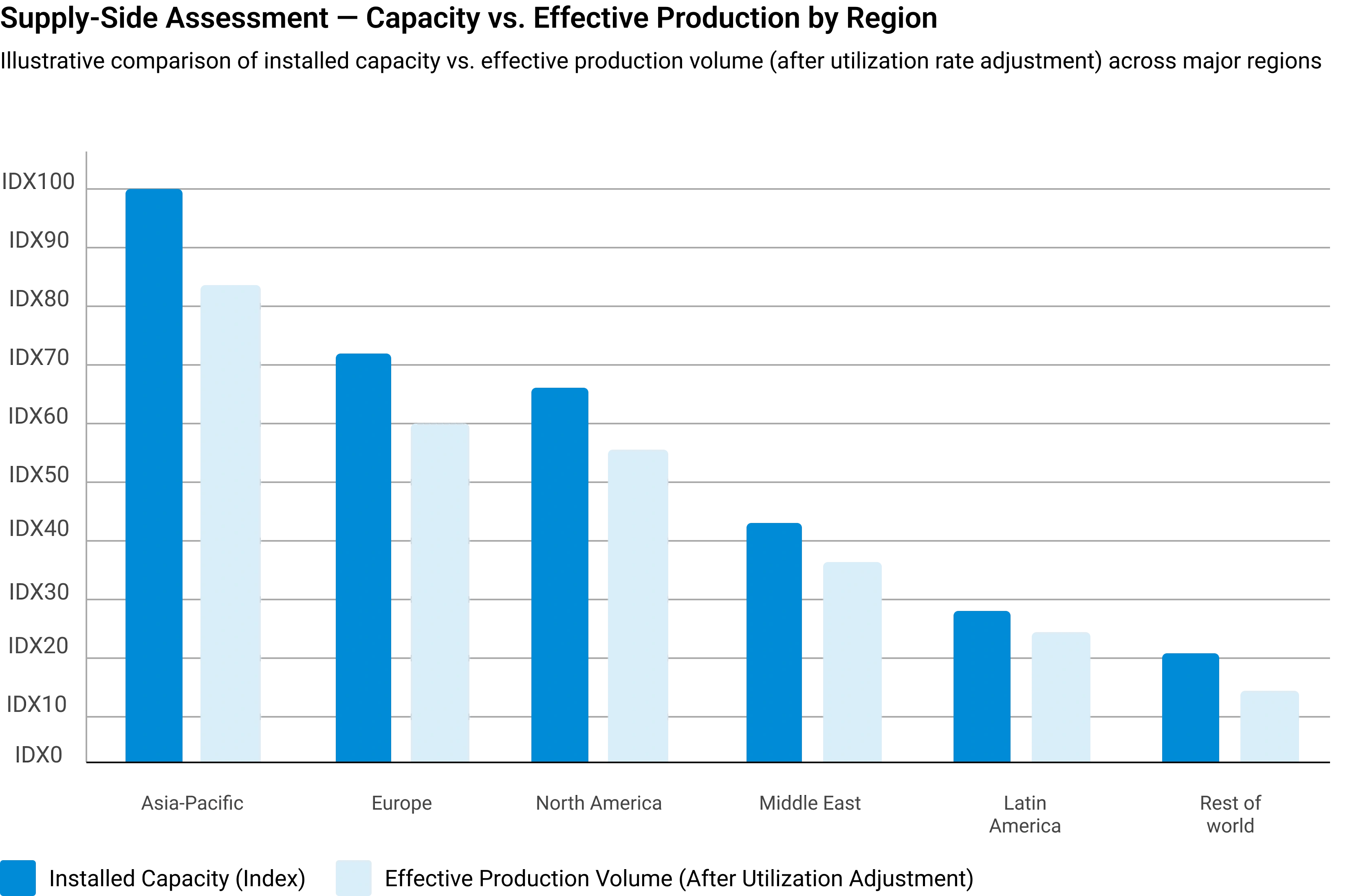
All major manufacturers are assessed for existing installed capacity, planned additions, expansions, new plant announcements, and technology adoption — mapped at global, regional, and country levels.
Capacity Utilization Adjustment
Installed capacity is adjusted using utilization rates based on demand conditions, feedstock availability, plant operating rates, maintenance schedules, and regulatory restrictions.
Manufacturer Revenue Analysis
Product-specific revenues, segment-level performance, regional distribution, average selling prices, and margin trends are evaluated to establish market value estimates.
Supply-Side Assessment — Capacity vs. Effective Production by Region
Illustrative comparison of installed capacity vs. effective production volume (after utilization rate adjustment) across major regions
Phase 3 — Demand-Side Assessment: Quantifying Chemical Consumption
Demand-side analysis quantifies chemical consumption across industries, applications, and geographies — identifying where and how chemicals are consumed throughout the value chain with precision.
End-Use Industry Analysis
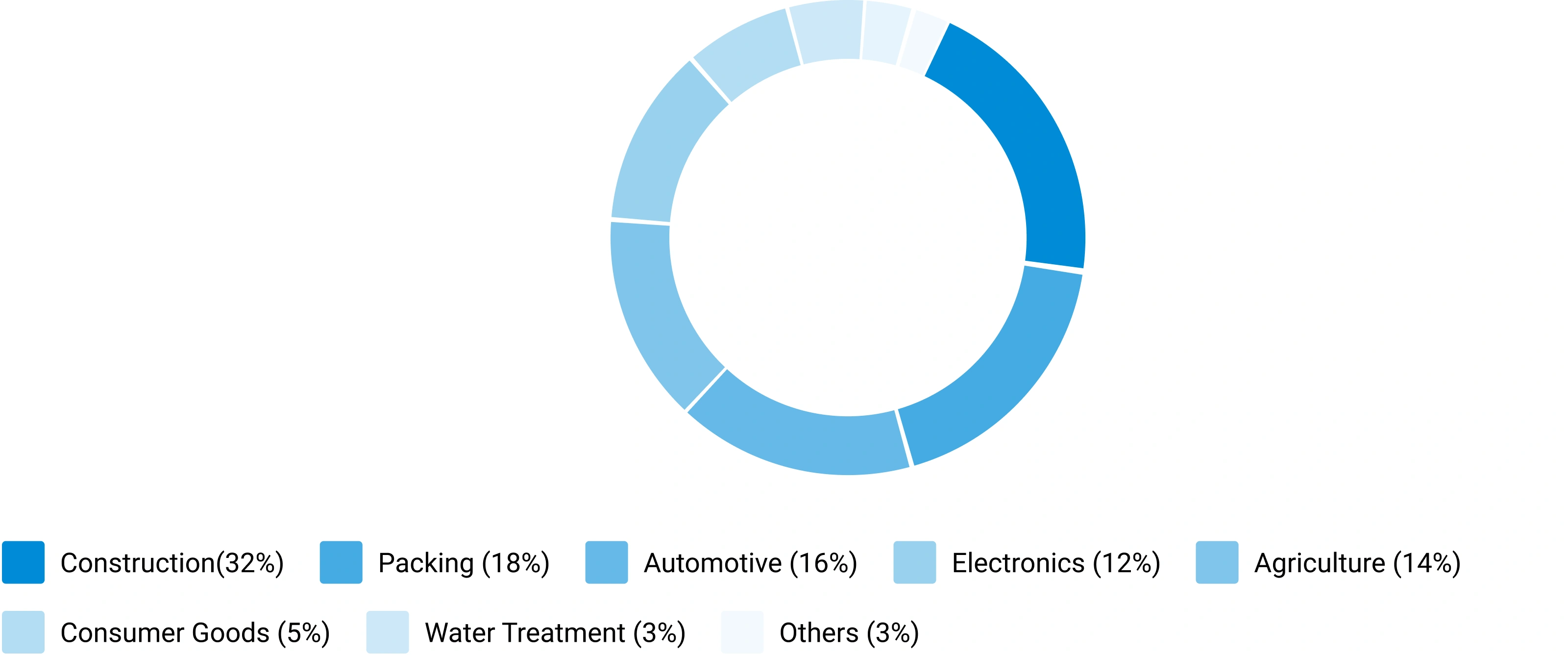
Chemical demand is evaluated across automotive, construction, packaging, electronics, agriculture, healthcare, consumer goods, industrial manufacturing, energy and utilities, and water treatment. Industry output, production trends, and consumption intensity are analyzed to determine demand patterns.
Consumption Modeling
Demand is estimated using measurable indicators: kilograms per vehicle, kilograms per square meter of construction, dosage per cubic meter of water treated, kilograms per hectare of agricultural land, and kilograms per ton of manufactured products. Consumption factors are validated through industry publications and primary interviews.
Application Analysis
The market is segmented by application area to understand product performance requirements, formulation trends, technology adoption, customer preferences, and regulatory requirements improving demand accuracy and segmentation granularity.
Demand-Side Assessment — End-Use Industry Demand Distribution
Illustrative distribution of chemical & materials demand across key end-use industries
Phase 4 - Trade Flow Analysis: Balancing Regional Supply and Demand
Trade flow analysis reconciles regional supply and demand estimates through import and export data, identifying net supply positions, regional dependencies, and market imbalances. It serves as an independent validation layer that tests the consistency of supply-side and demand-side estimates.
Import Analysis
Import data is evaluated to determine volumes, source countries, product dependency, regional supply gaps, and pricing trends — identifying markets that rely heavily on external supply and where domestic production is insufficient to meet demand.
Export Analysis
Export assessments reveal production surplus, export competitiveness, regional manufacturing strength, and global market participation. Export patterns also help validate domestic production estimates and identify net exporting regions.
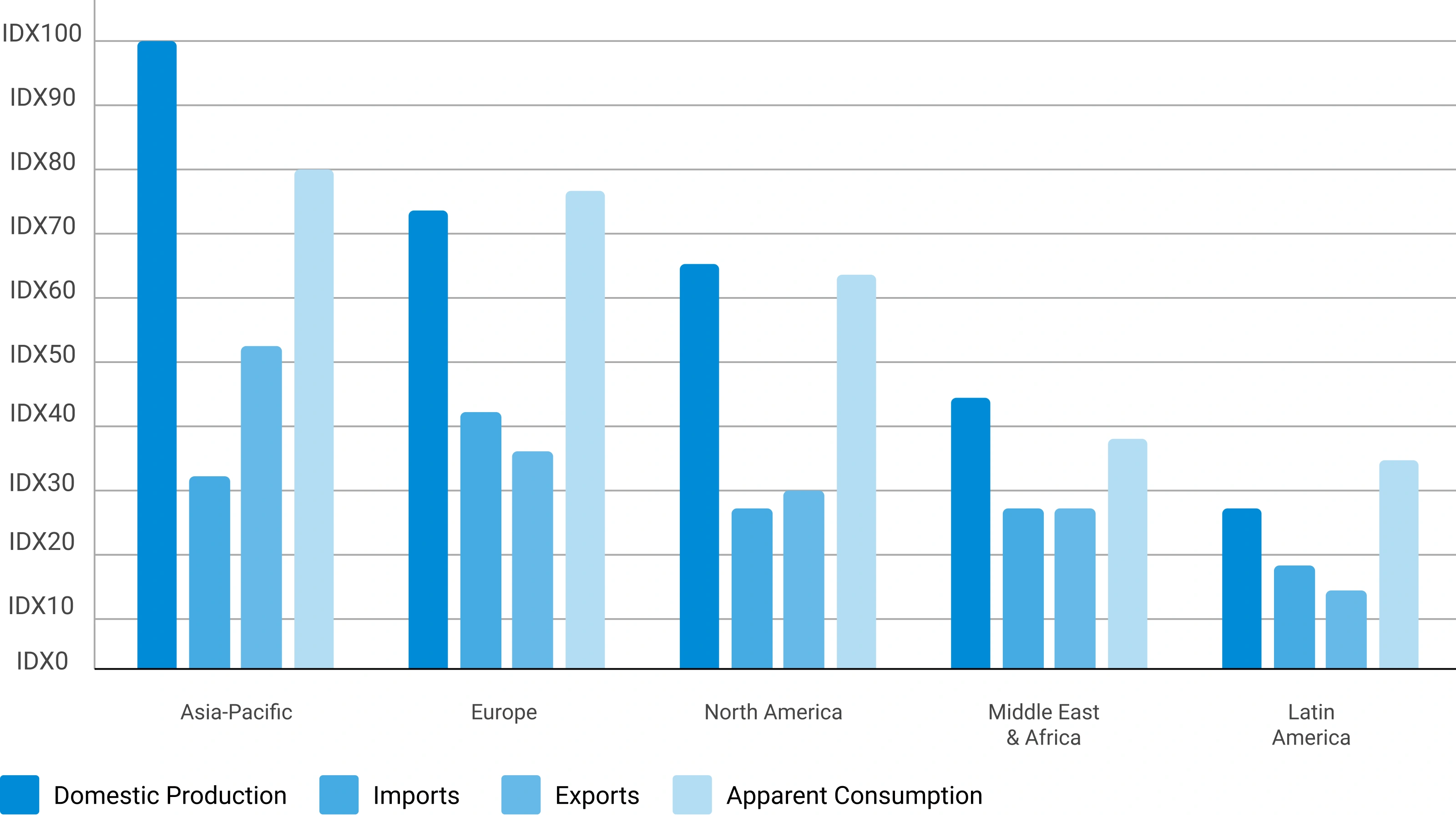
Apparent Consumption Model
Regional consumption is assessed using the standard apparent consumption formula:
Results identify net importing regions, net exporting regions, regional deficits, and surpluses — serving as an independent validation of supply and demand estimates.
Trade Flow Analysis — Net Supply Position by Region
Illustrative apparent consumption vs. domestic production across major regions — positive gap indicates net import dependency
Phase 5 — Primary Research: The Critical Validation Layer
Primary research tests and refines findings from secondary research through direct engagement with industry participants across the supply chain, demand side, and expert community. It captures intelligence that no database or published report can provide — the real-world experience of manufacturers, buyers, and specialists operating in the market.

Supply-Side Interviews
Conversations with chemical manufacturers, raw material suppliers, contract manufacturers, technology providers, and plant operators cover production trends, capacity utilization, pricing developments, technology shifts, and competitive dynamics.

Demand-Side Interviews
Engagement with OEMs, industrial consumers, procurement managers, distributors, formulators, and end-use manufacturers focuses on consumption trends, purchasing behavior, product substitution, demand outlook, and emerging applications.

Industry Expert Consultations
Additional interviews with industry consultants, independent experts, regulatory specialists, technical professionals, and research institutions provide deeper market context and validate key analytical assumptions.
Focus Areas of Primary Research:
Market Size & Forecast Validation
Revenue estimates, volume consumption, growth rates, forecast assumptions, regional demand.Supply Chain & Value Chain Assessment
Raw material sourcing, supply chain challenges, distribution networks, procurement practices.Production & Capacity Analysis
Manufacturing capacity, utilization rates, expansion projects, plant investments.Pricing & Cost Structure Analysis
Product pricing trends, feedstock costs, energy costs, margin pressures, pricing outlook.Competitive Landscape Assessment
Volume and value estimates confirmed to be fully consistent with one another before publicationInterview Volume by Market Scope
| Study Scope | Number of Interviews |
|---|---|
| Niche Market | 20 – 30 |
| Mid-Sized Market | 30 – 50 |
| Global Market | 50 – 80 |
| Highly Fragmented Market | 80 – 120 |
Interview Details:
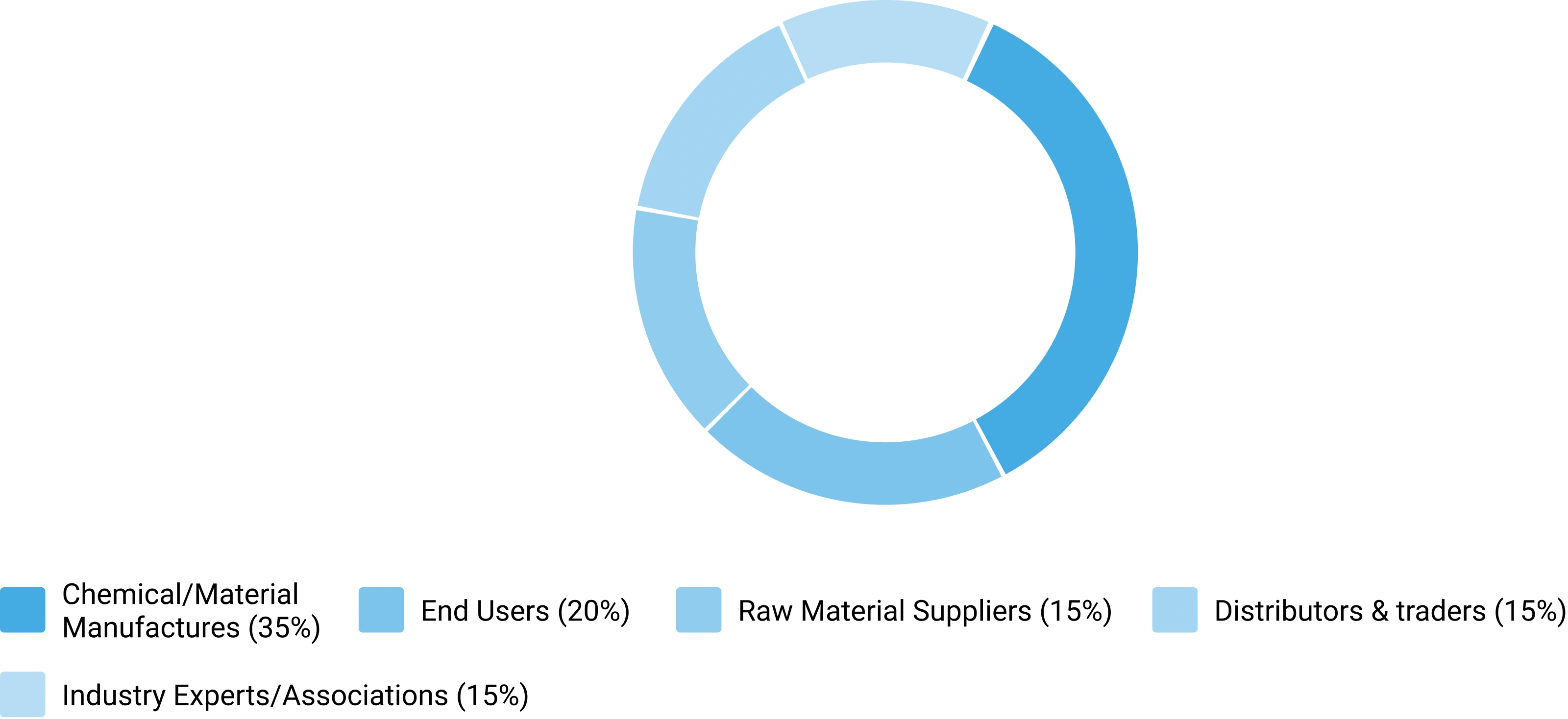
Category : Manufacturers, Suppliers, Distributors, End Users, Experts/Associations
Average Duration : 30–60 Minutes
Interview Mode : Video calls, telephonic interviews, expert consultations
Interview Format : Structured / Semi-Structured questionnaire
Focus Areas of Primary Research:
Market Size & Forecast Validation :
Revenue estimates, volume consumption, growth rates, forecast assumptions, regional demand.
Supply Chain & Value Chain Assessment :
Raw material sourcing, supply chain challenges, distribution networks, procurement practices.
Production & Capacity Analysis :
Manufacturing capacity, utilization rates, expansion projects, plant investments.
Pricing & Cost Structure Analysis :
Product pricing trends, feedstock costs, energy costs, margin pressures, pricing outlook.
Competitive Landscape Assessment :
Market share, competitor positioning, strategic initiatives, partnerships, acquisitions.
Primary Research — Stakeholder Coverage by Category
Distribution of interview respondents across stakeholder categories (% share from PPT data)
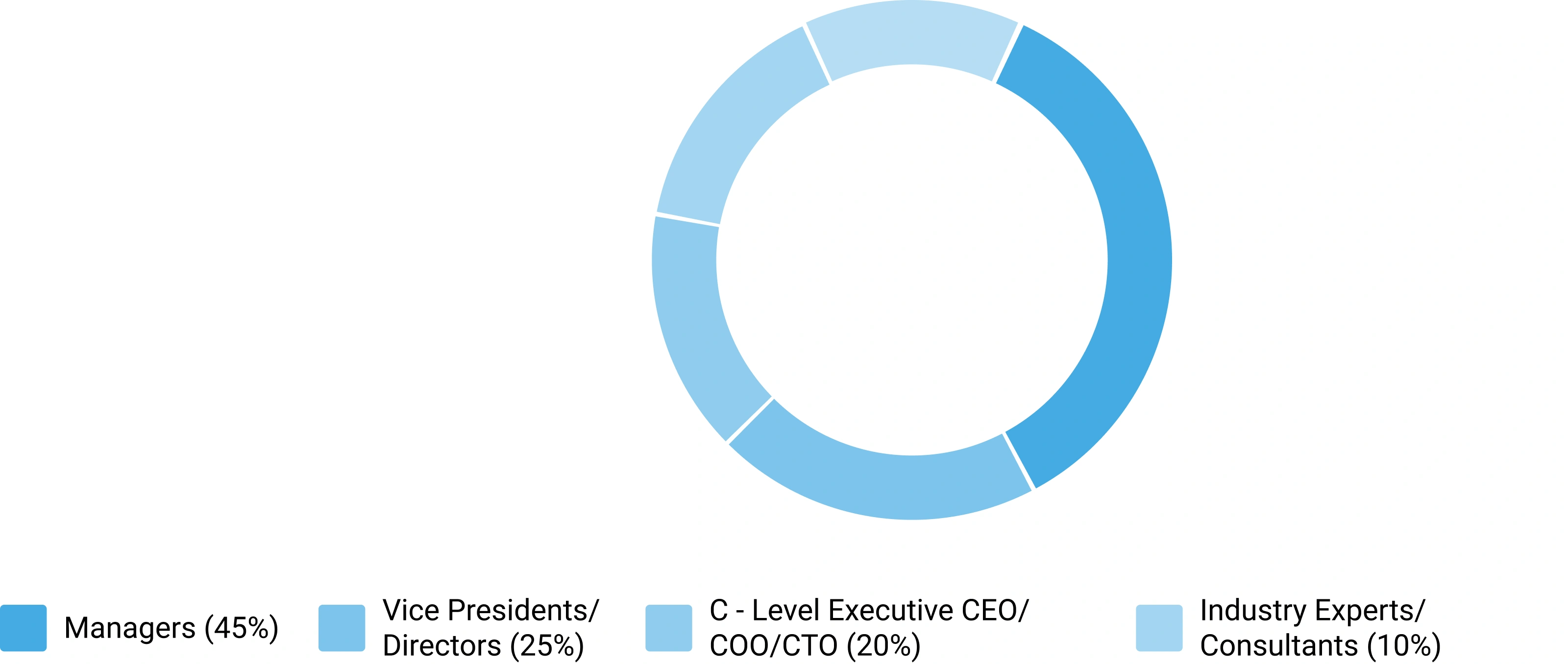
Primary Research — Respondent Designation Profile
Seniority breakdown of interview respondents (% share from PPT data)
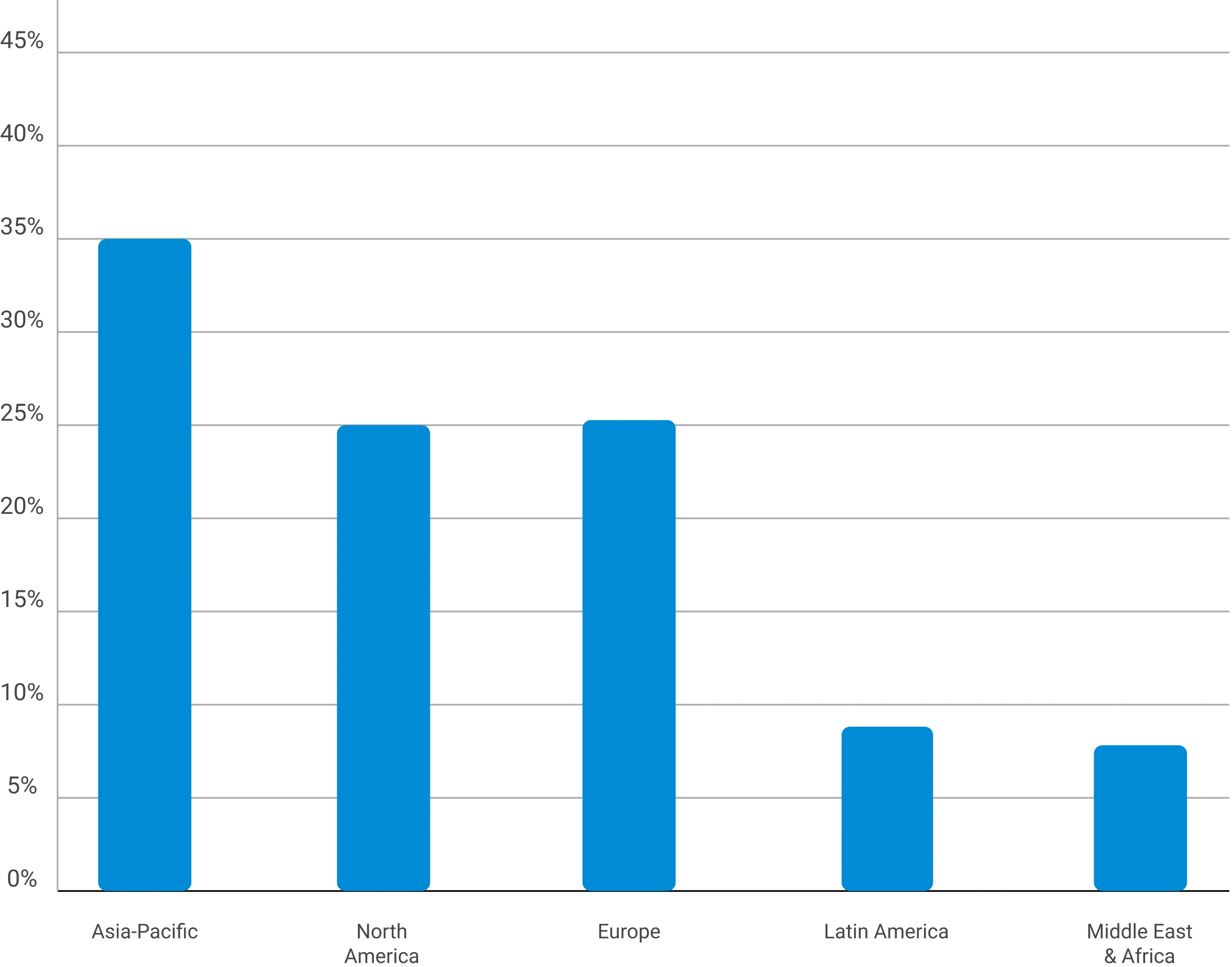
Primary Research — Geographic Coverage of Interviews
Regional distribution of primary research engagement (% share from PPT data)
Phase 6 — Data Triangulation and Market Validation
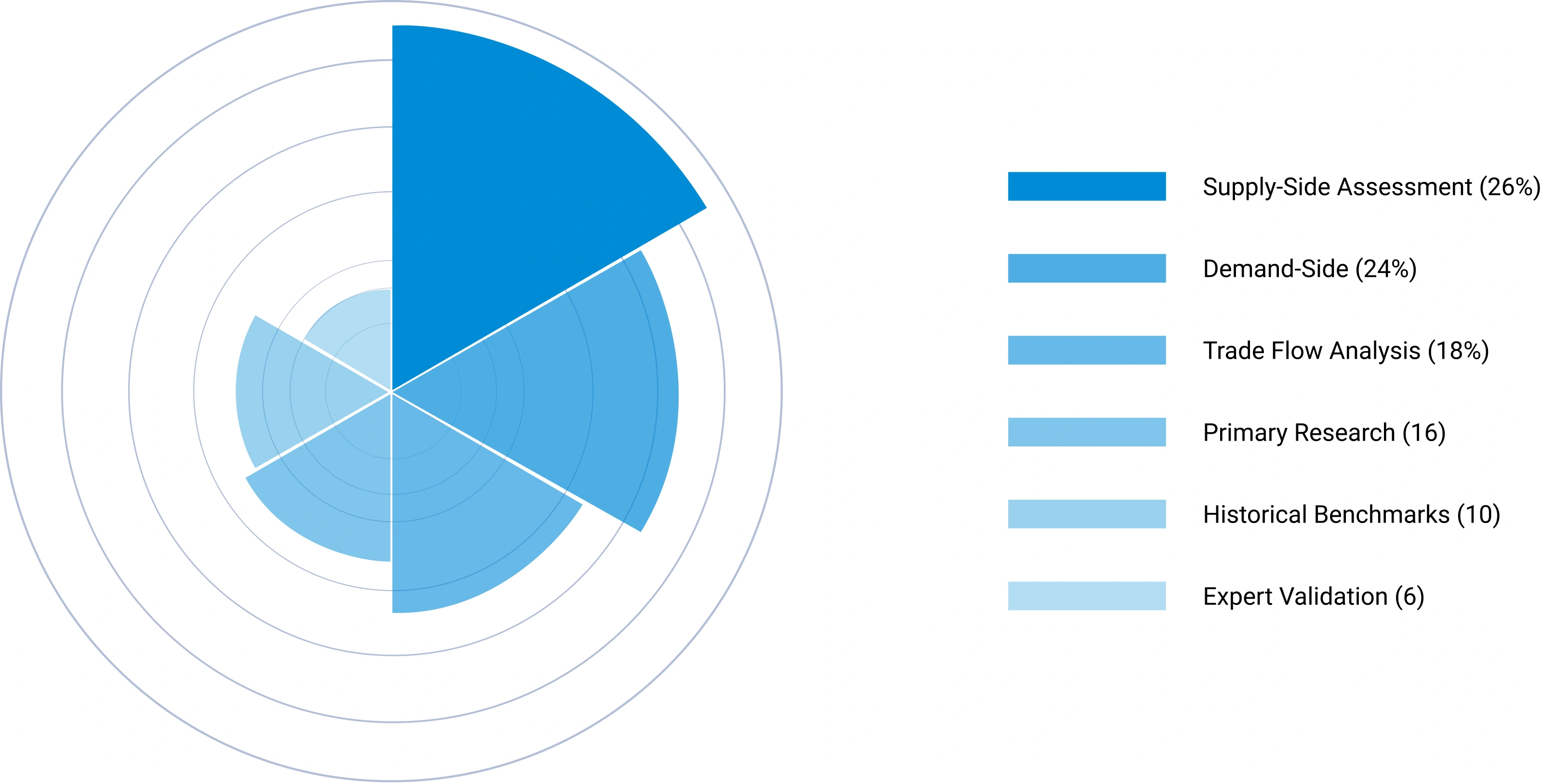
No single methodology is relied upon in isolation. Multiple independent estimation approaches are combined and reconciled to ensure consistency, accuracy, and analytical defensibility. Any material deviations between approaches are investigated and adjusted through additional validation cycles.
The final market size is derived through weighted triangulation of all validated methodologies. Any material deviations between approaches are investigated and adjusted through additional validation cycles. The outcome represents the most realistic assessment of the market based on available evidence and expert confirmation ensuring that volume and value estimates are fully consistent with one another.
Triangulation Framework — Input Contribution Weight
Relative weight each sizing input contributes to the final reconciled market estimate
Phase 7 — Forecast Modeling: Projecting Future Market Evolution
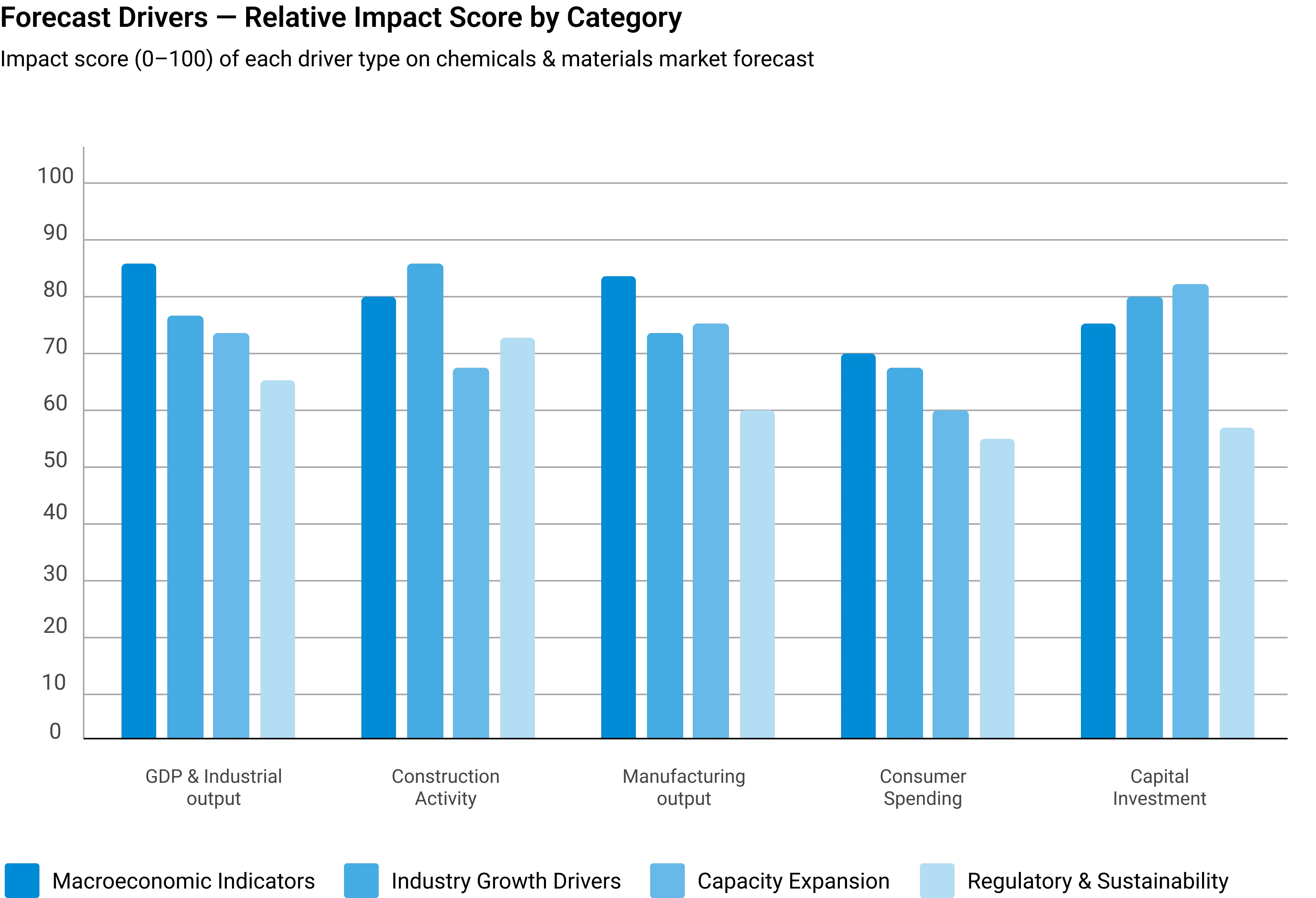
Forecasting evaluates the future trajectory of the market using a combination of quantitative indicators and qualitative assessments across economic, industry, and regulatory dimensions. Rather than simple extrapolation, each driver is independently modeled and integrated into a composite forecast.
Macroeconomic Indicators
GDP growth, industrial production, manufacturing output, construction activity, consumer spending, and capital investment form the quantitative foundation of long-term demand projections. These are applied at country, regional, and global levels.
Industry Growth Drivers
Urbanization, infrastructure development, industrialization, technological innovation, sustainability initiatives, and evolving product performance requirements are assessed at regional and industry levels — capturing both structural and cyclical demand drivers.
Capacity Expansion Analysis
Announced plant expansions, new manufacturing facilities, technology upgrades, and strategic investments are evaluated to determine future supply-demand dynamics and potential market tightness or oversupply situations.
Regulatory & Sustainability
Environmental regulations, chemical safety standards, emission reduction targets, circular economy initiatives, and sustainability requirements are incorporated as they often influence product adoption rates and market growth trajectories.
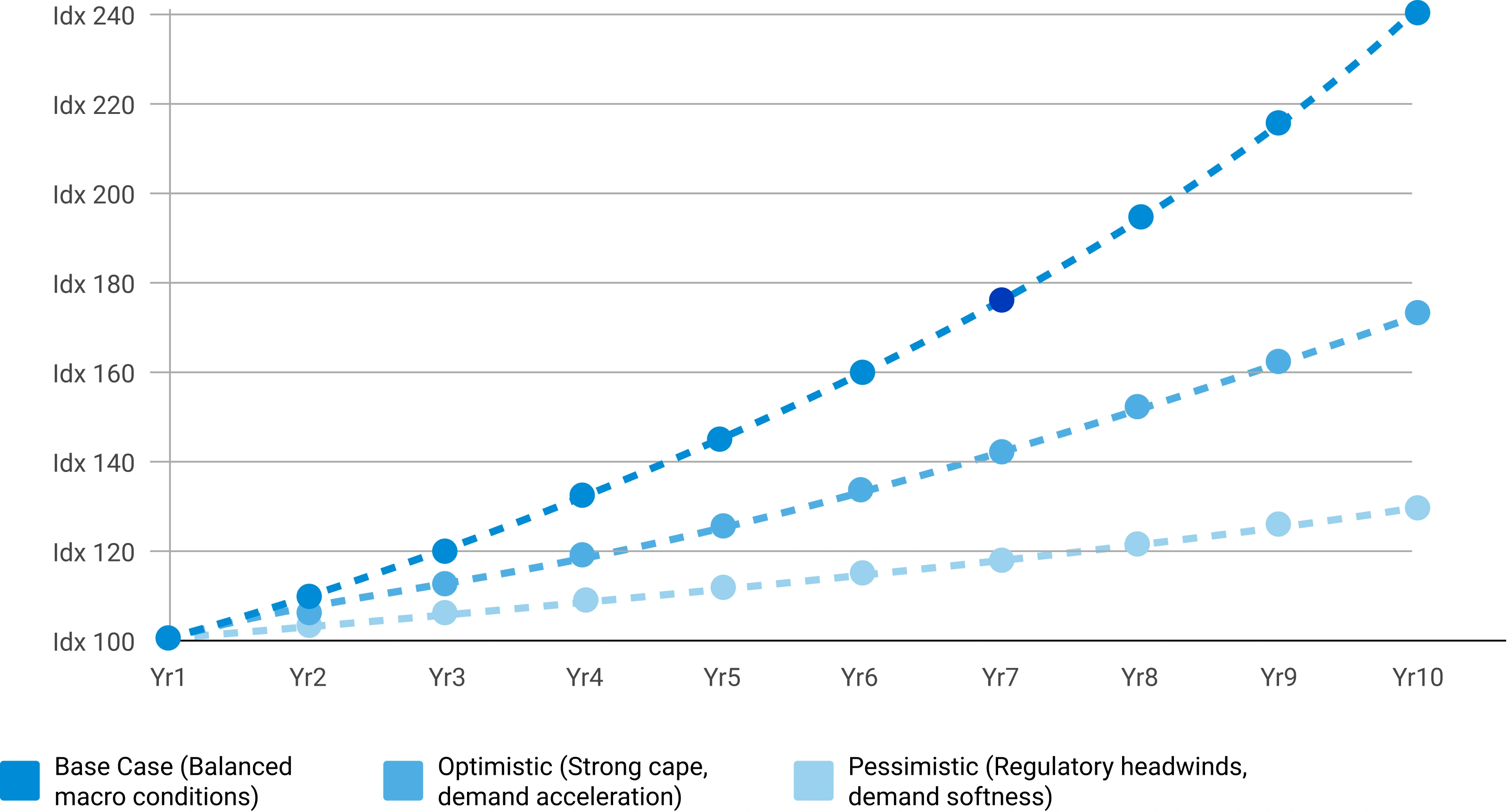
Scenario Forecast Range — Indexed Market Growth (Year 1–10)
Illustrative indexed growth trajectories across Base, Optimistic, and Pessimistic scenarios over a 10-year forecast horizon
Forecast Drivers — Relative Impact Score by Category
Impact score (0–100) of each driver type on chemicals & materials market forecast



Comments
Share your thoughts, ask a question, or provide feedback about this report.