
What is the Ammonium Nitrate Market Size and Share?
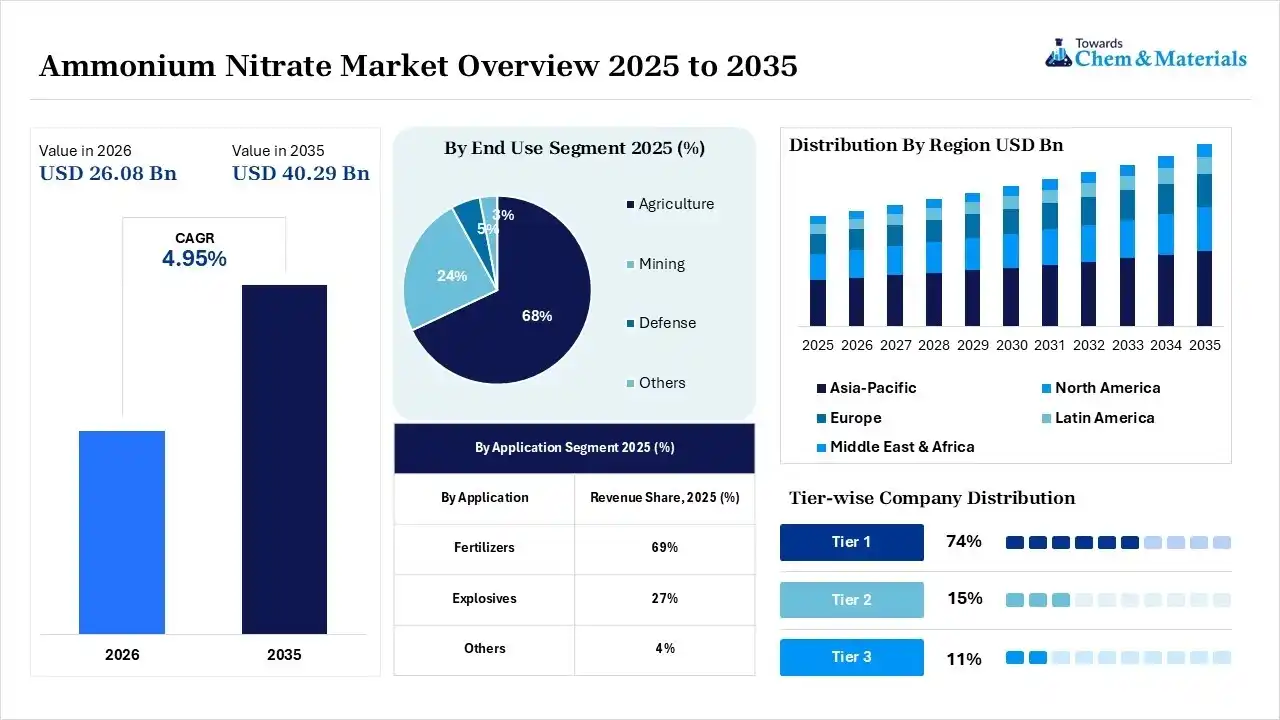
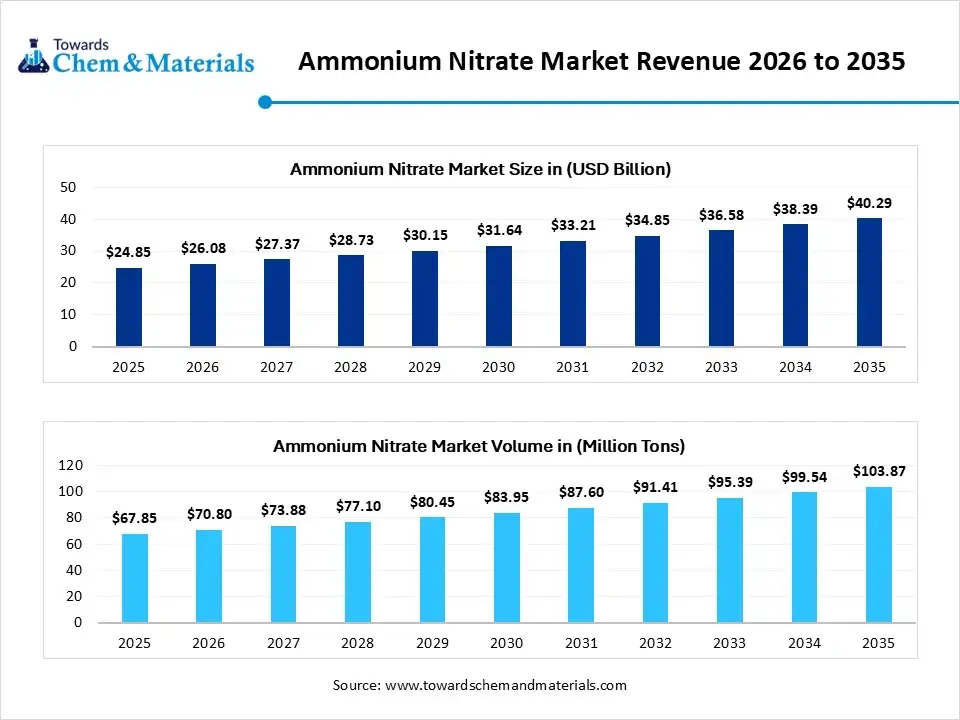
The ammonium nitrate market size was valued at USD 24.85 billion in 2025, is estimated to reach USD 26.08 billion in 2026, and is projected to reach USD 40.29 billion by 2035, exhibiting a compound annual growth rate (CAGR) of 4.95% over the forecast period from 2026 to 2035. Asia Pacific dominated the ammonium nitrate market with the largest revenue share of 42% in 2025 and is expected to grow at the fastest CAGR of 5.07% during the forecast period. In terms of volume, the ammonium nitrate market is projected to grow from 67.85 million tons in 2025 to 103.87 million tons by 2035, growing at a CAGR of 4.35% from 2026 to 2035. The main growth drivers for the market are the growing demand for high-efficiency nitrogen-based fertilizers for improving agricultural productivity and the use of ammonium nitrate for producing explosives in mining and infrastructure projects. Technological development and growth of precision farming, investments in low-carbon ammonia production technologies, and rising industrial and mining activities in emerging economies also drive growth.
Market Highlights
- By region,?Asia Pacific dominated the ammonium nitrate market by holding 42% share in 2025, driven by expanding agriculture and mining industries.
- By region, Europe held the 24% market share in 2025 and is?expected to grow at?the?fastest with a CAGR of 5.8% during the forecast period, driven by increasing explosives demand due to established mining activities.
- By application, the fertilizers segment dominated the market with the largest share of 69% in 2025 as rising food demand increases nitrogen fertilizer consumption.
- By application, the explosives segment?held 27% market share in 2025 and is expected to grow at?the fastest CAGR of 5.5% over the forecast period due to large-scale rock excavation projects.
- By end-use, the agriculture segment dominated the market with the largest share of 68% in 2025, as agricultural intensification increases nitrogen nutrient requirements.
- By end-use, the mining segment?held 24% market share in 2025 and is expected to grow at?the fastest CAGR of 5.8% over the forecast period, driven by metal and mineral extraction projects.
Quick Stats at a Glance
- Market in Size 2025: USD 24.85 Billion | CAGR (2026–2035): 4.95%
- Market Estimated Size in 2026: USD 26.08 Billion
- Market Projected Size by 2035: USD 40.29 Billion
- Asia Pacific: largest Regional Market Revenue Share of 42% in 2025 | USD 10.44 Billion
- North America: Fastest-growing Regional Market Revenue Share of 24% in 2025 | USD 5.96 Billion
- By country: The China held the largest Market share of 35% in 2025
- Market Volume in 2025: 67.85 Million Tons | Volume CAGR (2026–2035): 4.35%
- Market Estimated Volume in 2026: 70.80 Million Tons
- Market Projected Volume by 2035: 103.87 Million Tons
- Market Pricing (2025):
- Average Manufacturing Price: USD 275/Ton
- Average Selling Price: USD 355/Ton
- Pricing CAGR (2026–2035): 2.15%
The global ammonium nitrate market is expanding consistently, owing to the growing demand for high-efficiency, nitrogen-rich fertilizers and their use in mining and infrastructure projects. The high nitrogen content and the quick release of nutrients make ammonium nitrate a popular choice for use in agriculture, contributing to better crop productivity in the face of increasing food security concerns. Meanwhile, new mining developments in areas like Australia, Latin America, and Africa are driving up demand for ammonium nitrate explosives for rock blasting and mining.
The market, on the other hand, has been encumbered with natural gas price volatility, export bans, and geopolitical crises, all of which are being felt in the production side of the market, as natural gas is the main feedstock for ammonia production. These factors have increased the supply squeeze and raised prices in the European and Asian markets. The industry is highly concentrated, with the top five players accounting for more than 60 percent of the market. Yara International, CF Industries, EuroChem Group, Nutrien, Uralchem, and Orica dominate the market.
Strategic partnerships and acquisitions are popular among industry participants as a way to gain supply chains and move toward low-carbon production. For example, Fertiberia is participating in green ammonia projects that aim at reducing the emissions from ammonia production by using renewable hydrogen.
- In May 2025, Ridley Corporation made an offer of US$75 million to buy Dyno Nobel's Geelong North Shore property and US$300 million to acquire its fertilizer distribution unit to expand its footprint in the Australian fertilizer market. (Source: smallcaps.com)
The governments of many countries are also tightening regulations, as ammonium nitrate is an extremely dangerous material. Governments have tightened regulations on the transportation and storage of ammonium nitrate and imposed export restrictions on it, while the International Maritime Organization (IMO) and the U.S. Department of Homeland Security (DHS) have put in place stringent transportation and security measures for facilities that store ammonium nitrate.
Global Investment Movement for Ammonium Nitrate Market
- The key players are focusing on low-carbon and ESG-compliant feedstocks and green ammonia production. As an example, in January 2026, CF Industries and POET initiated a pilot program to create a low-carbon fertilizer supply chain to support sustainable ethanol production.
(Source: ir.cfindustries.com)
Supply disruptions, such as Russian export bans and fears of ammonia being transported through the Strait of Hormuz, have created price fluctuations, which have led investors to provide their investment for smaller facilities that are more localised, thus decreasing reliance on global vulnerable supply chains.
Investments in porous prilled ammonium nitrate for ANFO explosives are growing rapidly, especially in China, India, and Indonesia, where the growth of infrastructure and metal mining activities is driving increased consumption.
Ammonium Nitrate Market Trends
- Low-Carbon Transition: The ammonium nitrate industry is increasingly moving towards the use of blue and green ammonia feedstocks to lower greenhouse gas emissions and meet increasingly strict environmental regulations. To keep competitiveness in global fertilizer and industrial markets, producers are investing in renewable hydrogen and carbon-capture technologies to reduce embedded-carbon footprints.
- High-Energy Mining Explosives: Mining companies have a need for special formulations of high-energy explosives like Ammonium Nitrate Fuel Oil (ANFO) to reach deeper and more complex ores. This is also encouraging the growth of local explosives manufacturing plants in the developing copper, nickel, and other base metal mining areas.
- Nitrous Oxide Diversification: Technical grade ammonium nitrate is increasingly becoming relevant beyond its use in fertilizers and explosives due to growing demand for N2O in the pharmaceutical process and semiconductor industry. Manufacturers have new revenue opportunities as specialty chemicals and industrial gas applications grow.
- Strict Safety Regulations: Governments around the world have been concerned about the safety risks of storing and transporting ammonium nitrate and have introduced more stringent safety measures. More stringent licensing, product tracing, secure product storage, and emergency responses are having a profound impact on supply chain operations and investments in compliance.
Report Scope
| Report Attributes | Details |
| Market Size and Volume in 2026 | USD 26.08 Billion / 70.80 Million Tons |
| Revenue Forecast in 2035 | USD 40.29 Billion / 103.87 Million Tons |
| Growth Rate | CAGR 4.95% |
| Base Year of Estimation | 2025 |
| Forecast Period | 2025 - 2035 |
| High Impact Region | Asia Pacific |
| Segment Covered | By Application(), By End-Use(), By Region |
| Key Companies Profiled | Orica, Incitec Pivot Limited, Neochim PLC, URALCHEM, San Corporation, CF Industries Holdings, Inc., EuroChem Group AG, Austin Powder Company, Vijay Gas Industry P Ltd., OSTCHEM Holding |
Key Technological Shifts and AI in the Ammonium Nitrate Market
A technological shift is underway in the ammonium nitrate market, with the focus on sustainability, precision agriculture, and safety concerns. In order to reduce dependence on the energy-intensive Haber-Bosch process, electrochemical and plasma-based ammonia synthesis technologies are becoming more common in the industry. Large-scale simulations using artificial intelligence are making the production of decentralized and environmentally friendly ammonium nitrate more profitable by finding new catalysts.
At the same time, farmers are adopting IoT sensors, satellite-based data, drones, and variable rate application techniques, and AI is analyzing the field and weather data to optimize nitrogen use, boost output, and cut input costs and environmental effects. From forecasting models to supply-demand planning and logistics to digital twins and real-time monitoring systems, AI-driven tools are enhancing supply-demand planning and logistics while assisting manufacturers in identifying anomalies, forecasting potential hazards, and bolstering safety and regulatory compliance in ammonium nitrate production and storage facilities throughout the value chain.
Supply Chain Analysis of the Ammonium Nitrate Market
- Feedstock Procurement: It starts with the procurement of natural gas as the main feedstock for ammonia production and other feedstocks needed to produce nitric acid. Stable production and competitiveness can only be achieved through efficient procurement and transportation.
- Key Players: Yara International, CF Industries, Nutrien
- Chemical Synthesis and Processing: Controlled exothermic neutralization of ammonia and nitric acid to yield a concentrated ammonium nitrate melt. For this step, it is vital to have accurate process control and sophisticated safety systems in place to ensure product quality and efficient operation.
- Key Players: EuroChem, Deepak Fertilisers (DFPCL), Casale
- Compound Formulation and Blending: The ammonium nitrate melt is processed to be compounded and blended to create formulated fertilizer and/or industrial explosive products for specific end-use requirements.
- Key Players: Orica, Dyno Nobel, Enaex, and Uralchem
Regulatory Framework: Ammonium Nitrate Market
| Region? | Key Regulation? | Regulatory?Focus? |
| Asia Pacific? | Petroleum and Explosives Safety Organisation (PESO) | Strict licensing is required for possession, sale, and use. |
| North America? | Chemical Facility Anti-Terrorism Standards (CFATS) | Require high-risk facilities storing ammonium nitrate to implement stringent facility security plans, vulnerability assessments, and strict access controls. |
| European Union? | Seveso III Directive (2012/18/EU) | Dictates stringent safety protocols, emergency planning, and risk mitigation for the storage and handling of dangerous substances. |
Market Dynamics
Drivers
Fueling Industrial Expansion Through Mining and Infrastructure Development
An increasing demand for metals, minerals, and energy resources is contributing to the consumption of ammonium nitrate-based explosives. Ammonium nitrate, a primary oxidizing agent used in the commercial blasting market, is experiencing robust demand growth from growing mining activity and big infrastructure schemes, especially in the Asia-Pacific. The markets are continuing to grow as investments are made in the extraction of coal, the mining of metals, the construction of roads, tunnels, and urban development.
Restraint:
Navigating the Regulatory Maze and Safety Challenges
Ammonium nitrate's hazardous and potentially explosive nature subjects it to stringent government regulations worldwide. To ensure safe operation and to minimize accidents and misuse, authorities have established strict licensing, storage, transportation, and security regulations. These requirements have a positive impact on safety and traceability, whereas they also have a negative impact on compliance costs, administrative complexity, and approval time, which is challenging for manufacturers and distributors.
Opportunity:
Unlocking Smarter Farming Through Precision Nutrition Solutions
Right now, new possibilities are showing up for modern ammonium nitrate products, in particular coated types and controlled release products, because precision agriculture is getting adopted really fast. The whole idea is that agriculture is being run with data, like sensors, plus variable-rate application systems, which help make sure nutrients land at the right place, and in the right rhythm, so fertilizer use stays efficient. As this keeps moving forward, crop yields have climbed, nutrient losses have gone down, environmental burden has been limited, and overall, sustainable farming practices feel more encouraged than before.
Segmental Insights
Application Insights
The fertilizers segment dominated the market with the largest share of 69% in 2025, due to the high demand for ammonium nitrate as an efficient nitrogen fertilizer that makes it easily available for crop growth. Largely recommended for cereals, fruits, vegetables, and commercial crops due to its high nitrogen content and quick absorptive properties. The segment's market leadership was further strengthened by the rising need for food, greater agricultural intensification, and greater adoption of high-yield farming across emerging economies.
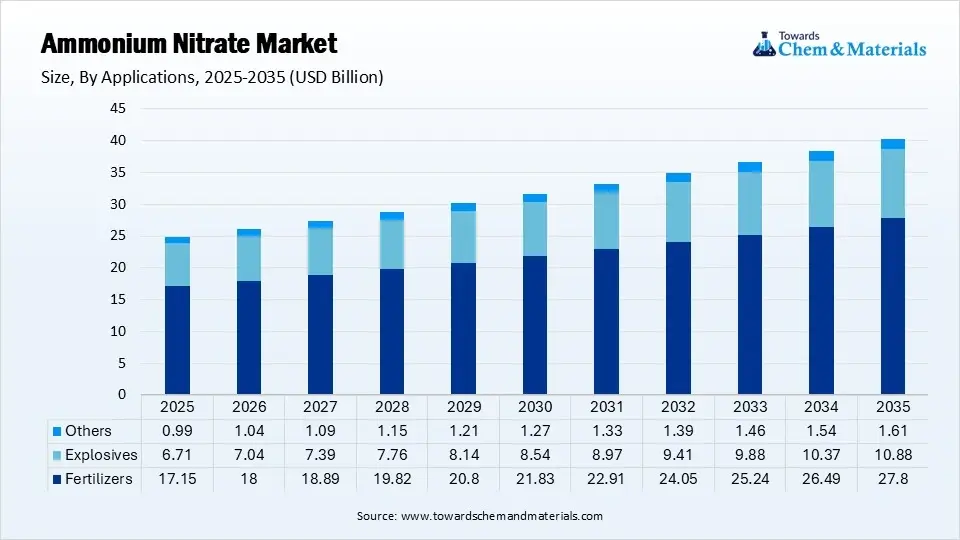 The explosives segment held the 27% market share in 2025 and is expected to grow at the fastest CAGR of 5.5% over the forecast period, driven by the growth of metal and coal mining activities, the rise in infrastructure investment, and the global expansion of quarrying activities. Ammonium nitrate-based explosives (ANFO) are especially favored because they are inexpensive, reliable, and have a strong blasting power, making them vital for rock and resource removal and large-scale excavation operations.
Ammonium Nitrate Market Share, By Application, 2025 (%)
| By Application | Revenue Share, 2025 (%) |
| Fertilizers | 69% |
| Explosives | 27% |
| Others | 4% |
End-Use Insights
The agriculture segment dominated the market with the largest share of 68% in 2025, because of the rising demand for high-performance nitrogen fertilizers to boost crop productivity and nutrient efficiency. The ready availability and effectiveness of ammonium nitrate under a wide range of soil conditions make it a widely used fertilizer in cereal crops, horticulture, and commercial farming. The dominance of the segment is attributed to the increased demand for food, a shrinking available area for agricultural land, and a growing trend towards the use of precision farming methods across the globe.
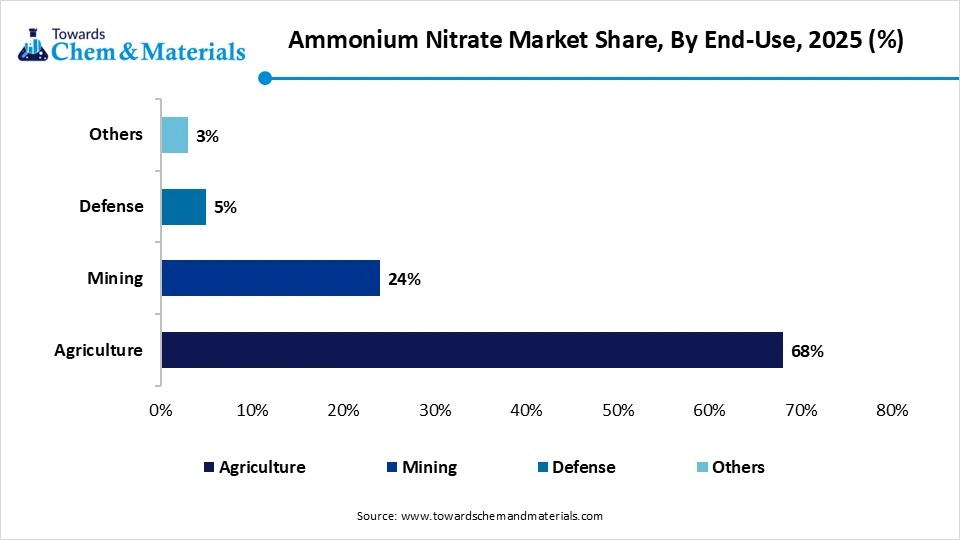 The mining segment held the 24% market share in 2025 and is expected to grow at the fastest CAGR of 5.8% over the forecast period. Exploration and extraction of coal, copper, iron ore, and critical minerals, which are essential for industrial development and energy transition technologies, are increasing, driving demand. Ammonium nitrate-based explosives are greatly superior in blast performance and efficiency; these are essential for large-scale surface and underground mining operations around the world.
Ammonium Nitrate Market Share, By End-Use, 2025 (%)
| By End-Use | Revenue Share, 2025 (%) |
| Agriculture | 68% |
| Mining | 24% |
| Defense | 5% |
| Others | 3% |
Regional Insights
How did the Asia Pacific dominate the Ammonium Nitrate Market in 2025?
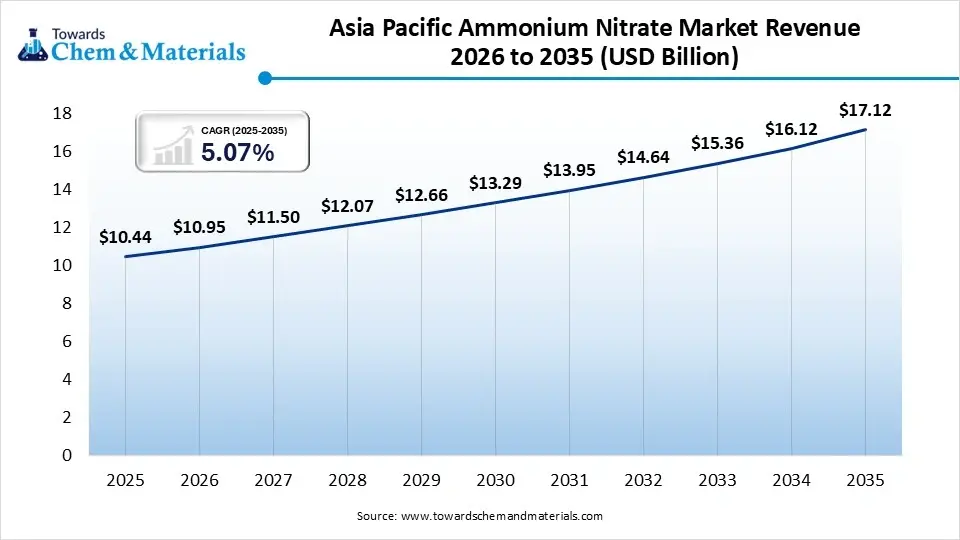
The Asia Pacific ammonium nitrate market size was estimated at USD 10.44 billion in 2025 and is projected to reach USD 17.12 billion by 2035, growing at a CAGR of 5.07% from 2026 to 2035. Asia Pacific?dominated the market by holding?42% share in 2025. The region is known for its high agricultural output, a rapidly expanding population, and growing food security needs, all of which are responsible for the high consumption of fertilizers in the region. Moreover, high volumes of coal, metal, and large-scale infrastructure and urban development projects in countries like China and India are creating significant demand for ammonium nitrate-based explosives. The market position of the region is further reinforced by increased investments in industrialisation and construction.
 China
China
- The ammonium nitrate market in China dominated the Asia Pacific ammonium nitrate market with a 35% share in 2025. Widespread cereal and vegetable production and food security programs lead to high demand for nitrogenous fertilizers such as ammonium nitrate.
- The demand for ammonium nitrate-based industrial explosives and blasting applications is high in large-scale coal mining, quarrying, and infrastructure development projects. Long-term consumption of ammonium nitrate is maintained in a variety of sectors through continuous investment in transportation networks, urbanization, and industrial expansion.
India
- The growing population and food demand are increasing the demand for fertilizers for better agricultural productivity and crop yields.
- The demand for ammonium nitrate explosives in various industrial applications is rising due to the growth of coal mining industries, coal production, and the development of large-scale infrastructure projects. The manufacturing of ammonium nitrate has a sustained market opportunity due to the government's development of irrigation, rural infrastructure, and agricultural modernization.
The Europe ammonium nitrate market size was estimated at USD 5.96 billion in 2025 and is projected to reach USD 9.87 billion by 2035, growing at a CAGR of 5.17% from 2026 to 2035. Europe held the 24% market share in 2025 and is?expected to grow at?the?fastest CAGR of 5.8% during the forecast period, due to investments in low-carbon ammonia production, compliance with environmental regulations, and the transition towards sustainable farming practices, all of which are all contributing to the growth of the region. European manufacturers are actively seeking green ammonia projects and production technologies that can advance the decarbonization efforts and carbon-border policies. Other factors driving market growth in the region include strong demand from precision agriculture and specialty industrial applications.
Germany
- The ammonium nitrate market in Germany accounted for 35% of the European ammonium nitrate market in 2025. Germany has high chemical production capabilities and advanced production technology, making it a leading producer of ammonium nitrate and related products.
- Investment in green ammonia, carbon capture technology, and low-emission fertilizer production is driving sustainable market growth. Innovative and energy-saving ammonium nitrate production processes are being developed due to strict environmental laws and the aims of decarbonization.
France
- The agriculture industry is highly productive and has a constant demand for nitrogen fertilizer to boost the quality of the crop and the productivity of the farm.
- The use of precision agriculture technologies is driving the use of more efficient fertilizers and contributing to demand for better ammonium nitrate formulations. Long-term market opportunities are improving due to government initiatives promoting sustainable farming and low-carbon industrial growth.
The North America ammonium nitrate market size was estimated at USD 4.47 billion in 2025 and is projected to reach USD 7.45 billion by 2035, growing at a CAGR of 5.24% from 2026 to 2035. North America held 18% market share in 2025, bolstered by a robust agricultural industry as well as mining and quarrying operations. The area has ample amounts of natural gas, sophisticated chemical production facilities, and large fertilizer manufacturing firms. The market is growing as demand for high-efficiency fertilizers further grows, alongside the investment in low-carbon ammonia technologies and resilient supply chains. Further, the growing demand for ammonium nitrate for use in explosives in the mining and infrastructure development industry helps to drive the demand in the region.
United States
- The U.S. dominated the North American ammonium nitrate market with a 74% share in 2025. Corn, wheat, and other commercial crops are grown over a wide area and continue to drive high demand for ammonium nitrate-based fertilizers across the country.
- Consumption of ammonium nitrate explosives, in industrial uses, is continuing to rise, particularly in the field of mining, quarrying, and infrastructure development. New investment trends in low-carbon fertilizers, digital agriculture technologies, and resilient supply chains are helping to drive future market growth opportunities.
Canada
- The use of blasting agents and explosives containing ammonium nitrate for large-scale extraction of potash, gold, and critical minerals generates significant demand.
- The natural gas supplies are ample and make ammonia more competitive, and raw material availability is not an issue for the fertilizer manufacturers. The consumption of industrial-grade ammonium nitrate is predicted to rise with the growth of investments in projects of mining modernization and infrastructure development.
The Latin America ammonium nitrate market size was estimated at USD 2.24 billion in 2025 and is projected to reach USD 3.83 billion by 2035, growing at a CAGR of 5.51% from 2026 to 2035. Latin America held 9% market share in 2025, due to the presence of a robust agriculture industry and growing mining activities in the region. This is one of the world's top agricultural commodity producers, with soybean, corn, and sugarcane crops resulting in high demand for nitrogenous fertilizers. At the same time, the investment in copper and other mineral extraction projects is rising, which is driving up the consumption of ammonium nitrate-based explosives. The expansion of agricultural intensification and infrastructure development projects continues to promote market expansion in the longer term.
 Brazil
- The ammonium nitrate market in Brazil dominated the Latin America ammonium nitrate market with a 42% share in 2025. Soybean, corn, sugarcane, and coffee are planted on a large scale, consuming a considerable amount of high efficiency Nitrogen fertilizers across the country.
- Rising rates of fertilizer application and better nutrient management practices are promoted by agricultural intensification and the export of commercial crops. There is growing demand for ammonium nitrate for industrial and blasting applications due to the expansion of mining operations and infrastructure investments.
Chile
- Industries using ammonium nitrate-based explosives play a crucial role in the copper mining industry in the country, which is of strategic importance.
- Long-term demand for industrial explosives is rising due to continued investment in copper mine expansions and new exploration projects.
- Stable mining policies and increasing foreign investments are supporting the growth of ammonium nitrate consumption across mining activities.
The Middle East and Africa ammonium nitrate market size was estimated at USD 1.74 billion in 2025 and is projected to reach USD 3.02 billion by 2035, growing at a CAGR of 5.67% from 2026 to 2035. The Middle East & Africa held 7% market share in 2025, driven by the expansion of mining, the development of infrastructure, and increased investments in agricultural productivity. The region enjoys rich natural gas supplies, especially in the Middle East, which offers a competitive edge in ammonia production. The increasing government efforts targeting economic diversification, enhancement of food security, and industrial development are offering new growth prospects for ammonium nitrate manufacturers. Industrial demand is also growing due to the African expansion of coal and mineral extraction activities.
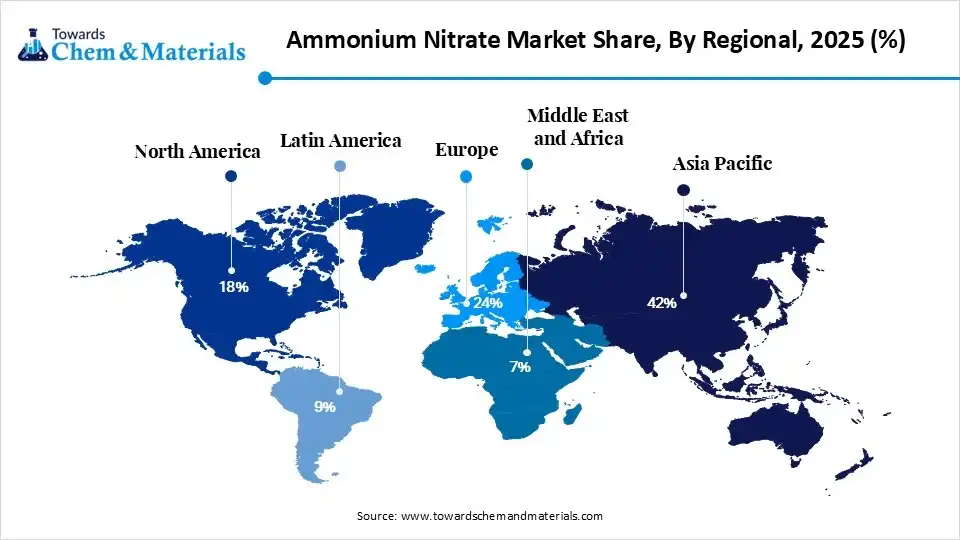
Ammonium Nitrate Market Share, By Regional, 2025 (%)
| Regional | Revenue Share, 2025 (%) |
| Asia-Pacific | 42% |
| Europe | 24% |
| North America | 18% |
| Latin America | 9% |
| Middle East & Africa | 7% |
Saudi Arabia
- The ammonium nitrate market in Saudi Arabia led the Middle East & Africa ammonium nitrate market with revenue share 42% in 2025 Natural gas is a plentiful resource, making ammonia production economic and enabling the production of large quantities of fertilizer.
- Demand for ammonium nitrate is rising with the growth in infrastructure development projects and economic diversification programs. Increasing domestic agricultural productivity and food security efforts by the government are contributing to the increasing use of nitrogen fertilizers.
South Africa
- The heavy demands for ammonium nitrate-based explosives and blasting solutions occur in the extensive coal, gold, and platinum mining activities.
- Ammonium nitrate products are used by industry and are continuing to be used in ongoing investments in transportation, energy, and construction infrastructure projects. The agriculture sector is a steady consumer with steady demand, which is being contributed through the technologies of modernisation and the increasing use of fertilisers in the country.
Competitive Analysis
Integrated production facilities, extensive distribution channels, and diversified product lines are the strengths of leading companies such as Yara International, CF Industries, Nutrien, EuroChem Group, Uralchem, and Orica. Local production and sustainable manufacturing technologies are now becoming the focus of emerging regional players as a path towards competitiveness. Partnerships, acquisitions, and capacity expansion remain top strategic moves that continue to influence the market.
- San Corporation is enhancing its presence in the market of ammonium nitrate by utilizing its manufacturing base and the high technology of production in the world to create high-quality ammonium nitrate porous prilled and chemical pure ammonium nitrate products. The company is also working on product innovation and expanding its portfolio of ammonium nitrate solutions to further strengthen its supply capacity and meet the increasing demand from fertilizer, chemical, mining, and specialty industrial applications.(Source: www.sinooan.com)
The innovation in green ammonia production, the optimization of processes based on artificial intelligence, and the digital monitoring of safety are now emerging as differentiating factors. But strict regulations, capital needs, and safety compliance are obstacles to market entry and benefit the incumbent players, which supports market consolidation.
Recent Developments
- In June 2026, President of Uzbekistan Shavkat Mirziyoyev presented a plan for $17 billion to transform the chemical industry of Uzbekistan by more than 350 projects focused on shifting from exporting raw materials to consumer-ready products. The project will boost local chemical production capacities and generate tremendous opportunities for value-added NH4NO3 and fertilizer production.(Source: indianchemicalnews.com)
- In April 2026, recognizing the need to decrease carbon emissions from PepsiCo's potato supply chain, CF Industries and PepsiCo signed a commercial contract to lower the carbon footprint by using certified low-carbon urea ammonium nitrate (UAN) fertilizer. The project is the first-time commercial release of low-carbon UAN from CF Industries that uses carbon capture and other emission reduction technologies. (Source: potatopro.com)
- In April 2026, PT Dahana inaugurated its first export shipment of 18,000 tons of ammonium nitrate to Australia, with a view to expanding its international business. The export marks the company's improved production capacity and conforms to international quality requirements, thus boosting its standing in the region's ammonium nitrate supply market. (Source: en.antaranews.com)
Top Players in the Ammonium Nitrate Market & Their Offerings
| Company | Headquarters | Country | Key Initiatives in the Market | Key Chemical and Material Products & Services |
| Orica | Melbourne | Australia | Expanding localized AN production and digital blasting solutions. | Ammonium nitrate, explosives, blasting systems, ANFO, emulsion mining services. |
| Incitec Pivot Limited | Melbourne | Australia | Strengthening fertilizer distribution and explosives production capabilities. | Ammonium nitrate, fertilizers, UAN, industrial explosives, nitrogen chemicals. |
| Neochim PLC | Dimitrovgrad | Bulgaria | Modernizing production facilities and expanding fertilizer exports. | Ammonium nitrate, nitric acid, calcium ammonium nitrate, ammonia, nitrogen fertilizers. |
Other Key Players
- URALCHEM
- San Corporation
- CF Industries Holdings, Inc.
- EuroChem Group AG
- Austin Powder Company
- Vijay Gas Industry P Ltd.
- OSTCHEM Holding
Segment Covered in the Report
By Application
- Fertilizers
- Ammonium Nitrate Fertilizer Grade
- Straight Nitrogen Fertilizers
- Blended Fertilizers
- Calcium Ammonium Nitrate (CAN)
- Agricultural CAN
- Specialty CAN
- Ammonium Nitrate Fertilizer Grade
- Explosives
- Industrial Explosives
- ANFO (Ammonium Nitrate Fuel Oil)
- Heavy ANFO
- Emulsion Explosives
- Bulk Emulsions
- Packaged Emulsions
- Industrial Explosives
- Others
- Chemical Intermediates
- Water Treatment
- Laboratory & Industrial Uses
By End-Use
- Agriculture
- Field Crops
- Cereals & Grains
- Oilseeds
- Horticulture
- Fruits
- Vegetables
- Field Crops
- Mining
- Surface Mining
- Coal Mining
- Metal Mining
- Underground Mining
- Hard Rock Mining
- Mineral Extraction
- Surface Mining
- Defense
- Military Explosives
- Ammunition Manufacturing
- Others
- Construction
- Quarrying
- Infrastructure Projects
By Regional
- North America
- Asia Pacific
- Europe
- Latin America
- Middle East & Africa



Comments
Share your thoughts, ask a question, or provide feedback about this report.