
Battery Electrolyte Market Size, Share, Growth, Trends, and Forecast 2026-2035
According to Vidyesh Swar Research, which specializes in research of specialty chemicals and battery advancements and new technology launches aligning with industry needs, with experience in industry analysis and market research. His research helps in optimizing opportunities created for the growth of the battery electrolyte market in and across the globe. The global battery electrolyte market size was estimated at USD 12.85 billion in 2025 and is predicted to increase from USD 14.89 billion in 2026 to approximately USD 55.96 billion by 2035, and is expected to grow at a CAGR of 15.85% during 2025-2035 due to growing demand for batteries across sectors and structural demand for electrification. The growing use and support for the manufacturing of lithium-ion batteries and growing manufacturing hubs across regions support the growth. The presence of key players like ENCHEM Co., Ltd., UBE Corporation / UBE Industries, Central Glass Co., Ltd., BASF SE, LG Chem Ltd., who specialize in batteries to enhance safety, boosts the growth of the market.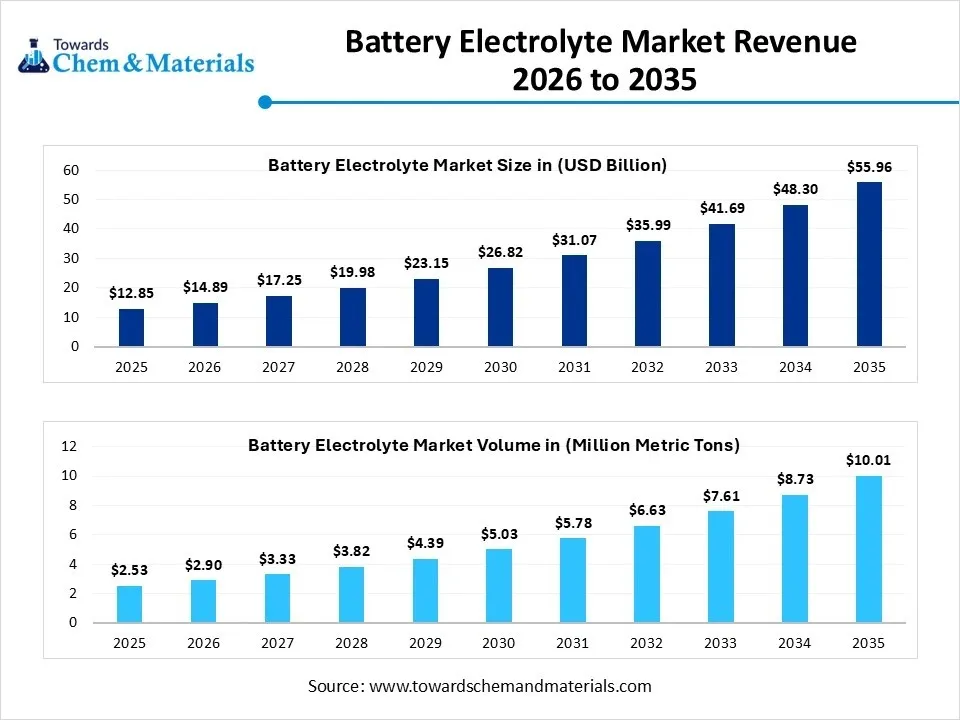
Key Takeaway
- By region, Asia Pacific dominated the battery electrolyte market with a share of 63% in 2025 and is expected to grow at a CAGR of 17.20% over the forecast period.
- By region, Europe held 15% market share in the battery electrolyte market in 2025 and is expected to experience the fastest growth with a CAGR of 18.10% in the forecast period.
- By electrolyte type, the liquid electrolyte segment dominated the market with a 71% share in 2025 and is expected to grow at a CAGR of 14.80% over the forecast period.
- By electrolyte type, the solid electrolyte segment held 18% market share in 2025 and is expected to have the fastest growth with a CAGR of 22.90% in the forecast period.
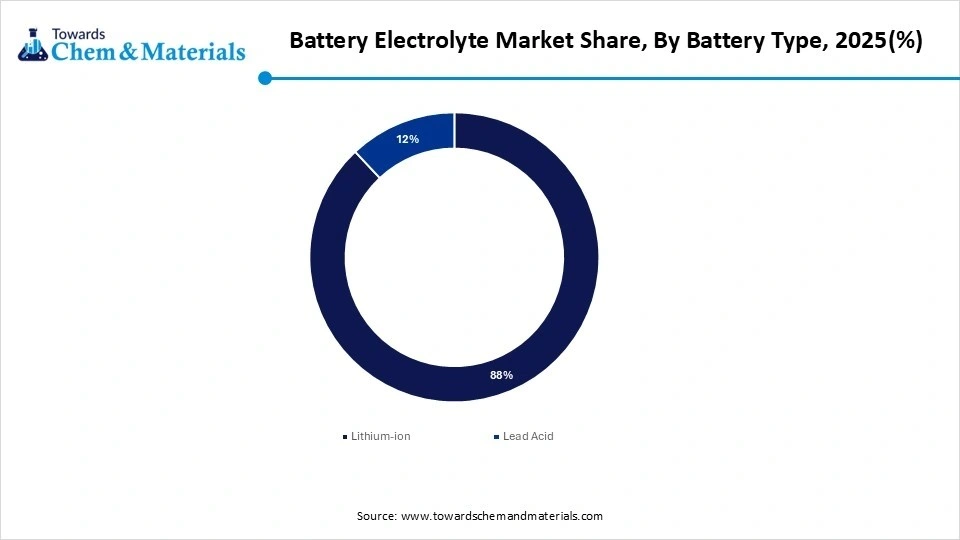
- By battery type, the lithium-ion segment dominated the market with an 88% share in 2025 and is expected to grow at a CAGR of 6.10% over the forecast period.
- By battery type, the lead acid segment held 12% market share in 2025 and is expected to have the fastest growth with a CAGR of 17.10% in the forecast period.
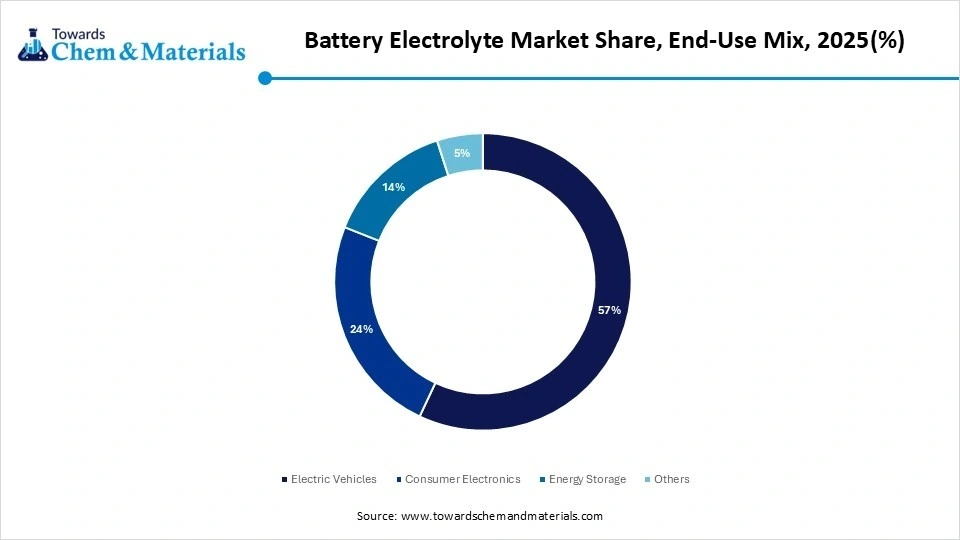
- By end use, the electric vehicle segment dominated the market with a 57% share in 2025 and is expected to grow at a CAGR of 11.40% over the forecast period.
- By end use, the consumer electronics segment held 24% market share in 2025 and is expected to have the fastest growth with a CAGR of 19.60% in the forecast period
Market Overview
Battery electrolytes are a medium through which ions travel and flow between battery electrodes, which helps the battery to store and provide electrical energy. They are generally a chemical medium through which the energy is transported or delivered. They are extensively used in electric vehicle production, renewable energy storage systems, and rising demand for higher energy density due to their battery chemistry. They are extensively used in stationary energy storage systems, consumer electronics, and even in industrial machinery and telecom for their ability to handle heavy equipment. The demand from modern passenger and commercial transport for high-energy-density and fast-charging capability batteries further drives demand for these batteries. The global battery electrolyte market size was estimated at USD 12.84 billion in 2025 and is expected to grow at a CAGR of 15.80% during 2025-2035.
- Key Insight: The battery electrolyte market is a multi-billion-dollar chemicals industry in 2025, due to increased global battery cell production.
Source: Towards Chemical and Materials
Electrolyte Market on Track to Nearly Quadruple by 2035
The battery electrolyte market is valued at USD 12.84 billion in 2025 and is expected to grow exceptionally at a CAGR of 15.80% for the period 2025-2035. The growth is driven by the growing demand for battery electrolytes, especially lithium batteries, for growing EV production, which is influenced by the growing electrification demand. Government policies, which align with the environmental sustainability demand for electrification across regions, will further contribute to the growth. Increased use of renewable energy sources like solar and wind requires massive stationary energy storage, which boosts the demand for advanced electrolyte batteries. Government policies and localization through regulations extensively influence the battery supply chain and domestic manufacturing plant growth, which will support the growth of the market in the coming years.
- Key Insight: The battery electrolyte market is poised to grow at a CAGR of 15.82% in the forecast period, significantly increasing due to growing demand for electrification across diverse sectors valued for global GDP growth.
Source: Towards Chemical and Materials
Electrolyte Volumes to Reach 2.48 million Metric Tons in 2025
According to the research, the electrolyte volume is 2.48 million metric tons in 2025 and is expected to reach 9.8 million metric tons in 2025. This is due to growing demand and the establishment of global battery manufacturing, which, in return increasing the global battery cell line supply, this is the result of scale in manufacturing. The rapid growth in the electric vehicle and energy storage market aligns with the growth of the battery electrolyte market as industries source lithium battery electrolytes and other battery electrolytes for their application in core components. The global dominance of production and shipments for core battery components has resulted in the growth in volume.
- Key Insight: The volume measures 2.48 million metric tons of electrolyte in 2025 due to a growing manufacturing base.
Source: Towards Chemical and Materials
Volume Growth to Outpace 14.70% CAGR Through 2035
According to my research, it was seen that revenue growth was higher than volume growth, that is, 15.80% and 14.70% CAGR, respectively. The growth is seen as positive, which is small, but it contributes to the market over decades from 2025 to 2035. The growth is seen and experienced by unit demand and by pricing.
- Key Insight: Revenue (15.80%) growth is higher than volume (14.70%) growth, implying positive pricing contribution.
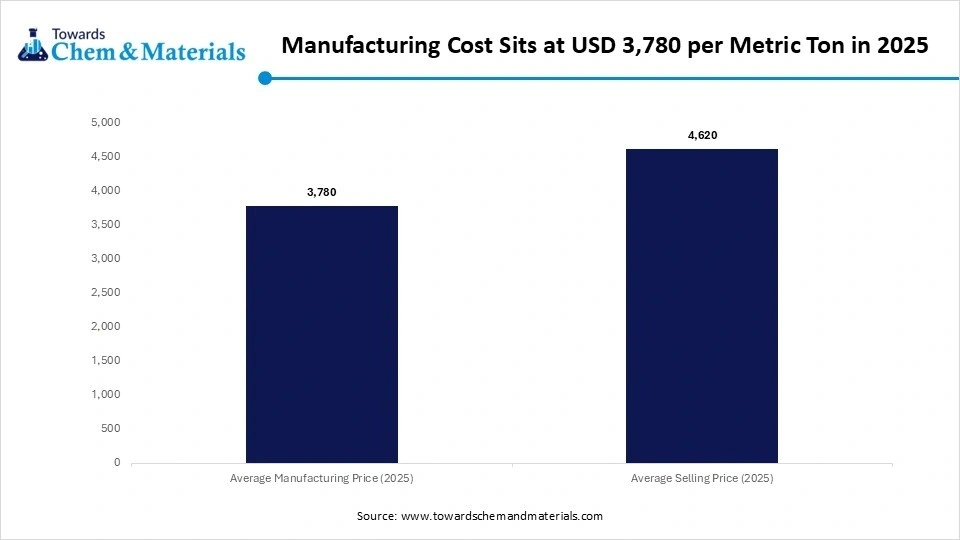
According to my research, it was observed that the manufacturing price offers a good cost-side view before commercial makeup is applied. The average manufacturing price in 2025 was USD 3,780 per Metric Ton, and the selling price was USD 4,620 per Metric Ton. This manufacturing cost forms the base for the margin analysis across the electrolyte value chain. Manufacturing cost depends on recycling and material availability, profitably selling at a good marginal value supporting the producers market.
- Key Insight: The market has experienced a rise in commercial selling for margin across the electrolyte value chain.
Source: Towards Chemical and Materials
Average Selling Price Reaches USD 4,620 per Metric Ton
The given graph shows that gross margin represents the net profit achieved by the manufacturers, which is USD 840 per metric ton (~18.2% of selling price) in the market. Reflecting the value captured by electrolyte formulators. The gap between the average manufacturing price of USD 3,780 per Metric Ton and the average selling price of USD 4,620 per metric ton achieves margins of 18.2% for electrolyte producers.
- Key Insight: The gap between selling price and manufacturing price represents the gross margin achieved by the producers.
Source: Towards Chemical and Materials
Electrolyte Pricing to Grow Only 2.90% Annually Through 2035
The graph highlights that electrolyser growth is driven by increasing demand rather than price inflation. Pricing is projected to grow at a modest CAGR of 2.90% while volume CAGR reaches 14.70% and revenue CAGR stands at 15.80%. This narrow difference between volume and revenue growth indicates that revenue expansion is supported by high demand instead of price increase. Overall, the market is expected to have long-term growth as manufacturers focus on capacity expansion, meeting rising demand, and maintaining relatively stable prices in the forecast period.
- Key Insight: With pricing growth at just 2.90%, market expansion is set to be driven by rising demand.
Source: Towards Chemical and Materials
Market Size vs. Market Volume Growth: A Decade-Long Divergence Check
The graph shows electrolyte value and volume growth, which are growing in close alignment between 2025 and 2035, indicating market expansion driven by rising demand rather than price increase. Market value is expected to grow from USD 12.84 billion in 2025 at a CAGR of 15.80% while volume is forecast to rise from 2.48 million metric tons at a CAGR of 14.70% during the same period. This alignment shows a healthy demand where the market is led by increasing production and consumption rather than inflation in pricing in long-term growth.
- Key Insight: Growth is closely aligned through 2035, led by growing demand driving market expansion.
Source: Towards Chemical and Materials
Regional Analysis
Asia-Pacific Commands 63% of the Global Battery Electrolyte Market
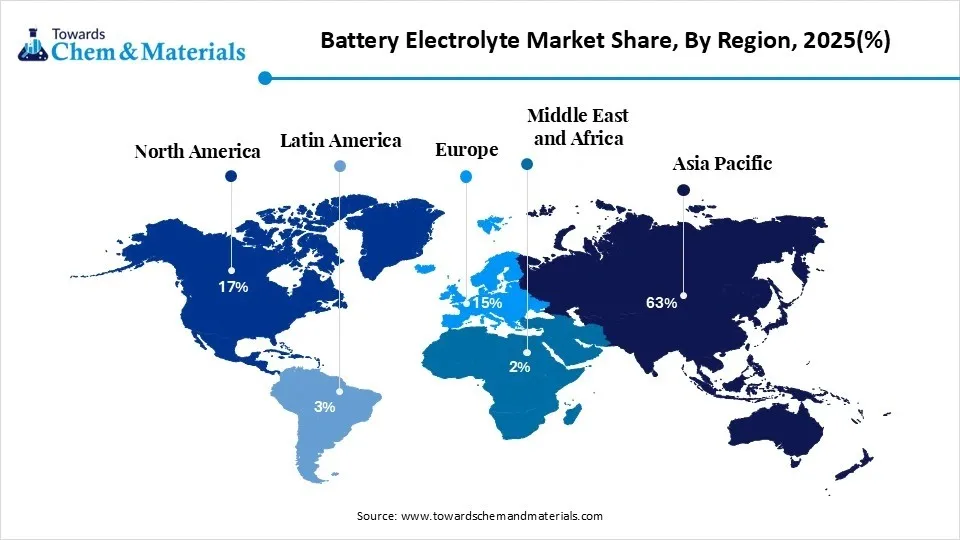
According to Research, Asia Pacific dominated the battery electrolyte market with a share of 63% in 2025 and is expected to grow at a CAGR of 17.20% over the forecast period, driven by the regional manufacturing base presence, which fulfils the growing demand for electrolyte by consumers. The rapid adoption of EV demand for lithium batteries is driven by the government enforcing electrification across sectors, aligning with environmental regulations. Large-scale investments in the supply chain in the region further drive adoption. Countries like China, Japan, and South Korea have advanced manufacturing bases, helping the growing battery capacity and demand contribute to its growth.
- Key Insight: Rapid EV adoption and a dominant share of 63% in 2025 increase regional demand.
Source: Towards Chemical and Materials
According to Research, North America held 17% market share in the battery electrolyte market in 2025; this is driven by localization incentives, which increase the demand for battery electrolytes. Rising EV adoption, local gigafactory investments, and federal policies like the United States Inflation Reduction Act promote localization of the supply chain, which further propels the growth. Increased domestic production as companies are actively mandating through companies such as Orbia Fluor & Energy Materials, which play a major role in the growth of the market. Major suppliers in the region like Enchem America, BASF Corporation, Mitsubishi Chemical Group, and Targray help in fulfilling the demand.
- Key Insight: Government localization incentives and domestic manufacturing bases are the major growth factors.
Source: Towards Chemical and Materials
Europe is the Fastest-Growing Electrolyte Market at 18.10% CAGR.
According to Research, Europe held 15% market share in the battery electrolyte market in 2025 and is expected to experience the fastest growth with a CAGR of 18.10% in the forecast period, driven by growing investments in local battery supply and accelerating gigafactory projects, increasing the expansion of the market. The strict emission regulations due to growing environmental concerns promote the adoption of EVs, supporting expansion. Through research, it was found that countries like Germany, France, and the Netherlands scale regional manufacturing of electrolytes. European companies like Basquevolt and Nordic Lyte invest in solid-state innovation, improving the safety of the product, which fuels the growth of the tech market.
- Key Insight: Strict regulations and accelerated gigafactory projects position Europe as the fastest-growing segment in the region.
According to Research, Latin America held a 3% market share in the battery electrolyte market in 2025, driven by regional mining bases, which help in fulfilling the demand for battery materials from the producers, supporting the battery material ecosystem. A strong shift towards electrification of automotives has gradually helped in expanding the regional demand for batteries. The renewable energy projects increase the high-energy density battery installation, aligning with the regulations.
- Key Insight: Mining activities and renewable energy projects are the major growth factors of the region in the market.
Source: Towards Chemical and Materials
According to Research, the Middle East and Africa held 2% market share in the battery electrolyte market in 2025, driven by energy diversification and industrial deployment focus; according to research, the region is currently a small regional base and an early-stage market. Energy diversification strategies and industrial development in the region through government investments and regulation help build storage and overcome battery demand. the researcher
- Key Insight: Industrial deployment and government sustainability initiatives are major factors for regional growth.
Source: Towards Chemical and Materials
Segmental Analysis
By Electrolyte Type
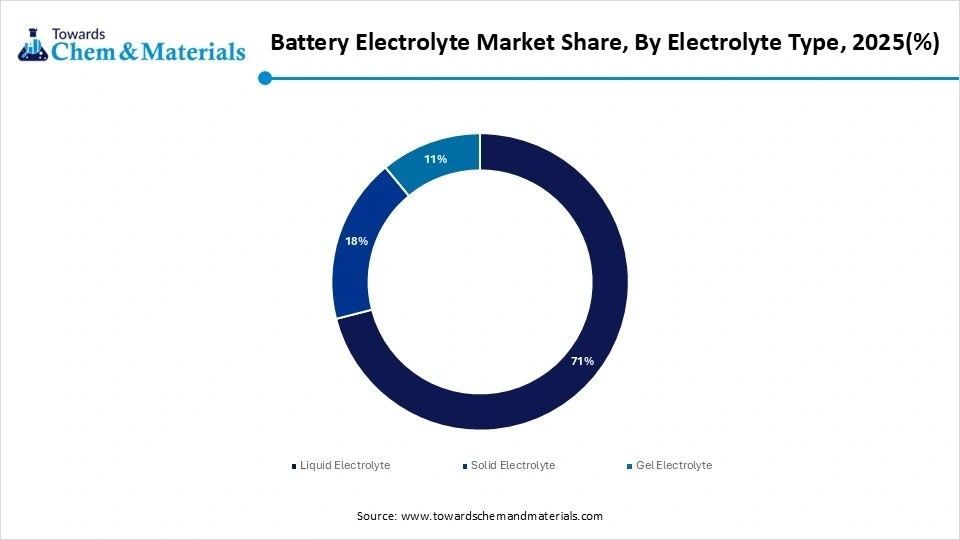
Electrolyte Type Mix: Liquid Electrolyte Dominates at 71% Share but Solid Electrolyte Is the Fastest-Growing Segment at 22.90% CAGR.
The liquid electrolyte segment dominated the market with a 71% share in 2025 and is expected to grow at a CAGR of 14.80% over the forecast period. The growth is driven by the growing use in consumer electronics and adoption of EVs, which rely on lithium-ion battery systems, and in electric vehicles where there is a need for high-energy-density materials. The ability and performance of the liquid electrolyte, like high ionic conductivity and electrochemical stability in various applications, propels the higher consumption. On the other hand, the solid electrolyte segment held 18% market share in 2025 and is expected to have the fastest growth with a CAGR of 22.90% in the forecast period, as it is growing at nearly 1.6x, aligning with future needs driven by the growing investment in solid-state commercialization of batteries as manufacturers are moving towards improvement of battery safety and energy density. The development of next-generation batteries and energy-dense batteries further propels the growth of the market.
- Key insight: Liquid electrolyte remains the dominant technology standard due to its demand, and solid-state alternatives grow for their stability.
Source: Towards Chemical and Materials
By Battery Type
Battery Type Mix: Lithium-ion Captures 88% of Electrolyte Demand
The lithium-ion segment dominated the market with an 88% share in 2025 and is expected to grow at a CAGR of 6.10% over the forecast period, driven by its battery chemistry. Lithium-ion batteries are gaining attention for use in electric vehicles and for commercial electronics due to their high energy density and properties. Rising EV production and expanding consumer electronics adoption through high production, aligning with investment by the industry due to global consumption, are boosting the growth of the market. On the other hand, the lead-acid segment held 12% market share in 2025 and is expected to have the fastest growth with a CAGR of 17.10% in the forecast period, driven by stable demand from the automotive sector for lead-acid batteries due to its ability to withstand the pressure of heavy equipment. Low-cost energy storage, maintenance, and application in industries for power applications propel the consumption of lead-acid batteries.
- Key Insight: Lithium-ion batteries are in high demand, but lead-acid gains stability.
Source: Towards Chemical and Materials
By End Use
End-Use Mix: Electric Vehicles Absorb 57% of Electrolyte Demand
The electric vehicle segment dominated the market with a 57% share in 2025 and is expected to grow at a CAGR of 11.40% over the forecast period, driven by the growing EV production bases in and across regions due to growing environmental sustainability regulations amid growing concerns, which drive demand for large-scale EV adoption, resulting in the higher production of battery electrolyte supporting market expansion. Especially driven by government incentives for the adoption of electrification. On the other hand, the consumer electronics segment held 24% market share in 2025 and is expected to have the fastest growth with a CAGR of 19.60% in the forecast period, driven by the high production of consumer electronics, which demand for electrolyte helps producers to increase production. Continuous innovation and advancement to increase battery life drive large-scale electrolyte improvement, supporting growth.
- Key Insight: Growing EV production and adoption sustain growth, whereas consumer electronics is growing at double the rate.
Source: Towards Chemical and Materials
Recent Developments
- In September 2026, SVOLT Energy Technology will begin series production of its hybrid semi-solid-state batteries, moving up its timeline to secure a competitive market position. These 100 kWh packs aim for cost parity with conventional lithium-ion batteries while offering an energy density of approximately 300 Wh/kg.(Source: www.electrive.com)
- In December 2025, Anthro Energy is building a 25 GWh advanced electrolyte manufacturing hub in Louisville, Kentucky. The facility will produce 12,000 metric tons annually of its patented advanced polymer electrolyte, Anthro Proteus. This material is designed to enhance the safety, energy density, and compatibility of next-generation lithium-ion batteries.(Source: www.indianchemicalnews.com)
- In June 2026, German battery manufacturer EAS Batteries officially commercialized its UHP601300 LFP 22 ultra-high-power lithium-ion battery cell. The cell integrates Asahi Kaseis patented Acetolyte™ electrolyte technology, an acetonitrile-based formula that reduces internal resistance and maximizes power output.
(Source: evtech.news)
Top players in the Battery Electrolyte Market & Their Offerings:
Guangzhou Tinci Materials Technology Co., Ltd: Tinci / CAPCHEMs peer, stock code SZSE: 002709)
Its headquarters is located in Guangzhou, Guangdong, China, its core business is related to lithium-ion battery electrolyte lithium hexafluorophosphate, daily-use/specialty chemicals, and organic silicone rubber products manufacturing. Electrolytes and related raw materials contributed over 80% of 2024 revenue. The companys FY2024 revenue was RMB 12.52 billion, with a net profit of RMB 483 million amid price declines, holding approximately 13% of the China lithium-ion electrolyte market. It ranks among the top three domestic players, with a production capacity of 850,000 tons/year, operating 15 production facilities in China along with expanding capacity in North America and Morocco, expecting to build a 100,000 ton/year electrolyte plant in Bohumín, Czech Republic, to supply European customers.
Shenzhen Capchem Technology Co., Ltd. (CAPCHEM, stock code SZSE: 300037)
Its headquarters is located in Shenzhen, Guangdong, China. They are the leading producer of battery chemicals like lithium-ion, sodium-ion, and solid-state battery electrolytes and additives, as well as organic chemicals, semiconductor chemicals, and capacitor chemicals. Having year-on-year revenue of approximately US$1.22 billion. It is one of the largest and world-leading producers of electrolyte and functional materials, supplying lithium battery, capacitor, and semiconductor chemicals globally, and has been listed on the Shenzhen Stock Exchange since 2010.
Mitsubishi Chemical Group Corporation
Its headquarters is located in Tokyo, Japan. Its core processing revolves around diversified chemicals for the battery materials business spanning electrolytes, electrolyte solvents/salts, and separator materials for lithium-ion batteries along with performance products, industrial gases, and pharmaceuticals. It is the largest supplier of lithium-ion battery electrolyte solvents and is listed on the Tokyo Stock Exchange, its core segment is battery materials in its specialty materials segment.
Soulbrain Co., Ltd.
Its headquarters is located in Seongnam, Gyeonggi Province, South Korea. It is an established South Korean electrolyte supplier to the domestic battery cell industry, it is privately held with periodic public disclosures via Korean regulatory filings. Its core business and manufacturing segment includes semiconductor and secondary battery materials, including lithium-ion battery electrolytes and precursor materials.
UBE Corporation
Its headquarters is located in Ube, Yamaguchi Prefecture, Japan. It is a diversified chemical producer of battery materials supplying separators and electrolytes, which are related to specialty chemicals for lithium-ion batteries, alongside its core chemicals, construction materials, and machinery. They are the global suppliers of lithium-ion battery separator film and related battery materials. It is listed on the Tokyo Stock Exchange, renamed from Ube Industries to UBE Corporation in 2022.
Other Top Players Are
- ENCHEM Co., Ltd.
- UBE Corporation / UBE Industries
- Central Glass Co., Ltd.
- BASF SE
- LG Chem Ltd.
- Zhangjiagang Guotai Huarong New Chemical Materials Co., Ltd.
- Dongwha Electrolyte Co., Ltd.
- Morita Chemical Industries Co., Ltd.
- Zhejiang Yongtai Technology Co., Ltd.
- Shanshan Technology / Ningbo Shanshan Co.
- Chunbo Co., Ltd.
- Targray Industries Inc.
- 3M Co.
- Panax Etec Co., Ltd.
- Gotion High-Tech Co., Ltd.
- Advanced Electrolyte Technologies (AET) / NOHMs Technologies
Expert insight
According to my research and assessment, the market is shifting towards more sustainable and electrification adoption in various sectors. I believe that there is strong demand from companies, along with suppliers and producers, for batteries from automotive to heavy equipment. In my view, there is strong growth in the EV sector creasing opportunity for advancement through modulations in batteries across the global market.
Our Experts
Vidyesh Swar led the primary market research, analysis of trends, segmentation, development of methodology, growth opportunities, pricing analysis, volume and supply chain analysis, competition, regional insights, and performance optimization and forecasts.
Aman was responsible for company insights, regulations, statistical analysis, partnerships and collaborations, and the qualitative data that help strengthen the market estimation.
Aditi reviewed the entire research document, performed quality checks, validated findings, refined content, corrected inconsistencies, and finalized the report to ensure accuracy, clarity, credibility, and readiness for publication.
Complete Market Segmentation Listing
By Electrolyte Type
- Liquid Electrolyte
- Carbonate-based Electrolytes
- Ether-based Electrolytes
- High-Voltage Electrolytes
- Solid Electrolyte
- Sulfide-based
- Oxide-based
- Polymer-based
- Gel Electrolyte
- Polymer Gel Electrolytes
- Hybrid Gel Electrolytes
By Battery Type
- Lithium-ion
- LFP
- NMC
- NCA
- LCO
- LMO
- Lead Acid
- Flooded Lead Acid
- AGM
- Gel Lead Acid
By End Use
- Electric Vehicles
- Passenger EVs
- Commercial EVs
- Two & Three Wheelers
- Consumer Electronics
- Smartphones
- Laptops
- Wearables
- Tablets
- Energy Storage
- Utility-scale Storage
- Residential Storage
- Commercial & Industrial Storage
- Others
- Aerospace
- Marine
- Medical Devices
- Industrial Equipment
By Regions
- North America
- Europe
- Asia Pacific
- Middle East & Africa
- Latin America
References used:
By Towards Chemical and Materials
- Battery Electrolyte Market dataset as provided: market size, volume, pricing, and segmentation shares/CAGRs by
- Electrolyte Type, Battery Type, End Use, and Region (2025 base year, 2025–2035 forecast).
- Independently Researched Public Sources
- International Energy Agency (IEA), Global EV Outlook 2026 — Executive Summary, iea.org
- International Energy Agency (IEA), Global EV Outlook 2025 — Executive Summary, iea.org
- International Energy Agency (IEA), Global Energy Review 2026 — Electric Vehicles, iea.org
- International Energy Agency (IEA), "EU Sustainable Batteries Regulation" policy page, iea.org
- European Council, "Council adopts new regulation on batteries and waste batteries," July 10, 2023,
- European Commission, "New rules to boost recycling efficiency from waste batteries," July 4, 2025,
- European Commission / EUR-Lex, "Sustainability rules for batteries and waste batteries" (Regulation (EU) 2023/1542 summary),
- Investing News Network, "Lithium Market Update: Q3 2025 in Review,"
- Investing News Network, "Lithium Market 2025: A Year of Volatility and Opportunity,"
- Fastmarkets and Benchmark Mineral Intelligence data
- Carbon Credits, "Lithium Prices Crash Below $10K, Hitting a 4-Year Low,"
- Benchmark Mineral Intelligence, "The top five battery producers: past, present and future,"
- TYCORUN, "Top 10 lithium electrolyte manufacturers in China in 2025,"
- Tianxia Gongchang Research, "China Lithium Battery Four Key Materials 2026,"
- Caixin Global, "U.S. Tops Chinas Lithium Battery Exports, With Surge in Power Storage," January 24, 2025, caixinglobal.com, citing China General Administration of Customs data
- EnergyTrend, "Chinas lithium-ion battery exports totaled US$43.687 billion from January to September 2024,"
- PatSnap, "Solid-State Battery Technology Landscape in 2026,"
- Knowmade, "Q4 2025 Solid-State Batteries Patent Landscape,"
- GreyB, "10 Solid-State Battery Companies to Watch In 2026,"
- Bamboo Works, "Tinci Materials eyes Hong Kong listing, hoping investors see past its sagging profits,"
- PitchBook, Guangzhou Tinci Materials Technology Company and Shenzhen Capchem Technology Company profiles, (Morningstar public fundamental data)
- Corporate websites and public disclosures: Capchem (en.capchem.com), Tinci (tinci.com), BASF (basf.com), Merck KGaA (merckgroup.com), LG Chem (lgchem.com), Mitsubishi Chemical Group (mcgc.com), UBE Corporation (ube.com), Central Glass (cgco.co.jp)



Comments
Share your thoughts, ask a question, or provide feedback about this report.