
What is the Activated Alumina Market Size and Share?
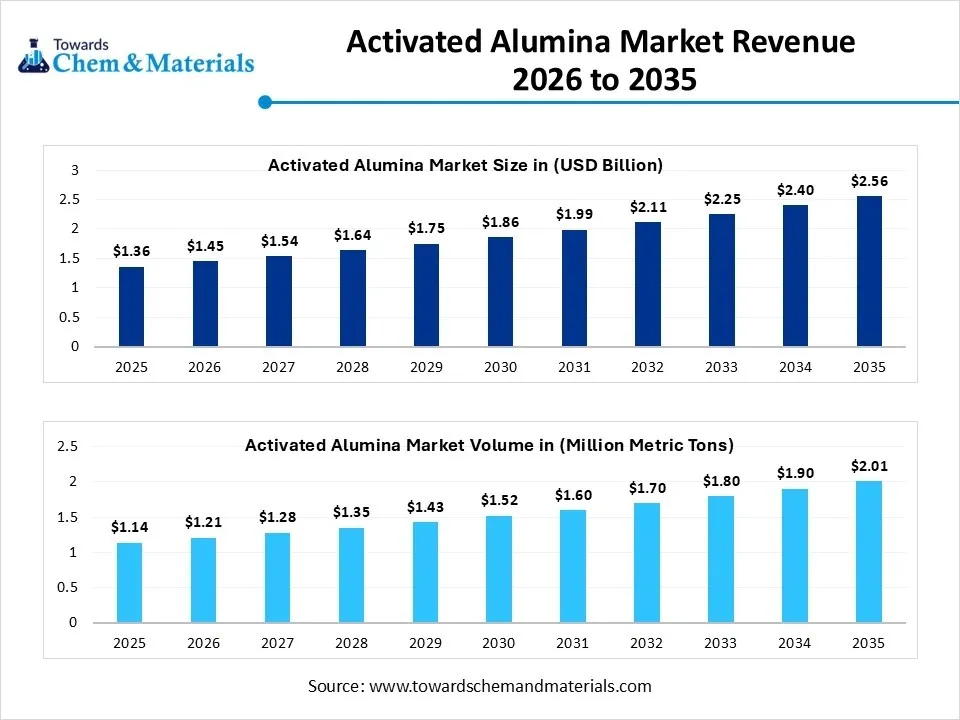
The global activated alumina market size was valued at USD 1.36 billion in 2025, is estimated to reach USD 1.45 billion in 2026, and is projected to reach USD 2.56 billion by 2035, exhibiting a compound annual growth rate (CAGR) of 6.51%over the forecast period from 2026 to 2035.Asia Pacific dominated the activated alumina market with the largest revenue share of 45% in 2025 and is expected to grow at the fastest CAGR of 6.64% during the forecast period. 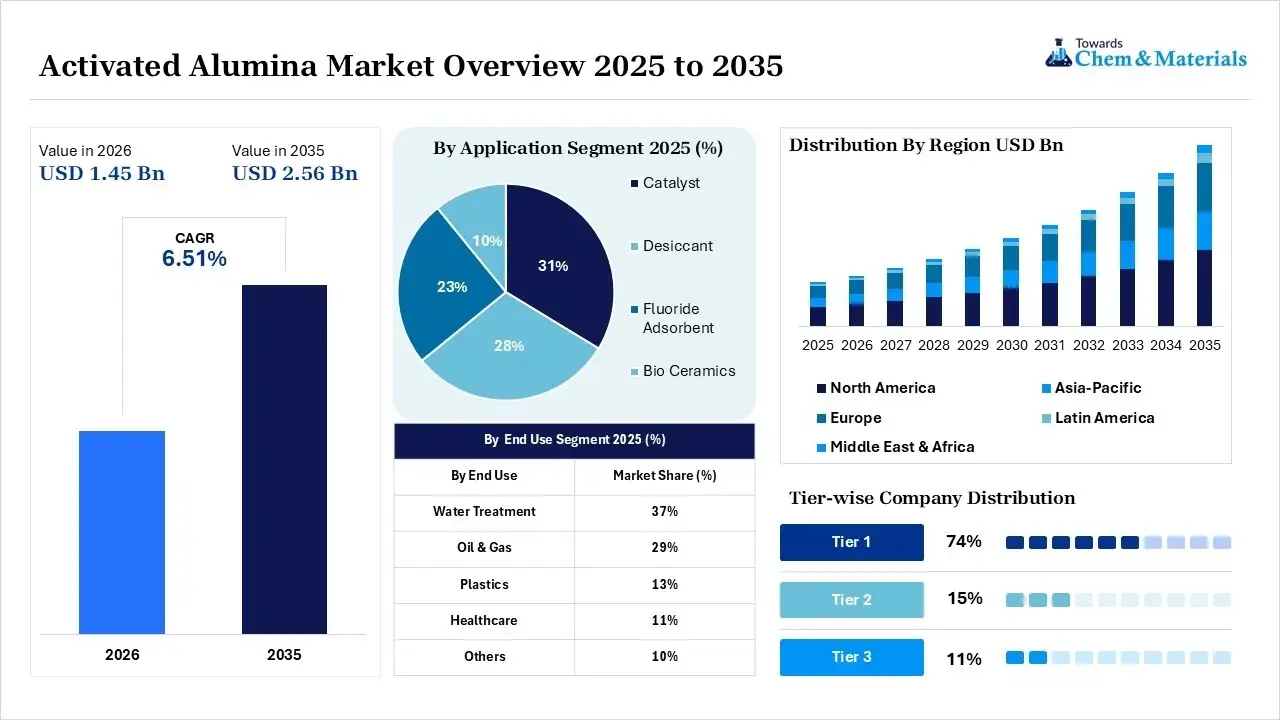
There is a growing adoption of the product in water treatment, gas dehydration, catalyst production, and purification applications, which are driving market expansion. The increasing demand for high-performance adsorbents and growing industrial processing activities are further bolstering product adoption in a variety of industrial end-use applications around the world.
Market Highlights
- By region, Asia Pacific dominated the activated alumina market by holding 45% share in 2025 and is expected to grow at a CAGR of 6.64% during the forecast period.
- By region, North America held 22% market share in 2025 and is expected to grow at the fastest with a CAGR of 7.31% during the forecast period.
- By application, the catalyst segment dominated the market with the largest share of 31% in 2025 and is expected to grow at a CAGR of 6.2% during the forecast period.
- By application, the fluoride adsorbent segment held 23% market share in 2025 and is expected to grow at the fastest CAGR of 7.54% over the forecast period.
- By end-use, the water treatment segment dominated the market with the largest share of 37% in 2025 and is expected to grow at a CAGR of 6.04% during the forecast period.
- By end-use, the oil & gas segment held 29% market share in 2025 and is expected to grow at the fastest CAGR of 7.21% over the forecast period.
According to Towards Chemicals and Materials Analytics and Consulting, the global activated alumina market volume was valued at 1.14 million metric tons in 2025 and is expected to surpass around 2.01 million metric tons by 2035, accelerating a compound annual growth rate (CAGR) of 5.86% over the forecast period from 2026 to 2035.
Expanding Industrial Purification Applications Supporting the Activated Alumina Market
Increased demand for efficient moisture removal, adsorption of contaminants, and purification has led to significant expansion in usage throughout the municipal, petrochemical, and chemical processing sectors. The activated alumina industry is continually evolving, as it is increasingly being used in the water purification, gas drying, catalyst support, and industrial adsorption sectors. Manufacturers are still stressing the development of advanced production processes providing enhanced pore structure, adsorption capacity, and operational durability in critical industrial applications.
Ongoing investment in manufacturing capabilities and product optimization continues to support diverse commercial opportunities for industrial applications. Reliable operational performance and efficient purification solutions for industry will be a major factor in driving market development in the coming years across several end-use applications.
Global Investment Movement for the Activated Alumina Market
Manufacturers keep investing in manufacturing plants that can offer high-quality activated alumina products to meet the needs of water treatment, catalyst production, industrial drying, and gas purification applications.
Investments in advanced activation technologies, better pore distribution, and optimal adsorption properties are given high priority by industry participants.
Manufacturers ongoing development efforts have resulted in the creation of a range of specialised grades of activated alumina that can be used for various industrial processing applications that demand a uniform purification and drying ability.
Companies still invest in the procurement, processing, and distribution infrastructure to enhance the efficiency of their operations in the activated alumina value chain. By improving logistics ability and creating long-term commercial ties, reliable product supply in the regional and international industrial markets is promoted.
Report Scope
| Report Attributes | Details |
| Market Size in 2026 | USD 1.45 Billion/ 1.21 Million Metric Tons |
| Expected Size in 2035 | USD 2.56 Billion/ 2.01 Million Metric Tons |
| Growth Rate | CAGR of 6.51% |
| Base Year of Estimation | 2025 |
| Forecast Period | 2025-2035 |
| Dominant Region | Asia Pacific |
| Segment Covered | By Application, By End Use, By Region |
| Key Companies Profiled | BASF SE, Honeywell International Inc. (Honeywell UOP), Axens, Sumitomo Chemical Co., Ltd., Evonik Industries AG (Porocel), Aluminum Corporation of China Limited (CHALCO), Huber Engineered Materials, Almatis GmbH, Zeochem AG, Dynamic Adsorbents Inc., Sorbead India, Jalon, AGC Chemicals |
Market Trends
- The wider activated alumina usage in municipal and industrial drinking water applications, where consistent operation and dependable adsorption properties are required, is continuing to increase as a result of growing emphasis on fluoride, arsenic, and other contaminants removal from drinking water.
- The market demand for the use of activated alumina has been further bolstered by the rising adoption of the material in gas dehydration and drying applications as industries seek to ensure they effectively remove moisture to enable efficient downstream processing and equipment protection.
- In modern manufacturing, chemical companies are increasingly adopting activated alumina due to its optimized pore structure, which provides enhanced surface properties for efficient catalysis in petrochemical, refinery, and chemical processing applications that demand reliable reaction performance.
- As the demands for purification and specialty processing in industry continue to change, manufacturers continue to focus on the development of advanced formulation techniques providing greater adsorption capacity, structural durability, and operational stability for the activated alumina products.
Key Technological Shifts and AI in the Activated Alumina Market
Advancing Artificial Intelligence and Process Innovation Across the Activated Alumina Market
AI has been making significant strides in enhancing production optimization efficiency and precision in activated alumina manufacturing processes, including the control of thermal processing, monitoring operations, and manufacturing efficiency. Digital process management allows manufacturers to analyze production performance, optimize calcination conditions, and increase the consistency of production. The advanced analytical technologies also enhance the quality control by enabling precise monitoring of the pore development and adsorption properties during the manufacturing stages. Process innovation goes on with special formulations that offer better moisture removal, contaminant adsorption, and catalyst support performance in industrial applications.
What is the Activated Alumina?
Activated alumina is a highly porous aluminium oxide product formed by controlled thermal processing of aluminium hydroxide and has outstanding adsorption properties for water purification, gas drying, catalyst support, moisture removal, and a large number of industrial separation applications that demand a high-performance adsorbent material.
Uses of the Activated Alumina
- Activated alumina is a highly effective media for the removal of fluoride, arsenic, and other contaminants from drinking water, which ensures consistent purification efficiency at municipal water treatment plants and enhanced water quality by ensuring reliable adsorption efficiency.
- Activated alumina is used by industries to dry compressed air and industrial gas lines to make them more reliable to work with and to prevent corrosion, contamination and performance issues to downstream equipment.
- The porous structure of activated alumina makes it a good catalyst support and increases the efficiency of the reactions; it has excellent mechanical stability, which makes it suitable for use in the petrochemical, refinery, and chemical manufacturing processes where reliable catalytic activity is required.
- Activated alumina is used in industrial dryer systems that demand efficient moisture removal, helping to maintain a stable production environment, as well as keeping sensitive products and production equipment from being exposed to excess moisture.
- Activated alumina has multiple industrial uses, such as chromatography, abrasives, and specialty process applications, where adsorption control, structural strength, and product consistency are key factors to the operation of the process.
Supply Chain Analysis of the Activated Alumina Market
Feedstock Procurement
- The procurement of the feedstock is the process of sourcing and refining high-grade bauxite ore or Aluminium Hydroxide (precursors) needed to produce high quality, consistent Aluminium Oxide (activated alumina) product.
- With the reliable raw material supply, the manufacturing process is maintained uninterrupted, and product purity, adsorption efficiency, and performance are guaranteed through various industrial applications that require activated alumina products.
- Alcoa Corporation: Alcoa Corporation acquires and delivers high-purity bauxite, as well as primary refined alumina raw materials, enabling reliable availability of raw materials for activated alumina production facilities that are located around the world.
- Other Key Players: CHALCO, Hindalco Industries Ltd.
Chemical Synthesis and Processing:
- Controlled thermal dehydration and calcination of aluminum hydroxide is also included in chemical synthesis, which yields porous gamma – alumina structures with optimal surface area and adsorption properties for industrial applications.
- Precision thermal processing directly affects activated alumina performance in purification, drying, and catalyst support, through its effects on pore structure, adsorption capacity, mechanical durability, and product consistency.
- BASF SE: In commercial applications of activated alumina, BASF SE carries out precision thermal treatments and activation processes that ensure optimized pore structure, surface properties, and adsorption performance.
- Other Key Players: Honeywell UOP, Axens
Compound Formulation and Blending:
- Activated Alumina powders are produced by a process that results in commercial spheres, pellets, or extrudates, depending on application, which are formed by the use of carefully selected binders that increase durability and operational performance within the application.
- Formulating the uniform makes the product stronger, reduces material degradation, and guarantees uniform adsorption performance in the difficult purification, drying, and catalytic process operations required in industrial processes.
- Evonik Industries: Specialist in the development of durable beads and activated alumina structures for demanding applications in the field of adsorption and catalysis in industry.
- Other Key Players: Huber Engineered Materials, Zeochem AG
Sustainability Analysis of the Activated Alumina
Sustainability is still a crucial factor influencing the activated alumina market, as producers continue to prioritize sustainable production methods and resource use. Ongoing process improvements enable optimal use of raw materials and ensure the product quality of industrial applications. Longer operational service life is also achieved in water purification, gas drying, and catalyst support applications of the activated alumina, since its performance is reliable. Businesses are still increasing their production efficiency by adopting better processing technologies, streamlining logistics, and following responsible production in order to ensure a stable commercial supply. Long-term industrial cooperation and consistent production quality also promote reliable production and sustainable performance in various end-use fields that need high-quality adsorption material.
Pricing Analysis for the Activated Alumina Market
The key factors that are driving the market for activated alumina prices are the cost of feedstock (aluminum hydroxide), the requirement for energy during the calcination process, transportation costs, and demand from industries such as water treatment, gas dehydration, and catalysts. The fluctuation in the price of the feedstock will have a great impact on the manufacturing cost, as primary industrial alumina derivatives are still important raw materials in the manufacturing process. In the case of high-temperature thermal activation, large amounts of fuel or electricity are needed, and the stability of the energy market is important for the price.
Activated Alumina Market: Global Trade Analysis
The activated alumina market provides a reliable solution for water treatment, gas drying, catalyst manufacturing, and industrial purification applications, and shows a stable status in the international trade. Established logistics networks are formed by major exporting countries, which use bulk maritime transport and regional distribution systems to feed industrial markets in the rest of the world. The industrial demand, availability of raw materials, transport costs, changing trade policies, and growing local manufacturing capability that provides reliable access to international products continue to affect trade activity.
Regulatory Framework: Activated Alumina Market
| Country Region | Regulatory Body | Key Regulations | Focus Areas |
| Asia Pacific | U.S. EPA | Toxic Substances Control Act (TSCA) | Fluoride/arsenic removal limits in drinking water |
| North America | Ministry of Ecology and Environment (China) | Environmental Protection Law | Industrial effluent standards |
| European Union | European Chemicals Agency (ECHA) | REACH (Registration, Evaluation | Safe chemical registration, restriction of hazardous impurities |
Market Dynamics
Driver: Strengthening Demand for Industrial Purification and Adsorption Technologies
The use of activated alumina is continuing to gain momentum in a variety of applications, from water treatment and gas drying to the production of catalysts and purification. As industries demand reliable adsorbents that have constant performance and can control moisture and contaminants, the need for them is growing. Reliable purification technologies and optimisation of industrial processes are becoming increasingly important, further supporting commercial use in various municipal utilities, petrochemical plants, and chemical production processes. The constant upgrading of products and the growth of industrial infrastructure throughout the world continue to support long-range market development in end-use markets.
Restraint : Managing High Production Costs and Energy-Intensive Manufacturing Processes
The production of activated alumina relies on the availability of good-quality raw materials and high-energy consumption thermal activation processes, which pose challenges in commercial production. The cost of aluminum hydroxide, regional energy costs, transportation costs, and some of the unique processes required for producing aluminum hydroxide also factor into the economics of the manufacturing process and the stability of these prices. Operational complexity is also a challenge for producers, particularly if they are required to deliver consistent pore structure, adsorption performance, and product quality over a variety of industrial contexts in which they must be able to operate reliably over long periods.
Opportunity: Expanding Growth Opportunities Through Advanced Water Treatment and Gas Processing Applications
The global market for activated alumina continues to offer significant prospects for all activated alumina producers, particularly in the municipal water purification, industrial drying, catalyst support, and natural gas processing applications. The growth of investment in supporting advanced processing technologies, specialized formulations, and manufacturing efficiencies allows companies to continue to grow their product offerings to meet changing industrial purification needs. Long-term product development and growth in industrial infrastructure are expected to boost commercial opportunities in well-established and emerging regional markets.
Segmental Insights
Application Insights
The catalyst segment dominated the market with the largest share of 31% in 2025 and is expected to grow at a CAGR of 6.2% over the forecast period, due to the fact that the activated alumina offers outstanding heat resistance, durability, and good surface properties for various catalytic processes. It is now being used in a wide range of applications in the refinery, in the production of petrochemicals, and for chemical processing applications where a reliable catalyst support is desired. A porous structure allows for optimal reactant interaction and excellent operation in harsh processing conditions. New technologies in industrial production continue to emerge, and growing activities in chemical production maintain catalyst use at all throughout continued commercial activity in many industrial applications that demand reliable catalytic performance.
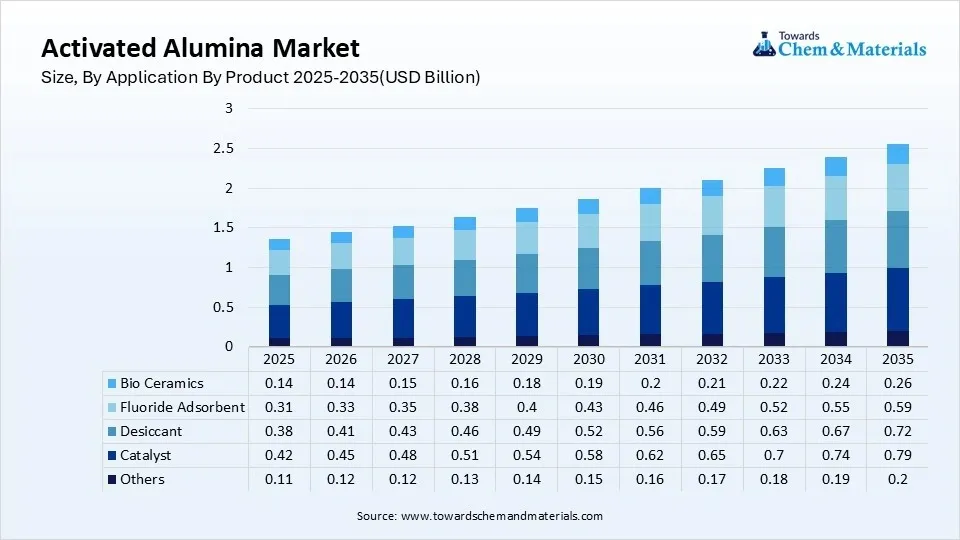
The fluoride adsorbent segment held the 23% market share in 2025 and is expected to grow at the fastest CAGR of 7.54% over the forecast period, owing to the growing focus on implementing effective purification systems for potable water by industries and local municipalities. Activated alumina has very good adsorption performance, can be used to remove fluoride and other contaminants without affecting the operation, and can be regenerated. As awareness of water quality increases, more and more products are being adopted by a growing number of industrial wastewater treatment facilities, and the purification facilities themselves are increasing in number. The long-term demand for activated alumina is anticipated to continue to grow in a large number of environmental treatment applications as a result of ongoing investment in new filtration technologies and eco-friendly purification systems.
Activated Alumina Market Share, By Application, 2025(%)
| By Application | Market Share (%) |
| Catalyst | 31% |
| Desiccant | 28% |
| Fluoride Adsorbent | 23% |
| Bio Ceramics | 10% |
| Others | 8% |
End-Use Insights
The water treatment segment dominated the market with the largest share of 37% in 2025 and is expected to grow at a CAGR of 6.04% over the forecast period, as activated alumina is used to remove impurities from water and its adsorption performance is stable all along the water purification system. Advanced adsorption materials are increasingly used to help municipal utilities and industrial facilities enhance the quality of water and overall operational efficiency. The continued investment in drinking water treatment, industrial wastewater treatment, and environmental protection projects further enhances commercial use. Stable product durability, high contaminant removal efficiency, and ease of compatibility with various treatment technologies also contribute to its general use in public infrastructure and industrial treatment plants around the world.
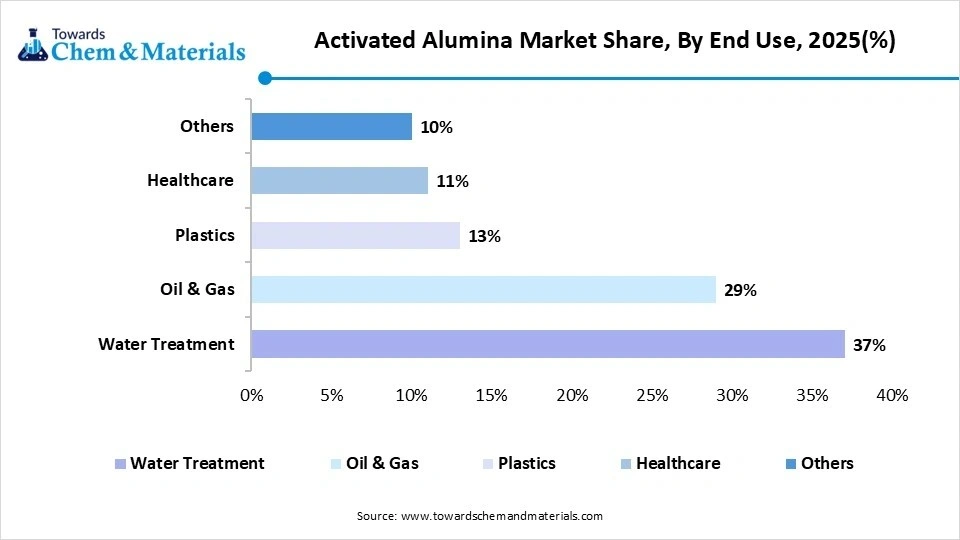
The oil & gas segment held the 29% market share in 2025 and is expected to grow at the fastest CAGR of 7.21% over the forecast period, as activated alumina is used in gas dehydration, moisture removal, and other oil and gas processing applications that require reliable adsorption performance. Activated alumina is used in processing facilities to help protect equipment, make the operation more reliable, and aid in downstream processing efficiency. The increased exploration, the development of petrochemicals, and the investment in gas processing facilities is continuing to stimulate wider use of products. Ongoing technological advancements to enable efficient purification and process optimization in industrial energy processing are likely to keep driving demand throughout the long-term in energy processing applications worldwide.
Activated Alumina Market Share, By End Use, 2025(%)
| By End Use | Market Share (%) |
| Water Treatment | 37% |
| Oil & Gas | 29% |
| Plastics | 13% |
| Healthcare | 11% |
| Others | 10% |
Regional Insights
How Did the Asia Pacific Dominate the Activated Alumina Market In 2025?
The Asia Pacific activated alumina market size was estimated at USD 0.61 billion in 2025 and is projected to reach USD 1.16 billion by 2035, growing at a CAGR of 6.64% from 2026 to 2035.Asia Pacific dominated the market with the largest share of 45% in 2025 and is expected to grow at a CAGR of 5.74% during the forecast period.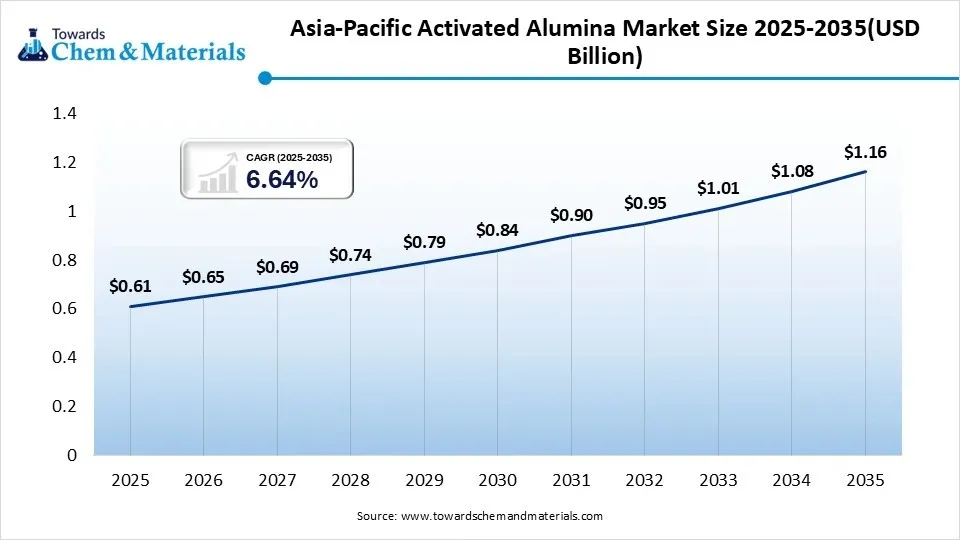
The massive manufacturing capacity, already developed chemical processing industry, and growing water treatment infrastructure in the Asia Pacific contributed to its dominance as the regional market. Consistent demand is provided by strong industrial development in the production of catalysts, gas purification, and environmental treatment applications. The regional manufacturers are still making efforts to increase their manufacturing capacity and make their supply chain more efficient to cater to the increasing demands of domestic and international markets. Asia Pacific is expected to be the major consumption and manufacturing hub for activated alumina products, with the continuous investments in advanced purification technology and the expansion of infrastructure and industrialization.
Developing Chinas activated alumina production technology
China is a large manufacturing base with a mature industrial infrastructure, a well-developed raw material supply chain, and a large chemical processing industry. Domestic companies are improving their manufacturing efficiencies, producing activated alumina for the production of catalysts, drying, and purification of water. Continuous investments in production technologies and industrial modernization, along with export-oriented manufacturing boosts the competitiveness of products on global markets. Well-developed research capacity and industry supply chains provide reliable commercial availability and consistent product quality across a range of industries.
Enhancing the Industrial Purification Industry in India
The increasing industrialization, the development of municipal wastewater treatment works, and enhanced chemical manufacturing activities continue to make India an important market. The use of activated alumina is being increased due to its use in many industrial processing facilities. Long-term commercial opportunities are enhanced through government-supported infrastructure development and increasing the extent of environmental management initiatives. Continuous development of production capability by domestic producers meets the increasing demand from the industrial drying, catalyst manufacturing, and water purification industry, which drives the steady growth of the market across the country
North America Activated Alumina Market Trends
The North America activated alumina market size was estimated at USD 0.30 billion in 2025 and is projected to reach USD 0.58 billion by 2035, growing at a CAGR of 6.81% from 2026 to 2035.North America held 22% market share in 2025 and is expected to grow at the fastest CAGR of 7.31% during the forecast period, due to the growing need for advanced adsorption materials in gas processing, catalyst manufacturing, and water purification applications. The country has a good technological capacity, strong industrial infrastructure, and ongoing investments in specialty chemical production, which promotes the widespread adoption of products. Manufacturers have a focus on innovation, efficiency, and sustainable processing methods to gain commercial competitiveness. Supporting the long term demand of activated alumina in global industrial applications within the regional market is the ongoing trend of industrial modernization, compliance with environmental regulations, and advanced requirements for purification.
Build up the United States Industrial Processing Sector
Demand for this product is significant in the United States, due to its widespread use in petrochemical applications, gas dehydration systems, refinery applications, and municipal water treatment projects. The strong innovation of industrial products will promote the development of higher added-value activated alumina products for various industrial applications. Ongoing investment in the chemicals industry, environmental technologies, and energy infrastructure ensures the use of products in the local industry. The continuous development of competent distribution systems and advanced research capabilities enhances the countrys presence and competitiveness in the global activated alumina industry.
Growing the Industrial Applications of Canada
Canada is sustaining the demand for activated alumina by increasing industrial processing, environmental purification, and energy-related use, where a high-quality adsorption material is needed. The development of advanced purification technologies has become more and more popular among industries for better efficiency and environmental performance. Continued investments in industrial modernization, resource development, and sustainable manufacturing processes boost commercial opportunities in a wide range of applications.
Europe Activated Alumina Market Trends
The Europe activated alumina market size was estimated at USD 0.26 billion in 2025 and is projected to reach USD 0.50 billion by 2035, growing at a CAGR of 6.76% from 2026 to 2035.Europe held 19% market share in 2025 and is expected to grow at a CAGR of 5.61% over the forecast period. Europe has an established presence in the chemical industry, environmental protection, and advanced industrial purification technologies. The use of activated alumina has grown rapidly across the region for a variety of applications that demand consistent adsorption performance, such as in catalyst manufacture, gas processing, and water treatment. Regulatory focus to ensure that manufacturers keep their production standards high and that they contribute to a sustainable industry.
Promoting the Advancement of Chemical Manufacturing Excellence in Germany
Germany is still one of the worlds largest industrial manufacturing centres and has a high degree of activated alumina use in catalyst manufacturing, chemical processing, and industrial purification. The advanced engineering skills allow for ongoing product innovations and manufacturing efficiency gains. Reliable product availability is bolstered through a network of reliable supply chains, research investments, and strong industrial collaboration, which further helps secure a reliable supply of products in both domestic and international markets. The application of high-performance adsorption materials has continued to drive strong commercial prospects across the nations industrial sector.
Enhancement of Frances Industrial Purification Infrastructure
The use of the activated alumina keeps growing in France in the field of municipal water treatment plants, chemical plants, or purification plants. Efficient technologies based on adsorption for environmental management and sustainable production are becoming more and more relevant in industries. Increased investment in industrial modernisation, into the development of advanced treatment and infrastructure technologies, promotes widespread commercial uptake. The demand for products continues from a wide range of manufacturing segments, which provides stability to the product consumption and reinforces the countrys presence in the regional activated alumina market.
Latin America Activated Alumina Market Trends
The Latin America activated alumina market size was estimated at USD 0.11 billion in 2025 and is projected to reach USD 0.22 billion by 2035, growing at a CAGR of 7.18% from 2026 to 2035.Latin America held 8% market share in 2025 and is expected to grow at a CAGR of 6.18% over the forecast period, with the growing industrialization, better environmental management, and heightened investments in water treatment facilities across the region. Efficient purification technologies for chemical processing and industrial drying applications are a strong focus for regional manufacturers and industrial users. The continuous development of infrastructure and increasing diversification of industry facilitate wider commercial exploitation in numerous end-use areas. Increased awareness of sustainable industrial processes and environmental protection further boosts the long-term market opportunities across the regional economy.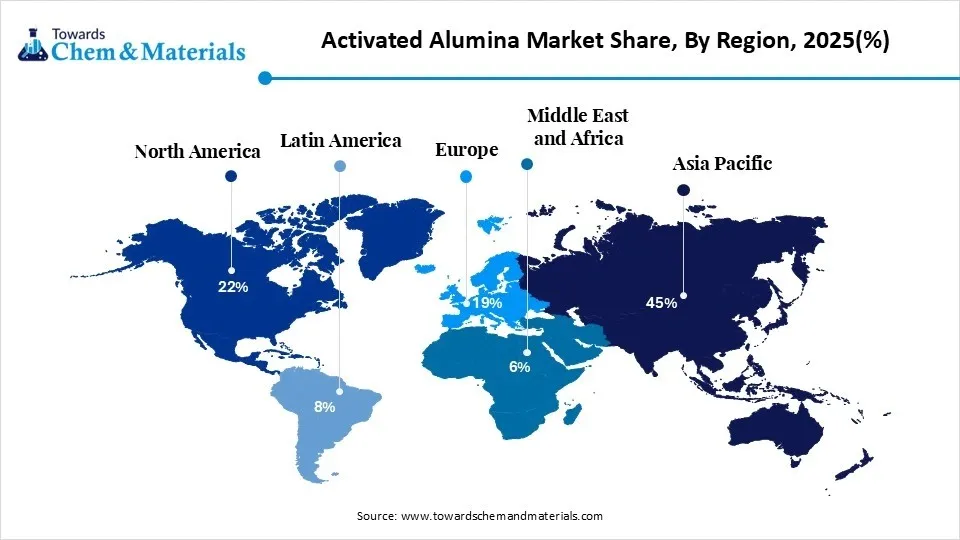
Strengthening Brazils Industrial Manufacturing Base
Brazil continues to grow the use of activated alumina in industrial processing, the chemical industry, and in municipal water treatment processes. On the other hand, with the development of industrial investment, the demand for reliable adsorption materials for enhancing purification efficiency and the reliability of the operation is also growing. The growing capacities are complemented by infrastructure modernization that helps industrial segments to use commercial manufacturing more widely. The national markets activated alumina use is stable and continues to emphasize environmental sustainability and efficient resource management.
Advancing Chiles Industrial Processing Industry
Growing mining-related processing activity, industrial purification, and environmental management requirements continue to drive Chiles activated alumina demand. More and more industries are beginning to use efficient adsorption materials with stable performance and high efficiency of adsorption processing. Industrial infrastructure and sustainable manufacturing processes, together with diversified economic development, promote long-term commercial opportunities. With improved purification technologies, continued investments in activated alumina are making its presence known in various industrial applications throughout the countrys changing industrial matrix.
Middle East & Africa Activated Alumina Market Trends
The Middle East & Africa activated alumina market size was estimated at USD 0.08 billion in 2025 and is projected to reach USD 0.17 billion by 2035, growing at a CAGR of 7.83% from 2026 to 2035.The Middle East & Africa held 6% market share in 2025 and is expected to grow at a CAGR of 6.66% over the forecast period. Oil processing activities in the Middle East and Africa are driving the rising consumption of activated alumina, while industrialization and investment in water purification systems are also fueling the markets growth in this region. The industries need a reliable adsorption material that is used for gas dehydration, refinery processes, and environmental treatment applications. The growing diversification of industries, upgrading of infrastructure, and development of manufacturing capacities help expand commercialization. The growth of sustainable management of resources and effective industrial processing fuels the regional economys long-term market opportunities for activated alumina.
Promoting Saudi Arabias Energy Processing Capabilities
Saudi Arabia is still a big consumer of activated alumina in natural gas processing, refinery processes, and industrial drying applications to support the rapidly developing energy sector in the kingdom. Ongoing investment in industrial infrastructures and production of petrochemicals makes the use of advanced adsorption technologies more and more prevalent. Long-term commercial prospects are bolstered by robust manufacturing development and operational modernisation, as well as a growing demand for purification, which enables efficient processing of industry throughout the national economy.
Strengthening South Africas Water Treatment Infrastructure
The adoption of activated alumina in South Africa, particularly in regard to the municipal water treatment projects, industrial purification activities, and environmental management projects, continues to grow. The trend of advanced adsorption technologies for better water quality and operational efficiency is being broadened by the development of the infrastructure. Despite the continuous industrial modernization, sustainable use of resources, and growing environmental awareness, there is a stable demand in the commercial sector for various industrial and public utility applications.
Recent Developments
- In April 2026, TRUNNANO, with the cooperation of KH570 silane coupling agent, successfully prepared a product of spherical alumina surface modification with KH570 silane coupling agent. The innovation enables thermal interface materials, conductive plastics, potting compounds, and high-end copper-clad laminates, and meets growing thermal management demands in high technology applications of electronic components. (Source: www.globenewswire.com)
Competitive Analysis
The activated alumina market is highly competitive, with global manufacturers having established a reputation for their innovation in application areas, product quality, and efficiency of adsorption. With rising demand from applications such as water treatment, gas processing, catalysts production, and industrial drying, companies are investing in new manufacturing technologies, specialized product development, and distribution networks overseas.
Ongoing research, process optimization, and sustainable manufacturing practices further contribute to the competitiveness of the product. The growth of production capacity, technology growth, and special application development are still competitive strategies, and play a significant role in companies gaining better market shares in the changing purification markets and industries.
- For instance, in 2025, in June 2026, Zibo Yuanyu New Materials Co., Ltd. (ZYNM) further improved its global promotion of its next-generation high-performance activated alumina product line, which is specially developed for the pressure swing adsorption system, ultra-deep air drying, and sustainable water purification, further enhancing its international market presence in June 2026.(Source: www.yuanyualumina.com)
- In June 2025, Activated Alumina Balls has developed an efficient activated alumina product for moisture removal in industrial gas processing applications, which can be used to improve the efficiency of moisture removal in nitrogen generation plants and to optimize the performance of the nitrogen generation plant, as well as to extend the service life of the moisture removal equipment in N2 generation plants. (Source: www.1888pressrelease.com)
Top Players in the Market & Their Offerings
| Company | Company Type/Position | Major Headquarters | Geographic Presence | Activated Alumina Offerings | Key Strength |
| BASF SE | Global Chemical Leader | Ludwigshafen, Germany | Global | Alumina-based adsorbents | Superior surface area |
| Honeywell International Inc. (UOP) | Technology & Process Solutions | United States | Global | Specialty adsorbents | Advanced gas processing |
| Sumitomo Chemical Co., Ltd. | Diversified Chemical Producer | Tokyo, Japan | Global | Spherical and powder-activated alumina | Controlled pore volume, low impurity levels |
Other Key Players
- BASF SE
- Honeywell International Inc. (Honeywell UOP)
- Axens
- Sumitomo Chemical Co., Ltd.
- Evonik Industries AG (Porocel)
- Aluminum Corporation of China Limited (CHALCO)
- Huber Engineered Materials
- Almatis GmbH
- Zeochem AG
- Dynamic Adsorbents Inc.
- Sorbead India
- Jalon
- AGC Chemicals
Segment Covered in the Report
By Application
- Catalyst
- Petrochemical Catalysts
- Chemical Processing Catalysts
- Refinery Catalysts
- Desiccant
- Compressed Air Drying
- Gas Drying
- Industrial Drying
- Fluoride Adsorbent
- Drinking Water Treatment
- Municipal Water Treatment
- Industrial Water Treatment
- Bio Ceramics
- Bone Graft Materials
- Dental Applications
- Orthopedic Implants
- Others
- Abrasives
- Chromatography
- Specialty Industrial Applications
By End Use
- Water Treatment
- Municipal Water Treatment
- Industrial Water Treatment
- Drinking Water Purification
- Oil & Gas
- Natural Gas Processing
- Refining
- Petrochemical Processing
- Plastics
- Polymer Production
- Additive Manufacturing
- Healthcare
- Pharmaceuticals
- Medical Devices
- Biomedical Applications
- Others
- Food & Beverage
- Electronics
- Chemical Manufacturing
By Regions
- North America
- Europe
- Asia Pacific
- Middle East & Africa
- Latin America



Comments
Share your thoughts, ask a question, or provide feedback about this report.