
What is the Lithium-Ion Battery Anode Market Size and Share?
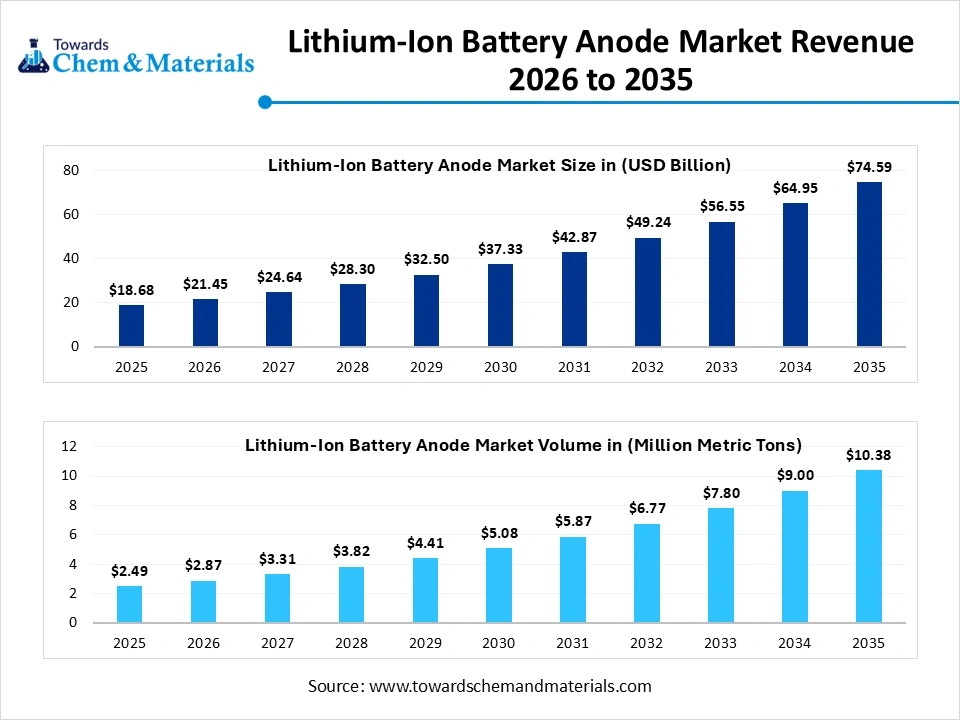
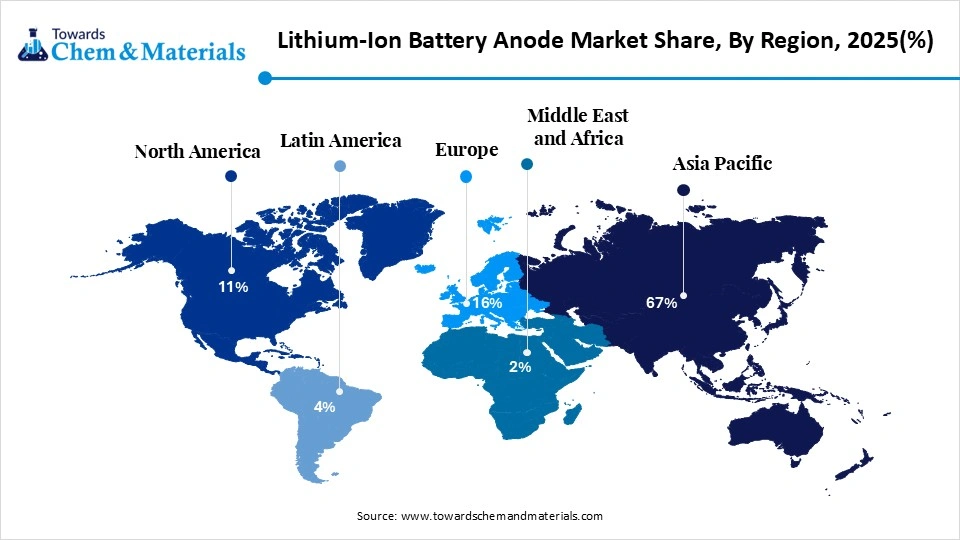
The lithium-ion battery anode market size was valued at USD 18.68 billion in 2025, is estimated to reach USD 21.45 billion in 2026, and is projected to reach USD 74.59 billion by 2035, exhibiting a compound annual growth rate (CAGR) of 14.85% over the forecast period from 2026 to 2035.Asia Pacific dominated the lithium-ion battery anode market with the largest revenue share of 67% in 2025 and is expected to grow at the fastest CAGR of 14.93% during the forecast period. Battery manufacturing activities, continuous innovations in battery materials, expanding adoption of electric mobility, and growing energy storage deployment are driving momentum. Anode technologies that enhance battery efficiency and charging capabilities, durability, and overall competitiveness of global battery production ecosystems drive market growth.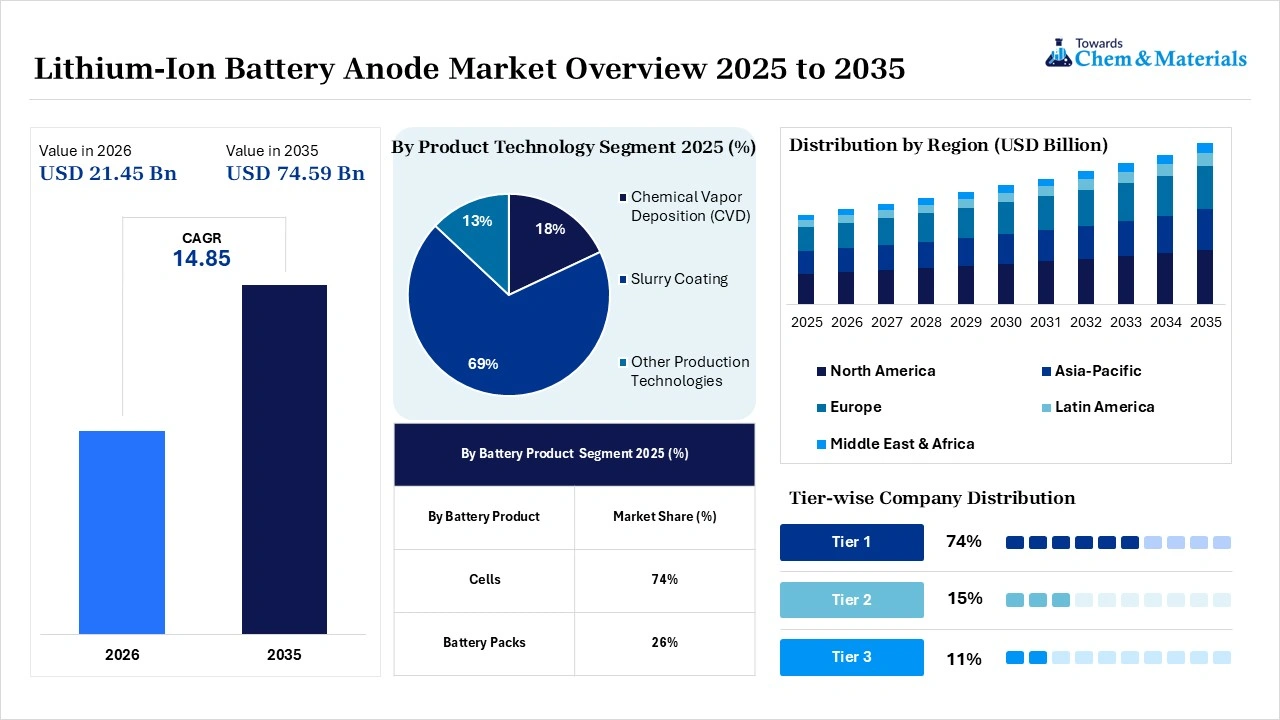
Market Highlights
- By region, Asia Pacific dominated the lithium-ion battery anode market by holding 67% share in 2025 and is expected to grow at a CAGR of 14.2% during the forecast period.
- By region, North America held 11% market share in 2025 and is expected to grow at the fastest rate with a CAGR of 15.9% during the forecast period.
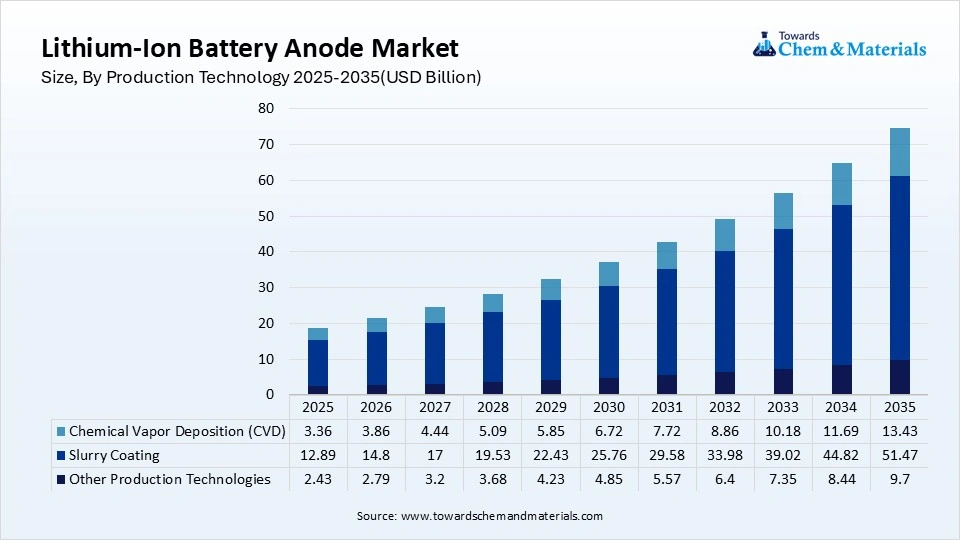
- By production technology, the slurry coating segment dominated the market with the largest share of 69% in 2025 and is expected to grow at a CAGR of 14.2% during the forecast period.
- By production technology, the chemical vapor deposition (CVD) segment held 18% market share in 2025 and is expected to grow at the fastest CAGR of 17.8% over the forecast period.
- By battery product, the cells segment dominated the market with the largest share of 74% in 2025 and is expected to grow at a CAGR of 15.2% during the forecast period.
- By battery product, the battery packs segment held 26% market share in 2025 and is expected to grow at the fastest CAGR of 16.1% over the forecast period.
- By material, the active anode materials segment dominated the market with the largest share of 92% in 2025 and is expected to grow at a CAGR of 11.6% during the forecast period.
- By material, the anode binders segment held 8% market share in 2025 and is expected to grow at the fastest CAGR of 15.1% over the forecast period.
- By end-use, the automotive segment dominated the market with the largest share of 81% in 2025 and is expected to grow at a CAGR of 12.2% during the forecast period.
- By end-use, the non-automotive segment held 19% market share in 2025 and is expected to grow at the fastest CAGR of 15.4% over the forecast period.
According to Towards Chemicals and Materials Analytics and Consulting, the global lithium-ion battery anode market volume was valued at 2.49 million metric tons in 2025 and is expected to surpass around 10.38 million metric tons by 2035, accelerating a compound annual growth rate (CAGR) of 15.35% over the forecast period from 2026 to 2035.
Promote Continuous Material Innovation to Advance Battery Performance
The demand for advanced graphite and silicon-based anode materials is further driven by increased production of EVs and a larger expansion of energy storage deployment. Companies are putting money into new binders, optimized slurry formulations, advanced production technologies, and high-purity active materials to improve battery reliability and consistent manufacturing. More cross-collaboration among material suppliers, battery manufacturers, and technology developers also drives innovation across the industry. Ongoing R&D efforts will continue to promote the development of next-generation anode materials with enhanced conductivity, durability, and energy efficiency for various battery applications.
- In May 2026, Trinseo announced that it launched a water-based SBR binder for graphite and silicon-based lithium-ion battery anodes, known as VOLTABOND 211, that passed validation testing with a 4 Ah pouch cell configuration with its unique features: reduced electrode surface resistivity, lower direct current internal resistance, and improved electrode distribution.(Source: https://chargedevs.com)
Global Investment Movement for the Lithium-Ion Battery Anode Market
Manufacturers keep investing in scaling up the production capacity of advanced anode materials and enhancing the graphite processing efficiency, silicon integration, and manufacturing uniformity. The industry continues to invest in research activities aimed at developing advanced binders, optimizing slurry composition, and improving conductivity and performance.
- Material innovations are still at the heart of the development of reliable anode technologies for next-generation electric mobility and energy storage applications all over the world.
- Investments for battery makers are increasingly focused on investments that support advanced production technologies, such as improvements in slurry coating and chemical vapor deposition.
Report Scope
| Report Attributes | Details |
| Market Size in 2026 | USD 21.45 Billion/ 2.87 Million Metric Tons |
| Expected Size in 2035 | USD 74.59 Billion/ 10.38 Million Metric Tons |
| Growth Rate | CAGR of 14.85% |
| Base Year of Estimation | 2025 |
| Forecast Period | 2025-2035 |
| Dominant Region | Asia Pacific |
| Segment Covered | By Production Technology, By Battery Product, By Material, By End Use, By Region |
| Key Companies Profiled | POSCO Future M, Mitsubishi Chemical Group, BTR New Material Group, Tokai Carbon, Himadri Speciality Chemical, Shanshan Technology, Resonac, SGL Carbon |
Recent Market Trends
- As manufacturers strive to meet increased demands for lithium battery charging capacity, higher energy density, higher efficiency, and more advanced battery technologies in both automotive and energy storage uses, they are increasingly relying on silicon-based materials for the lithium battery anode.
- Developers of battery materials keep developing water-based binder solutions to ensure the uniform properties of the slurry and increase the sustainability of the manufacturing process while maintaining high battery production standards.
- Manufacturing technologies for slurry coating and chemical vapor deposition are still making improvements to provide better quality electrodes and commercial-scale capacity to produce lithium-ion batteries.
- Collaborative programs for the development of new materials, such as advanced anode materials, refined production routes, and enhanced battery performance, are being increasingly strengthened by material suppliers.
Key Technological Shifts and AI in the Lithium-Ion Battery Anode Market
Speeding up AI and Technological Innovation for Lithium-Ion Battery Anode Manufacturing
From material development to production monitoring, process optimization, and quality management, AI technologies are increasingly helping to support lithium-ion battery anode production in manufacturing. Digital technologies are also helping manufacturers to test material properties and increase the efficiency of production, and enhance quality assurance in battery component manufacture. Technology-driven manufacturing also allows for better electrode distribution, conductivity, and reduced internal resistance, and facilitates reliable commercial production. The constant innovation in material engineering, manufacturing technologies, and intelligent production systems further contributes to the competitiveness in the dynamic lithium-ion battery anode market.
Supply Chain Analysis of the Lithium-Ion Battery Anode Market
Feedstock Procurement
- The raw materials for the production of the anode of lithium batteries come from natural graphite, synthetic graphite, silicon precursors, and other raw materials.
- Guaranteeing the supply of raw materials guarantees stability of quality and uninterrupted manufacturing operations.
- BTR New Energy Materials: BTR New Energy Materials acquires high-quality natural and synthetic graphite from all over the world. It has a broad sourcing base, ensuring reliable supplies of raw materials for battery companies.
- Other Key Players: Shanshan, POSCO Future M, Rio Tinto.
Chemical Synthesis and Processing
- The raw materials are purified, shaped, and graphitized to obtain battery-grade anode materials.
- This step enhances the purity, conductivity, and structural stability of materials, which is crucial for the development of high-performance batteries.
- POSCO Future M: The advanced graphitization technologies used in the production of high-purity synthetic graphite by POSCO Future M convert the precursor materials.
- Other Key Players: BTR, Hitachi Chemical (Resonac), Mitsubishi Chemical.
Compound Formulation and Blending
- The conducting additives, binders, and solvents are mixed with the active anode material to form a uniform slurry.
- Good formulation results in better adherence, uniformity of coatings, and battery performance.
- LG Energy Solution: LG Energy Solution prepares superior high-density anode slurry formulations that are optimized in material ratios. Its technologies enhance the quality and efficiency of electrode manufacturing in battery manufacturing.
- Other Key Players: SK On, Panasonic, Contemporary Amperex Technology Co. Limited (CATL).
Sustainability Analysis of the Lithium-Ion Battery Anode
As battery manufacturers work to boost production efficiency and maximize the use of materials, sustainability is emerging as a key consideration throughout the lithium-ion battery anode market. Advanced manufacturing processes are being used that minimise waste and ensure uniformity of anode material quality in the production of batteries. The industry is also promoting water-based binder systems and high-performance material formulations that will aid in cleaner manufacturing.
What is the Lithium-Ion Battery Anode?
The negative electrode of a lithium-ion battery, the lithium-ion battery anode, stores and releases lithium ions during battery charging and discharging cycles, allowing for efficient and stable battery operation, enhanced conductivity, and robust electrochemical performance in a variety of applications.
Uses of the Lithium-Ion Battery Anode
Lithium-ion battery anodes provide safe and efficient energy storage, charging, and operational life for passenger EVs, commercial EVs, and electric 2- and 3-wheelers for growing applications in transportation.In stationary energy storage systems, advanced anode materials enable reliable battery operation, higher charging efficiencies, stability, and energy retention to facilitate grid stability and integration of renewable power.Portable electronic devices that use compact, lightweight, and high-performance rechargeable battery technology for prolonged daily use benefit from the lithium-ion battery efficiency, charging capability, and reliability in operation.Industrial battery systems are based on high-performance anode materials for reliable power supply, stable operation, and energy storage to meet the requirements of industrial manufacturing, logistics, and industrial commercial equipment in different fields.
In advanced aerospace and marine battery systems, the anodes of lithium-ion batteries enable reliable performance, energy efficiency, long service life, and electrochemical stability in specific transportation and industrial applications.
Pricing Analysis for the Lithium-Ion Battery Anode Market
The pricing of the anode market for lithium batteries is influenced by the availability of raw materials, the complexity of the processing, the scale of the manufacturing, and the fluctuations in the supply and demand situation in battery production all over the world. Natural and synthetic graphite remain the key cost drivers, whereas silicon-based materials have an increased processing cost due to the specific manufacturing needs. The overall production costs are greatly affected by the method of purification, the graphitisation, and the chemical processing of the raw materials used for batteries.
Lithium-Ion Battery Anode Market: Global Trade Analysis
The global trade of lithium-ion battery anode continues to be affected by rising production of electric vehicles, growth in energy storage deployments, and rising demand for advanced battery materials. Commercial materials still rely mainly on synthetic and natural graphite; however, silicon and lithium metal are emerging as potential alternatives. The stability of raw material supply, processing efficiency, regional trade laws, and secure cross-border supply chains are vital to making international trade possible, while allowing for uninterrupted battery production activity.
Regulatory Framework: Lithium-Ion Battery Anode Market
| Country Region | Regulatory Body | Key Regulations | Focus Areas |
| Asia Pacific | MIIT Chin | China GB/T Standard | Looks after domestic standards and comprehensive lifecycle rules for battery components. |
| North America | U.S. Department of Energy (DOE | U.S. DOT Hazardous Materials Regulation | Sourcing transparency, reducing foreign entity of concern (FEOC) dependency for the critical anode mineral |
| European Union | European Chemicals Agency (ECHA | EU Battery Regulation (EU 2023/1542 | Mandatory carbon footprint declarations, strict ESG supply chain rules |
Market Dynamics
Driver:Surging Electric Vehicle and Energy Storage Sales
The Lithium-ion battery Anode market is driven by the growing usage of Electric Vehicles (EVs) and the widespread deployment of Energy Storage Systems (ESS) that rely on the requirement for reliable and high-performing battery components. In a continuous effort to improve conductivity, charging efficiency, and operational durability, manufacturers are continually working to advance their graphite, silicon-based materials, and binders. The expansion of battery production plants and the development of new materials are also driving the demand for high-quality anode materials.
Restraint : Complex Processing Requirements and Raw Material Dependence Challenge Market Expansion
Some of the advanced anode materials need special purification, graphitization, and processing technologies in advance of commercial battery production, which hampers the lithium-ion battery anode market. Natural graphite, synthetic graphite, silicon, and other key materials also involve the presence of dependence on the supply chain of the production network, which brings complexity. Other factors affecting material supply and continuity of manufacture include regional processing concentration and trading conditions. These factors contribute to the complexity of the lithium-ion battery anode value chain.
Opportunity: Material Innovation Gives New Scenarios for Advanced Battery Technologies
Manufacturers seeking to create next-generation lithium-ion batteries that are more efficient, durable, and efficient for charging have a wide range of opportunities for continuous innovation in advanced anode materials. Commercialization of higher-quality battery components is being supported by more research that involves silicon-based materials, lithium-metal technologies, water-based binder systems, and optimized slurry formulations. The ongoing advancement of materials for use in automotive, energy storage, aerospace, marine, consumer electronics, and industrial equipment continues to drive material innovation. Technology and production efficiencies continue to provide positive opportunities for producers in an ever-changing lithium-ion battery anode market.
Segmental Insights
Production Technology Insights
The slurry coating segment dominated the market with the largest share of 69% in 2025 and is expected to grow at a CAGR of 14.9% over the forecast period, since it can uniformly distribute active materials, conductive additives, binders, and solvents throughout battery electrodes. This process helps to ensure the quality of the electrodes, better adhesion, reliable conductivity, and efficient manufacturing processes in large quantities. As manufacturers continue to improve slurry preparation techniques, the precision of coating and production stability, and battery performance are still being improved. It also has excellent compatibility with product manufacturing processes in the industry, which will further promote its large-scale penetration in the automotive, industrial, and energy storage battery manufacturing industries.
- For instance, in April 2026, ViscoTecs first mobile material preparation system for homogeneous and consistent coating of battery electrodes for lithium-ion batteries was introduced, providing consistent coating of battery electrodes even in small-scale series production with the system called ViscoTreat-I Slurry.(Source: chargedevs.com)
The chemical vapor deposition (CVD) segment held the 18% market share in 2025 and is expected to grow at the fastest CAGR of 17.8% over the forecast period, due to its ability to deposit materials with controlled morphology, homogeneity, and quality of the electrode material for the manufacture of advanced lithium-ion batteries. This technology is being increasingly used by manufacturers to facilitate high-performance anode production and ensure precision, material uniformity, and consistent manufacturing results. Technology development supports next-generation battery materials with enhanced electrochemical properties in growing commercial applications, while continuing to enhance production efficiency.
Lithium-Ion Battery Anode Market Share,By Production Technology, 2025(%)
| By Production Technology | Market Share (%) |
| Chemical Vapor Deposition (CVD) | 18% |
| Slurry Coating | 69% |
| Other Production Technologies | 13% |
Battery Product Insights
The cells segment dominated the market with the largest share of 74% in 2025 and is expected to grow at a CAGR of 15.2% over the forecast period, as they are the primary energy storage element in various types of electric vehicles, energy storage systems, consumer electronics, aerospace and marine applications, and industrial equipment. The manufacturers keep on upgrading the performance of these cells by developing new anode materials, improving battery chemistry, and modifying the electrode manufacturing process. Ongoing material development ensures more reliable operations, better charging performance, and durability, plus better commercial battery production in various application fields.
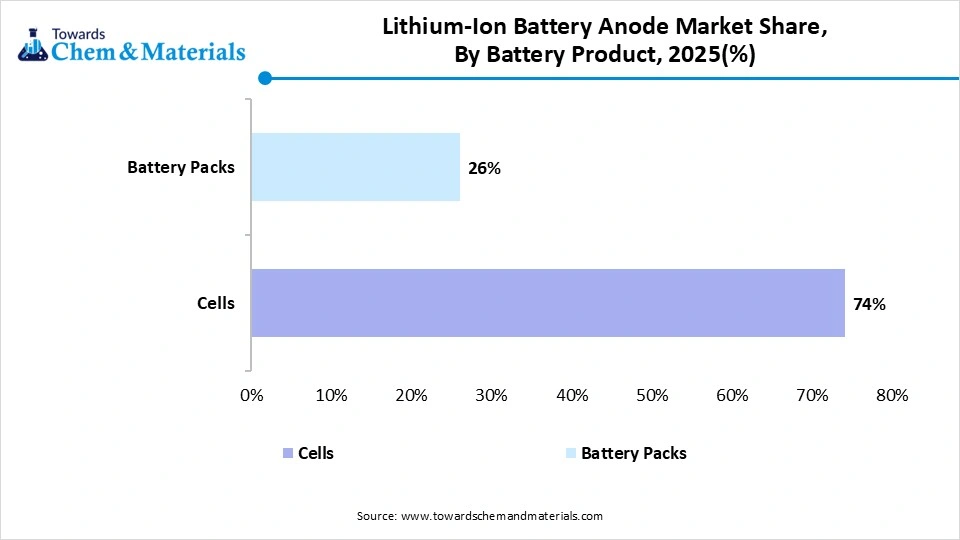
The battery packs segment held a 26% market share in 2025 and is expected to grow at the fastest CAGR of 16.1% over the forecast period, as they are combining several battery cells into an energy storage system for transportation, industrial equipment, and stationary market applications. The widespread adoption of electric mobility and renewable energy systems is driving the need for enhanced battery integration, thermal management, operational reliability, and longevity in battery systems. Further advances in battery architecture continue to bolster the growth of other commercial and industrial applications.
- For instance, in May 2026, Basquevolt commercialized the BQV400L battery cell based on a lithium-metal anode, polymer electrolyte, and NMC cathode, paving the way for the development of advanced battery pack technologies for commercial energy storage applications.(Source: www.electrive.com)
Lithium-Ion Battery Anode Market Share,By Battery Product, 2025(%)
| By Battery Product | Market Share (%) |
| Cells | 74.00% |
| Battery Packs | 26% |
Material Insights
The active anode materials segment dominated the market with the largest share of 92% in 2025 and is expected to grow at a CAGR of 11.6% over the forecast period, as they directly affect the battery capacity, conductivity, charging efficiency, and battery long-term operational performance. Manufacturers are still working on new natural graphite, synthetic graphite, silicon, and lithium-based materials for battery applications that offer better electrochemical capabilities. Throughout the production of modern Lithium-Ion Batteries, ongoing investments in material engineering further boost manufacturing consistency and overall operational reliability.
The anode binder segment held an 8% market share in 2025 and is expected to grow at the fastest CAGR of 15.1% over the forecast period, due to its ability to enhance the bond between active materials and current collectors, while retaining the structural integrity of the electrode during repeated charge-discharge cycles. The advanced binder technologies offer improved slurry stability, manufacturing consistency, conductivity, and long-term battery reliability. The increasing number of studies on water-based binder systems continues to promote sustainable manufacturing processes and better commercial battery manufacturing in a wider range of lithium-ion battery technologies.
- For instance, in June 2025, BASF introduced Oppanol N Plus, a high-performance polyisobutylene-based binder for next-generation batteries, such as solid-state batteries, to help increase battery production at The Battery Show Europe 2025 in Stuttgart.(Source: www.bestmag.co.uk)
Lithium-Ion Battery Anode Market Share,By Material, 2025(%)
| By Material | Market Share (%) |
| Active Anode Materials | 92.00% |
| Anode Binders | 8% |
End Use Insights
The automotive segment dominated the market with the largest share of 81% in 2025 and is expected to grow at a CAGR of 12.2% over the forecast period, as the top end-use market, due to the high energy density, reliable charging performance, and durability of lithium-ion batteries, as electric vehicles are put to use. Rising electrification of vehicles drives innovation in commercial electric vehicle anode materials, production technologies, and battery efficiency. Ongoing battery technology progress contributes to enhanced long-term performance and addresses the changing transport needs around the globe.
The non-automotive segment held a 19% market share in 2025 and is expected to grow at the fastest CAGR of 15.4% over the forecast period, as lithium-ion batteries are now being used for energy storage in the aerospace, marine, consumer electronics, and industrial sectors. As the market demand for reliable rechargeable energy storage increases, companies are striving to create innovative anode materials that offer greater efficiency, longevity, and stability. Ongoing developments in technology continue to reinforce its adoption in a variety of commercial and industrial applications.
Lithium-Ion Battery Anode Market Share,By End Use, 2025(%)
| By End Use | Market Share (%) |
| Automotive | 81% |
| Non-Automotive | 19% |
Regional Insights
How Did the Asia Pacific Dominate the Lithium-Ion Battery Anode Market In 2025?
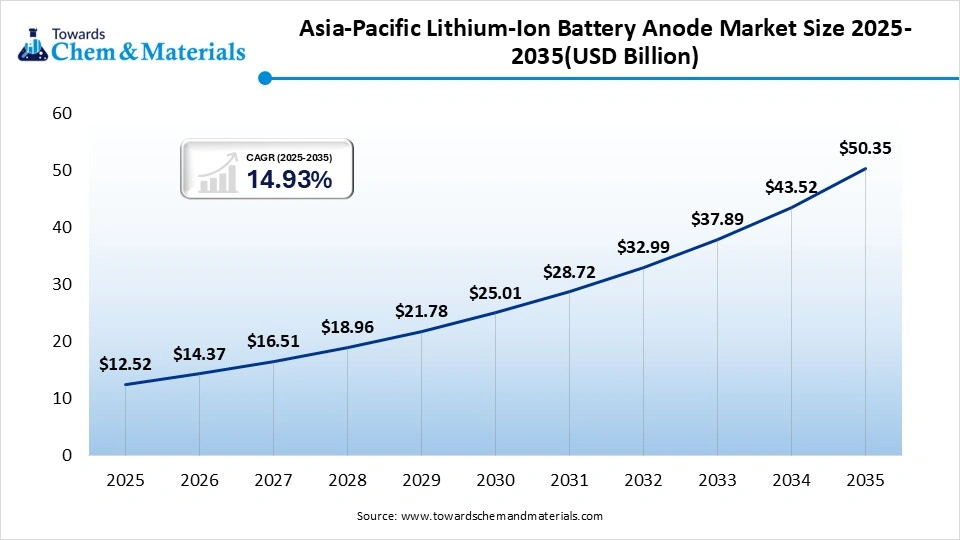
The Asia Pacific lithium-ion battery anode market size was estimated at USD 12.52 billion in 2025 and is projected to reach USD 50.35 billion by 2035, growing at a CAGR of 14.93% from 2026 to 2035.Asia Pacific dominated the market with the largest share of 67% in 2025 and is expected to grow at a CAGR of 14.2% during the forecast period, owing to a high battery manufacturing ecosystem, a well-established supply chain for the production of large-scale anode material, and integrated graphite processing capabilities. Ongoing technological developments, growing manufacturing facilities, and good cooperation between raw material suppliers, chemical companies, and battery manufacturers make the region attractive.
Strengthening Chinas Leadership in Battery Material Manufacturing
China, with its extensive battery manufacturing facilities and cutting-edge graphite processing capacity, continues to be a significant player in the regional market. The country has integrated supply chains that link the sourcing of raw materials, their processing, and battery production. Manufacturers are constantly upgrading production technologies and continuously developing the quality of natural and synthetic graphite anode materials.
Promoting the Battery Material Manufacturing Ecosystem in India
As manufacturing activities, technological development, and industry involvement in advanced battery manufacturing continue to grow, Indias battery material industry is growing steadily. Domestic manufacturers are developing material processing capabilities and are promoting innovation in battery components and anode materials. Sustained investments in manufacturing facilities and research and development efforts help ensure production efficiency and to enhance the value of the production chain.
North America
The North America lithium-ion battery anode market size was estimated at USD 2.05 billion in 2025 and is projected to reach USD 8.58 billion by 2035, growing at a CAGR of 15.39% from 2026 to 2035.North America held 11% market share in 2025 and is expected to grow at the fastest CAGR of 15.9% during the forecast period as investments in the manufacturing of domestic battery production and battery material manufacturing continue to rise, and critical mineral development is gaining traction in the region. The region has a set of enabling policy measures to advance sourcing transparency and manufacturing growth. Ongoing R&D, technological innovation, and battery material suppliers and manufacturers working together improve the competitiveness of the region and enable expanding demand in automotive, industrial, and stationary energy storage.
Enhance the United States Battery Manufacturing Industry
The U.S. is further developing its battery manufacturing sector by investing in new battery materials and domestic manufacturing capacity. Manufacturers concentrate on enhancing supply chain resilience and supporting innovation in battery technologies and anode material development. There are also regulatory steps in place to encourage sourcing transparency and secure supplies of critical minerals, further benefiting industrial growth.
Improving Canadas Capabilities For Advanced Battery Materials
Canada is also increasingly contributing to the development of the battery industry in the region, with its increased involvement in advanced material processing and battery-manufacturing activities. Battery materials are advancing with the help of strong collaboration among the industrial participants, which promotes technological development and production capacity. The sustainable manufacturing and development of the supply chain are becoming an increasingly important factor to ensure industrial competitiveness in the long-term.
Europe
The Europe lithium-ion battery anode market size was estimated at USD 2.99 billion in 2025 and is projected to reach USD 12.31 billion by 2035, growing at a CAGR of 15.20% from 2026 to 2035.Europe held 16% market share in 2025 and is expected to grow at a CAGR of 14.8% over the forecast period. The European Union is using a key focus on sustainable manufacturing, advanced material development, and a responsible battery supply chain to drive the lithium-ion battery anode market. Manufacturers are improving production technologies while meeting changing requirements for environmental and product sustainability. The cooperation among the battery manufacturers, material suppliers, and technology developers promotes innovation in advanced anode materials.
Supporting the development of the High-Performance Battery Material Industry in Germany
Germany is maintaining its leading position in advanced battery material manufacturing with excellent manufacturing capabilities, technological innovation, and collaborative research and development efforts. Manufacturers are focusing on high-quality production of anode materials and enhancing the performance and manufacturing efficiency of batteries. Cooperation between chemical companies, battery manufacturers, and material developers enables innovations and strengthens German capabilities in the EU lithium-ion battery anode market.
Enhancing Frances Sustainable Battery Manufacturing Landscape
France is working hard to boost sustainable manufacturing of batteries through more industrial development, more advanced material research, and greater cooperation between battery manufacturers and technology providers. Companies keep enhancing their manufacturing capabilities and continue to foster innovation in battery materials and manufacturing technologies. Focus on sustainable industrial processes and responsible development of the supply chain improves commercial battery manufacturing activities.
Latin America
The Latin America lithium-ion battery anode market size was estimated at USD 0.75 billion in 2025 and is projected to reach USD 3.36 billion by 2035, growing at a CAGR of 16.18% from 2026 to 2035.Latin America held 3% market share in 2025 and is expected to grow at a CAGR of 12.6% over the forecast period, as the region expands its industrial development, joins the battery material supply chain, and is interested in advanced battery manufacturing. The region is benefiting from the rising cooperation between material suppliers and battery manufacturers for commercial production. Industrial development and increased participation in the value chain in the battery materials sector continue to be strengthened with continuous improvement. The increasing attention on battery technologies further boosts the regions involvement in the developing global lithium-ion batteries market.
Enhancing Brazils Industrial Battery Material Development
Brazil still plays a significant role in the development of the battery industry in the region, as its industrial activities are expanding, as well as its involvement in the supply chains of battery materials. Manufacturers are still continuing to support advanced material production and promote the reduction of the entire battery manufacturing technology. Ongoing investment in battery industries and development of the battery supply chain further strengthen Brazils position in the growing lithium-ion battery anode industry and the larger battery manufacturing industry.
Increasing The Contribution of Chile to The Supply Chains of Batteries
Chile remains a key player in the global supply chains for battery materials, both by promoting industrial involvement and developing new partnerships with battery manufacturers and material suppliers. Advanced battery material production and processing activities benefit from stronger commercial opportunities with the growth of industrial development. Continuous investment in manufacturing capacities and the development of the supply chain boost regional competitiveness.
Middle East & Africa
The Middle East & Africa lithium-ion battery anode market size was estimated at USD 0.37 billion in 2025 and is projected to reach USD 1.86 billion by 2035, growing at a CAGR of 17.53% from 2026 to 2035.The Middle East & Africa held 3% market share in 2025 and is expected to grow at a CAGR of 11.8% over the forecast period. As the Middle East and Africa diversify their industries and invest more in battery material production, and as they become more active in global clean energy supply chains, lithium-ion battery anode sales are on the rise in the region. The production capabilities of manufacturers are advancing for producing materials for commercial batteries. Greater collaboration and development of technology among battery industry participants lead to industrial expansion and increased manufacturing efficiencies.
The Saudi’s Industrial Diversification Strategy
Saudi Arabia is still proactively promoting industrial diversification by fostering industry in the advanced manufacturing sector and increasing its involvement in clean energy industries. As more and more attention is given to industrial development, there are more chances for the development of battery materials and technology. R&D efforts of industry stakeholders contribute to manufacturing capacity building and better integration of the supply chain.
Enhancing the South African Battery Material Industry
South Africa is working towards further enhancing its battery material industry by building up industrial capacities, fostering multi-sector partnerships between manufacturing industries, and assisting battery material supply chains. Manufacturers keep enhancing their production capacity and are promoting technology development and industrial innovation. South Africas commitment to the regional supply of lithium-ion battery anode is further boosted by continued industrial progress, in addition to supporting long-term industrial development.
Recent Developments
- In June 2026, Oman announced a USD 1 billion plant to produce lithium-ion battery anode materials in Sohar Free Zone. Zhongke Electric started the construction work via its subsidiary, which will help to build overseas production capacity, promote economic diversification, and enhance the companys global capacity to produce lithium-ion battery anodes.m(Source: www.energetica-india.net )
- In May 2026, Epsilon Advanced Materials Pvt. Ltd. unveiled its Hard Carbon Anode material for grid-scale energy storage applications of Sodium-ion Batteries. The material, which was developed through in-house research, is graphite-free, improves commercial sodium-ion battery applications, and aids in the sustainable production of batteries.(Source: www.alchempro.com)
Competitive Analysis
The market for lithium-ion battery anode is highly competitive, with manufacturers emphasizing the growth in production capacity, power supply chain integration, and developing high-performance anode materials to enable next-generation battery technologies. Leading companies are still investing in natural graphite, synthetic graphite, silicon-based materials, and advanced binder solutions to enhance the efficiency, conductivity, and long-term operational performance of batteries. The competitive position of the industry is further strengthened with technological innovations in slurry coating, chemical vapor deposition, and advanced material engineering.
- For instance, in May 2026, Epsilon Advanced Materials Pvt. Ltd. (EAMPL) announced its introduction of a hard carbon anode material for sodium-ion batteries, catering to the increasing demand for grid-scale energy storage systems and also enabling the adoption of sustainable and alternative battery chemistries by developing advanced in-house materials.(Source: auto.economictimes.indiatimes.com)
- In April 2025, POSCO Group entered into a Memorandum of Understanding (MoU) with the Hyundai Motor Group (HMG) to further expand cooperation in the steel industry and in the secondary battery field as the worlds trading and economic environment continues to change.(Source: newsroom.posco.com)
Top Players in the Market & Their Offerings
| Company | Company Type/Position | Major Headquarters | Geographic Presence | Lithium-Ion Battery Anode Offerings | Key Strength |
| BTR New Material Group | Manufacture | Shenzhen, Chin | Global | Natural & Synthetic Graphite | Massive production scale |
| POSCO Future | Producer / Integrated Supply | Pohang, South Korea | Globa | Natural Graphite Anode | Full vertical integration linking raw material processing |
| Mitsubishi Chemical Group | Advanced Material Manufacture | Tokyo, Japan | Globa | Graphite Anode Material | High-purity carbon engineering |
Other Key Players
- POSCO Future M
- Mitsubishi Chemical Group
- BTR New Material Group
- Tokai Carbon
- Himadri Speciality Chemical
- Shanshan Technology
- Resonac
- SGL Carbon
Segment Covered in the Report
By Production Technology
- Chemical Vapor Deposition (CVD)
- Slurry Coating
- Other Production Technologies
- Dry Electrode Processing
- Plasma-Based Coating
- Electrophoretic Coating
By Battery Product
- Cells
- Cylindrical Cells
- Prismatic Cells
- Pouch Cells
- Battery Packs
- EV Battery Packs
- ESS Battery Packs
- Industrial Battery Packs
By Material
- Active Anode Materials
- Natural Graphite
- Synthetic Graphite
- Silicon
- Li-Compounds & Li-Metals
- Anode Binders
- PVDF
- SBR
- CMC
- Water-Based Binder Systems
By End Use
- Automotive
- Passenger Electric Vehicles
- Commercial Electric Vehicles
- Electric Two & Three Wheelers
- Non-Automotive
- Energy Storage
- Aerospace
- Marine
- Consumer Electronics
- Industrial Equipment
- Other
By Regions
- North America
- Europe
- Asia Pacific
- Middle East & Africa
- Latin America



Comments
Share your thoughts, ask a question, or provide feedback about this report.