Content
What is the Aluminum Plate Market Size and Share?
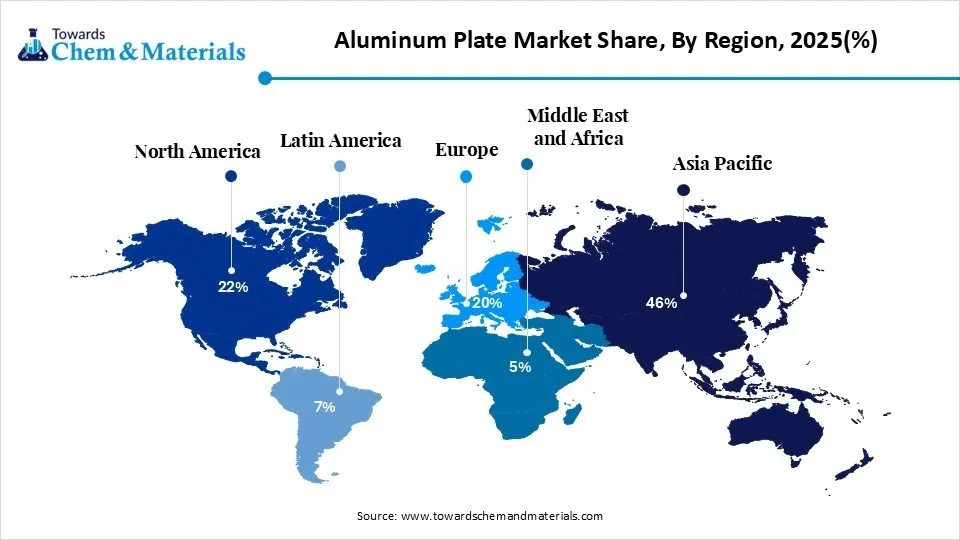
The global aluminum plate market size was valued at USD 70.10 billion in 2025, is estimated to reach USD 75.08 billion in 2026, and is projected to reach USD 139.32 billion by 2035, exhibiting a compound annual growth rate (CAGR) of 7.11% over the forecast period from 2026 to 2035. Asia Pacific dominated the aluminum plate market with the largest revenue share of 46% in 2025 and is expected to grow at the fastest CAGR of 7.22% during the forecast period.
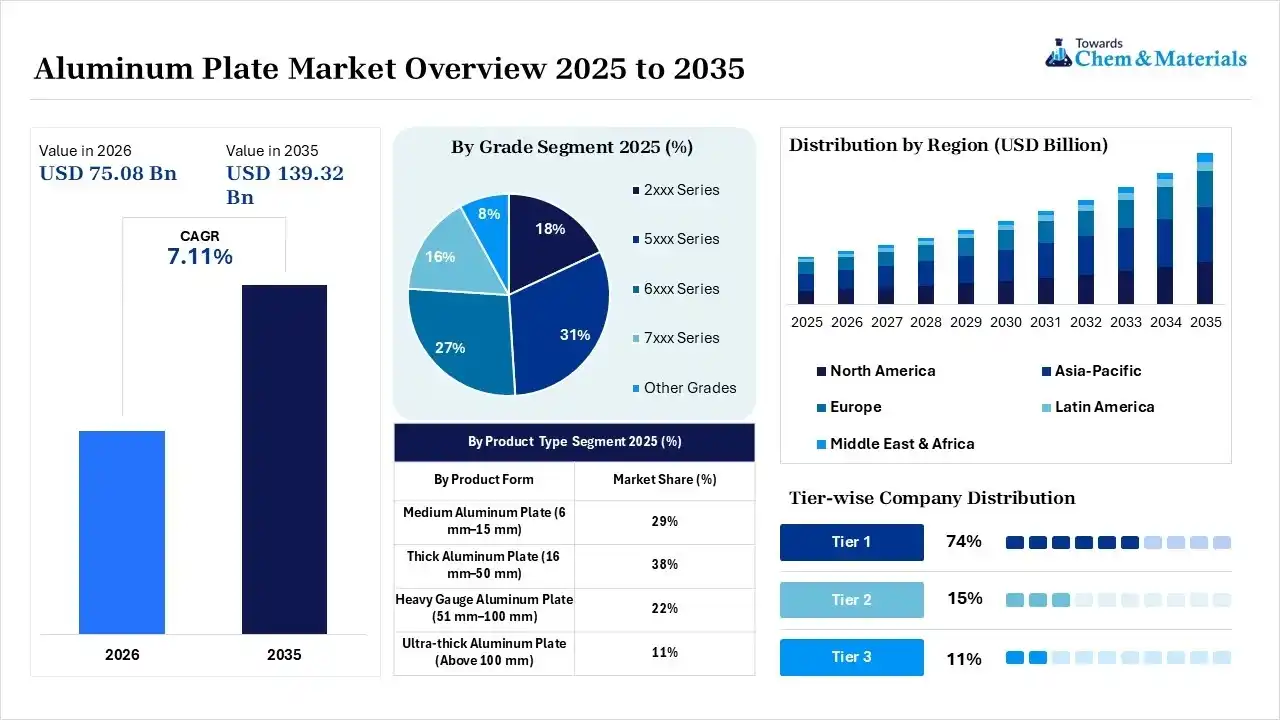
The trend toward EVs, ongoing development of high-strength aluminum alloys, growing recyclability programs, and investment in cutting-edge manufacturing technologies are all promoting the high use of aluminum plates in a variety of industrial applications. The market is fueled by the rising application of lightweight materials in the transportation industry (automotive, aerospace, defense, and infrastructure).
Key Takeaways
- By region, Asia Pacific dominated the aluminum plate market by holding 46% share in 2025 and is expected to grow at a CAGR of 5.9% during the forecast period.
- By region, North America held 22% market share in 2025 and is expected to grow at the fastest with a CAGR of 7.3% during the forecast period.
- By grade, the 5xxx series segment dominated the market with the largest share of 31% in 2025 and is expected to grow at a CAGR of 6.4% during the forecast period.
- By grade, the 6xxx series segment held 27% market share in 2025 and is expected to grow at the fastest CAGR of 7.2% over the forecast period.
- By product form, the thick aluminum plate (16 mm–50 mm) segment dominated the market with the largest share of 38% in 2025 and is expected to grow at a CAGR of 6.6% during the forecast period.
- By product form, the heavy gauge aluminum plate (51 mm–100 mm) segment held 22% market share in 2025 and is expected to grow at the fastest CAGR of 7% over the forecast period.
- By end use, the aerospace & defense segment dominated the market with the largest share of 30% in 2025 and is expected to grow at a CAGR of 6.7% during the forecast period.
- By end use, the automotive & transportation segment held 22% market share in 2025 and is expected to grow at the fastest CAGR of 7.5% over the forecast period.
According to Towards Chemicals and Materials Analytics and Consulting, the global aluminum plate market volume was valued at 19.06 million metric tons in 2025 and is expected to surpass around 34.20 million metric tons by 2035, accelerating a compound annual growth rate (CAGR) of 6.02% over the forecast period from 2026 to 2035.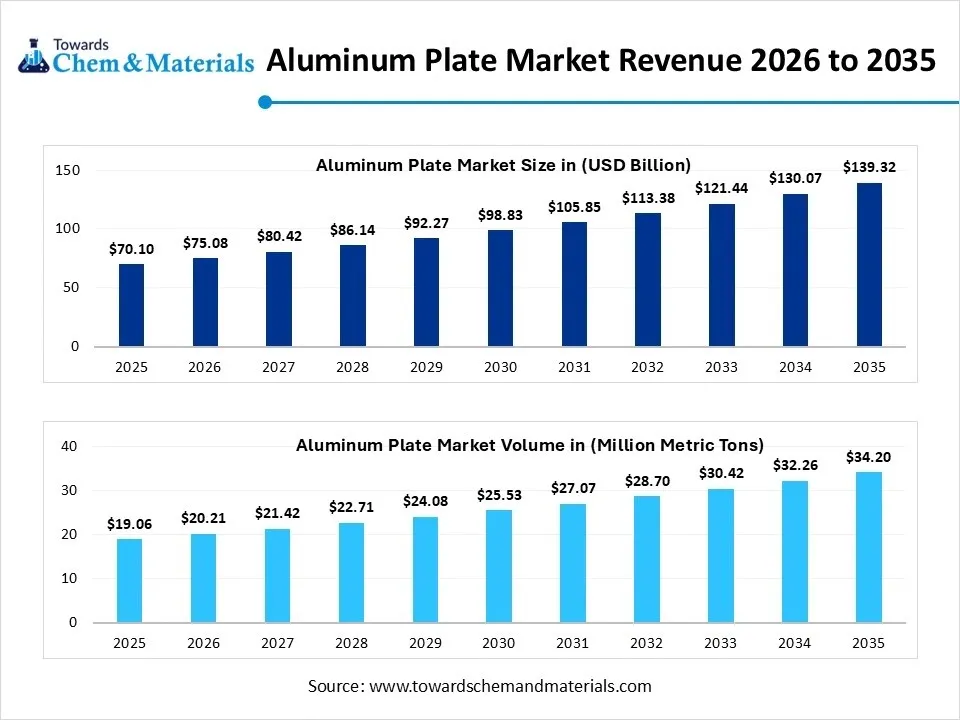
Expanding Lightweight Manufacturing Across Industrial Applications
As the demand for lightweight, durable, and corrosion-resistant materials continues to rise in various industries, the aluminum plate market is undergoing continuous growth. The battery enclosure, chassis, and structural parts of electric vehicles are increasingly being made using aluminum plates to enhance the efficiency and driving range of the vehicle. The demand for high-strength aluminum plates is still growing in the aerospace and defense sector due to the high strength-to-weight ratio, and in infrastructure, building panels, bridges, and solar panel frames are still in demand. Participants are also working on sustainable recycling technologies and new alloy development to enhance product performance and lower production costs. Market competitiveness is enhanced by integrated manufacturers, regional producers, and specialized companies, providing a variety of industrial demands and aluminum plate solutions.
- For instance, in November 2025, Kaiser Aluminum Corp. finished a $25 million expansion at its Trentwood rolling mill to increase its heat-treatment capacity and ramp up production by 5%. This investment enhances the companys capacity to offer high-quality flat-rolled aluminum products for the aerospace, automotive, and engineering sectors, and to ensure ongoing manufacturing growth over time.(Source:www.spokanejournal.com)
Global Investment Movement for the Aluminum Plate Market
Investment has shifted towards greater production of ultra-thick aluminum plates (above 100 mm) in 7xxx series alloys. The investments are aimed at increasing demand for lightweight, high-performance materials in aircraft structures, military equipment, and high-end defense applications. Companies are developing high-end rolling lines for very formable 5xxx and 6xxx series aluminum. These investments help prepare for the growing production of EVs and will help to streamline the manufacturing of battery enclosures, crash-management assemblies, and lightweight structural components.
Multi-million dollar capital investments in aluminum plate production for data centers, new solar framing systems, and advanced semiconductor equipment. The expansion of clean energy projects and digital infrastructure continues to provide high-quality aluminum plate manufacturers with long-term opportunities. Manufacturers are investing in advanced processing technologies and specialized manufacturing equipment to boost product quality, process efficiency, and customization of aluminum plates. These investments enhance competitiveness and enable a variety of industrial applications that demand precision-engineered materials.
Market Trends
- Auto makers are shifting from heavier components to aluminum plates for battery covers, chassis, and body structure to make their vehicles more efficient and have a longer range. The shift further boosts the demand for aluminum in the fast-growing electric mobility market.
- Aircraft modernization and defense enhancements are driving the demand for high-strength aluminum plates that are capable of withstanding extreme operating conditions. Manufacturers are still working on lighter-weight options that provide enhanced structural performance and durability with continued reliability.
- Aluminium manufacturers are focusing on recycled aluminium to lower energy use and carbon emissions. With the continued growth of environmental regulations and sustainability projects, “circular” manufacturing is ongoing, and resource efficiency is increasing throughout aluminum plate manufacturing.
- Manufacturers are turning to new alloy compositions and developing new manufacturing technologies to create stronger, more formable aluminum plates. The developments enable more sophisticated applications in the fields of automotive, aerospace, infrastructure, and industrial manufacturing.
Report Scope
| Report Attributes | Details |
| Market Size in 2026 | USD 75.08 Billion/ 20.21 Million Metric Tons |
| Expected Size in 2035 | USD 139.32 Billion/ 34.20 Million Metric Tons |
| Growth Rate | CAGR of 7.11% |
| Base Year of Estimation | 2025 |
| Forecast Period | 2025-2035 |
| Dominant Region | Asia Pacific |
| Segment Covered | By Grade, By Product Form, By End-use Industry, By Region |
| Key Companies Profiled | Hindalco Industries (HINDALCO), Vedanta Aluminium, National Aluminium Company Limited (NALCO), Bharat Aluminium Company (BALCO), Jindal Aluminium, RUSAL, Rio Tinto, Kobelco (Kobe Steel), Kaiser Aluminium, AMAG Austria Metall, Alimex, Nanshan Aluminium, Mingtai Group |
What is an aluminum plate?
The aluminum plate is a flat-rolled aluminum product with various grades, thicknesses, and finishes to satisfy different requirements in industry. Advanced production methods are employed to make these plates, which are used in a variety of applications, including aerospace, defense, automotive, transportation, construction, electronics, packaging, and industrial. They are also valuable replacements for heavier materials because of their resistance to corrosion, strength, easy recycling, and fabricability. The aluminum plates are available in various types, such as plain, perforated, tread, anodized, and clad plates for special applications with higher durability, performance, and design requirements.
Types of the Aluminum Plate
- Plain Aluminum Plates: These are used in a wide variety of general-purpose applications, as they have a simple design and can be produced in different thicknesses and sizes. They are used extensively in structural parts, machine parts, and ordinary processing, in which the requirement is for lightweight strength and easy processing.
- Perforated Aluminum Plates: Perforated aluminum plates are made with evenly spaced holes or decorative designs to improve ventilation, filtration, and aesthetics. They are used in a variety of applications such as HVAC systems, filtration screens, acoustic panels, and architectural applications that need airflow, functionality, and aesthetically pleasing surface finishes.
- Tread Aluminum Plates: These aluminum plates feature raised surface patterns for enhanced grip, durability, and slip resistance in challenging conditions. Typically used in industrial floors, stair treads, loading platforms, and walkways, where safety and durability are paramount.
- Anodized Aluminum Plates: Anodized aluminum plates are plates that are treated with electrochemistry to enhance corrosion resistance, surface hardness, and decoration. They are widely utilized in architectural facades, consumer electronics, and automotive trims, and where greater durability, beauty, and weather resistance are desired.
- Clad Aluminum Plates: Aluminum plates with a core material, which is bonded with aluminum alloy layers, have strong strength and durability. The main applications for these plates are in aircraft parts, military vehicles, and heavy-duty industrial equipment, where structural integrity and reliability are paramount under harsh conditions.
Benefits of the Aluminum Plate
- Lightweight Material for Increased Efficiency:Aluminum plates have a lightweight attribute, which is beneficial in transportation, aerospace, and industrial use to minimize the weight on the entire structure. Their lighter weight when compared to heavy materials allows them to have better energy efficiency, fuel usage, and performance in vehicles, aircraft, and other applications that demand weight reduction.
- Excellent Corrosion Resistance:The Aluminium plates are aluminum plates have a natural oxide film, which enhances the anti-corrosion properties of the plates by resisting corrosive agents from air and moisture. This property allows for extended service life in buildings, transportation, marine, and industrial applications that demand durability and low maintenance.
- High Strength and Durability:Aluminum plates give excellent mechanical strength and are also lightweight. Their high resistance to stress, harsh environments, and demanding operating conditions makes them ideal for use in aircraft, space vehicles, motor vehicles, and engineering applications where structural integrity in demanding applications is essential.
- Easy Fabrication and Processing:They can be easily cut, welded, shaped, molded, etc., into various designs as per the application. They are processed flexibly, which makes it easy to manufacture them in different industries, such as construction, transportation, electronics, and the production of industrial equipment.
Applications of Aluminum Plate:
- Transportation Components:The lightweight and durable properties of aluminum plate make it a wide application in the automotive, aircraft, and marine industries. These materials are useful for manufacturers to create effective transportation systems by lowering the weight of structures without compromising the strength and performance of the systems.
- Construction Structures:The aluminum plates are used to make panels, bridges, roofing plates, walls, etc., because of their properties of being strong, corrosion-resistant, and lightweight. They are highly durable and easy to fabricate, making them ideal for building infrastructure and architecture.
- Electronic Cooling Systems: The properties of aluminum plates, such as thermal conductivity, make them suitable for use as heat sinks in electronics. They regulate the temperature of electronic devices, such as computers, servers, and various other machines, to ensure efficient performance and the reliability of electronic components.
- Packaging Applications: Aluminum plates are employed in packaging applications, as well as in the food and medicine industries, because of their protective property. They prevent air from getting in and offer consistent material properties for products that demand safety, durability, and preservation properties.
- Industrial Equipment Manufacturing: The strength and versatility of aluminum plates make them suitable for use in a variety of machinery parts, structural components, and specialized equipment. They are able to withstand harsh conditions, making them suitable for long-lasting and versatile material solutions.
Key Technological Shifts and AI in the Aluminum Plate Market
Artificial intelligence and advanced manufacturing tech are changing how aluminum plates are made. They help with operational efficiency, better product quality, and smarter use of resources. With AI-driven alloy design, engineers can craft specialized aluminum compositions that fit the strict needs of aerospace and automotive work. Smart melting methods then blend real-time sensor data with physics-based modeling so the heating steps get optimized, energy use drops, and the metal doesn’t degrade as much. At the same time, computer vision setups keep watching aluminum plates while they are being produced, so defects get spotted instantly. That makes quality control tighter and wastes less.
Predictive maintenance tools also dig into how equipment is performing, which cuts down on unexpected stoppages instead of waiting until something breaks. And AI-powered recycling tech can automatically sort aluminum scrap, so recovered material stays high quality, not compromised. Overall, these upgrades push manufacturing productivity up, and they support more sustainable aluminum plate production.
Supply Chain Analysis of the Aluminum Plate Market
Feedstock Procurement
- The supply chain starts with the procurement of key raw materials—such as bauxite, alumina, and recycled aluminum scrap.
- The consistent supply of high-quality feedstock for aluminum plate production is guaranteed by the reliable sourcing of these materials.
- Rio Tinto: Aluminium Division’s bauxite business is sourced from its worldwide mining activities, while the alumina is sourced for producing aluminium, ensuring a reliable and integrated raw materials supply chain.
- Other Key Players: Alcoa, Vedanta, and CHALCO.
Chemical Synthesis and Processing
- The raw bauxite is subjected to the Bayer process to produce high-purity alumina, and then the primary aluminum is produced by the Hall-Héroult smelting process.
- The production stages provide the basic building blocks for aluminum plate production.
UC RUSAL: Produces alumina and supplies high-quality materials for manufacturing industrial aluminum plates, as well as primary aluminum, foundry alloys, and ingots. - Other Key Players: Emirates Global Aluminium (EGA), Norsk Hydro, Hindalco Industries.
Formulation And Casting
- Alloying elements, like copper and magnesium, are mixed in with the molten aluminum to create specific mechanical and chemical properties.
- The alloy is then molded into rolling ingots or slabs for additional processing into aluminum plates.
Hindalco Industries: Formulates unique compositions of aluminum alloys according to the various performance requirements of the industrial applications. - Other Key Players: Constellium, Arconic, UACJ Corporation
Regulatory Framework: Aluminum Plate Market
| Country Region | Regulatory Body | Key Regulations | Focus Areas |
| Asia Pacific | Bureau of Indian Standards (BIS) | IS 736:1986 (Wrought aluminum and alloy plates for general engineering) | Material composition, properties, dimensional tolerances, and mandatory ISI Mark licensing |
| North America | ASTM International | ASTM B209 (Aluminum and Alloy Sheet and Plate) | Alloy composition, temper limits, and finish standards |
| European Union | European Commission | REACH Regulation (EC) No 1907/2006) | Chemical restrictions (e.g., heavy metals) and food contact safety compliance |
Market Dynamics
Driver: Increasing Lightweight Material Adoption in Transportation
Aluminum plates are in demand worldwide, as light industries are adopting such materials. With a goal of lower weight and longer driving range, automakers are increasingly using aluminum plates to manufacture EV battery cases and chassis. Aluminium plates are also used in the aerospace and defense industry because of their high strength-to-weight ratio. The market growth of aluminum plates is continuing on the back of growing demand for fuel-efficient cars, better design of aircraft, and long-lasting transportation structures in various applications.
Restraint: High Energy Consumption During Production
The high energy consumption in the aluminum plate production process poses difficulties to market expansion. It includes energy-intensive operations such as aluminum smelting and rolling that consume a lot of electricity. Increasing energy costs can raise manufacturing expenses and impact overall production economics. These challenges prompt manufacturers to keep looking for new energy-saving processing technologies and sustainable manufacturing practices to stay competitive in the face of the pressures of operational costs.
Opportunity: Development of Advanced Aluminum Alloys
Advanced Alloys offer good market opportunities. Superhard aluminum plate grades are being developed, especially 7xxx series alloys, to enhance safety, strength, and performance in challenging applications. The materials are used in the manufacturing of various components for the defense, aerospace, automotive, and engineering industries, where they are required to withstand high stresses and stand up to wear and tear while simultaneously contributing to the overall strength and structural integrity of the aircraft.
Segmental Insights
Grade Insights
The 5xxx series segment dominated the market with the largest share of 31% in 2025 and is expected to grow at a CAGR of 6.4% over the forecast period because of its applications in various industries that demand durable and lightweight aluminum. These corrosion-resistant aluminum plates are used when strength and reliability are required in challenging applications. The transportation, manufacturing, and industrial segments continue to drive the growth of the utilization segment. With the greater demand for 5xxx series aluminum plates in different end-use markets, coupled with a growing focus on lightweight engineering solutions and advanced material specifications, the market for 5xxx series aluminum plates is projected to rise at a robust pace.
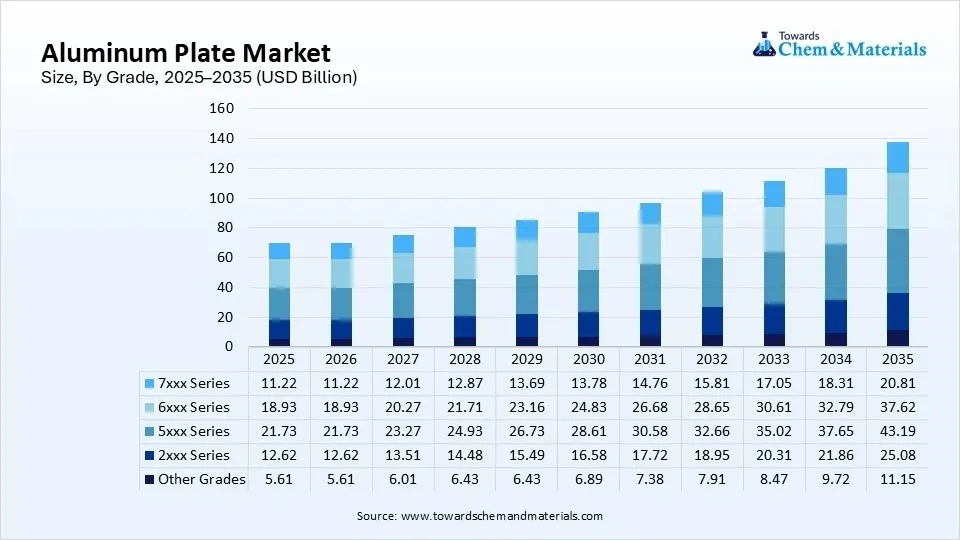 The 6xxx series segment held a 27% market share in 2025 and is expected to grow at the fastest CAGR of 7.2% over the forecast period, due to the demand for aluminum plates with better strength, formability, and performance characteristics, which is growing, resulting in strong growth for the 6xxx series segment. The materials are becoming more and more popular in applications where lightweight construction and structural reliability are crucial. Market growth is bolstered by the adoption of growing use in automotive, transportation, and industrial manufacturing. The extensive development of aluminum processing techniques and growing demand for effective material solutions are driving the use of 6xxx series plates in more sophisticated applications that demand durability and design flexibility.
Aluminum Plate Market Share, By Grade, 2025 (%)
| By Grade | Market Share (%) |
| 2xxx Series | 18% |
| 5xxx Series | 31% |
| 6xxx Series | 27% |
| 7xxx Series | 16% |
| Other Grades | 8% |
Product Form Insights
The thick aluminum plate (16 mm–50 mm) segment dominated the market with the largest share of 38% in 2025 and is expected to grow at a CAGR of 6.6% over the forecast period, as it has extensive applications in those areas that demand improved structural strength and stability. They are used in various industries, including aerospace, defense, industrial equipment, and construction, where their durability and resistance to harsh environments are essential. They offer high reliability, along with lightweight benefits, which make them well-suited to high-level manufacturing applications. Thick aluminum plates are still well supported by continuous industrial development and rising demand for robust aluminum solutions.
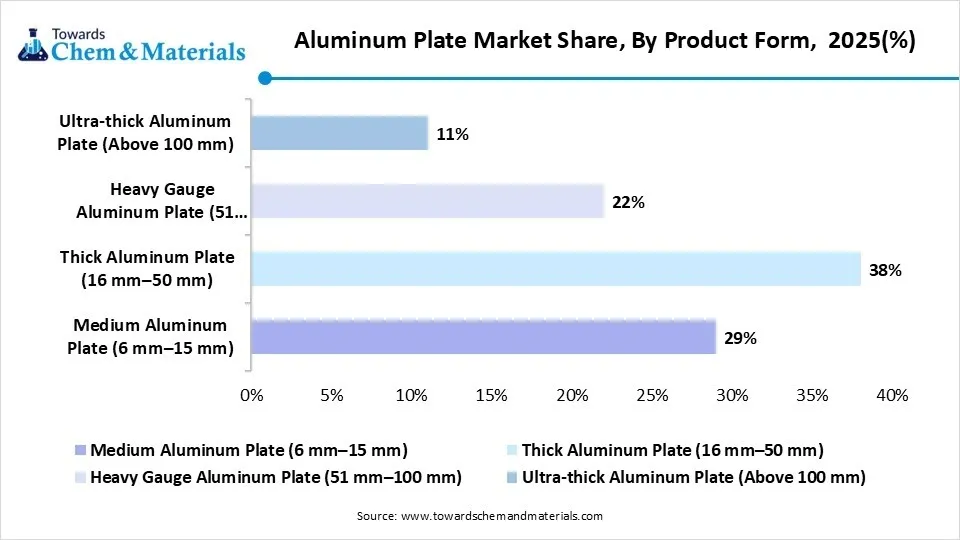
The heavy gauge aluminum plate (51 mm–100 mm) segment held a 22% market share in 2025 and is expected to grow at the fastest CAGR of 7% over the forecast period, due to the rising demand for materials with high performance in special industrial applications, which is driving the heavy gauge aluminum plate segment. These plates offer greater strength and durability, ideal for industries that demand consistent performance and reliability in their structures. The increasing investment in aerospace, defense, and engineering applications is providing new opportunities for the use of heavy-gauge aluminum plate. In addition, manufacturers are working on superior production capabilities to deliver increasingly customized and high-strength aluminum solutions to address the demand.
Aluminum Plate Market Share, By Product Form, 2025(%)
| By Product Form | Market Share (%) |
| Medium Aluminum Plate (6 mm–15 mm) | 29% |
| Thick Aluminum Plate (16 mm–50 mm) | 38% |
| Heavy Gauge Aluminum Plate (51 mm–100 mm) | 22% |
| Ultra-thick Aluminum Plate (Above 100 mm) | 11% |
Application Insights
The aerospace & defense segment dominated the market with the largest share of 30% in 2025 and is expected to grow at a CAGR of 6.7% over the forecast period, owing to its excellent strength-to-weight ratio. The materials allow manufacturers to create lighter aircraft structures and weapons for defense without compromising durability and reliability. Aluminum plate adoption is still receiving a boost from its growing demand for advanced aerospace solutions and military modernization activities.
- For instance, in April 2026, Textron Aviation Inc. announced its appointment of the Cessna SkyCourier for Belgium as a special mission aircraft using an aluminium four-blade propeller to provide greater performance during high-load operations.(Source: pressreleasehub.pa.media)
The automotive & transportation segment held the 22% market share in 2025 and is expected to grow at the fastest CAGR of 7.5% over the forecast period. With carmakers prioritizing lightweight vehicles to boost efficiency, the automotive and transportation industry is seeing growing use of aluminum plates. The lightweight aluminum materials used for battery enclosures, chassis, and structural components improve vehicle performance. With the continuous progress of electric vehicle development and transportation, the aluminum plate manufacturing industry is encountering new challenges and opportunities.
- For instance, in November 2026, Kaiser Aluminum Corp. is rolling forward again, finishing a $25 million expansion at its Trentwood rolling mill, the latest phase in the company’s long-term investments that have infused $415 million into the Spokane Valley plant over the past two decades. For Kaiser, the producer of heat-treated, flat-rolled aluminum products for the aerospace, automotive, and general engineering markets, the investment expands one of the plants heat-treat furnaces and boosts output by 5%, says Kevin Barron, vice president of manufacturing.(Source: www.spokanejournal.com)
Aluminum Plate Market Share, By Application, 2025(%)
| By Application | Market Share (%) |
| Aerospace & Defense | 30% |
| Marine & Shipbuilding | 14% |
| Automotive & Transportation | 22% |
| Heavy Machinery & Industrial Equipment | 16% |
| Construction & Infrastructure | 12% |
| Other End-use Industries | 6% |
Regional Insights
How Did the Asia Pacific Dominate the Aluminum Plate Market In 2025?
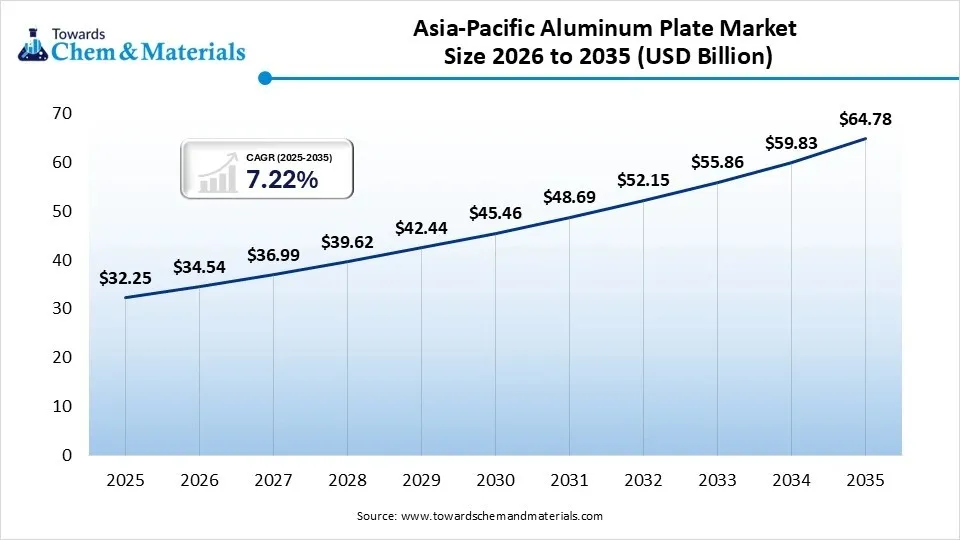
The Asia Pacific aluminum plate market size was estimated at USD 32.25 billion in 2025 and is projected to reach USD 64.78 billion by 2035, growing at a CAGR of 7.22% from 2026 to 2035. Asia Pacific dominated the market with the largest share of 46% in 2025 and is expected to grow at a CAGR of 5.9% during the forecast period because of the rising industrial manufacturing, transportation investments, and demand for lightweight materials in many end-user industries in the region. The area has robust manufacturing output for automobiles, infrastructure growth, and increased capital expenditure in advanced manufacturing. The increasing use of aluminum plates in the fields of aerospace, construction, and renewable energy is fueling market growth in the region. The regions dominance in the global aluminum plate industry is further reinforced by the presence of major aluminum producers, as well as the growing importance of sustainable material solutions in the industry.
 Strengthening China’s Aluminum Industry
China is also a major player in the aluminum plate market with its huge aluminum production capacity and robust industrial strength. Demand for aluminum plate solutions remains strong in the country, thanks to the growth of the automotive, aerospace, construction, and infrastructure industries. Striving to use lightweight materials and sophisticated manufacturing has helped facilitate greater use in various applications. At the same time, China has a strong production capacity and has a large number of aluminum manufacturing enterprises, which further enhances the competitiveness of Chinas supply of aluminum plates for domestic and international markets.
Advancing India’s Aluminum Industry
The growing industrial growth, infrastructure development, and demand from the transportation and manufacturing industries are driving the aluminum plate market in India. The use of lightweight materials is increasing in the field of vehicles, buildings, and engineering. To cater to the changing industrial needs, regional manufacturers are developing their manufacturing capacities. The rising importance of sustainable materials, recycling systems, and innovative aluminum technologies is likely to open up new market opportunities for companies in Indias growing aluminum sector.
North America Aluminum Plate Market Trends Analysis
North America aluminum plate market size was estimated at USD 15.42 billion in 2025 and is projected to reach USD 31.35 billion by 2035, growing at a CAGR of 7.35% from 2026 to 2035. North America held 22% market share in 2025 and is expected to grow at the fastest CAGR of 7.3% during the forecast period, driven by rising demand from sectors such as aerospace, automotive, defense, and advanced manufacturing. Technological developments, developed industrial structures, and increasing investments in lightweight material solutions are advantages for the region. Aluminum plates are being adopted in many applications, with their production increasing, supported by both increasing EV production and the modernization of aircraft. To match this evolution in requirements, manufacturers are also working to increase production capacity and enhance processing technologies.
Expanding United States Aluminum Production
Aluminium plates are also in high demand in the US for aerospace, automotive, defense, and industrial applications. As manufacturers continue to invest in advanced production technologies, they are finding ways to create high-quality aluminum products for specialty applications. Adopting EVs and developing airspace still provide good prospects for aluminum plate suppliers. It has established producers and a growing manufacturing capability to support the countrys role in creating innovative aluminum products for a variety of industries.
Developing Canada’s Aluminum Market
Canadas aluminum production facilities and increased demand by industry are creating a market for aluminum plates. International exploitation of light materials is being used in transport, construction, and engineering applications. As the demand for aluminium evolves, manufacturers are working to produce aluminium efficiently and sustainably. The demand for recyclable materials and advanced manufacturing is continuing to rise, presenting opportunities for the use of aluminum plates in Canadian industries.
Europe Aluminum Plate Market Trends Analysis
The Europe aluminum plate market size was estimated at USD 14.02 billion in 2025 and is projected to reach USD 28.56 billion by 2035, growing at a CAGR of 7.37% from 2026 to 2035. Europe held 20% market share in 2025 and is expected to grow at a CAGR of 5.8% over the forecast period, as demand for sustainable materials, advanced manufacturing techniques, and lightweight industrial applications grows. Aluminum plate is widely used in the regions automotive, aerospace, construction, and renewable energy industries. Recycling, energy efficiency, and creative alloy development are top priorities for manufacturers to address environmental and performance needs. The development of aluminium plate applications in the European markets is aided by strong industrial infrastructure and ongoing technological progress.
Enhancing Germany’s Aluminum Industry
Germanys aluminum plate market is enhanced by its robust automotive, engineering, and manufacturing sectors. The emphasis on light vehicles and innovative industrial solutions in the country creates new opportunities for the use of aluminium materials. The manufacturers are creating new and unique uses for aluminum plates to increase efficiency and performance in various industries. Germanys leading role in the European aluminum plate industry is further reinforced by its excellent engineering skills and commitment to sustainable production.
Supporting France’s Aluminum Sector
The aerospace, transportation, and industrial sectors in France are important markets for the growth of aluminum plates. The rising demand for lightweight materials promotes the use of aluminum solutions in a growing variety of applications. The country places a high importance on advanced manufacturing and sustainable industrial processes, which will continue to enable market development. The need for high-performance materials in the aerospace and engineering sectors opens up opportunities for French aluminum plate producers.
Latin America Aluminum Plate Market Trends Analysis
The Latin America aluminum plate market size was estimated at USD 4.91 billion in 2025 and is projected to reach USD 10.45 billion by 2035, growing at a CAGR of 7.85% from 2026 to 2035. Latin America held 6% market share in 2025 and is expected to grow at a CAGR of 5.5% over the forecast period, as industrial activities, infrastructure development, and demand for sturdy, lightweight materials continue to rise in the region. Aluminum plates are finding new applications in the construction, transportation, and manufacturing industries in the region. Increasing awareness of recyclable materials and sustainable production processes is making recycling more widespread. The market continues to grow due to an increase in industrial capabilities and infrastructure in manufacturing in Latin American countries.
 Strengthening Brazil’s Aluminum Demand
The rise in construction, transportation, and industrial manufacturing has boosted the demand for the aluminum plate market in Brazil. Expansion of infrastructure develops and promotes industrial use of lightweight and corrosion-resistant aluminum materials. Manufacturers are working on enhancing the production capacity to satisfy the various application needs. The increasing demand for sustainable materials and manufacturing solutions still brings opportunities for the use of aluminum plates in Brazilian industries.
Supporting Chile’s Aluminum Growth
The growing industrial activity and infrastructure needs affect the aluminum plate market in Chile. For applications that demand durability, lightweight performance, and corrosion resistance, aluminum plates are used. With increasing construction and industrial development, material suppliers can gain opportunities. With more and more emphasis on efficient and sustainable materials, the use of aluminum solutions is growing in different applications of the growing industrial development in Chile.
Middle East & Africa Aluminum Plate Market Trends Analysis
The Middle East & Africa aluminum plate market size was estimated at USD 3.51 billion in 2025 and is projected to reach USD 7.66 billion by 2035, growing at a CAGR of 8.12% from 2026 to 2035. The Middle East & Africa held 6% market share in 2025 and is expected to grow at a CAGR of 6.1% over the forecast period, due to demand Growth in industries, infrastructure, and lightweight materials. There is an increasing use of aluminum plates in the construction, transport, and industrial sectors in the region. Investments are being made in manufacturing capabilities and sustainable material solutions to create new opportunities. The development of aluminum resources and the trend of diversifying the industry continue to drive the regional market growth.
Advancing Saudi Arabia’s Aluminum Industry
Industrial growth, infrastructure developments, and the demand for advanced materials are driving Saudi Arabias aluminum plate market. The nations push to boost manufacturing capabilities provides opportunities for the use of aluminum in various industries. The lightweight and durable materials help to shape the development of the market for transportation, construction, and industrial applications. The ongoing diversification of industry promotes wider use of aluminum plate solutions.
Expanding South Africa’s Aluminum Market
The expanding industrial demand and the transport, construction, and manufacturing industries are driving the South African aluminium plate market. Aluminum plates are lightweight and durable, making them ideal for various applications throughout the country. Greater attention to efficient materials and sustainable practices aids in a greater uptake of recycling. Continued development and applications of industrial capabilities and requirements for advanced manufacturing solutions remain a driving opportunity for the aluminum plate supplier industry in South Africa.
Recent Developments
- In March 2026, Manaksia Aluminium introduced a specialized aluminum sheet line to produce High Security Registration Plates (HSRP). The company plans to double the production capacity to 200 tonnes a month by FY 2026-27. The development enhances its product range and enables access to high-security material applications.
(Source: www.alcircle.com) - In November 2025, Enecom developed a semi-rigid silicon solar panel with a thin aluminum sheet, free of glass, for marine, mobility, and off-grid uses. The High Flex Strong line offers lightweight solar solutions and flexible designs, enabling greater uptake of aluminium-reinforced renewable energy products.
(Source: www.pv-magazine.com) - In May 2026, to accommodate the increasing number of customers, Can-One USA started in-house prepress and plate-making. The growth is expected to enhance the companys internal manufacturing capabilities and build new job opportunities, backing its aluminum beverage-cans manufacturing business.
(Source: nashua.inklink.news)
Competitive Analysis
There are global integrated aluminum plate producers, regional aluminum manufacturers, and specialized aluminum solution providers in the aluminum plate market. Prominent manufacturers are investing in building their production capacity, creating special alloys, and finding more applications in aerospace, automotive, defense, and industrial markets. Global integrated companies like Alcoa Corporation and Rio Tinto have enormous supply chain activities from raw material to aluminum products. Companies like Hindalco Industries and Emirates Global Aluminium give the region a presence as a manufacturer and exporter. Specialized manufacturers, like Kaiser Aluminum, work on low-volume, high-value customized aluminum plates for use in a variety of applications, including marine, aerospace, and defense. Manufacturers are putting greater importance on lightweight solutions, recycling, and new processing technologies to satisfy changing customer needs and drive competitiveness.
- For instance, in September 2025, Novelis Inc. published its 2025 Sustainability Report, which details the progress made in the realization of its Novelis 3x30 strategy. The effort follows the companys dedication to furthering the circular aluminum solutions it is developing, to encourage recycling, and to build sustainable aluminum production throughout the world.(Source: investors.novelis.com )
- In June 2025, Alcoa Corporation, Ball Corporation, and Unilever PLC trialed the first use of ELYSIS® carbon-free smelting technology in consumer packaging in June 2025. The program promotes low-carbon aluminium production and fosters decarbonisation collaboration for sustainable manufacture and innovation for climate change.(Source: news.alcoa.com )
Top Players in the Market & Their Offerings
| Company Name | Company Type/Position | Major Headquarters | Geographic Presence | Aluminum Plate Offerings | Key Strength |
| Hindalco Industries Ltd. | Manufacturer & Supplier | Mumbai, Maharashtra, India | India, Asia, and worldwide | Standard/heat-treated alloys, industrial sheets | Strong metallurgical expertise and extensive |
| Alcoa Corporation | Manufacturer / Industry Leader | Pittsburgh, Pennsylvania, USA | Global; 10+ countries across the Americas | Aerospace and automotive-grade plates | High yield strength, machinability |
| Arconic | Manufacturer / Global Supplier | Pittsburgh, Pennsylvania, USA | North America, Europe, Asia | Aerospace-grade, high-strength aluminum plate | Advanced surface treatments, customized specialty alloys |
Other Key Players
- Hindalco Industries (HINDALCO)
- Vedanta Aluminium
- National Aluminium Company Limited (NALCO)
- Bharat Aluminium Company (BALCO)
- Jindal Aluminium
- RUSAL
- Rio Tinto
- Kobelco (Kobe Steel)
- Kaiser Aluminium
- AMAG Austria Metall
- Alimex
- Nanshan Aluminium
- Mingtai Group
Segment Covered in the Report
By Grade
- 2xxx Series
- 2014
- 2024
- Other 2xxx Series
- 5xxx Series
- 5052
- 5083
- 5086
- Other 5xxx Series
- 6xxx Series
- 6061
- 6082
- Other 6xxx Series
- 7xxx Series
- 7050
- 7075
- Other 7xxx Series
- Other Grades
- 1xxx Series
- 3xxx Series
- 4xxx Series
- 8xxx Series
By Product Form
- Medium Aluminum Plate (6 mm–15 mm)
- 6–8 mm
- 9–12 mm
- 13–15 mm
- Thick Aluminum Plate (16 mm–50 mm)
- 16–25 mm
- 26–40 mm
- 41–50 mm
- Heavy Gauge Aluminum Plate (51 mm–100 mm)
- 51–75 mm
- 76–100 mm
- Ultra-thick Aluminum Plate (Above 100 mm)
- 101–150 mm
- 151–200 mm
- Above 200 mm
By End-use Industry
- Aerospace & Defense
- Commercial Aircraft
- Military Aircraft
- Space Systems
- Marine & Shipbuilding
- Commercial Ships
- Naval Vessels
- Offshore Structures
- Automotive & Transportation
- Passenger Vehicles
- Commercial Vehicles
- Rail Transportation
- Heavy Machinery & Industrial Equipment
- Mining Equipment
- Agricultural Machinery
- Manufacturing Equipment
- Construction & Infrastructure
- Bridges
- High-rise Buildings
- Industrial Structures
- Other End-use Industries
- Energy
- Electronics
- Consumer Goods
By Regions
- North America
- Europe
- Asia Pacific
- Middle East & Africa
- Latin America
FAQ's




Select User License to Buy
Figures (6)










 sales@towardschemandmaterials.com
 Download Sample
 Schedule a Meeting