 Request Consultation
Content
Propane: The Fuel of Innocence
Introduction
Propane or propylene is a colourless substance and organic compound with a chemical formula of CH3CH=CH2. The unformulated substance consists of a hydrocarbon with a double bond; the first layer is a double bond, and the second layer comprises the alkene class of hydrocarbon. Propene is considered the most used in the global petrochemical industry, after only ethylene. The production process of propylene is steadfast in creating several ranges of downstream products and chemicals. The primary application of the process produces substances like acrolein, acrylonitrile, cumene, Propylene oxide, and butanal. These subsidiary products are the predominant process in producing acrylic propylene in the industry, which is important for the petroleum industry on a global scale.
The three carbon atoms and hydrogen atoms form a double bond; this enables alkene formation, and this accounts for higher reactivity, resulting in higher production. A study suggests that the Reliance Jamnagar refinery uses propane in heavy dosage for making petroleum. This compound is easily accessible in boilers as its boiling point is below -47 degrees Celsius. Propane is also used in liquefied petroleum gas to provide countries with petroleum. Amid ongoing war situations, a hefty amount of propane was being ordered to ensure availability of LPG in the long run.
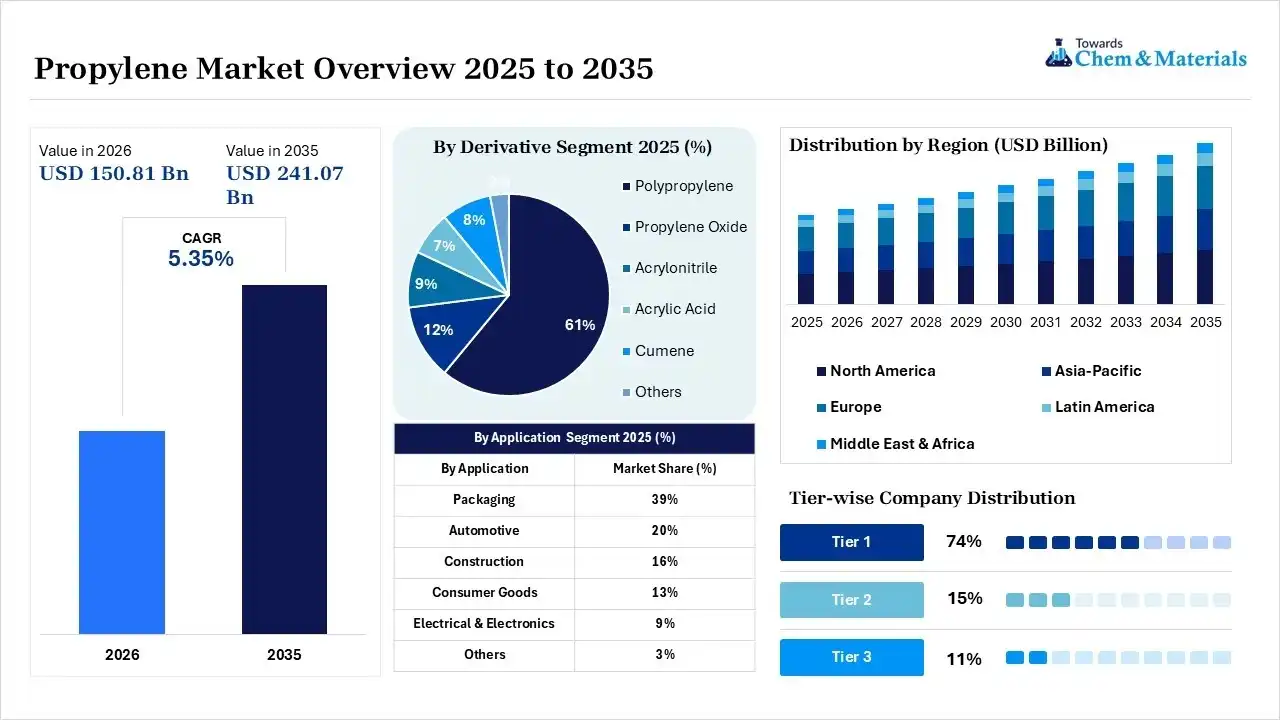
According to Towards Chemicals And Materials Analytics and Consulting, the global propylene market is projected to grow from USD 150.81 billion in 2026 to USD 241.07 billion by 2035, registering an impressive CAGR of 5.35% during the forecast period.
Get Full Access of Report | Immediate Delivery: https://www.towardschemandmaterials.com/checkout/6479
History of Propane
First, propane was discovered in 1864 by a scientist stating that it was naturally present in the petrol of Pennsylvania. Then, everyone understood it as the ethanol that is present in the petrol. But at a later stage in 1910, an accidental unearthing occurred when they were investigating why gasoline tankers were leaking vapours; a gas in a glass jar was popping out constantly, drawing the attention of the investigator, and then onwards this gas substance was taken into laboratories for testing. After testing for several years, it was concluded that this propane could be used for household activities; this was put into implementation in 1910 by implementing it into the pressure cooker in the United States of America.
Propylene became very important after the Second World War when the petrochemical industry expanded because there was a demand for plastics, synthetic fibres, chemicals and industrial materials. Most propylene had been made initially from steam cracking of naphtha and in oil refinery catalytic cracking. New technologies like propane dehydrogenation (PDH), metathesis and methanol to propylene (MTP) processes were developed to complement the existing methods because of the increasing demand. These advances in technology allowed producers to expand production without depending on refinery activity.
Propylene has evolved into an integral part of the production of polypropylene, acrylonitrile, propylene oxide, acrylic acid, and other specialty chemicals that are used in the automotive, packaging, construction, healthcare, and consumer goods sectors over the past few decades. The global production of propylene continues to be driven by growing industrialization, urbanization, and lightweight materials requirements today. At the same time, the industry is investing in energy-efficient manufacturing processes, reduction of carbon emissions, diversification of feedstocks, and measures towards the circular economy in order to address the increasing global demand for these products and make the industry more sustainable.
The History of Propane: From Accidental Discovery to an Essential Fuel
Government Initiatives worldwide
Governments globally are putting measures in place to boost the propylene market and promote environmental protection and industry competitiveness. North America welcomes investments in the petrochemical sector, both in the development of shale gas and the modernisation of manufacturing plants, through low-carbon technology incentives. European countries place greater importance on policies for the circular economy, tougher emission limits, recycling quotas and research into sustainable feedstocks, in order to minimise reliance on fossil fuels.
China has been putting substantial efforts into building integrated refinery and petrochemical plants, and encouraging domestic production by utilizing cutting-edge technologies, including propane dehydrogenation and coal-to-olefins. India supports capacity building for industrial development programmes, promotes domestic manufacturing and provides infrastructure for petrochemical parks and downstream industries. Research and process optimisation, as well as the production of specialty chemicals, continue to be areas of high investment for Japan and South Korea in order to remain competitive internationally. The Middle Eastern countries are progressing in building up their petrochemical production, incorporating refining units into downstream processing to add value to their hydrocarbon resources. Governments are moving toward incentivizing carbon reduction technologies, energy efficiency, recycling, and sustainable industrial practices in all regions.
AI is changing the Propylene Industry.
Artificial Intelligence is making a difference in the propylene value chain by making production planning, quality control, maintenance, and supply chain management more efficient. AI optimizes production through analyzing vast amounts of operational data, ensuring maximum yields, and minimizing energy usage.
Predictive maintenance keeps a constant watch on compressors, reactors, heat exchangers, and pipelines to keep them operating without failure and minimize the hassle and expense of maintenance. Machine learning models continuously fine-tune process parameters to ensure product quality and reduce waste generation, enhancing process control. AI also enhances supply chain operations by predicting consumer demand, managing inventory, planning logistics, and reducing shipping expenses.
AI-driven environmental monitoring systems can identify emissions and track energy usage, enabling regulatory compliance and environmental monitoring. AI also facilitates catalyst design, process simulation, and material discovery in research and development, driving innovation and enhancing manufacturing efficiency.
The use of AI should be avoided wherever it is not suitable.
While AI can provide numerous operational benefits, there are still some areas in the propylene industry where human judgment and experience are essential. Legal, economic, and ethical regulations regarding strategic investments, mergers and acquisitions, regulatory compliance, environmental permitting, and policy development can't be fully automated. In the case of industrial incidents, there is a need for speed; decisions need to be made in an unpredictable environment, where experienced engineers and safety personnel are needed. Human expertise is still needed to design the plant, review process safety, conduct hazard analysis, and approve the final design.
Beyond AI's capabilities, interpersonal skills are also essential for community engagement, contract negotiations, workforce management, and stakeholder communication. AI should therefore be a decision-making aid, not a replacement for qualified people in safety-critical, legal and strategic functions.
Technological Developments in the Propylene Industry.
The efficiency, flexibility and sustainability of propylene production continue to improve via technological innovation. The propane dehydrogenation (PDH) technology has emerged as one of the most rapidly growing production routes due to its ability to directly transform propane to high-purity propylene. Advanced catalysts have improved conversion efficiency, reduced energy consumption, and extended catalyst life.
Alternative production routes such as methanol-to-propylene (MTP) and olefin metathesis technology are available to improve the diversity of feedstocks available. Real-time monitoring, predictive optimisation and increased plant reliability are made possible using digital process control systems, Internet of Things (IoT) sensors and digital twin technologies.
Heat integration systems, advanced separation technologies and energy recovery equipment help to lower operational costs and greenhouse gas emissions. Petrochemical plants are starting to employ carbon capture and utilisation technologies to reduce their environmental footprint. Furthermore, the development of chemical recycling and circular economy innovations has enabled the recovery of valuable hydrocarbons from plastic waste, thus furthering the sustainable production of the plastic industry and minimizing reliance on virgin fossil feedstocks.
Types of Propylene
- Polymer-Grade Propylene (PGP): The most widely produced grade of propylene is polymer grade, which is about 99.5% pure. It is mainly used in the production of polypropylene, a widely used plastic in the world industry, as well as in fibre, film, automotive parts, packaging, and household goods.
- Chemical-Grade Propylene (CGP): Chemical-grade propylene is ~90-94 percent pure and is used as a raw material for the production of propylene oxide, acrylic acid, acrylonitrile, cumene, isopropyl alcohol, and several specialty chemicals employed in pharmaceuticals, coatings, textiles, and adhesives.
- Refinery-Grade Propylene (RGP): Propylene obtained as a product from the refinery is a mixture of 50–70% propylene, propane and other hydrocarbons. It is primarily formed during the refining of petroleum and can be upgraded to higher purity grades before use in petroleum-based chemical production.
- Bio-based Propylene: Bio-based propylene is generated by using renewable feedstocks like biomass, bioethanol, or waste. While still under commercial production, it is a type that can help carbon reduction projects and the move towards sustainable chemical production.
Workforce Requirement
The propylene industry requires a multi-disciplinary team of professionals with technical, operational, and business skills. Chemical engineers are key players in process design, optimizing plant performance, and plant safety. Process engineers keep track of manufacturing systems, optimise reaction conditions, and enhance product quality. Mechanical and electrical engineers maintain and repair production equipment, compressors, turbines, pumps, and instrumentation to ensure continuous plant performance. Instrumentation Specialists manage automation technology and process control systems to control industrial processes.
Regular testing at a laboratory or quality assurance unit is used to check the purity of the product and to ensure that the product meets industrial requirements. Environmental engineers design strategies for reducing emissions, wastewater treatment facilities, and energy conservation programs to comply with regulatory standards. HSE professionals are responsible for the safety of the workplace, risk assessment, and compliance with regulations in production facilities.
Data analysts and digital technology specialists are playing a more and more important role in supporting manufacturing by analysing operational data, optimizing predictive maintenance, and streamlining supply chains. The supply chain manager is responsible for sourcing the raw material, logistics, storage and delivery of the product, ensuring that production is not disrupted. Research scientists work on the development of more advanced catalysts, clean production technologies, and innovative petrochemical products that make them more competitive. Ongoing training of the workforce in digital technologies, automation, sustainability, and safety management of the industry will help to keep it productive, resilient, and ready to adapt to future technological advances.
Steps towards Sustainability
The propylene sector is taking various steps to minimise environmental effects, including maintaining production efficiency in the process. Advanced process optimisation, waste heat recovery, and the use of high-performance equipment are all key areas of work for promoting energy efficiency and reducing fuel usage and greenhouse gas emissions. Increasingly, manufacturers are using renewable electricity in manufacturing to lessen reliance on traditional energy sources.
Numerous companies are investing in CCS and CCSU technologies to lower carbon dioxide emissions from the production process. Wastewater recycling, closed-loop cooling systems, and enhanced water treatment technologies, which reduce the use of fresh water, have been added to water conservation as a priority. Advanced catalysts help to increase the conversion efficiency, increase the efficiency of less waste, and decrease energy use.
The industry is also contributing to the circular economy by developing technologies to recycle plastics into valuable petrochemical feedstocks for propylene production. Other measures to offset the dependency on fossil resources include feedstock diversification such as renewable raw materials and hydrocarbon feedstocks from biomass. Digital monitoring systems can help to optimize energy usage, reduce emissions, and enhance operational efficiency. Environmental reporting, audits, responsible procurement, and training staff are ongoing and improving company environmental performance. All of this is contributing to a propylene industry that is more responsible with climate and conserving resources for the future.
The global propylene industry takes strides forward with global policy.
International policy efforts are driving improvements to propylene industry efficiency, innovation and environmental stewardship. Numerous countries have developed industrial decarbonisation policies that provide incentives to industrial facilities to cut their GHG emissions by adopting cleaner production processes and by optimising their energy use. Plastic recycling has improved, and the use of recycled feedstock is increasing in the production of petrochemicals thanks to circular economy policies.
Governments have been investing in research grants and partnerships with industry for the development of low-carbon manufacturing methods, new feedstocks, hydrogen use, and carbon capture technologies. Industrial safety rules have enhanced the security criteria and boosted employee safety and environmental surveillance. International climate commitments have also been an impetus for companies' efforts to enhance the efficiency of resource use of resources, to lower emissions, and to report on sustainability transparently.
Advanced manufacturing, digital transformation, and infrastructure investment policies are helping to make the world more competitive by fostering investments in modern petrochemical facilities. Meanwhile, trade pacts and regional industrial cooperation are building up the supply chain and making it easier to transfer technology. All of these policy measures are contributing to the modernization of the propylene industry, increased sustainability, and industry resilience in the low-carbon global economy.
Data Innovations in the Propylene Industry
As a result of data-driven technologies, the propylene industry is changing with smarter, faster, and more efficient manufacturing operations. Banks of thousands of sensors installed throughout reactors, compressors, pipelines, storage systems, and processing units constantly gather data from modern production facilities. This information is instrumental in assessing equipment performance, manufacturing efficiency, and process stability.
By leveraging advanced analytics, manufacturers can gain insights into their operations, minimise energy usage, maximise use of feedstock, and boost plant productivity. The digital dashboards give the operator real-time visibility of the production performance, so they can react quickly to the ever-changing process conditions. Predictive analytics helps with equipment maintenance, foresees signs of wear, and prevents unscheduled failures that might cause downtime.
Digital twin technology, which renders virtual plants for manufacturing, can be used to test operational changes before those changes are actually made in real plants, and to simulate production scenarios and assess process improvements. Cloud-based data management systems help to ensure secure access to operational information to improve collaboration between production sites. The automated quality monitoring systems ensure that product specifications are continually checked, minimizing waste and guaranteeing production quality. Supply chain analytics improve supply chain management by providing better inventory planning, efficient transportation, and accurate demand forecasting. The innovations enable the propylene industry to enhance productivity and create operational efficiency.
Manufacturing of propylene
Propylene is one of the most important raw materials in today's chemical and manufacturing industry. It is a versatile petrochemical intermediate starting material for generating a large number of materials that are key to modern life. It has applications in packaging, the automotive industry, medicine, construction, electronics, textiles, agriculture, and consumer goods. Propylene is considered a cornerstone of the global industrial economy, as there are many applications for the product.
Polypropylene is one of the largest applications of propylene, a light-density, strong, chemically resistant and recyclable plastic that is used in a variety of applications. PP is applied in the packaging sectors, in containers to reuse, in medical syringes, in laboratory equipment, in the interior of vehicles, in furniture, in household appliances, and in electronics. The material's versatility enables manufacturers to develop products that are both durable and cost-effective.
Propylene is also used in the production of various industrial chemicals, including propylene oxide, acrylic acid, acrylonitrile and isopropyl alcohol. These compounds are also used to make paints, adhesives, coatings, detergents, synthetic rubber, insulation materials and cleaning products. Propylene-based fibres are used in the textile industry for carpets, upholstery, sportswear and industrial fabrics thanks to their durability and moisture resistance.
In healthcare, the excellent hygiene and chemical stability of propylene-based materials help in creating sterile medical packaging and disposable medical devices, surgical instruments, and pharmaceutical containers. The automotive sector is particularly interested in the use of lightweight polypropylene parts because they contribute to enhanced vehicle fuel efficiency without compromising on strength and safety for passengers.
Other uses of propylene products in agriculture include irrigation systems, greenhouse films, storage containers and chemical packaging. Propylene-based plastics, which have excellent insulating properties and resistance to heat and chemicals, are used in modern electrical and electronic products as cable insulation, for battery casings, and as protective housing.
With the transition towards sustainability in industries, propylene is a constantly evolving material with continuous product advancements, ranging from enhanced recycling options to the use of renewable feedstocks and energy-efficient processes. The versatility of this material enables manufacturers to create new materials that are more environmentally friendly without sacrificing performance. Propylene is one of the most crucial chemical feedstocks due to its extensive use and ongoing advancements in technology, playing a pivotal role in the modern industrial landscape and enhancing the quality of life in various industries.
Handling Profile of Propylene
Propylene is a highly flammable and colourless gas which requires highly developed safety precautions for its production, transportation, storage and industrial use. It is capable of forming combustible mixtures with air, so facilities that handle propylene incorporate explosion-resistant equipment, gas detection equipment, emergency shutdown, and provision for adequate ventilation to reduce the risk of fire.
Propylene is usually liquefied and transported and stored under pressure in special steel cylinders, pressure vessels, rail tankers and pipeline systems. Storage tanks are equipped with pressure relief valves, temperature monitors, etc., to ensure safe operation. Grounding and bonding are observed during loading and unloading operations to prevent ignition of the gas by static electricity.
Staff handling propylene use flame-resistant clothing and safety goggles, gloves, and other suitable personal protective equipment for pressurised gas handling. Routine inspections, preventive maintenance and emergency response drills help to reduce operational risks. Smoking, open flames, and ignition sources are not allowed in the storage and processing areas. Specialist courses are also provided for operators on leak detection, fire prevention, safe handling and emergency evacuation. Not only does proper handling help to protect the worker and equipment, but it also helps to keep industrial operations running and workplaces safe and sanitary, while keeping the environment safe and sanitary.
Manufacturing process of Propylene
There are several well-established industrial methods for producing propylene, mainly during the refining of petroleum and processing of petrochemicals. The manufacturing process starts with a hydrocarbon feedstock selection, which includes crude oil fractions, naphtha, propane, or natural gas liquids. They are used as feedstocks in processes carried out at controlled temperatures and pressures to break down the larger hydrocarbons into smaller, more valuable molecules.
The main route of production is steam cracking, which is the process of rapidly heating hydrocarbon feedstocks in special furnaces without oxygen. The high temperatures cause carbon-carbon bonds to be broken, yielding a mixture of hydrocarbons such as ethylene and propylene. Propane dehydrogenation is also an important production method where propane is directly converted to propylene in the presence of special catalysts at high temperatures.
Following production, the gas mixture is subjected to cooling, compression, and separation processes in which propylene is separated from the other hydrocarbons via distillation and purification. The purified product is then compressed, liquefied and kept under pressure for delivery to the downstream manufacturers. Automated process controls are used during the manufacturing process to continually monitor operating conditions to ensure maximum production efficiency, maintain product quality, reduce energy use and keep the plant operating safely.
Fluid Catalytic Cracking (FCC)
The Fluid Catalytic Cracking (FCC) process is one of the most significant processes in a refinery to generate valuable petroleum products such as propylene. In this process, the heavy hydrocarbon fraction extracted from the crude oil refining process is reduced to a lighter hydrocarbon fraction by catalytic cracking at high temperature. A finely powdered catalyst can be fluid when combined with hot hydrocarbon vapours, thus providing good contact between feedstock and catalyst particles.
It starts with preheating of heavy oil feedstocks before entry into the reactor. The catalyst inside the reactor breaks large hydrocarbon molecules into smaller molecules like gasoline, liquid petroleum gas, propylene and other light olefins. Under carefully controlled operating conditions, the cracking reaction takes place in seconds.
Following the reaction, the catalyst with the deposited carbon (coke) is removed from the hydrocarbons produced. The used catalyst is transferred to a regenerator where the coke is burnt off, and the catalyst is once again made active and returned to the reactor for its reuse. The cracked hydrocarbon mixture is then fed to the fractionation units in which individual products are separated based on their boiling point. The fluid catalytic cracking technology is one of the most efficient and economically significant process technologies to produce propylene and other valuable petrochemical feedstocks due to continuous catalyst regeneration, efficient heat recovery, and advanced process controls.
Applications of Propylene
Propylene is a useful material that is used to make a lot of different things. It is used to make plastics, synthetic fibers, solvents, chemicals, and parts for cars. Propylene is also used to make things for the healthcare industry like equipment and packaging. As more and more people move to cities, the uses for propylene are getting more and more varied.
The biggest use for propylene is to make polypropylene, which's a type of plastic. Polypropylene is lightweight, strong, and easy to work with. It is used to make all sorts of things like food packaging, containers, and parts for cars. People like to use polypropylene because it can be recycled, which is good for the environment. Propylene is also used to make propylene oxide, which is used to make foam for things like furniture and car seats. This foam is really good at keeping things warm or cool, which makes it useful for things like refrigerators and buildings.
Propylene is used to make a lot of things too, like acrylonitrile, which is used to make strong fibers and plastics. These materials are used to make things like clothes, protective gear, and parts for airplanes. Propylene is also used to make acrylic acid, which is used to make superabsorbent polymers. These polymers are used in things like baby diapers and medical equipment. Acrylic compounds are also used in paints, coatings, and adhesives because they are really good at sticking things. The healthcare industry uses propylene to make things like disinfectants and solvents. Medical equipment, like packaging and syringes, is also made from propylene because it is strong and resistant to chemicals.
The car industry uses propylene to make parts, like dashboard panels and bumpers. This helps to make cars more fuel-efficient and safer. The construction industry uses propylene to make things like insulation, pipes, and roofing materials. These materials are strong and last a long time even in tough weather conditions. Farmers use propylene to make things like irrigation equipment and greenhouse films. The electronics industry also uses propylene to make things like cable insulation and battery housings. As technology gets better, propylene will be used to make more things, like advanced composites and renewable energy systems. It is a versatile material that will continue to be important for a long time.
Propylene Uses in Body-Use Products
Propylene is a key building block in the petrochemical industry and is used in the production of articles that directly or indirectly come into contact with the human body. Propylene is not directly used on the human body, but is turned into a variety of safe, high-performance materials for healthcare, personal care/body applications, hygiene, cosmetics, pharmaceuticals, textiles and consumer products. This chemical versatility allows manufacturers to create a wide range of materials with lightweight, durable, hygienic, chemically stable and cost-effective properties. All of these properties make the products based on propylene indispensable in the enhancement of public health, comfort, hygiene and quality of life.
Propylene is one of the most important applications for body use, because it is used to produce the polymer polypropylene, which is used extensively in medical and healthcare applications. Polypropylene is highly resistant to chemicals, has low moisture absorption, high tensile strength, and is resistant to sterilisation. As a result, it is used to manufacture disposable syringes, specimen containers, surgical trays, medicine bottles, intravenous fluid containers, laboratory equipment, pipette tips, diagnostic kits, and medical packaging. Polypropylene is biologically inert and offers resistance to bacterial contamination, making it an ideal material for healthcare applications where cleanliness and patient safety are paramount.
Pharmaceuticals also use propylene-based chemicals to a large extent. One of the most common examples is isopropyl alcohol, which is synthesised from propylene. Isopropyl alcohol is commonly used in hospitals, clinics, pharmaceutical manufacturing facilities, and homes as an antiseptic and disinfectant. It is a component of hand sanitizers, skin disinfectants prior to injections, surgical preparation solutions, and cleaning that disinfects medical instruments and laboratory equipment. It provides control of infections due to its high volatility and wide range of antimicrobial activity.
Propylene derivatives are also used in many ways in the production of personal hygiene products. Polypropylene fibres are commonly used in disposable baby diapers, incontinence aids for adults, sanitary napkins, panty liners and absorbents for medical pads. These fibres make the product soft, flexible, breathable, and have superb moisture management properties while preserving the product strength. They are light and comfortable for the user, while keeping hygiene and durability.
There are several materials made from propylene that are useful in the cosmetics and personal care industry. Products from propylene are used in facial creams and moisturisers, shampoos, conditioners, deodorants, shaving products, body lotions, liquid soaps, facial cleansers, sunscreens and cosmetic products. Some propylene derivatives can serve as solvents, stabilisers, emulsifiers, viscosity modifiers or carriers for use in cosmetics to enhance their texture, consistency and shelf life. The ingredients are used to formulate products that are evenly distributed on the skin and can be safely stored in the product.
Propylene-containing products are also widely used in oral health care products.
Polypropylene is used to make toothbrush handles, as it is lightweight, water-resistant, and lasts well over time. Polypropylene is used in packaging for toothpaste, mouthwash, dental floss, and oral hygiene products due to its chemical resistance and protection from moisture and contamination.
Protective clothing and medical textiles are other important applications. Polypropylene nonwoven materials are used in the production of disposable gowns, face masks, surgical caps, shoe covers, protective gowns and sterile drapes in hospitals and healthcare centres. These materials offer good barrier protection against liquids, microorganisms and airborne particles and are light and comfortable to wear for longer periods of time. They have become particularly vital during an outbreak of any infectious disease at any time when more disposable protective gear is required.
Propylene is also used in the manufacturing of contact lenses, parts of medical devices and diagnostic equipment, specimen collection containers and medical device housings. These products' dimensional stability and chemical resistance ensure high levels of safety and performance during normal medical use.
As a material for sports and wellness, polypropylene fibres are frequently used in clothes designed for sports, thermal garments, compression wear, athletic underwear, and in sports accessories that are in continuous contact with the skin. These fibres have a high moisture absorption capacity, dry rapidly, inhibit microbial proliferation, and have a good thermal insulation property, yet are lightweight. As a result, they are more comfortable when exercising and during outdoor recreation.
Polypropylene is also used in the textile sector to make blankets, mattress covers, upholstery fabrics, shopping bags, and other accessories. Moisture, mildew, and chemical resistance ensure the products' durability and hygiene during their use. Often, healthcare textiles are also made with polypropylene fibres, as they remain structurally sound when washed and sterilised multiple times.
Packaging is yet another key application area of the packaging industry, since a large number of food-contact and pharmaceutical packaging materials are produced from polypropylene. Containers for medicines, tablet containers, food storage containers, reusable drinking bottles, microwave-safe containers and packaging for personal care products help to maintain hygiene and prevent contamination before they reach consumers. The stability of the material in chemical reactions means that it does not readily react with a large number of materials that can be packaged in it under normal conditions.
Other applications include health and rehabilitation products like orthopaedic braces, parts for mobility products, rehabilitation aids and protective medical accessories, all of which are based on propylene. They are flexible in terms of reducing the overall weight of medical devices while still providing enough mechanical strength.
Ongoing research by manufacturers to make propylene-based products more recyclable, less environmentally impactful, and more performing continues. The new polymer formulations offer a higher level of softness, flexibility, transparency, antimicrobial effect, and repeated sterilisation resistance. There are medical polymers that are developed specifically for advanced medical instruments, medical implant packaging, and high-performance diagnostic instruments.
With the focus on sustainability growing, manufacturers are seeking new renewable feedstocks, recycled polypropylene, and sustainable manufacturing methods without sacrificing product quality or patient safety. Circular manufacturing strategies are driving higher recovery and recycling rates of products in healthcare and consumer applications where feasible that contain polypropylene.
In general, propylene has been indispensable in the production of products that are designed for direct or indirect human use. The chemical itself is not used by consumers very often, but its derivatives offer safe healthcare, better personal hygiene, effective infection prevention, comfortable clothing, long-lasting consumer products, and safe pharmaceutical packaging. As advanced materials, optimized manufacturing processes, and sustainable production methods evolve, propylene-derived products will continue to play a vital role in today's society, healthcare, and personal well-being.
Future of the Propylene Industry
The future of the propylene industry is going to be shaped by technological concerns about the environment and changes in what people want to buy. As people want plastics, specialty chemicals, and packaging materials, propylene will continue to be an important material. The industry will have to balance making more propylene with being kind to the environment.
One of the changes will be the way propylene is made. New methods, like propane dehydrogenation, will become more popular. This will help to increase production while using less energy and reducing costs.
Technology will also change the way propylene is made. Computers and automation will help to make the process more efficient and reliable. This will help to reduce downtime and make the process more flexible. The industry will also have to think more about the environment. Companies will have to reduce their carbon footprint, use energy more efficiently, and make less waste. They will have to use technologies, like carbon capture, to reduce greenhouse gas emissions. The circular economy will also play a role in the future of the propylene industry. This means that companies will have to recycle and use less new material. They will have to work to make products that can be recycled and to make recycling easier.
New materials, like hydrocarbons, will also become more popular. These materials are made from things like plants and waste. They can be used to make propylene. This will help to reduce the industry's reliance on fuels and make it more sustainable.
Research and development will be crucial for the future of the propylene industry. Scientists and engineers will have to come up with better ways to make propylene and to use it to make new and interesting things.
The way propylene is sold will also have to change. Companies will have to work to make the supply chain more efficient and reliable. They will have to invest in infrastructure like pipelines and storage facilities to make it easier to get propylene to where it is needed.
Contact:
- Towards Chemicals and Materials Analytics and Consulting
- USA: +1 804 441 9344
- APAC: +61 485 981 310 or +91 87933 22019
- Europe: +44 7383 092 044
- Email: sales@towardschemandmaterials.com
About the Experts

Aditi Shivarkar
Aditi serves as Vice President at Towards Chemical and Material and brings over 15 years of experience in research, strategy, and industry analysis. She focuses on sectors such as specialty chemicals, advanced materials, and sustainable solutions. She studies how regulations, raw materials, and industrial demand shape the market, and she uses that understanding to guide businesses in the right direction. Aditi helps companies stay prepared for change, improve their market position, and make well-informed decisions.



Aman Singh
Aman Singh has more than 13 years of experience in research and consulting, with a strong focus on the global chemicals and materials space. He tracks developments in areas like green chemistry, high-performance materials, and industrial innovation. At Towards Chemical and Material, he leads the research team and ensures every report is clear, accurate, and useful. Aman breaks down complex industry changes and helps businesses understand what they mean in practical terms.