
U.S. Material Informatics Market Size, Competitive Landscape Analysis Report 2035
Material informatics refers to the use of data analytics, artificial intelligence, machine learning, simulation, and computational methods to accelerate material discovery, development, characterization, and optimization.
The U.S. material informatics market size was valued at USD 285.45 million in 2025, is estimated to reach USD 330.84 million in 2026, and is projected to reach USD 1,248.43 million by 2035, exhibiting a compound annual growth rate (CAGR) of 6.75% over the forecast period from 2026 to 2035. The heavy focus on personalized and advanced is accelerating the industrys potential nowadays.
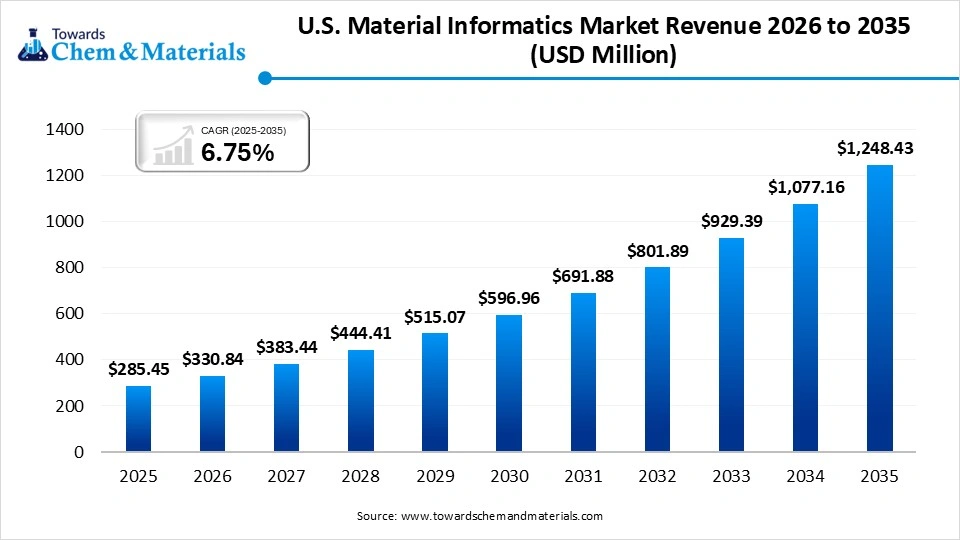
Market Highlights
- By component, the software segment dominated the market with a 72% share in 2025, as industries increasingly rely on advanced digital platforms for material analysis and research management.
- By component, the AI/ML integrated informatics platforms segment held the 31% market share in 2025 and is expected to be the fastest growing in the market, with a CAGR of 18.70% in the forecast period, owing to the increasing need for faster and smarter material research processes.
- By deployment mode, the cloud segment dominated the market with 68% share in 2025 and is expected to be the fastest-growing segment in the market, with a CAGR of 17.20% in the forecast period, as cloud-based platforms provide easier data access, flexible storage, and lower infrastructure costs.
- By technology, the artificial intelligence segment dominated the market with 39% share in 2025 and is expected to be the fastest-growing segment in the market, with a CAGR of 18.40% in the forecast period, as AI technologies help industries improve research speed, data analysis, and material prediction capabilities.
- By material type, the chemicals segment dominated the market with 26% share in 2025, owing to the chemical industries require continuous material testing, formulation improvement, and product innovation.
- By material type, the pharmaceutical & biomaterials segment held the 14% market share in 2025 and is expected to be the fastest-growing in the market, with a CAGR of 17.80% in the forecast period in 2025, owing to the increasing demand for advanced healthcare materials and faster drug development processes.
- By application, the material discovery segment dominated the market with 34% share in 2025 and is expected to be the fastest-growing in the market, with a CAGR of 18.10% in the forecast period, owing to industries increasingly searching for faster ways to identify advanced materials for industrial applications.
- By end-use industry, the chemicals segment dominated the market with 24% share in 2025, owing to chemical manufacturers requiring continuous research and material optimization for industrial production.
- By end-use industry, the pharmaceuticals & biotechnology segment held the 18% market share in 2025 and is expected to be the fastest-growing in the market, with a CAGR of 18.20% in the forecast period, as healthcare industries are increasingly adopting advanced digital research technologies.
- By enterprise size, the large enterprises segment dominated the market with 74% share in 2025, owing to major companies having stronger financial resources and advanced research infrastructure.
- By enterprise size, the small and medium enterprises segment held the 26% market share in 2025 and is expected to be the fastest-growing in the market, with a CAGR of 17.90% in the forecast period, as increasing availability of affordable cloud-based and AI-powered material informatics solutions.
Next Generation Materials Emergence
The usage of artificial intelligence, data analysis, and machine learning tools for the development of improved materials through a smarter and faster way is known as material informatics. Also, the greater demand for personalized and precision materials in major industries of the United States is driving substantial financial gains in the manufacturing sector nowadays. Also, the most demanded sectors, such as healthcare, electronics, automotive, and chemicals, have been seen seeking advanced materials in the United States, as per the recent survey.
Moreover, the industry is gaining strong attention in the United States because industries are looking for smarter ways to reduce research time and improve product innovation. Traditional material development methods often require long testing processes and high research costs. However, material informatics platforms help researchers predict material behavior digitally before physical testing begins. This process supports faster decision-making and improves overall development efficiency.
In recent years, the rising adoption of artificial intelligence across industrial sectors has supported the growth of the market. Moreover, companies are increasingly investing in advanced technologies to develop lightweight, durable, and sustainable materials for modern industrial applications.
Recent Market Trends:
- The greater shift towards artificial intelligence for accurate material development has attracted increased capital and better investment in manufacturing in recent years. Several companies are observed in heavy adoption of AI-based platforms to scan and analyze materials.
- Demand for sustainable materials is increasing research activity focused on lower-carbon, recyclable, lightweight, and high-performance material solutions. Also, several major firms are focusing on the material which is ecofriendly and minimize carbon reduction nowadays.
- Growth in batteries, energy storage, and electric vehicles is increasing demand for digital tools that support the development and optimization of advanced materials. Also, the ahead of the greater shift of electric vehicles, the manufacturers are seen using digital material research tools to develop higher performance materials.
Report Scope
| Report Attribute | Details |
| Market Size in 2026 | USD 330.84 Million |
| Revenue Forecast in 2035 | USD 1,248.43 Million |
| Growth Rate | CAGR 6.75% |
| Forecast Period | 2026 - 2035 |
| Base Year | 2025 |
| Segment Covered | By Component, By Deployment Mode, By Technology, By Material Type, By Application, By End-Use Industry, By Enterprise Size |
| Key companies profiled | Citrine Informatics, Schrodinger, Inc, Enthought, Inc., Exabyte.io, Kebotix, Matmerize, Inc., Allozymes, Noble.AI. |
Cloud Technologies Transforming Material Research
The industry is heavily observing the integration of machine learning and cloud-based research platforms into material development processes nowadays. Also, the companies are moving away from traditional trial-and-error methods and adopting digital technologies to improve research speed and accuracy. In recent years, cloud computing has helped researchers store, manage, and analyze large data sets more efficiently.
Current Regional Situations in the Material Informatics Market for the United States 2026
- California: The increasing presence of digital technology firms and advanced material research activities.
- Texas: Expanding industrial operations and energy-related projects are creating higher demand for material informatics solutions.
- New York: Increasing activities in healthcare technology, electronics, and scientific research.
U.S. Material Informatics Market Regulatory Landscape: Regulations
| Country Region | Regulatory Body | Key Regulations | Focus Areas |
| United States | U.S. Environmental Protection Agency (EPA) | Federal Insecticide, Fungicide, and Rodenticide Act (FIFRA) | Mandates that even if an AI model completely designs a new, highly stable quaternary ammonium or surfactant variant, the physical product must still clear real-world performance protocols (such as the EPA Product Performance Test Guidelines, Series 810) to validate surface pathogen eradication claims. |
Market Dynamics
Driver
Faster Material Discovering Driving Innovation
The heavy demand for faster material discovery and product innovation is creating profitable pathways for the industry participants in the current period. Also, industries such as chemicals, healthcare, electronics, automotive, and energy are looking for advanced technologies that can reduce research time and improve development efficiency. In recent years, companies have increasingly adopted artificial intelligence and machine learning tools to analyze material data more effectively.
Restraint
Expensive Platforms Restraining Industry Progress
The high implementation cost of advanced material informatics platforms is likely to create growth barriers for manufacturers during the coming years. Many companies, especially smaller businesses, face challenges in adopting these technologies due to expensive software systems, infrastructure requirements, and skilled workforce needs. In recent years, industries have also experienced difficulties in managing large volumes of material-related data accurately.
Opportunity
Sustainable Innovation Through Smarter Materials
The greater shift towards sustainable and advanced materials is expected to create lucrative opportunities in the industry during the forecast period. Also, industries are increasingly searching for eco-friendly, lightweight, and high-performance materials for applications in electric vehicles, renewable energy, healthcare, and electronics. In recent years, material informatics technologies have helped companies speed up the discovery of innovative materials while reducing development costs.
Segmental Insights
Component Insights
The software segment dominated the market with 72% share in 2025, as industries increasingly rely on advanced digital platforms for material analysis and research management. Software solutions help companies process large amounts of scientific data quickly and accurately. In recent years, businesses have focused on improving research efficiency, reducing testing time, and accelerating product development processes.
U.S. Material Informatics Market Share, By Component, 2025 (%)
| By Component | Revenue Share, 2025 (%) |
| Software | 72% |
| Services | 28% |
| AI/ML Integrated Informatics Platforms | 31% |
| Simulation & Modeling Software | 24% |
| Data Management & Analytics Software | 18% |
| Materials Discovery Platforms | 15% |
| Cloud-based Informatics Solutions | 12% |
The AI/ML integrated informatics platforms segment held the 31% market share in 2025 and is expected to be the fastest-growing in the market, with a CAGR of 18.70% in the forecast period, owing to the increasing need for faster and smarter material research processes. These technologies help researchers identify material properties, predict performance, and reduce development time more efficiently than traditional methods. In recent years, industries have increasingly adopted AI-driven systems to improve research accuracy and innovation speed.
Deployment Mode Insights
The cloud segment dominated the market with 68% share in 2025 and is expected to be the fastest-growing segment in the market, with a CAGR of 17.20% in the forecast period, as cloud-based platforms provide easier data access, flexible storage, and lower infrastructure costs. Industries are increasingly adopting cloud technologies to manage large volumes of material-related information more efficiently. In recent years, companies have focused on improving collaboration between research teams located in different regions.
U.S. Material Informatics Market Share, By Deployment Mode, 2025 (%)
| By Deployment Mode | Revenue Share, 2025 (%) |
| Cloud | 68% |
| On-Premise | 32% |
| Public Cloud | 45% |
| Private Cloud | 33% |
| Hybrid Cloud | 22% |
The public cloud segment held the 45% market share in 2025, due to its cost-effectiveness and easy accessibility for businesses of all sizes. Public cloud platforms allow companies to access advanced computing resources without investing heavily in physical infrastructure. In recent years, industries have increasingly preferred scalable and flexible research solutions to handle growing amounts of material data.
Technology Insights
The artificial intelligence segment dominated the market with 39% share in 2025 and is expected to be the fastest-growing segment in the market, with a CAGR of 18.40% in the forecast period, as AI technologies help industries improve research speed, data analysis, and material prediction capabilities. Companies are increasingly using AI tools to analyze complex material datasets and identify suitable materials for industrial applications. In recent years, industries have focused on reducing traditional trial-and-error research methods, which often require high costs and longer development periods.
U.S. Material Informatics Market Share, By Technology, 2025 (%)
| By Technology | Revenue Share, 2025 (%) |
| Artificial Intelligence | 39% |
| Big Data Analytics | 22% |
| High-throughput Computing | 16% |
| Digital Twin Technology | 11% |
| IoT-enabled Informatics | 7% |
| Quantum Computing | 5% |
The big data analytics segment held the 22% market share in 2025, owing to industries generating large amounts of material-related research data in the current period. Companies are increasingly using big data tools to organize, analyze, and manage scientific information more efficiently. In recent years, businesses have focused on improving material discovery processes through data-driven research methods.
Material Type Insights
The chemicals segment dominated the market with a 26% share in 2025, supported by the need for continuous material testing, formulation improvement, and product innovation in chemical industries. Companies are increasingly adopting material informatics solutions to speed up chemical research and reduce laboratory testing time. In recent years, the demand for sustainable chemicals, specialty chemicals, and advanced industrial materials has increased significantly.
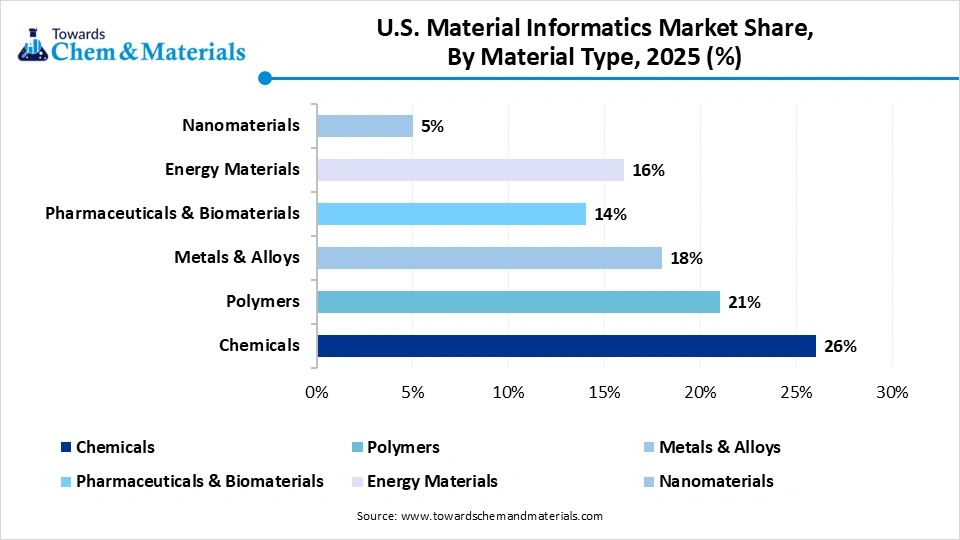
The pharmaceutical & biomaterials segment held the 14% market share in 2025 and is expected to be the fastest-growing in the market, with a CAGR of 17.80% in the forecast period in 2025, owing to the increasing demand for advanced healthcare materials and faster drug development processes. Industries are increasingly using material informatics technologies to improve biomaterial research, medical device development, and pharmaceutical innovation.
Application Insights
The material discovery segment dominated the market with 34% share in 2025 and is expected to be the fastest-growing in the market, with a CAGR of 18.10% in the forecast period, owing to industries increasingly searching for faster ways to identify advanced materials for industrial applications. Traditional material discovery methods often require long testing periods and high research costs. In recent years, companies have adopted material informatics platforms to improve research speed and reduce development risks.
U.S. Material Informatics Market Share, By Application, 2025 (%)
| By Application | Revenue Share, 2025 (%) |
| Material Discovery | 34% |
| Product Development | 23% |
| Process Optimization | 16% |
| Quality Control | 12% |
| Sustainability & Recycling Analysis | 9% |
| Predictive Maintenance | 6% |
The product development segment held the 23% market share in 2025, as industries are focusing on launching innovative and high-performance products in shorter timeframes. Companies are increasingly using material informatics technologies to improve product quality and reduce development costs. In recent years, industries such as automotive, electronics, healthcare, and energy have increased investments in advanced product innovation activities.
End-Use Industry Insights
The chemicals segment dominated the market with 24% share in 2025, owing to chemical manufacturers requiring continuous research and material optimization for industrial production. Companies are increasingly using digital research platforms to improve chemical formulations, reduce testing time, and enhance production efficiency.
U.S. Material Informatics Market Share, By End-use Industry, 2025 (%)
| By End-use Industry | Revenue Share, 2025 (%) |
| Chemicals | 24% |
| Pharmaceuticals & Biotechnology | 18% |
| Automotive | 16% |
| Aerospace & Defense | 12% |
| Electronics & Semiconductors | 11% |
| Energy & Utilities | 8% |
| Manufacturing | 7% |
| Academic & Research Institutes | 4% |
The pharmaceuticals & biotechnology segment held the 18% market share in 2025 and is expected to be the fastest-growing in the market, with a CAGR of 18.20% in the forecast period, as healthcare industries are increasingly adopting advanced digital research technologies. Material informatics solutions help pharmaceutical and biotechnology companies improve drug development, biomaterial testing, and research efficiency. In recent years, the demand for faster medical innovation and personalized healthcare solutions has increased significantly.
Enterprise Size Insights
The large enterprises segment dominated the market with 74% share in 2025, owing to major companies having stronger financial resources and advanced research infrastructure. Large organizations are increasingly investing in artificial intelligence, cloud computing, and digital material research platforms to improve innovation capabilities.
U.S. Material Informatics Market Share, By Enterprise Size, 2025 (%)
| By Enterprise Size | Revenue Share, 2025 (%) |
| Large Enterprises | 74% |
| Small & Medium Enterprises | 26% |
The small and medium enterprises segment held the 26% market share in 2025 and is expected to be the fastest-growing in the market, with a CAGR of 17.90% in the forecast period, as increasing availability of affordable cloud-based and AI-powered material informatics solutions. In recent years, technology providers have introduced cost-effective digital research platforms that are easier for smaller businesses to adopt.
Recent Development
- In December 2025, Citrine Informatics unveiled two capabilities, Apex and Omni. According to the company, Omni functions as a data harmonizer, while Apex provides AI capabilities for industrial materials applications.
Top Vendors in the U.S. Material Informatics Market & Their Offerings:
- Citrine Informatics: Citrine Informatics provides an enterprise materials informatics platform designed to support data management, machine learning, and materials product development
- Schrodinger, Inc.: Schrodinger provides physics-based computational software used for molecular discovery and materials-science applications. By seamlessly merging quantum mechanics with predictive machine learning algorithms, the platform evaluates billions of virtual chemical compounds. This advanced modeling predicts vital structural properties, driving innovation in aerospace, electronics, and industrial formulation markets.
- Enthought, Inc.: Enthought specializes in digital transformation, providing scientific software solutions alongside technical consulting services for materials-centric industries. The firm builds bespoke data platforms, custom machine learning applications, and scientific computing tools.
Other Key Players
- Exabyte.io
- Kebotix
- Matmerize, Inc.
- Allozymes
- Noble.AI
Segments Covered in the Report
By Component
- Software
- Materials Discovery Platforms
- Simulation & Modeling Software
- Data Management & Analytics Software
- AI/ML Integrated Informatics Platforms
- Cloud-based Informatics Solutions
- Services
- Consulting Services
- Integration & Deployment
- Maintenance & Support
- Training & Education Services
By Deployment Mode
- Cloud
- Public Cloud
- Private Cloud
- Hybrid Cloud
- On-Premise
By Technology
- Artificial Intelligence
- Deep Learning
- Machine Learning
- Reinforcement Learning
- Big Data Analytics
- Quantum Computing
- High-throughput Computing
- Digital Twin Technology
- IoT-enabled Informatics
By Material Type
- Chemicals
- Specialty Chemicals
- Petrochemicals
- Catalysts
- Polymers
- Thermoplastics
- Thermosets
- Elastomers
- Metals & Alloys
- Ferrous Alloys
- Non-ferrous Alloys
- Superalloys
- Pharmaceuticals & Biomaterials
- Drug Compounds
- Biocompatible Materials
- Energy Materials
- Battery Materials
- Solar Materials
- Hydrogen Materials
- Nanomaterials
By Application
- Material Discovery
- Product Development
- Quality Control
- Process Optimization
- Predictive Maintenance
- Sustainability & Recycling Analysis
By End-Use Industry
- Chemicals
- Pharmaceuticals & Biotechnology
- Automotive
- Aerospace & Defense
- Electronics & Semiconductors
- Energy & Utilities
- Manufacturing
- Academic & Research Institutes
By Enterprise Size
- Large Enterprises
- Small & Medium Enterprises
A Seven-Phase Framework
Our methodology is designed to be universally applicable across commodity chemicals, specialty chemicals, petrochemicals, construction chemicals, coatings, electronic chemicals, industrial gases, agrochemicals, water treatment chemicals, and performance materials. Each phase builds upon the last, creating a layered validation structure that minimizes estimation error and maximizes analytical confidence.
The framework ensures comprehensive market coverage, robust cross-validation, and reliable long-term forecasting — producing market estimates that withstand scrutiny from investors, regulators, and corporate strategy teams.

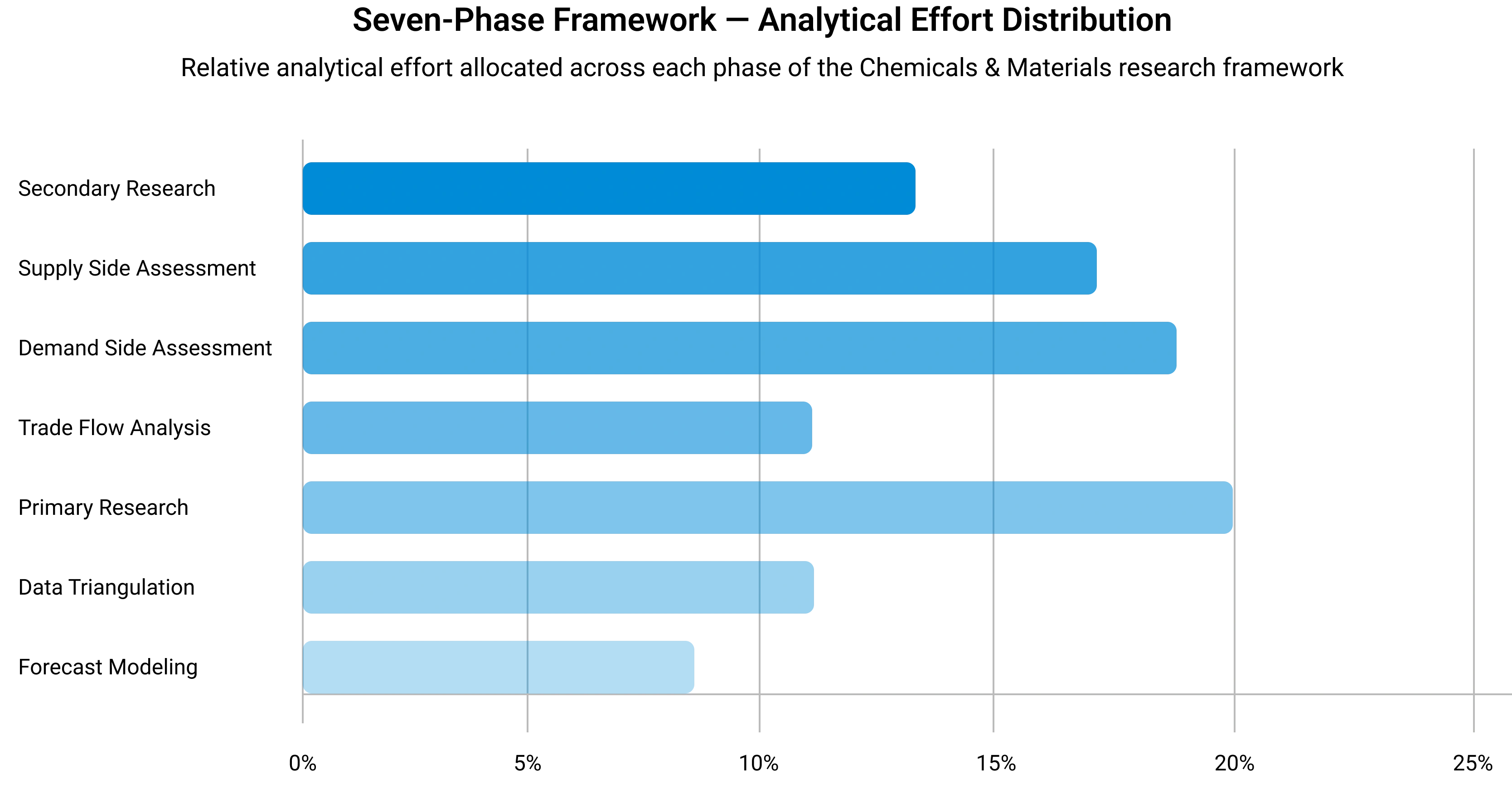
Seven-Phase Framework — Analytical Effort Distribution
Relative analytical effort allocated across each phase of the Chemicals & Materials research framework
Phase 1 - Secondary Research: Establishing the Foundation
Secondary research collects and evaluates publicly available information from authoritative sources, establishing the foundational understanding of market structure, value chain dynamics, competitive landscape, and end-use demand patterns. Every source is evaluated for credibility, recency, geographic relevance, and methodological soundness before inclusion.
Industry Associations
Sources include ACC, CEFIC, ICCA, JCIA, CPCIF, and SOCMA providing production volumes, consumption trends, capacity developments, and sustainability initiatives.
Company Disclosures
Annual reports, investor presentations, earnings transcripts, and regulatory filings reveal product portfolios, manufacturing footprints, capacity expansions, and revenue segmentation.
Government Databases
National statistical offices, customs authorities, environmental agencies, and industrial production databases provide verified statistics on output, trade flows, and regulatory compliance.
Trade Databases
UN Comtrade, ITC, Eurostat, and national customs authorities enable assessment of global product movement, import dependency, and export competitiveness across regions.
Our Secondary Research Sources
- Ministry of Chemicals and Fertilizers
- European Chemicals Agency
- United States Department of Energy
- Ministry of Industry and Information Technology
- Ministry of Economy Trade and Industry
- Ministry of Trade Industry and Energy
- National Institute of Standards and Technology
- Council of Scientific and Industrial Research
- Fraunhofer Society
- National Institute for Materials Science
Phase 2 — Supply-Side Assessment: Mapping Production Capabilities
Production Capacity Analysis
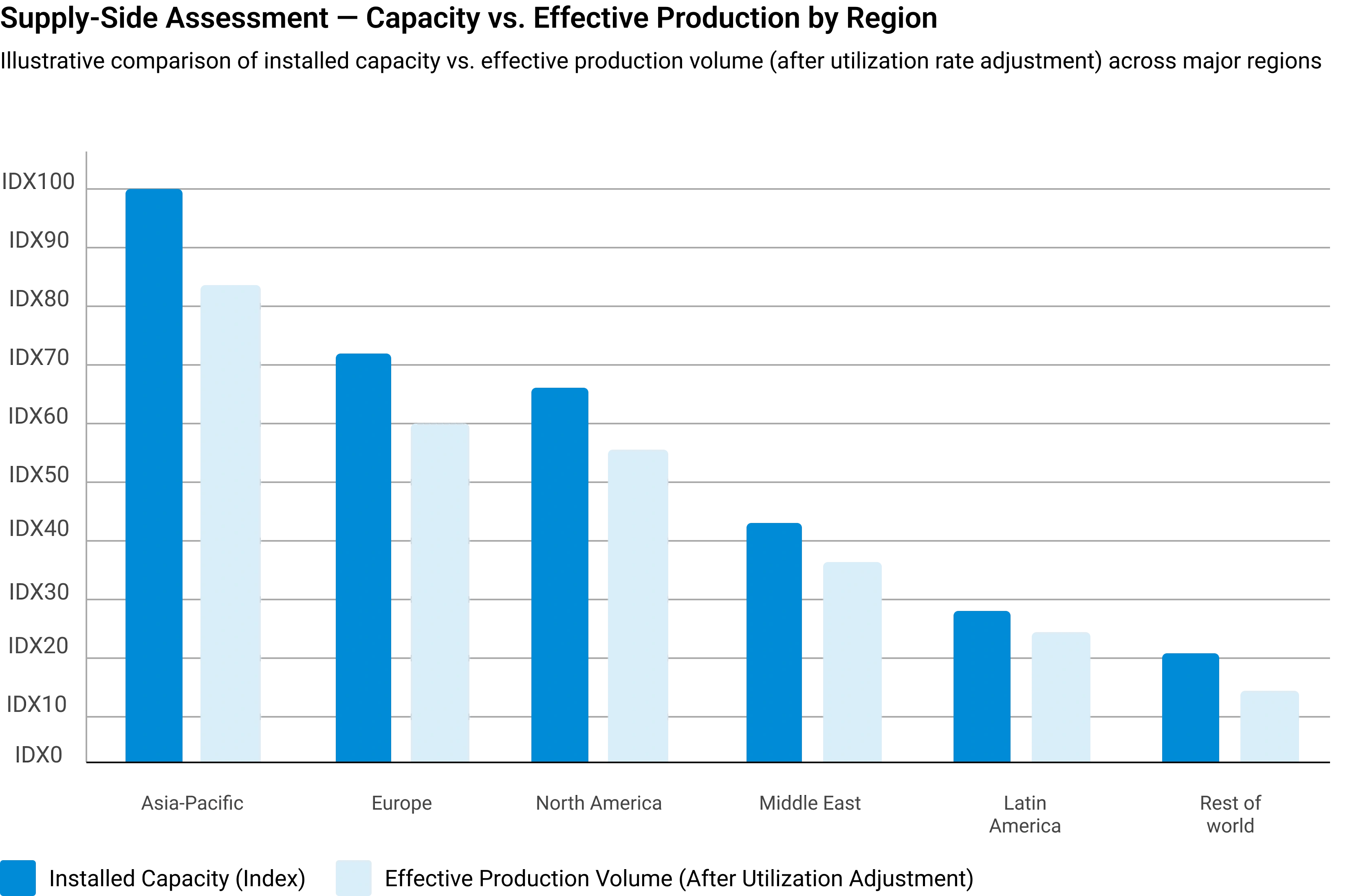
All major manufacturers are assessed for existing installed capacity, planned additions, expansions, new plant announcements, and technology adoption — mapped at global, regional, and country levels.
Capacity Utilization Adjustment
Installed capacity is adjusted using utilization rates based on demand conditions, feedstock availability, plant operating rates, maintenance schedules, and regulatory restrictions.
Manufacturer Revenue Analysis
Product-specific revenues, segment-level performance, regional distribution, average selling prices, and margin trends are evaluated to establish market value estimates.
Supply-Side Assessment — Capacity vs. Effective Production by Region
Illustrative comparison of installed capacity vs. effective production volume (after utilization rate adjustment) across major regions
Phase 3 — Demand-Side Assessment: Quantifying Chemical Consumption
Demand-side analysis quantifies chemical consumption across industries, applications, and geographies — identifying where and how chemicals are consumed throughout the value chain with precision.
End-Use Industry Analysis
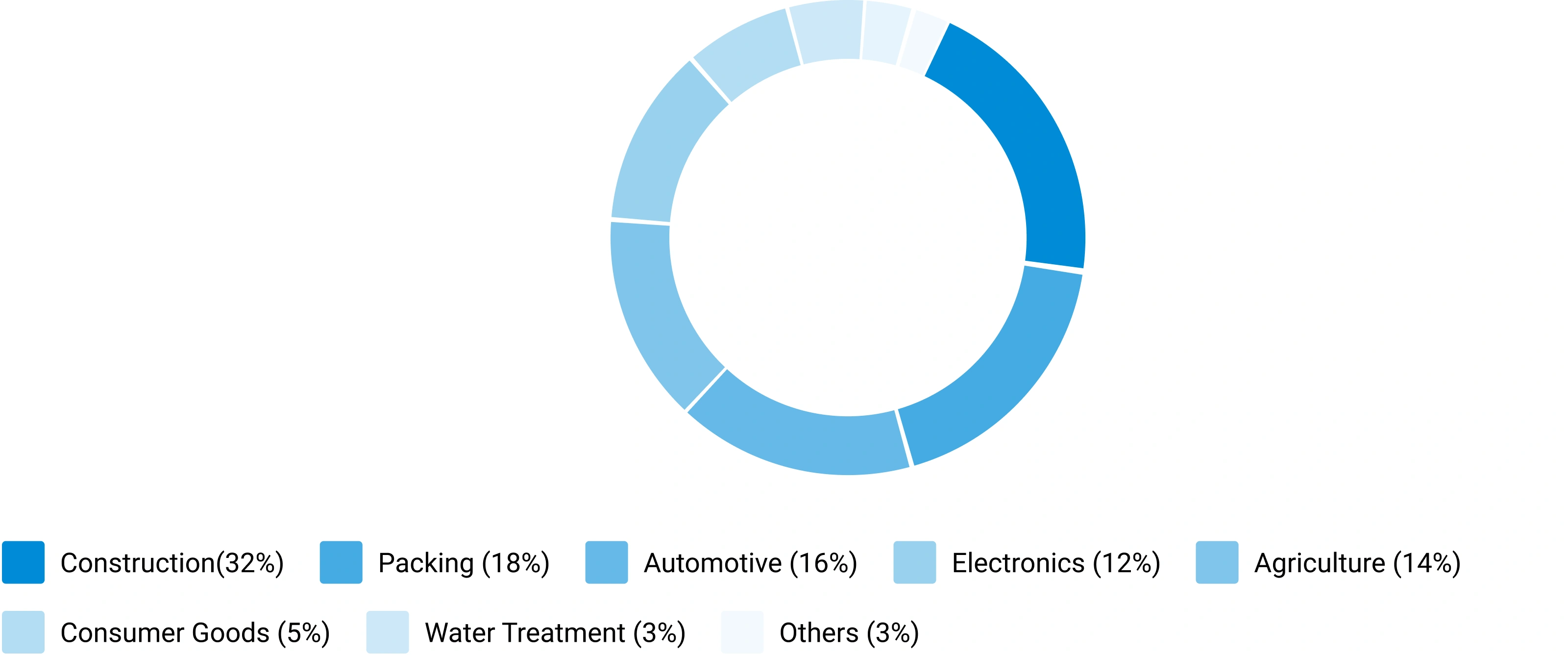
Chemical demand is evaluated across automotive, construction, packaging, electronics, agriculture, healthcare, consumer goods, industrial manufacturing, energy and utilities, and water treatment. Industry output, production trends, and consumption intensity are analyzed to determine demand patterns.
Consumption Modeling
Demand is estimated using measurable indicators: kilograms per vehicle, kilograms per square meter of construction, dosage per cubic meter of water treated, kilograms per hectare of agricultural land, and kilograms per ton of manufactured products. Consumption factors are validated through industry publications and primary interviews.
Application Analysis
The market is segmented by application area to understand product performance requirements, formulation trends, technology adoption, customer preferences, and regulatory requirements improving demand accuracy and segmentation granularity.
Demand-Side Assessment — End-Use Industry Demand Distribution
Illustrative distribution of chemical & materials demand across key end-use industries
Phase 4 - Trade Flow Analysis: Balancing Regional Supply and Demand
Trade flow analysis reconciles regional supply and demand estimates through import and export data, identifying net supply positions, regional dependencies, and market imbalances. It serves as an independent validation layer that tests the consistency of supply-side and demand-side estimates.
Import Analysis
Import data is evaluated to determine volumes, source countries, product dependency, regional supply gaps, and pricing trends — identifying markets that rely heavily on external supply and where domestic production is insufficient to meet demand.
Export Analysis
Export assessments reveal production surplus, export competitiveness, regional manufacturing strength, and global market participation. Export patterns also help validate domestic production estimates and identify net exporting regions.
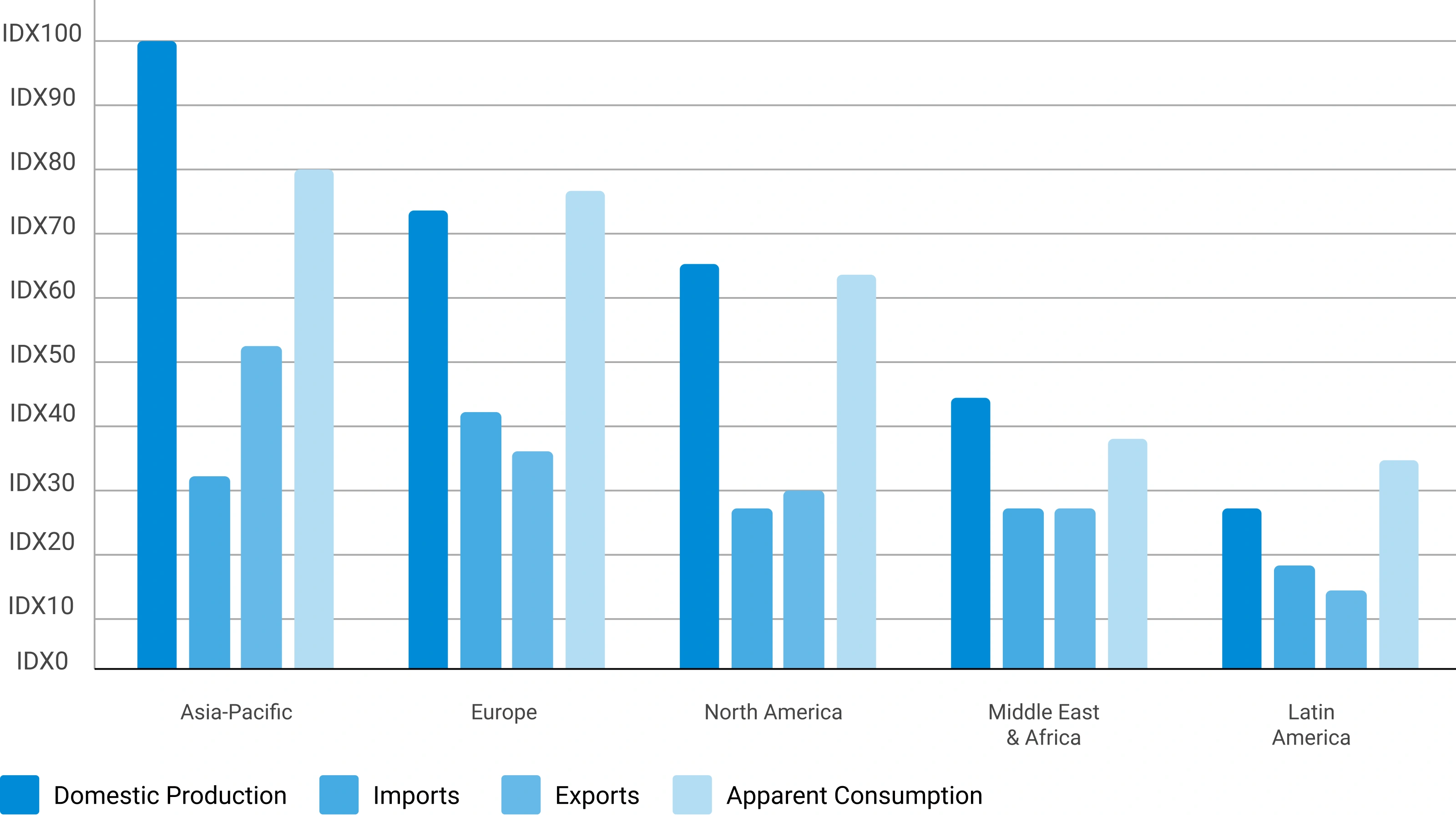
Apparent Consumption Model
Regional consumption is assessed using the standard apparent consumption formula:
Results identify net importing regions, net exporting regions, regional deficits, and surpluses — serving as an independent validation of supply and demand estimates.
Trade Flow Analysis — Net Supply Position by Region
Illustrative apparent consumption vs. domestic production across major regions — positive gap indicates net import dependency
Phase 5 — Primary Research: The Critical Validation Layer
Primary research tests and refines findings from secondary research through direct engagement with industry participants across the supply chain, demand side, and expert community. It captures intelligence that no database or published report can provide — the real-world experience of manufacturers, buyers, and specialists operating in the market.

Supply-Side Interviews
Conversations with chemical manufacturers, raw material suppliers, contract manufacturers, technology providers, and plant operators cover production trends, capacity utilization, pricing developments, technology shifts, and competitive dynamics.

Demand-Side Interviews
Engagement with OEMs, industrial consumers, procurement managers, distributors, formulators, and end-use manufacturers focuses on consumption trends, purchasing behavior, product substitution, demand outlook, and emerging applications.

Industry Expert Consultations
Additional interviews with industry consultants, independent experts, regulatory specialists, technical professionals, and research institutions provide deeper market context and validate key analytical assumptions.
Focus Areas of Primary Research:
Market Size & Forecast Validation
Revenue estimates, volume consumption, growth rates, forecast assumptions, regional demand.Supply Chain & Value Chain Assessment
Raw material sourcing, supply chain challenges, distribution networks, procurement practices.Production & Capacity Analysis
Manufacturing capacity, utilization rates, expansion projects, plant investments.Pricing & Cost Structure Analysis
Product pricing trends, feedstock costs, energy costs, margin pressures, pricing outlook.Competitive Landscape Assessment
Volume and value estimates confirmed to be fully consistent with one another before publicationInterview Volume by Market Scope
| Study Scope | Number of Interviews |
|---|---|
| Niche Market | 20 – 30 |
| Mid-Sized Market | 30 – 50 |
| Global Market | 50 – 80 |
| Highly Fragmented Market | 80 – 120 |
Interview Details:
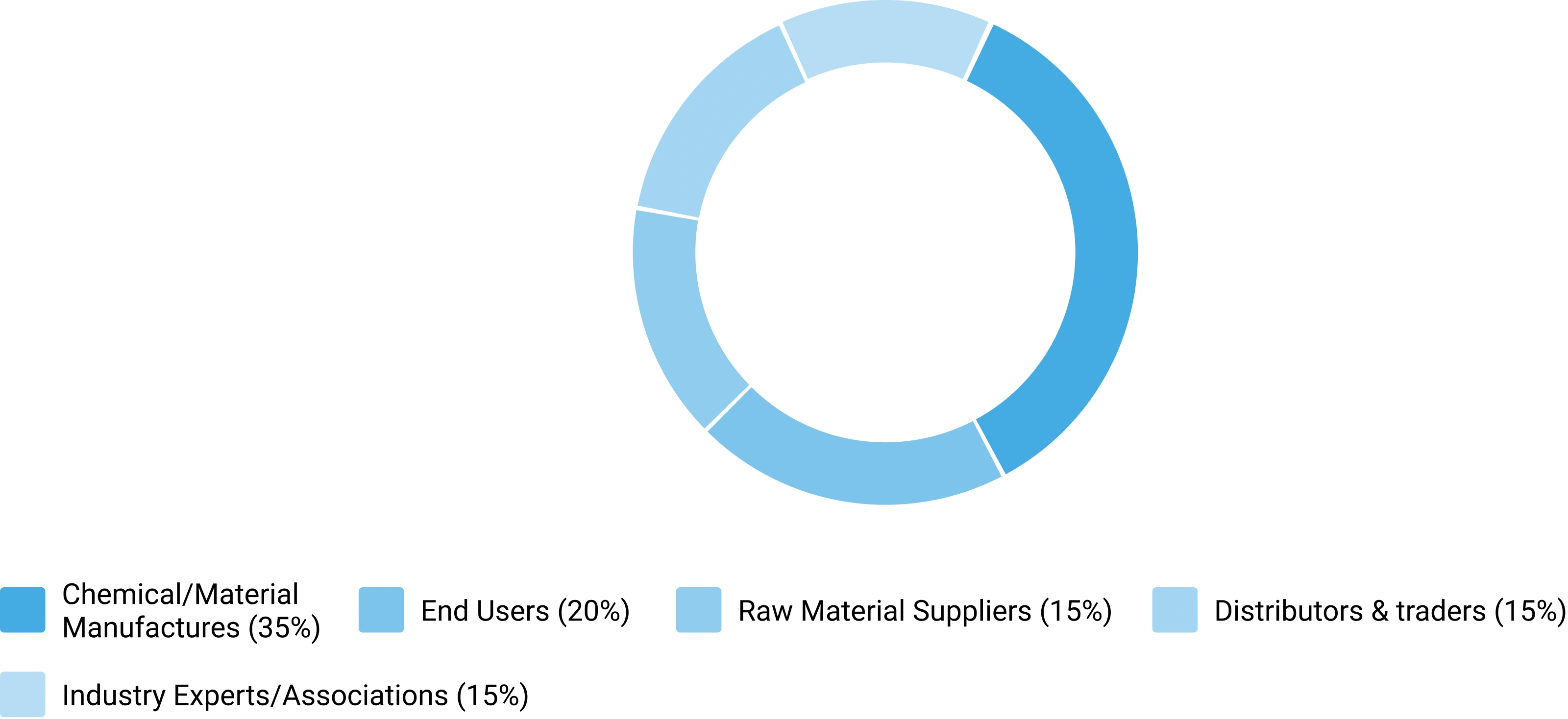
Category : Manufacturers, Suppliers, Distributors, End Users, Experts/Associations
Average Duration : 30–60 Minutes
Interview Mode : Video calls, telephonic interviews, expert consultations
Interview Format : Structured / Semi-Structured questionnaire
Focus Areas of Primary Research:
Market Size & Forecast Validation :
Revenue estimates, volume consumption, growth rates, forecast assumptions, regional demand.
Supply Chain & Value Chain Assessment :
Raw material sourcing, supply chain challenges, distribution networks, procurement practices.
Production & Capacity Analysis :
Manufacturing capacity, utilization rates, expansion projects, plant investments.
Pricing & Cost Structure Analysis :
Product pricing trends, feedstock costs, energy costs, margin pressures, pricing outlook.
Competitive Landscape Assessment :
Market share, competitor positioning, strategic initiatives, partnerships, acquisitions.
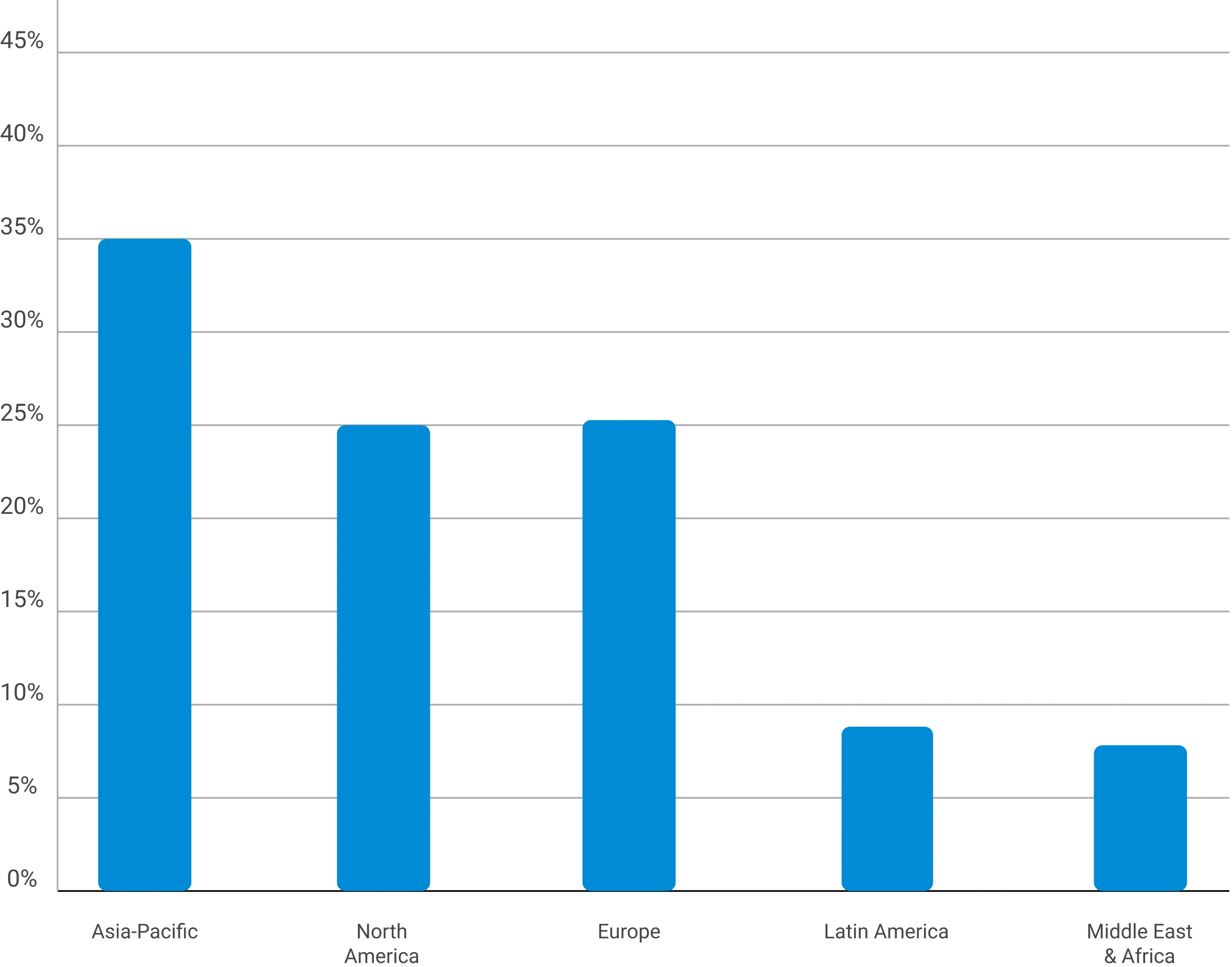
Primary Research — Stakeholder Coverage by Category
Distribution of interview respondents across stakeholder categories (% share from PPT data)
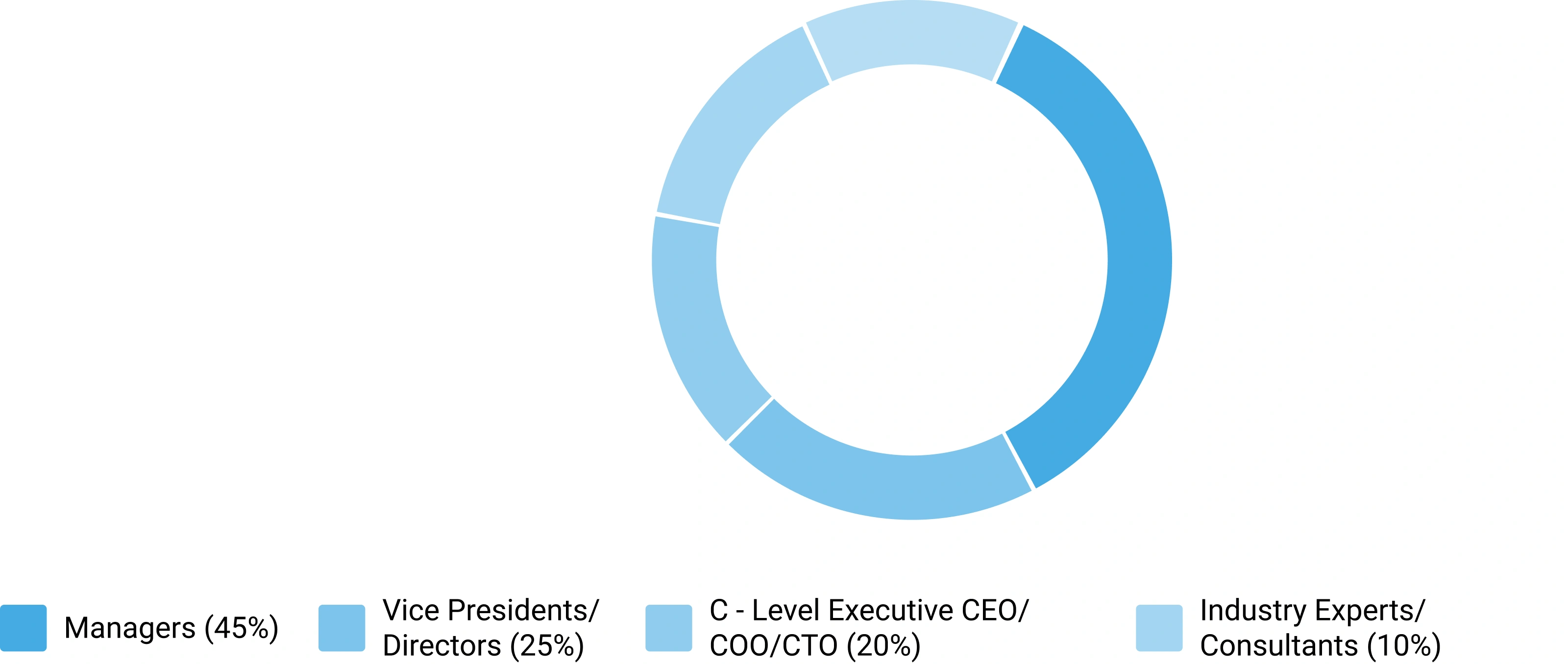
Primary Research — Respondent Designation Profile
Seniority breakdown of interview respondents (% share from PPT data)
Primary Research — Geographic Coverage of Interviews
Regional distribution of primary research engagement (% share from PPT data)
Phase 6 — Data Triangulation and Market Validation
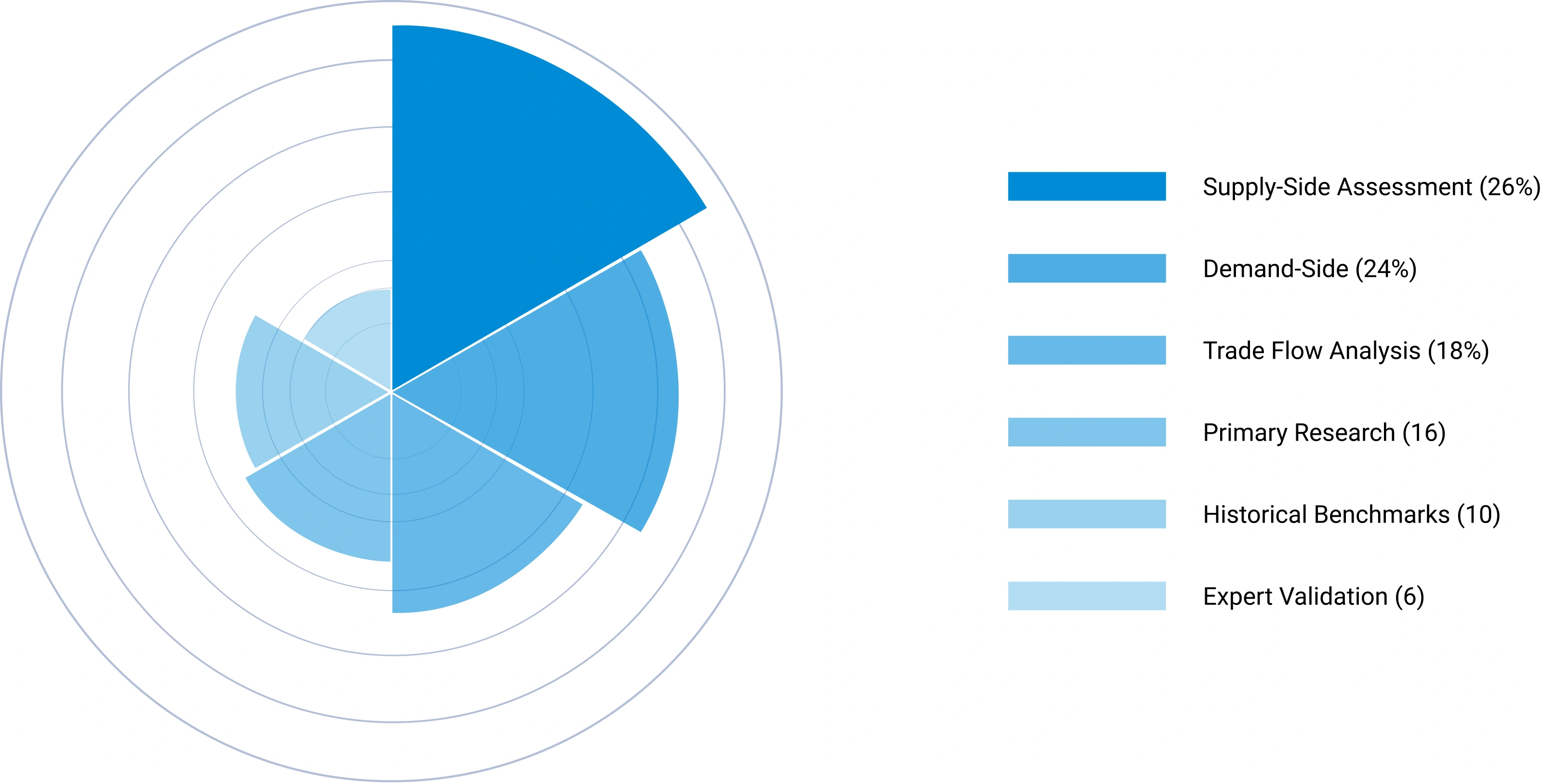
No single methodology is relied upon in isolation. Multiple independent estimation approaches are combined and reconciled to ensure consistency, accuracy, and analytical defensibility. Any material deviations between approaches are investigated and adjusted through additional validation cycles.
The final market size is derived through weighted triangulation of all validated methodologies. Any material deviations between approaches are investigated and adjusted through additional validation cycles. The outcome represents the most realistic assessment of the market based on available evidence and expert confirmation ensuring that volume and value estimates are fully consistent with one another.
Triangulation Framework — Input Contribution Weight
Relative weight each sizing input contributes to the final reconciled market estimate
Phase 7 — Forecast Modeling: Projecting Future Market Evolution
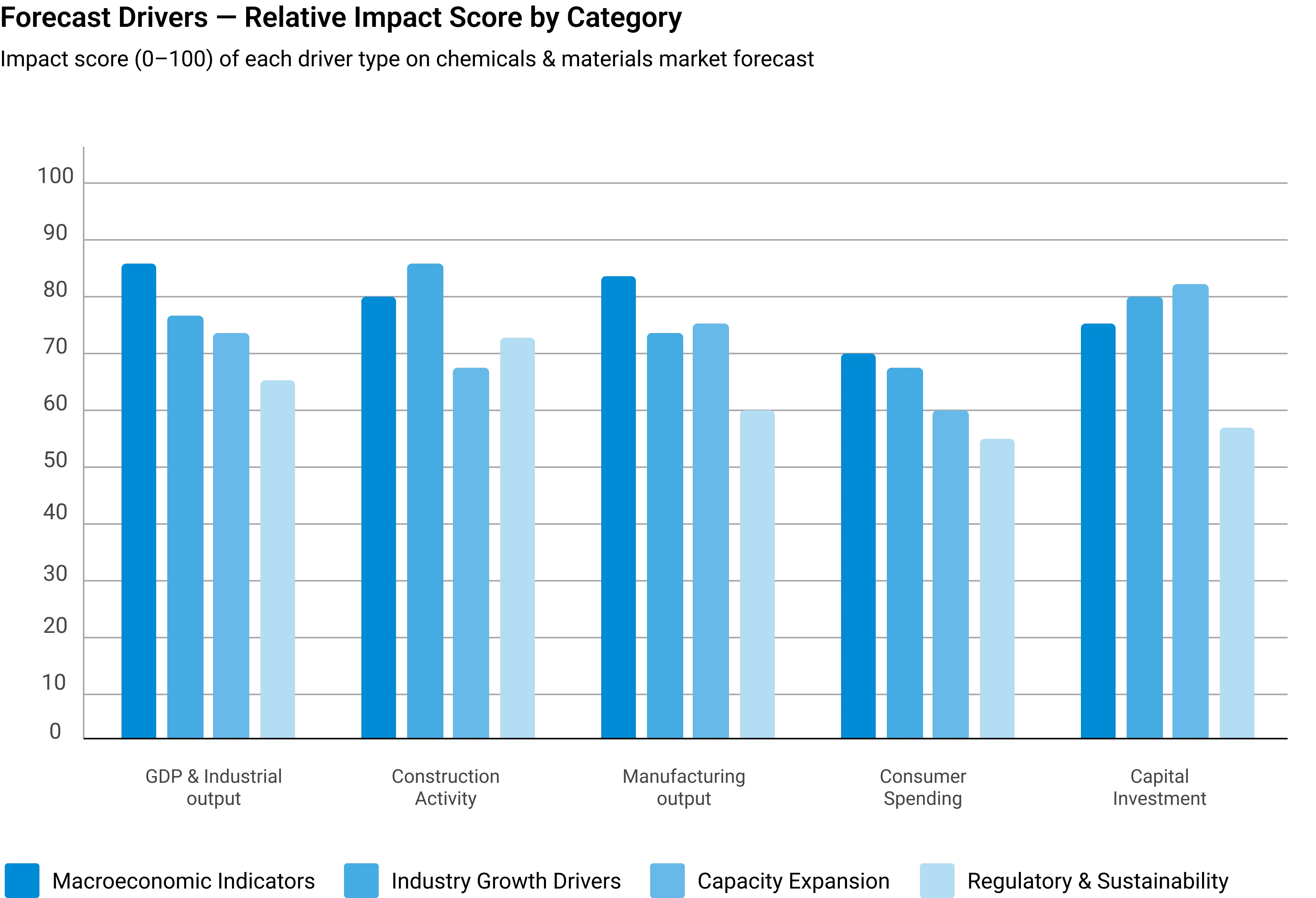
Forecasting evaluates the future trajectory of the market using a combination of quantitative indicators and qualitative assessments across economic, industry, and regulatory dimensions. Rather than simple extrapolation, each driver is independently modeled and integrated into a composite forecast.
Macroeconomic Indicators
GDP growth, industrial production, manufacturing output, construction activity, consumer spending, and capital investment form the quantitative foundation of long-term demand projections. These are applied at country, regional, and global levels.
Industry Growth Drivers
Urbanization, infrastructure development, industrialization, technological innovation, sustainability initiatives, and evolving product performance requirements are assessed at regional and industry levels — capturing both structural and cyclical demand drivers.
Capacity Expansion Analysis
Announced plant expansions, new manufacturing facilities, technology upgrades, and strategic investments are evaluated to determine future supply-demand dynamics and potential market tightness or oversupply situations.
Regulatory & Sustainability
Environmental regulations, chemical safety standards, emission reduction targets, circular economy initiatives, and sustainability requirements are incorporated as they often influence product adoption rates and market growth trajectories.
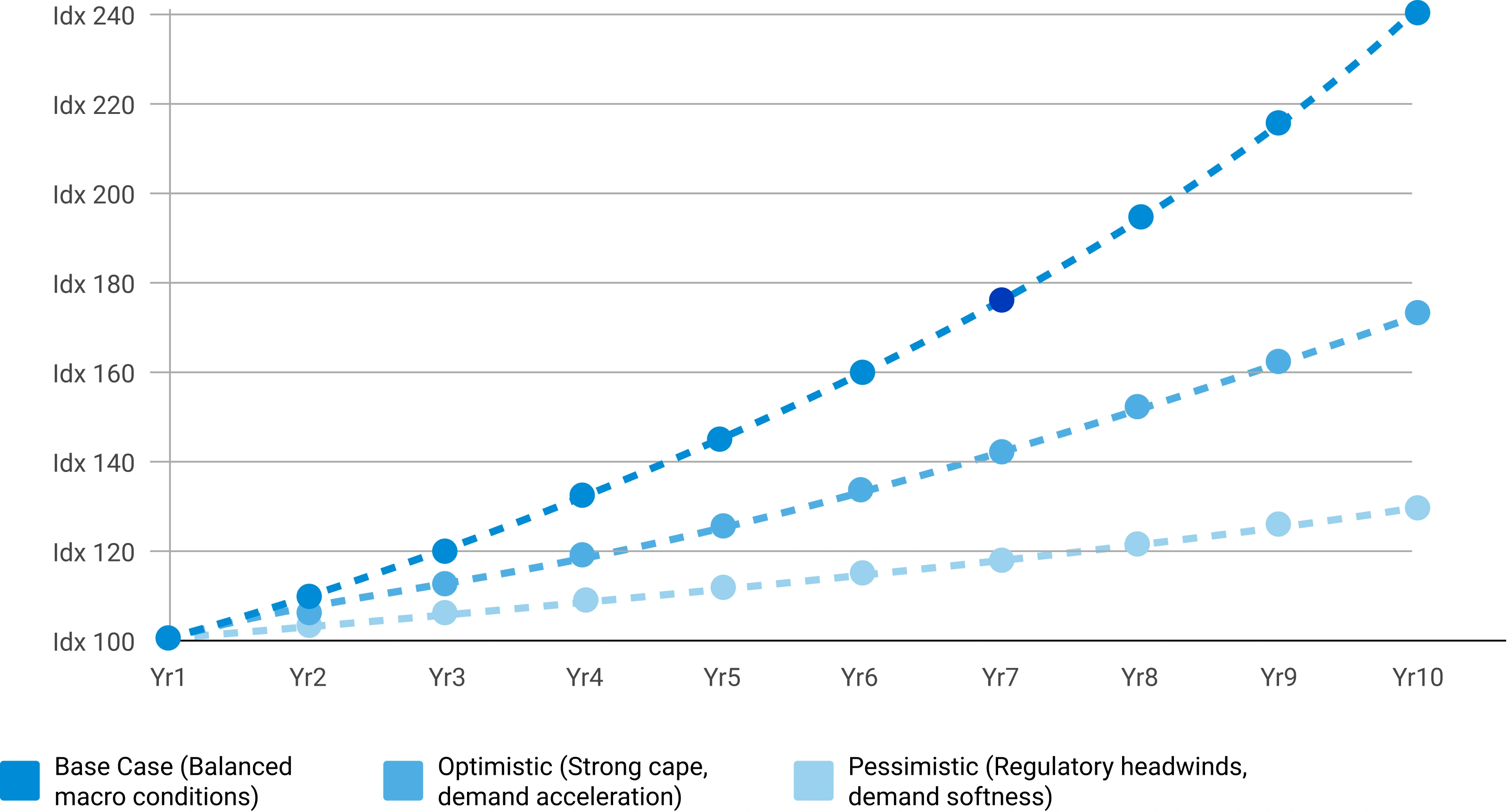
Scenario Forecast Range — Indexed Market Growth (Year 1–10)
Illustrative indexed growth trajectories across Base, Optimistic, and Pessimistic scenarios over a 10-year forecast horizon
Forecast Drivers — Relative Impact Score by Category
Impact score (0–100) of each driver type on chemicals & materials market forecast



Comments
Share your thoughts, ask a question, or provide feedback about this report.