Find the Right Market Report
Search thousands of industry reports, market insights, and research studies in one place.
Not sure where to start? Try one of these:
The U.S. oilfield chemicals market is estimated at USD 12.34 billion in 2026 and is projected to reach USD 18.50 billion by 2035, expanding at a CAGR of 4.60% from 2026 to 2035. The U.S. oilfield chemicals market was valued at USD 11.80 billion in 2025, the base year. The U.S. oilfield chemicals market covers chemicals used in U.S. oil and gas operations, including friction reducers, corrosion and scale inhibitors, biocides, surfactants, demulsifiers, polymers, gellants and viscosifiers, and other additives, used in drilling, cementing, well stimulation and hydraulic fracturing, production and enhanced oil recovery for onshore and offshore wells.
Friction Reducers & Polymers accounted for the largest share in 2025, at 26.00%, because slickwater fracturing uses them in every shale well. South accounted for 58.00% of revenue in 2025, supported by the Permian, Eagle Ford, Haynesville, and Gulf Coast activity. High production levels, longer laterals, mature well treatment programs and increased produced water reuse drive demand. Production chemicals are consolidating, with Brenntag buying Permian supplier Chem Tech in November 2025.
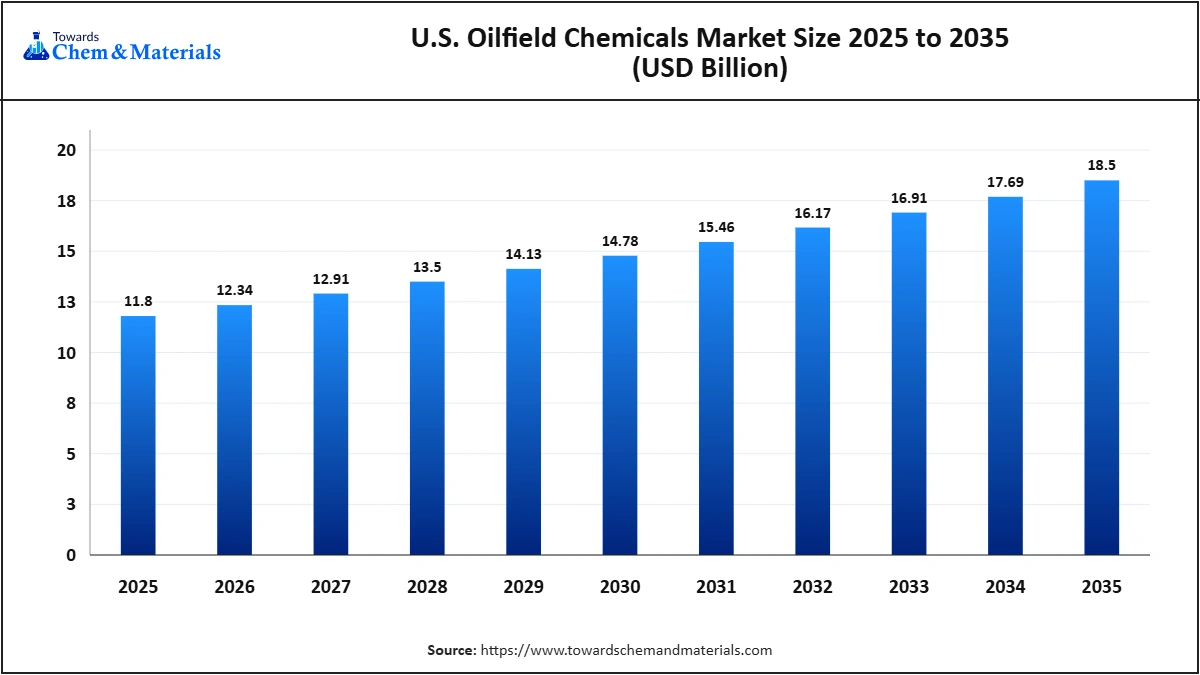
Note: 2025 is the base year; 2026-2035 values are forecasts.
Sources: Expert interviews, secondary sources, Towards Chemical and Materials database and Towards Chemical and Materials analysts.
The U.S. oilfield chemicals market is projected to grow from USD 11.80 billion in 2025 to USD 18.50 billion by 2035 because the United States is the world's largest oil and gas producer, and every shale well needs chemicals for fracturing and production. High production, longer laterals, mature well treatment and produced water reuse support steady growth, lifting the market to USD 14.78 billion by 2030 and sustaining a CAGR of 4.60% from 2026 to 2035. Oilfield chemicals use polyolefin-based additives and alpha olefin derivatives in some formulations.
Analyst View: We built the estimate from U.S. well completions, production volumes and chemical use per well and barrel by basin, cross-checked against U.S. chemical revenues of leading service companies. Our value sits just above published comparable estimates.
High U.S. oil and gas production levels are driving demand for drilling, completion and production chemicals across major shale basins. Longer horizontal laterals increase chemical consumption during hydraulic fracturing, while mature wells require additional treatments to manage corrosion, scaling and flow assurance. Produced water reuse and expanding LNG exports further support demand for specialized oilfield chemicals.
Volatility in crude oil and natural gas prices creates uncertainty in exploration and production spending, affecting oilfield chemical demand. Improvements in drilling efficiency can reduce rig requirements and limit chemical consumption from new wells. Environmental regulations increase compliance costs, while intense competition among suppliers and cost-conscious procurement practices create pricing pressure and constrain profit margins.
Increasing production from mature shale wells creates opportunities for specialized production chemicals that improve well performance and extend asset productivity. Produced water recycling is driving demand for advanced treatment formulations, while environmental concerns encourage low-toxicity chemistries. Digital injection monitoring, automated dosage optimization and expanding natural gas production across major U.S. basins offer additional growth opportunities.
Market Drivers - Impact & CAGR Contribution (2026-2035)
| Driver | Impact | ≈ CAGR Contribution | Time Horizon | Key Regions |
| High U | High | +1.80 pp | Short to long term | U.S.-wide, strongest in the South |
| S | Medium | +1.52 pp | Medium to long term | U.S.-wide, fastest uptake in West |
| oil and gas output | Medium | +1.29 pp | Short to medium term | U.S.-wide |
| Longer laterals need more chemicals | Low | +1.01 pp | Long term | South and West |
Note: Contributions are indicative estimates of each factor's effect on annual growth.
Sources: Expert interviews, secondary sources, Towards Chemical and Materials database and Towards Chemical and Materials analysts.
Taken together, these drivers add about 5.61 percentage points to the annual growth of the U.S. oilfield chemicals market, with high U having the largest effect. Their influence is strongest in the South, while uptake grows fastest in the West.
Market Restraints - Impact & Negative CAGR Contribution (2026-2035)
| Restraint | Impact | ≈ Negative CAGR Contribution | Time Horizon | Key Regions |
| Oil price volatility | High | -0.46 pp | Short to medium term | U.S.-wide |
| Drilling efficiency reduces rig counts | High | -0.33 pp | Medium term | Smaller and price-sensitive markets |
| Environmental restrictions | Medium | -0.22 pp | Short term | South and other mature markets |
Note: Contributions are indicative estimates of each factor's effect on annual growth.
Sources: Expert interviews, secondary sources, Towards Chemical and Materials database and Towards Chemical and Materials analysts.
These restraints are expected to reduce annual growth of the U.S. oilfield chemicals market by about 1.01 percentage points, led by oil price volatility. Their effect eases over the forecast period as suppliers, buyers and regulators adapt, leaving a net CAGR of 4.60% from 2026 to 2035.
| Segments | 2025 Share | 2035 Share | CAGR 2026-2035 |
| Friction Reducers & Polymers | 26.00% | 24.81% | 4.14% |
| Corrosion & Scale Inhibitors | 20.00% | 21.46% | 5.34% |
| Surfactants | 14.00% | 13.89% | 4.54% |
| Biocides | 9.00% | 8.97% | 4.54% |
| Demulsifiers | 9.00% | 8.97% | 4.54% |
| Others | 22.00% | 21.89% | 4.54% |
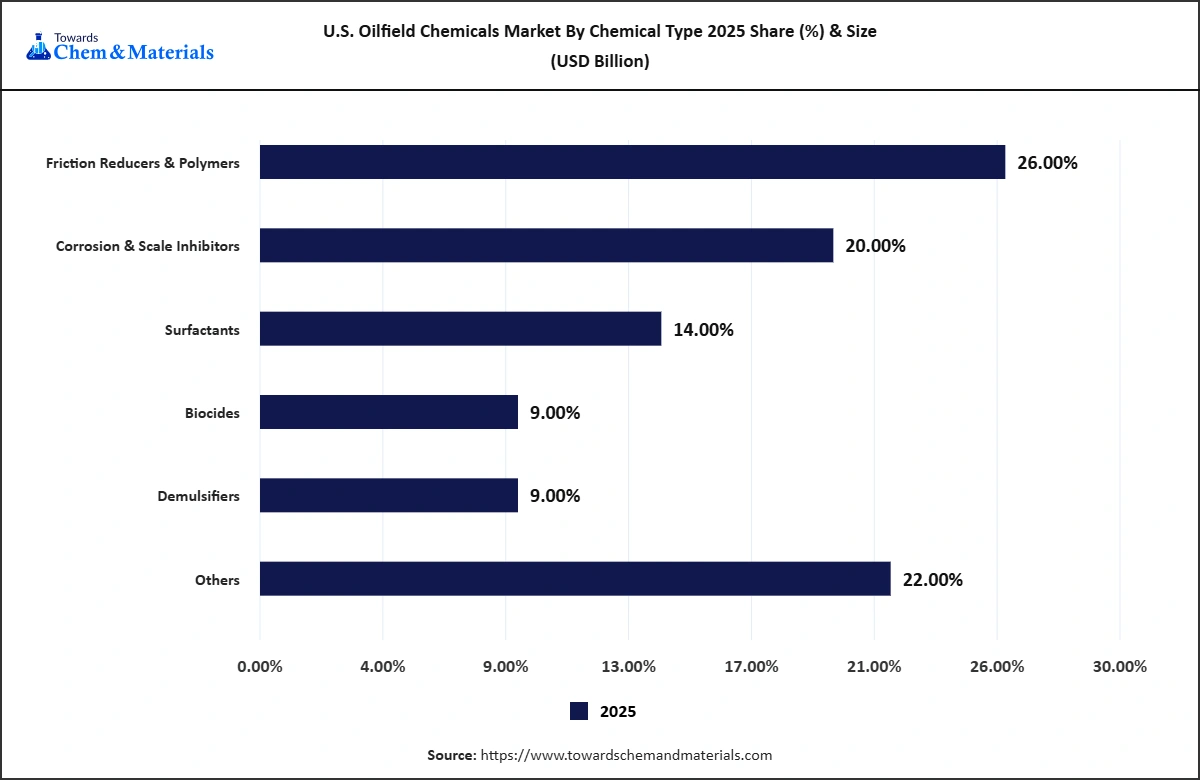
Note: 2025 is the base year; 2035 shares and CAGRs are forecasts.
Sources: Expert interviews, secondary sources, Towards Chemical and Materials database and Towards Chemical and Materials analysts.
Friction Reducers & Polymers dominated 26.00% market share in 2025, Corrosion & Scale Inhibitors for 20.00%, Surfactants for 14.00%, Biocides for 9.00%, Demulsifiers for 9.00% and Others for 22.00%. Friction Reducers & Polymers leads, while Corrosion & Scale Inhibitors is growing fastest.
Friction Reducers & Polymers: Holding the largest share of the U.S. oilfield chemicals market at 26.00% in 2025, this segment is projected to grow at a CAGR of 4.14% from 2026 to 2035. Its leading position reflects the widespread use of friction reducers and polymers in slickwater hydraulic fracturing across shale wells. However, the segment is expected to grow slower than the overall market over the forecast period.
Corrosion & Scale Inhibitors: Representing 20.00% of the market in 2025, this segment is projected to register a CAGR of 5.34% from 2026 to 2035. Increasing treatment requirements across mature wells, pipelines and production infrastructure are driving demand for corrosion and scale inhibitors. Consequently, the segment is expected to grow faster than the overall market over the forecast period.
Surfactants: With a 14.00% market share in 2025, this segment is projected to expand at a CAGR of 4.54% from 2026 to 2035. Surfactants support oilfield operations by improving fluid compatibility, hydrocarbon recovery and well cleanup. The segment is expected to grow broadly in line with the overall market over the forecast period.
Biocides: Contributing 9.00% to the U.S. oilfield chemicals market in 2025, this segment is projected to record a CAGR of 4.54% from 2026 to 2035. Growing requirements for bacterial control in fracturing fluids, produced water and injection systems are supporting demand for biocides. The segment is expected to grow broadly in line with the overall market.
Demulsifiers: Accounting for 9.00% of the market in 2025, this segment is forecast to expand at a CAGR of 4.54% from 2026 to 2035. Their role in separating oil and water during production and processing operations supports consistent demand across upstream activities. The segment is expected to grow broadly in line with the overall market over the forecast period.
Others: Collectively representing 22.00% of the market in 2025, this segment is projected to grow at a CAGR of 4.54% from 2026 to 2035. Its scope includes gellants, crosslinkers, clay stabilizers and other specialty formulations used in drilling, stimulation and production operations. The segment is expected to grow broadly in line with the overall market over the forecast period.
Segment Outlook: Friction Reducers & Polymers remains the largest chemical type segment through 2035, holding about 24.81% of the market in 2035, while Corrosion & Scale Inhibitors records the highest CAGR of 5.34% from 2026 to 2035. Biocides holds the smallest share today and serves more specialized needs within the U.S. oilfield chemicals market.
| Segments | 2025 Share | 2035 Share | CAGR 2026-2035 |
| Well Stimulation & Fracturing | 38.00% | 36.00% | 4.04% |
| Production | 30.00% | 32.49% | 5.44% |
| Drilling & Cementing | 22.00% | 21.68% | 4.44% |
| Enhanced Oil Recovery & Others | 10.00% | 9.84% | 4.44% |
Note: 2025 is the base year; 2035 shares and CAGRs are forecasts.
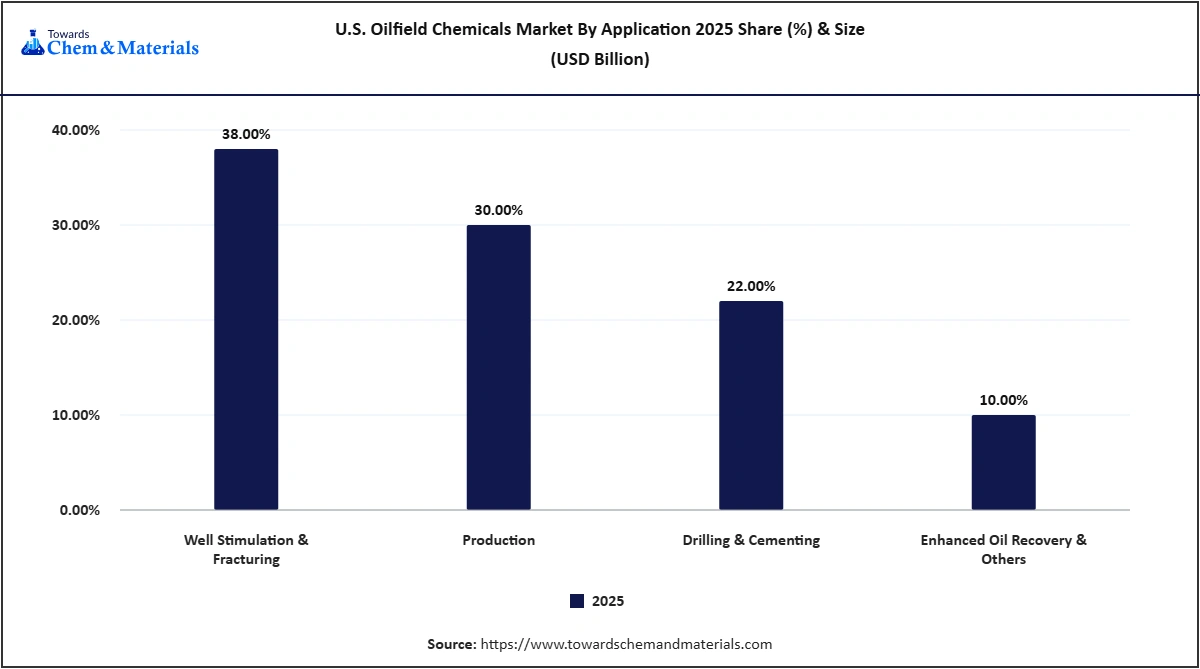
Sources: Expert interviews, secondary sources, Towards Chemical and Materials database and Towards Chemical and Materials analysts.
Well Stimulation & Fracturing accounted for 38.00% in 2025, Production for 30.00%, Drilling & Cementing for 22.00% and Enhanced Oil Recovery & Others for 10.00%. Well Stimulation & Fracturing leads, while Production is growing fastest.
Well Stimulation & Fracturing: With a 38.00% contribution to the U.S. oilfield chemicals market in 2025, well stimulation and fracturing remained the leading application segment. It is forecast to expand at a CAGR of 4.04% through 2035, supported by substantial chemical requirements for hydraulic fracturing across shale wells. However, growth is expected to remain below the overall market average.
Production: The production segment captured 30.00% of the market in 2025 and is anticipated to grow at the fastest CAGR of 5.44% between 2026 and 2035. Increasing treatment requirements in mature wells, particularly for corrosion control, scale prevention and flow assurance, are strengthening demand. Its growth rate is expected to exceed the overall market average.
Drilling & Cementing: Representing 22.00% of market revenue in 2025, drilling and cementing applications are projected to record a CAGR of 4.44% through 2035. Ongoing well construction activities and the need for specialized drilling fluids, cement additives and chemical formulations continue to support this segment. Its growth is expected to broadly align with the overall market.
Enhanced Oil Recovery & Others: This segment held a 10.00% market share in 2025 and is projected to advance at a CAGR of 4.44% from 2026 to 2035. Demand primarily stems from chemical applications that improve reservoir performance, enhance hydrocarbon recovery and support specialized oilfield operations. The segment is expected to maintain growth broadly in line with the overall market.
Segment Outlook: Well Stimulation & Fracturing remains the largest application segment through 2035, holding about 36.00% of the market in 2035, while Production records the highest CAGR of 5.44% from 2026 to 2035. Enhanced Oil Recovery & Others holds the smallest share today and serves more specialized needs within the U.S. oilfield chemicals market.
| Segments | 2025 Share | 2035 Share | CAGR 2026-2035 |
| Onshore | 86.00% | 86.22% | 4.63% |
| Offshore | 14.00% | 13.78% | 4.43% |
Note: 2025 is the base year; 2035 shares and CAGRs are forecasts.
Sources: Expert interviews, secondary sources, Towards Chemical and Materials database and Towards Chemical and Materials analysts.
Onshore accounted for 86.00% in 2025 and Offshore for 14.00%. Onshore leads and is also growing fastest.
Onshore: Dominating the U.S. oilfield chemicals market with an 86.00% share in 2025, the onshore segment is projected to register a CAGR of 4.63% from 2026 to 2035. Its substantial market presence reflects the concentration of oil and gas production across major U.S. shale basins, which drives consistent demand for drilling, fracturing and production chemicals. The segment is expected to grow broadly in line with the overall market over the forecast period.
Offshore: Although representing a smaller 14.00% share of the market in 2025, the offshore segment is anticipated to expand at a CAGR of 4.43% through 2035. Demand is supported by exploration and production activities in the Gulf of Mexico, where operators require specialized chemicals for corrosion control, flow assurance, drilling and subsea operations. Growth is expected to remain broadly in line with the overall market.
Segment Outlook: Onshore remains the largest location segment through 2035, holding about 86.22% of the market in 2035, and also records the highest CAGR of 4.63% from 2026 to 2035, strengthening its lead in the U.S. oilfield chemicals market.
Analyst View: Segment shares were allocated from demand, product portfolios and pricing in each category. Friction Reducers & Polymers, Well Stimulation & Fracturing and Onshore lead their categories because they meet the core needs of today's buyers. We expect Corrosion & Scale Inhibitors and Production to gain share as newer technologies, users and applications grow faster.
| Region | 2025 Share | 2035 Share | CAGR 2026-2035 |
| South | 58.00% | 55.51% | 4.14% |
| West | 23.00% | 25.62% | 5.74% |
| Midwest | 13.00% | 12.92% | 4.54% |
| Northeast | 6.00% | 5.95% | 4.54% |
Note: 2025 is the base year; 2035 shares and CAGRs are forecasts.
Sources: Expert interviews, secondary sources, Towards Chemical and Materials database and Towards Chemical and Materials analysts.
South accounted for 58.00% in 2025, West for 23.00%, Midwest for 13.00% and Northeast for 6.00%. South leads, while West is growing fastest.
South: Dominating the U.S. oilfield chemicals market with a 58.00% share in 2025, the South remains the largest regional market. It is projected to grow at a CAGR of 4.14% from 2026 to 2035, supported by extensive oil and gas activities across Texas, Louisiana and Oklahoma, which host major production areas such as the Permian, Eagle Ford, Haynesville and Gulf Coast. However, regional growth is expected to remain below the overall market rate.
West: Holding a 23.00% share of the market in 2025, the West is projected to register the fastest regional growth, with a CAGR of 5.74% through 2035. Expanding oil and gas activities in New Mexico's Delaware Basin, along with production operations in Colorado and Wyoming, are driving demand for drilling, stimulation and production chemicals. The region is expected to grow faster than the overall market.
Midwest: Contributing 13.00% to the U.S. oilfield chemicals market in 2025, the Midwest is forecast to expand at a CAGR of 4.54% from 2026 to 2035. Regional demand is supported by oil and gas production in North Dakota's Bakken formation, where drilling, hydraulic fracturing and production activities require specialized chemical treatments. Growth is expected to remain broadly in line with the overall market.
Northeast: Representing 6.00% of the market in 2025, the Northeast is anticipated to record a CAGR of 4.54% through 2035. Natural gas production across the Appalachian Basin, particularly in Pennsylvania, supports regional demand for drilling fluids, friction reducers and production chemicals. The region is expected to grow broadly in line with the overall market over the forecast period.
Analyst View: Regional shares were built from demand, installed base, spending and supplier presence in each region. South leads because of its mature demand base and strong suppliers. We assign West the highest growth premium because investment, adoption and capacity are expanding fastest there.
| Rank | Company Name | 2025 Share (%) | Key Products / Business | Headquarters |
| 1 | SLB (ChampionX) | 18.00% | Production chemicals and services | United States |
| 2 | Halliburton | 12.00% | Fracturing and drilling chemicals | United States |
| 3 | Baker Hughes | 9.00% | Production and drilling chemicals | United States |
| 4 | Ecolab (Nalco) | 5.00% | Water and production chemistry | United States |
| 5 | Clariant | 5.00% | Oil services chemicals | Switzerland |
| 6 | Dow | 4.00% | Surfactants and polymers | United States |
| 7 | Coastal Chemical (Brenntag) | 4.00% | Chemical distribution and production chemicals | United States |
| 8 | SNF | 4.00% | Friction reducer polymers | France |
| 9 | Innospec | 3.00% | Oilfield services chemicals | United States |
| 10 | BASF | 3.00% | Oilfield polymers and surfactants | Germany |
Note: Company shares are 2025 estimates.
Sources: Company press releases, expert interviews, secondary sources, Towards Chemical and Materials database and Towards Chemical and Materials analysts.
SLB (ChampionX) led the U.S. oilfield chemicals market with an estimated 18.00% share of 2025 revenue, followed by Halliburton at 12.00% share and Baker Hughes at 9.00% share. SLB (ChampionX) leads with production chemicals and services, Halliburton competes with fracturing and drilling chemicals, and Baker Hughes offers production and drilling chemicals. Ecolab (Nalco), Clariant, Dow, Coastal Chemical (Brenntag), SNF, Innospec and BASF compete through water and production chemistry, oil services chemicals, surfactants and polymers, chemical distribution and production chemicals, friction reducer polymers, oilfield services chemicals and oilfield polymers and surfactants.
The top 10 companies accounted for an estimated 67.00% of 2025 revenue, while the remaining 32.97% was shared among many regional chemical service companies and distributors. The U.S. oilfield chemicals market is moderately concentrated, and competition centres on field service networks, chemical performance in specific basins, water compatibility, logistics, environmental compliance and price.
SLB (ChampionX): Headquartered in the United States, SLB (ChampionX) held a leading position in the U.S. oilfield chemicals market, with an estimated 18.00% share in 2025. Its portfolio focuses on production chemicals and associated services, addressing chemical treatment requirements across upstream operations. Towards Chemical and Materials positions the company as a Leader in its Companies Quadrant.
Halliburton: With an estimated 12.00% market share in 2025, Halliburton is a major participant in the U.S. oilfield chemicals industry. The U.S.-based company specializes in fracturing and drilling chemicals, supporting well construction and stimulation activities across major shale basins. It occupies the Leader category in the Towards Chemical and Materials Companies Quadrant.
Baker Hughes: The United States-based company captured approximately 9.00% of the market in 2025. Its oilfield chemicals portfolio spans production and drilling applications, enabling it to serve multiple stages of upstream operations. Its established market presence and broad chemical offerings place Baker Hughes among the Leaders in the Towards Chemical and Materials Companies Quadrant.
Ecolab (Nalco): Representing an estimated 5.00% of the U.S. oilfield chemicals market in 2025, Ecolab (Nalco) maintains a presence through its water treatment and production chemistry solutions. Headquartered in the United States, the company addresses operational requirements related to water management and production efficiency. Towards Chemical and Materials classifies it as a Leader.
Clariant: Based in Switzerland, Clariant secured an estimated 5.00% share of the U.S. oilfield chemicals market in 2025. Its oil services chemical portfolio supports various upstream applications, including drilling, stimulation and production operations. The company features in the Leader category of the Towards Chemical and Materials Companies Quadrant.
Dow: Dow contributed approximately 4.00% to the U.S. oilfield chemicals market in 2025. The U.S.-headquartered company focuses on surfactants and polymer technologies that support oilfield fluid performance and treatment requirements. Its established materials expertise and chemical portfolio position it as a Leader in the Towards Chemical and Materials Companies Quadrant.
Coastal Chemical (Brenntag): Operating from the United States, Coastal Chemical (Brenntag) held an estimated 4.00% market share in 2025. Its business combines chemical distribution capabilities with production chemical solutions, allowing it to serve diverse oilfield requirements. Towards Chemical and Materials places the company in the Innovator category of its Companies Quadrant.
SNF: The France-headquartered company accounted for an estimated 4.00% of the U.S. oilfield chemicals market in 2025. Its portfolio emphasizes friction reducer polymers, which play an important role in hydraulic fracturing and fluid optimization. SNF is positioned as an Innovator in the Towards Chemical and Materials Companies Quadrant.
Innospec: With a 3.00% estimated market share in 2025, Innospec participates in the U.S. oilfield chemicals industry through its specialized oilfield chemical offerings. The company is headquartered in the United States and serves upstream applications with formulations designed to support operational performance. Towards Chemical and Materials identifies Innospec as an Innovator.
BASF: Headquartered in Germany, BASF held an estimated 3.00% share of the U.S. oilfield chemicals market in 2025. Its portfolio includes oilfield polymers and surfactants used in various drilling, stimulation and production applications. The company's chemical development capabilities support its positioning as an Innovator in the Towards Chemical and Materials Companies Quadrant.
The U.S. oilfield chemicals ecosystem links raw material suppliers, chemical formulators, service companies & distributors, operators and regulators, with each stage adding value before products reach end users.
| Ecosystem Stage | Role in the Market | Key Companies |
| Raw Material Suppliers | Supply monomers, surfactants and solvents | Dow, BASF, SNF |
| Chemical Formulators | Formulate oilfield chemicals | SLB (ChampionX), Baker Hughes, Clariant, Innospec |
| Service Companies & Distributors | Deliver and apply chemicals | Halliburton, Brenntag (Coastal Chemical) |
| Operators | Drill and produce | Shale operators and majors |
| Regulators | Set environmental rules | EPA, state agencies, Railroad Commission of Texas |
Sources: Company press releases, expert interviews, secondary sources, Towards Chemical and Materials database and Towards Chemical and Materials analysts.
Raw Material Suppliers: Supply monomers, surfactants and solvents. Key participants include Dow, BASF, SNF.
Chemical Formulators: Formulate oilfield chemicals. Key participants include SLB (ChampionX), Baker Hughes, Clariant, Innospec.
Service Companies & Distributors: Deliver and apply chemicals. Key participants include Halliburton, Brenntag (Coastal Chemical).
Operators: Drill and produce. Key participants include Shale operators and majors.
Regulators: Set environmental rules. Key participants include EPA, state agencies, Railroad Commission of Texas.
Value in the U.S. oilfield chemicals market flows from upstream material and technology suppliers to manufacturers and service providers, then through distribution partners to end users. Companies that integrate several stages or build long-term relationships with end users capture a larger share of this value.
The Towards Chemical and Materials Companies Quadrant evaluates key participants in the U.S. oilfield chemicals market across two dimensions: market strength and innovation and growth strategy. Market strength considers revenue scale, market share and geographic reach, while innovation and growth strategy assesses product portfolio breadth, R&D intensity and strategic partnerships. Company positioning reflects estimated 2025 market shares, alongside our assessment of product innovation, portfolio breadth and partnerships.
Sources: Company press releases, expert interviews, secondary sources, Towards Chemical and Materials database and Towards Chemical and Materials analysts.
Leaders: SLB (ChampionX), Halliburton, Baker Hughes, Ecolab (Nalco), Clariant and Dow combine high market share with broad portfolios and strong innovation.
Innovators: Coastal Chemical (Brenntag), SNF, Innospec and BASF bring newer technologies and specialised products.
By Chemical Type
By Application
By Location
By Region
The U.S. oilfield chemicals market was defined to include chemicals used in domestic oil and gas operations, such as friction reducers, corrosion and scale inhibitors, biocides, surfactants, demulsifiers, polymers, gellants, viscosifiers and other specialty additives. These chemicals support drilling, cementing, well stimulation and hydraulic fracturing, production and enhanced oil recovery across onshore and offshore operations.
The 2025 base-year estimate was developed using a bottom-up approach based on demand volumes and average selling prices across chemical types, applications, locations and regions. The resulting market value was cross-validated through a top-down assessment of market-specific revenues generated by leading companies and available published estimates. Segment, regional and company-level values were allocated based on their respective contributions to overall chemical demand and market activity.
Key estimates were further validated against company disclosures, regulatory filings, industry data and published third-party research. Inputs that could not be sufficiently verified or reconciled were excluded from the analysis. All segment, regional and company estimates were aligned with the same 2025 base year to ensure consistency. The 2026–2035 forecast was derived by applying the estimated growth rates to the 2025 base-year values, followed by recalculation and consistency checks across all market segments.
The U.S. oilfield chemicals market is set for steady expansion as high production and related demand keep growing. Our estimate links value to underlying demand, installed base and pricing, so the forecast follows real adoption rather than headline hype. The main upside comes from production chemicals and produced water treatment, while the main risks are oil price volatility and environmental restrictions.
Reliable market intelligence and data-driven insights across the global chemicals and materials industry, helping businesses understand trends, competition, pricing, and emerging opportunities.
Schedule a Demo