
Anode Materials Market Size, Share, Trends, and Forecast Analysis
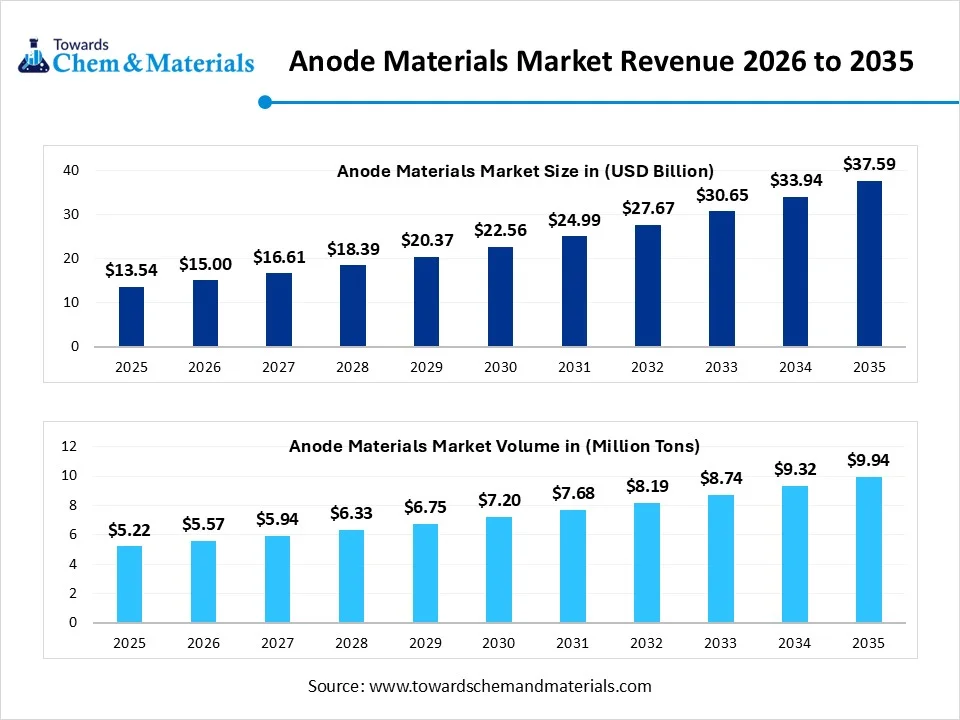
According to Vidyesh Swar Research, which specializes in research of specialty chemical advancements and new and innovative chemical technology launches that align with industrial needs and optimization and market research. Research helps in analyzing the key growth opportunities and market expansion in the coming decades and helps understand the growth of the anode materials market across the globe. the global anode materials market size was estimated at USD 13.54 billion in 2025 and is expected to be worth around USD 37.59 billion by 2035, growing at a CAGR of 10.75% from 2026 to 2035. In terms of volume, the anode materials market is projected to grow from 5.22 million tons in 2025 to 9.94 million tons by 2035. growing at a CAGR of 6.65% from 2026 to 2035. Silicon-based and silicon-carbon composite anodes for batteries are gaining popularity, which will enable higher energy density and faster charging. The increasing share of EVs and fast-charging stations is driving faster consumption of battery anodes worldwide.
Key Takeaways
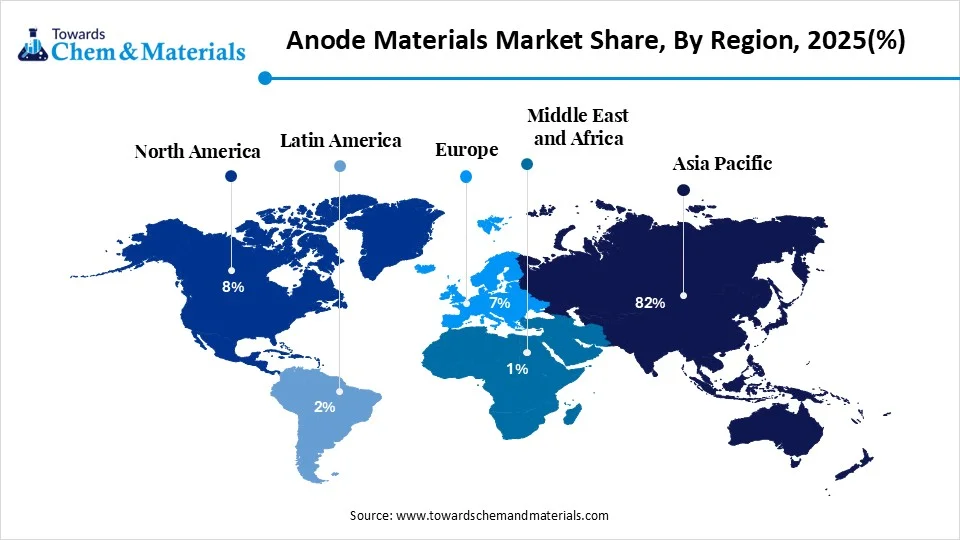
- By region, Asia Pacific dominated the anode materials market by holding 82% share in 2025 and is expected to grow at a CAGR of 10.3% during the forecast period.
- By region, North America held 8% market share in 2025 and is expected to grow at the fastest with a CAGR of 17.2% during the forecast period.
- By material type, the graphite segment dominated the market with the largest share of 79% in 2025 and is expected to grow at a CAGR of 9.2% during the forecast period.
- By material type, the silicon-based materials segment held 10% market share in 2025 and is expected to grow at the fastest CAGR of 27.8% over the forecast period.
- By form, the powder segment dominated the market with the largest share of 68% in 2025 and is expected to grow at a CAGR of 9.8% during the forecast period.
- By form, the coated particles segment held 13% market share in 2025 and is expected to grow at the fastest CAGR of 16.9% over the forecast period.
- By technology, the conventional graphitization segment dominated the market with the largest share of 49% in 2025 and is expected to grow at a CAGR of 8.4% during the forecast period.
- By technology, the silicon integration segment held 9% market share in 2025 and is expected to grow at the fastest CAGR of 29.6% over the forecast period.
- By battery chemistry, the lithium-ion segment dominated the market with the largest share of 96% in 2025 and is expected to grow at a CAGR of 10.2% during the forecast period.
- By battery chemistry, the sodium-ion segment held 2% market share in 2025 and is expected to grow at the fastest CAGR of 39.8% over the forecast period.
- By application, the lithium-ion segment dominated the market with the largest share of 90% in 2025 and is expected to grow at a CAGR of 10.2% during the forecast period.
- By application, the sodium-ion segment held 6% market share in 2025 and is expected to grow at the fastest CAGR of 39.8% over the forecast period.
- By end-use, the automotive segment dominated the market with the largest share of 68% in 2025 and is expected to grow at a CAGR of 13.2% during the forecast period.
- By end-use, the energy & utilities segment held 15% market share in 2025 and is expected to grow at the fastest CAGR of 18.4% over the forecast period.
Market Overview
Promoting the Localization of Battery Materials with Domestic Anode Production
Graphite is the predominant material, and silicon-based materials are an emerging growth segment. The global anode materials market is growing in tandem with the rise in the number of electric vehicles, the rising demand for fast-charging technology, and the growing renewable energy storage demand. Lithium-ion batteries are the dominant battery chemistry, while sodium-ion batteries are growing fast. The automotive application drives the end-use demand, and the energy and utilities end-use exhibits strong growth. Asia Pacific accounts for a high contribution in the region, whereas North America is expected to grow at a higher rate. Firms are bolstering manufacturing capacity, creating innovative materials, adopting new processing techniques, and strengthening regional supply chains.
- For instance, in March 2026, TACC Limited declared its plans to begin producing synthetic graphite anodes in Madhya Pradesh with an investment of more than ₹2,000 crore. The plant is expected to commence operations in the first quarter of 2027 and will be able to generate 20,000 MTPA initially.
Global Investment Movement for the Anode Materials Market
- Companies are turning to domestic anode material suppliers as investment starts to back their supply chain.
The initiative contributes to self-reliance in the supply of critical materials for batteries and the development of the countrys own supply of these materials. - Companies are increasing their international production to boost stability within the supply chain and meet customer demands worldwide.
- The investment focuses on the global market for orders while enhancing the production capability and competitiveness of the business.
- Regional anode manufacturing capacity is being supported, and clean energy supply chains are being developed through large-scale projects.
Anode Materials Market Trends
- The market for anode materials is maturing, and there is interest in silicon-based materials. The silicon-graphite composites, silicon oxide, silicon nanoparticles, and silicon-carbon composites are all part of their development.
- Advanced development and manufacturing processes of anode materials increasingly include coated particles. There are various coating methods, such as pitch coating, carbon coating, and polymer coating, for various battery needs.
- Silicon integration is quickly becoming a growing technology area in the manufacturing and development of anodes. There are silicon doping, silicon-graphite blending, and silicon-carbon encapsulation techniques.
Key Technological Shifts and AI in the Anode Materials Market
The discovery, formulation, and optimization of anode materials are increasingly being aided by the use of AI. Machine learning can perform compositional analysis of materials and forecast their electrochemical properties, which aids researchers in selecting promising candidates for graphite anodes, silicon-based anodes and advanced anodes. AI-supported workflows also optimize synthesis conditions, coating parameters, and the manufacturing process of electrodes. AI-driven design with iterative experimental tests has been proven to enhance the feasibility of graphite-based anode formulation and manufacturing reliability in recent research. AI is therefore emerging as an increasingly crucial tool to push the performance of anodes, process efficiency, and development of next-generation batteries.
Supply Chain Analysis of the Anode Materials Market
Feedstock Procurement
- Feedstock procurement is the process of buying raw natural flake graphite, petroleum coke, or needle coke needed for the production of anode materials.
- Reliable sourcing ensures continuity of downstream production activities and assists manufacturers in meeting required and needed material availability.
- BTR New Material Group: The BTR New Material Group acquires huge raw materials supplies of both natural and synthetic carbon feedstocks in long-term global contracts, enhancing procurement power.
- Key Players: Syrah Resources, Shanshan, and POSCO Future M.
Chemical Synthesis and Processing
- The chemical synthesis and processing is the purification, spheronizing, and graphitizing of raw carbon or silicon substrates at high temperatures.
- Shanghai Putailai: Shanghai Putailai has several large graphitization and carbonization lines to produce high-purity battery graphite from petroleum precursor materials.
- Other Key Players: Shanshan, BTR, and Hunan Zhongke Electric were recognized.
Compounding and Blending Processes
- Compound formulation and blending is a process of coating the graphite particles with a binder or a silicon-carbon composite with conductive additives.
- The processes contribute to the uniformity of the material and contribute to the preparation of active anode material for batteries.
- POSCO Future M: The active material surface is uniformly coated with carbon to improve structural stability and battery capacity with POSCO Future M. This contribution supports the formulation phase; it integrates coating processes with the development of active materials.
- Other Key Players: Mitsubishi Chemical, Resonac, and Sila Nanotechnologies.
Sustainability Analysis of the Anode Materials
The emergence of new innovations among the anode materials is gaining traction as part of the collective movement to enhance material sustainability and bolster its supply chains. Graphite from recycling can help battery companies to both diversify from imported materials and comply with the requirements of regulations encouraging the use of domestic feedstocks. A study on recycled silicon is also helping to develop environmentally friendly materials for the lithium-ion battery anode. Synthetic graphite production is also being investigated using more energy-efficient methods, including the possibility of lowering the energy requirement for conventional graphitization.
What is the anode material?
Battery materials employed in anode systems in lithium-ion and sodium-ion battery chemistries and other reported battery chemistries. They are made of graphite, silicon-based materials, hard carbon, soft carbon, lithium titanate, tin-based material, metal oxide, and advanced materials.
Uses of the Anode Materials
- The anode materials enable battery systems in all electric vehicles, such as Battery Electric Vehicles, Plug-In Hybrid Electric Vehicles, and Hybrid Electric Vehicles. The following is a list of reported applications in automotive battery systems that are considered important.
- Anode materials are applied in the energy storage sector, including grid-scale, commercial, industrial, and residential storage. These applications are associated with the reported energy and utilities end-use.
- Anode materials are being used in batteries for smartphones, laptops, tablets, wearables, cameras, and other consumer electronic products. They are used in various portable electronic devices and equipment.
- The materials used for the anode are reported to be used in material handling, telecom backup, industrial backup, and other industrial battery applications. The applications indicate the use of anode material in all kinds of industrial energy storage applications.
Pricing Analysis for the Anode Materials Market
The factors such as material type, processing requirements, manufacturing technology, and availability of feedstock are the factors that affect the pricing analysis of the anode materials market. Graphite-based materials require the procurement of natural flake graphite, petroleum coke, or needle coke and processing. For advanced materials, it is necessary to add other treatments, such as coating, blending, or silicon integration. All these factors are included in the changes in the pricing of anode materials.
Anode Materials Market: Global Trade Analysis
Anode materials are sourced, processed, manufactured, and supplied in various geographic markets that form the global trade activity. The international location of production grows, and the trade regulations and protectionism shape supply chain strategies. Domestic processing activities are also contributing to the development of the regional supply chain.
Regulatory Framework: Anode Materials Market
| Country Region | Regulatory Body | Key Regulations | Focus Areas |
| Asia Pacific | Ministry of Commerce (MOFCOM) | Decision No. 58 of 2025 | National security, export licensing |
| North America | US Department of Commerce | Inflation Reduction Act (IRA); Anti-Dumping (AD) | Building domestic processing supply chains |
| European Union | European Commission | EU Battery Regulation | Carbon footprint disclosures, life-cycle traceability |
Anode Materials Market Dynamics
Driver
Strengthening Battery Supply-Chain Development
Investment is being made in the development of domestic battery supply chains, including the production and processing of anode materials. Companies are scaling up production of graphite, as well as overseas plants and other material capabilities, to enhance supply availability. Reported production initiatives include synthetic graphite, natural graphite, silicon-based materials, and hard carbon. Projects also exist at a regional level to help develop local manufacturing ability and critical materials.
Restraint
Intensifying Trade Regulations and Supply-Chain Pressures
International anode material supply chains are facing challenges due to trade regulations and protectionism. The major concern pinpoints national security needs, export licensing, anti-dumping, and domestic processing policies in the major regions. These regulatory changes can impact sourcing strategies and overseas production decisions. In response, companies are engaging in a variety of activities, such as overseas manufacturing, domestic processing, and attempts to bring supply chains into balance.
Opportunity
Expanding Alternative Battery Chemistries
The rising growth of sodium-ion batteries opens a range of opportunities for sodium-ion anode material manufacturers in emerging energy storage applications. Hard carbon is also recognized as an anode material suitable for sodium-ion battery development. One other application area is energy storage systems, especially in the context of grid-scale storage. Specialized anode materials have a growing potential for research and commercial applications, driven by sodium-ion technologies. The developments can help diversify the reported market away from the traditional chemistry used in lithium-ion batteries.
Segmental Insights
Material Type Insights
Graphite Dominated the Anode Materials Market with 79% of Market Share in 2025
The graphite segment dominated the market with the largest share of 79% in 2025 and is expected to grow at a CAGR of 9.2% over the forecast period, due to its wide acceptance in battery applications and manufacturing processes. According to the nature of graphite, there are four types: natural graphite, synthetic graphite, flake graphite, amorphous graphite, needle coke-based materials, petroleum coke-based materials, and coal-tar pitch-based materials. Synthetic graphite is also under the investment scope of domestic and overseas production.
- For instance, in April 2025, Vianode introduced a recycled-graphite synthetic graphite anode material for sustainable EV battery production in April 2025. The development encourages less reliance on imported materials and encourages domestic feedstocks.
The silicon-based materials segment held the 10% market share in 2025 and is expected to grow at the fastest CAGR of 27.8% over the forecast period. The silicon-based materials segment consists of silicon-graphite composites, silicon oxide, silicon nanoparticles, and silicon-carbon composites. These materials are an important group of advanced anodes. The silicon integration is also one of the fastest-growing technology areas, driving further progress of silicon-based anode technologies. In addition, research is being conducted on recycled silicon for high-performance and eco-friendly lithium-ion batteries.
- For instance, in July 2025, the international research project Recycled Silicon, a new nanocomposite for high-performance, sustainable lithium-ion batteries, was launched by AIT, which focuses on sustainable batteries.
Form Insights
The Powder Segment Dominated the Anode Materials Market with 68% of Market Share in 2025
The powder segment dominated the market with the largest share of 68% in 2025 and is expected to grow at a CAGR of 9.8% over the forecast period. Powder is a well-established method for the production of anode materials and is key to reported applications. The location is indicative of the wide variety of material configurations that can be achieved using powder. The segment has its own processing activities, such as purification, graphitization, spheronization, and related processing activities, to support it. The powder-based materials are thus keeping an important place in the reported structure of the production of the anode material.
The coated particles segment held the 13% market share in 2025 and is expected to grow at the fastest CAGR of 16.9% over the forecast period. The coated particles segment comprises particles coated with pitch, carbon, or polymer. Coating methods are integrated into the process of compounding and blending of anode material development. The surfaces of active material can be coated with carbon to ensure structural stability and improve battery capacity, etc.
Technology Insights
Conventional Graphitization Dominated the Anode Materials Market with 49% of Market Share in 2025
The conventional graphitization segment dominated the market with the largest share of 49% in 2025 and is expected to grow at a CAGR of 8.4% over the forecast period. Traditional graphitization is still a significant technology in anode material production, especially in the case of graphite-based material. The segment covered high-temperature graphitization and processing of carbon-based feedstocks to battery graphite. Older techniques are still being used to produce graphite; newer techniques are being developed that would improve the manufacturing efficiency.
- For instance, in December 2025, Solidion Technology received new federal funding in December 2025 for a project to consider ways to produce graphite using energy-efficient methods. It seeks to diversify the U.S. energy supply chain and lower energy requirements.
The silicon integration segment held the 9% market share in 2025 and is expected to grow at the fastest CAGR of 29.6% over the forecast period, comprising silicon doping, silicon-graphite blending, and silicon-carbon encapsulation. These methods can be applied to the development of advanced silicon-containing anode material in lithium-ion batteries. Surface modification, nanoengineering, spray drying, and sol-gel processing are other areas of emerging technology where silicon integration is important. Another example of technology development in this category of materials is the research on recycled silicon.
Battery Chemistry Insights
Lithium-Ion Dominated the Anode Materials Market with 96% of Market Share in 2025
The lithium-ion segment dominated the market with the largest share of 96% in 2025 and is expected to grow at a CAGR of 10.2% over the forecast period. Inside the category, the lithium iron phosphate, NMC, NCA, lithium cobalt oxide, lithium manganese oxide, and lithium titanate configurations are included. Anode materials for lithium-ion applications include graphite, silicon-based materials, and others. There are also known uses and applications, including electric vehicles, energy storage, consumer electronics, industrial, and others. It continues to hold its key role in the available application structure and battery chemistry.
The sodium-ion segment held the 2% market share in 2025 and is expected to grow at the fastest CAGR of 39.8% over the forecast period. Prussian Blue/White, layered oxide, and polyanionic are all included in the segmentation. In addition, hard carbon anode materials are being developed in particular for sodium-ion battery applications. New advancements enable further interest in alternative battery technologies and energy-storage applications, especially in the realm of special anode materials like hard carbon, which can facilitate sodium-ion systems.
- For instance, in June 2026, CATL presented the TENER Sodium Energy Storage System in Munich, Germany, which has been commercialized in terms of technology, production capacity, and supply chain readiness.
Application Insights
Lithium-Ion Dominated the Anode Materials Market with 90% of Market Share in 2025
The lithium-ion segment dominated the market with the largest share of 90% in 2025 and is expected to grow at a CAGR of 10.2% over the forecast period. Aerospace and defense, consumer electronics, energy storage systems, medical devices, specialty electronics, marine systems, power tools, and electric vehicles are all applications of these batteries. The variety of listed applications illustrates the wide range of applications used for lithium-ion batteries. Electric vehicles involve battery electric vehicles, plug-in hybrid electric vehicles, and hybrid electric vehicles. Other energy storage applications include grid-scale, commercial, industrial, and residential storage.
The sodium-ion segment held the 6% market share in 2025 and is expected to grow at the fastest CAGR of 39.8% over the forecast period, as they are closely linked to the development of energy storage systems and requirements for alternative battery chemistry. The area of grid-scale storage is cited as an important application area for sodium-ion technologies. In addition, specially developed hard carbon anode materials for sodium-ion batteries are being developed to meet the rising demand for energy storage. These developments suggest a growing interest in alternative batteries for energy-storage applications.
End-Use Insights
Automotive Dominated the Anode Materials Market with 68% of Market Share in 2025
The automotive segment dominated the market with the largest share of 68% in 2025 and is expected to grow at a CAGR of 13.2% over the forecast period. It covers 2-wheelers, passenger vehicles, and commercial vehicles. Electric vehicle applications are a key market segment in the automotive battery market, which includes battery electric vehicles, plug-in hybrid electric vehicles, and hybrid electric vehicles. Batteries are used in all of these applications, with graphite and advanced anode materials used in battery systems. As such, the automotive sector is closely tied to the reported advances in synthetic graphite, recycled graphite, and other anode material technologies used in battery production.
The energy & utilities segment held the 15% market share in 2025 and is expected to grow at the fastest CAGR of 18.4% over the forecast period. The segment comprises renewable energy, grid storage, and distributed energy storage applications. This growing application field is complemented by the development of sodium-ion batteries and hard carbon anodes. Anode materials are also gaining in importance in stationary energy applications with grid-scale storage projects.
- For instance, in May 2025, NTT Anode Energy is installing three grid-scale battery storage facilities and will offer a turnkey BESS construction and operation service from July 2025.
Regional Insights
How Did the Asia Pacific Dominate the Anode Materials Market in 2025?
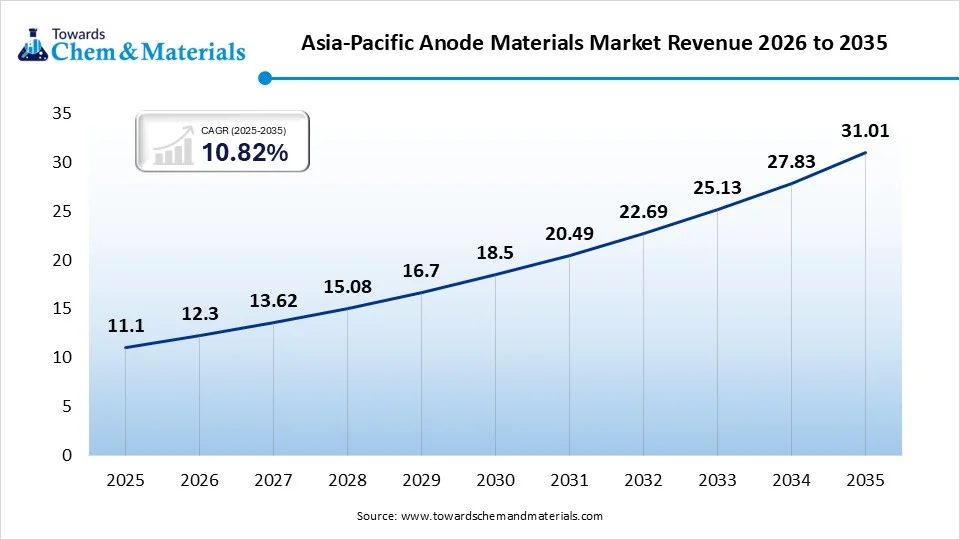
The Asia Pacific anode materials market size was estimated at USD 11.10 billion in 2025 and is projected to reach USD 31.01 billion by 2035, growing at a CAGR of 10.82% from 2026 to 2035. because of their long-standing battery material manufacturing, integrated supply chain, and graphite processing capabilities. The area is well endowed with various natural graphite, synthetic graphite, graphitization, carbonization, coating, and compound formulation industries. The governmental initiatives on increasing domestic production are also contributing to the development of the supply chain.
Advancing China’s Anode Materials Industry
China is a key manufacturing hub in the Asia Pacific and has a large base of experienced manufacturers and graphite processing plants, making it a key player in the Asia Pacific anode materials market. Entering the regional competitive landscape are some other Chinese participants, such as Shanshan. The Chinese can source raw materials, process them chemically, graphitize, surface treat, and form the materials. These activities improve the countrys capacity in the entire supply chain of anode materials and meet the needs of battery manufacturing.
Building India’s Domestic Anode Materials Capabilities
India is increasing their participation in the Asia Pacific anode materials market with domestic battery material manufacturing initiatives. The nations focus now turns towards the preparation of synthetic graphite-based active anode materials and the development of local battery-supply-chain capabilities. The developments facilitate higher engagement in anode material production and processing. The development of India also exemplifies the regional trend of self-reliance in the production of key battery components and greater participation in the evolving battery manufacturing landscape.
North America
North America held 8% market share in 2025 and is expected to grow at the fastest CAGR of 17.2% during the forecast period. The efforts of strengthening the battery material supply chain and processing capacity in the North American region are making the region an important market in the anode materials industry. Regional activities focus on the use of domestic feedstocks, recycled graphite, energy-efficient graphite production, and diversification of the supply chains. All these advances add to the availability of materials for battery and electric vehicle producers. This regional characteristic also highlights the increased focus on minimizing reliance on imported materials and improving their regional capabilities in graphite production, processing, and the development of advanced graphite anode materials.
Strengthening United States Anode Materials Capabilities
In the United States, the development of domestic anode material capabilities is underway with the development of graphite production, diversification of supply chains, and utilization of domestic sources. The development of Solidion Technology showcases progress in the areas of more energy-efficient production of graphite and less reliance on traditional graphitization processes. These activities will build the countrys capabilities in the regional battery materials value chain, as well as national processing capacities and the development of resilient supply chains for critical battery materials.
Supporting Canada’s Battery Materials Ecosystem
Canada is playing a role in the evolving battery material supply chain in North America. The market links Canada to the promotion of the use of domestic feedstocks and less reliance on imported materials. These activities contribute to Canadas overall regional involvement in battery material development and help to establish a link between sustainable availability of feedstocks and evolving requirements for new battery anode materials in the supply chain.
Europe
Europe held 7% market share in 2025 and is expected to grow at a CAGR of 13.8% over the forecast period. Europe is building its Anode Materials business on battery recycling, critical material recovery, resilience of its supply chain, and sustainability criteria. The EU Battery Regulation is a regulatory framework that prioritizes carbon footprint disclosures and life-cycle traceability of batteries. Battery recycling operations are also enhancing the local resource recovery capacity. These developments will help with Europes transition towards more sustainable battery material supply chains and less reliance on imported critical materials.
Countries
Developing Germany’s Battery Materials Ecosystem
Germany is working on improving its resource recovery capacity with industrial recycling programs for end-of-life batteries. This is a step towards Europes overall goal of minimizing dependence on critical materials imports and enhancing material circulation in battery supply chains. Germany also benefits from European sustainability agendas, such as life cycle traceability and carbon footprint disclosure. These activities help to create a more integrated and environmentally friendly battery materials value chain in the region.
- For instance, in March 2026, Tozero opened an industrial demonstration plant in Germany for lithium and other critical raw materials from end-of-life batteries.
Supporting France’s European Anode Materials Landscape
France is governed by a regulatory framework in Europe that strongly focuses on carbon footprint disclosures, traceability of batteries over their life cycle, and responsible use of battery materials. The priorities help to promote more sustainable supply chains and focus on material recovery. Frances geographic location also links it with the rest of the Western European battery industry and advanced material industry, which also enhances the prospects of battery technology evolution and sustainable anode material development.
Latin America
Latin America held 2% market share in 2025 and is expected to grow at a CAGR of 9.6% over the forecast period, with Brazil and Chile being the most prominent countries. The growing significance of battery technologies, electric mobility, and energy storage applications is linked to regional development. The region is growing extensively due to ongoing advancements. Thus, the region is identified with the countries and with potential involvement in the applications and activities of the battery value chain, to form a part of the global scene in the technology of anode materials.
Countries
Developing Brazil’s Anode Materials Market
Brazil is part of a region, which is provided in the package, and constitutes an emerging market structure in Latin America. Its market positioning relates to other battery technologies, electric mobility, and energy storage applications. Brazils presence helps drive the integration of the region in the global battery materials value chain, and its presence with other Latin American markets confirms the importance of advanced battery materials in emerging energy and transportation uses.
Advancing Chile’s Battery Materials Landscape
Chiles location is a factor in Latin Americas role in the growing battery materials business. Because of its increased importance for battery-related applications and new energy technologies. The regional context of the development of electric mobility and energy storage includes Chile. These applications remain important for the development of new and advanced materials for batteries, such as the anode materials, in the broader context of the global shift to ever-more complex battery technologies.
Middle East & Africa
The Middle East & Africa held 1% market share in 2025 and is expected to grow at a CAGR of 10.7% over the forecast period, with the development of battery energy storage applications and manufacturing initiatives. Large capacity battery storage projects are a sign of increasing demand in Saudi Arabia, and battery material participation is being increased across the region due to manufacturing development. These advancements further anchor the regions growth within the global battery materials sector and its energy and clean-energy supply chains.
Countries
Expanding Saudi Arabia’s Battery Storage Applications
Saudi Arabia is an important Middle East and African market, with its developing project for large-scale battery energy storage. The project in the country shows a great need for graphite anode materials for stationary storage applications. The linkage between energy storage infrastructure and the requirements for anode materials bolsters Saudi Arabias position in the regional battery value chain. The nation is also situated in the GCC market structure, where it will integrate its battery storage project with the regional energy framework. These activities enable larger-scale applications of batteries.
- For instance, in November 2025, Saudi Arabias Bisha project was powered by LFP cells produced by BYD, and used graphite anode material that was similar to the amount needed for electric vehicle batteries.
Supporting South Africa’s Regional Battery Materials Landscape
South Africa contributes to the overall battery materials market in the region. The country is part of the region that includes Saudi Arabia, Egypt, and other markets. Its location contributes to the regional environment of battery technologies, energy storage, and industrial applications. The inclusion of South African participation reinforces the role of battery materials in the regional market in the context of the ongoing development of advanced energy infrastructure and the adoption of battery technologies in new applications in the region.
Competitive Analysis
The anode materials market consists of global manufacturers and companies building up their capacity in key battery-material value chains. BTR New Energy Materials enjoys a world-leading position with a large production scale and natural and artificial graphite products. Other competitors that were identified are Mitsubishi Chemical Group, Epsilon Advanced Materials, Shanshan Technology, Sumitomo Chemical, Himadri Speciality Chemical, Jiangxi Zichen, Hitachi Chemical, SGL Carbon, JFE Chemical Corporation, and Nippon Carbon. All of these are signs of ongoing rivalry among graphite materials, new technologies, the growing supply chain, and new battery applications.
- For instance, in March 2026, POSCO Future M revealed plans for an artificial graphite anode facility in an overseas market to boost overseas order growth.
- In March 2026, BTR New Material Group (BTR) exhibited innovations at The Battery Show Asia 2026 and launched 26C ultra-fast charging graphite anode products.
Recent Developments
- In June 2026, Zhongke Electric started the construction of the factory for producing anode materials through its subsidiary company, Chongqing Shenzhen, in the Sohar Free Zone. The USD 1 billion project enables Oman to diversify its economy and enhance its contribution to the worlds clean energy supply chains.
- In May 2026, Epsilon Advanced Materials introduced a hard carbon anode material for sodium-ion batteries, responding to the rising demand of the grid-scale energy storage market. The development comes as the industry becomes more interested in alternative battery chemistries and as a range of sodium-ion anode materials becomes available.
Top Players in the Anode Materials Market & Their Offerings
| Company | Company Type/Position | Major Headquarters | Geographic Presence | Anode Materials Offerings | Key Strength |
| BTR New Energy Materials | Global Market Leader | Shenzhen, China | Global | Natural graphite, artificial graphite | Massive production scale |
| Shanghai Putailai (Zichen) | Leading Anode Producer | Shanghai, China | Global | Artificial graphite anode active materials | Vertical integration and advanced surface coating tech |
| POSCO Future M | Materials Subsidiary | Pohang, South Korea | Global | Natural/artificial graphite | Strong supply chain backing |
Anode Materials Market Key Players
- Mitsubishi Chemical Group
- Epsilon Advanced Materials
- BTR New Energy Material
- POSCO Future M
- Shanshan Technology (Ningbo Shanshan)
- Sumitomo Chemical
- Himadri Speciality Chemical
- Jiangxi Zichen (Zichen)
- Hitachi Chemical
- SGL Carbon
- JFE Chemical Corporation
- Nippon Carbon
Anode Materials Market Segment Covered in the Report
By Material Type
- Graphite
- Natural Graphite
- Flake Graphite
- Amorphous Graphite
- Synthetic Graphite
- Needle Coke-Based
- Petroleum Coke-Based
- Coal-Tar Pitch-Based
- Natural Graphite
- Silicon-Based Materials
- Silicon-Graphite Composites
- Silicon Oxide (SiOx)
- Silicon Nanoparticles
- Silicon-Carbon Composites
- Lithium Titanate
- Lithium Titanate Oxide (LTO)
- LTO-Carbon Composite
- Hard Carbon
- Biomass-Derived Hard Carbon
- Resin-Derived Hard Carbon
- Pitch-Derived Hard Carbon
- Soft Carbon
- Petroleum Coke-Based
- Pitch-Based
- Tin-Based Materials
- Tin Oxide
- Tin-Carbon Composite
- Metal Oxide Materials
- Titanium Oxide
- Iron Oxide
- Molybdenum Oxide
- Other Advanced Materials
- Phosphorus-Based Materials
- Graphene-Based Materials
- Silicon-Metal Composites
- Conversion-Type Materials
By Form
- Powder
- Micronized Powder
- Ultrafine Powder
- Granules
- Spherical Granules
- Irregular Granules
- Coated Particles
- Pitch-Coated
- Carbon-Coated
- Polymer-Coated
- Composite Materials
- Graphite-Silicon Composite
- Silicon-Carbon Composite
- Graphite-Metal Composite
By Technology
- Conventional Graphitization
- High-Temperature Graphitization
- Continuous Graphitization
- Coating Technology
- Pitch Coating
- Carbon Coating
- Polymer Coating
- Spheronization
- Mechanical Spheronization
- Chemical-Assisted Spheronization
- Silicon Integration
- Silicon Doping
- Silicon-Graphite Blending
- Silicon-Carbon Encapsulation
- Surface Modification
- Oxidation Treatment
- Functional Coating
- Pore Engineering
- Advanced Manufacturing
- Nanoengineering
- Spray Drying
- Sol-Gel Processing
By Battery Chemistry
- Lithium-Ion
- Lithium Iron Phosphate (LFP)
- Anode Materials Manganese Cobalt (NMC)
- Anode Materials Cobalt Aluminum (NCA)
- Lithium Cobalt Oxide (LCO)
- Lithium Manganese Oxide (LMO)
- Lithium Titanate (LTO)
- Sodium-Ion
- Prussian Blue/White
- Layered Oxide
- Polyanionic
- Solid-State Batteries
- Sulfide-Based
- Oxide-Based
- Polymer-Based
- Other Battery Chemistries
- Lithium-Sulfur
- Metal-Air
- Zinc-Based
By Application
- Electric Vehicles
- Battery Electric Vehicles
- Plug-in Hybrid Electric Vehicles
- Hybrid Electric Vehicles
- Energy Storage Systems
- Grid-Scale Storage
- Commercial & Industrial Storage
- Residential Storage
- Consumer Electronics
- Smartphones
- Laptops & Tablets
- Wearables
- Cameras
- Power Tools
- Cordless Power Tools
- Garden Equipment
- Professional Tools
- Industrial Batteries
- Material Handling
- Telecom Backup
- Industrial Backup
- Other Applications
- Aerospace & Defense
- Medical Devices
- Marine
- Specialty Electronics
By End-Use Industry
- Automotive
- Passenger Vehicles
- Commercial Vehicles
- Two-Wheelers
- Energy & Utilities
- Renewable Energy
- Grid Storage
- Distributed Energy Storage
- Electronics
- Mobile Electronics
- Computing Devices
- Wearable Electronics
- Industrial
- Manufacturing
- Automation
- Material Handling
- Consumer
- Household Appliances
- Personal Electronics
- Aerospace & Defense
- Aircraft
- Unmanned Systems
- Defense Electronics
By Regions
- North America
- Europe
- Asia Pacific
- Middle East & Africa
- Latin America
A Seven-Phase Framework
Our methodology is designed to be universally applicable across commodity chemicals, specialty chemicals, petrochemicals, construction chemicals, coatings, electronic chemicals, industrial gases, agrochemicals, water treatment chemicals, and performance materials. Each phase builds upon the last, creating a layered validation structure that minimizes estimation error and maximizes analytical confidence.
The framework ensures comprehensive market coverage, robust cross-validation, and reliable long-term forecasting — producing market estimates that withstand scrutiny from investors, regulators, and corporate strategy teams.

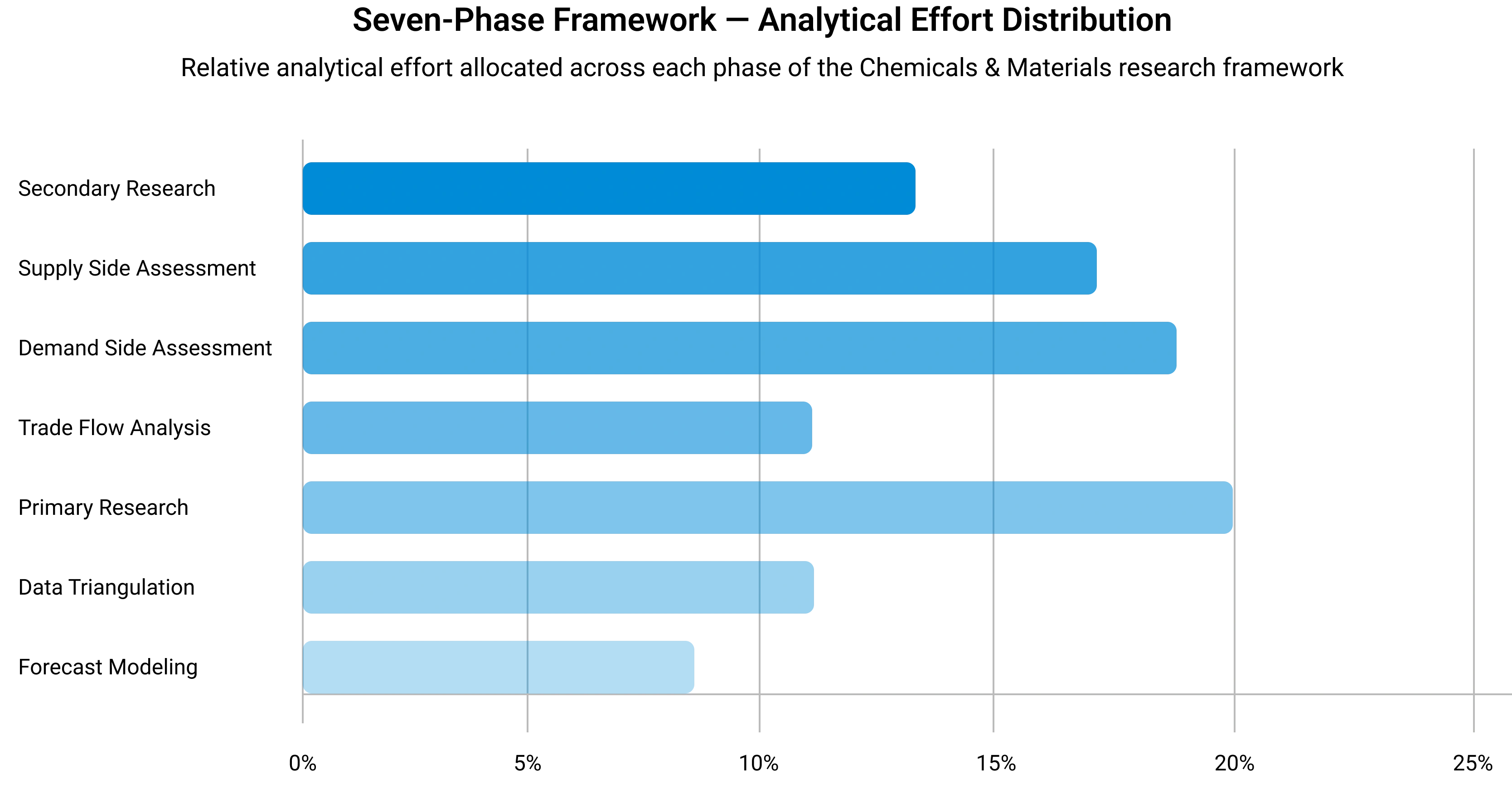
Seven-Phase Framework — Analytical Effort Distribution
Relative analytical effort allocated across each phase of the Chemicals & Materials research framework
Phase 1 - Secondary Research: Establishing the Foundation
Secondary research collects and evaluates publicly available information from authoritative sources, establishing the foundational understanding of market structure, value chain dynamics, competitive landscape, and end-use demand patterns. Every source is evaluated for credibility, recency, geographic relevance, and methodological soundness before inclusion.
Industry Associations
Sources include ACC, CEFIC, ICCA, JCIA, CPCIF, and SOCMA providing production volumes, consumption trends, capacity developments, and sustainability initiatives.
Company Disclosures
Annual reports, investor presentations, earnings transcripts, and regulatory filings reveal product portfolios, manufacturing footprints, capacity expansions, and revenue segmentation.
Government Databases
National statistical offices, customs authorities, environmental agencies, and industrial production databases provide verified statistics on output, trade flows, and regulatory compliance.
Trade Databases
UN Comtrade, ITC, Eurostat, and national customs authorities enable assessment of global product movement, import dependency, and export competitiveness across regions.
Our Secondary Research Sources
- Ministry of Chemicals and Fertilizers
- European Chemicals Agency
- United States Department of Energy
- Ministry of Industry and Information Technology
- Ministry of Economy Trade and Industry
- Ministry of Trade Industry and Energy
- National Institute of Standards and Technology
- Council of Scientific and Industrial Research
- Fraunhofer Society
- National Institute for Materials Science
Phase 2 — Supply-Side Assessment: Mapping Production Capabilities
Production Capacity Analysis
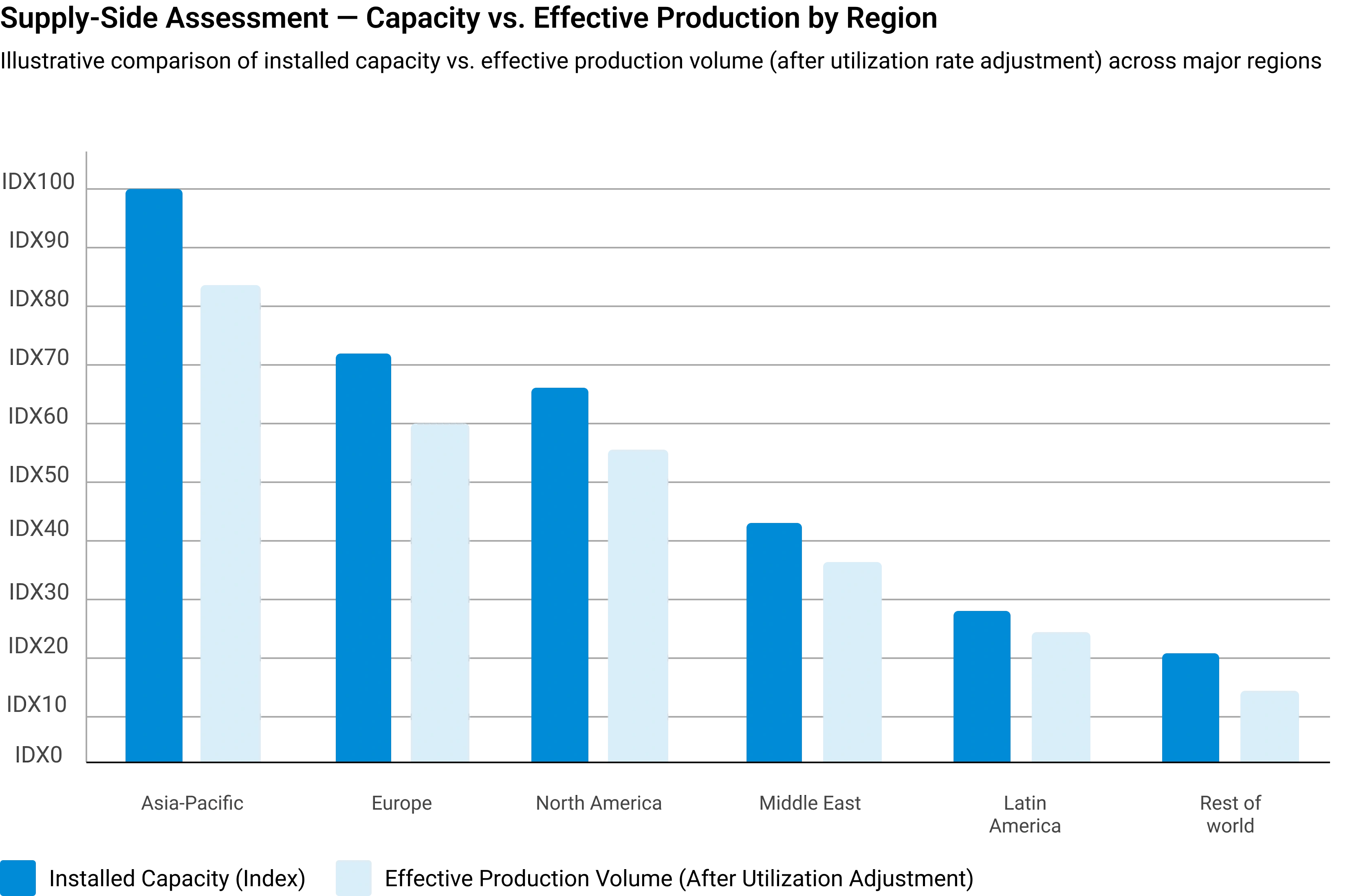
All major manufacturers are assessed for existing installed capacity, planned additions, expansions, new plant announcements, and technology adoption — mapped at global, regional, and country levels.
Capacity Utilization Adjustment
Installed capacity is adjusted using utilization rates based on demand conditions, feedstock availability, plant operating rates, maintenance schedules, and regulatory restrictions.
Manufacturer Revenue Analysis
Product-specific revenues, segment-level performance, regional distribution, average selling prices, and margin trends are evaluated to establish market value estimates.
Supply-Side Assessment — Capacity vs. Effective Production by Region
Illustrative comparison of installed capacity vs. effective production volume (after utilization rate adjustment) across major regions
Phase 3 — Demand-Side Assessment: Quantifying Chemical Consumption
Demand-side analysis quantifies chemical consumption across industries, applications, and geographies — identifying where and how chemicals are consumed throughout the value chain with precision.
End-Use Industry Analysis
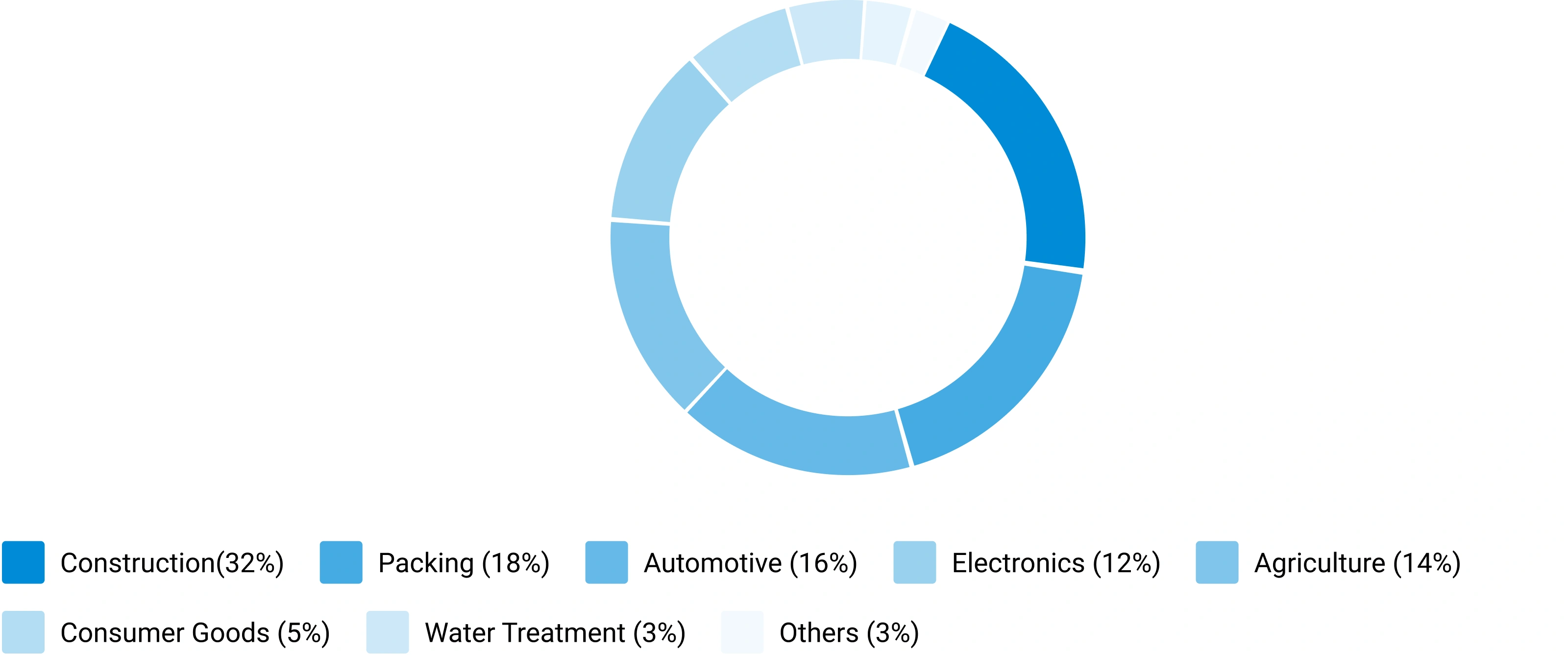
Chemical demand is evaluated across automotive, construction, packaging, electronics, agriculture, healthcare, consumer goods, industrial manufacturing, energy and utilities, and water treatment. Industry output, production trends, and consumption intensity are analyzed to determine demand patterns.
Consumption Modeling
Demand is estimated using measurable indicators: kilograms per vehicle, kilograms per square meter of construction, dosage per cubic meter of water treated, kilograms per hectare of agricultural land, and kilograms per ton of manufactured products. Consumption factors are validated through industry publications and primary interviews.
Application Analysis
The market is segmented by application area to understand product performance requirements, formulation trends, technology adoption, customer preferences, and regulatory requirements improving demand accuracy and segmentation granularity.
Demand-Side Assessment — End-Use Industry Demand Distribution
Illustrative distribution of chemical & materials demand across key end-use industries
Phase 4 - Trade Flow Analysis: Balancing Regional Supply and Demand
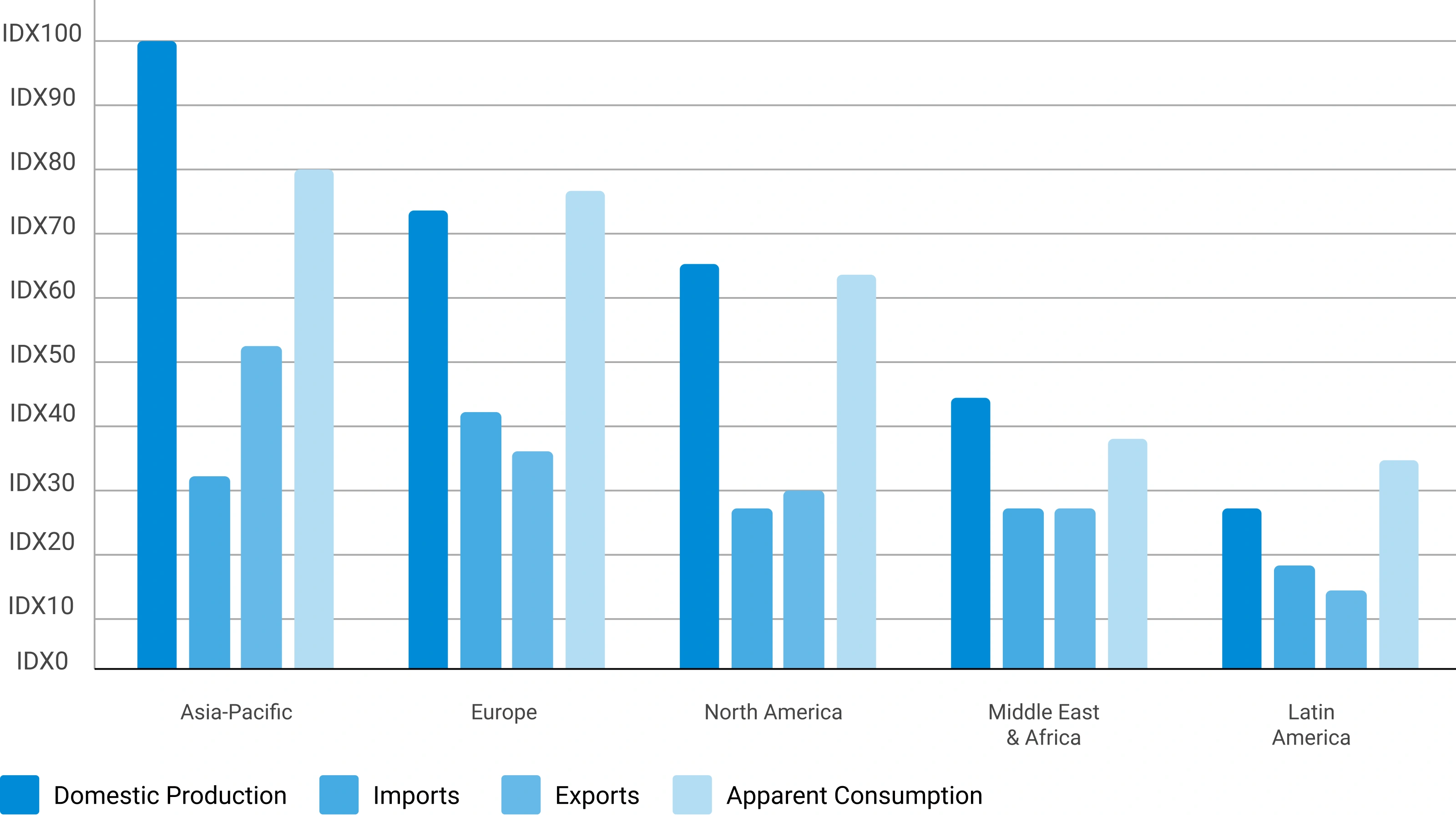
Trade flow analysis reconciles regional supply and demand estimates through import and export data, identifying net supply positions, regional dependencies, and market imbalances. It serves as an independent validation layer that tests the consistency of supply-side and demand-side estimates.
Import Analysis
Import data is evaluated to determine volumes, source countries, product dependency, regional supply gaps, and pricing trends — identifying markets that rely heavily on external supply and where domestic production is insufficient to meet demand.
Export Analysis
Export assessments reveal production surplus, export competitiveness, regional manufacturing strength, and global market participation. Export patterns also help validate domestic production estimates and identify net exporting regions.
Apparent Consumption Model
Regional consumption is assessed using the standard apparent consumption formula:
Results identify net importing regions, net exporting regions, regional deficits, and surpluses — serving as an independent validation of supply and demand estimates.
Trade Flow Analysis — Net Supply Position by Region
Illustrative apparent consumption vs. domestic production across major regions — positive gap indicates net import dependency
Phase 5 — Primary Research: The Critical Validation Layer
Primary research tests and refines findings from secondary research through direct engagement with industry participants across the supply chain, demand side, and expert community. It captures intelligence that no database or published report can provide — the real-world experience of manufacturers, buyers, and specialists operating in the market.

Supply-Side Interviews
Conversations with chemical manufacturers, raw material suppliers, contract manufacturers, technology providers, and plant operators cover production trends, capacity utilization, pricing developments, technology shifts, and competitive dynamics.

Demand-Side Interviews
Engagement with OEMs, industrial consumers, procurement managers, distributors, formulators, and end-use manufacturers focuses on consumption trends, purchasing behavior, product substitution, demand outlook, and emerging applications.

Industry Expert Consultations
Additional interviews with industry consultants, independent experts, regulatory specialists, technical professionals, and research institutions provide deeper market context and validate key analytical assumptions.
Focus Areas of Primary Research:
Market Size & Forecast Validation
Revenue estimates, volume consumption, growth rates, forecast assumptions, regional demand.Supply Chain & Value Chain Assessment
Raw material sourcing, supply chain challenges, distribution networks, procurement practices.Production & Capacity Analysis
Manufacturing capacity, utilization rates, expansion projects, plant investments.Pricing & Cost Structure Analysis
Product pricing trends, feedstock costs, energy costs, margin pressures, pricing outlook.Competitive Landscape Assessment
Volume and value estimates confirmed to be fully consistent with one another before publicationInterview Volume by Market Scope
| Study Scope | Number of Interviews |
|---|---|
| Niche Market | 20 – 30 |
| Mid-Sized Market | 30 – 50 |
| Global Market | 50 – 80 |
| Highly Fragmented Market | 80 – 120 |
Interview Details:
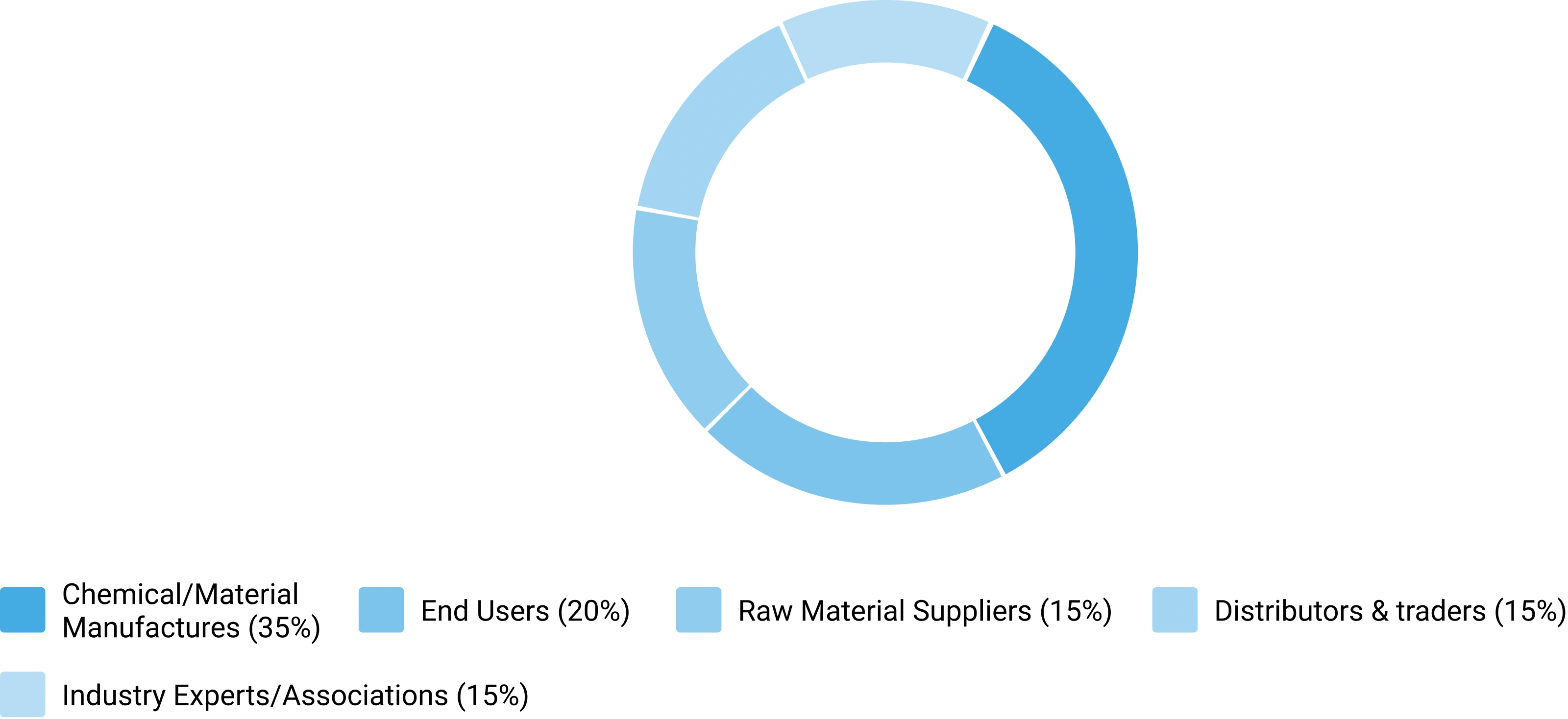
Category : Manufacturers, Suppliers, Distributors, End Users, Experts/Associations
Average Duration : 30–60 Minutes
Interview Mode : Video calls, telephonic interviews, expert consultations
Interview Format : Structured / Semi-Structured questionnaire
Focus Areas of Primary Research:
Market Size & Forecast Validation :
Revenue estimates, volume consumption, growth rates, forecast assumptions, regional demand.
Supply Chain & Value Chain Assessment :
Raw material sourcing, supply chain challenges, distribution networks, procurement practices.
Production & Capacity Analysis :
Manufacturing capacity, utilization rates, expansion projects, plant investments.
Pricing & Cost Structure Analysis :
Product pricing trends, feedstock costs, energy costs, margin pressures, pricing outlook.
Competitive Landscape Assessment :
Market share, competitor positioning, strategic initiatives, partnerships, acquisitions.
Primary Research — Stakeholder Coverage by Category
Distribution of interview respondents across stakeholder categories (% share from PPT data)
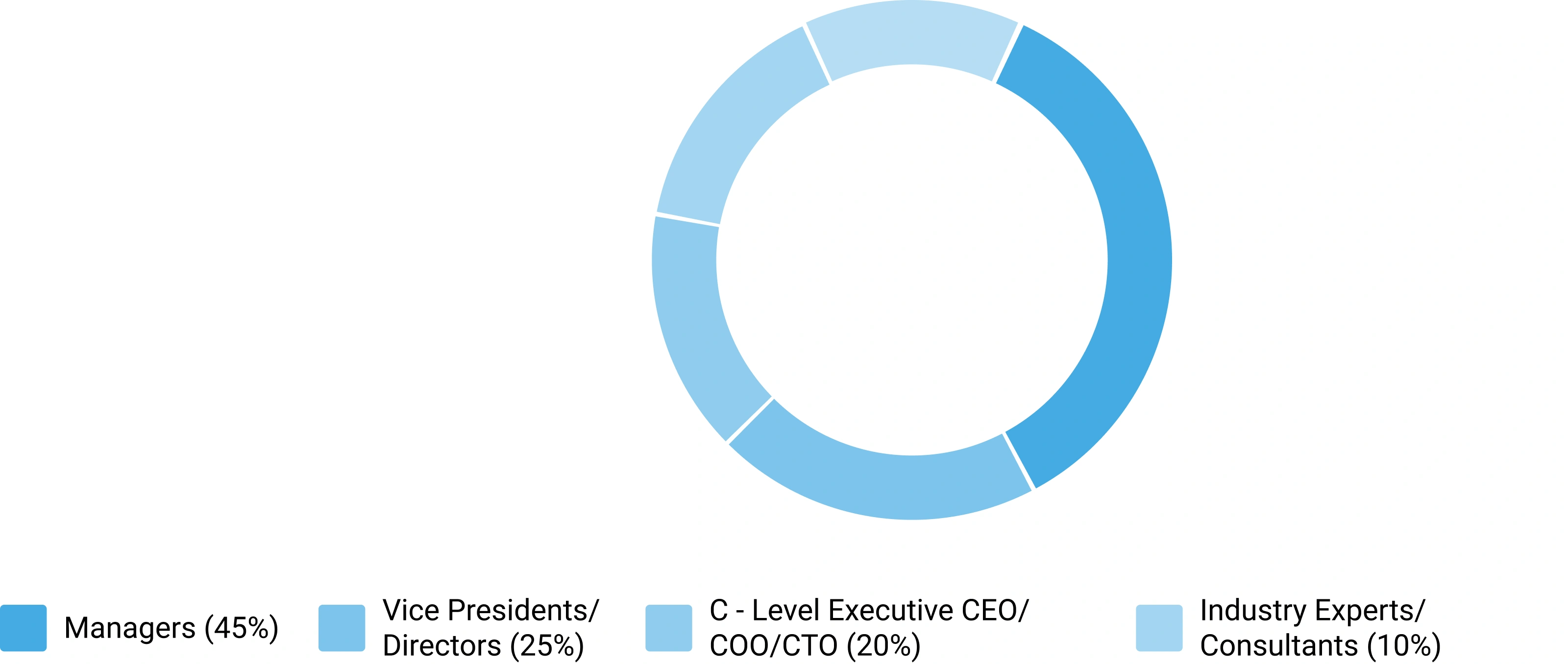
Primary Research — Respondent Designation Profile
Seniority breakdown of interview respondents (% share from PPT data)
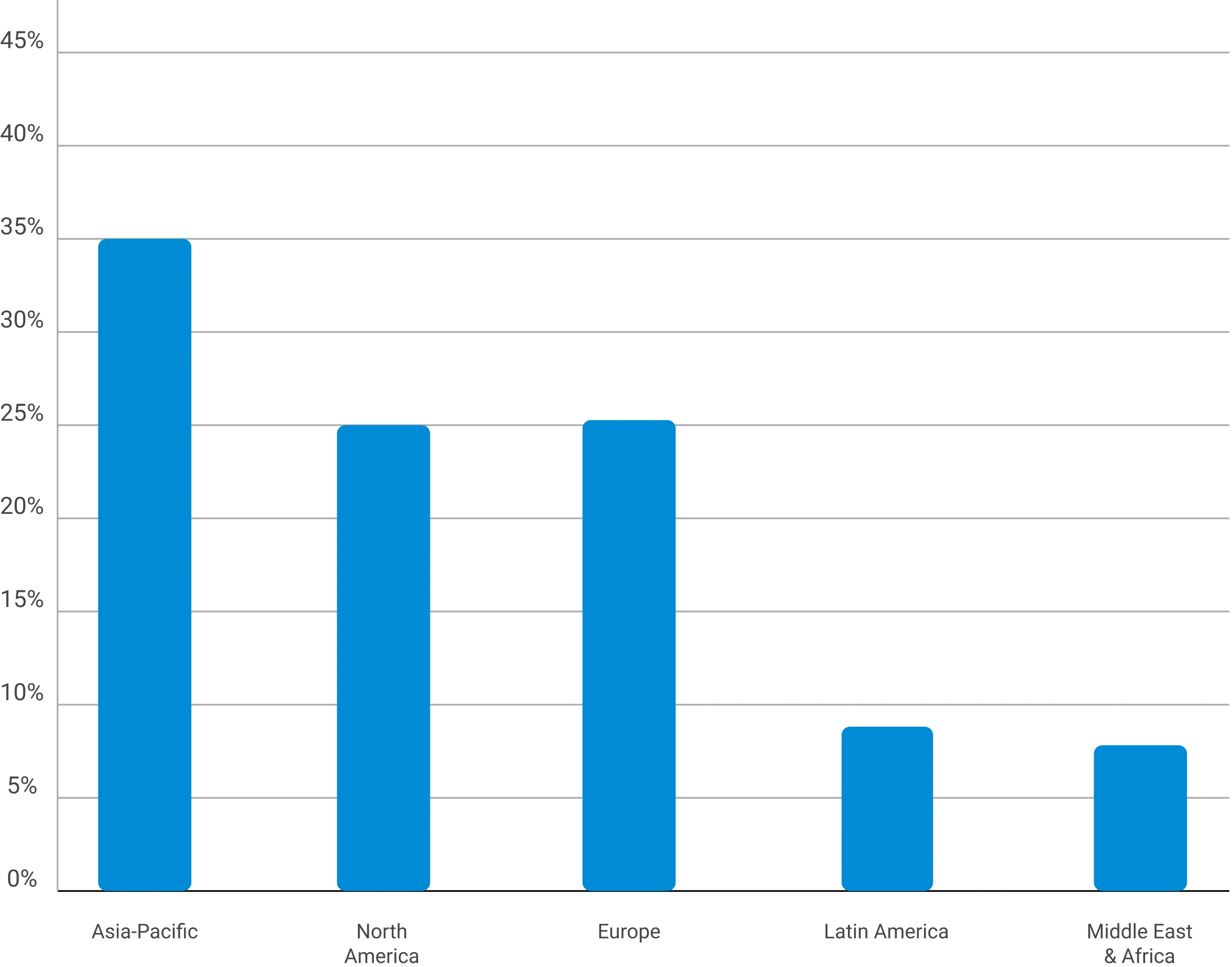
Primary Research — Geographic Coverage of Interviews
Regional distribution of primary research engagement (% share from PPT data)
Phase 6 — Data Triangulation and Market Validation
No single methodology is relied upon in isolation. Multiple independent estimation approaches are combined and reconciled to ensure consistency, accuracy, and analytical defensibility. Any material deviations between approaches are investigated and adjusted through additional validation cycles.
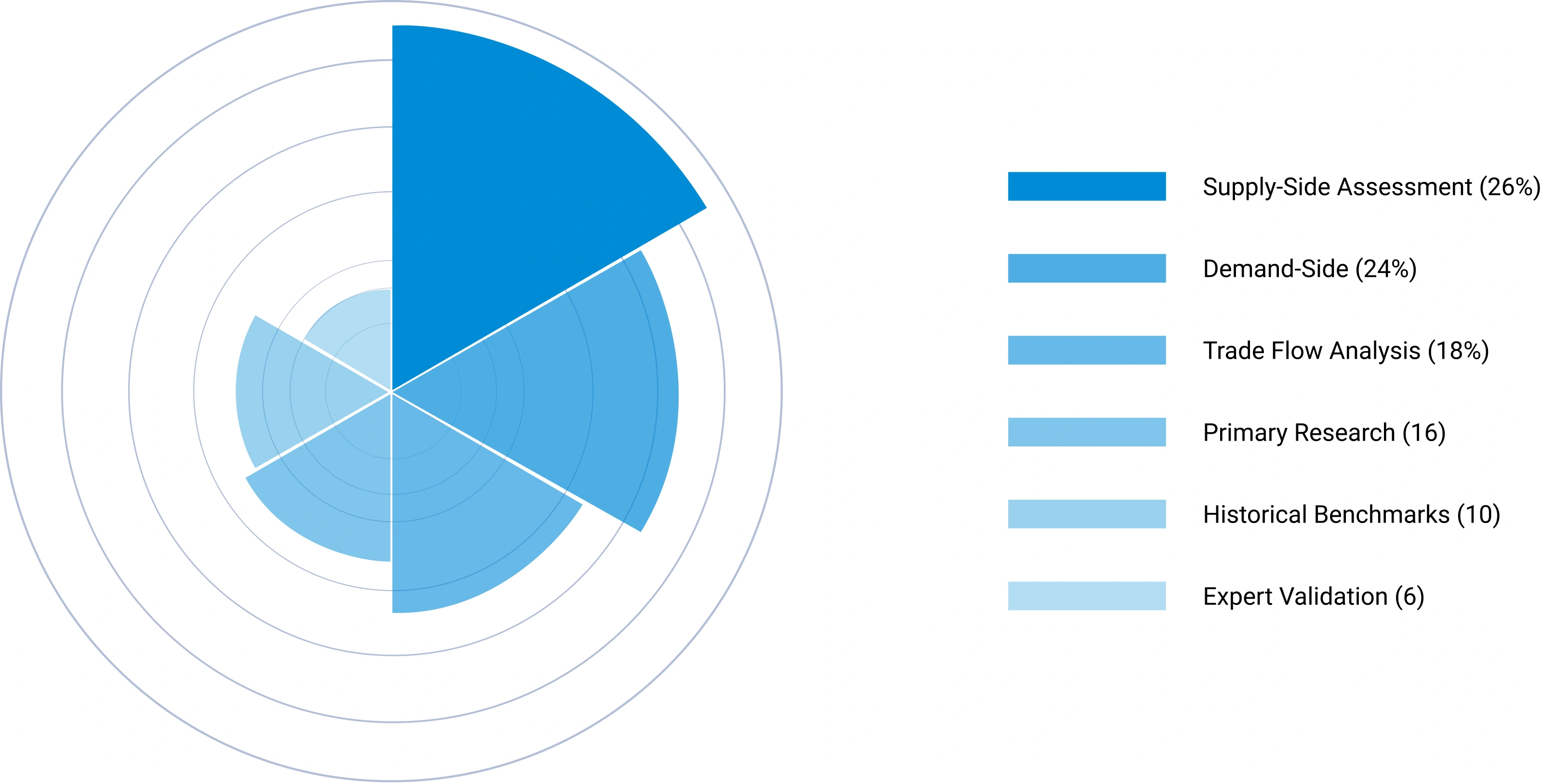
The final market size is derived through weighted triangulation of all validated methodologies. Any material deviations between approaches are investigated and adjusted through additional validation cycles. The outcome represents the most realistic assessment of the market based on available evidence and expert confirmation ensuring that volume and value estimates are fully consistent with one another.
Triangulation Framework — Input Contribution Weight
Relative weight each sizing input contributes to the final reconciled market estimate
Phase 7 — Forecast Modeling: Projecting Future Market Evolution
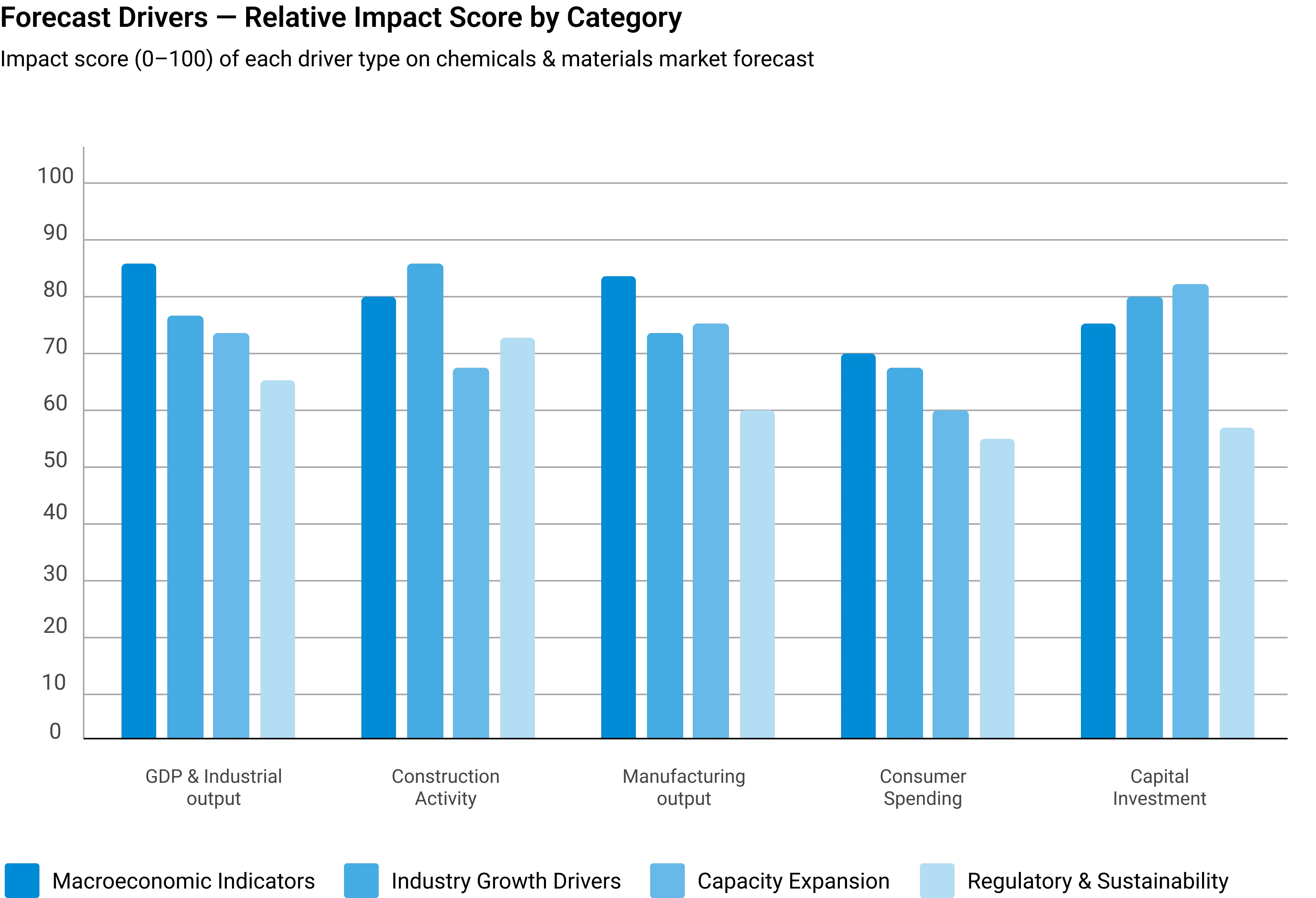
Forecasting evaluates the future trajectory of the market using a combination of quantitative indicators and qualitative assessments across economic, industry, and regulatory dimensions. Rather than simple extrapolation, each driver is independently modeled and integrated into a composite forecast.
Macroeconomic Indicators
GDP growth, industrial production, manufacturing output, construction activity, consumer spending, and capital investment form the quantitative foundation of long-term demand projections. These are applied at country, regional, and global levels.
Industry Growth Drivers
Urbanization, infrastructure development, industrialization, technological innovation, sustainability initiatives, and evolving product performance requirements are assessed at regional and industry levels — capturing both structural and cyclical demand drivers.
Capacity Expansion Analysis
Announced plant expansions, new manufacturing facilities, technology upgrades, and strategic investments are evaluated to determine future supply-demand dynamics and potential market tightness or oversupply situations.
Regulatory & Sustainability
Environmental regulations, chemical safety standards, emission reduction targets, circular economy initiatives, and sustainability requirements are incorporated as they often influence product adoption rates and market growth trajectories.
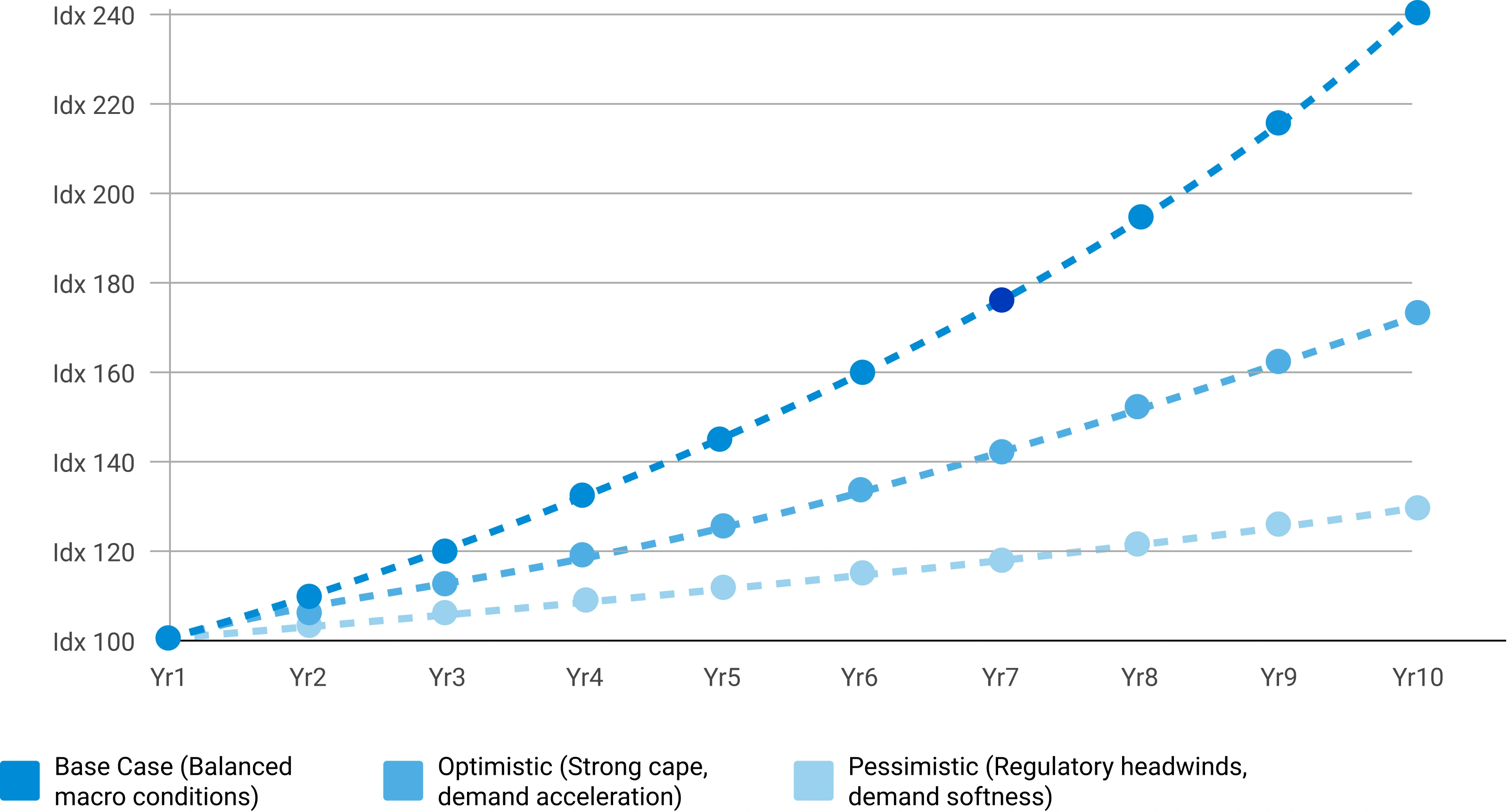
Scenario Forecast Range — Indexed Market Growth (Year 1–10)
Illustrative indexed growth trajectories across Base, Optimistic, and Pessimistic scenarios over a 10-year forecast horizon
Forecast Drivers — Relative Impact Score by Category
Impact score (0–100) of each driver type on chemicals & materials market forecast



Comments
Share your thoughts, ask a question, or provide feedback about this report.