Find the Right Market Report
Search thousands of industry reports, market insights, and research studies in one place.
Not sure where to start? Try one of these:
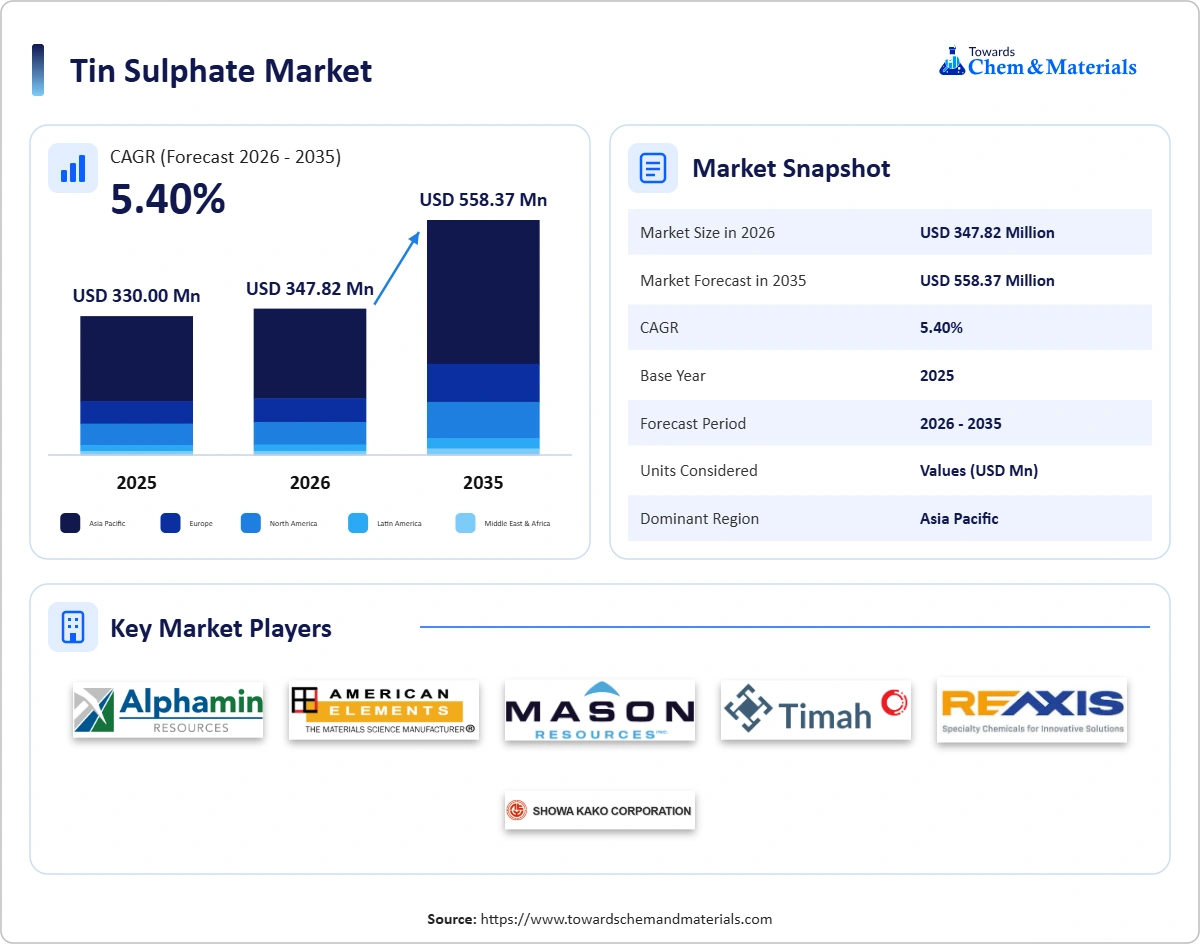
The global tin sulphate market size was valued at USD 330 million in 2025 and is expected to reach USD 558.37 million by 2035, growing at a CAGR of 5.40% during the forecast period of 2026-2035. The tin sulphate market was valued at USD 330.00 million in 2025, the base year. The tin sulphate market covers stannous sulphate (tin(II) sulphate, SnSO4) supplied as powder, crystals, and solutions, used mainly in acid tin and tin-alloy electroplating for electronics, semiconductors, and printed circuit boards, electrolytic coloring of anodized aluminum for architectural profiles, tinplate production for packaging, and as a chemical intermediate and catalyst.
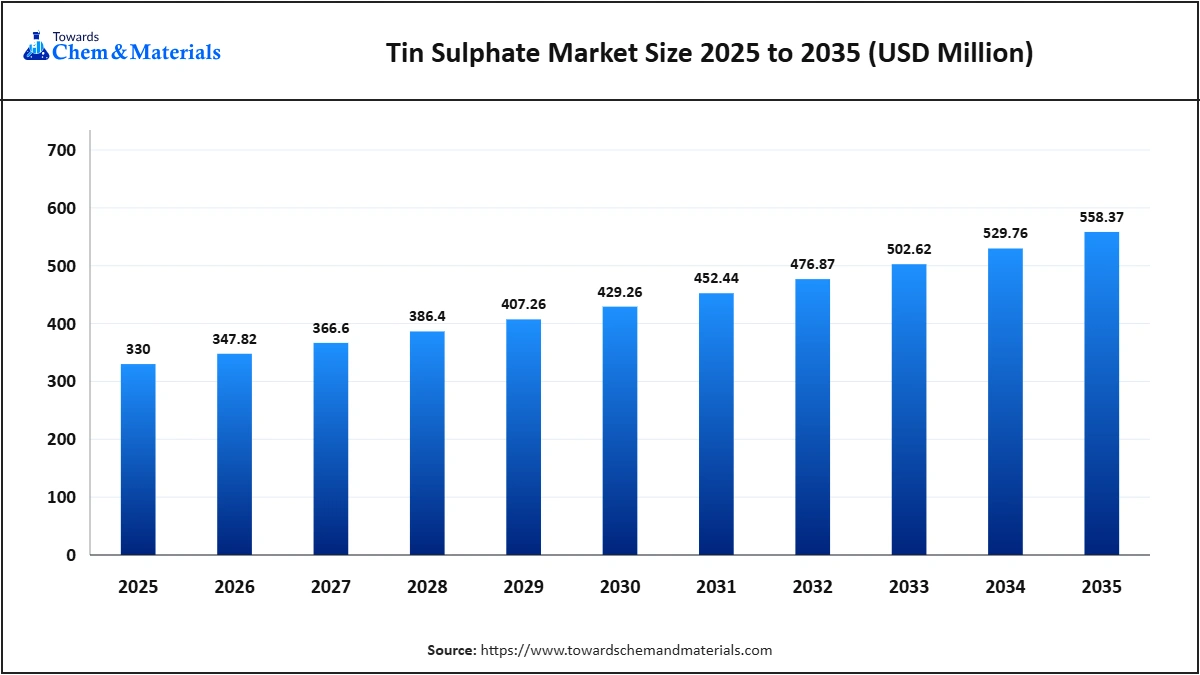
Note: 2025 is the base year; 2026–2035 values are forecasts.
Sources: Expert interviews, secondary sources, Towards Chemical and Materials database and Towards Chemical and Materials analysts.
In terms of form, the powder and crystals represented the largest form share in 2025, at 71.40%, because solid tin sulphate is easier to store and transport and is dissolved to make up plating baths. Asia Pacific accounted for 61.20% of revenue in 2025, supported by China's tin chemical production and the region's dominance in electronics manufacturing and aluminum extrusion. Electronics and semiconductor packaging, the adoption of lead-free solder plating, architectural aluminum applications, food and beverage can manufacture, and rising tin prices drive demand.
The tin sulphate market is projected to grow from USD 330.00 million in 2025 to USD 558.37 million by 2035 because tin sulphate is the main tin source for acid tin plating in electronics and for coloring anodized aluminum, and both industries continue to grow, especially in Asia. Semiconductor packaging and connector plating, architectural aluminum in construction, tinplate packaging, and higher tin prices support steady growth, lifting the market to USD 429.26 million by 2030 and sustaining a CAGR of 5.40% from 2026 to 2035.
Analyst View: We built the estimate from consumption volumes by form, application and end use in each region, multiplied by tin-linked prices, and cross-checked against producer output, plating chemical sales and published estimates. Published figures conflict, so our base year is set on an evidence basis. The growth rate reflects electronics and construction demand, moderated by tin price volatility and alternative plating chemistries such as methane sulfonate baths.
Driver: Growing demand for electronics and semiconductor plating is increasing tin sulphate consumption in precision coating applications. Expanding solar and low-emissivity glass production is creating additional demand for tin-based coatings. Continued PVC stabilizer manufacturing, rising tin prices, and increasing adoption of aluminum anodizing processes are further supporting market growth.
Restraint: Volatility in global tin prices creates uncertainty in raw material procurement and production costs, affecting manufacturers' profit margins. Concentrated tin supply in Asia increases exposure to supply chain disruptions. Additionally, stringent environmental regulations, substitution by alternative plating chemistries, and the corrosive nature of handling tin sulphate may constrain market expansion.
Opportunity: Growing demand for electronic-grade, high-purity tin salts is creating opportunities for manufacturers to serve advanced semiconductor and electronics applications. Expanding solar glass production and the transition toward lead-free soldering are supporting new demand avenues. Additionally, tin recovery from industrial waste and expanding electronics manufacturing in emerging economies offer further growth potential.
| Segments | 2025 Share | 2025 Value (USD Million) | 2035 Value (USD Million) | CAGR 2026–2035 |
| Powder & Crystals | 71.40% | 235.62 | 385.42 | 5.04% |
| Solution | 28.60% | 94.38 | 172.95 | 6.24% |
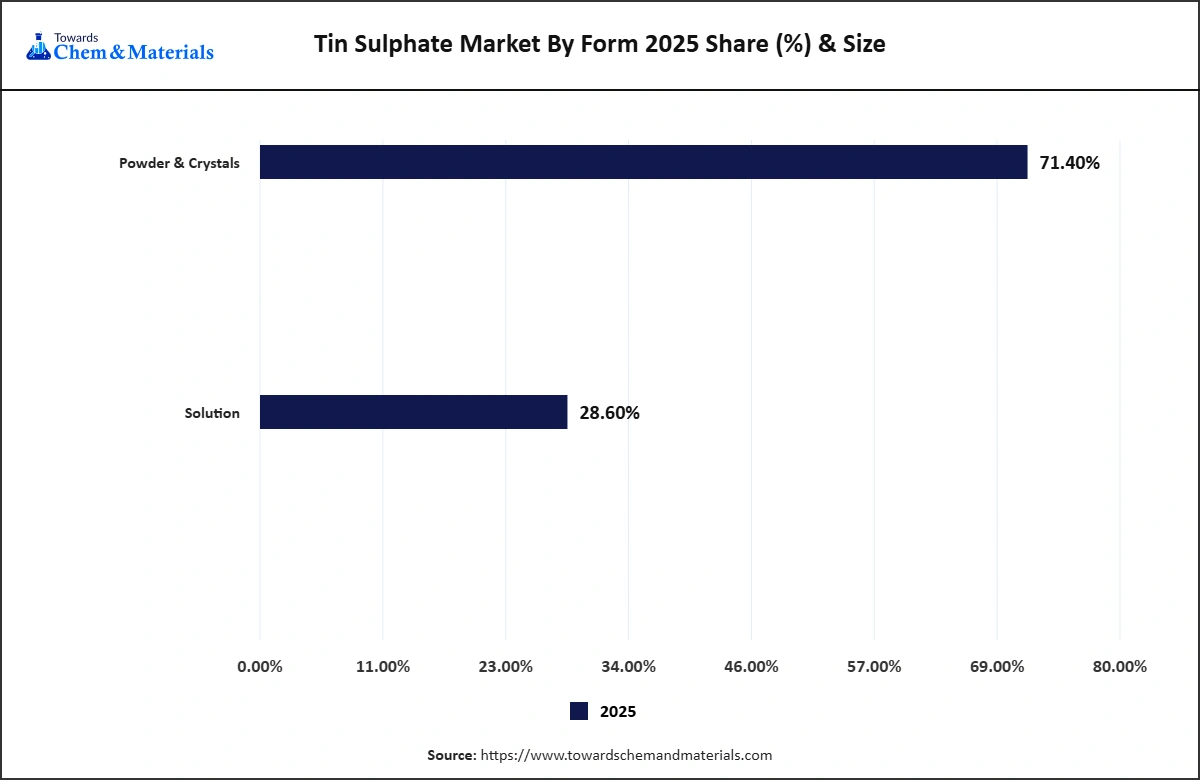
Note: 2025 is the base year; 2035 values are forecasts.
Sources: Expert interviews, secondary sources, Towards Chemical and Materials database and Towards Chemical and Materials analysts.
Powder and Crystals contributed 71.40% (USD 235.62 million) in 2025, and solution for 28.60% (USD 94.38 million).
Powder & Crystals: This segment accounted for 71.40% (USD 235.62 million) of the tin sulphate market in 2025 and is projected to reach USD 385.42 million by 2035, expanding at a CAGR of 5.04% from 2026 to 2035. Powder and crystals are the main forms, shipped to platers and anodizers who dissolve them to prepare and replenish baths.
Solution: This category held 28.60% (USD 94.38 million) of the tin sulphate market in 2025 and is projected to reach USD 172.95 million by 2035, expanding at a CAGR of 6.24% from 2026 to 2035. Solutions are supplied ready to use, saving time and reducing dust, and are growing faster in automated plating lines.
| Segments | 2025 Share | 2025 Value (USD Million) | 2035 Value (USD Million) | CAGR 2026–2035 |
| Tin Electroplating | 52.60% | 173.58 | 298.99 | 5.59% |
| Aluminum Anodizing & Electrolytic Coloring | 18.40% | 60.72 | 100.69 | 5.19% |
| Tinplate Production | 12.20% | 40.26 | 66.76 | 5.19% |
| Chemical & Catalyst | 9.60% | 31.68 | 52.53 | 5.19% |
| Others | 7.20% | 23.76 | 39.40 | 5.19% |
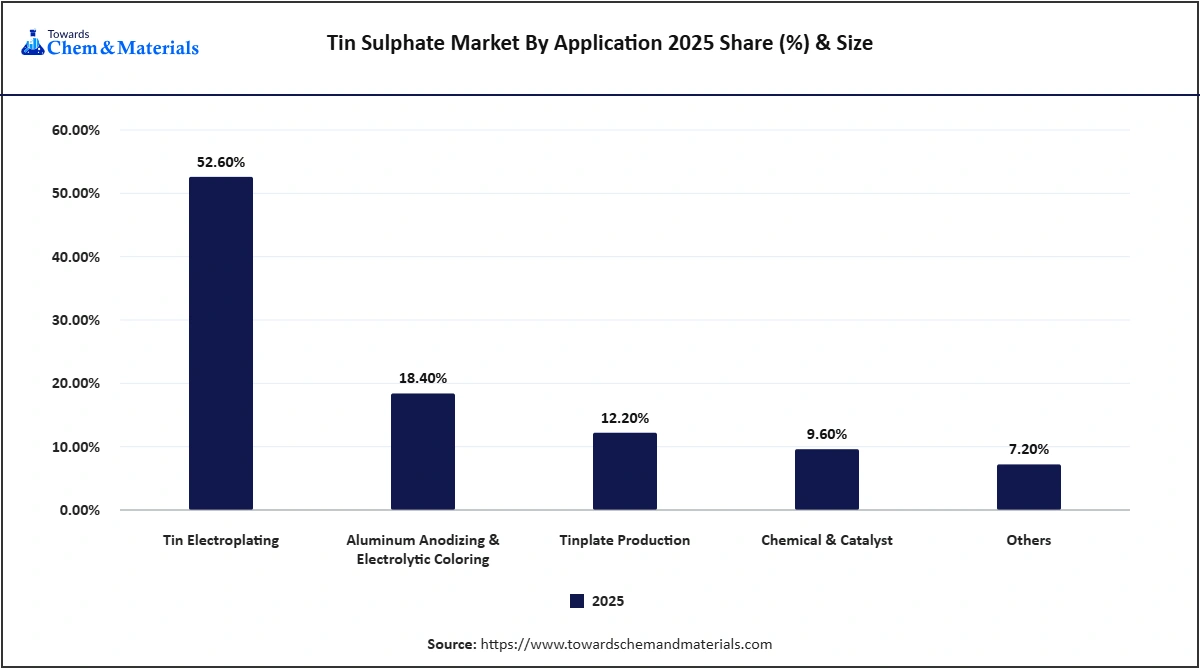
Note: 2025 is the base year; 2035 values are forecasts.
Sources: Expert interviews, secondary sources, Towards Chemical and Materials database and Towards Chemical and Materials analysts.
Tin Electroplating accounted for 52.60% (USD 173.58 million) in 2025, aluminum anodizing and electrolytic coloring for 18.40% (USD 60.72 million), tinplate production for 12.20% (USD 40.26 million), chemical and catalyst for 9.60% (USD 31.68 million) and others for 7.20% (USD 23.76 million).
Tin Electroplating: This segment commanded 52.60% (USD 173.58 million) of the tin sulphate market in 2025 and is projected to reach USD 298.99 million by 2035, expanding at a CAGR of 5.59% from 2026 to 2035. Tin electroplating is the largest application, using acid sulphate baths to deposit bright or matte tin and tin-alloy layers on connectors, lead frames, printed circuit boards and semiconductor packages.
| Segments | 2025 Share | 2025 Value (USD Million) | 2035 Value (USD Million) | CAGR 2026–2035 |
| Electronics & Semiconductors | 38.60% | 127.38 | 230.76 | 6.12% |
| Construction & Architecture | 18.60% | 61.38 | 99.24 | 4.92% |
| Others | 16.20% | 53.46 | 86.44 | 4.92% |
| Packaging | 14.20% | 46.86 | 75.77 | 4.92% |
| Automotive | 12.40% | 40.92 | 66.16 | 4.92% |
Note: 2025 is the base year; 2035 values are forecasts.
Sources: Expert interviews, secondary sources, Towards Chemical and Materials database and Towards Chemical and Materials analysts.
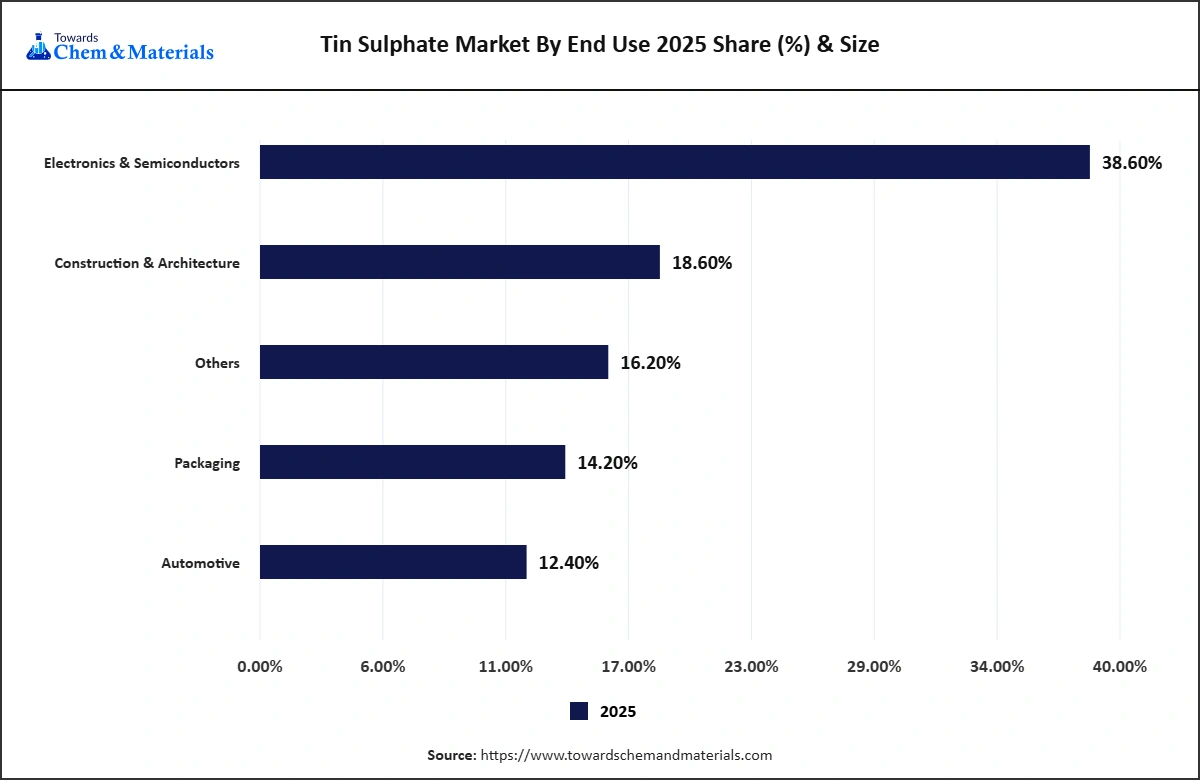
Electronics and Semiconductors dominated the revenue share with 38.60% (USD 127.38 million) in 2025, construction and architecture for 18.60% (USD 61.38 million), others for 16.20% (USD 53.46 million), packaging for 14.20% (USD 46.86 million), and automotive for 12.40% (USD 40.92 million).
Electronics & Semiconductors: This segment accounted for 38.60% (USD 127.38 million) of the tin sulphate market in 2025 and is projected to reach USD 230.76 million by 2035, expanding at a CAGR of 6.12% from 2026 to 2035. Electronics and semiconductors are the largest and fastest-growing end use, driven by advanced packaging, connectors and lead-free finishes.
Analyst View: Segment values were allocated by matching consumption volumes and prices to form, application, end use, using producer and end-use industry data. We expect the faster-growing segments identified above to gain share over the forecast period.
| Region | 2025 Share | 2025 Value (USD Million) | 2035 Value (USD Million) | CAGR 2026–2035 |
| Asia Pacific | 61.20% | 201.96 | 356.63 | 5.85% |
| Europe | 16.20% | 53.46 | 84.23 | 4.65% |
| North America | 15.40% | 50.82 | 80.07 | 4.65% |
| Latin America | 4.40% | 14.52 | 22.88 | 4.65% |
| Middle East & Africa | 2.80% | 9.24 | 14.56 | 4.65% |
Note: 2025 is the base year; 2035 values are forecasts.
Sources: Expert interviews, secondary sources, Towards Chemical and Materials database and Towards Chemical and Materials analysts.
Asia Pacific accounted for 61.20% (USD 201.96 million) in 2025, Europe for 16.20% (USD 53.46 million), North America for 15.40% (USD 50.82 million), Latin America for 4.40% (USD 14.52 million), and Middle East & Africa for 2.80% (USD 9.24 million). Asia Pacific leads and is also growing fastest.
Asia Pacific: This region captured 61.20% (USD 201.96 million) of the tin sulphate market revenue in 2025 and is projected to reach USD 356.63 million by 2035, expanding at a CAGR of 5.85% from 2026 to 2035. Asia Pacific leads and grows fastest because China, Taiwan, South Korea, Japan and Southeast Asia dominate electronics and semiconductor manufacturing and aluminum extrusion, and China produces most tin chemicals.
Europe: This region dominated 16.20% (USD 53.46 million) of the tin sulphate market revenue in 2025 and is projected to reach USD 84.23 million by 2035, expanding at a CAGR of 4.65% from 2026 to 2035. Europe uses tin sulphate in architectural aluminum coloring, electronics, and automotive plating, with production by TIB Chemicals.
North America: This region accounted for 15.40% (USD 50.82 million) of the tin sulphate market in 2025 and is projected to reach USD 80.07 million by 2035, expanding at a CAGR of 4.65% from 2026 to 2035. North America uses tin sulphate in electronics plating, automotive components, and architectural aluminum.
Latin America: This region held 4.40% (USD 14.52 million) of the tin sulphate market revenue in 2025 and is projected to reach USD 22.88 million by 2035, expanding at a CAGR of 4.65% from 2026 to 2035. Latin America is supported by aluminum, packaging, and electronics assembly in Brazil and Mexico.
Middle East & Africa: This region accounted for 2.80% (USD 9.24 million) of the tin sulphate market in 2025 and is projected to reach USD 14.56 million by 2035, expanding at a CAGR of 4.65% from 2026 to 2035. The Middle East and Africa are supported by construction and architectural aluminum demand in Gulf countries.
Analyst View: Regional shares were built from consumption by end-use industry in each region. Asia Pacific leads because it dominates production and downstream electronics and chemical manufacturing. We assign Asia Pacific the highest growth premium because downstream capacity is expanding fastest there.
| Rank | Company Name | Market-Specific Revenue (USD Million) | 2025 Share | Key Products / Business | Headquarters |
| 1 | Yunnan Tin Group | 56.00 | 16.97% | Stannous sulphate | China |
| 2 | TIB Chemicals | 20.00 | 6.06% | Tin sulphate | Germany |
| 3 | Guangdong Guanghua Sci-Tech | 16.00 | 4.85% | Electronic chemicals | China |
| 4 | Mason Corporation | 14.00 | 4.24% | Tin chemicals | United States |
| 5 | Nihon Kagaku Sangyo | 14.00 | 4.24% | Tin plating chemicals | Japan |
| 6 | Reaxis | 10.00 | 3.03% | Tin catalysts and chemicals | United States |
| 7 | Showa Kako | 10.00 | 3.03% | Tin chemicals | Japan |
| 8 | Guangxi Heshan Liuxi New Materials | 8.00 | 2.42% | Tin sulphate | China |
| 9 | Shreenivas Chemicals | 5.00 | 1.52% | Tin chemicals | India |
| 10 | American Elements | 4.00 | 1.21% | High-purity tin compounds | United States |
Note: Company revenues and shares are 2025 estimates.
Sources: Company press releases, expert interviews, secondary sources, Towards Chemical and Materials database and Towards Chemical and Materials analysts.
Yunnan Tin Group led the tin sulphate market with an estimated 16.97% (USD 56.00 million) of 2025 revenue, followed by TIB Chemicals at 6.06% (USD 20.00 million) and Guangdong Guanghua Sci-Tech at 4.85% (USD 16.00 million). Yunnan Tin Group leads with integrated stannous sulphate production in China. TIB Chemicals is a leading European producer, and Guangdong Guanghua Sci-Tech supplies electronic chemicals including tin salts. Mason Corporation, Nihon Kagaku Sangyo, Reaxis, Showa Kako, Guangxi Heshan Liuxi New Materials, Shreenivas Chemicals and American Elements compete through regional production, plating chemicals, tin catalysts and high-purity grades.
The top 10 companies accounted for an estimated 47.58% (USD 157.00 million) of 2025 revenue, while the remaining 52.42% (USD 173.00 million) was shared among regional tin chemical producers and plating chemical suppliers. The tin sulphate market is fragmented, and competition focuses on purity, consistency, raw material security, price, technical service, regulatory compliance, and delivery reliability. Integrated producers with access to raw materials have cost advantages.
The tin sulphate ecosystem links mining and refining with chemical producers, distributors and laboratory suppliers, and downstream industrial users.
| Ecosystem Stage | Role in the Market | Key Companies |
| Tin Mining & Smelting | Supply refined tin | Yunnan Tin, Guangxi China Tin, PT Timah, Alphamin |
| Producers | Make tin salts | Yunnan Tin, TIB Chemicals, Mason Corporation, Showa Kako, Nihon Kagaku Sangyo |
| Distributors | Supply industry and laboratories | Regional distributors, laboratory suppliers |
| End Users | Use tin salts | Platers, glass coaters, PVC stabilizer makers, anodizers |
Sources: Company press releases, expert interviews, secondary sources, Towards Chemical and Materials database and Towards Chemical and Materials analysts.
The Towards Chemical and Materials Companies Quadrant positions key participants in the tin sulphate market by market strength, reflecting revenue scale, market share and geographic reach, and by innovation and growth strategy, reflecting product portfolio breadth, R&D intensity and partnerships. Positions reflect each company's estimated 2025 revenue in this market and our assessment of its integration, product quality, and reach.
Sources: Company press releases, expert interviews, secondary sources, Towards Chemical and Materials database and Towards Chemical and Materials analysts.
Leaders: Yunnan Tin Group, TIB Chemicals, Guangdong Guanghua Sci-Tech, and Mason combine large revenue with raw material integration and broad customer reach.
Challengers: Nihon Kagaku Sangyo has significant volumes but narrower portfolios or less product development.
Innovators: Reaxis, Showa Kako and Shreenivas Chemicals bring high-purity grades and specialty applications.
Niche Players: Guangxi Heshan Liuxi New Materials and American Elements serve smaller regional or laboratory segments.
By Form
By Application
By End Use
By Region
The tin sulphate market was defined as stannous sulphate powder, crystals, and solutions for tin electroplating, aluminum electrolytic coloring, tinplate production, and chemical uses across the globe. The 2025 base year was built bottom-up from consumption volumes by segment and region, and average prices, and checked top-down against producer capacity and output and the revenues of leading suppliers.
Segment, regional, and company values were allocated from segments and regional consumption. Key estimates were verified by cross-checking company disclosures, regulatory and industry data, and published third-party estimates, and inputs that could not be reconciled were excluded. All segment, regional and company figures were reconciled to the same 2025 base year, and the 2026–2035 forecast, which applies a constant CAGR from the 2025 base, was recalculated and validated.
The tin sulphate market is a mature, plating-driven tin chemical segment, with growth led by electronics and construction in Asia. Our estimate links demand to consumption and tin-linked prices, so the forecast follows electronics production, construction and packaging activity. The main upside comes from semiconductor packaging, while the main risks are tin price volatility and competing plating chemistries.
Reliable market intelligence and data-driven insights across the global chemicals and materials industry, helping businesses understand trends, competition, pricing, and emerging opportunities.
Schedule a Demo