Find the Right Market Report
Search thousands of industry reports, market insights, and research studies in one place.
Not sure where to start? Try one of these:
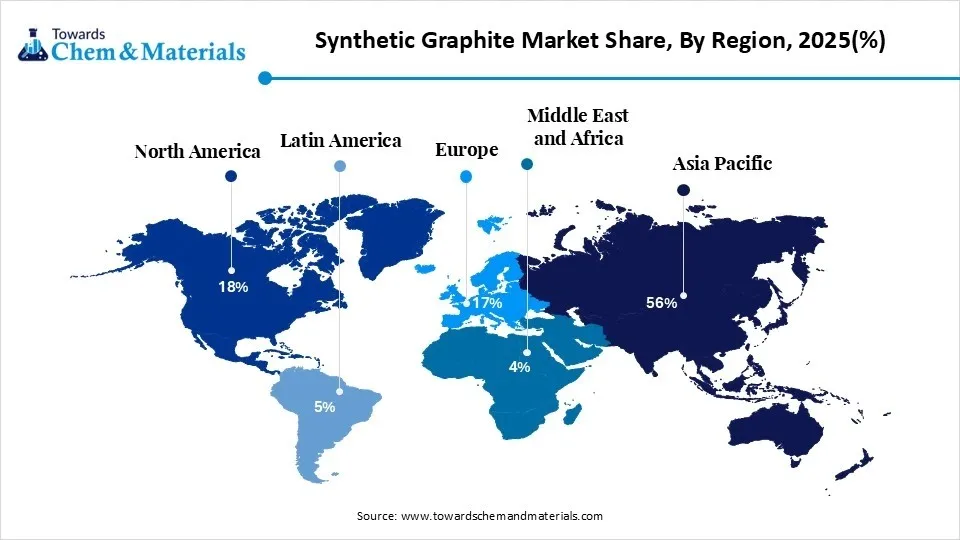
The global synthetic graphite market market size was valued at USD 12.44 billion in 2025, is estimated to reach USD 13.55 billion in 2026, and is projected to reach USD 29.32 billion by 2035, exhibiting a compound annual growth rate (CAGR) of 8.95% over the forecast period from 2026 to 2035.Asia Pacific dominated the synthetic graphite market with the largest revenue share of 56% in 2025 and is expected to grow at the fastest CAGR of 9.05% during the forecast period. In terms of volume, the synthetic graphite market is projected to grow from 3.88million tons in 2025 to 8.57million tons by 2035. growing at a CAGR of 9.05% from 2026 to 2035.The growth of the market is driven by the surging electric vehicle demand, the rise of green steelmaking, and government clean-energy policies. Key collaboration between companies like Imerys and Shanshan, ExxonMobil, ACP Technologies, & Superior Graphite plays a significant role in the growth of the market, according to the latest report.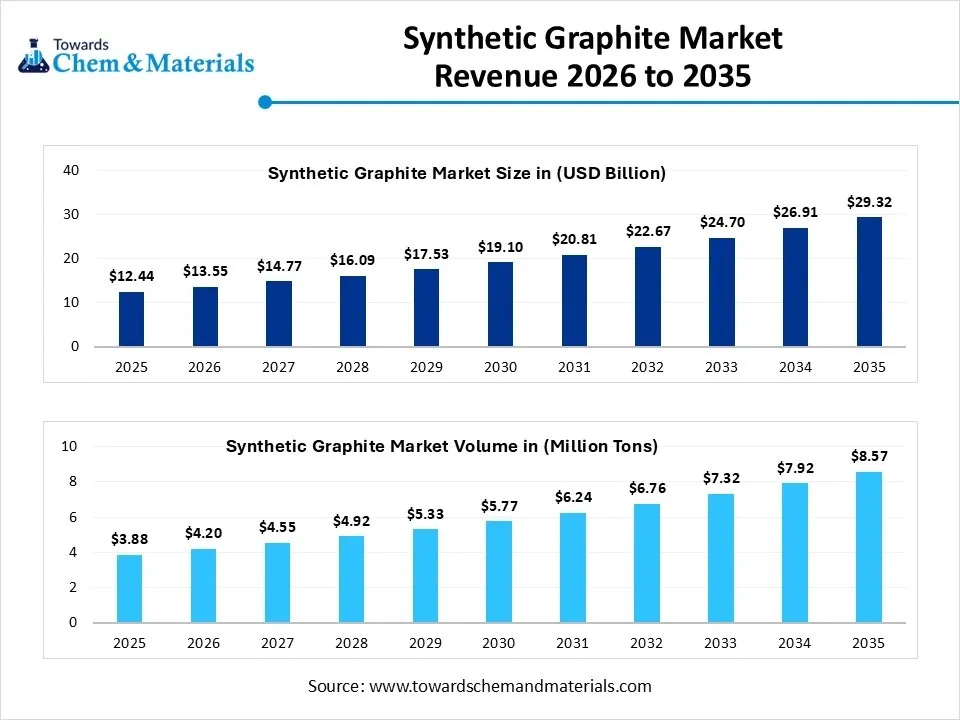
Synthetic Graphite is a high-purity carbon material artificially produced from carbon precursors (primarily petroleum coke and coal tar pitch) through high-temperature treatment (up to 3,000°C). It exhibits superior electrical conductivity, thermal stability, lubricity, and corrosion resistance. It is widely used in applications such as lithium-ion batteries, electrodes in electric arc furnaces, refractories, lubricants, and nuclear reactors. The growing need for high-purity synthetic graphite in various sectors such as refractories, electric vehicle (EV) batteries, and solar panels is expected to boost market growth shortly.
The synthetic graphite market is highly significant because it produces high-purity carbon materials essential for modern technology, electric vehicles, and heavy industry. It is a massive global sector, expected to grow to billions of dollars as the world shifts to renewable energy and cleaner transportation. Synthetic graphite is the primary material used in the anode the negative terminal of lithium-ion batteries. Because it is man-made, its structure can be tightly controlled to allow faster charging and longer battery life than natural graphite.
The market is the primary source of graphite electrodes used in Electric Arc Furnaces. These furnaces are used to recycle scrap steel, making them highly significant in the push for more sustainable, low-carbon steel production. Because it conducts heat very well, synthetic graphite is used as a thermal management film in smartphones, laptops, and other electronic devices to prevent them from overheating. High-purity synthetic graphite is used as a moderator in nuclear reactors and forms the heat-resistant linings (refractories) in industrial furnaces.
| Report Attributes | Details |
| Market Size in 2026 | USD 13.55 Billion/ 4.20 Million Tons |
| Market Size by 2035 | USD 29.32 Billion/ 8.57 Million Tons |
| Growth rate from 2025 to 2026 | CAGR 8.95% |
| Base Year of Estimation | 2025 |
| Forecast Period | 2025 - 2035 |
| Dominant Region | Asia Pacific |
| Segment Covered | By Product Type, By Application, By End-Use Industry, By Manufacturing Process, By Raw Material, By Region |
| Key Profiled Companies | GrafTech International, Showa Denko K.K., Tokai Carbon Co., Ltd., HEG Ltd., Nippon Carbon Co., Ltd., SEC Carbon, Ltd., SGL Carbon SE, Mersen Group, Graphite India Limited, Fangda Carbon New Material Co., Ltd., Jilin Carbon Co., Ltd., Kaifeng Carbon Co., Ltd., Shida Carbon Group, Baotailong New Materials Co., Ltd., Sinosteel Corporation, Toyo Tanso Co., Ltd., Imerys Graphite & Carbon, AMG Graphite (Graphit Kropfmühl), Shanghai Carbon Co., Ltd., South Graphite Co., Ltd. |
Growing Demand from the Metallurgy Sector
In metallurgical applications, graphite is used in different forms, such as refractories, bricks, electrodes, crucibles, and monolithic. Etc. This increasing utilisation of synthetic graphite in this segment is expected to be propelled by the increased global production of crude aluminium and steel. Furthermore, in electric furnaces, synthetic graphite is utilized to produce ferroalloys, steel, and aluminium, creating future opportunities in the market.
Competition from Natural Graphite
Natural graphite competes with synthetic graphite, particularly in cost-sensitive applications. Despite its superior properties, the decreased cost of natural graphite can make it more tempting, particularly in markets with less stringent performance criteria. Moreover, the production method for synthetic graphite is energy-intensive and includes significant capital investment, which results in high production costs, hampering market growth further.
Chemical Synthesis and Processing
Quality Testing and Certification
Distribution to Industrial Users
How did Asia Pacific Dominate the Synthetic Graphite Market in 2025?
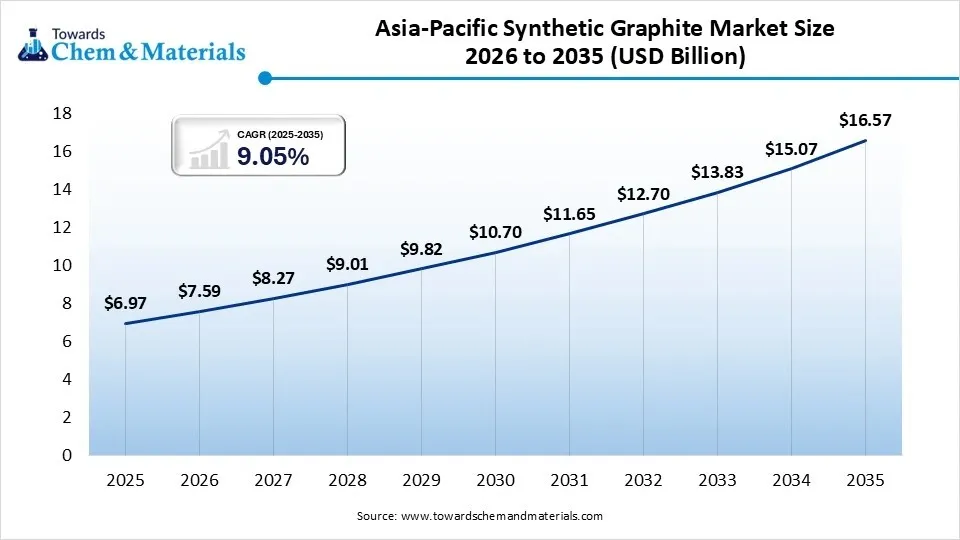
The Asia Pacific synthetic graphite market size was estimated at USD 6.97 billion in 2025 and is projected to reach USD 16.57 billion by 2035, growing at a CAGR of 9.05% from 2026 to 2035.Asia Pacific dominated the market with the largest share of 56% in 2025. The region secured this lead through massive electric vehicle battery manufacturing, large-scale steel production, and a dominant electronics supply chain. China, Japan, South Korea, and India are the worlds largest hubs for lithium-ion battery manufacturing. Synthetic graphite is the top choice for the anode, the negative part of a battery, because its highly ordered structure allows for faster charging and longer battery life.
 China
India
North America Synthetic Graphite Market Growth Factor
United States
Canada
Europe Synthetic Graphite Market Growth Factor
Europe held a market share of 17% in 2025, the surging demand for Electric Vehicles (EVs). Synthetic graphite is highly pure and acts as a key material in EV battery anodes. Europes strict emission laws and localized battery manufacturing drive this growth. Major investments are expanding regional capacity. For example, Vianode opened a large production facility in Norway. Talga Group is building a battery anode plant in Sweden.
Germany
France
Latin America Synthetic Graphite Market Growth Factor
Latin America held a market share of 5% in 2025, due to increasing demand for electric vehicles (EVs), renewable energy storage, and steel manufacturing. Countries like Brazil and Argentina are the main areas driving this growth. They have rich raw material reserves. Latin America, especially the Lithium Triangle of Argentina, Chile, and Bolivia, holds massive lithium reserves. This makes the region a natural hub for manufacturing lithium-ion batteries. As Latin America adopts more solar and wind power, the region needs better ways to store the energy.
Brazil
Argentina
Middle East & Africa Synthetic Graphite Market Growth Factor
The Middle East & Africa held a market share of 4% in 2025. Major drivers include the rise of electric vehicle (EV) production and the need for advanced lithium-ion batteries. Synthetic graphite is also used in steel production and energy storage. Governments in regions like Saudi Arabia and the UAE are pushing for sustainable energy and EV manufacturing. Synthetic graphite is a critical material used to build EV batteries. Synthetic graphite is used to make graphite electrodes. These electrodes melt scrap metal in electric arc furnaces to produce new steel. The growing construction and industrial sectors in MEA fuel this demand.
Saudi Arabia
UAE
By Product Insights
Graphite electrodes are among the most important products used in heavy industrial applications, especially in electric arc furnaces (EAFs) for steel and non-ferrous metal production. They carry large amounts of electrical current to create the intense heat required for melting scrap metal, making them essential for efficient and sustainable steel manufacturing. In addition to steel production, graphite electrodes are also used in the manufacturing of silicon and yellow phosphorus through submerged arc furnace operations. As the global focus on recycling and low-carbon steel production continues to grow, demand for high-quality graphite electrodes is expected to increase steadily.
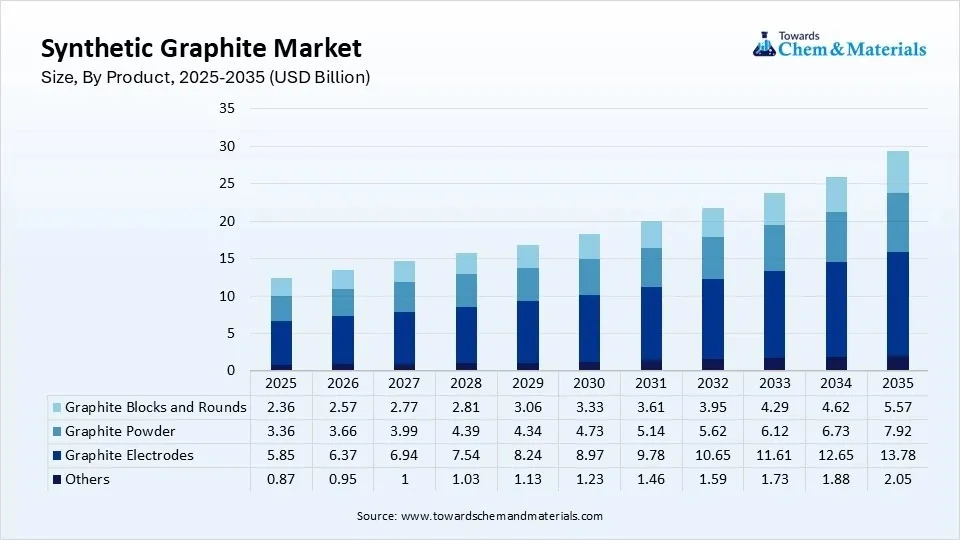
Graphite blocks and rounds are valued for their outstanding thermal stability, excellent electrical conductivity, resistance to chemicals, and ease of machining. These properties make them suitable for a wide range of industrial applications. In metallurgy, they are commonly used in high-temperature furnace components such as linings, heating elements, and insulation materials because they maintain their strength even under extreme heat. In the electronics industry, graphite blocks and rounds are widely used to produce molds for continuous casting, sintering applications, and electrical discharge machining (EDM) electrodes, where high precision and long service life are essential.
Synthetic Graphite Market Share, By Product, 2025(%)
| By Product | Revenue Share, 2025 (%) |
| Graphite Electrodes | 47% |
| Graphite Blocks and Rounds | 19% |
| Graphite Powder | 27% |
| Others | 7.00% |
By Application Insights
Lithium-ion batteries represent one of the fastest-growing application areas for synthetic graphite, which is widely used as the anode material. The rapid expansion of the electric vehicle (EV) market has significantly increased demand for these batteries due to their high energy density, long lifespan, and reliable charging performance. Government initiatives promoting cleaner transportation and lower carbon emissions are further accelerating EV adoption worldwide, creating strong demand for synthetic graphite used in battery production.
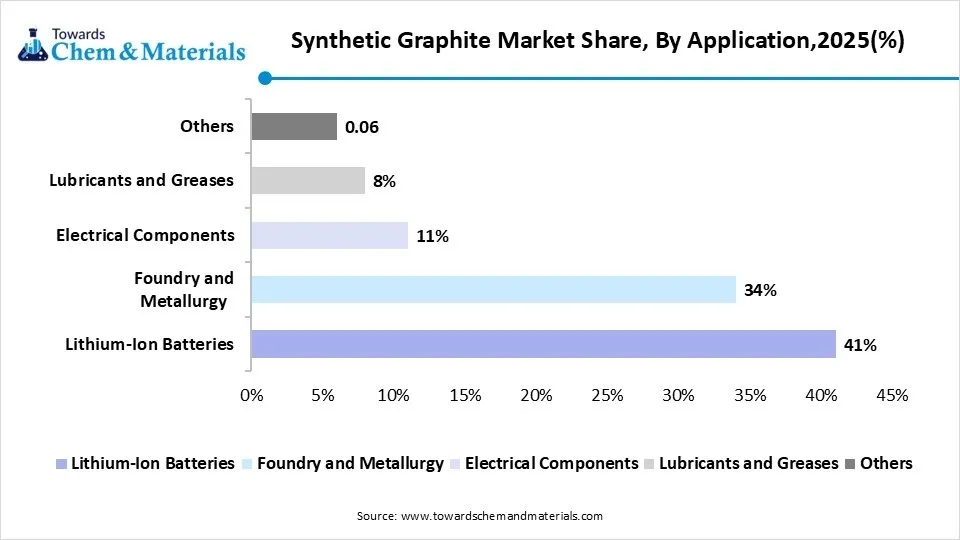
The foundry and metallurgy industries also remain major consumers of synthetic graphite because of its excellent thermal conductivity, high-temperature resistance, and chemical stability. In foundries, it is used to manufacture molds, crucibles, and cores that can withstand molten metals without losing their shape or performance, resulting in improved casting accuracy and product quality. In the steel industry, synthetic graphite is widely used as electrodes in electric arc furnaces, where its superior electrical conductivity and durability enable efficient melting of scrap metal during steel production.
The electronics and electrical industries continue to drive the consumption of synthetic graphite as demand rises for electric vehicles, renewable energy systems, and advanced electronic devices. Manufacturers increasingly require materials that offer high electrical performance, durability, and reliable operation under demanding conditions. With ongoing technological advancements and the growing adoption of electrification across industries, synthetic graphite is expected to remain an essential material supporting future innovation and industrial growth.
Synthetic Graphite Market Share, By Application,2025(%)
| By Application | Revenue Share, 2025 (%) |
| Lithium-Ion Batteries | 41% |
| Foundry and Metallurgy | 34% |
| Electrical Components | 11% |
| Lubricants and Greases | 8% |
| Others | 6% |
By Region
Reliable market intelligence and data-driven insights across the global chemicals and materials industry, helping businesses understand trends, competition, pricing, and emerging opportunities.
Schedule a Demo