Find the Right Market Report
Search thousands of industry reports, market insights, and research studies in one place.
Not sure where to start? Try one of these:
The sodium tungstate market is estimated at USD 598.26 million in 2026 and is projected to reach USD 1,156.64 million by 2035, expanding at a CAGR of 7.60% from 2026 to 2035. The report covers sodium tungstate (Na₂WO₄), primarily available in dihydrate form. It is commercially supplied as powders, crystals, and solutions in technical and high-purity grades. Sodium tungstate is used as a catalyst in oxidation and epoxidation reactions and refinery processes. It also serves as an intermediate in the production of tungsten oxides, tungstic acid, phosphotungstic acid, and pigments. Additionally, it finds applications in fireproofing, textile processing, corrosion inhibition, water treatment, electronics, ceramics, pharmaceuticals, and laboratory research.
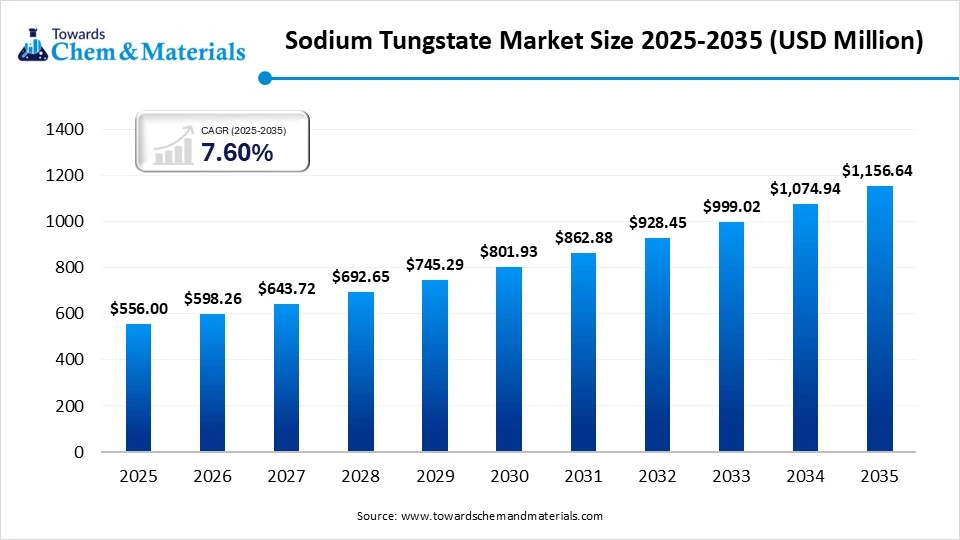
Note: 2025 is the base year; 2026-2035 values are forecasts.
Sources: Expert interviews, secondary sources, the Towards Chemical and Materials database, and Towards Chemical and Materials analysts.
Dihydrate powder and crystals captured the largest share in 2025, at 72.40%, because solid sodium tungstate is easier to store, ship, and dose. In the context of regional market growth, Asia Pacific showcased 58.40% of revenue growth in 2025 because China dominates tungsten mining and processing. This growth is attributed to an increasing demand for catalysis in chemical and refinery processes, tungsten chemical production for electronics and ceramics, research and pharmaceutical applications, and higher tungsten prices following China's export controls on tungsten items in 2025.
The sodium tungstate market is projected to grow from USD 556.00 million in 2025 to USD 1,156.64 million by 2035 because sodium tungstate is a versatile tungsten chemical used in catalysis and as an intermediate, and tightening tungsten supply has raised its value. Catalyst demand in chemical and refinery processes, electronics and ceramics applications, research and pharmaceutical use, and higher tungsten prices support strong growth, boosting the market revenue growth to USD 801.93 million by 2030 and sustaining a CAGR of 7.60% from 2026 to 2035.
Analyst View: We built the estimate from consumption volumes by form, purity, application, and end use in each region, multiplied by prices linked to tungsten concentrate and APT prices, and cross-checked against producer output and published estimates, resulting in a base-year estimate marginally higher than the upper end of the credible comparable range. The growth rate is set on an evidence basis below some published estimates, reflecting strong demand and price support moderated by possible price normalization.
The sodium tungstate market is driven by increasing demand for tungsten-based catalysts, expanding electronics applications, and rising tungsten prices. Growing adoption of tungstates as environmentally friendly alternatives to chromate-based corrosion inhibitors further supports demand. Additionally, expanding research into electrochromic materials, chemical sensors, and advanced functional materials is creating new application opportunities.
The market faces challenges due to China's dominance in global tungsten supply, increasing export restrictions, and geopolitical uncertainties. Volatility in tungsten prices affects production costs and profit margins. Additionally, limited specialty application volumes restrict economies of scale, while stringent environmental regulations on mining and processing increase operational costs.
Opportunities are emerging through the development of non-Chinese tungsten supply chains and recycling-based production. Increasing demand for high-purity sodium tungstate in electronics and semiconductor applications offers premium market potential. Furthermore, growing investments in green oxidation catalysis, sustainable chemical processing, and tungsten-based energy storage materials are expected to create new growth avenues.
| Segments | 2025 Share | 2025 Value (USD Million) | 2035 Value (USD Million) | CAGR 2026–2035 |
| Dihydrate Powder & Crystals | 72.40% | 402.54 | 806.57 | 7.20% |
| Solution | 27.60% | 153.46 | 350.07 | 8.60% |
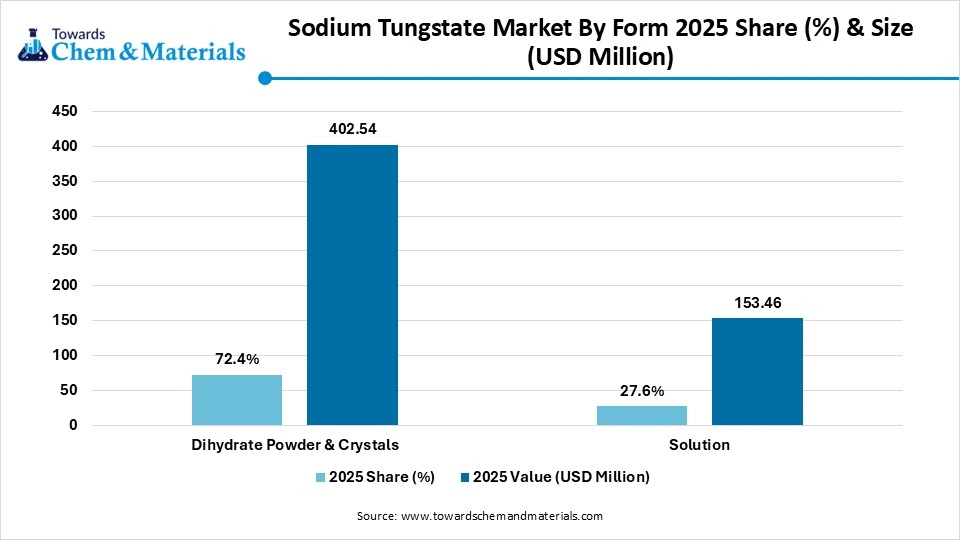
Note: 2025 is the base year; 2035 values are forecasts.
Sources: Expert interviews, secondary sources, the Towards Chemical and Materials database, and Towards Chemical and Materials analysts.
Dihydrate Powder and Crystals garnered 72.40% (USD 402.54 million) in 2025, with a solution for 27.60% (USD 153.46 million).
Dihydrate Powder & Crystals This segment accounted for 72.40% (USD 402.54 million) of the sodium tungstate market in 2025 and is projected to reach USD 806.57 million by 2035, expanding at a CAGR of 7.20% from 2026 to 2035. Dihydrate powder and crystals are the main commercial form, easy to store and ship and dissolved by users as needed.
Solution Representing 27.60% (USD 153.46 million) of the market in 2025, this segment is expected to reach USD 350.07 million by 2035, growing at a CAGR of 8.60% during 2026-2035. Its faster growth is attributed to increasing preference for ready-to-use formulations across catalysis, water treatment, and specialty chemical manufacturing. Direct applicability eliminates the need for dissolution, reduces preparation requirements, and supports more streamlined industrial operations.
| Segments | 2025 Share | 2025 Value (USD Million) | 2035 Value (USD Million) | CAGR 2026–2035 |
| Technical Grade | 58.60% | 325.82 | 646.25 | 7.09% |
| High Purity Grade | 41.40% | 230.18 | 510.39 | 0.08 |
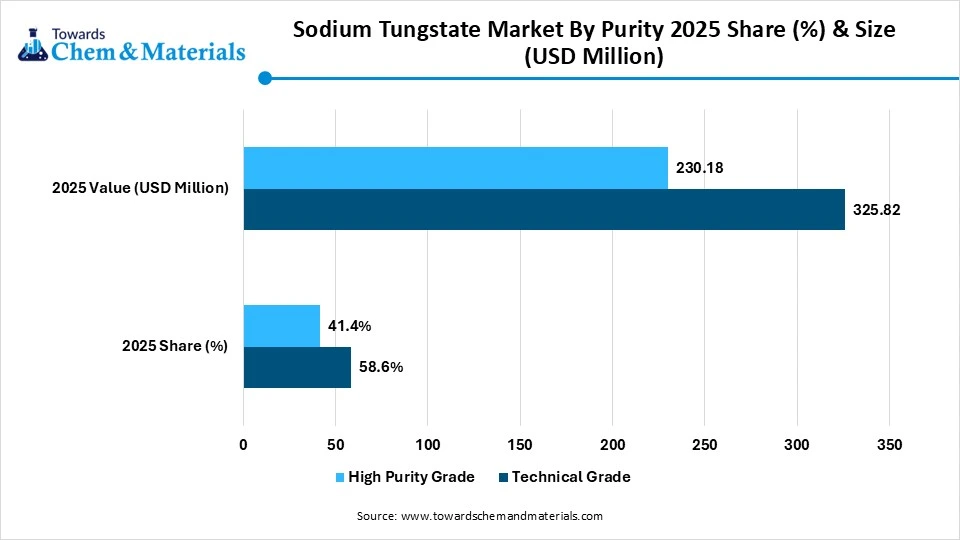
Note: 2025 is the base year; 2035 values are forecasts.
Sources: Expert interviews, secondary sources, the Towards Chemical and Materials database, and Towards Chemical and Materials analysts.
Technical grade accounted for 58.60% (USD 325.82 million) in 2025, and high-purity grade for 41.40% (USD 230.18 million).
Technical Grade This segment registered 58.60% (USD 325.82 million) of the sodium tungstate market share in 2025 and is projected to reach USD 646.25 million by 2035, expanding at a CAGR of 7.09% from 2026 to 2035. Technical grades are used in catalysts, fireproofing, textiles, and chemical intermediates where moderate purity is acceptable.
High Purity Grade Accounting for 41.40% (USD 230.18 million) of the market in 2025, this category is projected to reach USD 510.39 million by 2035, growing at a CAGR of 8.29% during 2026-2035. High-purity grades are used in electronics, ceramics, pharmaceuticals, and research and are growing faster with electronic applications.
| Segments | 2025 Share | 2025 Value (USD Million) | 2035 Value (USD Million) | CAGR 2026–2035 |
| Catalysts | 34.20% | 190.15 | 377.63 | 7.10% |
| Chemical Intermediates | 22.60% | 125.66 | 259.02 | 7.50% |
| Electronics & Ceramics | 14.60% | 81.18 | 192.2 | 9.00% |
| Pharmaceuticals & Research | 10.40% | 57.82 | 119.2 | 7.50% |
| Fire Retardants & Textiles | 9.40% | 52.26 | 107.73 | 7.50% |
| Corrosion Inhibitors & Water Treatment | 8.80% | 48.93 | 100.86 | 7.50% |
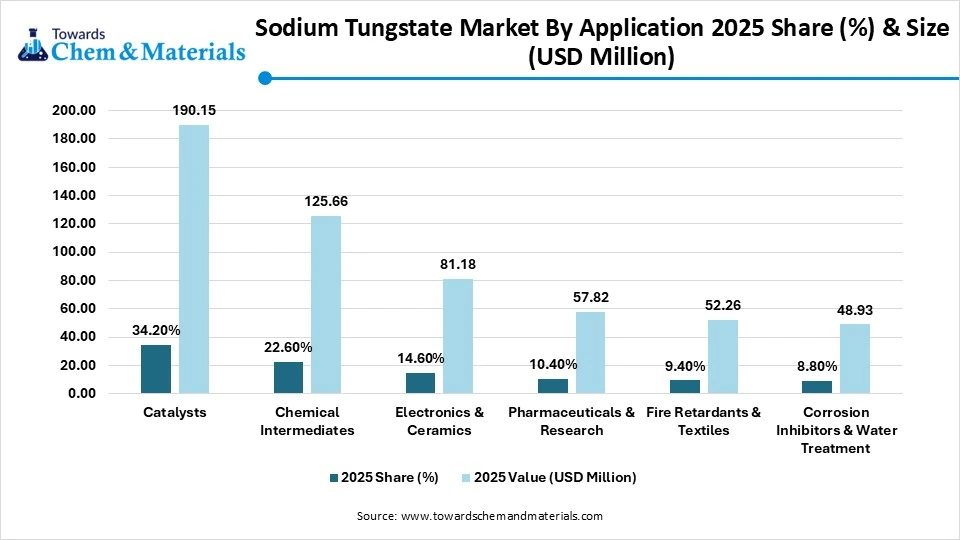
Note: 2025 is the base year; 2035 values are forecasts.
Sources: Expert interviews, secondary sources, the Towards Chemical and Materials database, and Towards Chemical and Materials analysts.
Catalysts accounted for 34.20% (USD 190.15 million) in 2025, chemical intermediates for 22.60% (USD 125.66 million), electronics and ceramics for 14.60% (USD 81.18 million), pharmaceuticals and research for 10.40% (USD 57.82 million), fire retardants and textiles for 9.40% (USD 52.26 million), and corrosion inhibitors and water treatment for 8.80% (USD 48.93 million).
Catalysts: This segment gained 34.20% (USD 190.15 million) of the sodium tungstate market share in 2025 and is projected to reach USD 377.63 million by 2035, expanding at a CAGR of 7.10% from 2026 to 2035. Catalysts are the largest application, including sodium tungstate with hydrogen peroxide for epoxidation and oxidation reactions and as a precursor for refinery catalysts.
Electronics & Ceramics: This segment accounted for 14.60% (USD 81.18 million) of the sodium tungstate market in 2025 and is projected to reach USD 192.20 million by 2035, expanding at a CAGR of 9.00% from 2026 to 2035. Electronics and ceramics are the fastest-growing applications, using tungsten compounds in electrochromic films, sensors, capacitors, and ceramic colorants.
| Segments | 2025 Share | 2025 Value (USD Million) | 2035 Value (USD Million) | CAGR 2026–2035 |
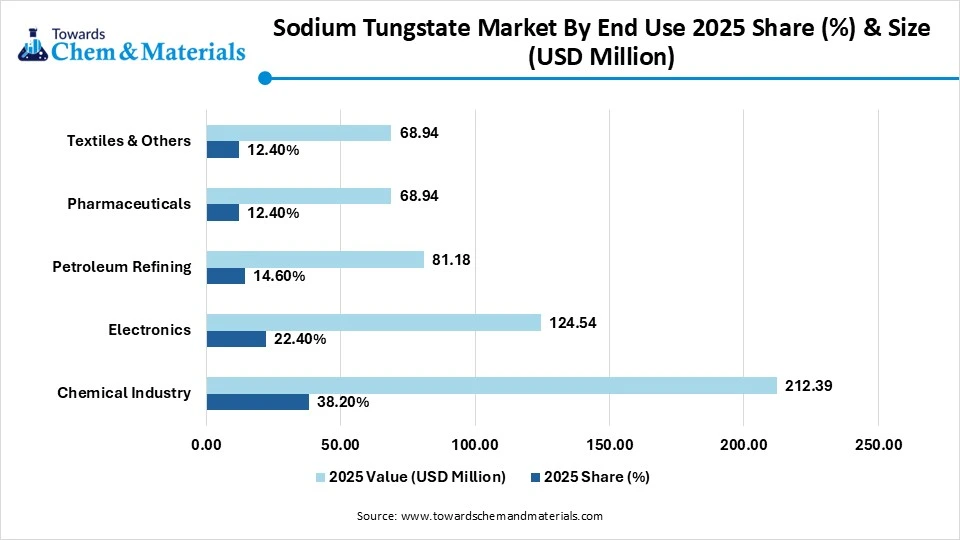
| Chemical Industry | 38.20% | 212.39 | 420.48 | 0.07 |
| Electronics | 22.40% | 124.54 | 285.99 | 0.09 |
| Petroleum Refining | 14.60% | 81.18 | 166.81 | 0.07 |
| Pharmaceuticals | 12.40% | 68.94 | 141.68 | 0.07 |
| Textiles & Others | 12.40% | 68.94 | 141.68 | 0.07 |
Note: 2025 is the base year; 2035 values are forecasts.
Sources: Expert interviews, secondary sources, Towards Chemical and Materials database and Towards Chemical and Materials analysts.
Chemical Industry accounted for 38.20% (USD 212.39 million) in 2025, electronics for 22.40% (USD 124.54 million), petroleum refining for 14.60% (USD 81.18 million), pharmaceuticals for 12.40% (USD 68.94 million) and textiles and others for 12.40% (USD 68.94 million).
Chemical Industry: This segment captured 38.20% (USD 212.39 million) of the sodium tungstate market revenue in 2025 and is projected to reach USD 420.48 million by 2035, expanding at a CAGR of 7.07% from 2026 to 2035. The chemical industry is the largest end user, using sodium tungstate in catalysis and as a raw material for other tungsten chemicals.
Electronics: Representing 22.40% (USD 124.54 million) of the market in 2025, this category is predicted to reach USD 285.99 million by 2035, growing at a CAGR of 8.67%. The faster growth is driven by increasing incorporation of tungsten-based materials in display technologies, sensors, electronic components, and electrochromic applications, alongside rising demand for advanced functional materials in the electronics industry.
Analyst View: Segment values were allocated by matching consumption volumes and prices to form, purity, application, end use, using producer and end-use industry data. We expect the faster-growing segments identified above to gain share over the forecast period.
In 2025, Asia Pacific dominated the market with a 58.40% share (USD 324.70 million), followed by Europe at 17.60% (USD 97.86 million), North America at 16.80% (USD 93.41 million), Latin America at 4.20% (USD 23.35 million), and the Middle East & Africa at 3.00% (USD 16.68 million). Asia Pacific also represents the fastest-growing regional market.
Asia Pacific: With a dominant 58.40% market share (USD 324.70 million) in 2025, the region is forecast to reach USD 706.53 million by 2035, registering the highest CAGR of 8.08% during 2026-2035. Its leadership stems from China's dominance in global tungsten mining and processing, supported by integrated producers such as China Minmetals, Xiamen Tungsten, and Chongyi Zhangyuan. Additionally, electronics demand from Japan and South Korea strengthens regional consumption.
Sodium Tungstate Market by Region 2025 Share and Size
| Region | 2025 Share | 2025 Value (USD Million) | 2035 Value (USD Million) | CAGR 2026–2035 |
| Asia Pacific | 58.40% | 324.70 | 706.53 | 0.08 |
| Europe | 17.60% | 97.86 | 190.43 | 0.07 |
| North America | 16.80% | 93.41 | 181.78 | 0.07 |
| Latin America | 4.20% | 23.35 | 45.44 | 0.07 |
| Middle East & Africa | 3.00% | 16.68 | 32.46 | 0.07 |
Note: 2025 is the base year; 2035 values are forecasts.
Sources: Expert interviews, secondary sources, Towards Chemical and Materials database and Towards Chemical and Materials analysts.
Europe: This region held 17.60% (USD 97.86 million) of the sodium tungstate market in 2025 and is projected to reach USD 190.43 million by 2035, expanding at a CAGR of 6.88% from 2026 to 2035. Europe has tungsten processed by H.C. Starck Tungsten and Wolfram Bergbau und Hütten and demand from chemicals and catalysts.
North America: Holding a 16.80% share (USD 93.41 million) in 2025, the market is projected to reach USD 181.78 million by 2035, advancing at a CAGR of 6.88%. Dependence on imported tungsten materials makes regional buyers sensitive to international supply disruptions. The presence of producers such as Global Tungsten & Powders, coupled with growing interest in alternative sourcing following export restrictions, is shaping regional supply strategies.
Latin America: This region contributed 4.20% (USD 23.35 million) of the sodium tungstate market share in 2025 and is projected to reach USD 45.44 million by 2035, expanding at a CAGR of 6.88% from 2026 to 2035. Latin America is supported by chemical and refining industries in Brazil and Mexico.
Middle East & Africa: With a 3.00% market share (USD 16.68 million) in 2025, the region is forecast to reach USD 32.46 million by 2035, expanding at a CAGR of 6.88%. Consumption is largely associated with the petroleum refining and petrochemical sectors, particularly in Gulf countries, where ongoing refinery operations and demand for specialized catalyst materials support the use of tungsten-based chemicals.
Analyst View: Regional shares were built from consumption by end-use industry in each region. Asia Pacific leads because it dominates production and downstream electronics and chemical manufacturing. We assign Asia Pacific the highest growth premium because downstream capacity is expanding fastest there.
Note: Company revenues and shares are 2025 estimates.
Sources: Company press releases, expert interviews, secondary sources, Towards Chemical and Materials database and Towards Chemical and Materials analysts.
China Minmetals led the sodium tungstate market with an estimated 9.35% (USD 52.00 million) of 2025 revenue, followed by Xiamen Tungsten at 8.63% (USD 48.00 million) and Chongyi Zhangyuan Tungsten at 5.40% (USD 30.00 million). China Minmetals, Xiamen Tungsten and Chongyi Zhangyuan Tungsten lead with integrated tungsten mining, refining and chemical production in China. H.C. Starck Tungsten, now part of Masan High-Tech Materials, Jiangxi Yaosheng Tungsten, Global Tungsten & Powders of the Plansee Group and Sandvik's Wolfram Bergbau und Hütten compete through tungsten chemicals outside and inside China, while Merck KGaA, Thermo Fisher and American Elements supply laboratory and high-purity grades.
The top 10 companies accounted for an estimated 42.99% (USD 239.00 million) of 2025 revenue, while the remaining 57.01% (USD 317.00 million) was shared among smaller Chinese tungsten processors and regional chemical distributors. The sodium tungstate market is fragmented, and competition focuses on purity, consistency, raw material security, price, technical service, regulatory compliance, and delivery of reliability. Integrated producers with access to raw materials have cost advantages.
The sodium tungstate ecosystem links mining and refining with chemical producers, distributors and laboratory suppliers, and downstream industrial users.
| Ecosystem Stage | Role in the Market | Key Companies |
| Mining & Concentrates | Mine tungsten ore | Chinese miners, Almonty, Sandvik |
| Refining & Producers | Convert concentrates to APT and sodium tungstate | China Minmetals, Xiamen Tungsten, H.C. Starck Tungsten, GTP |
| Distributors | Supply laboratories and industry | Merck KGaA, Thermo Fisher, regional distributors |
| End Users | Use in catalysts and electronics | Chemical companies, refiners, electronics makers |
Sources: Company press releases, expert interviews, secondary sources, Towards Chemical and Materials database and Towards Chemical and Materials analysts.
The Towards Chemical and Materials Companies Quadrant positions key participants in the sodium tungstate market by market strength, reflecting revenue scale, market share and geographic reach, and by innovation and growth strategy, reflecting product portfolio breadth, R&D intensity and partnerships. Positions reflect each company's estimated 2025 revenue in this market and our assessment of its integration, product quality, and reach.
Leaders: China Minmetals, Xiamen Tungsten, Chongyi Zhangyuan Tungsten and H.C. Starck Tungsten combine large revenue with raw material integration and broad customer reach.
Challengers: Jiangxi Yaosheng Tungsten has significant volumes but narrower portfolios or less product development.
Innovators: Global Tungsten & Powders, Wolfram Bergbau und Hütten and Thermo Fisher Scientific bring high-purity grades and specialty applications.
Niche Players: Merck and American Elements serve smaller regional or laboratory segments.
By Form
By Purity
By Application
By End Use
By Region
The sodium tungstate market was defined as sodium tungstate dihydrate powder, crystals, and solutions in technical and high-purity grades for catalysis, chemical intermediates, electronics, pharmaceuticals, and other uses, worldwide. The 2025 base-year estimate was developed using regional and segment-wise consumption volumes multiplied by corresponding average selling prices. The resulting market value was then validated against manufacturers' production capacities, actual output levels, and reported revenues of leading suppliers to ensure consistency with industry supply and revenue data.
Segment, regional, and company values were allocated from segments and regional consumption. Key estimates were verified by cross-checking company disclosures, regulatory and industry data, and published third-party estimates, and inputs that could not be reconciled were excluded. All segment, regional and company figures were reconciled to the same 2025 base year, and the 2026-2035 forecast, which applies a constant CAGR from the 2025 base, was recalculated and validated.
The sodium tungstate market is shaped by tungsten supply as much as by demand, with China's export controls raising prices and encouraging diversification. Our estimate links demand to consumption and tungsten-linked prices, so the forecast follows catalyst, electronics and chemical demand and tungsten markets. The main upside comes from electronics and catalysis, while the main risk is price volatility.
Reliable market intelligence and data-driven insights across the global chemicals and materials industry, helping businesses understand trends, competition, pricing, and emerging opportunities.
Schedule a Demo