
Sodium Sulfide Market Size Analysis Report 2035
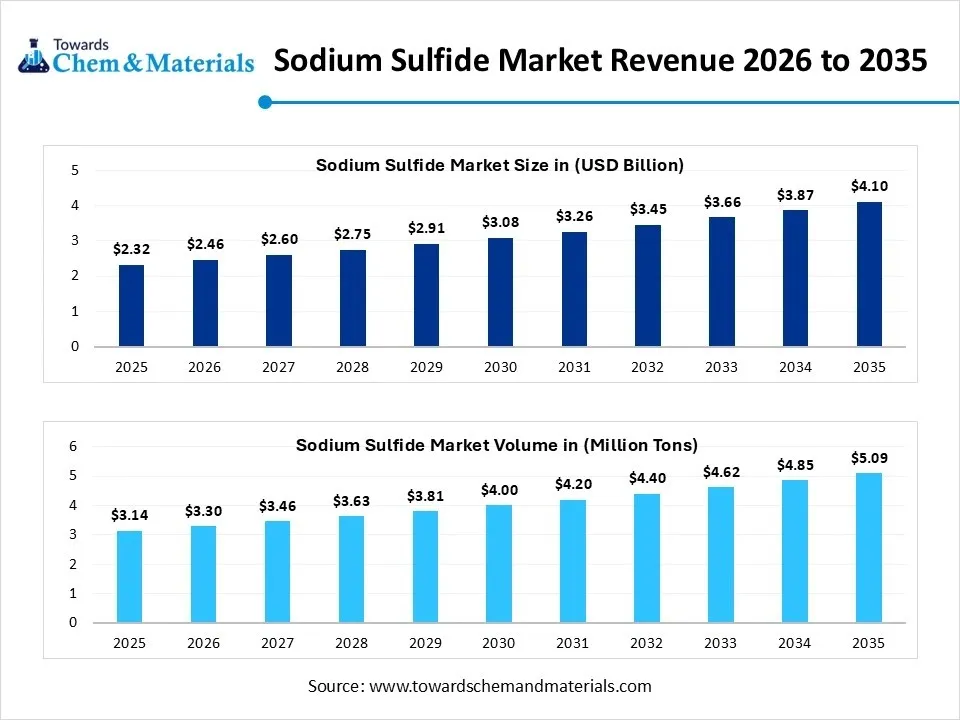
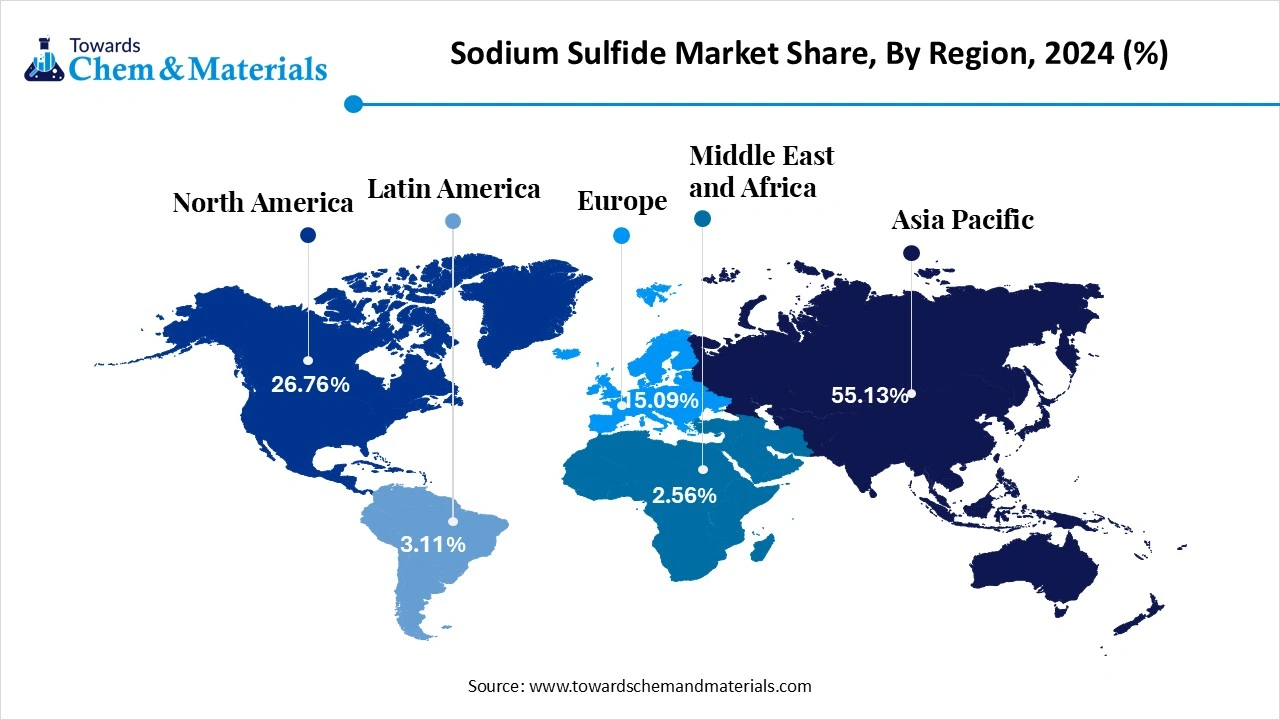
The sodium sulfide market size was valued at USD 2.32 billion in 2025, is estimated to reach USD 2.46 billion in 2026, and is projected to reach USD 4.10 billion by 2035, exhibiting a compound annual growth rate (CAGR) of 5.85% over the forecast period from 2026 to 2035.Asia Pacific dominated the sodium sulfide market with the largest revenue share of 52% in 2025 and is expected to grow at the fastest CAGR of 5.92% during the forecast period. The market is growing because of the increasing demand of industries such as pulp and paper, leather processing plants, textile dyeing, mining, and wastewater treatment sectors. The market growth is expected to remain at its current trend, driven by the rapid industrialization in the Asia Pacific region, along with the developments in membrane electrolysis and sustainable production technologies.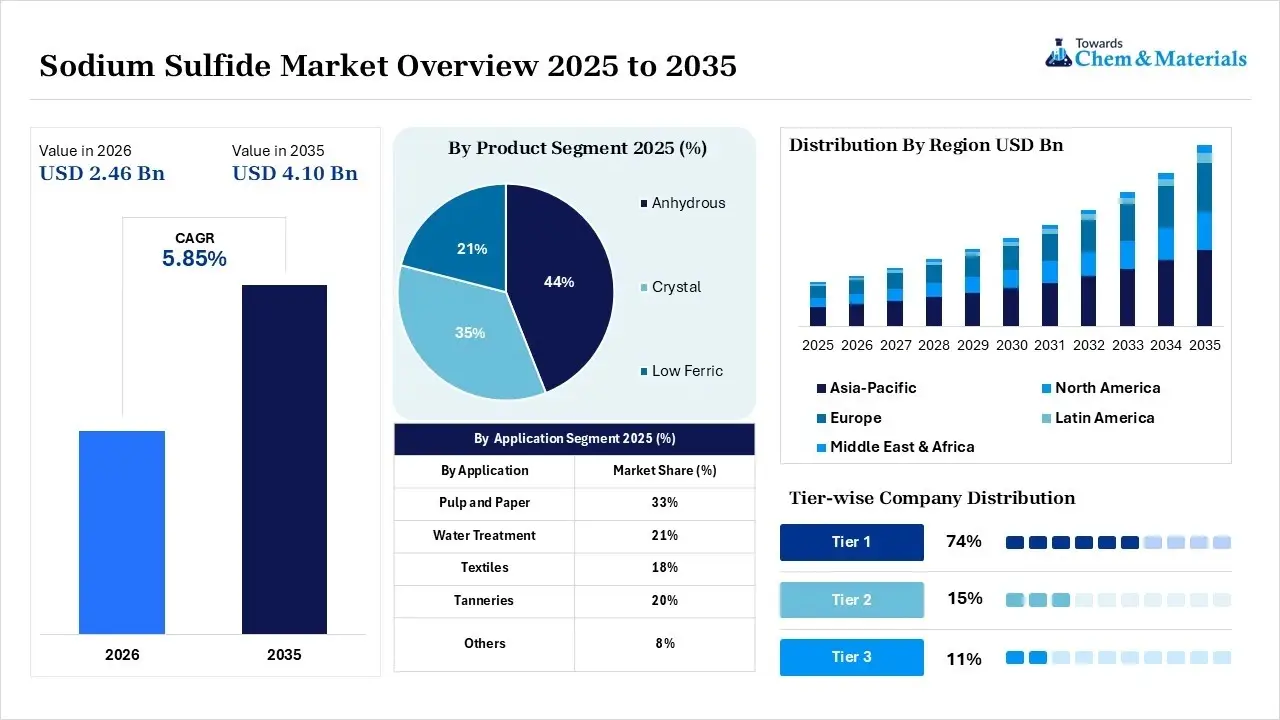
Key Takeaways
- By region, Asia Pacific dominated the sodium sulfide market by holding 52% share in 2025, driven by investments in manufacturing capacity.
- By region, North America held 15% market share in 2025 and is expected to grow at the fastest, with a CAGR of 6.6% during the forecast period as water treatment investments increase chemical usage.
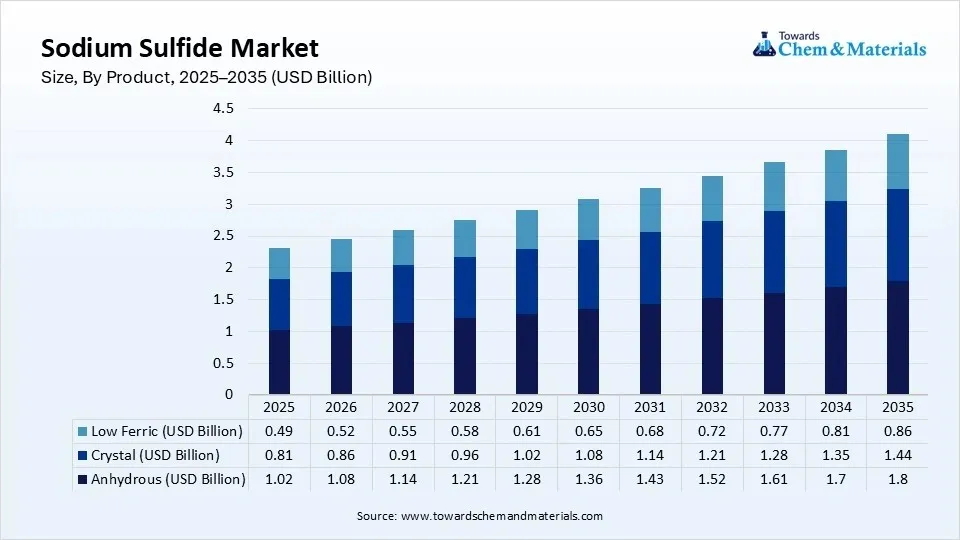
- By product, the anhydrous segment dominated the market with the largest share of 44% in 2025 as stable purity improves industrial efficiency.
- By Product, the crystal segment held 35% market share in 2025 and is expected to grow at the fastest CAGR of 6.3% over the forecast period due to easy handling and storage improve operational flexibility.
- By application, the pulp and paper segment dominated the market with the largest share of 33% in 2025, as kraft pulping operations rely heavily on sodium sulfide.
- By application, the water treatment segment held 21% market share in 2025 and is expected to grow at the fastest CAGR of 6.7% over the forecast period, driven by municipal treatment investments
According to Towards Chemicals and Materials Analytics and Consulting, the global sodium sulfide market volume was valued at 3.14 million metric tons in 2025 and is expected to surpass around 5.09 million metric tons by 2035, accelerating a compound annual growth rate (CAGR) of 4.95% over the forecast period from 2026 to 2035.
Market Overview
The leather tanning, kraft pulp making, textile dyeing, mining, and industrial wastewater treatment are a few of the markets where the demand for the market is increasing and contributing to the market growth. New growth opportunities are emerging as packaging production grows, environmental standards for the removal of heavy metals increase, and mineral processing activities are also growing.
Membrane-based electrolysis technologies are increasingly being used by manufacturers to produce low-ferric sodium sulfide of higher purity, with less wastewater generation. Moreover, sustainable production techniques with recovered sulfur dioxide emissions are improving sustainability and helping to implement circular production of chemicals.
- For instance, in January 2026, Zhongna Energy launched the worlds first sodium-ion battery cathode material production project for 10,000 tons, advancing the commercialization of sodium-ion batteries on a large scale.(Source: eu.36kr.com)
Rising Demand for Durable Materials: Sodium Sulfide Market to Expand
Sodium sulfide is an inorganic compound that is colorless and water soluble formula and solid which is present in amorphous and crystalline forms, and forms an alkaline solution when mixed. It releases hydrogen sulfide when it is exposed to moist air. They also have diverse applications like pulp and paper industry, water treatment, textile industry, chemical manufacturing, ore flotation, and oil recovery.
What Are the Key Market Drivers Responsible for The Growth of The Sodium Sulfide Market?
The growth of the sodium sulfide market is driven by the growing and increasing demand for water treatment and the growth of the leather and textile industry, where there is increasing demand for sodium sulfide due to its properties and versatile applications, which fuels the growth of the market. The growth is also driven by the improved and sustainable production methods with technological advancements to enhance safety and align with the environmental regulations due to strict environmental regulations for the treatment of wastewater and industrial applications, which boosts the growth of the market. The product is in high demand due to its cost-effectiveness and its application in varied industries like pulp and paper, leather and textile, flotation process, and for water treatment, and as an intermediate in the chemical photography, which increases the demand and further supports the growth and expansion of the market.
Market Trends
- The increasing demand from the leather industry for tanning and softening, and the demand from the growing fashion industry, boosts the growth of the market.
- The growing demand for wastewater treatment due to environmental regulations and the growing shift towards sustainability fuels the growth of the market.
- Technological advancements in the production and application of sodium sulfide and innovation in technology boost the growth of the market.
- The industrial growth and growing industries like leather, paper, and chemical industries fuel the growth of the market.
Report Scope
| Report Attributes | Details |
| Market Size in 2026 | USD 2.46 Billion /3.30 Million Tons |
| Expected Size by 2035 | USD 4.10 Billion /5.09 Million Tons |
| Growth Rate from 2025 to 2035 | CAGR 5.85% |
| Base Year of Estimation | 2025 |
| Forecast Period | 2025 - 2035 |
| Dominant Region | Asia Pacific |
| Segment Covered | By Product, By Application, By Region |
| Key Companies Profiled | Solvay S.A., Nippon Chemical Industrial Co., Ltd., TIB Chemicals AG, Rongyuan Chemical Co., Ltd., Gujarat Alkalies and Chemicals Ltd (GACL), Shaanxi Fuhua Chemical Co., Ltd., Weifang Yidu Chemical Co., Ltd., Tessenderlo Group, Sichuan Shenhong Chemical Industry Co., Ltd., NaFine Chemical Industry Group Co., Ltd. |
Supply Chain Analysis of the Sodium Sulfide Market
Feedstock Procurement
- The necessary feedstocks for commercial sodium sulfide production, such as sodium sulfate, sulfur, sodium hydroxide, coal, and reducing agents, are derived from the mining and chemical industries.
- Solvay SA: Gains access to high-quality sulfur and alkali feedstocks by combining its chemical operations, ensuring the availability and stability of raw material feedstocks and production efficiency.
- Other Key Players: Kemcore, PVS Chemicals.
Chemical Synthesis and Processing:
- Sodium sulfate is then treated by carbothermic reduction, or sulfur is treated with sodium hydroxide under controlled conditions to produce sodium sulfide, which is then purified, filtered, evaporated, and flaked or crystallized.
- Nouryon: As the manufacturer of sodium sulfide for industrial purposes in pulp, mining, and water treatment, Nouryon is employing state-of-the-art chemical processing technologies and quality control systems.
- Other Key Players: Solvay, Chemical Products Corporation
Compound Formulation and Blending
- The purified sodium sulfide is used in the leather processing industry, in mining, in pulp, and in specialty chemicals, and is processed into flakes, crystals, or low-iron types of purified sodium sulfide in different purities and concentrations required by application.
- Merck Group (Sigma-Aldrich): Quality control is a strict requirement for all formulations of high-purity sodium sulfide reagents for laboratory, analytical, and specialty industrial applications from Merck KGaA (Sigma-Aldrich).
- Other Key Players: Sankyo Kasei Co., Ltd., Vizag Chemical.
Market Opportunity
What Are the Key Growth Opportunities Responsible for The Growth of The Sodium Sulfite Market?
The key growth opportunity responsible for the growth of the market is the growing industries in all the regions, and rapid industrialization increases the demand for the market and creates opportunities for growth. The demand from industries like the pulp and paper industry for kraft pulping and deinking processes to produce recycled paper, in water treatment to reduce the environmental impact and regulate the industrial wastewater, and in leather processing as a dehairing agent, in textile manufacturing for dyeing and processing, these applications in various industries further fuels the growth opportunities in the market and also supports expansion of the market.
Market Challenge
The Rise in Raw Material Prices and Strict Environmental Regulations
The key challenge that hinders the growth of the market is the high raw material prices, which affect and impact the manufacturing cost, and also affect the profit margin of the product, affecting the overall final price of the product. This volatility of the market and in the cost of the product is a challenge in maintaining a stable price and profitability. The strict environmental regulation is another challenge that hinders the growth of the market.
Segmental Insights
Product Insights
Which Product Segment Dominated the Sodium Sulfide Market In 2024?
The anhydrous segment dominated the sodium sulfide market in 2024. The growth of the market is driven by its properties, which make it ideal for applications like its solubility, since it is highly soluble in water, forming an alkaline solution. Its reactivity with acids and oxidation also makes it ideal for use.
The growth is also driven by its application in various industries like pulp and paper, textile, leather, in chemical synthesis, mineral floatation, water treatment, for synthesis of organic and in organic compounds, also used are toning agent in photography and is extensively used in the sodium sulfur batteries which makes it a preferred choice and also increases the demand for the product. These applications and properties support the growth and expansion of the market.
The crystal segment expects significant growth in the sodium sulfide market during the forecast period. The growth of the market is driven by its cost-effectiveness and emerging economies. It is used in crystalline mass and flake form. The product is also in high demand due to properties like high reactivity, water solubility, and formation of an alkaline solution, which drives the growth of the market. The growing and expanding applications like chemical manufacturing, the textile industry, pulp and paper industry, water treatment, and metal precipitation help in the further growth of the market and also support the expansion of the market.
Application Insights
How Did the Pulp and Paper Segment Dominate the Sodium Sulfide Market In 2024?
The pulp and paper segment dominated the sodium sulfide market in 2024. The growth of the market is driven using sodium sulfide in the kraft process for pulping wood and for lignin removal, which allows efficient extraction of cellulose fibers, which fuels the demand from the industry. The growth is also driven by the environmental impact and sustainability, which aligns with the global environmental concerns, ensuring water management in processing and streamlining, which plays a significant role and fuels the growth of the market. The growth is also driven because of the quality management and cost effectiveness further drives the demand and supports the growth and expansion of the market.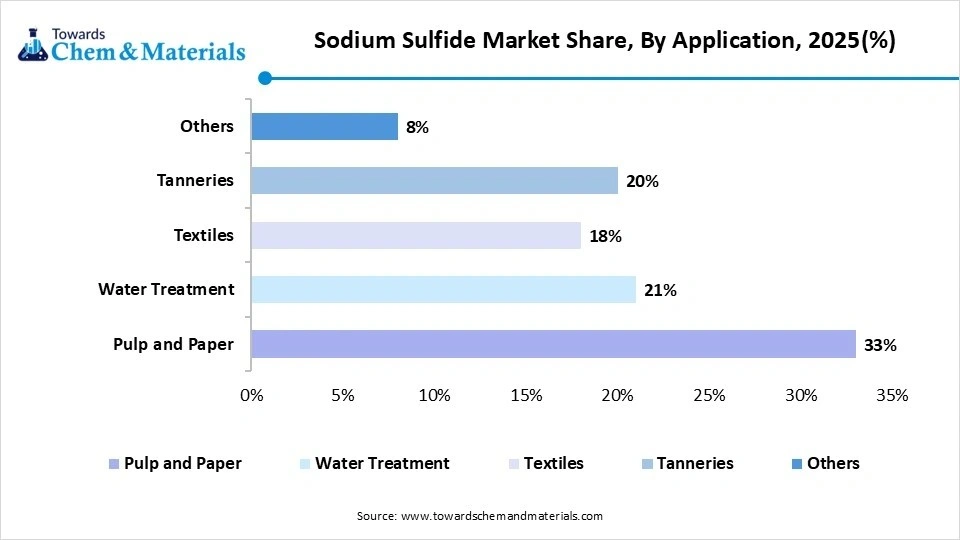
The water treatment segment expects significant growth in the market during the forecast period. The growth of the market is driven by the growing demand for metal precipitators and oxygen scavengers for water treatment and for increasing efficiency, which drives the growth. It works by forming insoluble metal sulfides when reacting with heavy metals in wastewater, and then is removed by sedimentation and filtration. This is the most effective and productive method practiced, and is also used to remove chlorine and oxygen from water. Strict environmental regulation aligning with the growth of environmental concerns and demand from industries for compliance and managing discharges, water treatment further increases the demand and supports the growth and expansion of the market.
Regional Insights
How did the Asia Pacific Dominate the Sodium Sulfide Market in 2025?
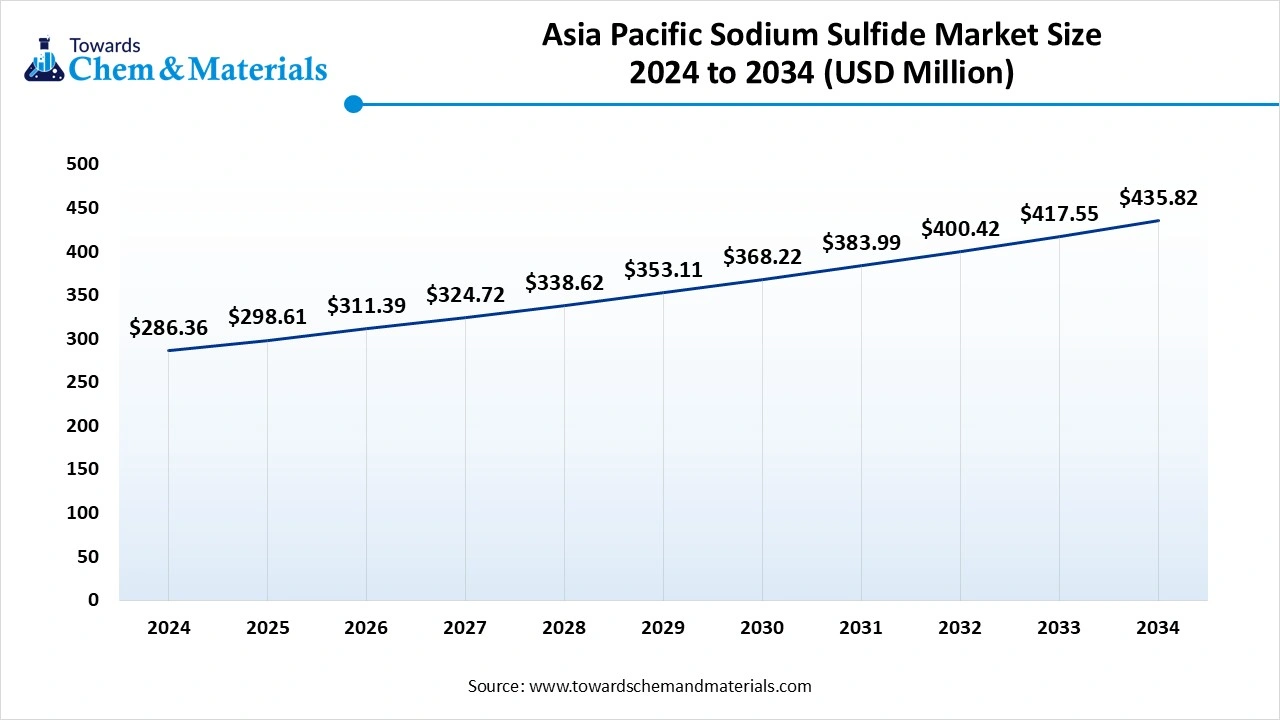
The Asia Pacific sodium sulfide market size was estimated at USD 1.21 billion in 2025 and is projected to reach USD 2.15 billion by 2035, growing at a CAGR of 5.92% from 2026 to 2035.Asia Pacific dominated the market with the largest share of 52% in 2025. The regions demand is continuing to be fueled by the growth of industrialization, leather processing, robust pulp and paper production, and growing mining. Major chemical manufacturers and the availability of abundant raw materials also contribute to the market growth. The areas strong position is being reinforced by increased investment in the treatment of effluents and the production of textiles.
China
- China is the largest regional producer of sodium sulfide, with a wide range of chemical production and excellent demand from the leather, paper, and mining industries.
- Sodium sulfide demand in manufacturing facilities for the removal of heavy metals continues to rise due to growing utilization of wastewater treatment investments.
- Sodium sulfide is used consistently throughout the countrys industrial sector, largely because of its use in the expanding textile industry and in sulfur dye production.
India
- Sodium sulfide is being used extensively as a dehairing chemical in the leather tanning industry, which forms the bulk of its consumption.
- The rising kraft paper production is to meet the growing demand of packaging manufacturers, meeting the requirement of sustainable packaging.
- Chemical manufacturing and investments in wastewater treatment facilities are still growing, and continue to be driven by government-led industrial development and urbanization.
North America held 15% market share in 2025 and is expected to grow at the fastest CAGR of 6.6% during the forecast period. Wastewater treatment, pulp/paper, and specialty chemical production provide support for the market. Sodium sulfide is used in industrial effluent treatment because of the strict environmental regulations. Stable product consumption across the region is also partly due to mining activities.
United States
- The use of sodium sulfide in industrial wastewater treatment and heavy metal precipitation is encouraged by strict environmental regulations.
- The pulp and paper industry is well developed with a sustained demand for products resulting from kraft pulping.
Sodium sulfide is still being used in mining, in flotation processes to recover and process minerals.
Canada
- The increasing volume of mining activities boosts the demand for sodium sulfide in different ore flotation and mineral beneficiation processes.
- Stable demand for kraft pulp processing facilities is sustained by the activity of sustainable forestry and paper manufacturing.
- Efforts in environmental compliance drive more use of advanced wastewater treatment chemicals.
Europe held 18% market share in 2025. Specialty chemicals, advanced processing leather industries, and wastewater Treatment are supporting the market. Stronger environmental laws promote cleaner production technologies and the effective use of industrial chemicals. Sustainability is on-going trend as long as it remains a factor in driving demand in multiple end-use industries.
Germany
- The strong demand from the chemical manufacturing industry ensures a steady demand for sodium sulfide for industrial processing applications.
- As wastewater treatment plant (WWTP) technology advances, more product is used for heavy metal removal.
- The areas of paper and specialty chemical industries also continue to contribute to the growth of the regional market.
France
- Demand for sodium sulfide remains fairly steady in industrial applications, including leather processing and textiles.
- Adoption of cleaner chemical manufacturing technologies is supported by the sustainable growth of industrial production.
- The continued growth of investments in industrial wastewater treatment is opening new markets.
Latin America held 8% market share in 2025. As more and more minerals are mined, the need for sodium sulfide for flotation and mineral processing grows. The leather and textile industries are growing, contributing to steady consumption of industrial chemicals. Demand in the wastewater treatment and manufacturing industries remains robust.
Brazil
- The use of sodium sulfide in ore beneficiation processes is being further increased with the expansion of the mining sector.
- The leather processing industry is growing, and there is steady demand for chemicals used for dehairing.
Increased investments in industrial wastewater treatment are helping expand the market.
Chile
- Copper mines make huge demands for flotation chemicals such as sodium sulfide.
- Industry modernization helps drive the use of efficient mineral processing chemicals in the mining industry.
- Industrial expansion boosts chemical demand overall in various industrial sub-sectors.
The Middle East & Africa held 7% market share in 2025, as the increasing consumption of sodium sulfide in the area is supported by mining and industrial development. Rising the investments in water treatment courses leads to increased demand for pollution control chemicals. An increase in manufacturing helps to build a good market.
Saudi Arabia
- As more money is invested in wastewater treatment, more sodium sulfide will be used in the environment.
- Expansion of chemical manufacturing provides long-term development of the regional market.
South Africa
- The sodium sulfide used in the mineral flotation process continues to be strongly supported by the mining industry.
- Industrial wastewater treatment projects are growing to meet rising demands in environmental applications.
Recent Developments
- In May 2025, Japanese manufacturer NGK Insulators introduced its proprietary sodium-sulfur (NAS) battery technology in a major project in Japan, with a pilot initiative also underway in the United States. Regarded as one of the most advanced non-lithium electrochemical storage solutions, the NAS battery is designed for medium- to long-duration energy storage (LDES), offering up to around 7 hours of capacity. Operating at a high temperature of 300°C, it features a sulfur anode and a sodium cathode. The system is engineered for durability, with a capacity loss of less than 1% annually, even under daily full-depth cycling.(Source: energy-storage.news)
- In January 2025, India has a chance to build its energy storage ecosystem using sodium-ion batteries (SIBs), thanks to its plentiful supply of raw materials needed for SIB production, especially compared to lithium-ion batteries (LIBs). This finding comes from a new report created as part of a joint UK-India program. The program, called Accelerating Smart Power and Renewable Energy (ASPIRE), is run by the UKs Foreign Commonwealth and Development Office (FCDO) in partnership with Indias Ministry of Power and Ministry of New and Renewable Energy. KPMG is the main advisor to the FCDO on this project.(Source: pv-magazine-india)
Top Companies List
- Solvay S.A.
- Nippon Chemical Industrial Co., Ltd.
- TIB Chemicals AG
- Rongyuan Chemical Co., Ltd.
- Gujarat Alkalies and Chemicals Ltd (GACL)
- Shaanxi Fuhua Chemical Co., Ltd.
- Weifang Yidu Chemical Co., Ltd.
- Tessenderlo Group
- Sichuan Shenhong Chemical Industry Co., Ltd.
- NaFine Chemical Industry Group Co., Ltd.
Segments Covered
By Product
- Anhydrous
- Industrial Grade
- High Purity Grade
- Crystal
- Yellow Crystal
- Red Crystal
- Low Ferric
- Standard Low Ferric
- Ultra-Low Ferric
By Application
- Pulp and Paper
- Kraft Pulping
- Chemical Recovery
- Water Treatment
- Industrial Wastewater
- Municipal Water Treatment
- Textiles
- Dyeing
- Fiber Processing
- Tanneries
- Leather Dehairing
- Leather Processing
- Others
- Mining
- Chemical Manufacturing
- Pharmaceuticals
By Region
- North America
- U.S.
- Canada
- Europe
- Germany
- UK
- France
- Italy
- Spain
- Sweden
- Denmark
- Norway
- Asia Pacific
- China
- Japan
- India
- South Korea
- Thailand
- Latin America
- Brazil
- Mexico
- Argentina
- Middle East and Africa (MEA)
- South Africa
- UAE
- Saudi Arabia
- Kuwait
A Seven-Phase Framework
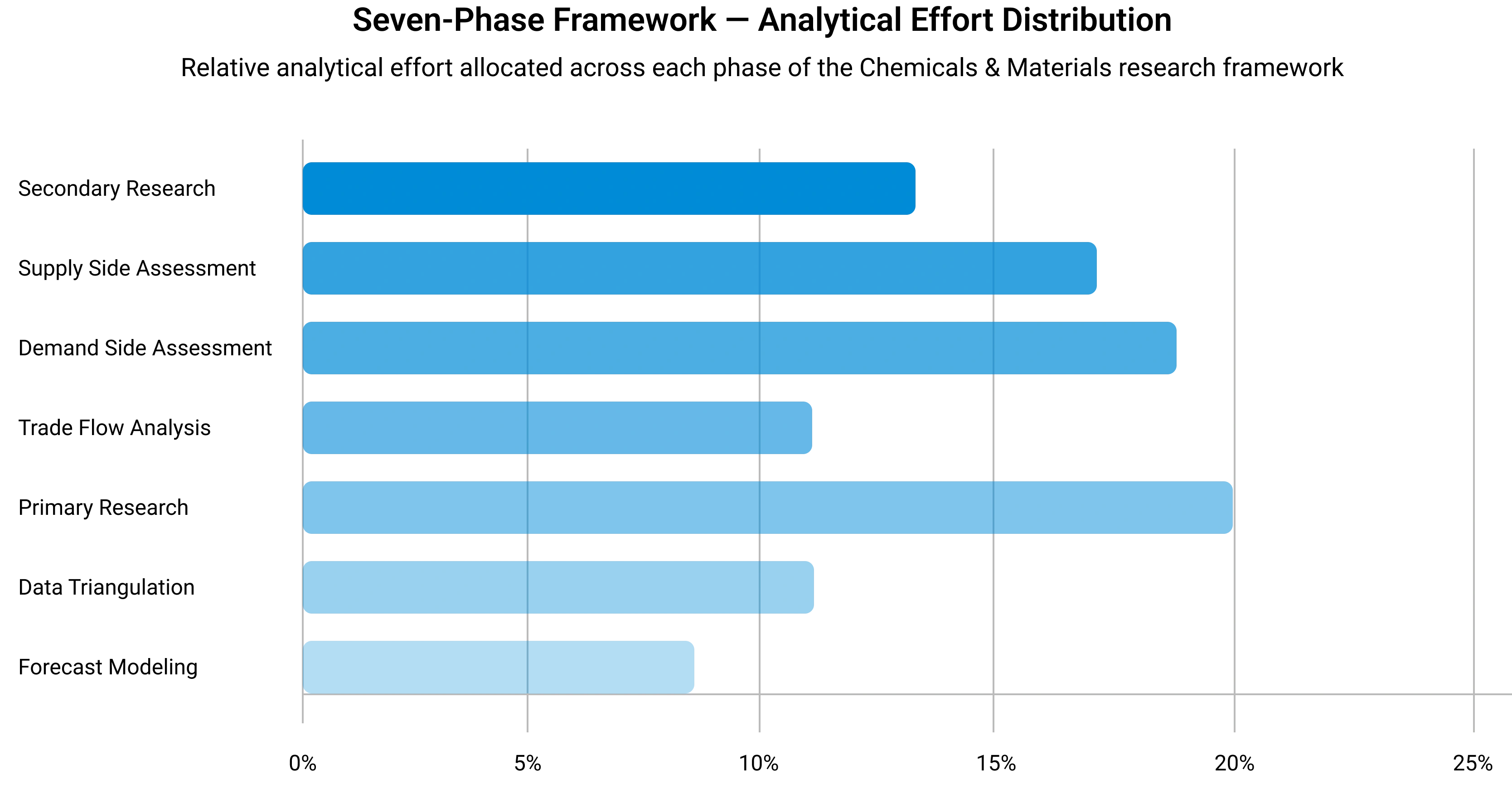
Our methodology is designed to be universally applicable across commodity chemicals, specialty chemicals, petrochemicals, construction chemicals, coatings, electronic chemicals, industrial gases, agrochemicals, water treatment chemicals, and performance materials. Each phase builds upon the last, creating a layered validation structure that minimizes estimation error and maximizes analytical confidence.
The framework ensures comprehensive market coverage, robust cross-validation, and reliable long-term forecasting — producing market estimates that withstand scrutiny from investors, regulators, and corporate strategy teams.

Seven-Phase Framework — Analytical Effort Distribution
Relative analytical effort allocated across each phase of the Chemicals & Materials research framework
Phase 1 - Secondary Research: Establishing the Foundation
Secondary research collects and evaluates publicly available information from authoritative sources, establishing the foundational understanding of market structure, value chain dynamics, competitive landscape, and end-use demand patterns. Every source is evaluated for credibility, recency, geographic relevance, and methodological soundness before inclusion.
Industry Associations
Sources include ACC, CEFIC, ICCA, JCIA, CPCIF, and SOCMA providing production volumes, consumption trends, capacity developments, and sustainability initiatives.
Company Disclosures
Annual reports, investor presentations, earnings transcripts, and regulatory filings reveal product portfolios, manufacturing footprints, capacity expansions, and revenue segmentation.
Government Databases
National statistical offices, customs authorities, environmental agencies, and industrial production databases provide verified statistics on output, trade flows, and regulatory compliance.
Trade Databases
UN Comtrade, ITC, Eurostat, and national customs authorities enable assessment of global product movement, import dependency, and export competitiveness across regions.
Our Secondary Research Sources
- Ministry of Chemicals and Fertilizers
- European Chemicals Agency
- United States Department of Energy
- Ministry of Industry and Information Technology
- Ministry of Economy Trade and Industry
- Ministry of Trade Industry and Energy
- National Institute of Standards and Technology
- Council of Scientific and Industrial Research
- Fraunhofer Society
- National Institute for Materials Science
Phase 2 — Supply-Side Assessment: Mapping Production Capabilities
Production Capacity Analysis
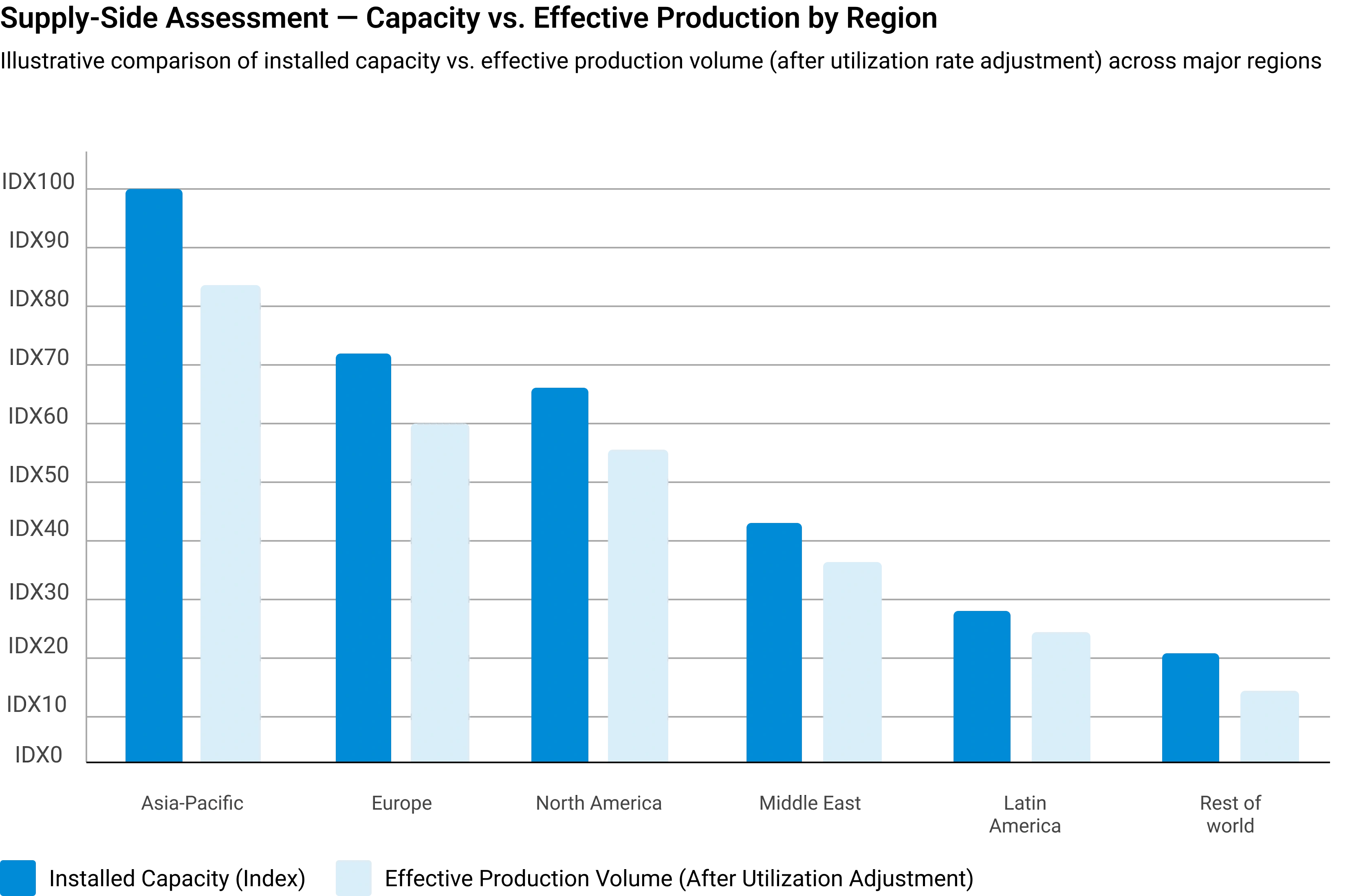
All major manufacturers are assessed for existing installed capacity, planned additions, expansions, new plant announcements, and technology adoption — mapped at global, regional, and country levels.
Capacity Utilization Adjustment
Installed capacity is adjusted using utilization rates based on demand conditions, feedstock availability, plant operating rates, maintenance schedules, and regulatory restrictions.
Manufacturer Revenue Analysis
Product-specific revenues, segment-level performance, regional distribution, average selling prices, and margin trends are evaluated to establish market value estimates.
Supply-Side Assessment — Capacity vs. Effective Production by Region
Illustrative comparison of installed capacity vs. effective production volume (after utilization rate adjustment) across major regions
Phase 3 — Demand-Side Assessment: Quantifying Chemical Consumption
Demand-side analysis quantifies chemical consumption across industries, applications, and geographies — identifying where and how chemicals are consumed throughout the value chain with precision.
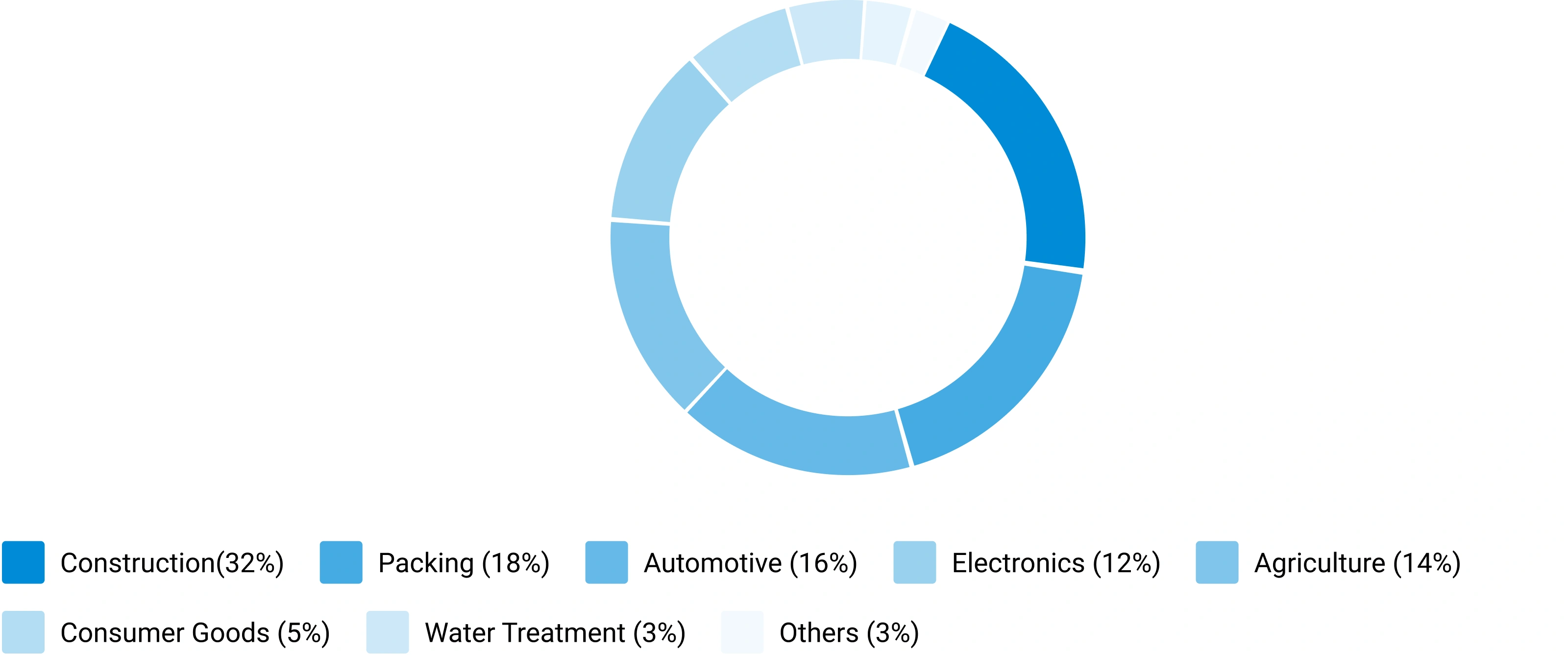
End-Use Industry Analysis
Chemical demand is evaluated across automotive, construction, packaging, electronics, agriculture, healthcare, consumer goods, industrial manufacturing, energy and utilities, and water treatment. Industry output, production trends, and consumption intensity are analyzed to determine demand patterns.
Consumption Modeling
Demand is estimated using measurable indicators: kilograms per vehicle, kilograms per square meter of construction, dosage per cubic meter of water treated, kilograms per hectare of agricultural land, and kilograms per ton of manufactured products. Consumption factors are validated through industry publications and primary interviews.
Application Analysis
The market is segmented by application area to understand product performance requirements, formulation trends, technology adoption, customer preferences, and regulatory requirements improving demand accuracy and segmentation granularity.
Demand-Side Assessment — End-Use Industry Demand Distribution
Illustrative distribution of chemical & materials demand across key end-use industries
Phase 4 - Trade Flow Analysis: Balancing Regional Supply and Demand
Trade flow analysis reconciles regional supply and demand estimates through import and export data, identifying net supply positions, regional dependencies, and market imbalances. It serves as an independent validation layer that tests the consistency of supply-side and demand-side estimates.
Import Analysis
Import data is evaluated to determine volumes, source countries, product dependency, regional supply gaps, and pricing trends — identifying markets that rely heavily on external supply and where domestic production is insufficient to meet demand.
Export Analysis
Export assessments reveal production surplus, export competitiveness, regional manufacturing strength, and global market participation. Export patterns also help validate domestic production estimates and identify net exporting regions.
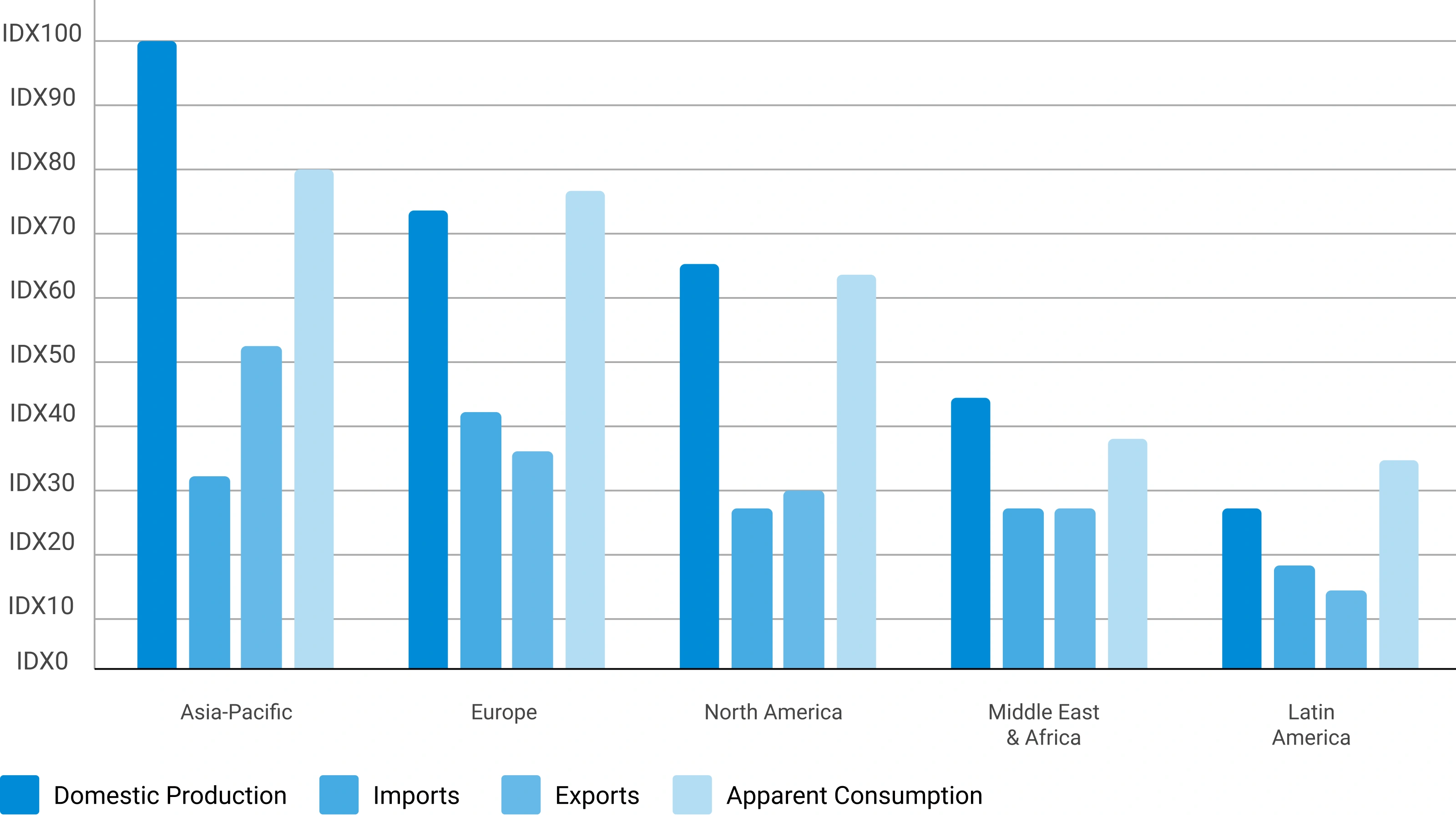
Apparent Consumption Model
Regional consumption is assessed using the standard apparent consumption formula:
Results identify net importing regions, net exporting regions, regional deficits, and surpluses — serving as an independent validation of supply and demand estimates.
Trade Flow Analysis — Net Supply Position by Region
Illustrative apparent consumption vs. domestic production across major regions — positive gap indicates net import dependency
Phase 5 — Primary Research: The Critical Validation Layer
Primary research tests and refines findings from secondary research through direct engagement with industry participants across the supply chain, demand side, and expert community. It captures intelligence that no database or published report can provide — the real-world experience of manufacturers, buyers, and specialists operating in the market.

Supply-Side Interviews
Conversations with chemical manufacturers, raw material suppliers, contract manufacturers, technology providers, and plant operators cover production trends, capacity utilization, pricing developments, technology shifts, and competitive dynamics.

Demand-Side Interviews
Engagement with OEMs, industrial consumers, procurement managers, distributors, formulators, and end-use manufacturers focuses on consumption trends, purchasing behavior, product substitution, demand outlook, and emerging applications.

Industry Expert Consultations
Additional interviews with industry consultants, independent experts, regulatory specialists, technical professionals, and research institutions provide deeper market context and validate key analytical assumptions.
Focus Areas of Primary Research:
Market Size & Forecast Validation
Revenue estimates, volume consumption, growth rates, forecast assumptions, regional demand.Supply Chain & Value Chain Assessment
Raw material sourcing, supply chain challenges, distribution networks, procurement practices.Production & Capacity Analysis
Manufacturing capacity, utilization rates, expansion projects, plant investments.Pricing & Cost Structure Analysis
Product pricing trends, feedstock costs, energy costs, margin pressures, pricing outlook.Competitive Landscape Assessment
Volume and value estimates confirmed to be fully consistent with one another before publicationInterview Volume by Market Scope
| Study Scope | Number of Interviews |
|---|---|
| Niche Market | 20 – 30 |
| Mid-Sized Market | 30 – 50 |
| Global Market | 50 – 80 |
| Highly Fragmented Market | 80 – 120 |
Interview Details:
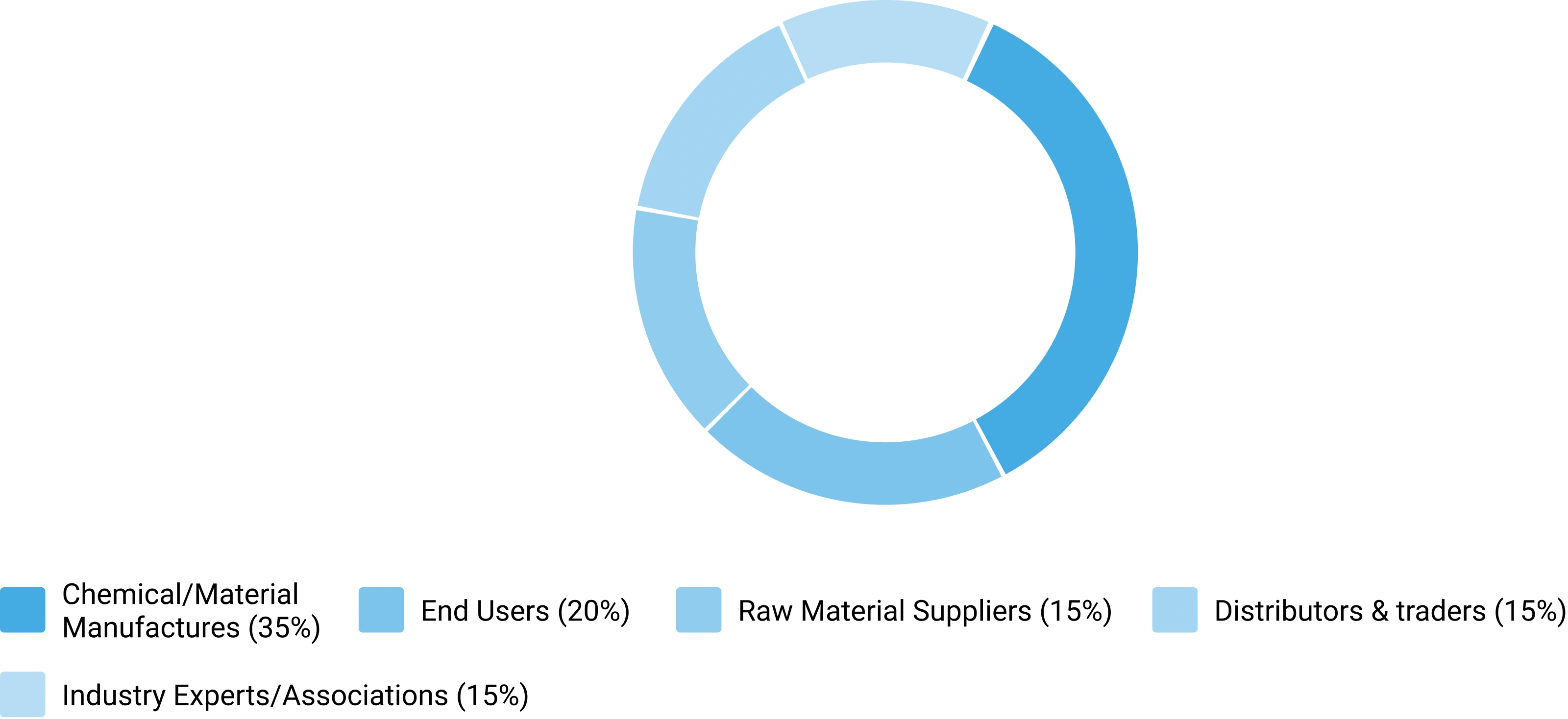
Category : Manufacturers, Suppliers, Distributors, End Users, Experts/Associations
Average Duration : 30–60 Minutes
Interview Mode : Video calls, telephonic interviews, expert consultations
Interview Format : Structured / Semi-Structured questionnaire
Focus Areas of Primary Research:
Market Size & Forecast Validation :
Revenue estimates, volume consumption, growth rates, forecast assumptions, regional demand.
Supply Chain & Value Chain Assessment :
Raw material sourcing, supply chain challenges, distribution networks, procurement practices.
Production & Capacity Analysis :
Manufacturing capacity, utilization rates, expansion projects, plant investments.
Pricing & Cost Structure Analysis :
Product pricing trends, feedstock costs, energy costs, margin pressures, pricing outlook.
Competitive Landscape Assessment :
Market share, competitor positioning, strategic initiatives, partnerships, acquisitions.
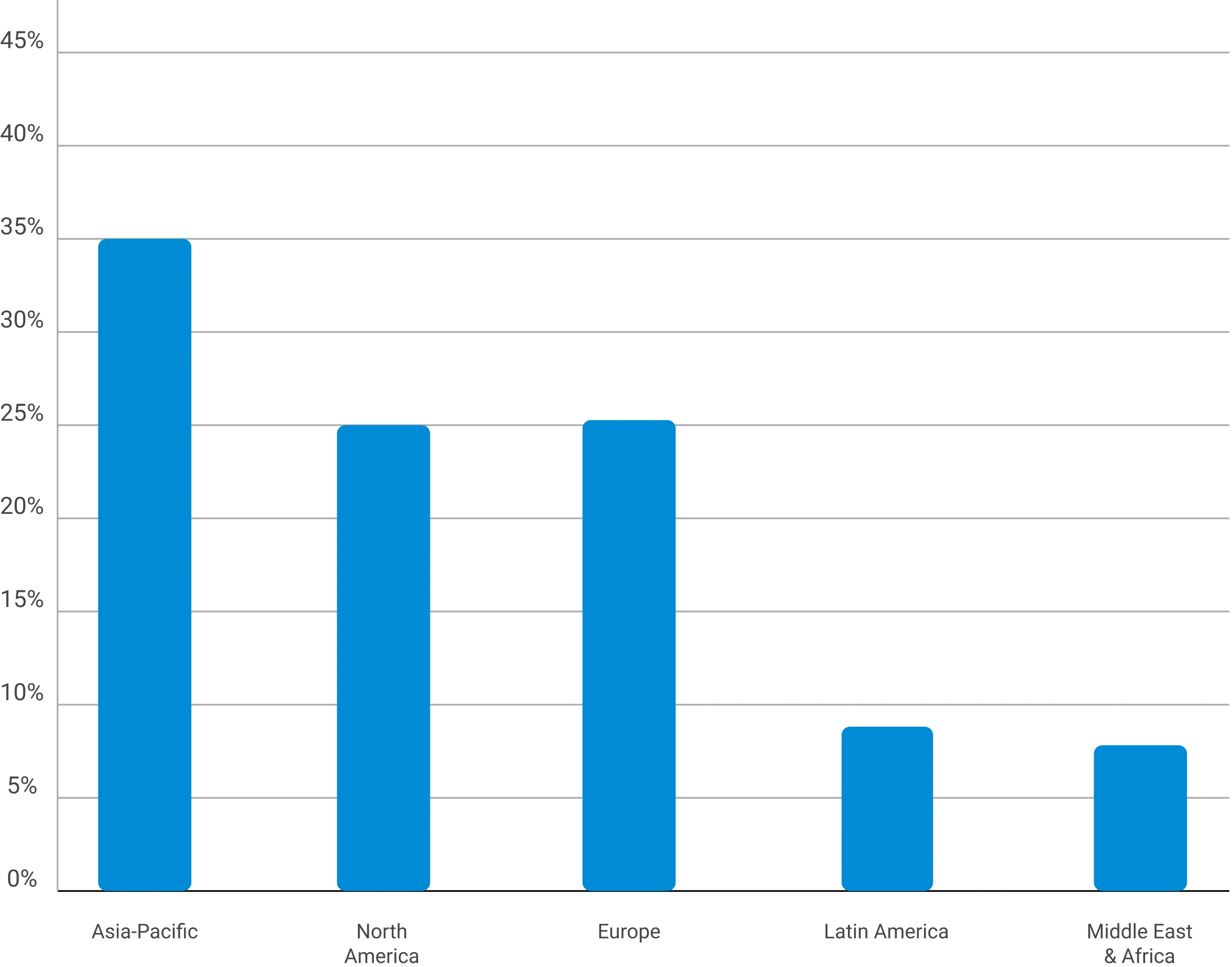
Primary Research — Stakeholder Coverage by Category
Distribution of interview respondents across stakeholder categories (% share from PPT data)
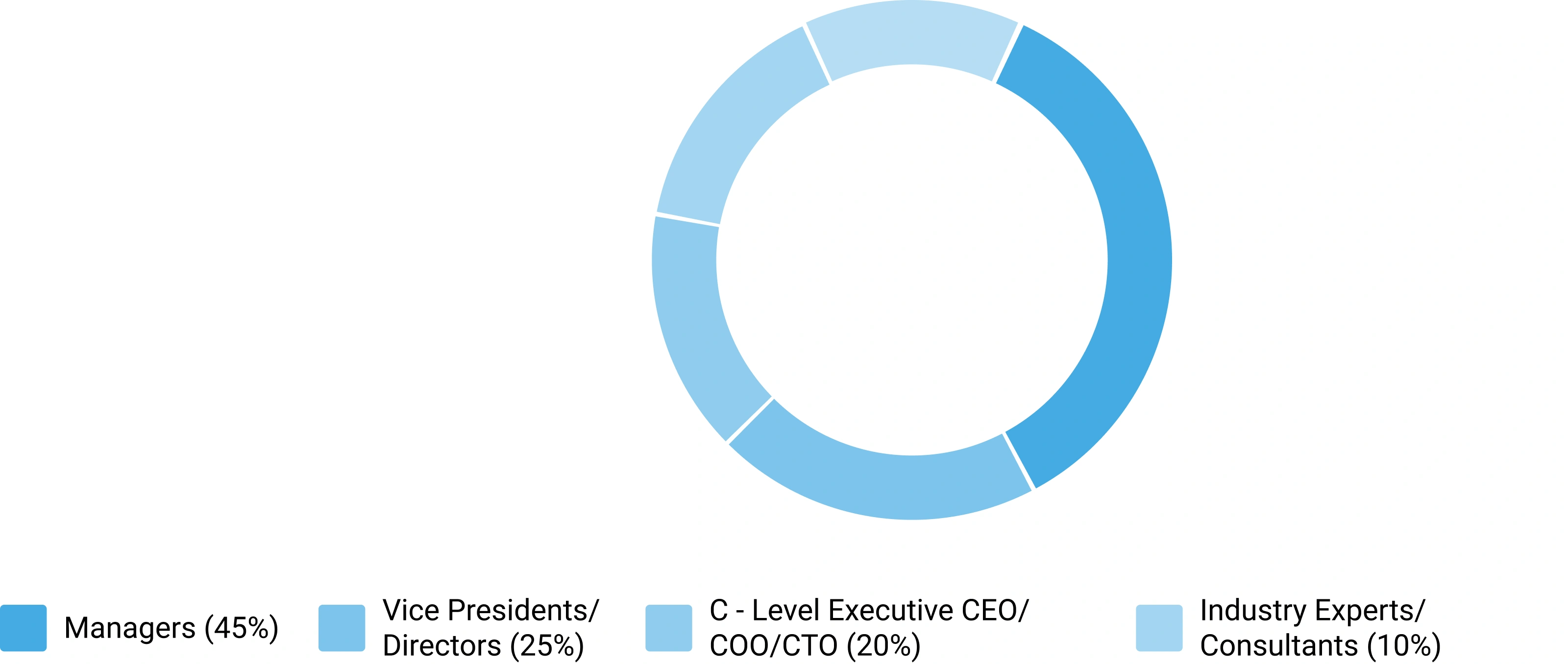
Primary Research — Respondent Designation Profile
Seniority breakdown of interview respondents (% share from PPT data)
Primary Research — Geographic Coverage of Interviews
Regional distribution of primary research engagement (% share from PPT data)
Phase 6 — Data Triangulation and Market Validation
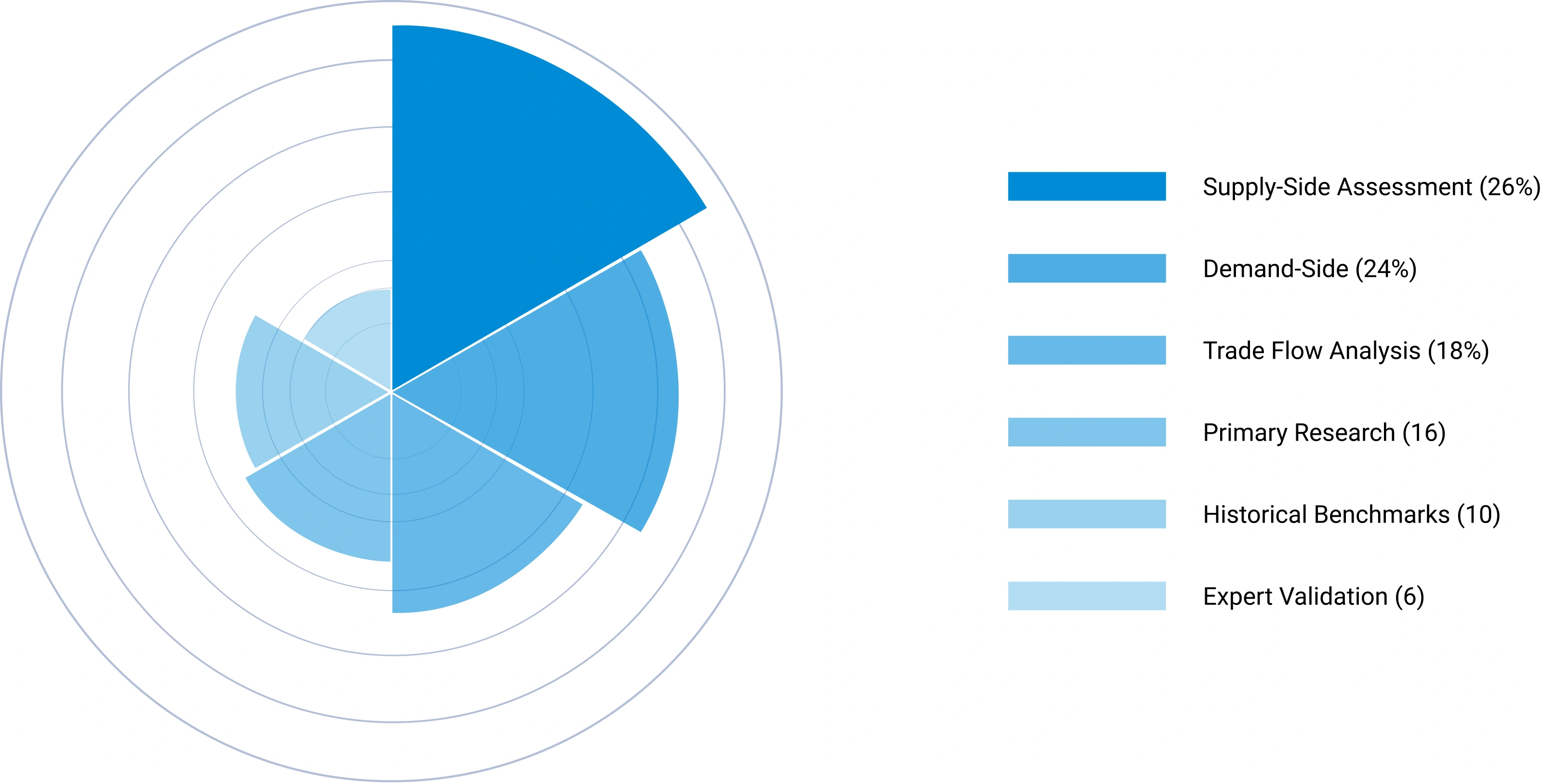
No single methodology is relied upon in isolation. Multiple independent estimation approaches are combined and reconciled to ensure consistency, accuracy, and analytical defensibility. Any material deviations between approaches are investigated and adjusted through additional validation cycles.
The final market size is derived through weighted triangulation of all validated methodologies. Any material deviations between approaches are investigated and adjusted through additional validation cycles. The outcome represents the most realistic assessment of the market based on available evidence and expert confirmation ensuring that volume and value estimates are fully consistent with one another.
Triangulation Framework — Input Contribution Weight
Relative weight each sizing input contributes to the final reconciled market estimate
Phase 7 — Forecast Modeling: Projecting Future Market Evolution
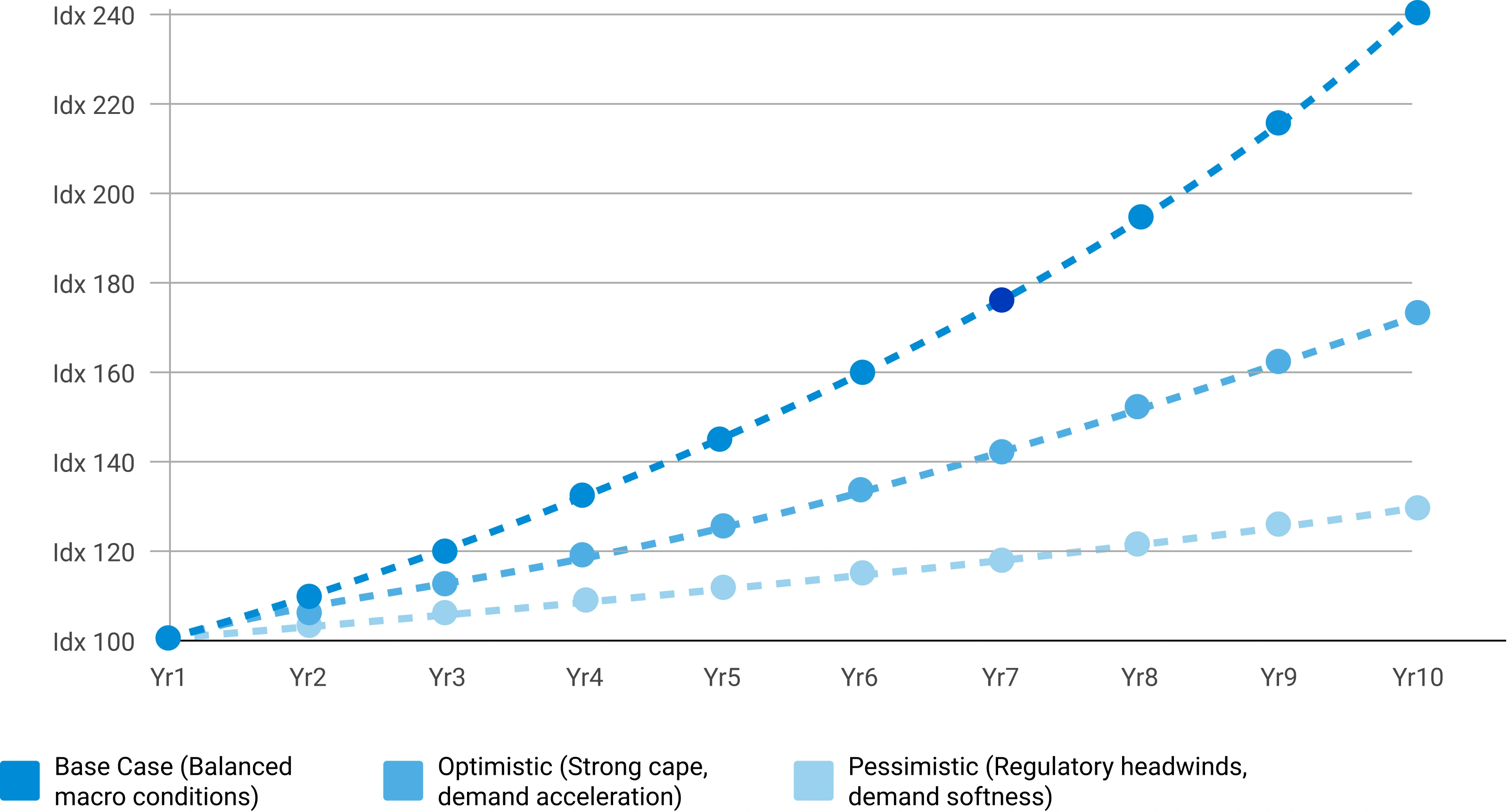
Forecasting evaluates the future trajectory of the market using a combination of quantitative indicators and qualitative assessments across economic, industry, and regulatory dimensions. Rather than simple extrapolation, each driver is independently modeled and integrated into a composite forecast.
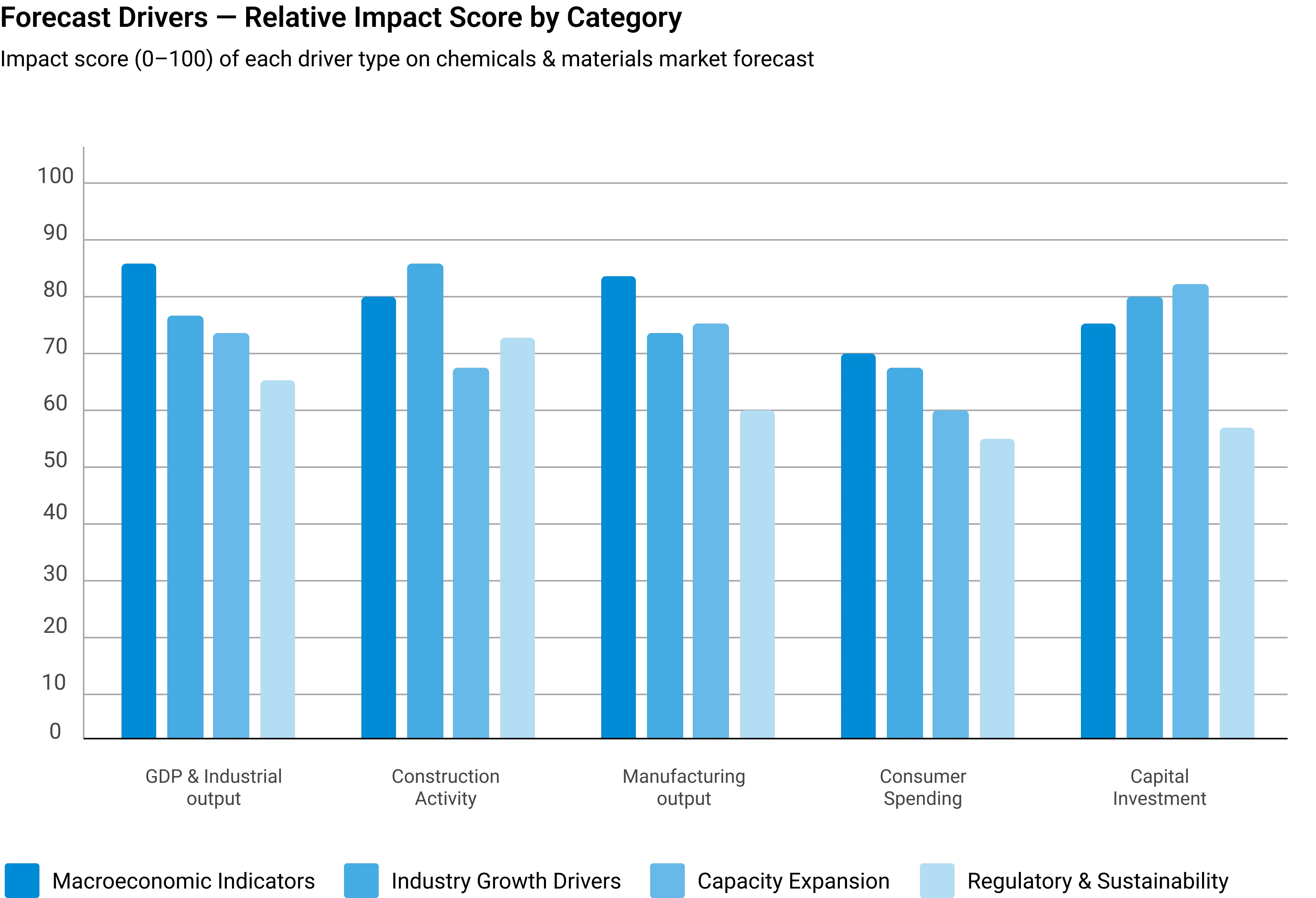
Macroeconomic Indicators
GDP growth, industrial production, manufacturing output, construction activity, consumer spending, and capital investment form the quantitative foundation of long-term demand projections. These are applied at country, regional, and global levels.
Industry Growth Drivers
Urbanization, infrastructure development, industrialization, technological innovation, sustainability initiatives, and evolving product performance requirements are assessed at regional and industry levels — capturing both structural and cyclical demand drivers.
Capacity Expansion Analysis
Announced plant expansions, new manufacturing facilities, technology upgrades, and strategic investments are evaluated to determine future supply-demand dynamics and potential market tightness or oversupply situations.
Regulatory & Sustainability
Environmental regulations, chemical safety standards, emission reduction targets, circular economy initiatives, and sustainability requirements are incorporated as they often influence product adoption rates and market growth trajectories.
Scenario Forecast Range — Indexed Market Growth (Year 1–10)
Illustrative indexed growth trajectories across Base, Optimistic, and Pessimistic scenarios over a 10-year forecast horizon
Forecast Drivers — Relative Impact Score by Category
Impact score (0–100) of each driver type on chemicals & materials market forecast



Comments
Share your thoughts, ask a question, or provide feedback about this report.