Find the Right Market Report
Search thousands of industry reports, market insights, and research studies in one place.
Not sure where to start? Try one of these:
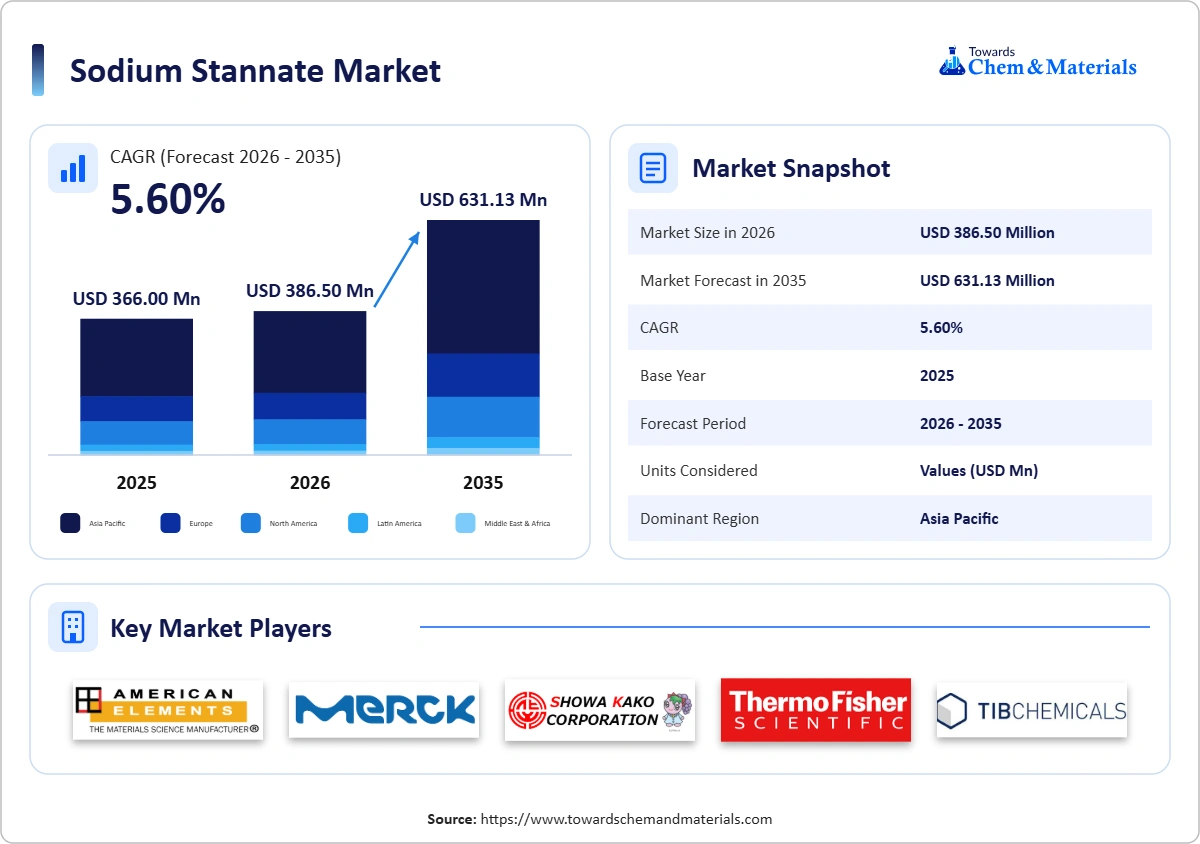
The global sodium stannate market size was valued at USD 366 billion in 2025 and is expected to reach USD 631.13 billion by 2035, growing at a CAGR of 5.60% during the forecast period of 2026-2035. The market was valued at USD 366.00 million in 2025. The market covers anhydrous sodium stannate (Na₂SnO₃), sodium stannate trihydrate (Na₂SnO₃·3H₂O) and other commercially available grades. Sodium stannate is used primarily in alkaline tin electroplating, hydrogen peroxide stabilization, ceramics and glass manufacturing, chemical synthesis, and specialized industrial applications.
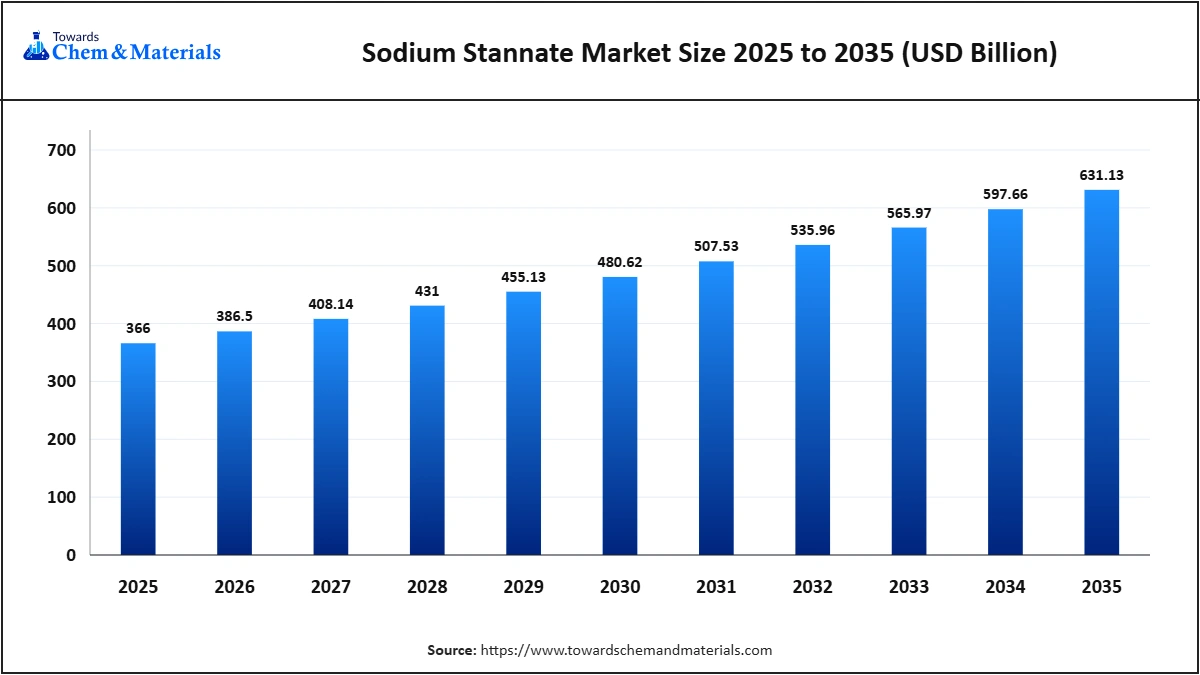
Note: 2025 is the base year; 2026–2035 values are forecasts.
Sources: Expert interviews, secondary sources, Towards Chemical and Materials database and Towards Chemical and Materials analysts.
Trihydrate sodium stannate accounted for the largest product-type share in 2025, representing 58.40% of the global market, supported by its established use in electroplating and industrial chemical processes. Asia Pacific dominated the market with a 56.80% revenue share, driven by its extensive tin-processing industry, chemical manufacturing capabilities, and large electronics and electroplating industries. Demand is supported by expanding electronics manufacturing, automotive component finishing, hydrogen peroxide production, and industrial applications in ceramics and glass. Growing demand for tin-based plating chemicals and the development of specialized high-purity grades are expected to create additional opportunities. However, market growth faces challenges from tin-price volatility, competition from alternative plating chemistries, environmental compliance requirements, and the geographical concentration of upstream tin supply.
The sodium stannate market is projected to grow from USD 366.00 million in 2025 to USD 631.13 million by 2035 because sodium stannate is a key chemical for alkaline tin plating and peroxide stabilization, and electronics, automotive, and chemical production keep expanding. Electronics and electric-vehicle component plating, hydrogen peroxide capacity, ceramics and glass demand, and higher tin prices support steady growth, lifting the market to USD 480.62 million by 2030 and sustaining a CAGR of 5.60% from 2026 to 2035.
Analyst View: We built the estimate from consumption volumes by type, application, and end use in each region, multiplied by prices linked to tin metal costs, and cross-checked against producer output and published estimates, resulting in a base-year estimate slightly higher than the highest credible comparable figure. The growth rate reflects electronics and chemical demand, which we judge supports a slightly higher rate than comparable estimates, moderated by tin price volatility and substitution.
Driver: Rising electronics manufacturing, electric vehicle production and demand for hydrogen peroxide are driving sodium stannate consumption. Increasing applications in alkaline tin electroplating, automotive component finishing, ceramics and glass manufacturing are further supporting market expansion. Rising demand for corrosion-resistant coatings and specialized industrial chemicals is creating additional growth opportunities.
Restraint: Volatile tin prices increase sodium stannate production costs and create uncertainty in procurement and pricing. Competition from acid tin-plating baths and alternative tin compounds limit adoption in certain applications. Additionally, stringent environmental regulations, wastewater treatment requirements, and dependence on concentrated tin supply chains create operational and supply-related challenges.
Opportunity: Growing demand for high-purity sodium stannate, particularly in specialized electronics and chemical applications, offers significant opportunities. Expanding hydrogen peroxide production, tin recovery from industrial waste and increasing electroplating capacity in emerging economies can support market expansion. Investments in purification technologies and sustainable raw-material sourcing may further strengthen industry growth.
| Segments | 2025 Share | 2025 Value (USD Million) | 2035 Value (USD Million) | CAGR 2026–2035 |
| Trihydrate | 58.40% | 213.74 | 356.38 | 5.25% |
| Anhydrous | 30.00% | 109.80 | 201.23 | 6.25% |
| Others | 11.60% | 42.46 | 73.52 | 5.65% |
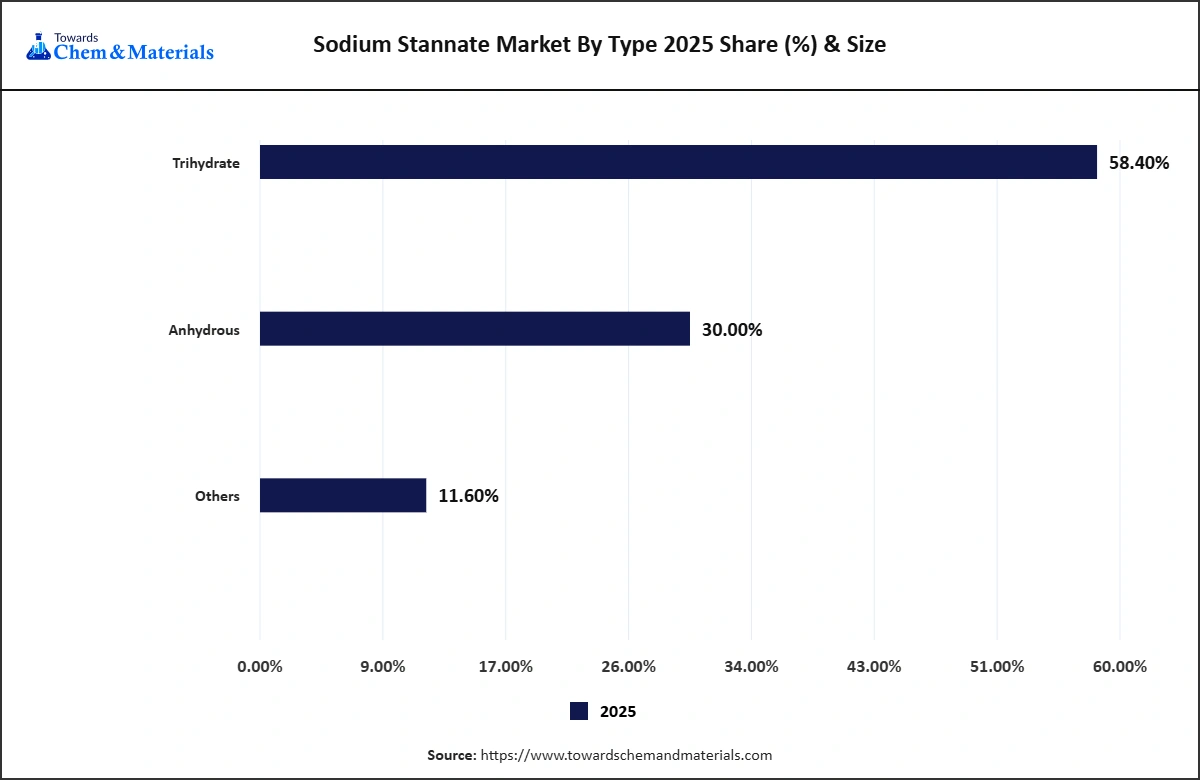
Note: 2025 is the base year; 2035 values are forecasts.
Sources: Expert interviews, secondary sources, Towards Chemical and Materials database and Towards Chemical and Materials analysts.
Trihydrate accounted for 58.40% (USD 213.74 million) in 2025, anhydrous for 30.00% (USD 109.80 million) and others for 11.60% (USD 42.46 million).
Trihydrate: This category accounted for 58.40% (USD 213.74 million) of the sodium stannate market in 2025 and is projected to reach USD 356.38 million by 2035, expanding at a CAGR of 5.25% from 2026 to 2035. Trihydrate sodium stannate is the standard commercial form used in alkaline plating baths and chemical processes.
Anhydrous: The segment accounted for 30.00% (USD 109.80 million) of the sodium stannate market in 2025 and is projected to reach USD 201.23 million by 2035, expanding at a CAGR of 6.25% from 2026 to 2035. Anhydrous sodium stannate offers higher tin content per kilogram and is preferred where water content matters, and is growing slightly faster.
Others: This segment accounted for 11.60% (USD 42.46 million) of the sodium stannate market in 2025 and is projected to reach USD 73.52 million by 2035, expanding at a CAGR of 5.65% from 2026 to 2035. Others include solutions and specialty grades.
| Segments | 2025 Share | 2025 Value (USD Million) | 2035 Value (USD Million) | CAGR 2026–2035 |
| Electroplating | 46.40% | 169.82 | 282.47 | 5.22% |
| Ceramics & Glass | 14.60% | 53.44 | 92.31 | 5.62% |
| Chemicals & Catalysts | 12.40% | 45.38 | 78.40 | 5.62% |
| Water Treatment & Peroxide Stabilization | 10.20% | 37.33 | 74.26 | 7.12% |
| Textiles | 9.20% | 33.67 | 58.17 | 5.62% |
| Others | 7.20% | 26.35 | 45.52 | 5.62% |
Note: 2025 is the base year; 2035 values are forecasts.
Sources: Expert interviews, secondary sources, Towards Chemical and Materials database and Towards Chemical and Materials analysts.
Electroplating accounted for 46.40% (USD 169.82 million) in 2025, ceramics and glass for 14.60% (USD 53.44 million), chemicals and catalysts for 12.40% (USD 45.38 million), water treatment and peroxide stabilization for 10.20% (USD 37.33 million), textiles for 9.20% (USD 33.67 million) and others for 7.20% (USD 26.35 million).
Electroplating: The category recorded 46.40% (USD 169.82 million) of the sodium stannate market in 2025 and is projected to reach USD 282.47 million by 2035, expanding at a CAGR of 5.22% from 2026 to 2035. Electroplating is the largest application because alkaline stannate baths deposit tin and tin-zinc or tin-copper alloys on steel, copper and electronic parts with good throwing power.
Ceramics & Glass: The category held 14.60% (USD 53.44 million) of the sodium stannate market in 2025 and is projected to reach USD 92.31 million by 2035, expanding at a CAGR of 5.62% from 2026 to 2035. Ceramics and glass use sodium stannate in glazes, opacifiers and glass treatments.
Chemicals & Catalysts: This segment accounted for 12.40% (USD 45.38 million) of the sodium stannate market in 2025 and is projected to reach USD 78.40 million by 2035, expanding at a CAGR of 5.62% from 2026 to 2035. Chemicals and catalysts use it as a tin source for other tin compounds and catalysts.
Water Treatment & Peroxide Stabilization: In terms of market share, this segment accounted for 10.20% (USD 37.33 million) in 2025 and is projected to reach USD 74.26 million by 2035, expanding at a CAGR of 7.12% from 2026 to 2035. Water treatment and hydrogen peroxide stabilization is the fastest-growing application as hydrogen peroxide production expands for semiconductors, pulp bleaching and environmental uses.
Textiles: This segment accounted for 9.20% (USD 33.67 million) of the sodium stannate market in 2025 and is projected to reach USD 58.17 million by 2035, expanding at a CAGR of 5.62% from 2026 to 2035. Textiles use sodium stannate for silk weighting, mordanting and flame-retardant finishes.
Others: In terms of market share, this segment accounted for 7.20% (USD 26.35 million) in 2025 and is projected to reach USD 45.52 million by 2035, expanding at a CAGR of 5.62% from 2026 to 2035. Others include analytical reagents and specialty uses.
| Segments | 2025 Share | 2025 Value (USD Million) | 2035 Value (USD Million) | CAGR 2026–2035 |
| Electronics | 34.60% | 126.64 | 234.84 | 6.37% |
| Chemicals | 18.60% | 68.08 | 112.71 | 5.17% |
| Automotive | 14.20% | 51.97 | 86.04 | 5.17% |
| Construction | 12.40% | 45.38 | 75.14 | 5.17% |
| Others | 10.60% | 38.80 | 64.23 | 5.17% |
| Textiles | 9.60% | 35.14 | 58.17 | 5.17% |
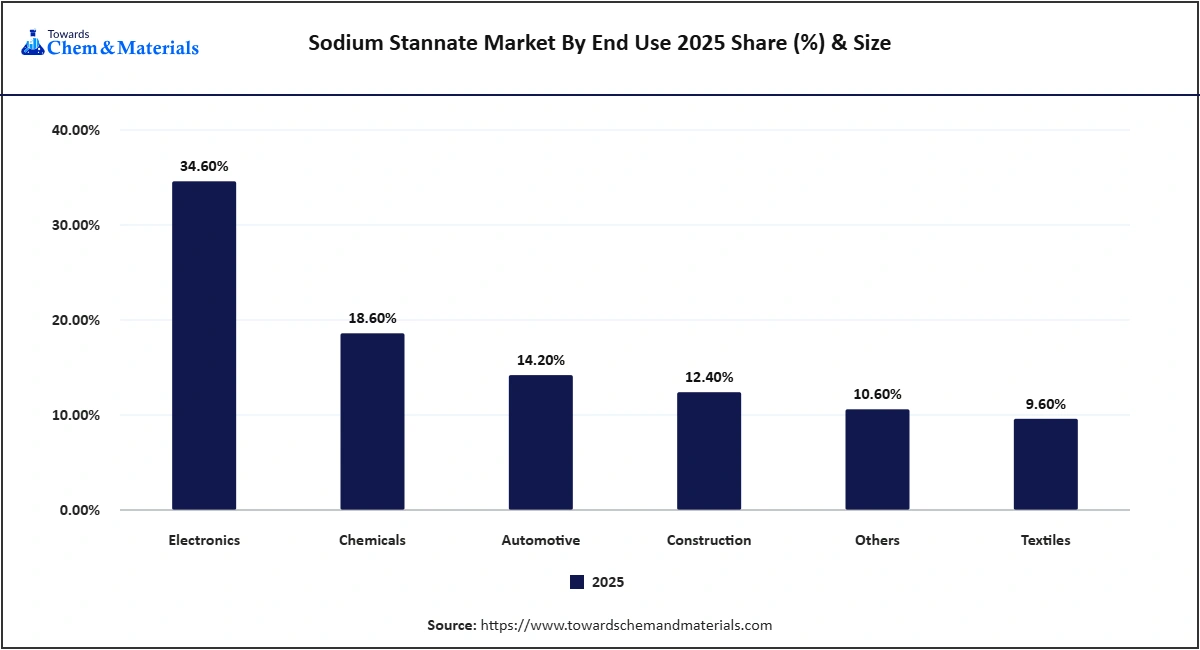
Note: 2025 is the base year; 2035 values are forecasts.
Sources: Expert interviews, secondary sources, Towards Chemical and Materials database and Towards Chemical and Materials analysts.
Electronics registered 34.60% (USD 126.64 million) in 2025, chemicals for 18.60% (USD 68.08 million), automotive for 14.20% (USD 51.97 million), construction for 12.40% (USD 45.38 million), others for 10.60% (USD 38.80 million) and textiles for 9.60% (USD 35.14 million).
Electronics: This segment valued at 34.60% (USD 126.64 million) of the sodium stannate market in 2025 and is projected to reach USD 234.84 million by 2035, expanding at a CAGR of 6.37% from 2026 to 2035. Electronics is the largest and fastest-growing end use because tin and tin-alloy plating protects connectors, components and printed circuit boards.
Chemicals: The segment generated 18.60% (USD 68.08 million) of the sodium stannate market in 2025 and is projected to reach USD 112.71 million by 2035, expanding at a CAGR of 5.17% from 2026 to 2035. Chemical producers use sodium stannate for peroxide stabilization and tin compound synthesis.
Automotive: This segment valued at 14.20% (USD 51.97 million) of the sodium stannate market in 2025 and is projected to reach USD 86.04 million by 2035, expanding at a CAGR of 5.17% from 2026 to 2035. Automotive uses plated parts, including components for electric vehicles.
Construction: This segment generated 12.40% (USD 45.38 million) of the sodium stannate market in 2025 and is projected to reach USD 75.14 million by 2035, expanding at a CAGR of 5.17% from 2026 to 2035. Construction uses plated hardware, ceramics, and glass products.
Others: This category captured 10.60% (USD 38.80 million) of the sodium stannate market in 2025 and is projected to reach USD 64.23 million by 2035, expanding at a CAGR of 5.17% from 2026 to 2035. Others include packaging and general industry.
Textiles: This segment garnered 9.60% (USD 35.14 million) of the sodium stannate market in 2025 and is projected to reach USD 58.17 million by 2035, expanding at a CAGR of 5.17% from 2026 to 2035. Textile producers use it for finishing and flame retardancy.
Analyst View: Segment values were allocated by matching consumption volumes and prices to type, application, end use, using producer and end-use industry data. We expect the faster-growing segments identified above to gain share over the forecast period.
| Region | 2025 Share | 2025 Value (USD Million) | 2035 Value (USD Million) | CAGR 2026–2035 |
| Asia Pacific | 56.80% | 207.89 | 375.95 | 6.10% |
| Europe | 18.40% | 67.34 | 108.69 | 4.90% |
| North America | 17.20% | 62.95 | 101.60 | 4.90% |
| Latin America | 4.60% | 16.84 | 27.17 | 4.90% |
| Middle East & Africa | 3.00% | 10.98 | 17.72 | 4.90% |
Note: 2025 is the base year; 2035 values are forecasts.
Sources: Expert interviews, secondary sources, Towards Chemical and Materials database and Towards Chemical and Materials analysts.
Asia Pacific represented 56.80% (USD 207.89 million) in 2025, Europe for 18.40% (USD 67.34 million), North America for 17.20% (USD 62.95 million), Latin America for 4.60% (USD 16.84 million), and Middle East & Africa for 3.00% (USD 10.98 million). Asia Pacific leads and is also growing fastest.
Asia Pacific: This region generated 56.80% (USD 207.89 million) of the sodium stannate market in 2025 and is projected to reach USD 375.95 million by 2035, expanding at a CAGR of 6.10% from 2026 to 2035. Asia Pacific dominates the sodium stannate market because of its established tin-processing industry, significant chemical manufacturing capacity and large downstream electronics, automotive, electroplating, and glass industries. China plays an important role in regional tin production and chemical manufacturing, while Japan, South Korea and Taiwan contribute substantial demand through electronics and industrial finishing applications. Growing manufacturing activity and expanding downstream industrial capacity are expected to support regional market growth.
Europe: This region valued at 18.40% (USD 67.34 million) of the sodium stannate market revenue in 2025 and is projected to reach USD 108.69 million by 2035, expanding at a CAGR of 4.90% from 2026 to 2035. Europe has specialized tin chemical producers such as TIB Chemicals and demand from automotive plating and chemicals, under strict REACH rules.
North America: This region commanded 17.20% (USD 62.95 million) of the sodium stannate market share in 2025 and is projected to reach USD 101.60 million by 2035, expanding at a CAGR of 4.90% from 2026 to 2035. North America uses sodium stannate in electronics, automotive plating, and hydrogen peroxide production.
Latin America: The continent registered 4.60% (USD 16.84 million) of the sodium stannate market share in 2025 and is projected to reach USD 27.17 million by 2035, expanding at a CAGR of 4.90% from 2026 to 2035. Latin America is supported by plating and ceramics industries in Brazil and Mexico.
Middle East & Africa: This region accounted for 3.00% (USD 10.98 million) of the sodium stannate market in 2025 and is projected to reach USD 17.72 million by 2035, expanding at a CAGR of 4.90% from 2026 to 2035. The Middle East and Africa are supported by chemical and construction industries.
Analyst View: Regional shares were built from consumption by end-use industry in each region. Asia Pacific leads because it dominates production and downstream electronics and chemical manufacturing. We assign Asia Pacific the highest growth premium because downstream capacity is expanding fastest there.
| Rank | Company Name | Market-Specific Revenue (USD Million) | 2025 Share | Key Products / Business | Headquarters |
| 1 | Yunnan Tin Group | 58.00 | 15.85% | Tin chemicals including sodium stannate | China |
| 2 | TIB Chemicals | 30.00 | 8.20% | Inorganic tin chemicals | Germany |
| 3 | Liuzhou China Tin Group | 22.00 | 6.01% | Tin chemicals | China |
| 4 | Mason Corporation | 14.00 | 3.83% | Tin chemicals | United States |
| 5 | Showa Kako | 12.00 | 3.28% | Tin and specialty chemicals | Japan |
| 6 | Nihon Kagaku Sangyo | 12.00 | 3.28% | Tin plating chemicals | Japan |
| 7 | Merck KGaA | 8.00 | 2.19% | Reagent grade chemicals | Germany |
| 8 | American Elements | 6.00 | 1.64% | High-purity compounds | United States |
| 9 | Thermo Fisher Scientific | 6.00 | 1.64% | Laboratory chemicals | United States |
| 10 | Shreenivas Chemicals | 5.00 | 1.37% | Tin chemicals | India |
Note: Company revenues and shares are 2025 estimates.
Sources: Company press releases, expert interviews, secondary sources, Towards Chemical and Materials database and Towards Chemical and Materials analysts.
The sodium stannate market comprises integrated tin producers, specialized inorganic chemical manufacturers, specialty chemical suppliers, and laboratory reagent distributors. Competition is influenced by raw-material access, product purity, manufacturing consistency, application-specific technical support, regulatory compliance, and distribution capabilities. Market share estimates are based on estimated sodium stannate-specific revenues rather than total corporate revenues.
Yunnan Tin Group led the sodium stannate market with an estimated 15.85% (USD 58.00 million) of 2025 revenue, followed by TIB Chemicals at 8.20% (USD 30.00 million) and Liuzhou China Tin Group at 6.01% (USD 22.00 million). Yunnan Tin Group, the world's largest tin producer, leads with integrated tin chemical production. TIB Chemicals is a leading European inorganic tin chemicals maker, and Liuzhou China Tin Group is another integrated Chinese producer. Mason Corporation, Showa Kako, Nihon Kagaku Sangyo, Merck KGaA, American Elements, Thermo Fisher and Shreenivas Chemicals compete through regional production, plating chemicals and laboratory grades.
The top 10 companies captured an estimated 47.27% (USD 173.00 million) of 2025 revenue, while the remaining 52.73% (USD 193.00 million) was shared among regional tin chemical producers and distributors. The sodium stannate market is fragmented, and competition focuses on purity, consistency, raw material security, price, technical service, regulatory compliance, and delivery reliability. Integrated producers with access to raw materials have cost advantages.
The sodium stannate ecosystem links mining and refining with chemical producers, distributors and laboratory suppliers, and downstream industrial users.
| Ecosystem Stage | Role in the Market | Key Companies |
| Tin Mining & Smelting | Supply refined tin | Yunnan Tin, Guangxi China Tin, Alphamin, PT Timah |
| Producers | Make sodium stannate | Yunnan Tin, TIB Chemicals, Mason Corporation, Showa Kako |
| Distributors | Supply laboratories and industry | Merck KGaA, Thermo Fisher, regional distributors |
| End Users | Use in plating and chemicals | Platers, electronics makers, peroxide producers, ceramics makers |
Sources: Company press releases, expert interviews, secondary sources, Towards Chemical and Materials database and Towards Chemical and Materials analysts.
The Towards Chemical and Materials Companies Quadrant positions key participants in the sodium stannate market by market strength, reflecting revenue scale, market share and geographic reach, and by innovation and growth strategy, reflecting product portfolio breadth, R&D intensity and partnerships. Positions reflect each company's estimated 2025 revenue in this market and our assessment of its integration, product quality, and reach.
Sources: Company press releases, expert interviews, secondary sources, Towards Chemical and Materials database and Towards Chemical and Materials analysts.
Leaders: Yunnan Tin Group, TIB Chemicals, Liuzhou China Tin Group and Mason combine large revenue with raw material integration and broad customer reach.
Challengers: Showa Kako have significant volumes but narrower portfolios or less product development.
Innovators: Nihon Kagaku Sangyo, Merck and Thermo Fisher Scientific bring high-purity grades and specialty applications.
Niche Players: American Elements and Shreenivas Chemicals serve smaller regional or laboratory segments.
By Type
By Application
By End Use
By Region
The sodium stannate market was defined to include anhydrous sodium stannate, sodium stannate trihydrate and other commercially available grades used in electroplating, ceramics and glass manufacturing, chemical synthesis, hydrogen peroxide stabilization, textiles and specialized industrial applications.
The 2025 base-year market size was estimated using a bottom-up approach based on regional consumption volumes, application-level demand, and average selling prices. These estimates were cross-checked using available producer information, manufacturing capacity, trade data, industry publications, and downstream consumption indicators.
The market was segmented by product type, application, end-use industry, and geographical region. Segment and regional revenues were allocated using estimated consumption patterns and corresponding product prices.
Company-specific market shares were estimated using sodium stannate-related revenues rather than total corporate revenues. Where direct product-level financial disclosures were unavailable, estimates were developed using production capacity, product portfolios, regional presence, and industry interviews.
The 2026–2035 forecast incorporates expected changes in electronics manufacturing, electroplating activity, hydrogen peroxide production, ceramics and glass demand, raw-material prices, and regional industrial expansion. Segment-level growth assumptions were reconciled with the overall market forecast to maintain consistency across the forecast period.
The sodium stannate market is a mature tin chemical segment whose value tracks tin prices and electronics and chemical demand. Our estimate links demand to consumption and tin-linked prices, so the forecast follows plating, peroxide and ceramics activity. The main upside comes from electronics and peroxide, while the main risk is tin price volatility.
Reliable market intelligence and data-driven insights across the global chemicals and materials industry, helping businesses understand trends, competition, pricing, and emerging opportunities.
Schedule a Demo