
Powder Metallurgy Market Size Analysis Report 2035
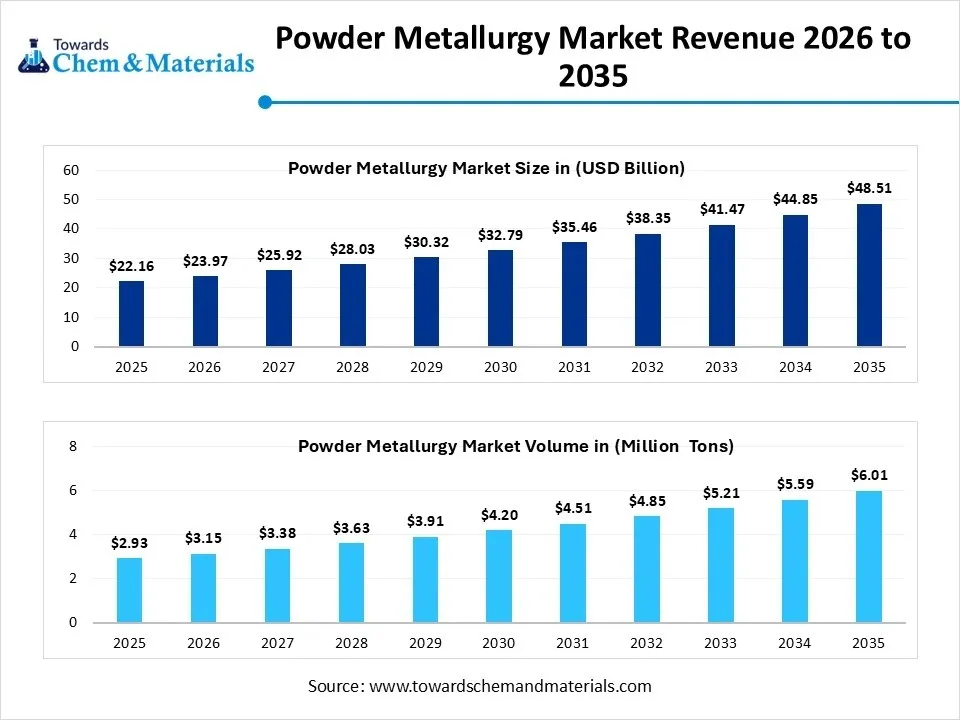
According to Towards Chemical and Materials, the global powder metallurgy market size was valued at USD 22.16 billion in 2025, is estimated to reach USD 23.97 billion in 2026, and is projected to reach USD 48.51 billion by 2035, exhibiting a compound annual growth rate (CAGR) of 8.15% over the forecast period from 2026 to 2035. Asia Pacific dominated the powder metallurgy market with the largest revenue share of 43% in 2025 and is expected to grow at the fastest CAGR of 8.27% during the forecast period. In terms of volume, the powder metallurgy market is projected to grow from 2.93 million tons in 2025 to 6.01 million tons by 2035. It is projected to grow at a CAGR of 7.45% from 2026 to 2035. The growth of the market is driven by the growing demand from the automotive industry for lightweight materials to increase fuel efficiency, the shift towards electric vehicles, and the rise of 3D printing, which fuels the growth of the market. The key collaborations between major players like Hoganas AB and GKN Power Metallurgy involve major sectors such as aerospace, automotive, and defense OEMs, which increases the demand and growth of the market.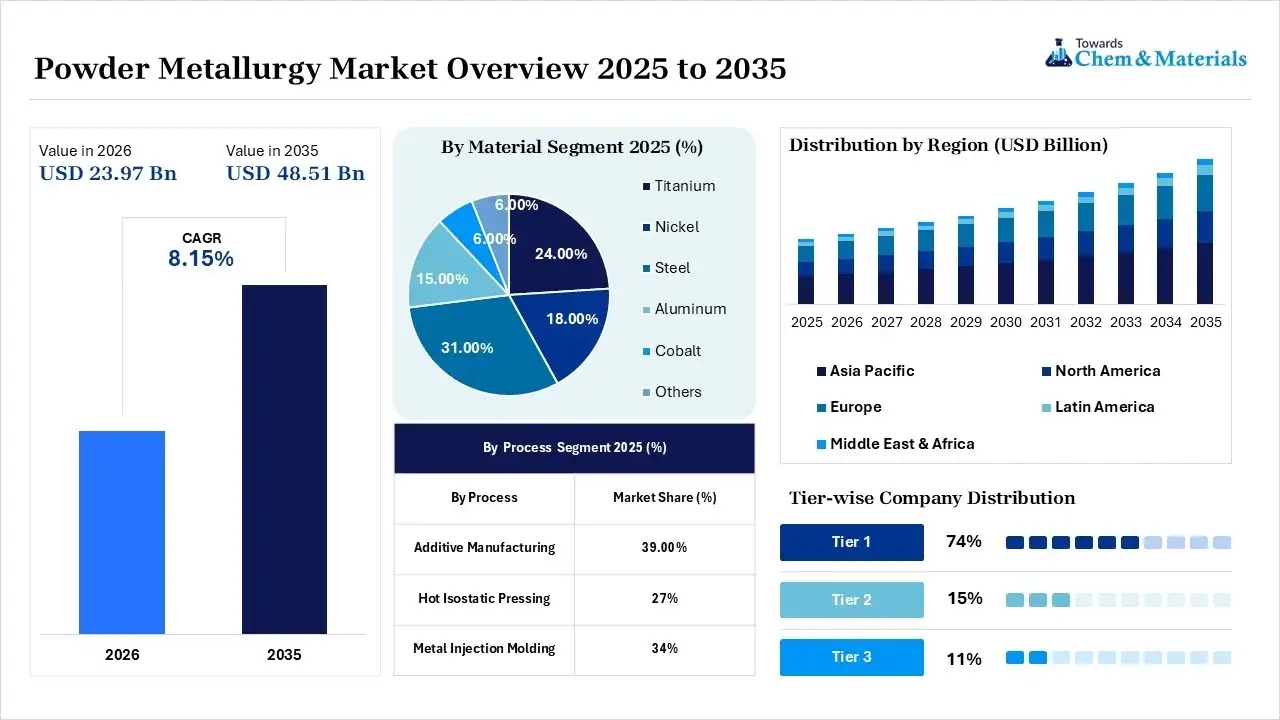
Market Highlights
- By region, Asia Pacific dominated the market with a share of 43% in 2025. Manufacturing expansion strengthens regional demand.
- By region, North America held a 22% market share in 2025 and is expected to experience the fastest growth with a CAGR of 9.40% in the forecast period. Aerospace innovation increases powder usage.
- By material, the steel segment dominated the market with a 31% share in 2025. Automotive production drives steel powder demand.
- By material, the titanium segment held a 24% market share in 2025 and is expected to have the fastest growth with a CAGR of 10.80% in the forecast period. Growing demand in aerospace increases titanium powder consumption.
- By process, the additive manufacturing segment dominated the market with a 39% share in 2025 and is expected to have the fastest growth with a CAGR of 12.10% in the forecast period. Industrial 3D printing expands across sectors.
- By application, the automotive segment dominated the market with a 37% share in 2025. Vehicle electrification expands powder metallurgy applications.
- By application, the medical & dental segment held 15% market share in 2025 and is expected to have the fastest growth with a CAGR of 10.9% in the forecast period. Personalized implants increase powder utilization.
- By end use, the OEMs segment dominated the market with a 73% share in 2025. Large-scale manufacturing secures consistent demand. Personalized implants increase powder utilization.
- By end use, the AM operators segment held 27% market share in 2025 and is expected to have the fastest growth with a CAGR of 11.80% in the forecast period. Contract manufacturing services are expanding globally.
Powder Metallurgy Market: Expanding Application In Major Sectors
According to Towards Chemicals and Materials Analytics and Consulting, the powder metallurgy market volume is expected to increase from 2.93 million tons in 2025 to 3.15 million tons in 2026 and reach 6.01 million tons by 2035, growing at a CAGR of 7.45% over 2026-2035.
The powder metallurgy market is expanding rapidly due to the global focus on vehicle lightweighting, the surge in electric vehicle (EV) adoption, and the growth of metal additive manufacturing. PM is preferred because it shapes complex metal components with nearly 97% material efficiency and produces less waste than traditional machining. This manufacturing sector is highly efficient, transforming fine metal powders into precise, complex parts through pressing and heating. It is important because it reduces metal waste, enables the creation of unique materials, and lowers production costs. The process produces parts that are very close to their final size, requiring little to no additional shaping.
It enables the development of porous metals used in self-lubricating engine parts or filters, something that is impossible with traditional casting. Vehicles benefit from lightweight gears and bearings made through this method, which enhances fuel efficiency and supports electric drivetrains. Aerospace applications include using strong, lightweight metals like titanium to save fuel and withstand high temperatures. Additionally, it is employed in manufacturing affordable, custom hip stems and porous spinal implants, as well as porous, customizable titanium parts for bone implants and joint replacements that bond easily with the human body.
- For instance, DSH Technologies, a Pineville, North Carolina-based provider of debinding and sintering services, launched a membership program. The launch aims to provide direct access for manufacturers to metallurgical expertise, process, and laboratory services.
(Source: www.voxelmatters)
Global Investment Flow for Powder Metallurgy Market 2026
The major giants such as GKN Sinter Metals, Sumitomo Electric Industries, Sandvik AB, Carpenter Technology Corporation, Höganäs AB, Advanced Technology & Materials Co. Ltd. (AT&M), and Hitachi Chemical are investing heavily in the production of soft magnetic composites and scaling up plants, which increases market growth.
Industry participants are investing in powder metallurgy capacity, advanced materials, additive manufacturing, and process technologies.
The Odisha Government has signed a landmark Memorandum of Understanding (MoU) with Adani Enterprises Limited (AEL) and Abu Dhabi-based International Resources Holding (IRH) to build an integrated greenfield aluminium project. Valued at ₹1.08 lakh crore (USD 11.5 billion), this venture is officially recorded as the largest metallurgical
- Foreign Direct Investment (FDI) in India’s history.(Source: www.newindianexpress.com)
- Carpenter Technology Corporation is investing $354.25 million to expand its specialty metals manufacturing plant in Limestone County, Alabama, a move projected to create at least 62 jobs over three years. The company is involved in the manufacture of specialty metals, especially for the aerospace industry (Source: www.sedc.org)
Market Growth Trends:
- The Rise of Electric Vehicles: The growing demand for lightweight materials to increase fuel efficiency, as the auto industry is the biggest user of powder metallurgy. To save battery life, the automotive industry needs ultra-lightweight parts in EVs, which is a growing trend in the market.
- 3D Printing (Additive Manufacturing): The growing use of metal powders in 3D printers a, nd demand from aerospace and medical companies for 3D3D-printed, highly complex, custom parts built layer by layer, like rocket engine nozzles or hip replacements, is a growing trend.
- Medical Device Production: Medical and dental fields are adopting powder metallurgy. Components like implants and surgical tools utilize metal injection molding for precise, safe fits. This is a growing trend driving growth.
Powder Metallurgy Market: Innovation Through AI Integration
The integration of AI in the powder metallurgy market is a key technological shift, as it is used for material discovery, production efficiency, and quality control. It shifts manufacturing from manual, trial-and-error methods to a precise, data-driven, and automated process. Key technological shifts include predictive material design, dynamic process control, real-time defect detection, and predictive maintenance, which drive the growth of the market. For instance, AI-assisted monitoring has been shown to achieve over 99% accuracy in identifying specific internal defects in sintered metal products.
Supply Chain Analysis of Powder Metallurgy Market:
Chemical Production and Processing
- Metal powders are produced through oxide reduction, precipitation, or thermal decomposition. The powders are further mixed with binders and pressed into molds, then heated below the melting point by a process called sintering. This creates strong, complex metal parts with very little waste.
- Höganäs AB manufactures iron, steel, stainless steel, and specialty metal powders for powder metallurgy applications. Its products are widely used to produce precision components for automotive, industrial machinery, and additive manufacturing.
- Key players: Höganäs AB, GKN Powder Metallurgy, Rio Tinto Metal Powders, Miba AG
Quality Testing and Certification
- Powder metallurgy materials must comply with standards for particle size distribution, density, compressibility, mechanical strength, chemical composition, and product reliability before commercial use.
GKN Powder Metallurgy develops precision-engineered powder metallurgy components and advanced materials that comply with stringent automotive and industrial quality standards, supporting lightweight and high-performance applications - Key Authorities & Standards: International Organization for Standardization, ASTM International, Metal Powder Industries Federation, SAE International.
Distribution to Industrial Users
- Powder metallurgy products are supplied to automotive manufacturers, aerospace companies, industrial equipment manufacturers, medical device producers, electronics companies, and energy industries for precision component manufacturing.
- Miba AG supplies powder metallurgy components for automotive, industrial, and energy applications, offering high-performance sintered parts that improve efficiency, durability, and precision in demanding operating environments.
- Key players: Höganäs AB, GKN Powder Metallurgy, Miba AG.
Powder Metallurgy Regulatory Landscape
| Country / Region | Regulatory Body | Key Regulations | Focus Areas | Notable Notes |
| United States | Occupational Safety and Health Administration; Environmental Protection Agency | OSHA Metal Powder Safety Standards; Clean Air Act | Worker safety, emissions control, advanced manufacturing | The U.S. promotes powder metallurgy for automotive, aerospace, medical devices, and additive manufacturing applications. |
| European Union | European Chemicals Agency; European Commission | REACH Regulation; Industrial Emissions Directive | Chemical safety, sustainable manufacturing | Europe emphasizes energy-efficient powder metallurgy processes and recyclable metal powders. |
| China | Ministry of Industry and Information Technology; Ministry of Ecology and Environment | Environmental Protection Law; Advanced Manufacturing Policies | Precision components, industrial modernization | China is expanding powder metallurgy production to support automotive, electronics, and industrial machinery sectors. |
| India | Ministry of Heavy Industries; Bureau of Indian Standards | Bureau of Indian Standards (BIS) powder-metallurgy standards, including standards covering iron powder, copper powder, density, sampling, and related metallurgical products | Automotive components, industrial production | India is increasing the adoption of powder metallurgy in automotive and engineering industries to improve manufacturing efficiency. |
| Japan | Ministry of Economy, Trade and Industry | Industrial Standardization Act; Industrial Safety Regulations | High-performance metal powders, precision engineering | Japan focuses on advanced powder metallurgy technologies for automotive, aerospace, and electronics applications. |
| Germany | Federal Ministry for Economic Affairs and Energy, German Institute for Standardization | REACH Compliance; DIN Powder Metallurgy Standards | Lightweight components, additive manufacturing | Germany has an established powder-metallurgy manufacturing and engineering base serving automotive, industrial, and additive-manufacturing applications. |
Powder Metallurgy Market Dynamics
| Drivers | Restrains | Opportunities |
| Automotive Lightweighting & Electrification: | High Material Costs: | Additive Manufacturing: |
| The growing demand for lightweight and advanced materials for automotive and other industries to reduce weight drives the growth of the market. | The metal powders are very expensive, as their production requires high-energy processing, complex processes, and strict quality control, which challenges the growth of the market. | Metal 3D printing relies entirely on fine metal powders. It enables you to create complex, customized parts for aerospace and medicine with almost zero material waste. |
| EV Motor Manufacturing: | Massive Equipment Investment: | Aerospace and Defense: |
| The rising demand for specialized components and soft magnetic composites, which allow electric motors to run more efficiently, drives the growth of the market. | The high setup cost, automated compactors, and high-heat furnaces are major restraints to growth and also restrict small companies from entering the market. | Powder metallurgy allows the production of lightweight, heat-resistant titanium and nickel alloy parts. This reduces total aircraft weight and improves fuel efficiency. |
| Material Recycling & Sustainability: | Mechanical Limitation: | Medical Devices: |
| The PM process generates very little scrap, and it allows manufacturers to easily use recycled metal powders, which lowers both costs and environmental impact. | The default and uneven density of parts and weaker mechanical properties in comparison to traditional forging are major restraints in the growth of the market. | Biocompatible metal powders are perfect for surgical tools and custom orthopedic implants. The process ensures precise fits for patient-specific needs. |
Segmental Insights
Material Insights
The steel segment dominated the market with a 31% share in 2025 because steel is cheap, strong, and easy to get. Powder metallurgy is a process that melts metal into a fine powder and shapes it under extreme heat and pressure. This process makes "near-net-shape" parts. Think of it like baking cookies; you use exactly the dough you need instead of cutting shapes out of a giant sheet and throwing away the scraps.
- For instance, Sandvik launched Osprey MAR 55, a patent-pending metal additive manufacturing tool steel powder designed specifically to "bridge the gap between maraging steels and carbon-bearing tool steels". It eliminates the traditional compromise between the weldability of carbon-free maraging steels and the performance of carbon-bearing steels.
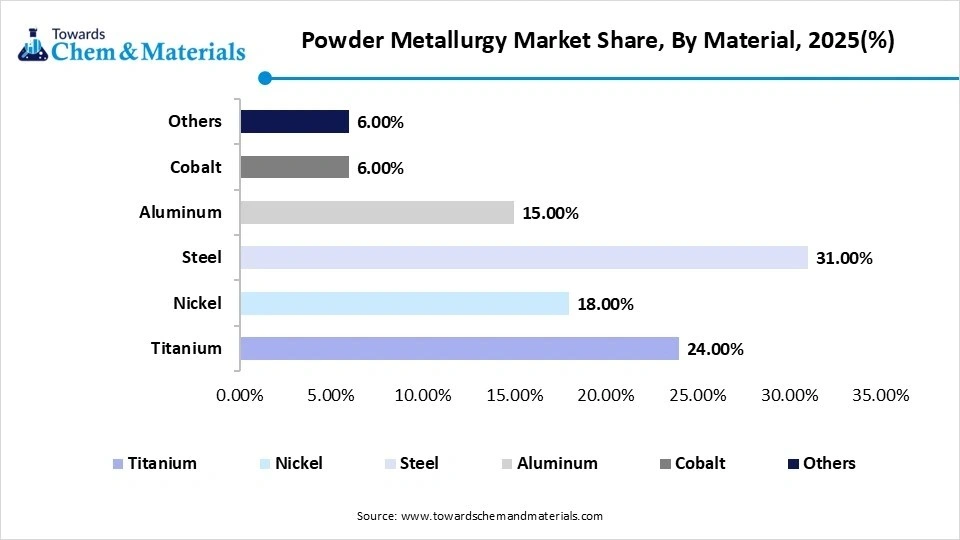
The titanium segment held 24% market share in 2025 and is expected to have the fastest growth with a CAGR of 10.80% in the forecast period, due to its exceptional strength-to-weight ratio, corrosion resistance, and biocompatibility. This growth is driven by rising demand from the aerospace, defense, and healthcare industries. Aircraft and defense companies use titanium powder to build lightweight, durable, and fuel-efficient engine and structural parts. Lighter planes use less fuel, which lowers both costs and carbon emissions.
Powder Metallurgy Market Share, By Material, 2025(%)
| By Material | Market Share (%) |
| Titanium | 24.00% |
| Nickel | 18.00% |
| Steel | 31.00% |
| Aluminum | 15.00% |
| Cobalt | 6.00% |
| Others | 6.00% |
Process Insights
The additive manufacturing segment dominated the market with a 39% share in 2025 and is expected to have the fastest growth with a CAGR of 12.10% in the forecast period. It lets engineers make complex, lightweight, and custom parts that are impossible to build with normal tools. Companies like GE Aviation use additive manufacturing to print complex parts, like jet fuel nozzles, using titanium powder. This drops part counts and saves major weight. 3D printing builds objects layer by layer. It only uses the exact powder needed. This cuts material waste compared to cutting parts out of a big block of metal.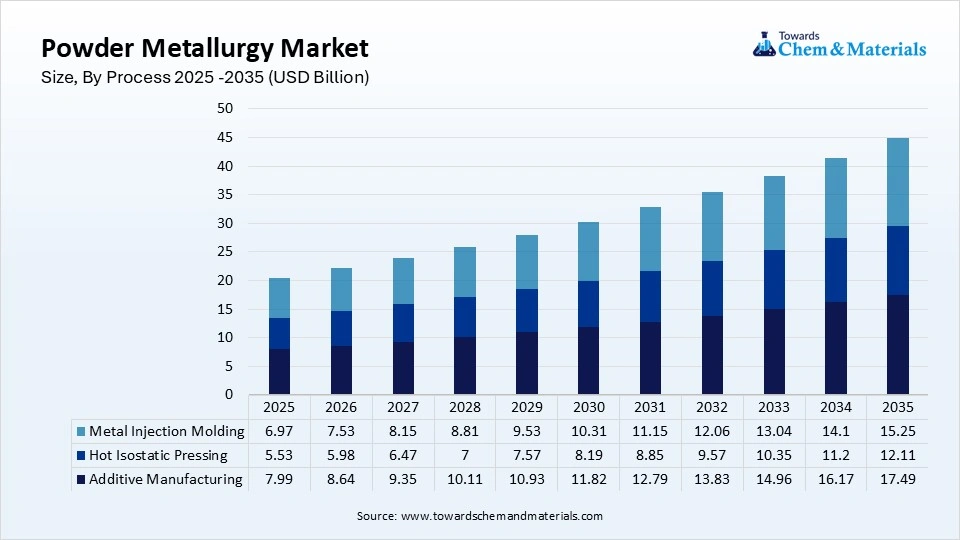 Metal Injection Molding held a 34% market share of 34% in 2025 by combining the complex shaping of plastic molding with the strength of metal. Recent technological advancements in sintering allow MIM parts to achieve nearly 100% density, making them just as strong as traditionally forged metals. Growing applications in automotive parts and heavy investments such as facility expansions by firms like INDO-MIM drive the growth of the market.
Powder Metallurgy Market Share, By Process, 2025(%)
| By Process | Market Share (%) |
| Additive Manufacturing | 39.00% |
| Hot Isostatic Pressing | 27% |
| Metal Injection Molding | 34% |
Application Insights
The automotive segment dominated the market with a 37% share in 2025 through cost reduction, lightweighting, and electric vehicle (EV) advancements. PM methods, like compression molding, compress metal powder into finished parts. This process cuts the total cost per part by 15 to 25% compared to traditional machining. Auto companies want lighter cars to improve gas mileage and battery range. PM uses lightweight metals like aluminum and titanium. These powders drop component weight by up to 50% while keeping the same strength.
The medical & dental segment held 15% market share in 2025 and is expected to have the fastest growth with a CAGR of 10.9% in the forecast period because it uniquely enables the production of highly customized, lightweight, and biocompatible parts. The core factors like patient-specific customization, bone integration, better healing, biocompatible materials, precision, and size drive the growth and expansion of the market.
AerospaceFoam Market Share, By Application, 2025(%)
| By Application | Market Share (%) |
| Aerospace & Defense | 24.00% |
| Automotive | 37.00% |
| Medical & Dental | 15.00% |
| Oil & Gas | 10.00% |
| Industrial | 14.00% |
End Use Insights
The OEMs segment dominated the market with a 73% share in 2025 because OEMs use metal powder to mass-produce cheap and lightweight parts, which helps in making parts of automotive like lighter cars, increasing the efficiency of gas and battery, which drives the growth. Key reasons for growth are less waste, fast and cheap mass production, and complex shapes supporting the expansion of the market. The growing partnership between GKN Powder Metallurgy and Hoganas AB, which produces and creates custom metal powders matching their specific design goals driving growth and expansion of the market.
The AM operators segment held 27% market share in 2025 and is expected to have the fastest growth with a CAGR of 11.80% in the forecast period, driven by its ability to bridge the gap between design and production using 3D printing, fueling the growth. The segment is expanding due to several major factors like rising demand for custom parts, shift to serial production, innovations in efficiency, and regional expansion, which fuel the growth of the market.
For Instance, BLT-PrintInsight is an intelligent quality management software platform developed by Xian Bright Laser Technologies (BLT) for metal Laser Beam Powder Bed Fusion (PBF-LB) Additive Manufacturing. It is designed to track and manage the full 3D printing lifecycle by combining real-time monitoring with in-depth traceability.
Aerospace Foam Market Share, By End Use, 2025(%)
| By End Use | Market Share (%) |
| OEMs | 73.00% |
| AM Operators | 27.00% |
Regional Analysis
How did Asia Pacific Dominate the Powder Metallurgy Market in 2025?
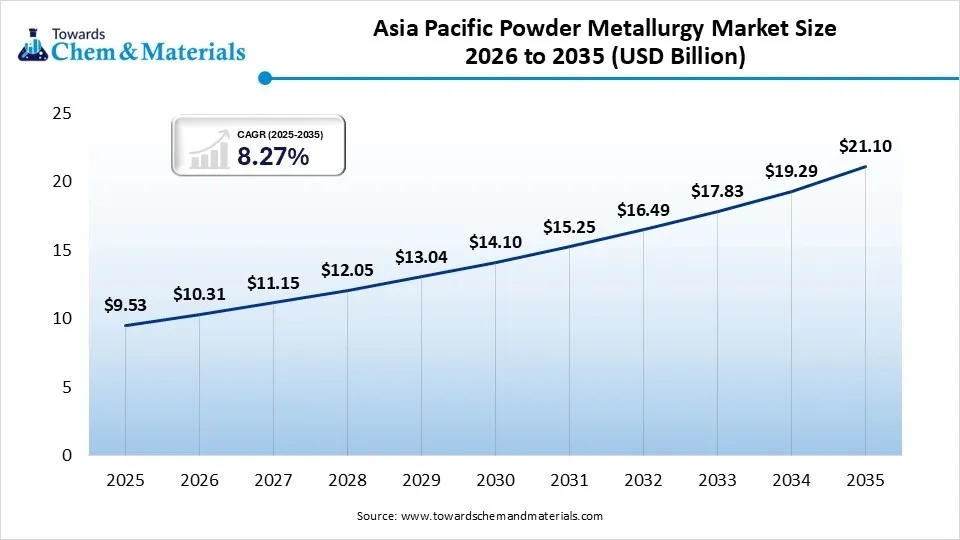
The Asia Pacific powder metallurgy market size was estimated at USD 9.53 billion in 2025 and is projected to reach USD 21.10 billion by 2035, growing at a CAGR of 8.27% from 2026 to 2035. Asia Pacific dominated the market with a share of 43% in 2025, due to massive automotive production, rapid industrialization, and booming consumer electronics manufacturing in China, India, and Japan, which drive the growth of the market. The growing demand from factories due to the presence of major hubs and the demand for powder-based sintering to create cost-effective gears and bearings drives the growth of the market. Metal injection molding is a technology that is highly used and adopted by the Asian smartphone and consumer electronics industry, as it mass-produces complex, high-precision shapes using metal powders, driving growth and expansion of the market.
- For instance, China’s rapid domestic expansion and aggressive export growth of New Energy Vehicles (NEVs) act as a primary driver of the global rare earth element (REE) market, allowing Beijing to tighten its vertical integration from raw mineral extraction to downstream advanced manufacturing.(Source:rareearthexchanges.com)
India
- The Indian automotive sector is the largest sector, which increases demand for lightweight materials to build lighter vehicles, supporting the growth of the market.
- The Government Make in India Push, which encourages companies to build factories in India, boosts local production, fueling demand in the market.
- The market is also growing due to demand for additive manufacturing and 3D printing. It allows aerospace and medical companies in India to create highly complex parts that traditional machines cannot make.
China
China is a major and a powerhouse for powder metallurgy, producing thousands of tons of metal powder annually, and increased demand from automotive and other sectors further fuels the production and demand.
China also has a major and cost-effective supply chain for metal powders, with the presence of major suppliers like NBTM New Materials Group and JH MIM, further reporting the strong growth of the market in the region.
North America Powder Metallurgy Market Growth Factor
North America held a Powder Metallurgy market share of 22% in 2025 and is expected to have the fastest growth with a CAGR of 9.40%” with “North America held a 22% market share in 2025 and is projected to grow at a CAGR of 8.38% from 2026 to 2035. The growth of the market is driven by the need for lightweight electric vehicle (EV) parts, increased 3D printing (additive manufacturing), and high defense spending. The presence of a large aerospace and defense sector in the region, as these industries require high-performance, heat-resistant metal powders for missiles, jets, and satellites, further supports the growth of the market. Industrial automation demand is increasing, and demand for high-quality, wear-resistant gear and magnetic gears supports the growth and expansion of the market in the region.
U.S.
- The U.S. powder metallurgy market is a multi-billion-dollar industry, and raw metal and powders are produced by major suppliers, companies like ATI Inc. and Carpenter Technology Corporation.
- The major manufacturers operate heavily in the U.S. industrial Midwest, with companies like GKN Powder Metallurgy (headquartered in Detroit, Michigan) leading the global market.
- The industry is heavily supported by the Metal Powder Industries Federation (MPIF), which represents major North American powder producers, part makers, and equipment suppliers.
Canada
- The raw powder production, Canada produces high-quality metal powders for global use; Rio Tinto Iron and Titanium manufactures famous ATOMET iron and steel powders. These are used to make heavy-duty metal parts for cars and tools.
- Canadian factories mold these powders into custom parts for different industries. AMKAD Metal Components Inc. (Ontario) manufactures custom metal parts. They focus on strength and precision. TMetal Inc. (Richmond Hill, Ontario) produces powdered metal parts and specialized metal shapes.
Europe Powder Metallurgy Market Growth Factor
The Europe powder metallurgy market size was estimated at USD 5.54 billion in 2025 and is projected to reach USD 12.37 billion by 2035, growing at a CAGR of 8.36% from 2026 to 2035. Europe held a market share of 25% in 2025, due to growing demand to produce the metal powder so as to reduce waste by reusing metal powders and relying on resource-efficient processes supporting sustainability trends, which drives growth. This process is highly cost-effective and creates very little waste. Europe is a global leader in this manufacturing process, driven by major automotive, aerospace, and medical device industries. EEurope'sPM industry is heavily concentrated in Germany, Sweden, and the UK. These nations host massive manufacturing supply chains, ranging from raw metal powder production to final component fabrication.
UK
- European sustainability trends and initiatives, due to growing environmental concerns,s drive demand for powdemetal productsit and demand from large firms; for example, the GKN PLC plant in Redditch, driving growth of the market.
- Companies like Makin Metal Powders (UK) Ltd. in Lancashire make copper and bronze powders for global shipping.
- Suppliers like William Rowland supply metals like aluminum and zinc, rising metal powder production.
Italy
- Italy has a strong presence in the powder metallurgy industry, which supplies metal powders to cars, medical tools, and bikes. Major producers include Pometon in Venice, which makes up to 80,000 metric tons of iron and non-ferrous powders yearly.
- The growth of the market is primarily driven by the demand from the automotive and aerospace sectors. Italy's advanced manufacturing sector is increasingly using 3D printing methods using metal powder, which drives the growth of the market.
Latin America Powder Metallurgy Market Growth Factor
The Latin America powder metallurgy market size was estimated at USD 1.33 billion in 2025 and is projected to reach USD 3.15 billion by 2035, growing at a CAGR of 9.00% from 2026 to 2035. Latin America held a market share of 5% in 2025, due togrowingg automotive production, the need for lighter metal parts and less expensive parts, and industrialization, which increases demand in the market. Manufacturers like Dicoi S.A. (based in Buenos Aires) specialize in pressing and sintering ferrous and non-ferrous components, exporting to countries like Brazil and Mexico. Companies like Metalpó produce millions of sintered parts for domestic appliances and the automotive sector. They also use water atomization to supply copper powders to regional markets.
Brazil
- The growing investments in additive manufacturing and domestic parts lightweighting boost the demand for powder metallurgy. The key growth factors include the growing automotive need, sustainability, and cost efficiency drive growth.
- Metalpó company produces up to 120 million sintered parts yearly for alternators and other machinery. They work with carbon iron, stainless steel, and bronze.
Argentina
- The strong local automotive industry, industrial machinery needs, and 3D printing. The process uses almost 100% of the raw material. This makes it cheaper to manufacture complex items.
- The growing metal powder production and local automotive industry presence, and sustainability trends like cutting waste and lowering costs drive growth of the market.
Middle East and Africa Powder Metallurgy Market Growth Factor
The Middle East and Africa powder metallurgy market size was estimated at USD 0.89 bbillionand is projected to reach USD 2.18 billion by 2035, growing at a CAGR of 9.37% from 2026 to 2035. The Middle East and Africa held a market share of 5% in 2025, due to aggressive regional government plans, expanding aerospace needs, and a strong drive for eco-friendly manufacturing, which drives the growth of the market. Governments are heavily funding local factories. For example, Saudi Arabias Vision 2030 aims to build local auto and defense parts. These policies encourage the use of powder metallurgy. The MEA region is famous for heavy industry. Industries use hot isostatic pressing (a high-pressure heating method) to make extremely strong metal tools. These tools survive harsh desert mining and drilling conditions.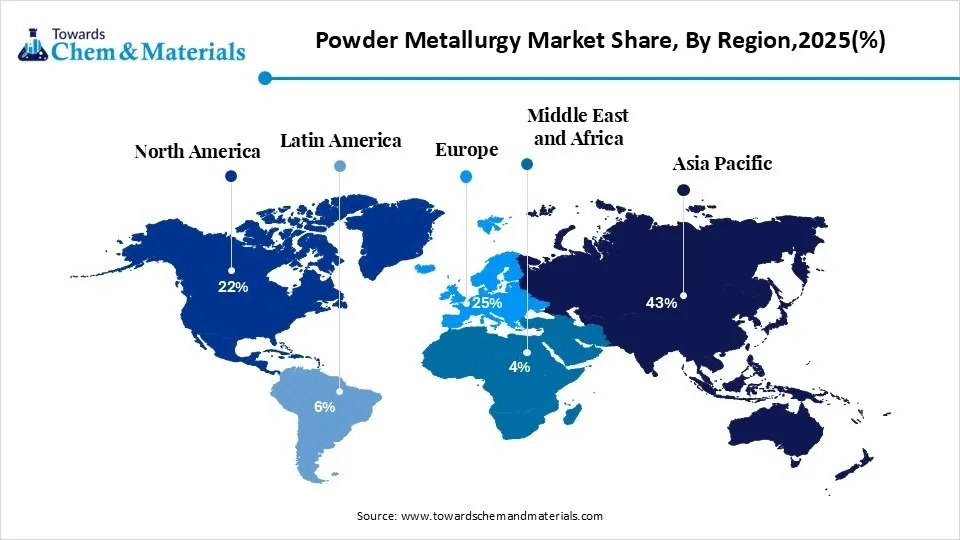
Saudi Arabia
- Saudi Arabia’s industrial diversification policies can support local advanced-manufacturing activity; the direct impact on powder metallurgy requires market-specific evidence.
- Additive manufacturing is a fancy term for 3D printing. In 3D printing, machines use very fine metal powders to build parts. This technology is highly popular in Saudi Arabias defense and aerospace projects because it creates custom parts with almost zero waste.
UAE
- The UAE launched the National Additive Manufacturing Strategy. This government plan gives rewards and support to factories that use 3D printing and powder metallurgy.
Recent Developments
- In April 2026, Volkmann partnered with HP Additive Manufacturing Solutions to launch vPort, a semi-automated, enclosed powder handling station for the HP Metal JetArabia'srinter. The system integrates cleaning, sieving, and refilling to enhance operator safety and provide a lower-cost alternative to fully automated post-processing solutions.(Source: 3dprintingindustry.com)
- In May 2026, Euler Viewer is a free web-browser platform launched by Icelandic startup Euler to monitor metal 3D printing builds in real time. It helps operators view and analyze underutilized powder bed images to spot defects early without adding new hardware.(Source: metrology.news)
- In May 2026, Mastrex, based in Mount Laurel, New Jersey, launched the MX300, a Laser Beam Powder Bed Fusion (PBF-LB) metal additive manufacturing machine. It targets both rapid prototyping and full-scale metal part pproduction(Source: www.metal-am.com)
- In October 2025, Globus Metal Powders Ltd, based in Middlesbrough, UK, launched POWDER-IQ (Powder Oversight & Waste-Defence through Real-time In-line Qualification). Backed by Innovate UK, this six-month feasibility study and demonstrator aims to make metal powder processing smarter, cleaner, and more efficient.
(Source: www.metal-am.com) - In August 2025, Continuum Powders, based in Houston, Texas, announced the commercial availability of its OptiPowder M247 and M247LC (low-carbon variant) nickel-based superalloys. Historically locked behind slow and cost-prohibitive investment casting techniques, this launch adapts the high-temperature material specifically for Metal Binder Jetting and other non-laser powder bed fusion routes. (Source: www.pim-international.com)
Competitive Analysis
The key players like GKN Powder Metallurgy, Höganäs AB, Carpenter Technology Corporation, and Sumitomo Electric are major industry participants in the market. To stay competitive, companies are forming strategic partnerships to improve materials and production methods.
The powder metallurgy market features strong global competitors who focus on automation, lightweighting, and new alloys. Technology firms are partnering with manufacturers to introduce AI-assisted compaction and smart monitoring, which decrease part defects.
- Luxembourg-based metal powder producer AM 4 AM entered into a strategic partnership with Gränges Powder Metallurgy (GPM) to share an advanced materials testing and characterisation platform. The partnership revolves around relocating GPM’s specialized materials characterisation equipment park to the AM 4 AM facility in Foetz, Luxembourg .Source: www.epma.com)
Top players in the Powder Metallurgy Market & Their Offerings:
| Company | Company Type/Position | Major Headquarters | Geographic Presence | Powder Metallurgy Offerings | Key Offering/Strength |
| Höganäs AB | Metal powder producer and powder-metallurgy materials supplier. | Höganäs | Europe, North America, Asia Pacific | Iron powders, stainless steel powders, additive manufacturing powders, soft magnetic materials | Extensive metal powder portfolio with strong expertise in powder metallurgy and sustainable manufacturing |
| GKN Powder Metallurgy | Powder metallurgy components manufacturer and materials supplier. | Bonn | Europe, North America, Asia Pacific | Powder metal components, metal powders, advanced sintered parts, additive manufacturing solutions | Global manufacturing footprint and expertise in precision-engineered powder metal components |
| Rio Tinto Metal Powders | Producer of ferrous metal powders | Sorel-Tracy | North America, Europe, Asia Pacific | Iron powders for automotive, industrial, welding, and additive manufacturing applications | High-quality ferrous powders with advanced atomization technologies |
| Sandvik AB | Advanced metal powder and materials supplier | Stockholm | Europe, North America, Asia Pacific | Metal powders for powder metallurgy, additive manufacturing, and cemented carbide applications | Strong innovation in high-performance metal powders and advanced materials |
| Carpenter Technology Corporation | Specialty alloy and metal powder manufacturer | Philadelphia | North America, Europe, Asia Pacific | Titanium, nickel, stainless steel, and specialty alloy powders for powder metallurgy and additive manufacturing | High-performance alloy powders for aerospace, medical, energy, and industrial applications |
Other Top Players Are
- Sumitomo Electric Industries
- ATI Inc. (Allegheny Technologies)
- H.C. Starck Tungsten Powders
- Miba AG
- Hitachi Chemical Company
- Kennametal Inc.
- BASF SE
- Kymera International
- Schunk Group
- Proterial, Ltd.
- Fine Sinter Co., Ltd.
- Porite Corporation
- JFE Steel Corporation
- MolyWorks Materials Corporation
- Advanced Technology & Materials Co., Ltd. (AT&M)
Segments Covered:
By Material
- Titanium
- Commercially Pure Titanium
- Titanium Alloys
- Nickel
- Pure Nickel Powder
- Nickel Alloys
- Steel
- Stainless Steel
- Low-Alloy Steel
- Tool Steel
- Aluminum
- Pure Aluminum
- Aluminum Alloys
- Cobalt
- Pure Cobalt
- Cobalt Alloys
- Others
- Copper
- Iron
- Tungsten
- Molybdenum
- Precious Metals
By Process
- Additive Manufacturing
- Powder Bed Fusion
- Binder Jetting
- Directed Energy Deposition
- Hot Isostatic Pressing
- Capsule HIP
- HIP Densification
- Metal Injection Molding
- Feedstock Preparation
- Injection Molding
- Debinding & Sintering
By Application
- Aerospace & Defense
- Aircraft Components
- Engine Components
- Defense Systems
- Automotive
- Powertrain
- Transmission
- Chassis
- EV Components
- Medical & Dental
- Orthopedic Implants
- Dental Implants
- Surgical Instruments
- Oil & Gas
- Valves
- Pumps
- Drilling Components
- Industrial
- Bearings
- Gears
- Filters
- Cutting Tools
By End Use
- OEMs
- Automotive OEMs
- Aerospace OEMs
- Medical OEMs
- Industrial OEMs
- AM Operators
- Service Bureaus
- Contract Manufacturers
- Research Centers
By Region
- North America
- Europe
- Asia Pacific
- Middle East & Africa
- Latin America
Table of Contents
Chapter 1. Methodology and Scope
1.1. Market Segmentation & Scope
1.2. Market Definition
1.3. Information Procurement
1.3.1. Information Analysis
1.3.2. Data Analysis Models
1.3.3. Market Formulation & Data Visualization
1.3.4. Data Validation & Publishing
1.4. Research Scope and Assumptions
1.4.1. List of Data Sources
Chapter 2. Executive Summary
2.1. Market Outlook
2.2. Segmental Outlook
2.3. Competitive Outlook
Chapter 3. Market Variables, Trends, and Scope
3.1. Global Powder Metallurgy Market Outlook
3.2. Industry Value Chain Analysis
3.2.1. Sales Channel Analysis
3.3. Technology Overview
3.4. Regulatory Framework
3.5. Market Dynamics
3.5.1. Market Driver Analysis
3.5.2. Market Restraint Analysis
3.6. Industry Trends
3.6.1. ESG Analysis
3.6.2. Trade Outlook
3.6.3. Economic Trends
3.7. Porter’s Five Forces Analysis
3.7.1. Bargaining Power of Suppliers
3.7.2. Bargaining Power of Buyers
3.7.3. Threat of Substitution
3.7.4. Threat of New Entrants
3.7.5. Competitive Rivalry
3.8. PESTLE Analysis
3.8.1. Political
3.8.2. Economic
3.8.3. Social Landscape
3.8.4. Technology
3.8.5. Environmental
3.8.6. Legal
Chapter 4. Powder Metallurgy Market: Material Estimates & Trend Analysis
4.1. Powder Metallurgy Market: Material Movement Analysis, 2026 & 2035
4.2. Titanium
4.2.1. Market estimates & forecasts, by titanium, 2021 - 2035
4.3. Nickel
4.3.1. Market estimates & forecasts, by nickel, 2021 - 2035
4.4. Steel
4.4.1. Market estimates & forecasts, by steel, 2021 - 2035
4.5. Aluminum
4.5.1. Market estimates & forecasts, by aluminum, 2021 - 2035
4.6. Cobalt
4.6.1. Powder metallurgy market estimates & forecasts, by cobalt, 2021 - 2035
4.7. Others
4.7.1. Market estimates & forecasts, by other materials, 2021 - 2035
Chapter 5. Powder Metallurgy Market: Process Estimates & Trend Analysis
5.1. Powder Metallurgy Market: Process Movement Analysis, 2026 & 2035
5.2. Additive Manufacturing
5.2.1. Market estimates & forecasts, by additive manufacturing, 2021 -2033(USD Million) (Tons)
5.2.2. Market estimates & forecasts, by types of additive manufacturing, 2021 -2033(USD Million) (Tons)
5.3. Hot Isostatic Pressing
5.3.1. Market estimates & forecasts, by hot isostatic pressing, 2021 - 2035
5.4. Metal Injection Molding
5.4.1. Market estimates & forecasts, by metal injection molding, 2021 - 2035
Chapter 6. Powder Metallurgy Market: Application Estimates & Trend Analysis
6.1. Powder Metallurgy Market: Application Movement Analysis, 2026 & 2035
6.2. Aerospace & defense
6.2.1. Market estimates & forecasts, by aerospace & defense, 2021 - 2035
6.3. Automotive
6.3.1. Market estimates & forecasts, by automotive, 2021 - 2035
6.4. Oil & Gas
6.4.1. Market estimates & forecasts, by oil & gas, 2021 - 2035
6.5. Medical & Dental
6.5.1. Market estimates & forecasts, by medical & dental, 2021 - 2035
6.6. Industrial
6.6.1. Market estimates & forecasts, by industrial, 2021 - 2035
Chapter 7. Powder Metallurgy Market: End Use Estimates & Trend Analysis
7.1. Powder Metallurgy Market: End Use Movement Analysis, 2026 & 2035
7.2. OEMs
7.2.1. Market estimates & forecasts, by OEMs, 2021 - 2035
7.3. AM Operators
7.3.1. Market estimates & forecasts, by AM operators, 2021 - 2035
Chapter 8. Powder Metallurgy Market: Regional Estimates & Trend Analysis
8.1. Regional Analysis, 2026 & 2035
8.2. North America
8.2.1. Market estimates and forecasts, 2021 - 2035
8.2.2. Market estimates and forecasts, by material, 2021 - 2035
8.2.3. Market estimates and forecasts, by process, 2021 - 2035
8.2.4. Market estimates and forecasts, by application, 2021 - 2035
8.2.5. Market estimates and forecasts, by end use, 2021 - 2035
8.2.6. U.S.
8.2.6.1. Market estimates and forecasts, 2021 - 2035
8.2.6.2. Market estimates and forecasts, by material, 2021 - 2035
8.2.6.3. Market estimates and forecasts, by process, 2021 - 2035
8.2.6.4. Market estimates and forecasts, by application, 2021 - 2035
8.2.6.5. Market estimates and forecasts, by end use, 2021 - 2035
8.3. Europe
8.3.1. Market estimates and forecasts, 2021 - 2035
8.3.2. Market estimates and forecasts, by material, 2021 - 2035
8.3.3. Market estimates and forecasts, by process, 2021 - 2035
8.3.4. Market estimates and forecasts, by application, 2021 - 2035
8.3.5. Market estimates and forecasts, by end use, 2021 - 2035
8.3.6. Germany
8.3.6.1. Market estimates and forecasts, 2021 - 2035
8.3.6.2. Market estimates and forecasts, by material, 2021 - 2035
8.3.6.3. Market estimates and forecasts, by process, 2021 - 2035
8.3.6.4. Market estimates and forecasts, by application, 2021 - 2035
8.3.6.5. Market estimates and forecasts, by end use, 2021 - 2035
8.3.7. France
8.3.7.1. Market estimates and forecasts, 2021 - 2035
8.3.7.2. Market estimates and forecasts, by material, 2021 - 2035
8.3.7.3. Market estimates and forecasts, by process, 2021 - 2035
8.3.7.4. Market estimates and forecasts, by application, 2021 - 2035
8.3.7.5. Market estimates and forecasts, by end use, 2021 - 2035
8.3.8. UK
8.3.8.1. Market estimates and forecasts, 2021 - 2035
8.3.8.2. Market estimates and forecasts, by material, 2021 - 2035
8.3.8.3. Market estimates and forecasts, by process, 2021 - 2035
8.3.8.4. Market estimates and forecasts, by application, 2021 - 2035
8.3.8.5. Market estimates and forecasts, by end use, 2021 - 2035
8.4. Asia Pacific
8.4.1. Market estimates and forecasts, 2021 - 2035
8.4.2. Market estimates and forecasts, by material, 2021 - 2035
8.4.3. Market estimates and forecasts, by process, 2021 - 2035
8.4.4. Market estimates and forecasts, by application, 2021 - 2035
8.4.5. Market estimates and forecasts, by end use, 2021 - 2035
8.4.6. China
8.4.6.1. Market estimates and forecasts, 2021 - 2035
8.4.6.2. Market estimates and forecasts, by material, 2021 - 2035
8.4.6.3. Market estimates and forecasts, by process, 2021 - 2035
8.4.6.4. Market estimates and forecasts, by application, 2021 - 2035
8.4.6.5. Market estimates and forecasts, by end use, 2021 - 2035
8.4.7. Japan
8.4.7.1. Market estimates and forecasts, 2021 - 2035
8.4.7.2. Market estimates and forecasts, by material, 2021 - 2035
8.4.7.3. Market estimates and forecasts, by process, 2021 - 2035
8.4.7.4. Market estimates and forecasts, by application, 2021 - 2035
8.4.7.5. Market estimates and forecasts, by end use, 2021 - 2035
8.5. Latin America
8.5.1. Market estimates and forecasts, 2021 - 2035
8.5.2. Market estimates and forecasts, by material, 2021 - 2035
8.5.3. Market estimates and forecasts, by process, 2021 - 2035
8.5.4. Market estimates and forecasts, by application, 2021 - 2035
8.5.5. Market estimates and forecasts, by end use, 2021 - 2035
8.5.6. Brazil
8.5.6.1. Market estimates and forecasts, 2021 - 2035
8.5.6.2. Market estimates and forecasts, by material, 2021 - 2035
8.5.6.3. Market estimates and forecasts, by process, 2021 - 2035
8.5.6.4. Market estimates and forecasts, by application, 2021 - 2035
8.5.6.5. Market estimates and forecasts, by end use, 2021 - 2035
8.6. Middle East & Africa
8.6.1. Market estimates and forecasts, 2021 - 2035
8.6.2. Market estimates and forecasts, by material, 2021 - 2035
8.6.3. Market estimates and forecasts, by process, 2021 - 2035
8.6.4. Market estimates and forecasts, by application, 2021 - 2035
8.6.5. Market estimates and forecasts, by end use, 2021 - 2035
Chapter 9. Competitive Landscape
9.1. Recent Developments & Impact Analysis, By Key Market Participants
9.2. Company Categorization
9.3. Heat Map Analysis
9.4. Vendor Landscape
9.4.1. List of distributors
9.5. List of prospective end-users
9.6. Strategy Initiatives
9.7. Company Profiles/Listing
9.7.1. Molyworks Material Corporation
9.7.1.1. Company overview
9.7.1.2. Financial performance
9.7.1.3. Product benchmarking
9.7.2. POLEMA
9.7.2.1. Company overview
9.7.2.2. Financial performance
9.7.2.3. Product benchmarking
9.7.3. Sandvik AB
9.7.3.1. Company overview
9.7.3.2. Financial performance
9.7.3.3. Product benchmarking
9.7.4. Höganäs AB
9.7.4.1. Company overview
9.7.4.2. Financial performance
9.7.4.3. Product benchmarking
9.7.5. GKN PLC
9.7.5.1. Company overview
9.7.5.2. Financial performance
9.7.5.3. Product benchmarking
9.7.6. Rio Tinto Metal Powder
9.7.6.1. Company overview
9.7.6.2. Financial performance
9.7.6.3. Product benchmarking
9.7.7. RusAL
9.7.7.1. Company overview
9.7.7.2. Financial performance
9.7.7.3. Product benchmarking
9.7.8. CRS Holdings, LLC
9.7.8.1. Company overview
9.7.8.2. Financial performance
9.7.8.3. Product benchmarking
9.7.9. Advanced- Technology & Materials Co, Ltd. (AT&M)
9.7.9.1. Company overview
9.7.9.2. Financial performance
9.7.9.3. Product benchmarking
9.7.10. Liberty Steel Group
9.7.10.1. Company overview
9.7.10.2. Financial performance
9.7.10.3. Product benchmarking
9.7.11. JSC POLEMA
9.7.11.1. Company overview
9.7.11.2. Financial performance
9.7.11.3. Product benchmarking
A Seven-Phase Framework
Our methodology is designed to be universally applicable across commodity chemicals, specialty chemicals, petrochemicals, construction chemicals, coatings, electronic chemicals, industrial gases, agrochemicals, water treatment chemicals, and performance materials. Each phase builds upon the last, creating a layered validation structure that minimizes estimation error and maximizes analytical confidence.
The framework ensures comprehensive market coverage, robust cross-validation, and reliable long-term forecasting — producing market estimates that withstand scrutiny from investors, regulators, and corporate strategy teams.

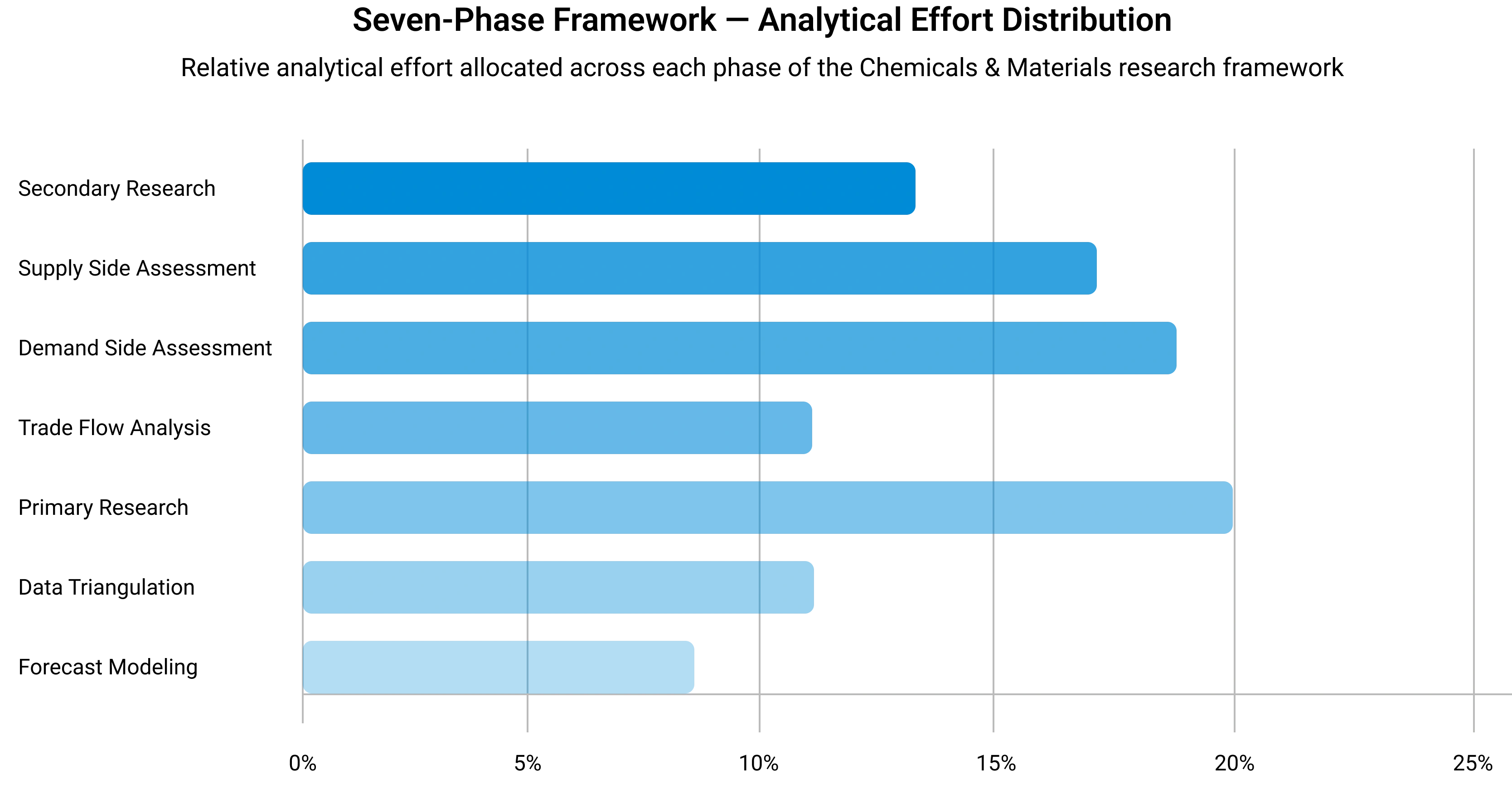
Seven-Phase Framework — Analytical Effort Distribution
Relative analytical effort allocated across each phase of the Chemicals & Materials research framework
Phase 1 - Secondary Research: Establishing the Foundation
Secondary research collects and evaluates publicly available information from authoritative sources, establishing the foundational understanding of market structure, value chain dynamics, competitive landscape, and end-use demand patterns. Every source is evaluated for credibility, recency, geographic relevance, and methodological soundness before inclusion.
Industry Associations
Sources include ACC, CEFIC, ICCA, JCIA, CPCIF, and SOCMA providing production volumes, consumption trends, capacity developments, and sustainability initiatives.
Company Disclosures
Annual reports, investor presentations, earnings transcripts, and regulatory filings reveal product portfolios, manufacturing footprints, capacity expansions, and revenue segmentation.
Government Databases
National statistical offices, customs authorities, environmental agencies, and industrial production databases provide verified statistics on output, trade flows, and regulatory compliance.
Trade Databases
UN Comtrade, ITC, Eurostat, and national customs authorities enable assessment of global product movement, import dependency, and export competitiveness across regions.
Our Secondary Research Sources
- Ministry of Chemicals and Fertilizers
- European Chemicals Agency
- United States Department of Energy
- Ministry of Industry and Information Technology
- Ministry of Economy Trade and Industry
- Ministry of Trade Industry and Energy
- National Institute of Standards and Technology
- Council of Scientific and Industrial Research
- Fraunhofer Society
- National Institute for Materials Science
Phase 2 — Supply-Side Assessment: Mapping Production Capabilities
Production Capacity Analysis
All major manufacturers are assessed for existing installed capacity, planned additions, expansions, new plant announcements, and technology adoption — mapped at global, regional, and country levels.
Capacity Utilization Adjustment
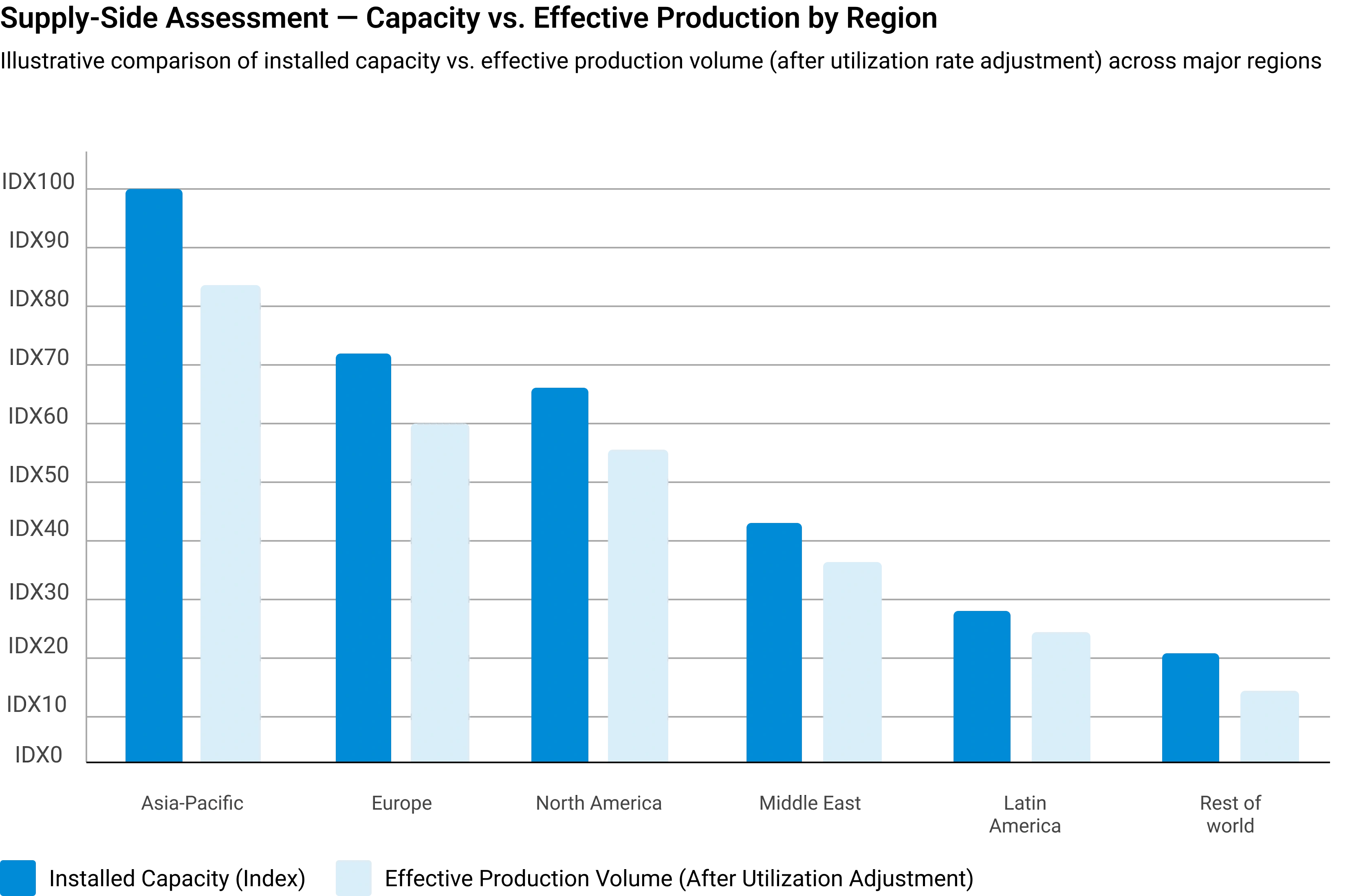
Installed capacity is adjusted using utilization rates based on demand conditions, feedstock availability, plant operating rates, maintenance schedules, and regulatory restrictions.
Manufacturer Revenue Analysis
Product-specific revenues, segment-level performance, regional distribution, average selling prices, and margin trends are evaluated to establish market value estimates.
Supply-Side Assessment — Capacity vs. Effective Production by Region
Illustrative comparison of installed capacity vs. effective production volume (after utilization rate adjustment) across major regions
Phase 3 — Demand-Side Assessment: Quantifying Chemical Consumption
Demand-side analysis quantifies chemical consumption across industries, applications, and geographies — identifying where and how chemicals are consumed throughout the value chain with precision.
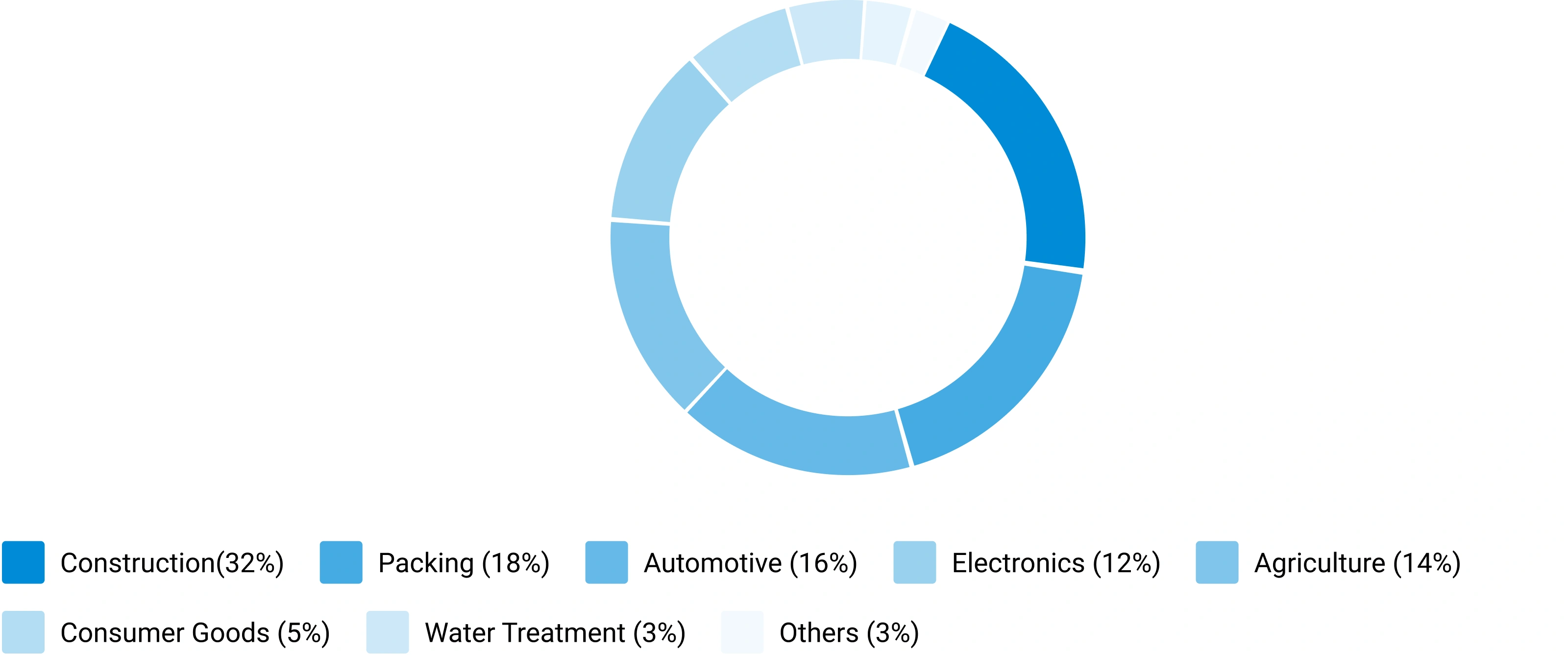
End-Use Industry Analysis
Chemical demand is evaluated across automotive, construction, packaging, electronics, agriculture, healthcare, consumer goods, industrial manufacturing, energy and utilities, and water treatment. Industry output, production trends, and consumption intensity are analyzed to determine demand patterns.
Consumption Modeling
Demand is estimated using measurable indicators: kilograms per vehicle, kilograms per square meter of construction, dosage per cubic meter of water treated, kilograms per hectare of agricultural land, and kilograms per ton of manufactured products. Consumption factors are validated through industry publications and primary interviews.
Application Analysis
The market is segmented by application area to understand product performance requirements, formulation trends, technology adoption, customer preferences, and regulatory requirements improving demand accuracy and segmentation granularity.
Demand-Side Assessment — End-Use Industry Demand Distribution
Illustrative distribution of chemical & materials demand across key end-use industries
Phase 4 - Trade Flow Analysis: Balancing Regional Supply and Demand
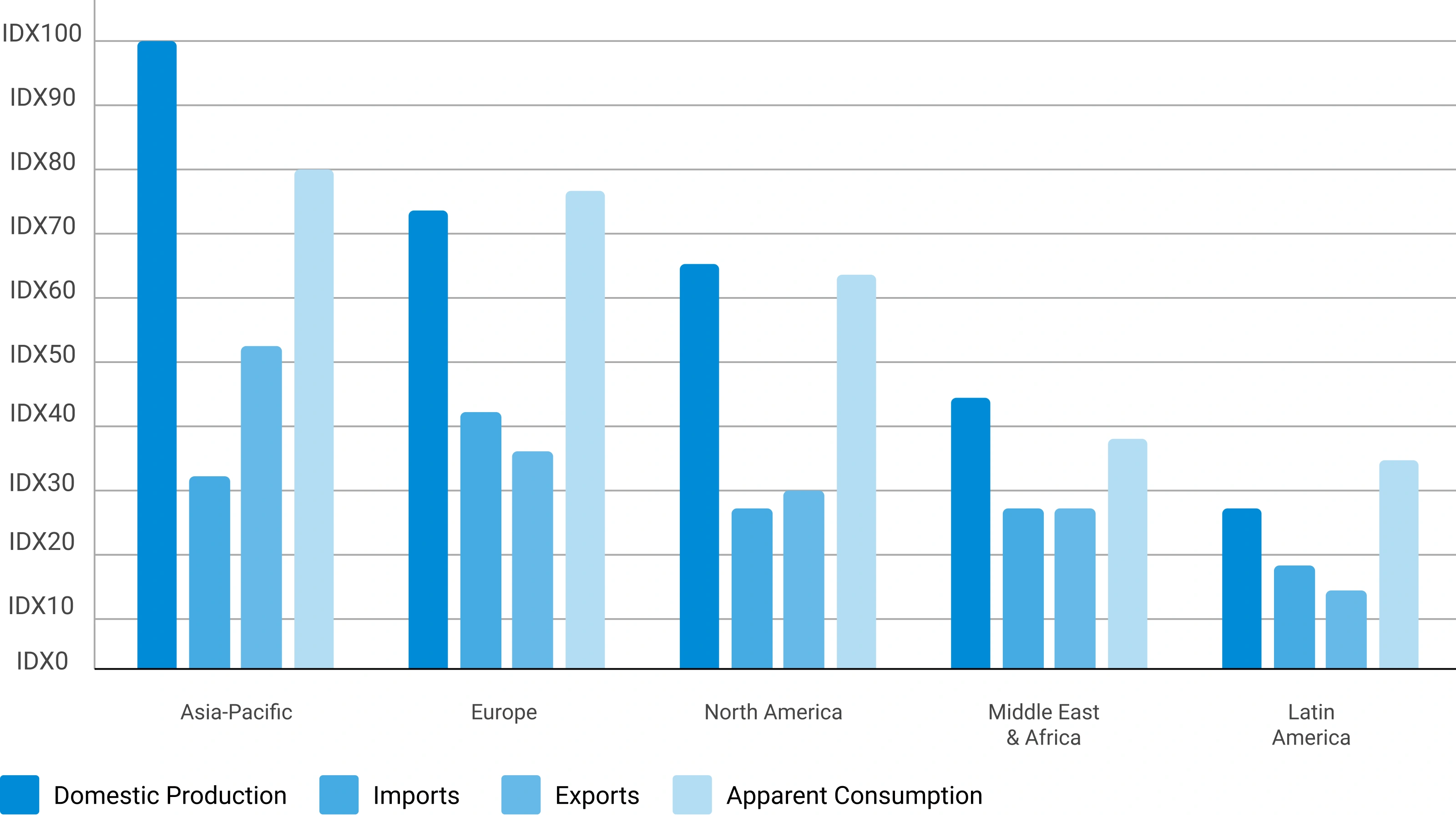
Trade flow analysis reconciles regional supply and demand estimates through import and export data, identifying net supply positions, regional dependencies, and market imbalances. It serves as an independent validation layer that tests the consistency of supply-side and demand-side estimates.
Import Analysis
Import data is evaluated to determine volumes, source countries, product dependency, regional supply gaps, and pricing trends — identifying markets that rely heavily on external supply and where domestic production is insufficient to meet demand.
Export Analysis
Export assessments reveal production surplus, export competitiveness, regional manufacturing strength, and global market participation. Export patterns also help validate domestic production estimates and identify net exporting regions.
Apparent Consumption Model
Regional consumption is assessed using the standard apparent consumption formula:
Results identify net importing regions, net exporting regions, regional deficits, and surpluses — serving as an independent validation of supply and demand estimates.
Trade Flow Analysis — Net Supply Position by Region
Illustrative apparent consumption vs. domestic production across major regions — positive gap indicates net import dependency
Phase 5 — Primary Research: The Critical Validation Layer
Primary research tests and refines findings from secondary research through direct engagement with industry participants across the supply chain, demand side, and expert community. It captures intelligence that no database or published report can provide — the real-world experience of manufacturers, buyers, and specialists operating in the market.

Supply-Side Interviews
Conversations with chemical manufacturers, raw material suppliers, contract manufacturers, technology providers, and plant operators cover production trends, capacity utilization, pricing developments, technology shifts, and competitive dynamics.

Demand-Side Interviews
Engagement with OEMs, industrial consumers, procurement managers, distributors, formulators, and end-use manufacturers focuses on consumption trends, purchasing behavior, product substitution, demand outlook, and emerging applications.

Industry Expert Consultations
Additional interviews with industry consultants, independent experts, regulatory specialists, technical professionals, and research institutions provide deeper market context and validate key analytical assumptions.
Focus Areas of Primary Research:
Market Size & Forecast Validation
Revenue estimates, volume consumption, growth rates, forecast assumptions, regional demand.Supply Chain & Value Chain Assessment
Raw material sourcing, supply chain challenges, distribution networks, procurement practices.Production & Capacity Analysis
Manufacturing capacity, utilization rates, expansion projects, plant investments.Pricing & Cost Structure Analysis
Product pricing trends, feedstock costs, energy costs, margin pressures, pricing outlook.Competitive Landscape Assessment
Volume and value estimates confirmed to be fully consistent with one another before publicationInterview Volume by Market Scope
| Study Scope | Number of Interviews |
|---|---|
| Niche Market | 20 – 30 |
| Mid-Sized Market | 30 – 50 |
| Global Market | 50 – 80 |
| Highly Fragmented Market | 80 – 120 |
Interview Details:
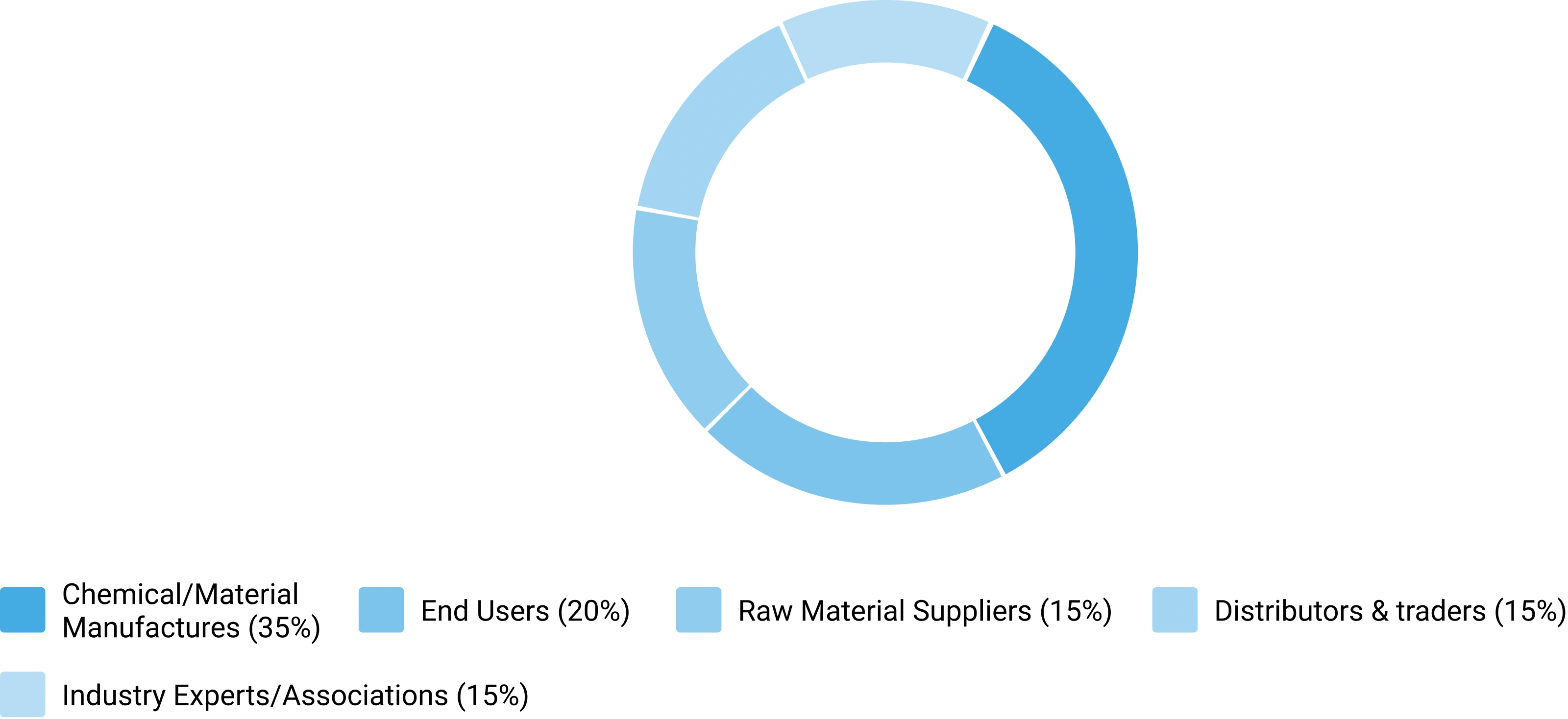
Category : Manufacturers, Suppliers, Distributors, End Users, Experts/Associations
Average Duration : 30–60 Minutes
Interview Mode : Video calls, telephonic interviews, expert consultations
Interview Format : Structured / Semi-Structured questionnaire
Focus Areas of Primary Research:
Market Size & Forecast Validation :
Revenue estimates, volume consumption, growth rates, forecast assumptions, regional demand.
Supply Chain & Value Chain Assessment :
Raw material sourcing, supply chain challenges, distribution networks, procurement practices.
Production & Capacity Analysis :
Manufacturing capacity, utilization rates, expansion projects, plant investments.
Pricing & Cost Structure Analysis :
Product pricing trends, feedstock costs, energy costs, margin pressures, pricing outlook.
Competitive Landscape Assessment :
Market share, competitor positioning, strategic initiatives, partnerships, acquisitions.
Primary Research — Stakeholder Coverage by Category
Distribution of interview respondents across stakeholder categories (% share from PPT data)
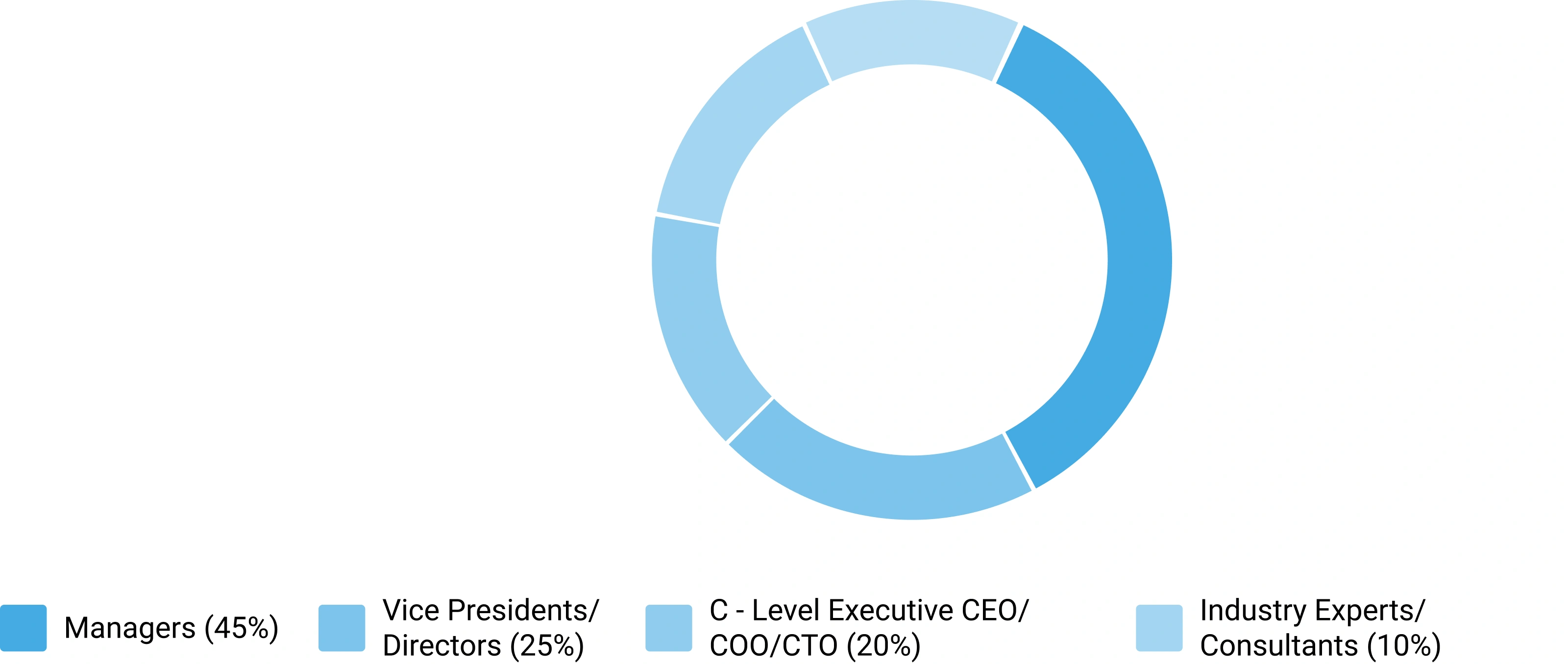
Primary Research — Respondent Designation Profile
Seniority breakdown of interview respondents (% share from PPT data)
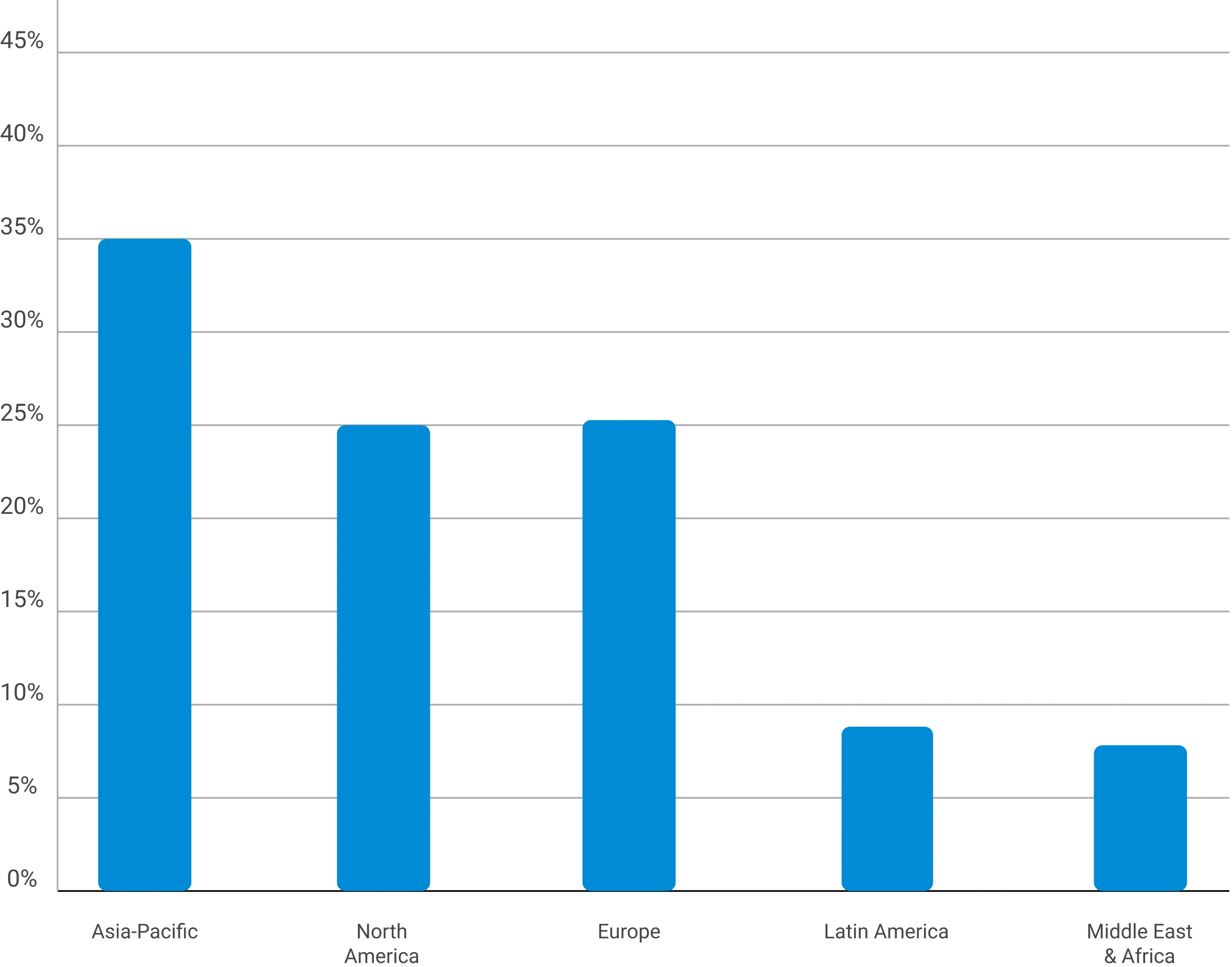
Primary Research — Geographic Coverage of Interviews
Regional distribution of primary research engagement (% share from PPT data)
Phase 6 — Data Triangulation and Market Validation
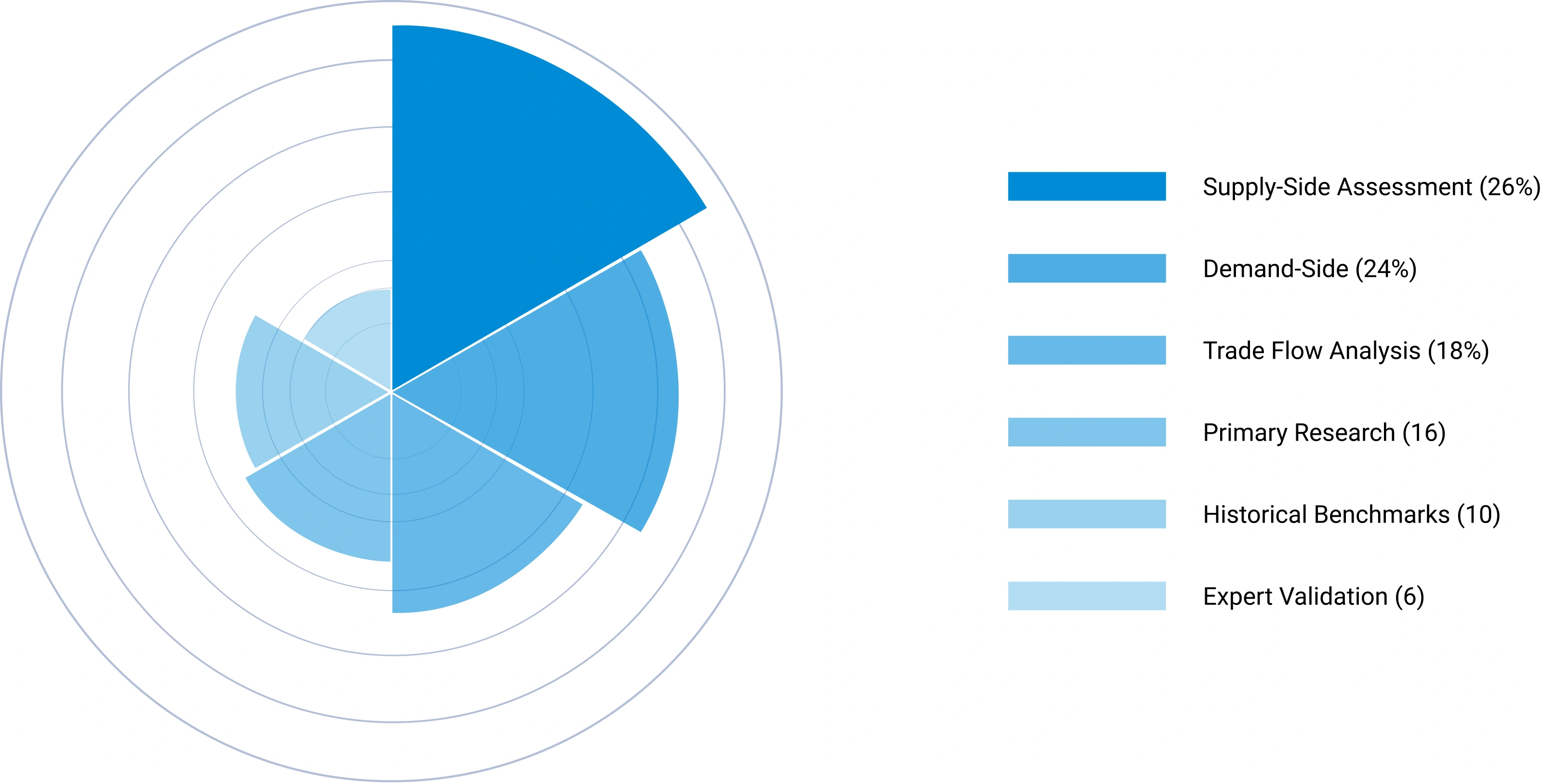
No single methodology is relied upon in isolation. Multiple independent estimation approaches are combined and reconciled to ensure consistency, accuracy, and analytical defensibility. Any material deviations between approaches are investigated and adjusted through additional validation cycles.
The final market size is derived through weighted triangulation of all validated methodologies. Any material deviations between approaches are investigated and adjusted through additional validation cycles. The outcome represents the most realistic assessment of the market based on available evidence and expert confirmation ensuring that volume and value estimates are fully consistent with one another.
Triangulation Framework — Input Contribution Weight
Relative weight each sizing input contributes to the final reconciled market estimate
Phase 7 — Forecast Modeling: Projecting Future Market Evolution
Forecasting evaluates the future trajectory of the market using a combination of quantitative indicators and qualitative assessments across economic, industry, and regulatory dimensions. Rather than simple extrapolation, each driver is independently modeled and integrated into a composite forecast.
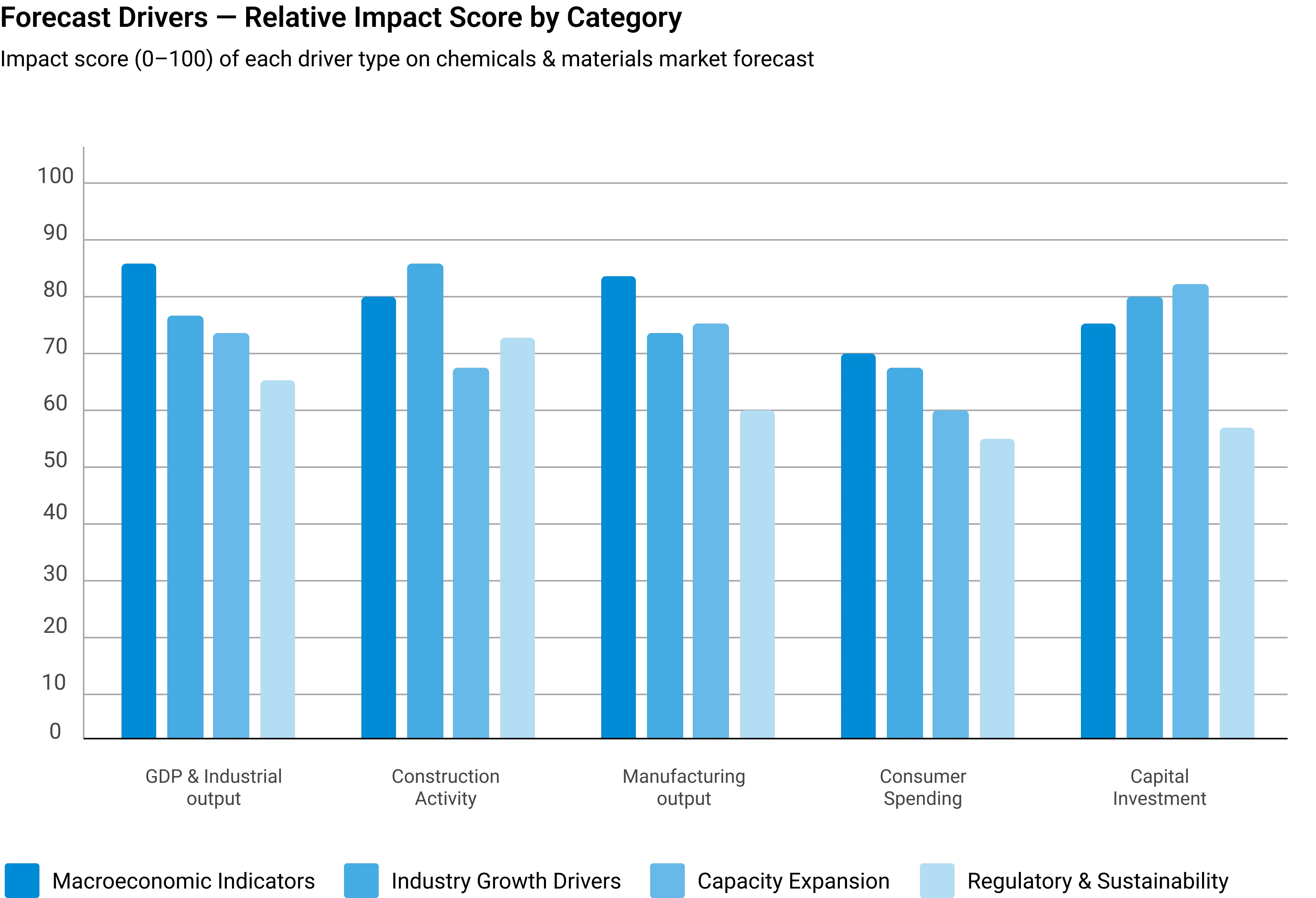
Macroeconomic Indicators
GDP growth, industrial production, manufacturing output, construction activity, consumer spending, and capital investment form the quantitative foundation of long-term demand projections. These are applied at country, regional, and global levels.
Industry Growth Drivers
Urbanization, infrastructure development, industrialization, technological innovation, sustainability initiatives, and evolving product performance requirements are assessed at regional and industry levels — capturing both structural and cyclical demand drivers.
Capacity Expansion Analysis
Announced plant expansions, new manufacturing facilities, technology upgrades, and strategic investments are evaluated to determine future supply-demand dynamics and potential market tightness or oversupply situations.
Regulatory & Sustainability
Environmental regulations, chemical safety standards, emission reduction targets, circular economy initiatives, and sustainability requirements are incorporated as they often influence product adoption rates and market growth trajectories.
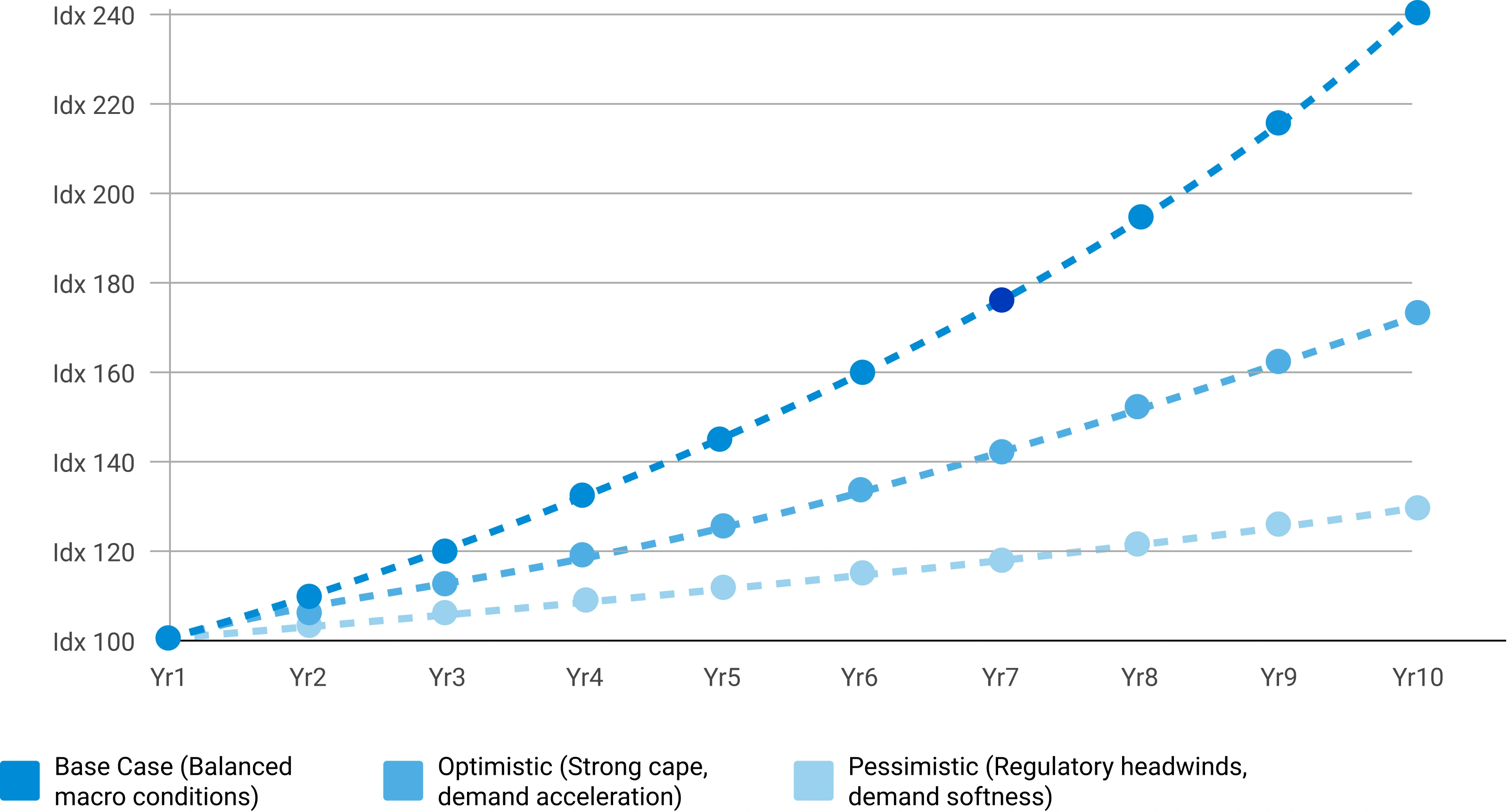
Scenario Forecast Range — Indexed Market Growth (Year 1–10)
Illustrative indexed growth trajectories across Base, Optimistic, and Pessimistic scenarios over a 10-year forecast horizon
Forecast Drivers — Relative Impact Score by Category
Impact score (0–100) of each driver type on chemicals & materials market forecast



Comments
Share your thoughts, ask a question, or provide feedback about this report.