Find the Right Market Report
Search thousands of industry reports, market insights, and research studies in one place.
Not sure where to start? Try one of these:
The North America specialty chemicals market size was valued at USD 313.5 billion in 2025, is estimated to reach USD 332.4 billion in 2026, and is projected to reach USD 563.0 billion by 2035, exhibiting a compound annual growth rate (CAGR) of 6.03% over the forecast period from 2026 to 2035.The regional activities towards the specialized industries are actively providing greater attention to specialty chemicals. Moreover, research and development activities are becoming a major element of the industrys potential as manufacturers are demanding specific and designed chemicals for their work purposes in North America nowadays.
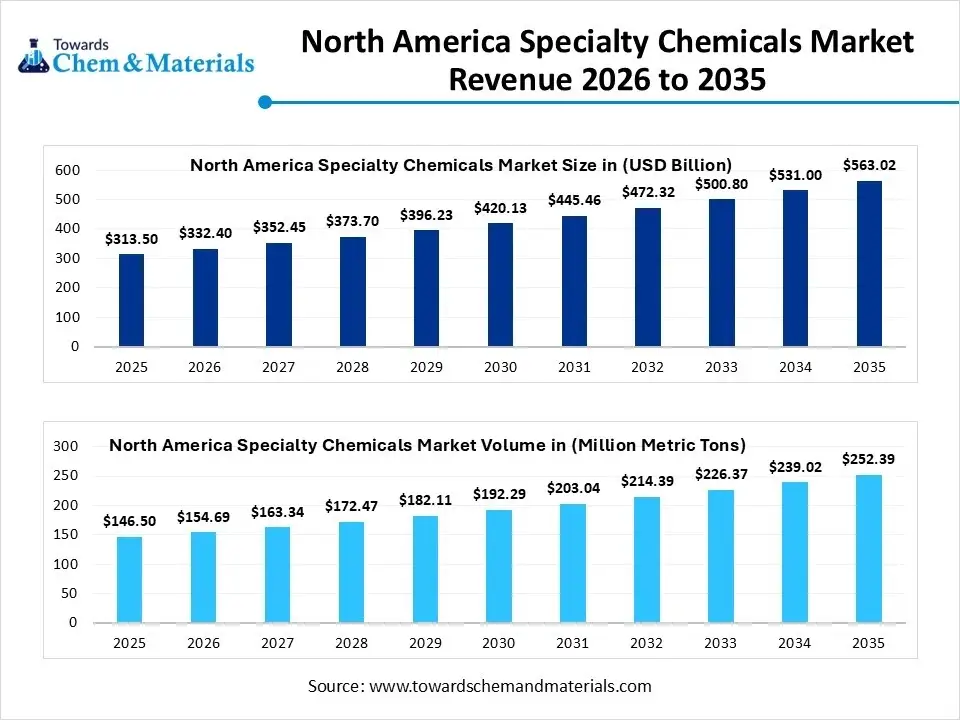
According to Towards Chemicals and Materials Analytics and Consulting, the North America specialty chemicals market volume was valued at 146.5 million metric tons in 2025 and is expected to surpass around 252.4 million metric tons by 2035, accelerating at a compound annual growth rate (CAGR) of 5.59% over the forecast period from 2026 to 2035.
The industrial shift towards specialized applications has become a major pillar of the specialty chemical industry growth in North America in recent years. These innovative chemicals are actively used heavily in major industries such as the automotive, construction, healthcare, personal care, and water treatment, which is leading to further industry potential. Also, having greater benefits like a heavy and advanced industrial base and continuous investment in innovation is actively supporting the market flow in North America these days.
Artificial intelligence, automation, and data analytics are also becoming more common in production facilities. These technologies help companies improve production quality, reduce waste, predict equipment maintenance, and optimize manufacturing processes. At the same time, investments in semiconductor manufacturing, electric vehicles, renewable energy, and advanced healthcare are creating new opportunities for specialty chemical suppliers.
Companies operating in the North American specialty chemicals industry are increasing investments in sustainable manufacturing to reduce carbon emissions and meet environmental regulations. Funding is being directed toward energy-efficient production plants, renewable energy integration, bio-based raw materials, and recycling technologies.
Chemical manufacturers are investing heavily in advanced technologies to improve production efficiency and product quality. Capital is being used to install automation systems, artificial intelligence, industrial Internet of Things (IIoT) devices, robotics, and advanced process control technologies across manufacturing facilities.
A significant share of investment is flowing toward the development of high-performance specialty chemicals for industries such as electric vehicles, semiconductors, healthcare, aerospace, electronics, and renewable energy.
| Report Attributes | Details |
| Market Size in 2026 | USD 332.4 Billion/ 154.7 Million Metric Tons |
| Expected Size in 2035 | USD 563.0 Billion/ 252.4 Million Metric Tons |
| Growth Rate | CAGR of 6.03% |
| Base Year of Estimation | 2025 |
| Forecast Period | 2025-2035 |
| Segment Covered | By Product, By End Use Industry, By Function, By Distribution Channel, By Region |
| Key Companies Profiled | Albemarle Corporation, Ashland Global Holdings, Axalta Coating Systems, Cabot Corporation, Celanese Corporation, Chevron Phillips Chemical, Corteva Agriscience, DuPont de Nemours |
Artificial intelligence is becoming an important part of specialty chemical manufacturing, as per the latest survey. Also, companies use AI to monitor production, predict equipment maintenance, improve product quality, and reduce energy consumption. AI can quickly analyze large amounts of production data and recommend better operating conditions, helping manufacturers reduce waste and improve efficiency. It also supports faster research by identifying suitable raw materials and optimizing chemical formulations.
Production & Processing
Sustainability has become one of the biggest priorities in the North America specialty chemicals industry. Also, the companies are investing in bio-based raw materials, recyclable products, energy-efficient manufacturing, and low-carbon production technologies. Many manufacturers are reducing water consumption, lowering greenhouse gas emissions, and increasing the use of renewable energy in their production facilities. Businesses are also developing specialty chemicals that support recycling, cleaner manufacturing, and environmentally friendly industrial processes.
Specialty chemicals are high-value chemicals made to perform a specific job instead of being produced in large quantities like basic chemicals. These products are designed to improve the quality, durability, safety, or performance of different products and manufacturing processes. They are used in many industries, including construction, automotive, healthcare, agriculture, electronics, personal care, and water treatment. Unlike commodity chemicals, specialty chemicals are customized to meet customer requirements.
| Country Region | Regulatory Body | Key Regulations | Focus Areas |
| United States | U.S. Environmental Protection Agency (EPA) | Pre-Manufacture Notice (PMN) & Risk Evaluations • Mandatory review protocols for entirely new specialty chemical formulations before market commercialization |
Direct phase-outs, strict ban boundaries, or active volume caps placed against Persistent, Bioaccumulative, and Toxic (PBT) compounds. |
| Canada | Environment & Climate Change Canada | CEPA Section 64 | Toxic Substance Designation & Management • Systematic screening processes to officially flag materials dangerous to human health or regional biodiversity |
The increasing demand from industries such as healthcare, construction, electronics, automotive, renewable energy, and personal care is creating substantial growth prospects for manufacturing firms. These industries require chemicals with specific properties that improve product performance and manufacturing efficiency. Growing investments in electric vehicles, semiconductor manufacturing, and advanced healthcare products are creating additional demand for specialty chemicals.
High cost of production and raw materials is likely to hinder the industry growth during the project time. Many specialty chemicals require advanced manufacturing technologies, expensive ingredients, and strict quality control systems. Fluctuating prices of raw materials and energy also increase manufacturing costs. Environmental regulations require companies to invest in cleaner production technologies, which adds further expenses.
Environmentally friendly products are likely to create significant opportunities in the upcoming years. Also, the companies are developing bio-based chemicals, recyclable materials, and low-carbon products that help customers achieve their sustainability goals. Expanding investments in electric vehicles, renewable energy, advanced electronics, and water treatment are also increasing demand for innovative specialty chemicals. Manufacturers that focus on sustainable product development and digital manufacturing technologies are expected to gain a competitive advantage.
The construction chemicals segment dominated the market with a 18% share in 2025 and is expected to grow at a CAGR of 5.90% in the forecast period, as they are custom chemical formulations that are efficiently used to improve the performance, strength, and durability of buildings. They are used in concrete mixtures, which improve resistance; waterproofing chemicals, which help seal out moisture; and repair, protection, and flooring, which help as a protective anti-corrosion coating against harsh chemicals and conditions.
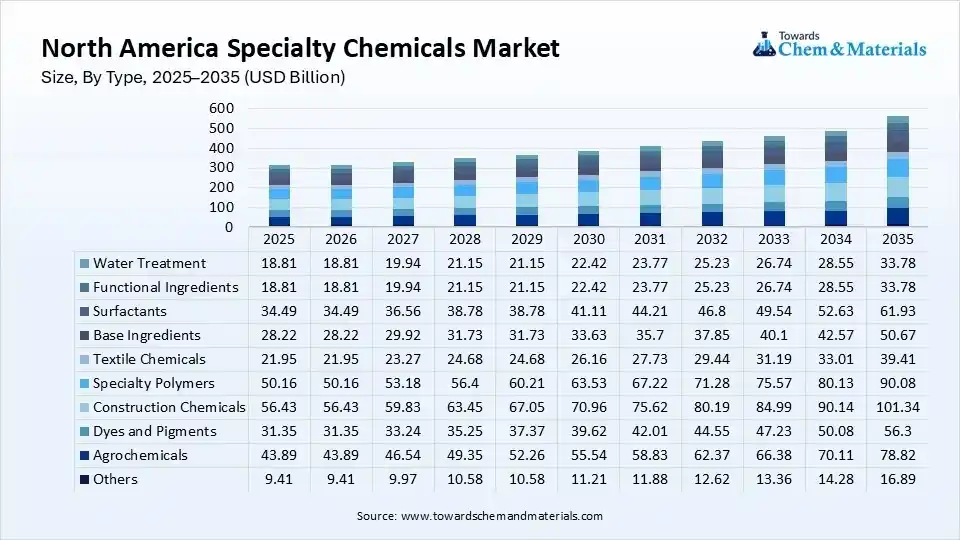
The speciality polymers segment held a 16% market share in 2025 and is expected to be the fastest-growing in the market, with a CAGR of 6.80% in the forecast period, because they are high-performance and high-value materials that are designed for specific and advanced functions in various industries, which increases demand. They are tailored for extreme temperature resistance, chemical stability, and water solubility for key sectors like functionalised additives, surface coatings, and engineering plastics, which boosts the growth of the market.
North America Specialty Chemicals Market Share, By Type,2025(%)
| By Type | Market Share (%) |
| Agrochemicals | 14% |
| Dyes and Pigments | 10% |
| Construction Chemicals | 18% |
| Specialty Polymers | 16% |
| Textile Chemicals | 7% |
| Base Ingredients | 9% |
| Surfactants | 11% |
| Functional Ingredients | 6% |
| Water Treatment | 6% |
| Others | 3% |
The construction segment dominated the market with a 19% share in 2025 and is expected to grow at a CAGR of 5.90% in the forecast period, owing to demand for materials like concrete admixtures, protective coatings, and waterproofing agents, due to its ability to enhance the working and efficiency of the building. The demand is also fueled by its properties and applications, like it helps improve the strength, increasing the lifespan of buildings and infrastructure, and workability, which helps boost the growth of the market.
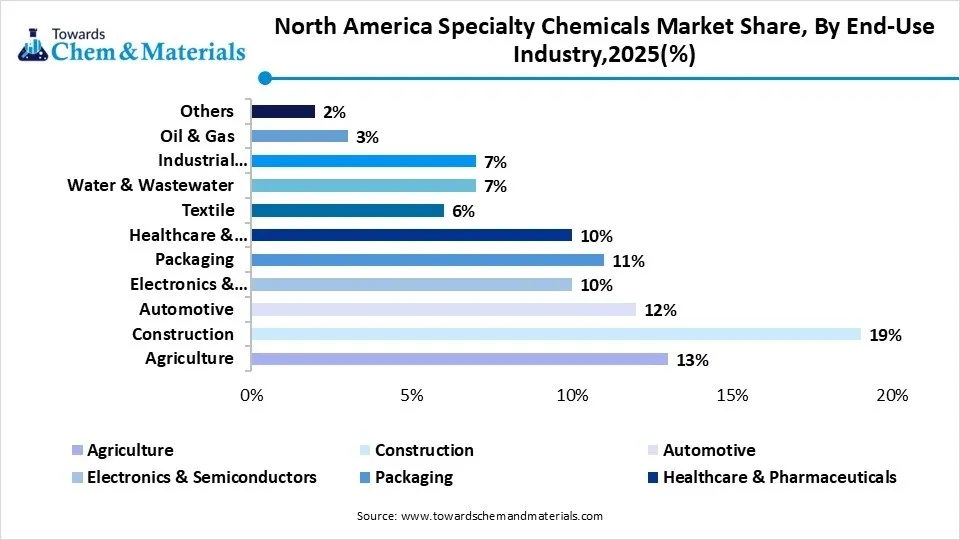
The electronics and semiconductor segment held a 10% market share in 2025 and is expected to be the fastest-growing in the market, with a CAGR of 7.20% in the forecast period, owing to its ultra-high-purity materials, which are essential for etching, cleaning, and photolithography, propelling growth, as these materials are a critical substance that helps in preventing microscopic defects on microchips, driving growth. It is dominated by wet process chemicals, electronic specialty gases, and photoresists.
North America Specialty Chemicals Market Share, By End-Use Industry,2025(%)
| By End-Use Industry | Market Share (%) |
| Agriculture | 13% |
| Construction | 19% |
| Automotive | 12% |
| Electronics & Semiconductors | 10% |
| Packaging | 11% |
| Healthcare & Pharmaceuticals | 10% |
| Textile | 6% |
| Water & Wastewater | 7% |
| Industrial Manufacturing | 7% |
| Oil & Gas | 3% |
| Others | 2% |
The performance enhancement segment dominated the market with a 28% share in 2025 and is expected to grow at a CAGR of 6.00% in the forecast period, owing to most industries require chemicals that improve the quality, durability, efficiency, and reliability of their products. Manufacturers use these chemicals to increase product strength, improve heat resistance, enhance coating performance, and extend product life. Industries such as automotive, construction, electronics, healthcare, and packaging depend on performance-enhancing specialty chemicals to produce better products while meeting strict quality standards.
The separation segment held an 8% market share in 2025 and is expected to be the fastest-growing in the market, with a CAGR of 6.70% in the forecast period, owing to industries increasingly requiring efficient technologies to separate, purify, and recover valuable materials during manufacturing. Specialty chemicals used in separation processes improve filtration, water treatment, oil and gas processing, pharmaceutical manufacturing, food processing, and chemical production. Growing environmental regulations and increasing demand for resource recovery are encouraging companies to invest in advanced separation technologies.
North America Specialty Chemicals Market Share, By Function, 2025(%)
| By Function | Market Share (%) |
| Performance Enhancement | 28% |
| Protection | 19% |
| Processing Aid | 16% |
| Cleaning | 13% |
| Separation | 8% |
| Surface Modification | 10% |
| Preservation | 6% |
Distribution Channel
The direct sales segment dominated the market with a 61% share in 2025 and is expected to grow at a CAGR of 5.70% in the forecast period, owing to specialty chemicals often require technical support, customized formulations, and long-term customer relationships. Large industrial customers usually purchase chemicals directly from manufacturers to ensure consistent product quality, reliable supply, and technical assistance. Direct sales also allow manufacturers to understand customer requirements and develop customized chemical solutions.
The online procurement platforms segment held an 11% market share in 2025 and is expected to be the fastest-growing in the market, with a CAGR of 8.10% in the forecast period, owing to industries increasingly adopting digital purchasing systems that make buying specialty chemicals faster and more efficient. These platforms allow customers to compare products, check technical specifications, monitor inventory, place orders, and track deliveries through one digital system. Online procurement reduces paperwork, improves transparency, and speeds up purchasing decisions.
North America Specialty Chemicals Market Share, By Distribution Channel, 2025(%)
| By Distribution Channel | Market Share (%) |
| Direct Sales | 61% |
| Distributors & Wholesalers | 28% |
| Online Procurement Platforms | 11% |
United States dominated the market with a share of 76% in 2025 and is expected to grow at a CAGR of 5.80% over the forecast period, due to the presence of advanced manufacturing bases, pharmaceutical sectors, and electronic materials demand, which boosts growth. The countries demand for customized compounds like coatings, thermal compounds, and adhesives is driven by their specific application and demand. Also, the stricter environmental rules and sustainability shift towards the use of bio-based and low-emission biodegradable products further help in the expansion of the market.
Canada Growing Extraction Activity
Canada held a market share of 14% in 2025 and is expected to have the fastest growth with a CAGR of 6.20% in the forecast period, driven by strong demand from oilfield operations, the construction sector, and pulp and paper processing units for processing efficient and high-quality materials. The presence of oil and gas extraction activities in Western Canada increases the demand for specialised flow assurance and enhanced recovery formulations, which boosts growth. Major players like Guardian Chemicals Inc., Andicor Specialty Chemicals Corp, and CDN Isotopes focus on custom solutions and also help in the supply of functional products to tailor to the growing need.
The industry is highly competitive because companies continuously invest in research, sustainability, digital manufacturing, and product innovation. Leading manufacturers compete by developing advanced specialty chemicals, expanding production capacity, improving environmental performance, and strengthening customer relationships.
Eastman Chemical is investing in molecular recycling technology to convert difficult-to-recycle plastic waste into new raw materials. The company is also expanding its specialty materials business and increasing production capacity to support packaging, automotive, and consumer product industries.
| Company | Company Type/Position | Major Headquarters | Geographic Presence | Offerings | Key Strength |
| PPG Industries | Global coating and paint manufacturing titan. | Pittsburgh, Pennsylvania, USA. | Pervasive distribution across all US states and Canada with dedicated technical centers. | High-durability aerospace coatings, automotive refinishes, marine protectants, and industrial surface sealants. | Unmatched formulation expertise in lightweight aerospace sealants and advanced color-matching technologies |
| Huntsman Corporation | Advanced materials and performance polyurethane pioneer | The Woodlands, Texas, USA. | Extensively integrated manufacturing footprints across the US Gulf Coast and North American chemical corridors. | MDI-based polyurethanes, epoxy resins, aerospace structural adhesives, and specialty chemical surfactants. | Market-leading innovation in lightweight carbon-composite resins used for high-end automotive applications |
| H.B. Fuller Company | Pure-play specialty adhesive and industrial bonding leader. |
St. Paul, Minnesota, USA. | Massive network of regional formulation plants supporting immediate just-in-time delivery across North America. | Industrial hot-melt adhesives, construction sealants, textile bonding polymers, and renewable commercial roofing resins. | Niche focus on engineering highly specialized polymer bonds for complex electronics packaging and green building infrastructure. |
By Product
By End Use Industry
By Function
By Distribution Channel
Reliable market intelligence and data-driven insights across the global chemicals and materials industry, helping businesses understand trends, competition, pricing, and emerging opportunities.
Schedule a Demo