Find the Right Market Report
Search thousands of industry reports, market insights, and research studies in one place.
Not sure where to start? Try one of these:
The North America hazardous waste management market size was valued at USD 31.8 billion in 2025 and is expected to reach USD 54.84 billion by 2035, growing at a CAGR of 5.6% during the forecast period of 2026-2035. The market includes services for the collection, transportation, treatment, disposal, recycling, and recovery of hazardous waste generated by industrial, chemical, healthcare and pharmaceutical activities. Key services involve incineration, chemical and physical treatment, secure landfill disposal, solvent recycling, and oil re-refining, across the United States, Canada and Mexico. In 2025, treatment and disposal accounted for 52% of total market revenue, primarily through incineration, chemical treatment, and secure landfills.
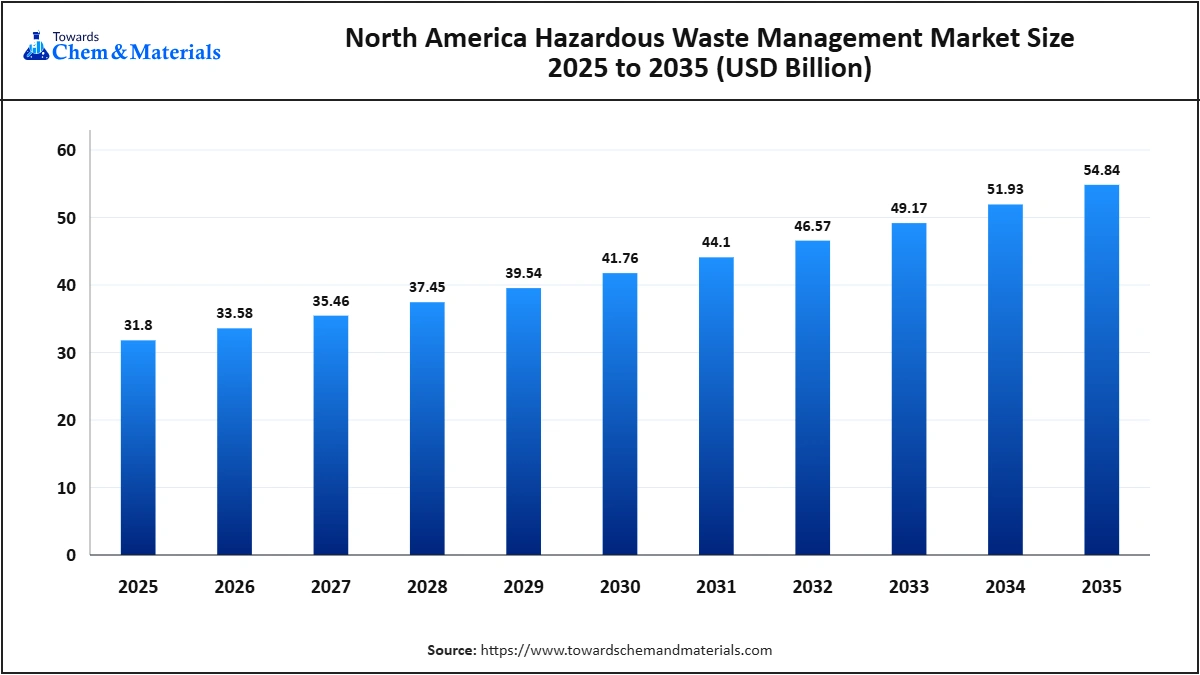
Note: 2025 is the base year; 2026-2035 values are forecasts.
Sources: Expert interviews, secondary sources, Towards Chemical and Materials database and Towards Chemical and Materials analysts.
The United States accounted for 86% of revenue, driven by its robust chemical, manufacturing, and oil and gas sectors, along with strict RCRA regulations. Limited permitted disposal capacity and growing demand for specialized hazardous waste treatment are strengthening the position of established waste management operators. The market is experiencing increasing consolidation, alongside investments in PFAS destruction, solvent recycling, oil re-refining, and digital waste tracking systems. For instance, in June 2026, Veolia completed its USD 3 billion acquisition of Clean Earth, reflecting continued consolidation in the North American hazardous waste management industry.
The North America hazardous waste management market is projected to grow from USD 31.80 billion in 2025 to USD 54.84 billion by 2035, driven by increasing industrial waste generation, stringent environmental regulations, and increasing demand for compliant hazardous-waste collection services, treatment, and disposal. Chemical processing, petrochemical production, oil and gas operations, manufacturing and healthcare activities generate substantial quantities of hazardous waste, creating a strong need for specialized management services.
The market is expected to reach USD 41.76 billion by 2030 and sustain a CAGR of 5.6% from 2026 to 2035. Manufacturing reshoring across North America is contributing to higher industrial waste generation, particularly in the chemical, automotive, and manufacturing industries. The use of digital manifests, solvent recycling, oil re-refining, and advanced recovery technologies is improving operational efficiency and resource recovery. AI in chemical manufacturing aids in reducing hazardous waste generation and enhances recycling initiatives for polyolefin and other plastic waste streams.
Analyst View: We estimated the market using hazardous waste volumes by type and country, alongside average service prices, cross-validated against North American revenues of leading hazardous waste management operators. Our assessment incorporates collection and transportation, treatment and disposal, recycling and recovery services, waste generator industries, country-level demand, and regulatory requirements.
Rising industrial production and stringent environmental regulations are supporting demand for hazardous waste management services across North America and stringent environmental regulations governing hazardous waste handling and disposal. Chemical, petrochemical, manufacturing, oil and gas, and pharmaceutical facilities generate hazardous waste requiring specialized management. U.S. regulations, particularly the Resource Conservation and Recovery Act (RCRA), mandate compliance with hazardous waste handling and disposal standards, creating a sustained need for professional hazardous waste management services.
Regulatory focus on PFAS is spurring growth in specialized treatment technologies and disposal infrastructure for PFAS waste. Increased manufacturing in North America is driving demand for hazardous waste management services, while limited treatment capacity highlights the importance of compliant facilities and specialized processing capabilities.
The market faces challenges from complex environmental permitting procedures, high infrastructure investment requirements, economic fluctuations, liability exposure, and transportation costs. Developing hazardous waste treatment and disposal facilities requires substantial investment and strict compliance with environmental regulations, permitting for incinerators and specialized treatment facilities can be lengthy, delaying infrastructure development.
Economic cycles influence industrial production and hazardous waste generation, especially in the chemical, manufacturing, and oil and gas sectors. Reduced industrial activity leads to lower waste volumes, impacting service demand and revenues. Hazardous waste management companies encounter substantial environmental and legal liabilities from improper handling and disposal. Additionally, high transportation costs for specialized waste streams can elevate operating expenses and hinder profitability.
Expanding PFAS treatment and destruction capabilities offers hazardous waste management companies a growth opportunity. Increasing regulatory demands and concerns over PFAS contamination are increasing the need for specialized treatment technologies and compliant disposal facilities, enabling companies to enhance services and address the evolving requirements of industrial waste generators. Recycling and resource recovery offer substantial growth prospects, as industries are embracing solvent recycling and oil re-refining to reduce waste disposal and reclaim reusable materials.
Manufacturing expansion in Mexico offers opportunities for hazardous waste management service providers, driven by increased industrial activity. The pharmaceutical and healthcare sectors are generating increasing demand for specialized waste management services due to the unique handling and treatment needs of medical and pharmaceutical waste. The adoption of solvent-recovery and reuse programmes and digital waste tracking systems is creating opportunities for operators to improve resource efficiency, regulatory compliance, and service differentiation.
| Driver | Impact | ≈ CAGR Contribution | Time Horizon | Key Regions |
| Industrial production | High | +2.19 pp | Short to long term | North America-wide, strongest in U.S. |
| Strict RCRA rules | Medium | +1.84 pp | Medium to long term | North America-wide, fastest uptake in Mexico |
| PFAS regulation | Medium | +1.57 pp | Short to medium term | North America-wide |
| Reshoring | Low | +1.23 pp | Long term | U.S. and Mexico |
Note: Contributions are indicative estimates of each factor's effect on annual growth.
Sources: Expert interviews, secondary sources, Towards Chemical and Materials database and Towards Chemical and Materials analysts.
The increasing industrial production, stringent environmental regulations, PFAS management requirements, and manufacturing reshoring are projected to contribute around 6.83 percentage points to the annual growth of the North America hazardous waste management market. With the expansion of industrial production, especially in chemical, petrochemical, manufacturing, and oil and gas industries, the regional market is expected to grow during the forecast period.
| Restraint | Impact | ≈ Negative CAGR Contribution | Time Horizon | Key Regions |
| Permitting difficulty for new sites | High | -0.55 pp | Short to medium term | North America-wide |
| Economic cycles | High | -0.41 pp | Medium term | Smaller and price-sensitive markets |
| Liability risks | Medium | -0.27 pp | Short term | U.S. and other mature markets |
Note: Contributions are indicative estimates of each factor's effect on annual growth.
Sources: Expert interviews, secondary sources, Towards Chemical and Materials database and Towards Chemical and Materials analysts.
Permitting difficulties, economic fluctuations, and environmental liability risks are estimated to reduce annual market growth by approximately 1.23 percentage points. Economic fluctuations affect industrial waste generation and service demand, while liability risks tied to hazardous waste management heighten operational challenges for providers. Nevertheless, increasing industrial activity, PFAS treatment requirements, and limited permitted disposal capacity are expected to support continued market expansion, resulting in a projected CAGR of 5.6% from 2026 to 2035.
| Segments | 2025 Share | 2035 Share | CAGR 2026-2035 |
| Treatment & Disposal | 52.00% | 49.53% | 5.09% |
| Collection & Transportation | 28.00% | 27.70% | 5.49% |
| Recycling & Recovery | 20.00% | 22.78% | 6.99% |
Note: 2025 is the base year; 2035 shares and CAGRs are forecasts.
Sources: Expert interviews, secondary sources, Towards Chemical and Materials database and Towards Chemical and Materials analysts.
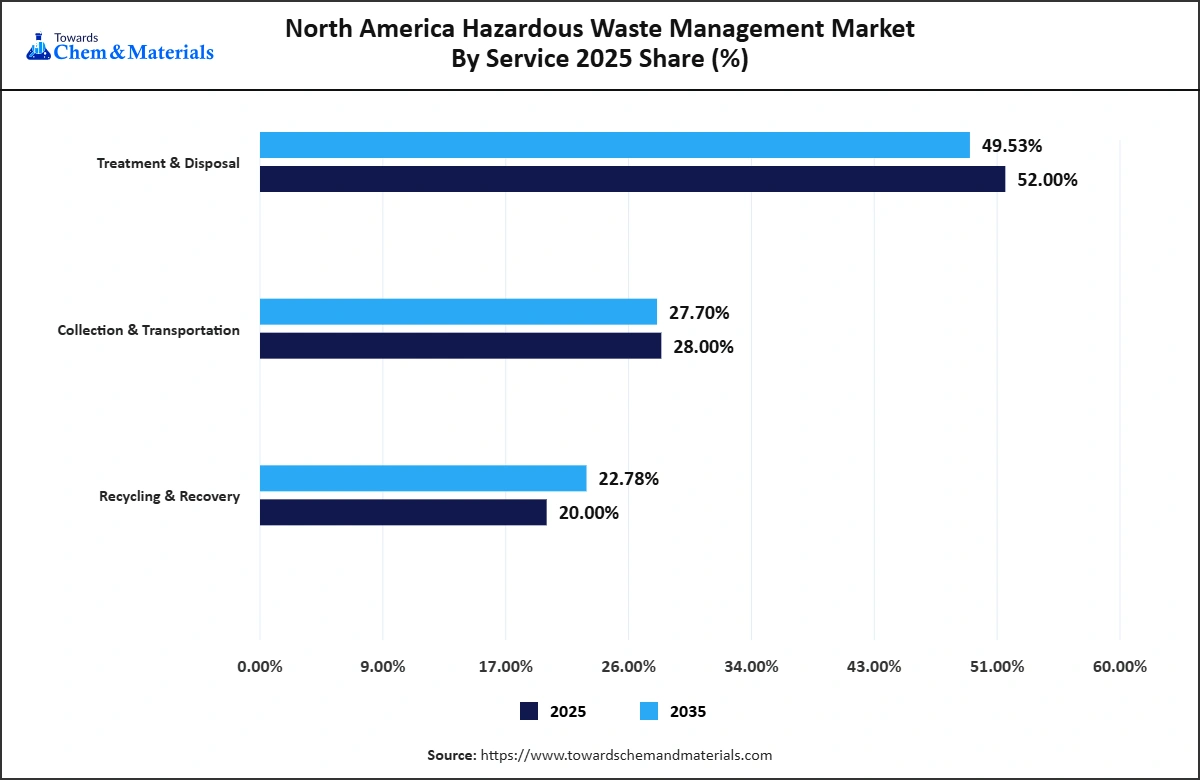
Treatment and disposal accounted for 52% of the North America hazardous waste management market in 2025, making it the largest service segment. Its position reflects demand for incineration, chemical and physical treatment, stabilization, and secure landfill disposal. Collection and transportation represented 28% of market revenue, supported by the need to collect, package, document, and transport hazardous waste to authorized facilities. Recycling and recovery accounted for the remaining 20%, with demand supported by solvent recovery, used-oil re-refining and other resource-recovery activities.
Treatment and disposal accounted for 52% of the market in 2025 and is projected to expand at a CAGR of 5.09% from 2026 to 2035. This segment highlights services for hazardous waste management, such as incineration, treatment, and secure landfill disposal, stressing the importance of strict environmental regulations and compliant facilities for industry leadership. However, the segment is expected to grow slower than the overall market over the forecast period.
Collection and transportation held 28% of the market in 2025. The segment is anticipated to register a CAGR of 5.49% through 2035. Collection and transportation services involve the handling, packaging, and tracking of hazardous waste from generators to authorized treatment and disposal facilities. The segment is projected to record growth broadly in line with the overall market.
Recycling and recovery accounted for 20% of the market in 2025 and is expected to expand at a CAGR of 6.99% from 2026 to 2035. Increasing emphasis on resource efficiency, waste reduction, and circular economy practices is encouraging industrial facilities to adopt recovery-based waste management solutions. The segment is expected to grow faster than the overall market.
Segment Outlook: During the forecast period, treatment and disposal is expected to retain its position as the largest service category. However, the share of recycling and recovery is projected to increase from 20% in 2025 to 22.78% in 2035, indicating a gradual shift toward resource recovery and circular waste management services.
| Segments | 2025 Share | 2035 Share | CAGR 2026-2035 |
| Chemical & Industrial Waste | 54.00% | 51.13% | 5.02% |
| Oil & Petroleum Waste | 18.00% | 17.71% | 5.42% |
| Medical & Pharmaceutical Waste | 14.00% | 13.77% | 5.42% |
| PFAS & Others | 14.00% | 17.40% | 7.92% |
Note: 2025 is the base year; 2035 shares and CAGRs are forecasts.
Sources: Expert interviews, secondary sources, Towards Chemical and Materials database and Towards Chemical and Materials analysts.
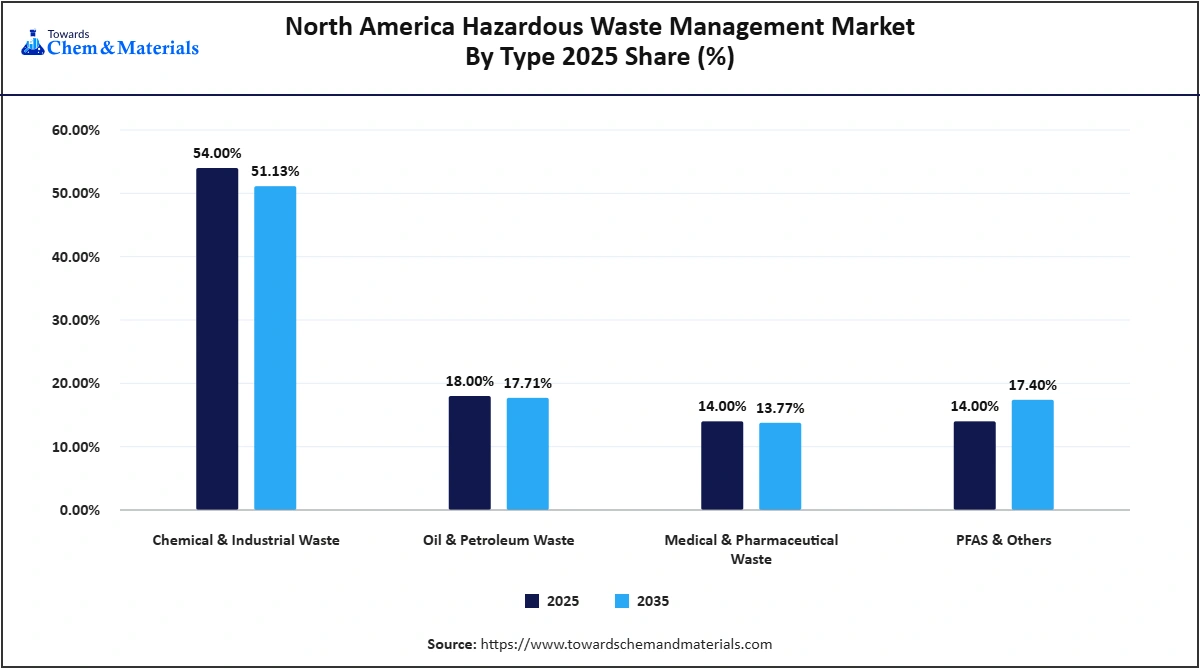
In 2025, chemical and industrial waste accounted for 54% of the North America hazardous waste management market, followed by oil and petroleum waste at 18%, medical and pharmaceutical waste at 14%, and PFAS and other waste at 14%. Chemical and industrial waste, mainly from processing facilities and manufacturing plants, requires specialized treatment due to its hazardous nature. PFAS-containing and other specialized waste streams are projected to grow rapidly through 2035, fueled by increased regulatory scrutiny and demand for advanced treatment options.
Chemical and industrial waste accounted for 54% of the market in 2025 and is projected to expand at a CAGR of 5.02% from 2026 to 2035. This segment identifies hazardous waste from chemical processing plants and manufacturing facilities, highlighting a consistent demand for collection, treatment, and disposal services in North America. However, its growth is anticipated to lag behind the overall market growth.
Oil and petroleum waste held 18% of the market in 2025. The segment is anticipated to register a CAGR of 5.42% through 2035. This category encompasses hazardous waste from oilfields, refineries, and petroleum processing, necessitating specialized waste management services. The segment is projected to grow alongside the overall market.
Medical and pharmaceutical waste captured 14% of the market in 2025 and is projected to expand at a CAGR of 5.42% by 2035. This segment covers regulated waste from hospitals, healthcare facilities, pharmaceutical manufacturers, and research organizations. Rising activities in healthcare and pharmaceutical production are driving demand for specialized waste collection, treatment, and disposal services, with broad growth anticipated in line with the overall market.
PFAS and others represented 14% of the market in 2025 and are expected to register a CAGR of 7.92% through 2035. This category includes PFAS-containing waste and other emerging or specialized hazardous waste streams requiring specific treatment and disposal approaches. The segment is expected to grow faster than the overall market.
Segment Outlook: Based on the analysis, chemical and industrial waste is expected to remain the largest waste type segment through 2035, although its share is projected to decline from 54% in 2025 to around 51.13% in 2035. PFAS and other waste are expected to record the highest waste type-level CAGR of 7.92%, increasing their share to 17.40%. Growing regulatory requirements and investments in specialized PFAS treatment and destruction infrastructure are expected to support this shift in waste management demand.
| Segments | 2025 Share | 2035 Share | CAGR 2026-2035 |
| Chemical & Petrochemical | 32.00% | 30.67% | 5.15% |
| Manufacturing | 26.00% | 25.88% | 5.55% |
| Oil & Gas | 16.00% | 15.92% | 5.55% |
| Healthcare & Pharma | 14.00% | 15.59% | 6.75% |
| Others | 12.00% | 11.94% | 5.55% |
Note: 2025 is the base year; 2035 shares and CAGRs are forecasts.
Sources: Expert interviews, secondary sources, Towards Chemical and Materials database and Towards Chemical and Materials analysts.
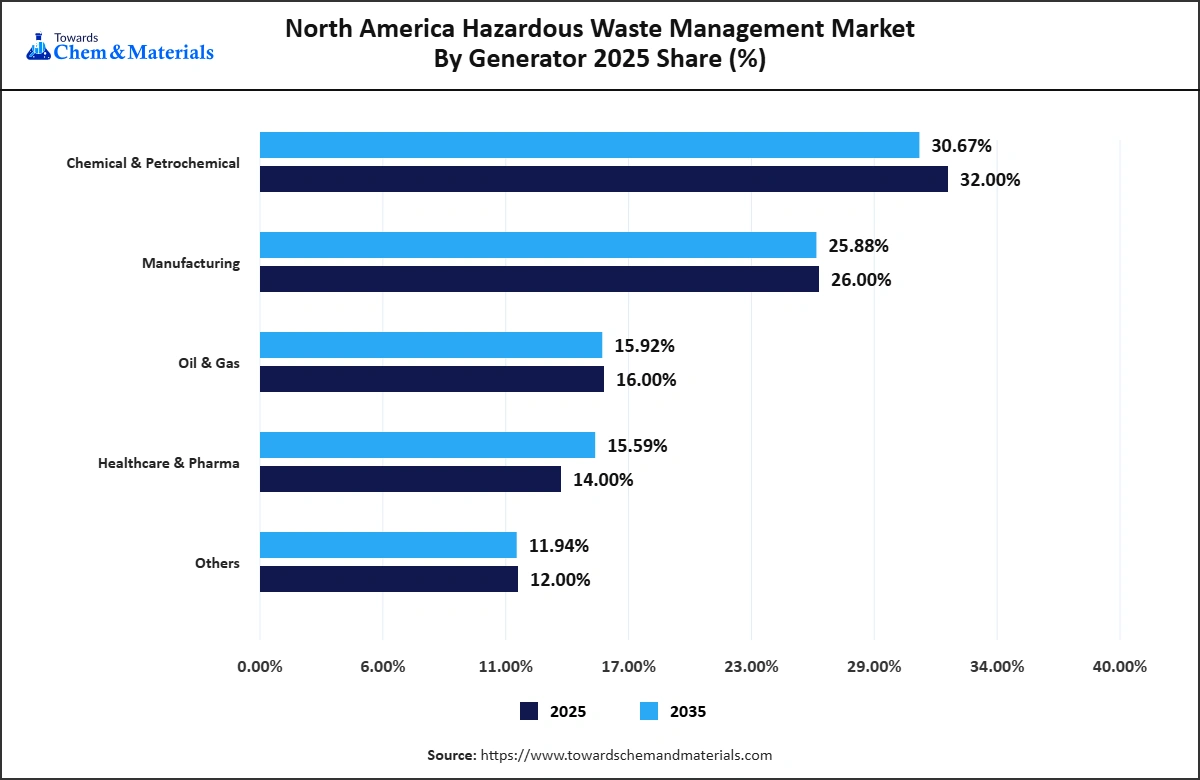
In 2025, chemical and petrochemical industries accounted for 32% of the North America hazardous waste management market, followed by manufacturing at 26%, oil and gas at 16%, healthcare and pharmaceuticals at 14%, and other generators at 12%. Chemical and petrochemical industries dominate because their production and processing activities generate substantial volumes of hazardous waste requiring specialized handling and treatment. Healthcare and pharmaceutical generators are expected to experience rapid growth due to rising healthcare activities and manufacturing needs.
Chemical and petrochemical accounted for 32% of the market in 2025. The generators are projected to expand at a CAGR of 5.15% from 2026 to 2035. Chemical and petrochemical facilities produce hazardous waste from processing and manufacturing activities. Their significant waste management and environmental compliance needs reinforce their leading market position, although growth is anticipated to be slower than the overall market.
Manufacturing captured 26% of the market in 2025 and is anticipated to register a CAGR of 5.55% through 2035. Manufacturing facilities produce hazardous waste such as paints, solvents, and metals, necessitating specialized management. Growing manufacturing activity and reshoring in North America are driving demand for waste management services, which are projected to grow alongside the overall market.
Oil and gas held 16% of the market in 2025 and is projected to expand at a CAGR of 5.55% from 2026 to 2035. Oil and gas operations generate hazardous waste through drilling, extraction, refining, and petroleum processing activities. The demand for compliant waste handling and specialized treatment solutions is anticipated to drive growth across upstream and downstream operations, aligning with the overall market expansion.
Healthcare and pharma represented 14% of the market in 2025. The segment is expected to register a CAGR of 6.75% through 2035. Increasing healthcare activities and pharmaceutical production are supporting demand for compliant waste management services. The segment is expected to grow faster than the overall market.
Others accounted for 12% of the market in 2025 and is anticipated to register a CAGR of 5.55% from 2026 to 2035. This category includes hazardous waste generated by government facilities, retail operations, and other specialized sources, requires appropriate collection, transportation, and disposal services to meet waste management regulations. Market growth is expected to drive expansion in this segment during the forecast period.
Segment Outlook: Chemical and petrochemical industries are expected to remain the largest generator segment throughout the forecast period, although their share is projected to decline from 32.00% in 2025 to roughly 30.67% in 2035. Healthcare and pharmaceuticals are expected to record the highest generator-level CAGR of 6.75%, increasing their share to 15.59%. Growing pharmaceutical production and healthcare waste management requirements are expected to support this shift in generator demand.
Analyst View: In our analysis, segment estimates were developed by allocating market demand according to hazardous waste generation volumes, service requirements, waste composition, industry-level activity, country-level demand, and average service prices. Treatment and disposal, chemical and industrial waste, and chemical and petrochemical generators remain the leading segments because they address the core hazardous waste management requirements of North American industries. These developments are expected to gradually reshape the North America hazardous waste management market through 2035.
| Country | 2025 Share | 2035 Share | CAGR 2026-2035 |
| U.S. | 86.00% | 85.01% | 5.48% |
| Canada | 9.00% | 9.25% | 5.88% |
| Mexico | 5.00% | 5.74% | 7.08% |
Note: 2025 is the base year; 2035 shares and CAGRs are forecasts.
Sources: Expert interviews, secondary sources, Towards Chemical and Materials database and Towards Chemical and Materials analysts.
The United States dominated the North America hazardous waste management market with an 86% revenue share in 2025, followed by Canada at 9% and Mexico at 5%. The United States leads because of its large chemical, manufacturing, and oil and gas industries, benefiting from strong hazardous waste treatment systems and strict RCRA regulations. Meanwhile, Mexico is expected to witness the fastest growth, fueled by expanding manufacturing, rising industrial waste, and stricter regulations.
The U.S. accounted for 86% of the market in 2025. The country is projected to register a CAGR of 5.48% from 2026 to 2035. Stringent RCRA requirements and environmental compliance obligations are driving demand for specialized hazardous waste services. Established waste management operators and extensive treatment infrastructure enhance the U.S. market position, which is anticipated to grow in line with overall market trends.
Canada represented 9% of the market in 2025 and is anticipated to expand at a CAGR of 5.88% through 2035. The market in Canada is influenced by oil sands operations, industrial manufacturing, petroleum processing, and other resource-intensive activities that generate hazardous waste requiring specialized collection, transportation, treatment, and disposal services. Canada is expected to grow broadly in line with the overall market.
Mexico captured 5% of the market in 2025 and is expected to record the fastest CAGR of 7.08% from 2026 to 2035. Market growth is supported by expanding manufacturing activities and rising demand for compliant hazardous waste management services. Manufacturing expansion and reshoring are creating additional requirements for hazardous waste collection, transportation, treatment, and disposal. Mexico is expected to grow faster than the overall market.
Analyst View: In our analysis, country-level estimates for hazardous waste management are based on generation volumes, industrial activity, treatment infrastructure, service prices, and supplier presence. The U.S. leads due to a mature industrial base and robust waste management services. Mexico shows significant growth due to rising manufacturing investments and faster adoption of hazardous waste management services.
| Rank | Company Name | 2025 Share (%) | Key Products / Business | Headquarters |
| 1 | Clean Harbors | 22.00% | Incineration, treatment and Safety-Kleen recycling | United States |
| 2 | Veolia North America | 14.00% | Hazardous waste incl. Clean Earth | France |
| 3 | Republic Services (US Ecology) | 8.00% | Hazardous waste treatment and landfill | United States |
| 4 | WM (Waste Management) | 5.00% | Industrial and hazardous waste | United States |
| 5 | Stericycle (WM Healthcare Solutions) | 4.00% | Medical waste | United States |
| 6 | Heritage-Crystal Clean | 3.00% | Used oil and solvent recycling | United States |
| 7 | GFL Environmental | 3.00% | Liquid and industrial waste | Canada |
| 8 | Heritage Environmental Services | 2.00% | Treatment and disposal | United States |
| 9 | Triumvirate Environmental | 1.00% | Hazardous waste services | United States |
| 10 | Terrapure Environmental | 1.00% | Industrial waste services | Canada |
Note: Company shares are 2025 estimates.
Sources: Company press releases, expert interviews, secondary sources, Towards Chemical and Materials database and Towards Chemical and Materials analysts.
The North America hazardous waste management market features a combination of large integrated operators and specialized regional service providers. Competition is shaped by access to permitted treatment and disposal facilities, incineration capabilities, transportation networks, geographic coverage, and expertise in managing specialized waste streams.
Clean Harbors, Veolia North America, Republic Services and WM are among the major participants, while Heritage Environmental Services, GFL Environmental, Triumvirate Environmental and other specialized operators serve selected industrial and regional markets. Companies with integrated collection, treatment, recycling and disposal capabilities can offer broader service coverage and develop long-term relationships with industrial waste generators.
The top 10 companies accounted for an estimated 63.00% of 2025 revenue, while the remaining around 37.00% was shared among numerous regional transporters, specialized waste management providers, and treatment facilities. The market exhibits moderate concentration, with key operators leveraging advantages in treatment capacity, incineration and landfill access, and transportation networks. Competition focuses on service coverage, treatment capabilities, operational reliability, environmental compliance, infrastructure, and pricing.
Clean Harbors: Clean Harbors, based in the United States, held an estimated 22% share of the North America hazardous waste management market in 2025. Its service portfolio focuses on hazardous waste incineration, treatment, and Safety-Kleen recycling services. Based on the Towards Chemical and Materials Companies Quadrant assessment, the company is positioned as a Leader.
Veolia North America: Veolia North America, headquartered in France, accounted for an estimated 14% of the market in 2025. Its service portfolio focuses on hazardous waste management services, including Clean Earth. In the Towards Chemical and Materials Companies Quadrant, Veolia North America is categorized as a Leader.
Republic Services (US Ecology): Republic Services is headquartered in the United States. In 2025, it held an estimated 8% market share. Its portfolio includes hazardous waste treatment and landfill services for industrial waste generators. According to the Towards Chemical and Materials Companies Quadrant, Republic Services is placed as a Leader.
WM (Waste Management): WM, based in the United States, accounted for an estimated 5% of the market in 2025. It provides industrial and hazardous waste management services, leveraging an established waste collection network and extensive waste management operations. The competitive assessment classifies WM as a Leader.
Stericycle (WM Healthcare Solutions): Stericycle is headquartered in the United States. In 2025, the company held an estimated 4% market share. Its specialized healthcare waste management capabilities support its position in the market. The company is classified as a Leader in the competitive assessment of the Towards Chemical and Materials Companies Quadrant.
Heritage-Crystal Clean: Heritage-Crystal Clean is based in the United States, with an estimated 3% market share in 2025. The company's specialized resource recovery capabilities support demand from industrial customers seeking waste recycling and management solutions. In the Towards Chemical and Materials Companies Quadrant, it is classified as a Leader.
GFL Environmental: GFL Environmental is headquartered in Canada. The company held an estimated 3% market share in 2025. Its portfolio includes liquid and industrial waste management services supported by an established environmental services network. According to the Towards Chemical and Materials Companies Quadrant, GFL Environmental is positioned as an Innovator.
Heritage Environmental Services: Heritage Environmental Services, headquartered in the United States, accounted for an estimated 2% of the market in 2025. Its services revolve around hazardous waste treatment and disposal, targeting specialized waste management needs and compliant solutions for industrial generators. In the Towards Chemical and Materials Companies Quadrant, the company is categorized as an Innovator.
Triumvirate Environmental: Triumvirate Environmental, based in the United States, held an estimated 1% share of the market in 2025. The company’s portfolio focuses on specialized hazardous waste management services. According to the Towards Chemical and Materials Companies Quadrant, Triumvirate Environmental is positioned as an Innovator.
Terrapure Environmental: Terrapure Environmental, headquartered in Canada, accounted for an estimated 1% market share in 2025. The company serves the regional market through specialized industrial waste handling and management capabilities. In the Towards Chemical and Materials Companies Quadrant, the company is classified as an Innovator.
The North America hazardous waste management ecosystem connects hazardous waste generators, collection and transportation providers, treatment and disposal operators, recyclers, and regulatory authorities. Each stage contributes to the collection, movement, processing, recovery, and compliant disposal of hazardous waste generated across chemical, petrochemical, manufacturing, oil and gas, healthcare, and pharmaceutical industries.
| Ecosystem Stage | Role in the Market | Key Companies |
| Generators | Produce hazardous waste | Chemical plants, factories, hospitals |
| Collection & Transport | Move waste | Clean Harbors, Veolia, regional haulers |
| Treatment & Disposal | Treat, incinerate and landfill | Clean Harbors, Veolia, Republic Services |
| Recyclers | Recover solvents and oils | Safety-Kleen, Heritage-Crystal Clean |
| Regulators | Set rules | EPA RCRA, Environment Canada, SEMARNAT |
Sources: Company press releases, expert interviews, secondary sources, Towards Chemical and Materials database and Towards Chemical and Materials analysts.
Generators: Hazardous waste generators include chemical plants, petrochemical facilities, manufacturing factories, oil and gas operations, hospitals, and pharmaceutical companies.
Collection & Transport: Collection and transportation providers handle the collection, packaging, movement, and tracking of hazardous waste from generators to authorized treatment and disposal facilities. Clean Harbors, Veolia, and regional transportation companies support regulatory compliance through appropriate waste handling and transportation networks.
Treatment & Disposal: Treatment and disposal operators manage hazardous waste through incineration, chemical and physical treatment, and secure landfill facilities. Companies such as Clean Harbors, Veolia, and Republic Services provide specialized infrastructure and services to manage hazardous waste streams in accordance with environmental requirements.
Recyclers: Recyclers recover reusable materials from hazardous waste streams, particularly solvents and used oils. Key participants include Safety-Kleen and Heritage-Crystal Clean in this stage.
Regulators: Regulatory authorities such as the U.S. EPA, Environment and Climate Change Canada, and Mexico's SEMARNAT that establish and enforce hazardous waste regulations, guided by the U.S. RCRA.
Value in the North America hazardous waste management market flows from hazardous waste generators to collection and transportation providers, followed by treatment and disposal operators and recycling companies. Regulatory authorities oversee the entire value chain by establishing environmental standards and compliance requirements. Companies that integrate multiple stages, maintain permitted treatment infrastructure, develop specialized waste processing capabilities, and establish long-term relationships with industrial generators can strengthen their competitive positions and capture a larger share of market value.
The Towards Chemical and Materials Companies Quadrant positions key participants in the North America hazardous waste management market by market strength, reflecting revenue scale, market share, and geographic reach, and by innovation and growth strategy, reflecting product portfolio breadth, R&D intensity, and partnerships. Positions reflect each company's estimated 2025 share of the North America hazardous waste management market and our assessment of its product innovation, portfolio breadth, and partnerships.
Sources: Company press releases, expert interviews, secondary sources, Towards Chemical and Materials database and Towards Chemical and Materials analysts.
Leaders: Clean Harbors, Veolia North America, Republic Services (US Ecology), WM (Waste Management), Stericycle (WM Healthcare Solutions), and Heritage-Crystal Clean combine high market share with broad portfolios and strong innovation.
Innovators: GFL Environmental, Heritage Environmental Services, Triumvirate Environmental, and Terrapure Environmental bring newer technologies and specialised products.
By Service
By Waste Type
By Generator
By Country
The North America hazardous waste management market is assessed through a bottom-up analysis of demand in the U.S., Canada, and Mexico, focusing on hazardous waste generation, service needs, pricing, industrial activity, and infrastructure availability. The market is segmented into collection and transportation, treatment and disposal, and recycling and recovery to reflect service variations. It includes waste from sectors such as chemicals, manufacturing, oil and gas, healthcare, and pharmaceuticals, categorized by type into chemical, industrial, oil, medical, and PFAS waste, ensuring no double counting of services among categories. The 2025 base-year estimate was developed by combining country-level hazardous waste generation volumes, service demand, and average pricing. The resulting estimate was cross-checked against the North American hazardous waste management revenues of leading operators, company disclosures, expert interviews, industry data, and published third-party market estimates. Segment, country, and company shares were allocated according to service portfolios, waste generation patterns, geographic presence, and competitive positioning. The forecast incorporates assumptions about industrial production, environmental regulations, and PFAS management, alongside manufacturing reshoring and recycling services. It also considers infrastructure development, permitting challenges, economic fluctuations, environmental liabilities, and transportation costs. Estimates for incineration capacity, secure landfill availability, and digital waste tracking were reconciled using a 2025 base year, with a projected market CAGR of 5.6% from 2026 to 2035 to ensure consistency across various categories and regions.
The North America hazardous waste management market is expected to maintain steady growth through 2035, supported by industrial demand, regulatory compliance requirements, and the need for specialized waste treatment. Treatment and disposal will remain the largest service category, while recycling and recovery are expected to gain share as industrial customers place greater emphasis on resource efficiency and waste minimization.
The United States will continue to dominate the regional market because of its established treatment infrastructure and broad industrial base. Mexico offers an emerging growth opportunity, although the pace of expansion will depend on industrial investment, compliant facility development, and the availability of specialized waste management services. For operators, investment in permitted infrastructure, treatment capabilities, efficient logistics and regulatory compliance will remain central to competitive differentiation.
Reliable market intelligence and data-driven insights across the global chemicals and materials industry, helping businesses understand trends, competition, pricing, and emerging opportunities.
Schedule a Demo