Find the Right Market Report
Search thousands of industry reports, market insights, and research studies in one place.
Not sure where to start? Try one of these:
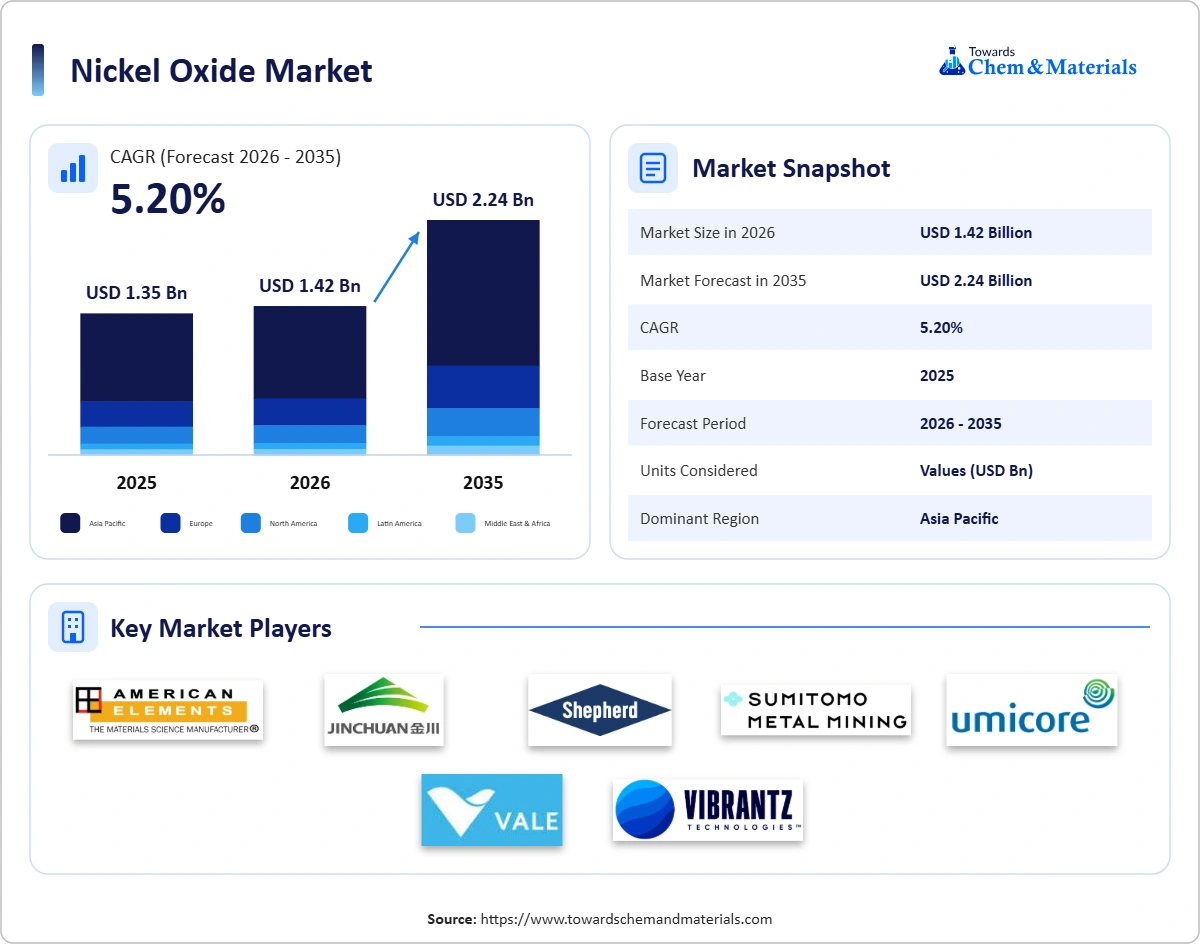
The global nickel oxide market size was valued at USD 1.35 billion in 2025 and is expected to reach USD 2.24 billion by 2035, growing at a CAGR of 5.20% during the forecast period of 2026-2035. The nickel oxide market was valued at USD 1.35 billion in 2025, the base year. The nickel oxide market includes green nickel oxide (NiO) and black nickel oxide in different forms, such as nickel oxide sinter and fine powders.
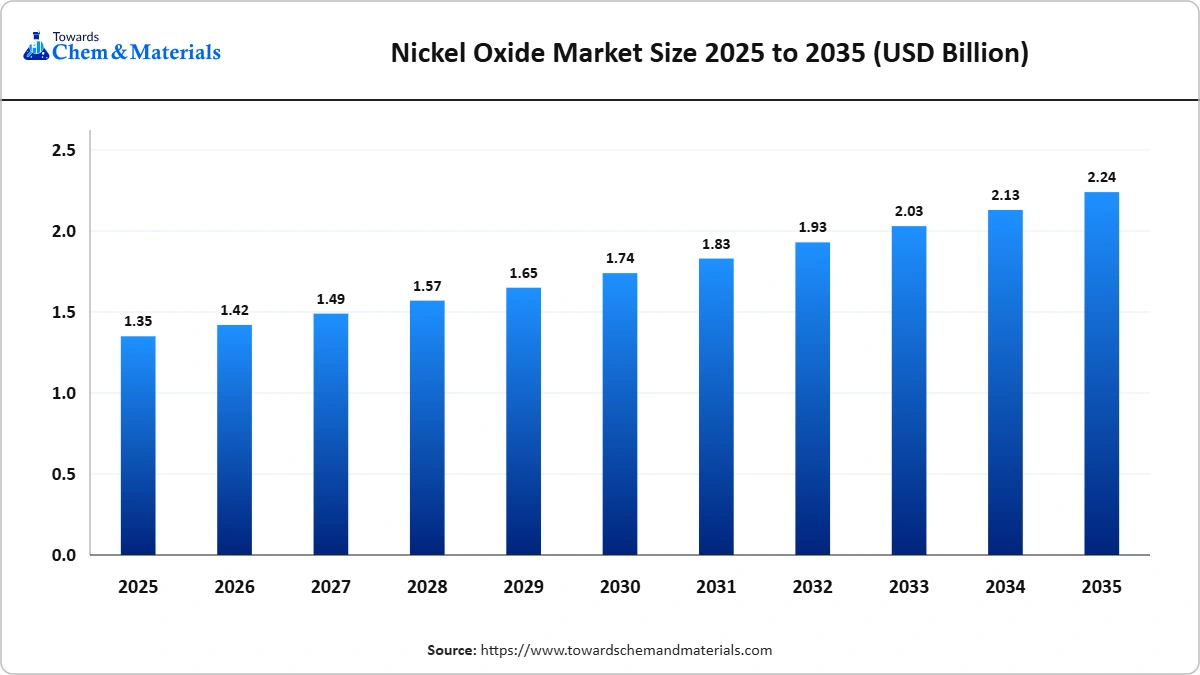
Note: 2025 is the base year; 2026-2035 values are forecasts.
Sources: Expert interviews, secondary sources, Towards Chemical and Materials database, and Towards Chemical and Materials analysts.
These products are available in metallurgical, chemical, and high-purity electronic grades and serve a wide range of industries. Key applications include stainless steel and alloy manufacturing, ceramics, glass, pigments, catalysts, electronic components such as thermistors and ferrites, solid oxide fuel cells, and battery materials. Stainless Steel & Alloys represented the largest application segment, accounting for 46.00% of the market in 2025. This leading share reflects the use of nickel oxide sinter as a direct feedstock in steelmaking and alloy production. Asia Pacific dominated the regional market with a 62.00% revenue share in 2025, supported by China's and Japan's strong stainless steel, electronics, and nickel-processing industries. Market demand continues to benefit from consumption across stainless steel manufacturing, electronics, catalysts, and fuel cell technologies. However, changes in nickel raw material supply policies are influencing the industry landscape. In February 2026, Indonesia reduced the production quota for the Weda Bay mining operation, highlighting the impact of resource allocation policies on nickel supply.
The nickel oxide market is poised for steady growth, increasing from USD 1.35 billion in 2025 to USD 2.24 billion by 2035. Its role in supplying nickel for steel and alloy production, along with its use in catalysts, ceramics, and electronic components, continues to support demand. Growing applications across stainless steel manufacturing, electronics, catalyst production, and fuel cell technologies are expected to push the market to USD 1.74 billion by 2030, registering a CAGR of 5.20% from 2026 to 2035.
Analyst View: Our market estimate draws on nickel oxide production and consumption patterns across key applications, alongside regional pricing trends linked to nickel. We cross-checked these estimates against producer activity and trade data to maintain consistency. Given the limited availability of published market estimates, our assessment relies on available industry evidence and demand indicators.
Market Drivers - Impact & CAGR Contribution (2026-2035)
| Driver | Impact | ≈ CAGR Contribution | Time Horizon | Key Regions |
| Stainless steel and alloys | High | +2.03 pp | Short to long term | Global, strongest in Asia Pacific |
| Electronics | Medium | +1.71 pp | Medium to long term | Global, fastest uptake in Asia Pacific |
| Catalysts | Medium | +1.46 pp | Short to medium term | Global |
| Fuel cells | Low | +1.14 pp | Long term | Developed and emerging markets |
Note: Contributions are indicative estimates of each factor's effect on annual growth.
Sources: Expert interviews, secondary sources, Towards Chemical and Materials database, and Towards Chemical and Materials analysts.
Collectively, these growth drivers contribute approximately 6.34 percentage points to the nickel oxide market's annual growth, with demand from stainless steel and alloy production serving as the primary growth contributor. Their impact is most pronounced in Asia Pacific, which also remains the fastest-growing region in terms of market adoption.
MMarket Restraints - Impact & Negative CAGR Contribution (2026-2035)
| Restraint | Impact | ≈ Negative CAGR Contribution | Time Horizon | Key Regions |
| Nickel price volatility | High | -0.51 pp | Short to medium term | Global |
| Nickel compound regulation | High | -0.38 pp | Medium term | Price-sensitive and emerging markets |
| Substitution | Medium | -0.25 pp | Short term | Asia Pacific and other mature markets |
Note: Contributions are indicative estimates of each factor's effect on annual growth.
Sources: Expert interviews, secondary sources, Towards Chemical and Materials database and Towards Chemical and Materials analysts.
These restraints are expected to reduce annual growth of the nickel oxide market by about 1.14 percentage points, led by nickel price volatility. Their effect eases over the forecast period as suppliers, buyers, and regulators adapt, leaving a net CAGR of 5.20% from 2026 to 2035.
| Segments | 2025 Share | 2035 Share | CAGR 2026-2035 |
| Stainless Steel & Alloys | 46.00% | 44.20% | 4.74% |
| Catalysts | 14.00% | 13.84% | 5.14% |
| Ceramics, Glass & Pigments | 14.00% | 13.84% | 5.14% |
| Electronics & Fuel Cells | 14.00% | 16.07% | 6.74% |
| Batteries & Others | 12.00% | 12.05% | 5.14% |
Note: 2025 is the base year; 2035 shares and CAGRs are forecasts.
Sources: Expert interviews, secondary sources, Towards Chemical and Materials database, and Towards Chemical and Materials analysts.
Stainless Steel & Alloys accounted for 46.00% in 2025, Catalysts for 14.00%, Ceramics, Glass & Pigments for 14.00%, Electronics & Fuel Cells for 14.00%, and Batteries & Others for 12.00%. Stainless Steel & Alloys leads, while Electronics & Fuel Cells is growing fastest.
Stainless Steel & Alloys segment held the largest share of the nickel oxide market at 46.00% in 2025 and is projected to grow at a CAGR of 4.74% from 2026 to 2035. Its leading position reflects the use of nickel oxide sinter as a direct nickel source in steel and alloy furnaces. However, the segment is expected to expand at a slower pace than the overall market during the forecast period.
Catalysts segment accounts for 14.00% of the market in 2025; the catalysts segment is projected to register a CAGR of 5.14% by 2035. Nickel oxide supports catalyst production across various industrial processes, helping maintain consistent demand.
Ceramics, Glass & Pigments segment captured 14.00% of the market in 2025 and is expected to expand at a CAGR of 5.14% through 2035. Its demand is supported by the use of nickel oxide in ceramic colours, glass formulations, and pigment production.
Electronics & Fuel Cells holds a 14.00% market share in 2025; this segment is forecast to grow at the fastest CAGR of 6.74% from 2026 to 2035. Increasing applications of nickel oxide in electronic components and fuel cell technologies are expected to support its stronger growth. As a result, the segment is projected to outperform the overall market.
Batteries & Others segment represented 12.00% of the nickel oxide market in 2025 and is projected to grow at a CAGR of 5.14% by 2035. Demand comes from battery-related applications and other specialised uses of nickel oxide.
Segment Outlook: Stainless Steel & Alloys is expected to retain its leading position through 2035, although its market share is projected to moderate to approximately 44.20%. Meanwhile, Electronics & Fuel Cells is set to record the fastest growth, with a CAGR of 6.74% over the forecast period. Batteries & Others remains the smallest application segment, serving more specialised areas of nickel oxide demand.
| Segments | 2025 Share | 2035 Share | CAGR 2026-2035 |
| Green Nickel Oxide | 62.00% | 60.27% | 4.89% |
| Black Nickel Oxide | 38.00% | 39.73% | 5.69% |
Note: 2025 is the base year; 2035 shares and CAGRs are forecasts.
Sources: Expert interviews, secondary sources, Towards Chemical and Materials database, and Towards Chemical and Materials analysts.
Green Nickel Oxide accounted for 62.00% in 2025 and Black Nickel Oxide for 38.00%. Green Nickel Oxide leads, while Black Nickel Oxide is growing fastest.
Green Nickel Oxide segment dominated the nickel oxide market with a 62.00% share in 2025 and is projected to grow at a CAGR of 4.89% from 2026 to 2035. Its leading position reflects its established role across key industrial applications.
Black Nickel Oxide representing 38.00% of the market in 2025, this segment is projected to register a CAGR of 5.69% by 2035. Its use in catalyst production and ceramic applications supports demand, while its relatively faster growth is expected to help it gain market share over the forecast period.
Segment Outlook: Green Nickel Oxide is expected to maintain its leading position through 2035, although its share is projected to moderate to approximately 60.27%. In comparison, Black Nickel Oxide is forecast to record the faster CAGR of 5.69%. Its stronger growth trajectory highlights the expanding demand for this type across specialised industrial applications.
| Segments | 2025 Share | 2035 Share | CAGR 2026-2035 |
| Metallurgical | 50.00% | 47.77% | 4.69% |
| Chemical | 32.00% | 31.70% | 5.09% |
| High-Purity Electronic | 18.00% | 20.54% | 6.69% |
Metallurgical accounted for 50.00% in 2025, Chemical for 32.00%, and High-Purity Electronic for 18.00%. Metallurgical leads, while High-Purity Electronic is growing fastest.
Metallurgical Grade segment held the largest share of the nickel oxide market at 50.00% in 2025 and is projected to grow at a CAGR of 4.69% through 2035. Its leading position reflects its established role in metal production and alloy manufacturing. However, the segment is expected to grow at a slower pace than the overall market during the forecast period.
Chemical Grade accounting for 32.00% of the market in 2025, the chemical grade segment is projected to register a CAGR of 5.09% from 2026 to 2035. Its use across chemical processing and industrial applications supports steady demand.
High-Purity Electronic Grade segment represented 18.00% of the market in 2025 and is forecast to record the fastest growth, with a CAGR of 6.69% by 2035. Increasing demand for advanced electronic components and high-performance materials is expected to support its expansion.
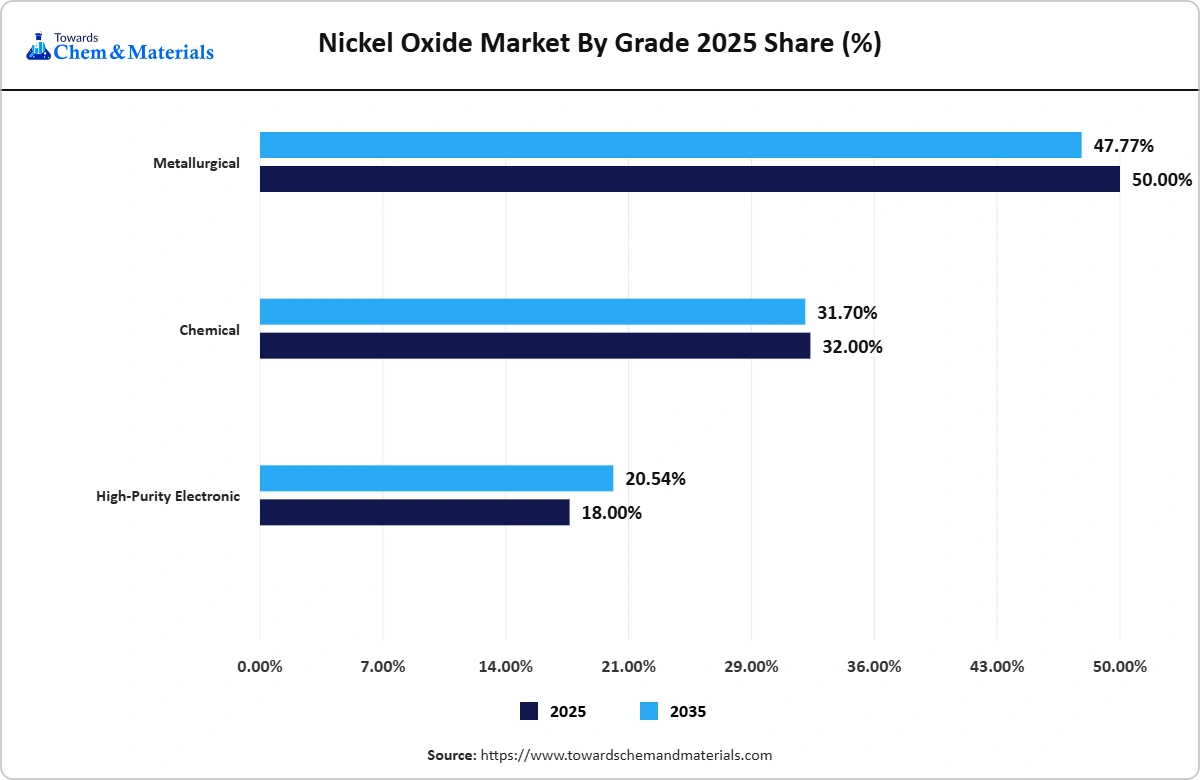
Note: 2025 is the base year; 2035 shares and CAGRs are forecasts.
Sources: Expert interviews, secondary sources, Towards Chemical and Materials database, and Towards Chemical and Materials analysts.
Segment Outlook: Metallurgical Grade is expected to retain its position as the largest segment through 2035, although its market share is projected to ease to approximately 47.77%. Meanwhile, High-Purity Electronic Grade is set to record the fastest growth, with a CAGR of 6.69%. Despite starting from a smaller base, its stronger growth trajectory reflects the increasing importance of specialised grades in advanced technology applications.
Analyst View: We assessed segment shares using application-level demand, product portfolios, and prevailing pricing patterns across each grade. Metallurgical Grade maintains its leading position because of its established role in traditional nickel oxide applications, while Chemical Grade continues to serve a broad range of industrial needs. Looking ahead, High-Purity Electronic Grade is expected to gain ground as demand for advanced electronics and specialised materials expands. These shifts point to a gradual change in the market's grade mix over the forecast period.
| Region | 2025 Share | 2035 Share | CAGR 2026-2035 |
| Asia Pacific | 62.00% | 64.73% | 5.64% |
| Europe | 18.00% | 16.96% | 4.44% |
| North America | 12.00% | 11.16% | 4.44% |
| Latin America | 4.00% | 3.57% | 4.44% |
| Middle East & Africa | 4.00% | 3.57% | 4.44% |
Note: 2025 is the base year; 2035 shares and CAGRs are forecasts.
Sources: Expert interviews, secondary sources, Towards Chemical and Materials database, and Towards Chemical and Materials analysts.
Asia Pacific accounted for 62.00% in 2025, Europe for 18.00%, North America for 12.00%, Latin America for 4.00%, and the Middle East & Africa for 4.00%. Asia Pacific leads and is also growing fastest.
Asia Pacific dominated the nickel oxide market with a 62.00% share in 2025 and is projected to grow at the fastest CAGR of 5.64% through 2035. Its leading position is supported by strong stainless steel production, electronics manufacturing, and nickel processing activities across China and Japan. With continued industrial expansion and established supply networks, the region is expected to outperform the overall market during the forecast period.
Europe held 18.00% of the nickel oxide market in 2025 and is expected to register a CAGR of 4.44% from 2026 to 2035. Demand is supported by the region's alloy manufacturing base and applications in ceramics and other industrial processes. However, growth is projected to remain below the overall market average.
North America captured 12.00% of the market in 2025 and is projected to expand at a CAGR of 4.44% through 2035. Demand from alloy manufacturing and catalyst applications continues to support regional consumption. Nevertheless, the market is expected to grow at a slower pace than the global average.
Latin America accounted for 4.00% of the nickel oxide market in 2025 and is forecast to grow at a CAGR of 4.44% from 2026 to 2035. The region's relatively limited industrial demand and smaller application base are expected to keep its market expansion below the overall growth rate.
Middle East & Africa represented 4.00% of the market in 2025 and is projected to register a CAGR of 4.44% over the forecast period. Its comparatively limited demand base and developing industrial applications are expected to result in slower growth than the overall nickel oxide market.
Analyst View: We assessed regional market shares by considering application-level demand, installed industrial capacity, spending patterns, and supplier presence. Asia Pacific maintains a clear lead, supported by its established nickel processing industry and strong stainless steel and electronics manufacturing base. We also expect the region to retain its growth advantage as industrial investment and production capacity continue to expand. In comparison, other regions are likely to experience more moderate growth, reflecting their smaller demand bases and narrower application reach.
| Rank | Company Name | 2025 Share (%) | Key Products / Business | Headquarters |
| 1 | Sumitomo Metal Mining | 14.00% | Nickel oxide powder | Japan |
| 2 | Vale Base Metals | 8.00% | Nickel oxide products | Brazil |
| 3 | Jinchuan Group | 8.00% | Nickel oxide | China |
| 4 | Umicore | 4.00% | Nickel specialty materials | Belgium |
| 5 | Shepherd Chemical | 4.00% | Nickel oxide | United States |
| 6 | GEM Co. | 4.00% | Nickel materials | China |
| 7 | Jilin Ji En Nickel | 4.00% | Nickel products | China |
| 8 | Vibrantz Technologies | 3.00% | Ceramic colours | United States |
| 9 | American Elements | 2.00% | Nickel oxide grades | United States |
| 10 | Nihon Kagaku Sangyo | 2.00% | Nickel compounds | Japan |
Note: Company shares are 2025 estimates.
Sources: Company press releases, expert interviews, secondary sources, Towards Chemical and Materials database, and Towards Chemical and Materials analysts.
Sumitomo Metal Mining led the nickel oxide market with an estimated 14.00% share of 2025 revenue, followed by Vale Base Metals at 8.00% share and Jinchuan Group at 8.00% share. Sumitomo Metal Mining leads with nickel oxide powder, Vale Base Metals competes with nickel oxide products, and Jinchuan Group offers nickel oxide. Umicore, Shepherd Chemical, GEM Co., Jilin Ji En Nickel, Vibrantz Technologies, American Elements and Nihon Kagaku Sangyo compete through nickel specialty materials, nickel oxide, nickel materials, nickel products, ceramic colours, nickel oxide grades and nickel compounds.
The top 10 companies accounted for an estimated 53.33% of 2025 revenue, while the remaining 46.67% was shared among many Chinese nickel processors. The nickel oxide market is concentrated among nickel producers, and competition centres on nickel cost, purity and particle size, consistency for electronics, supply reliability and price.
The nickel oxide ecosystem links nickel miners, refiners, processors, end users, and regulators, with each stage adding value before products reach end users. Material informatics and AI in chemicals support high-purity nickel oxide development.
| Ecosystem Stage | Role in the Market | Key Companies |
| Nickel Miners | Mine nickel ore | Indonesian and other miners |
| Refiners | Make nickel oxide | Sumitomo Metal Mining, Vale, Jinchuan |
| Processors | Make powders and compounds | Shepherd, Umicore |
| End Users | Use nickel oxide | Steel, ceramic, catalyst, electronics makers |
| Regulators | Set nickel rules | REACH, EPA |
Sources: Company press releases, expert interviews, secondary sources, Towards Chemical and Materials database, and Towards Chemical and Materials analysts.
Nickel Miners: Mine nickel ore. Key participants include Indonesian and other miners.
Refiners: Make nickel oxide. Key participants include Sumitomo Metal Mining, Vale, and Jinchuan.
Processors: Make powders and compounds. Key participants include Shepherd, Umicore.
End Users: Use nickel oxide. Key participants include Steel, ceramic, catalyst, and electronics makers.
Regulators: Set nickel rules. Key participants include REACH, EPA.
Value in the nickel oxide market flows from upstream material and technology suppliers to manufacturers and service providers, then through distribution partners to end users. Companies that integrate several stages or build long-term relationships with end users capture a larger share of this value.
The Towards Chemical and Materials Companies Quadrant positions key participants in the nickel oxide market by market strength, reflecting revenue scale, market share and geographic reach, and by innovation and growth strategy, reflecting product portfolio breadth, R&D intensity and partnerships. Positions reflect each company's estimated 2025 share of the nickel oxide market and our assessment of its product innovation, portfolio breadth and partnerships.
Sources: Company press releases, expert interviews, secondary sources, Towards Chemical and Materials database and Towards Chemical and Materials analysts.
Leaders: Sumitomo Metal Mining, Vale Base Metals, Jinchuan Group, Umicore, Shepherd Chemical and GEM Co. combine high market share with broad portfolios and strong innovation.
Innovators: Jilin Ji En Nickel, Vibrantz Technologies, American Elements and Nihon Kagaku Sangyo bring newer technologies and specialised products.
By Application
By Type
By Grade
By Region
The nickel oxide market scope covers green nickel oxide (NiO) and black nickel oxide, including nickel oxide sinter and fine powders across metallurgical, chemical, and high-purity electronic grades. These products serve a wide range of applications, including stainless steel and alloy manufacturing, ceramics, glass and pigments, catalysts, electronic components such as thermistors and ferrites, solid oxide fuel cells, battery materials, and other industrial uses. The 2025 base-year market size was estimated using a bottom-up approach, based on demand volumes and average selling prices across applications, product types, grades, and regions. The resulting estimates were cross-checked through a top-down assessment of market-specific revenues reported by leading companies and available published estimates. Segment, regional, and company-level values were allocated according to the corresponding demand distribution across applications, types, grades, and regions. Key estimates were further validated against company disclosures, regulatory records, industry data, and published third-party research. Inputs that could not be independently reconciled were excluded from the assessment. All segment, regional, and company estimates were aligned with the same 2025 base year. The 2026-2035 forecast was then calculated using a constant CAGR from the 2025 baseline, with projected values recalculated and cross-checked for consistency.
The nickel oxide market is expected to maintain steady growth, supported by rising demand from stainless steel production and other industrial applications. Our market assessment is grounded in underlying consumption patterns, installed production capacity, and pricing trends, ensuring that the forecast reflects actual market demand and adoption. Growing interest in high-purity grades and fuel cell technologies presents additional growth opportunities, while nickel price fluctuations and regulatory requirements remain key challenges for market expansion.
Reliable market intelligence and data-driven insights across the global chemicals and materials industry, helping businesses understand trends, competition, pricing, and emerging opportunities.
Schedule a Demo