Find the Right Market Report
Search thousands of industry reports, market insights, and research studies in one place.
Not sure where to start? Try one of these:
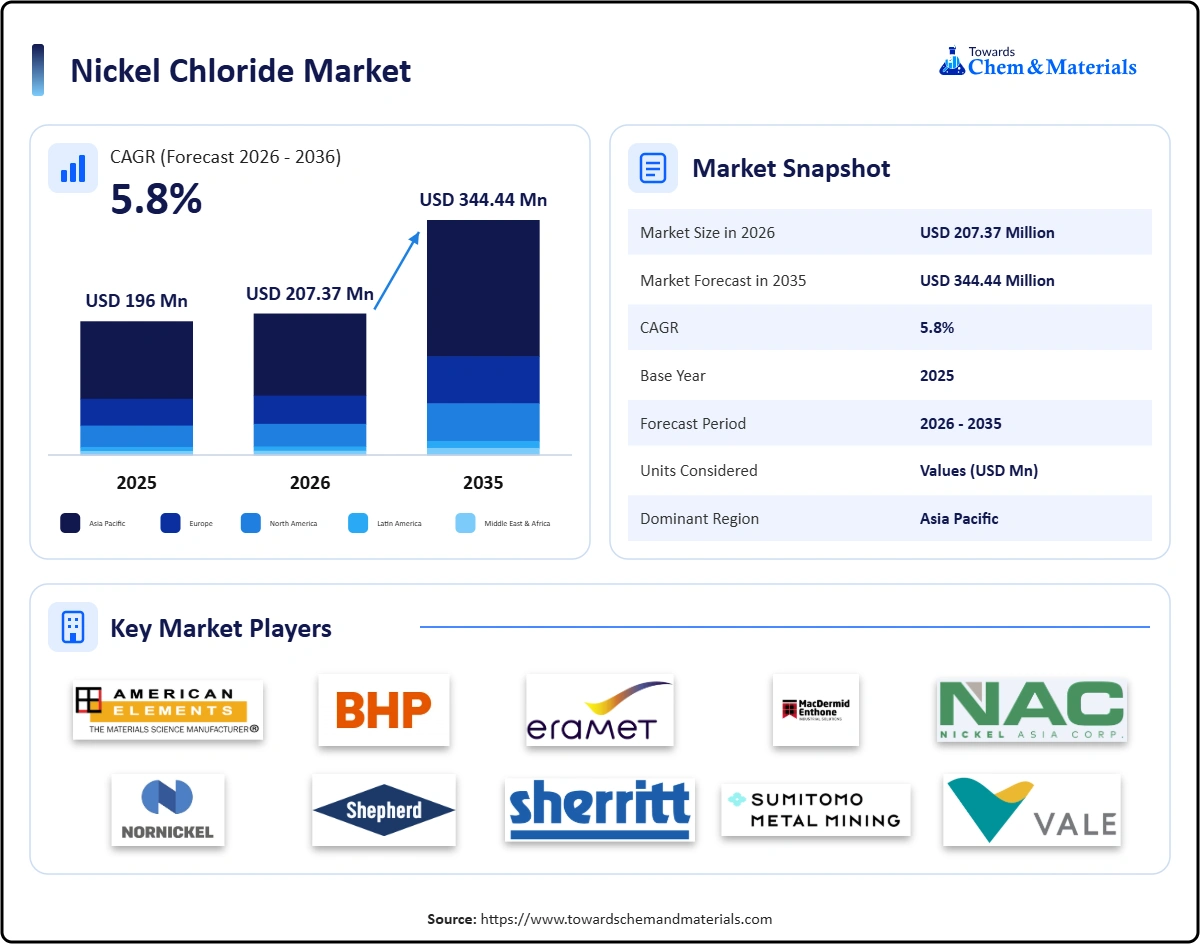
The global nickel chloride market size was valued at USD 196 million in 2025 and is expected to reach USD 344.44 million by 2035, growing at a CAGR of 5.8% during the forecast period of 2026-2035. The market includes nickel (II) chloride in hexahydrate and anhydrous forms, available in plating, battery, and reagent grades.
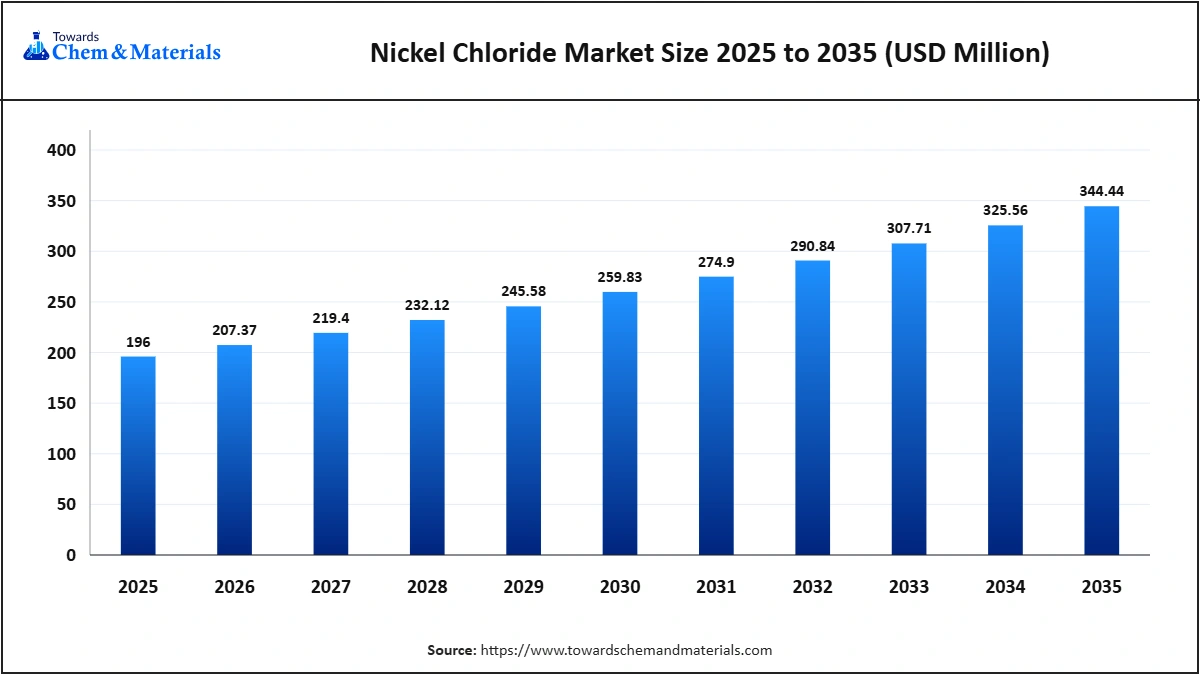
Note: 2025 is the base year; 2026-2035 values are forecasts.
Sources: Expert interviews, secondary sources, Towards Chemical and Materials database and Towards Chemical and Materials analysts.
These products are used across electroplating, catalysts, battery materials and precursors, chemical synthesis, and other industrial applications. In 2025, hexahydrate accounted for the largest market share of 78%, supported by its extensive use in nickel electroplating processes, particularly Watts and Woods strike baths. Asia Pacific accounted for the largest estimated market share, supported by its concentration of electroplating activity, nickel chemical manufacturing and industrial end users. Market expansion is supported by the demand for electroplating, catalysts, and battery materials. Supply-side developments are influencing market conditions. For instance, Indonesia's February 2026 quota reduction for Weda Bay lifted nickel prices, highlighting the influence of regional supply policies on nickel-related markets. Increasing interest in recycled nickel and high-purity nickel compounds is creating opportunities for manufacturers.
The global nickel chloride market is expected to grow from USD 196.00 million in 2025 to USD 344.44 million by 2035, driven by increasing demand for nickel-based compounds across electroplating, catalyst production, and battery materials manufacturing. Nickel chloride plays an important role in nickel electroplating baths, including Watts and Woods strike baths, where it supports plating efficiency and deposit characteristics. Its applications in chemical synthesis and catalyst production contribute to demand across industrial sectors.
The demand for nickel chloride is on the rise with growth in automotive and electronics manufacturing, as well as interest in battery materials. The Asia Pacific region is expected to play a significant role in this market. However, fluctuations in nickel prices and changes in regional supply policies could affect raw material availability and production costs. These developments are expected to increase market revenue to USD 259.83 million by 2030 and sustain a CAGR of 5.8% through 2035.
Analyst View: Our market assessment covers nickel chloride consumption across product forms, applications, and regional markets. The estimate considers nickel chloride consumption by application and geography, nickel-linked prices, producer activity, and trade data. The forecast incorporates developments in electroplating, catalyst manufacturing, battery materials, and regional nickel supply. As published market estimates are limited, the assessment uses available industry evidence and cross-checks to establish the market valuation and growth outlook.
The nickel chloride market is driven by the rise in demand for electroplating across automotive, electronics, machinery, and metal finishing industries. Nickel chloride is a key component of nickel-plating electrolytes, including Watts and Woods strike baths, where it contributes to the plating process and helps achieve desired coating characteristics. Growing industrial production and demand for durable, corrosion-resistant metal finishes are supporting its consumption.
The expansion of catalyst manufacturing and chemical synthesis is enhancing market growth, primarily driven using nickel chloride. The development of battery materials and nickel-based precursors fosters growth opportunities, while robust nickel salt production infrastructure and increasing industrial manufacturing in Asia Pacific support regional demand.
Volatility in nickel prices remains a key challenge for nickel chloride manufacturers, as fluctuations in raw material costs directly affect production expenses and pricing strategies. Changes in global nickel supply, mining output, and regional production policies can further disrupt procurement activities, creating uncertainty around input availability and profit margins. Stringent regulatory requirements also create operational challenges for nickel chloride producers, particularly regarding health, safety, and environmental compliance under frameworks such as REACH. Meeting these standards can increase compliance and production costs. Furthermore, the growing availability of alternative plating chemistries and substitute materials may reduce reliance on nickel chloride in certain applications, potentially limiting market growth over the forecast period.
The demand for battery materials and nickel-based precursors creates opportunities for nickel chloride manufacturers to expand their product portfolios. Increasing interest in advanced battery supply chains and nickel-containing chemical materials may support demand for specialized nickel chloride grades. Recycled nickel also offers opportunities to improve raw material sourcing and reduce dependence on primary nickel production. Manufacturers can explore nickel recovery and recycling processes to strengthen supply chain efficiency and support more sustainable production practices.
In recent years, Asia Pacific has shown growth potential in electroplating and nickel processing, particularly in India, where industrial manufacturing and automotive sectors are expanding. The demand for high-purity nickel chloride and specialized catalysts may drive manufacturers to enhance product quality and processing capabilities.
| Driver | Impact | ≈ CAGR Contribution | Time Horizon | Key Regions |
| Electroplating demand | High | +2.26 pp | Short to long term | Global, strongest in Asia Pacific |
| Catalysts | Medium | +1.91 pp | Medium to long term | Global, fastest uptake in Asia Pacific |
| Battery materials | Medium | +1.63 pp | Short to medium term | Global |
| Electronics | Low | +1.27 pp | Long term | Developed and emerging markets |
Note: Contributions are indicative estimates of each factor's effect on annual growth.
Sources: Expert interviews, secondary sources, Towards Chemical and Materials database and Towards Chemical and Materials analysts.
The nickel chloride market is supported by increasing electroplating demand, expanding catalyst applications, and growing consumption of nickel-based battery materials. These drivers have an estimated combined gross contribution of 7.08 percentage points to modeled annual growth before accounting for restraints. Electroplating demand represents the largest growth contributor, reflecting the extensive use of nickel chloride in Watts and Woods strike baths.
| Restraint | Impact | ≈ Negative CAGR Contribution | Time Horizon | Key Regions |
| Nickel price volatility | High | -0.57 pp | Short to medium term | Global |
| REACH restrictions | High | -0.42 pp | Medium term | Price-sensitive and emerging markets |
| Health rules | Medium | -0.28 pp | Short term | Asia Pacific and other mature markets |
Note: Contributions are indicative estimates of each factor's effect on annual growth.
Sources: Expert interviews, secondary sources, Towards Chemical and Materials database and Towards Chemical and Materials analysts.
The identified restraints are estimated to offset approximately 1.28 percentage points of annual market growth. Nickel price volatility represents the primary challenge, followed by chemical registration, classification, labelling and occupational-safety compliance requirements and health-related regulations governing nickel compound handling and exposure. These challenges can increase production costs, affect raw material procurement, and create compliance requirements for manufacturers. Despite these restraints, demand from electroplating, catalysts, and battery materials is expected to support market expansion and sustain a CAGR of 5.8% from 2026 to 2035.
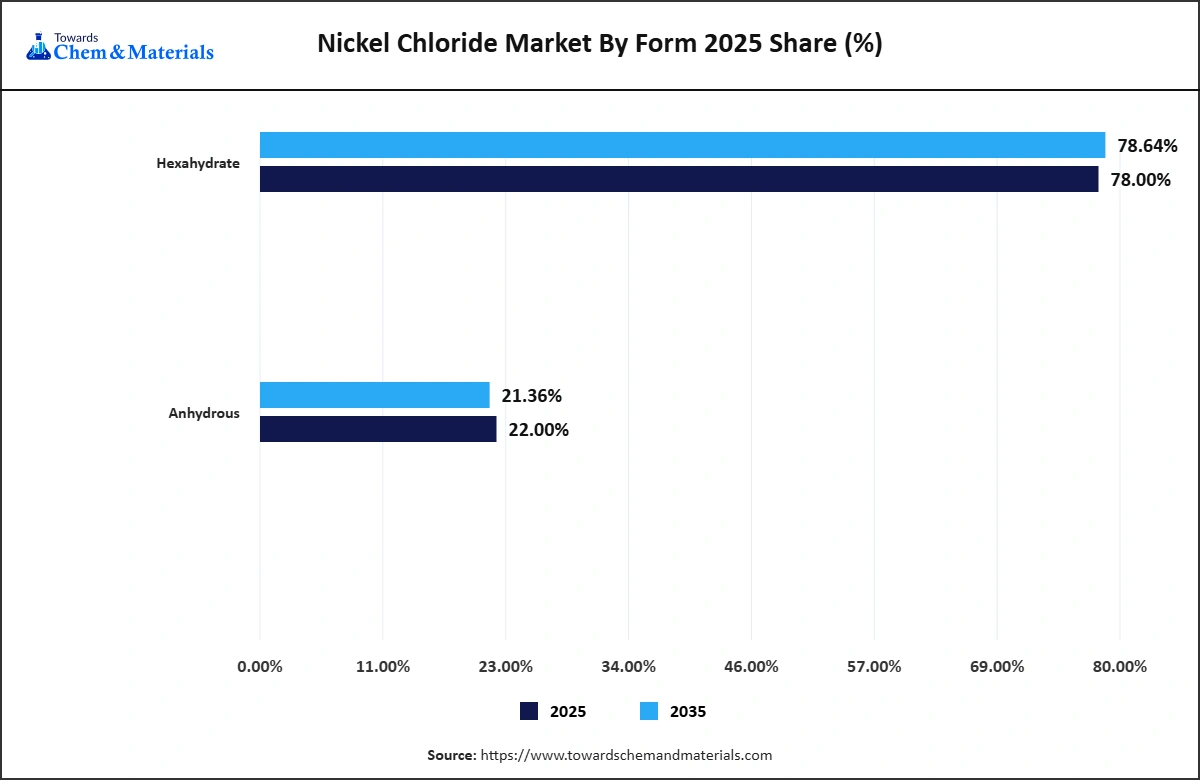
| Segments | 2025 Share | 2035 Share | CAGR 2026-2035 |
| Hexahydrate | 78.00% | 78.64% | 5.89% |
| Anhydrous | 22.00% | 21.36% | 5.49% |
Note: 2025 is the base year; 2035 shares and CAGRs are forecasts.
Sources: Expert interviews, secondary sources, Towards Chemical and Materials database and Towards Chemical and Materials analysts.
In 2025, hexahydrate dominated the nickel chloride market with a 78% share, while anhydrous nickel chloride accounted for 22%. The hexahydrate's lead is due to its commercial availability and use in electroplating, especially in Watts and Woods strike baths. It is expected to grow faster than anhydrous nickel chloride during the forecast period.
The hexahydrate segment accounted for 78% of the market in 2025. This form is projected to expand at a CAGR of 5.89% from 2026 to 2035. Hexahydrate represents the commonly used commercial crystalline form of nickel chloride. Its established role in electroplating formulations supports demand across automotive components, electronics, and industrial metal finishing. The continued expansion of plating applications is expected to strengthen the segment's leading position.
Anhydrous nickel chloride captured 22% of the market in 2025 and is anticipated to expand at a CAGR of 5.49% through 2035. Its consumption is supported by applications in specialty chemical production, catalyst development, and industrial synthesis processes. Nevertheless, its more specialized end-use applications are likely to limit growth compared with the widely used hexahydrate form.
Segment Outlook: During the forecast period, Hexahydrate is expected to maintain its dominant position in the nickel chloride market, increasing its share to around 78.64%. It is also projected to record the highest CAGR of 5.89% during the forecast period, supported by its established use in nickel electroplating applications.
| Segments | 2025 Share | 2035 Share | CAGR 2026-2035 |
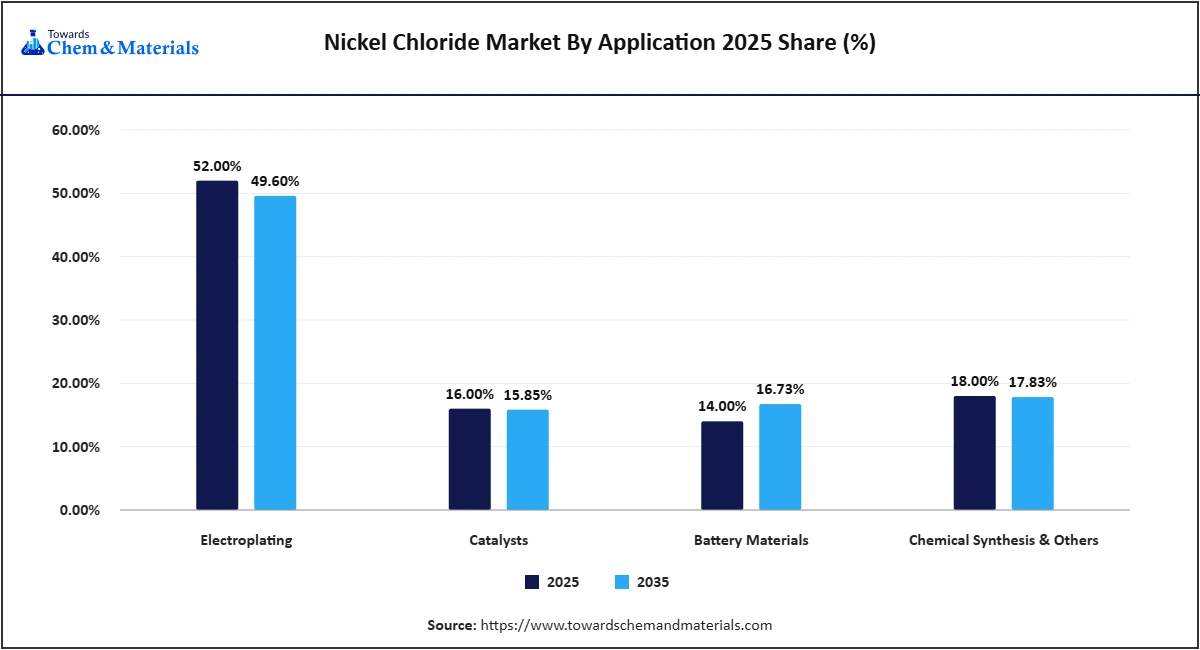
| Electroplating | 52.00% | 49.60% | 5.30% |
| Catalysts | 16.00% | 15.85% | 5.70% |
| Battery Materials | 14.00% | 16.73% | 7.70% |
| Chemical Synthesis & Others | 18.00% | 17.83% | 5.70% |
Note: 2025 is the base year; 2035 shares and CAGRs are forecasts.
Sources: Expert interviews, secondary sources, Towards Chemical and Materials database and Towards Chemical and Materials analysts.
In 2025, electroplating dominated the application segment with a 52% market share, followed by chemical synthesis and others at 18%, catalysts at 16%, and battery materials at 14%. The increasing use of nickel chloride in electroplating, particularly in Watts and Woods strike baths, underscores its lead in the market. However, battery materials are anticipated to register the fastest growth through 2035, supported by increasing demand for nickel-based battery materials and chemical precursors.
The electroplating segment accounted for 52% of the market in 2025 and is projected to expand at a CAGR of 5.30% from 2026 to 2035. Nickel chloride is crucial for nickel electroplating baths used in metal finishing and surface treatment. Demand is sustained by growth in automotive, electronics, and industrial manufacturing, although this segment is expected to grow more slowly than the overall market during the forecast period.
Catalysts segment represented 16% of the market in 2025. The segment is projected to grow at a CAGR of 5.70% through 2035. Nickel chloride is used in selected catalyst-related applications and chemical processes. Demand from industrial chemical manufacturing and catalytic applications is expected to support segment expansion throughout the forecast period.
Battery materials segment captured 14% of the market in 2025 and is anticipated to register the fastest CAGR of 7.70% from 2026 to 2035. The interest in nickel-based battery materials and precursor production is creating additional demand opportunities. The expansion of battery supply chains and increasing investments in nickel-related chemical processing are expected to strengthen this segment's contribution to overall market growth.
The chemical synthesis and others segment held 18% of the market in 2025. These applications are projected to expand at a CAGR of 5.70% through 2035. Nickel chloride is utilized in specific chemical synthesis and industrial applications, acting as a nickel-containing chemical intermediate. This supports ongoing demand in specialized manufacturing, with expectations for stable growth in the segment during the forecast period.
Segment Outlook: Electroplating is expected to remain the largest application segment through 2035, although its market share is projected to decline to roughly 49.60%. Battery materials are anticipated to record the fastest growth, increasing their share to 16.73% by 2035. The faster expansion of battery materials reflects the growing importance of nickel-based compounds in emerging battery supply chains and changing application demand within the nickel chloride market.
Analyst View: In our analysis, hexahydrate and electroplating represent the leading categories across their respective segments due to their established industrial applications and significant consumption base. However, battery materials are expected to gain market share as demand for nickel-based battery compounds and precursor materials expands. The faster growth of battery materials indicates an emerging shift in the application mix, while electroplating is expected to remain the primary source of nickel chloride consumption.
| Region | 2025 Share | 2035 Share | CAGR 2026-2035 |
| Asia Pacific | 58.00% | 60.74% | 6.29% |
| Europe | 20.00% | 18.70% | 5.09% |
| North America | 16.00% | 14.96% | 5.09% |
| Latin America | 3.00% | 2.80% | 5.09% |
| Middle East & Africa | 3.00% | 2.80% | 5.09% |
Note: 2025 is the base year; 2035 shares and CAGRs are forecasts.
Sources: Expert interviews, secondary sources, Towards Chemical and Materials database and Towards Chemical and Materials analysts.
Asia Pacific accounted for the largest regional share of the global nickel chloride market in 2025, with a 58% share, followed by Europe at 20% and North America at 16%. Latin America and the Middle East and Africa each accounted for 3% of the global market. Asia Pacific is projected to be the fastest-growing regional market, driven by China's established electroplating industry, substantial nickel salt production, and increasing industrial applications, enhancing its growth during the forecast period.
Asia Pacific accounted for 58% of the global nickel chloride market in 2025. The region is projected to register a CAGR of 6.29% from 2026 to 2035. China represents a major production and consumption market in the region, supported by its established electroplating industry and nickel salt manufacturing capabilities. In addition, Indonesia's influence on nickel supply and production policies contributes to regional market dynamics. Asia Pacific is projected to increase its market share to around 60.74% by 2035.
Europe held 20% of the global nickel chloride market in 2025 and is expected to expand at a CAGR of 5.09% through 2035. Strong automotive production, industrial electroplating activities, and a well-developed specialty chemicals sector contribute to regional consumption. Increasing use of nickel chloride in metal surface treatments, catalyst formulations, and chemical manufacturing is expected to sustain demand. However, stringent REACH regulations and occupational safety requirements may pose compliance challenges for manufacturers and influence the pace of market growth.
North America captured 16% of the global market in 2025 and is projected to register a CAGR of 5.09% from 2026 to 2035. Automotive and electronics manufacturing activities contribute to nickel chloride consumption, while specialized chemical production supports additional demand. The region is expected to maintain a significant market position throughout the forecast period.
Latin America held 3% of the market in 2025 and is expected to expand at a CAGR of 5.09% through 2035. The market in Latin America is driven by industrial manufacturing, metal finishing, and chemical processing, and faces limitations due to its small electroplating and nickel salt production base, impacting global revenue. Regional demand is expected to increase gradually as industrial applications develop.
The Middle East and Africa accounted for 3% of the global nickel chloride market in 2025. The region is projected to grow at a CAGR of 5.09% from 2026 to 2035. Regional demand is supported by industrial processing, metal finishing, and selected chemical manufacturing applications. The market is expected to expand gradually as industrial activity and demand for specialty nickel compounds develop across the region.
Analyst View: According to our analysis, Asia Pacific will maintain its leadership in the nickel chloride market due to its established electroplating industry, strong nickel salt production capacity, and expanding battery materials applications. The region is also expected to record the fastest growth, increasing its market share to 60.74% by 2035. Europe and North America will remain important established markets, supported by automotive, electronics, and industrial chemical demand, while Latin America and the Middle East and Africa are expected to experience gradual expansion during the forecast period.
| Rank | Company Name | 2025 Share (%) | Key Products / Business | Headquarters |
| 1 | Jinchuan Group | 14.00% | Nickel salts | China |
| 2 | Umicore | 8.00% | Nickel specialty chemicals | Belgium |
| 3 | Atotech (MKS) | 8.00% | Plating chemistry | Germany |
| 4 | Shepherd Chemical | 6.00% | Nickel salts | United States |
| 5 | GEM Co. | 6.00% | Nickel salts and recycled nickel | China |
| 6 | Sumitomo Metal Mining | 5.00% | Nickel products | Japan |
| 7 | Jilin Ji En Nickel | 4.00% | Nickel products | China |
| 8 | MacDermid Enthone | 4.00% | Plating chemistry | United States |
| 9 | American Elements | 3.00% | Nickel chloride grades | United States |
| 10 | Nihon Kagaku Sangyo | 3.00% | Nickel and metal salts | Japan |
Note: Company shares are 2025 estimates.
Sources: Company press releases, expert interviews, secondary sources, Towards Chemical and Materials database and Towards Chemical and Materials analysts.
Jinchuan Group led the global nickel chloride market in 2025 with an estimated 14% share, followed by Umicore and Atotech (MKS), each accounting for approximately 8% of market revenue. These companies maintain competitive positions through established nickel salt portfolios, specialty nickel chemicals, and electroplating chemistry solutions.
Jinchuan Group maintains its leadership through nickel salt production, while Umicore competes through specialty nickel chemicals and advanced material solutions. Atotech (MKS) focuses on electroplating chemistry and surface finishing technologies. Shepherd Chemical and GEM Co. are notable players in nickel salt manufacturing, with GEM also gaining from its involvement in recycled nickel. Other participants include Sumitomo Metal Mining, Jilin Ji En Nickel, MacDermid Enthone, American Elements, and Nihon Kagaku Sangyo. These companies compete through nickel products, plating chemistry, specialized nickel chloride grades, and other metal salts.
The top 10 companies accounted for an estimated 61% of global market revenue in 2025, while the remaining 39% was distributed among numerous Chinese and Indian nickel salt producers and other regional suppliers. The market is concentrated in China, with competition primarily influenced by nickel feedstock costs, product purity, plating and battery-grade quality, supply consistency, regulatory compliance, and pricing.
Jinchuan Group: Jinchuan Group is headquartered in China and held an estimated 14% share of the nickel chloride market in 2025. Its product portfolio focuses on nickel salts, supported by its established position in the nickel industry. The company is positioned as a Leader in the Towards Chemical and Materials Companies Quadrant.
Umicore: Umicore is from Belgium and accounted for an estimated 8% market share in 2025. Its portfolio includes specialty nickel chemicals and advanced materials used across industrial applications. In the Towards Chemical and Materials Companies Quadrant, the company is classified as a Leader.
Atotech (MKS): Atotech (MKS) is based in Germany and held an estimated 8% market share in 2025. The company specializes in plating chemistry and surface finishing solutions, supporting demand for nickel-based electroplating applications. It is positioned as a Leader in the Towards Chemical and Materials Companies Quadrant.
Shepherd Chemical: Shepherd Chemical is a U.S.-based manufacturer of specialty inorganic chemicals and represented an estimated 6% market share in 2025. Its portfolio includes nickel salts and specialty inorganic chemicals for industrial applications. The company is recognized as a Leader in the Towards Chemical and Materials Companies Quadrant.
GEM Co.: GEM Co. is based in China and accounted for an estimated 6% share of the nickel chloride market in 2025. Its business includes nickel salts and recycled nickel materials, supported by its participation in the battery materials and resource recycling industries. The company is classified as a Leader in the Towards Chemical and Materials Companies Quadrant.
Sumitomo Metal Mining: Sumitomo Metal Mining is headquartered in Japan. The company held an estimated 5% market share in 2025. Its portfolio includes nickel products and related materials supporting industrial and advanced material applications. In the Towards Chemical and Materials Companies Quadrant, the company is positioned as a Leader.
Jilin Ji En Nickel: Jilin Ji En Nickel from China accounted for an estimated 4% market share in 2025. The company focuses on nickel products and related nickel materials, supporting demand across industrial applications. It is positioned as an Innovator in the Towards Chemical and Materials Companies Quadrant.
MacDermid Enthone: MacDermid Enthone, part of Element Solutions Inc., is headquartered in the United States and represented an estimated 4% market share in 2025. Its portfolio focuses on plating chemistry and surface treatment solutions for industrial applications. In the Towards Chemical and Materials Companies Quadrant, the company is classified as an Innovator.
American Elements: American Elements is based in the United States. The company held an estimated 3% share of the market in 2025. Its portfolio includes specialized nickel chloride grades and other advanced materials used in industrial and chemical applications. The company is recognized as an Innovator in the Towards Chemical and Materials Companies Quadrant.
Nihon Kagaku Sangyo: Nihon Kagaku Sangyo is headquartered in Japan and accounted for an estimated 3% market share in 2025. The company supplies nickel and other metal salts for industrial chemical applications. According to the Towards Chemical and Materials Companies Quadrant, it is acknowledged as an Innovator.
The nickel chloride ecosystem connects upstream nickel suppliers, nickel salt manufacturers, plating chemistry suppliers, industrial end users, and regulatory organizations. Each participant contributes to raw material sourcing, chemical processing, product formulation, industrial applications, and regulatory compliance. Material informatics and AI in chemical manufacturing also support developments in catalyst design and electroplating bath optimization.
| Ecosystem Stage | Role in the Market | Key Companies |
| Nickel Suppliers | Supply nickel | Indonesian and other producers |
| Salt Producers | Make nickel chloride | Jinchuan, Umicore, Shepherd, GEM |
| Plating Chemistry Suppliers | Formulate baths | Atotech, MacDermid Enthone |
| End Users | Use in plating and catalysts | Platers, catalyst makers |
| Regulators | Set nickel compound rules | REACH, EPA |
Sources: Company press releases, expert interviews, secondary sources, Towards Chemical and Materials database and Towards Chemical and Materials analysts.
Nickel Suppliers: Nickel and other raw materials are essential for producing nickel chloride, with Indonesian and international producers supplying these upstream materials. Variations in mining output, production quotas, and nickel prices impact the cost and availability of feedstock.
Salt Producers: Companies such as Jinchuan Group, Umicore, Shepherd Chemical, and GEM Co. manufacture nickel chloride and other nickel-based compounds. They supply these chemicals for various industrial applications through their nickel salt and specialty chemical product lines.
Plating Chemistry Suppliers: Companies like Atotech (MKS) and MacDermid Enthone provide electroplating chemicals, bath formulations, and surface treatment solutions for industrial metal finishing applications.
End Users: Nickel chloride is utilized by electroplating companies, catalyst manufacturers, battery material producers, and chemical manufacturers, who drive demand according to their production needs and application requirements.
Regulators: Regulatory organizations establish requirements concerning nickel compound handling, occupational exposure, environmental protection, and chemical safety. REACH and the U.S. EPA influence compliance practices across the nickel chloride supply chain.
The market value chain begins with nickel sourcing and raw material processing, followed by nickel chloride manufacturing and chemical formulation. Finished nickel chloride products reach electroplating companies, catalyst manufacturers, battery material producers, and other industrial customers through direct procurement and chemical distribution channels. Manufacturers with integrated nickel sourcing, consistent product quality, and established relationships with end users can strengthen supply reliability and competitive positioning.
The Towards Chemical and Materials Companies Quadrant positions key participants in the nickel chloride market by market strength, reflecting revenue scale, market share, and geographic reach, and by innovation and growth strategy, reflecting product portfolio breadth, R&D intensity, and partnerships. Positions reflect each company's estimated 2025 share of the nickel chloride market and our assessment of its product innovation, portfolio breadth, and partnerships.
Sources: Company press releases, expert interviews, secondary sources, Towards Chemical and Materials database and Towards Chemical and Materials analysts.
Leaders: Jinchuan Group, Umicore, Atotech (MKS), Shepherd Chemical, GEM Co., and Sumitomo Metal Mining combine high market share with broad portfolios and strong innovation.
Innovators: Jilin Ji En Nickel, MacDermid Enthone, American Elements, and Nihon Kagaku Sangyo bring newer technologies and specialised products.
The global nickel chloride market is defined as nickel (II) chloride in hexahydrate and anhydrous forms, including plating, battery, and reagent grades used in electroplating, catalysts, battery materials and precursors, chemical synthesis, and other industrial applications. The market assessment employs a bottom-up approach, analyzing nickel chloride consumption and pricing across various regions and applications. The 2025 market value is based on specific demand estimates, validated by company data and industry metrics. It evaluates demand for hexahydrate and anhydrous nickel chloride in electroplating, catalyst manufacturing, battery materials, and chemical synthesis. Regional assessments account for production capacity, industrial consumption, and supplier presence, while company market shares are derived from product portfolios and revenue analyses. The forecast for 2026-2035 incorporates expected developments in electroplating demand, battery material production, catalyst applications, nickel feedstock prices, and regional supply policies. Regulatory requirements, including REACH-related restrictions and occupational health standards, are considered when assessing potential market restraints. Segment, regional, and company estimates are reconciled against the same 2025 base year, and forecast values are validated for consistency with the projected market CAGR.
The nickel chloride market is expected to grow steadily, driven by strong demand from electroplating, catalyst manufacturing, and battery materials. Electroplating is the largest application, and hexahydrate is the most widely used form due to its availability. The Asia Pacific region, especially China, will lead the market and is projected to see rapid growth through 2035. The battery materials segment offers significant growth potential, fueled by increasing interest in nickel-based compounds and high-purity grades. However, the market faces challenges such as nickel price volatility, REACH regulations, and competition. Manufacturers that prioritize product quality, efficient sourcing, and regulatory compliance are more likely to strengthen their competitive position.
Reliable market intelligence and data-driven insights across the global chemicals and materials industry, helping businesses understand trends, competition, pricing, and emerging opportunities.
Schedule a Demo