Find the Right Market Report
Search thousands of industry reports, market insights, and research studies in one place.
Not sure where to start? Try one of these:
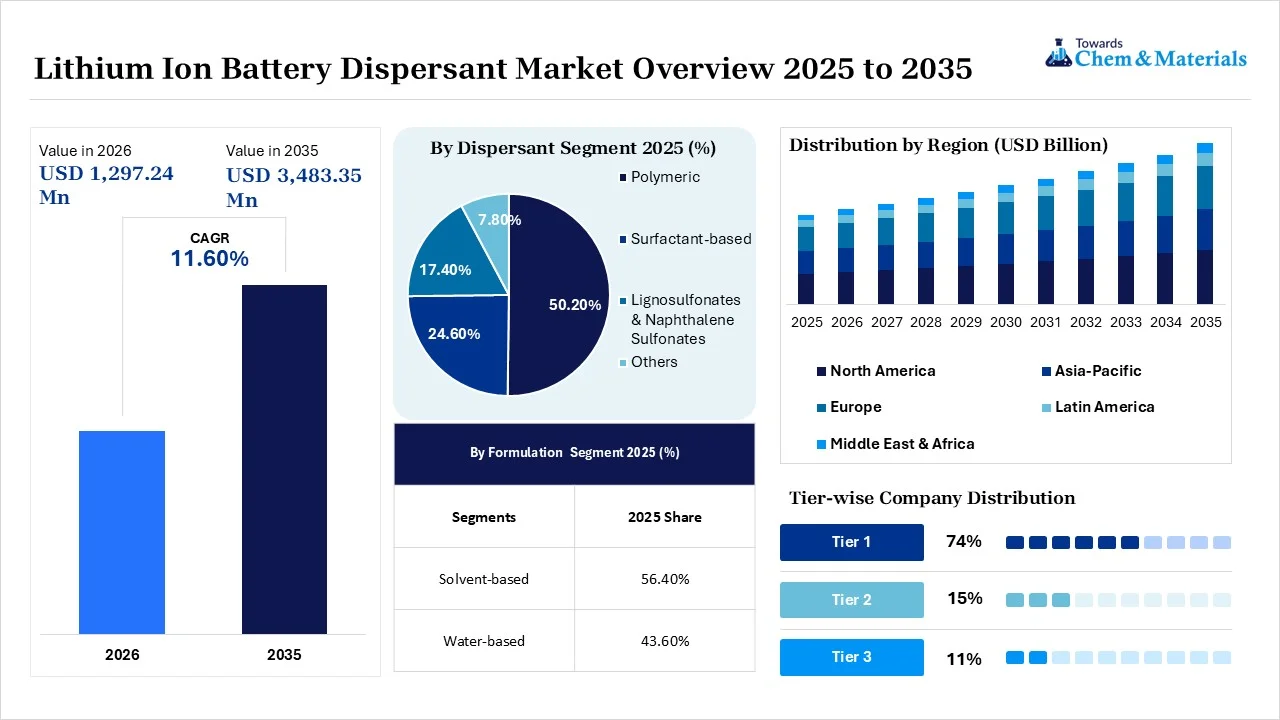
The global lithium ion battery dispersant market is expected to grow from USD 1,297.24 million in 2026 to USD 3,483.35 million by 2035. The market is forecast to grow at a CAGR of 11.60% from 2026 to 2035. The lithium-ion battery dispersant market includes polymeric, surfactant, lignosulfonate, naphthalene sulfonate, and other dispersants that keep carbon nanotubes, conductive carbons, and active materials evenly distributed in electrode slurries and conductive pastes in both solvent-based and water-based formulations.
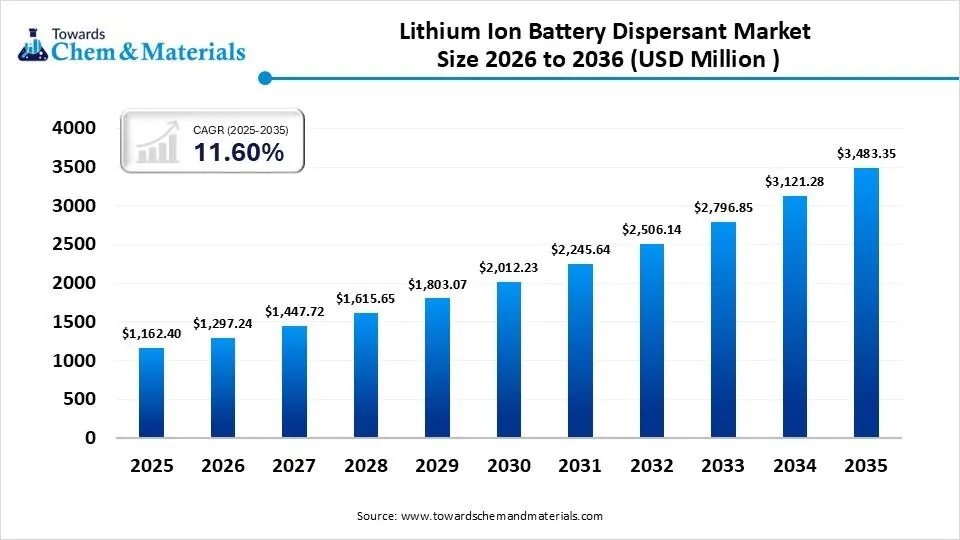
Note: 2025 is the base year; 2026–2035 values are forecasts.
Sources: Expert interviews, secondary sources, the Towards Chemicals and Materials database, and Towards Chemicals and Materials.
Polymeric segment dominated the market with the largest share of 50.20% in 2025, because block copolymers and polyvinylpyrrolidone are essential for stabilizing carbon nanotube pastes in cathodes. Asia Pacific accounted for 52.60% of the market share in 2025, supported by electrode and conductive paste production in China, South Korea, and Japan. Demand is driven by growing electric vehicles and energy storage battery production, the switch from carbon black to carbon nanotube conductive networks, higher solids content in slurries to cut drying energy, and the shift to water-based anode and cathode processing. Suppliers of carbon nanotube dispersions are building plants near battery factories in Europe and North America.
Analyst View: The lithium-ion battery dispersant market is poised for strong growth as rising battery production increases demand for stable, high-performance electrode slurries. The growing use of carbon nanotube pastes, water-based processing, and advanced electrode materials is creating opportunities for specialized dispersant solutions. The growth rate shows strong electrode volume growth and rising nanotube use, moderated by price competition and lower loading per kilogram of electrode.
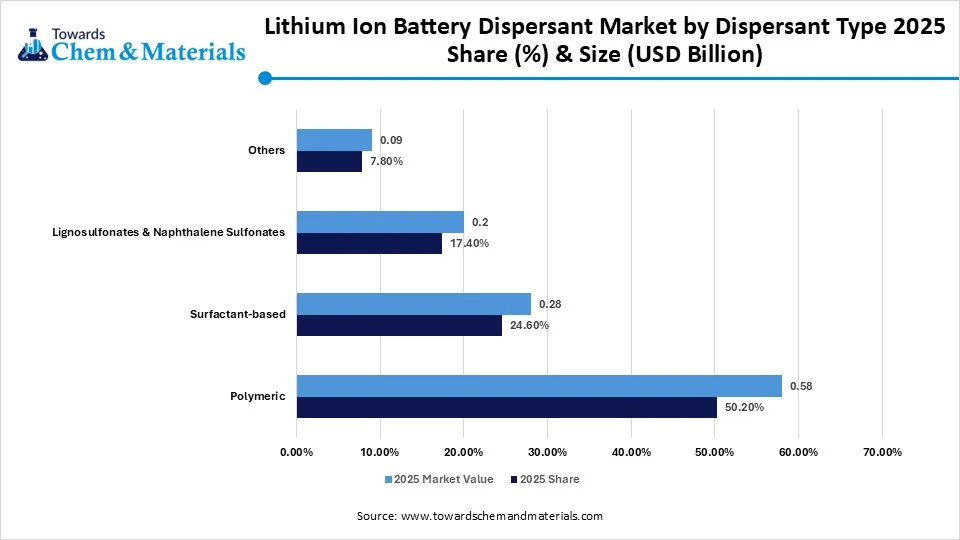
Note: 2025 is the base year.
Sources: Expert interviews, secondary sources, the Towards Chemicals And Materials database, and Towards Chemicals And Materials analysts.
The polymeric segment is expected to dominate the market with a 50.20% share in 2025 and is the fastest-growing dispersant type, supported by block copolymers and polyvinylpyrrolidone that keep carbon nanotubes from clumping in cathode pastes. Surfactant-based dispersants, at 24.60%, are used in anode and water-based slurries, while lignosulfonates & naphthalene sulfonates account for 17.40%, primarily in lower-cost formulations, and other dispersants account for 7.80% in 2025.
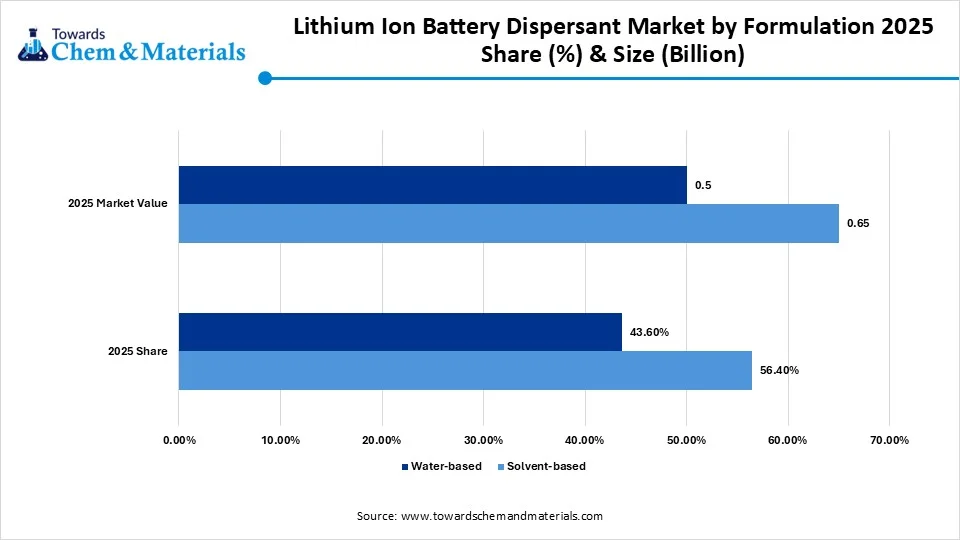
Note: 2025 is the base year.
Sources: Expert interviews, secondary sources, the Towards Chemicals and Materials database, and Towards Chemicals and Materials analysts.
Solvent-based formulations accounted for 56.40% share and are valued at USD 655.59 million in 2025 because most cathodes are still processed in NMP with PVDF (polyvinylidene fluoride) binders. Water-based formulations, valued at USD 506.81 million and 43.60% share, are gaining share as anode processing is already water-based and cell manufacturers develop water-based cathode processes to cut solvent costs and emissions.
Note: 2025 is the base year.
Sources: Expert interviews, secondary sources, the Towards Chemicals And Materials database, and Towards Chemicals And Materials analysts.
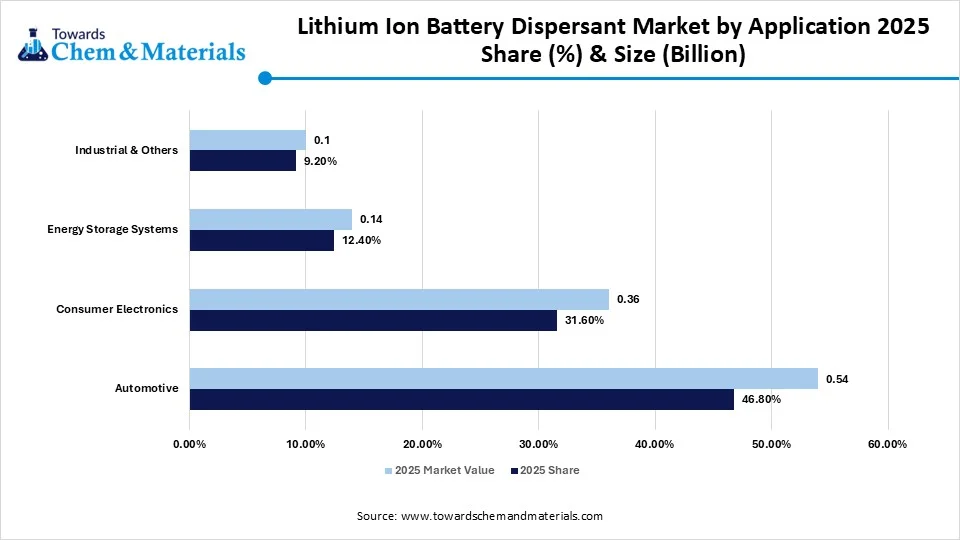
Automotive accounted for 46.80% (USD 544.00 million) share in 2025 and is the fastest-growing application, led by EV batteries that use nanotube-rich cathodes. Consumer electronics, at 31.60% (USD 367.32 million), remains a large application for high-energy cells; energy storage systems account for 12.40% (USD 144.14 million), and industrial and others account for 9.20% (USD 106.94 million).
Analyst View: The market is led by the polymeric, solvent-based, and automotive applications, reflecting the need for better electrode stability and reliable performance in high-volume battery production. While polymeric dispersants benefit from their ability to improve carbon nanotube dispersion, water-based formulations are gaining traction as manufacturers seek to reduce processing costs and environmental impact. Automotive demand remains the primary growth driver, supported by EV battery expansion, while energy storage offers additional opportunities as battery deployment increases. Overall, suppliers that can deliver effective dispersants for advanced electrode materials while supporting more sustainable manufacturing processes are well positioned to capture the market growth.
Note: 2025 is the base year.
Sources: Expert interviews, secondary sources, the Towards Chemicals and Materials database, and Towards Chemicals and Materials analysts.
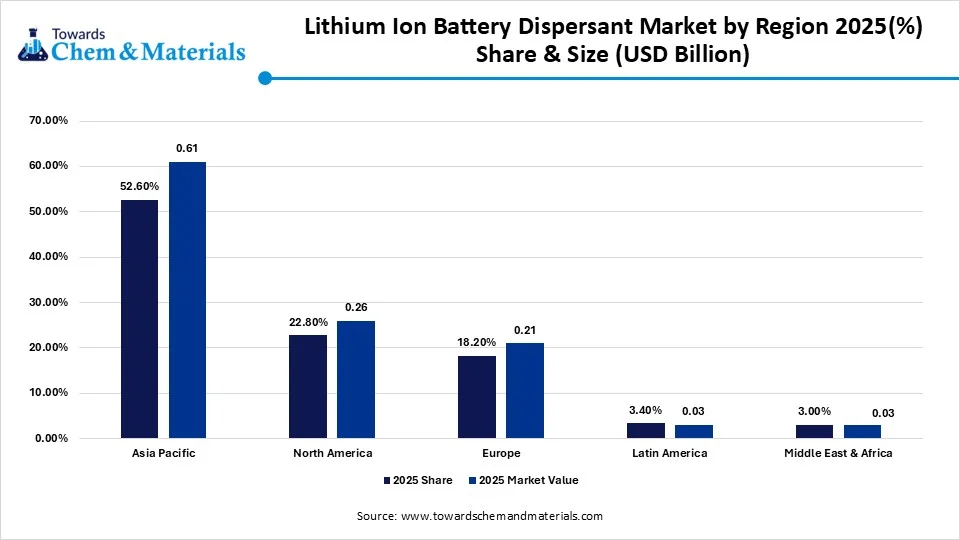
Asia Pacific accounted for 52.60% (USD 611.42 million) of the share in 2025, driven by electrode and conductive paste production in China, South Korea, and Japan. North America, at 22.80% (USD 265.03 million), grows with new cell plants and local carbon nanotube dispersion plants, while Europe, at 18.20% (USD 211.56 million), is the fastest-growing region, supported by gigafactories in Hungary, Poland, and Germany and local dispersion supply. Latin America, at 3.40% (USD 39.52 million), and the Middle East and Africa, at 3.00% (USD 34.87 million), are smaller markets linked to battery assembly and early cell projects.
Analyst View: Regional shares were built from electrode production in each region, weighted by dispersant loading and price, and adjusted for where conductive pastes are made. Asia Pacific leads because it hosts most electrode and paste production. We project Europe to have the highest growth premium because new gigafactories and local paste plants are expanding quickly in Central Europe.
| Rank | Company Name | Market-Specific Revenue (USD Million) | 2025 Share | Key Products / Business | Headquarters |
| 1 | BASF | 96 | 8.26% | Polymeric dispersants and battery formulation additives | Germany |
| 2 | Ashland | 72 | 6.19% | PVP and cellulosic dispersants and binders | United States |
| 3 | Kao Corporation | 64 | 5.51% | Battery dispersants for conductive carbons | Japan |
| 4 | LG Chem | 58 | 4.99% | CNT dispersions and dispersants | South Korea |
| 5 | artience (Toyocolor) | 56 | 4.82% | LIOACCUM carbon nanotube dispersions | Japan |
| 6 | Evonik | 52 | 4.47% | Specialty dispersing additives | Germany |
| 7 | Lubrizol | 44 | 3.79% | Polymeric dispersants for battery slurries | United States |
| 8 | BYK | 38 | 3.27% | Wetting and dispersing additives | Germany |
| 9 | Nippon Shokubai | 30 | 2.58% | Battery polymer additives and dispersants | Japan |
| 10 | Croda | 26 | 2.24% | Specialty dispersants | United Kingdom |
Note: Company revenues and shares are 2025 estimates.
Sources: Company press releases, expert interviews, secondary sources, the Towards Chemicals and Materials database, and Towards Chemicals and Materials analysts.
BASF led the lithium-ion battery dispersant market with an estimated share of 8.26% and a value of USD 96.00 million in 2025 revenue, followed by Ashland at a 6.19% share and USD 72.00 million in value, and Kao Corporation holds a 5.51% share and USD 64.00 million in value. BASF leads with a broad range of polymeric dispersants and battery additives, Ashland with polyvinylpyrrolidone and cellulosic grades widely used in electrode slurries, and Kao Corporation with dispersants for conductive carbons in Japanese and Asian cells.
The top 10 companies accounted for an estimated share of 46.12% and valued at USD 536.00 million in 2025 revenue, while the remaining 53.88% share and USD 626.40 million value were shared among Chinese dispersant producers, conductive paste makers that produce their own dispersants, and specialty additive suppliers. The lithium ion battery dispersant market is moderately fragmented, and competition centers on dispersion stability, compatibility with binders and solvents, low impurity levels, and qualification with cell manufacturers. Both large global chemical companies and specialized paste makers are competing in the market.
By Dispersant Type
By Formulation
By Application
By Region
The lithium ion battery dispersant market was defined as dispersants used in lithium-ion battery electrode slurries and conductive pastes, including polymeric, surfactant, lignosulfonate, naphthalene sulfonate, and other types, sold worldwide. The 2025 base year was built bottom-up from electrode production, dispersant loading in slurries and pastes, and dispersant prices, and checked top-down against the dispersant battery revenue of leading specialty chemical and conductive paste suppliers. Segment, regional, and company values were allocated from dispersant types, formulations, applications, and regional electrode production. Key estimates were verified by cross-checking company disclosures, regulatory and industry data, and published third-party estimates, and inputs that could not be reconciled were excluded. All segment, regional, and company figures were reconciled to the same 2025 base year, and the 2026–2035 forecast, which applies a constant CAGR from the 2025 base, was recalculated and validated.
The lithium ion battery dispersant market grows with electrode production and with the use of carbon nanotube pastes and high-solids slurries. Our estimate links demand to electrode output, dispersant loading, and prices, so the forecast follows battery growth and electrode process changes. The main upside comes from water-based cathode processing and local supply chains, while the main risks are price pressure and the possible spread of dry electrodes.
Reliable market intelligence and data-driven insights across the global chemicals and materials industry, helping businesses understand trends, competition, pricing, and emerging opportunities.
Schedule a Demo