Content
What is the Ferrous Scrap Recycling Market Size and Share?
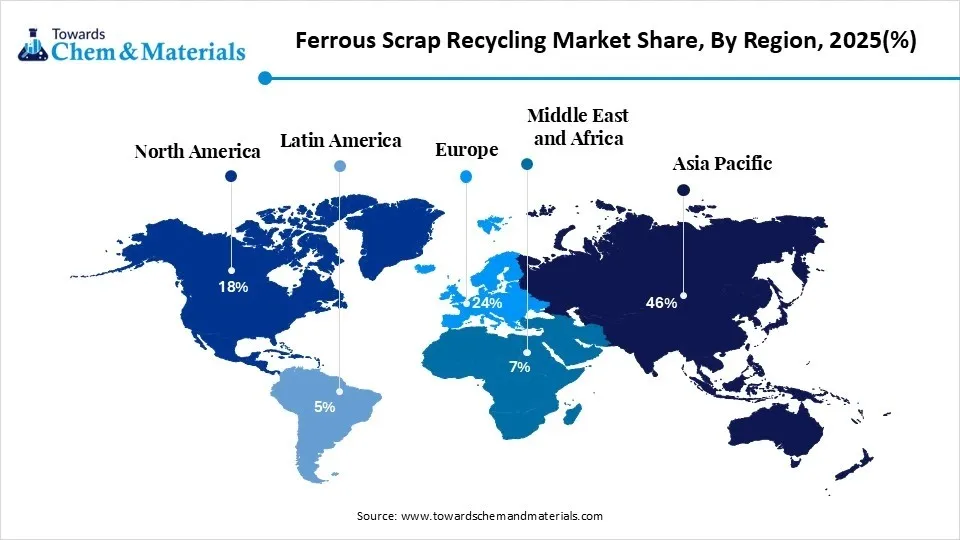
The global ferrous scrap recycling market size was valued at USD 313.55 billion in 2025, is estimated to reach USD 335.34 billion in 2026, and is projected to reach USD 613.92 billion by 2035, exhibiting a compound annual growth rate (CAGR) of 6.95% over the forecast period from 2026 to 2035.Asia Pacific dominated the ferrous scrap recycling market with the largest revenue share of 46% in 2025 and is expected to grow at the fastest CAGR of 7.07% during the forecast period.
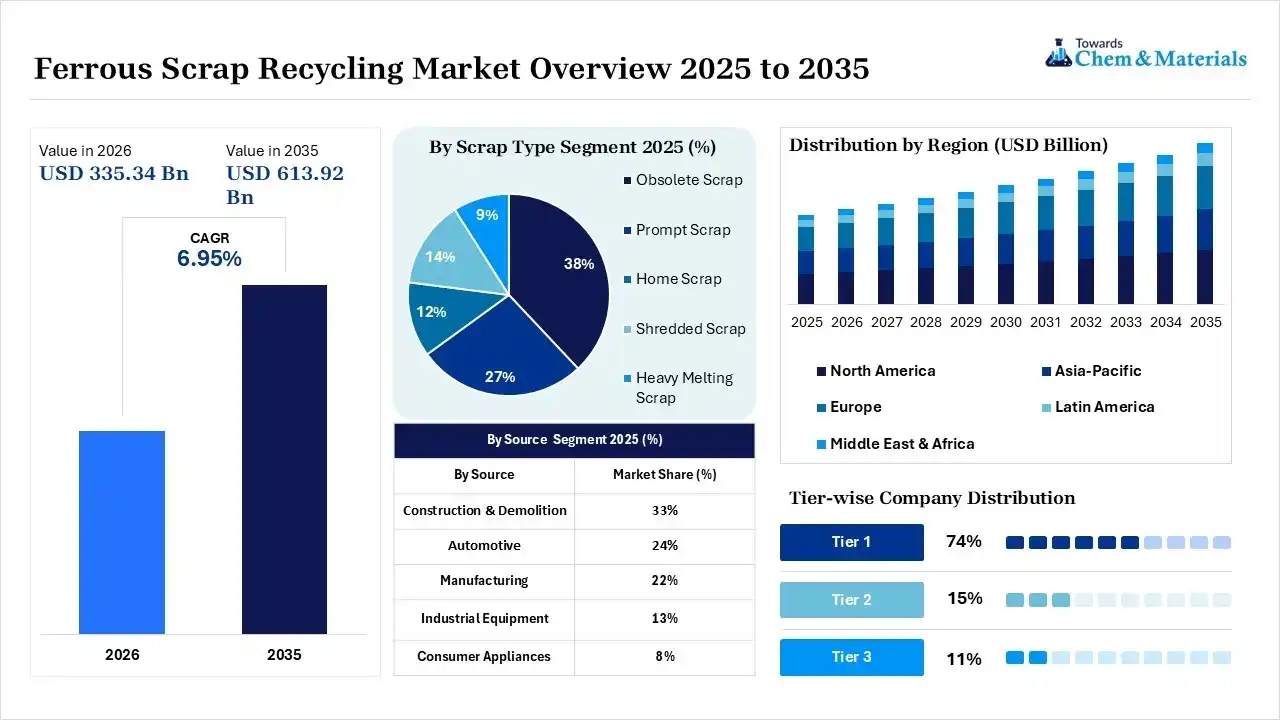
AI technologies and supportive government policies, including those that encourage circular economy practices and the use of secondary raw materials, boost the market. The market is driven by growing carbon emission reduction programs, the expansion of Electric Arc Furnace (EAF) steelmaking, growing construction and infrastructure sector activities, and the adoption of automated sorting.
Market Highlights
- By region, Asia Pacific dominated the ferrous scrap recycling market by holding 46% share in 2025 and is expected to grow at a CAGR of 7.3% during the forecast period.
- By region, the Middle East& Africa held 7% market share in 2025 and is expected to grow at the fastest with a CAGR of 8.2% during the forecast period.
- By scrap type, the obsolete scrap segment dominated the market with the largest share of 38% in 2025 and is expected to grow at a CAGR of 6.5% during the forecast period.
- By scrap type, the heavy melting scrap segment held 9% market share in 2025 and is expected to grow at the fastest CAGR of 7.8% over the forecast period.
- By source, the construction & demolition segment dominated the market with the largest share of 33% in 2025 and is expected to grow at a CAGR of 6.7% during the forecast period.
- By source, the consumer appliances segment held 8% market share in 2025 and is expected to grow at the fastest CAGR of 7.5% over the forecast period.
- By processing method, the collection segment dominated the market with the largest share of 29% in 2025 and is expected to grow at a CAGR of 5.9% during the forecast period.
- By processing method, the shredding segment held 21% market share in 2025 and is expected to grow at the fastest CAGR of 7.6% over the forecast period.
- By grade, the carbon steel scrap segment dominated the market with the largest share of 42% in 2025 and is expected to grow at a CAGR of 6.4% during the forecast period.
- By grade, the stainless steel scrap segment held 21% market share in 2025 and is expected to grow at the fastest CAGR of 7.9% over the forecast period.
- By end-use industry, the steel manufacturing segment dominated the market with the largest share of 56% in 2025 and is expected to grow at a CAGR of 6.8% during the forecast period.
- By end-use industry, the automotive manufacturing segment held 10% market share in 2025 and is expected to grow at the fastest CAGR of 7.7% over the forecast period.
- By recycling technology, the mechanical recycling segment dominated the market with the largest share of 47% in 2025 and is expected to grow at a CAGR of 5.8% during the forecast period.
- By recycling technology, the AI-based sorting segment held 7% market share in 2025 and is expected to grow at the fastest CAGR of 9.8% over the forecast period.
According to Towards Chemicals and Materials Analytics and Consulting, the global ferrous scrap recycling volume was valued at 743.15 million metric tons in 2025 and is expected to surpass around 1,312.15 million metric tons by 2035, accelerating a compound annual growth rate (CAGR) of 27.15% over the forecast period from 2026 to 2035.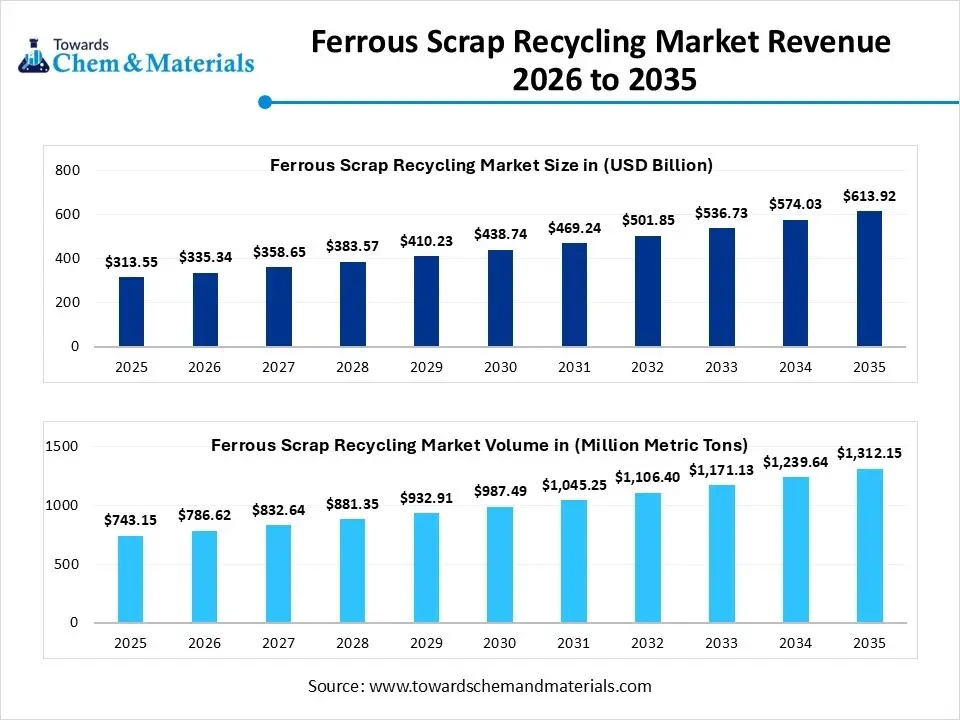
Market Overview
Growing Adoption of Circular Steel Production Strengthens the Ferrous Scrap Recycling Market
The ferrous scrap recycling market is growing because more steel producers are turning to recycled ferrous materials to meet their need to be more resource efficient and environmentally friendly in primary steel production. With the shift to Electric Arc Furnace (EAF) technology, the demand for high-quality ferrous scrap continues to grow, and volatile iron ore prices further incentivize producers to use secondary raw materials to maintain cost stability. Artificial Intelligence, Computer Vision, Robotic Sorting, Laser Induced Breakdown Spectroscopy (LIBS), Hyperspectral Imaging, and Smart Shredding Systems are all technological advances that are improving recovery efficiency, reducing contamination, and improving grade accuracy.
Global Investment Movement for Ferrous Scrap Recycling Market
The steel makers are investing more and more in the collection, processing, and recycling of steel scrap to guarantee the availability of the required steel as feedstock for EAF operations. Automotive manufacturers and recyclers are building end-of-life vehicle dismantling locations and organized vehicle collection systems throughout the region to ensure a steady supply of end-of-life vehicle material. Investments are being directed to developing economies to develop the informal and fragmented scrap collection networks into organized, traceable, and efficient systems. These efforts have led to better transparency in the supply chain, higher collection effectiveness, and better quality secondary raw materials availability.
- For instance, in June 2026, ROGESA has announced in June 2026 plans to build an AI and X-ray enabled scrap processing plant in Germany, which will be supported by a total of €2.8 million in government grants for the reduction of copper contamination, the improvement of the quality of recovered steel, the reduction of energy consumption, and the reinforcement of the EUs low carbon steel production strategy.(Source: news.metal.com)
What is Ferrous Scrap Recycling?
Ferrous scrap recycling is a process that involves the collection, sorting, shredding, and melting of iron- and steel-based waste to produce reusable metal for manufacturing. It consists mainly of magnetic materials like carbon steel, cast iron, and used cars, facilitating efficient resource recovery and sustainable steel production.
Uses of Ferrous Scrap Recycling
- High-Quality Foundry Castings - Iron and metal foundries can recycle ferrous scrap from various sources to produce engine blocks, industrial machinery parts, heavy equipment parts, and other precision castings that demand high and repeatable quality in the product.
- Use of Ferrous scrap as an effective cooling agent in BOFs - Ferrous scrap is used as an effective cooling agent in BOFs as it absorbs the excess heat generated during carbon refinement, which helps to maintain stable conditions during the BOF processing and efficient steel production.
- Recoverable Iron-steel Industrial Value-added Resources: Production offcuts, rejected components, and industrial steel wastes from manufacturing are being recycled to recover valuable raw materials and make better use of resources while minimizing reliance on new iron ore resources.
Report Scope
| Report Attributes | Details |
| Market Size in 2026 | USD 335.34 Billion/ 786.62 Million Metric Tons |
| Expected Size in 2035 | USD 613.92 Billion/ 1,312.15 Million Metric Tons |
| Growth Rate | CAGR of 6.95% |
| Base Year of Estimation | 2025 |
| Forecast Period | 2025-2035 |
| Dominant Region | Asia Pacific |
| Segment Covered | By Scrap Type, By Source, By Processing Method, By Grade, By End Use Industry, By Recycling Technology, By Region |
| Key Companies Profiled | European Metal Recycling, Sims Limited, Commercial Metals Company, Nucor Corporation, ArcelorMittal, Gerdau, Schnitzer Steel Industries (Radius Recycling), Tata Steel, OmniSource |
Recent Market Trends
- AI, automated optical sorting, and computer vision technologies are reshaping ferrous scrap recycling by making it more accurate in identifying and sorting different metal grades.
- The advanced systems optimize material purity, reduce contamination, improve recovery efficiency, and help recyclers run with greater consistency by processing higher volumes and larger sizes of scrap.
- Today, the efficiency of scrap processing is enhanced by the use of modern hammer mills, a high-speed shredder, and advanced recovery equipment that maximizes material recovery and minimizes impurities.
- The trend for reducing carbon emissions and energy usage is gaining momentum through the installation of Electric Arc Furnace technology in steel manufacturing, instead of traditional blast furnaces.
Advancing Artificial Intelligence and Smart Processing in the Ferrous Scrap Recycling Market
AI is transforming ferrous scrap recycling through enhanced identification and sorting precision and operational efficiency in recycling plants. High-speed cameras are incorporated with spectroscopic sensors, which are used to analyse the texture, shape, and surface characteristics of the scrap in real time, allowing identification of materials in just a few seconds. Coatings, non-ferrous contaminants, and other undesirable components are all identified by machine learning algorithms, which help to increase the purity of the recycled material. Advanced computer vision systems also determine the grade of different steels and iron without the need for manual inspection, which is a very time-consuming process.
Supply Chain Analysis of the Ferrous Scrap Recycling Market
Feedstock Procurement
- This is the stage where end-of-life vehicles, industrial wastes, manufacturing scraps, and structural steel are collected from various commercial and industrial customers for recycling.
An efficient procurement process guarantees the supply of good-quality ferrous scrap, thereby enabling a stable recycling process and regular production of steel. - Nucor: Nucor collects a large amount of post-consumer and manufacturing scrap in its comprehensive recycling system, which provides a consistent supply of feedstock.
- Other Key Players: Sims Metal, OmniSource, European Metal Recycling (EMR).
Chemical Synthesis and Processing:
- Ferrous scrap is collected and then shredded, magnetized, sorted, and melted to yield high-quality recycled metal for steel.
- Efficient processing eliminates contaminants and increases metal purity, metal recovery, and utilization of less virgin iron ore.
- ArcelorMittal: ArcelorMittal has been using recycled ferrous scrap in its large-scale operations in Electric Arc Furnaces to minimize the use of primary raw materials.
- Other Key Players: Tata Steel, Steel Dynamics, Cleveland-Cliffs.
Compound Formulation and Blending
- Recycled metal is melted down and mixed with alloying materials such as carbon, manganese, and chromium to create desired steel alloys.
- Appropriate formulation guarantees that the quality of recycled steel meets the quality criteria, mechanical requirements, and application performance requirements.
- JFE Steel: Through secondary metallurgy, JFE Steel produces special high-strength recycled steel grades by carefully controlling the chemical composition.
- Other Key Players: Nippon Steel, POSCO, Hyundai Steel.
Sustainability Analysis of the Ferrous Scrap Recycling
Promoting Resource Efficiency Through Sustainable Ferrous Scrap Recycling
Ferrous scrap recycling helps to sustain the steel industry by lowering emissions, reducing natural resources used, and saving energy. By recycling one tonne, this saves iron ore, coal, and limestone, which helps to conserve natural resources. Scrap-based Electric Arc Furnace production reduces the primary energy consumption and also reduces the volume of large waste metal sent to landfill, reducing long-term soil and water pollution. Notwithstanding these benefits, some impurities still remain, such as copper and tin, from processing contaminated scrap, and the scarcity of scrap available for recycling due to export restrictions.
Regulatory Framework: Ferrous Scrap Recycling Market
| Country Region | Regulatory Body | Key Regulations | Focus Areas |
| Asia Pacific | Ministry of Steel | Steel Scrap Recycling Policy | Formalizing collection, de-pollution of end-of-life vehicles (ELVs) |
| North America | Environmental Protection Agency | Resource Conservation and Recovery Act (RCRA) | Safe processing, storage management |
| European Union | European Environment Agency | Circular Economy Action Plan | High demolition-waste recovery targets |
Market Dynamics
Driver: Rising Electric Arc Furnace Adoption Accelerates Ferrous Scrap Demand
Global steel production is experiencing growing demand for high-quality ferrous scraps, with the rise of Electric Arc Furnace (EAF) steelmaking. EAF technology is different from conventional blast furnace technology because it depends mainly on recycled steel as feedstock, allowing manufacturers to decrease carbon emissions, increase energy efficiency, and save natural resources. The investments in organized recycling and advanced processing technologies, as well as in reliable recycling infrastructure, are growing as steel producers persist in their transition to lower-emission production technologies to ensure a constant stream of high-quality recycled materials.
Restraint : Scrap Contamination Increases Processing Complexity and Costs
These mixed alloys, residual copper, tin, coatings, and other contaminants further complicate sorting and refining operations in order to get a better quality ferrous scrap for recycling. Poor quality feedstocks increase processing time, increase operating costs, create extra slag in melting, and impact the quality of steels. Municipal and industrial scrap streams are also often contaminated, which demands even more advanced separation technologies, thus raising investment costs and decreasing the recycling share and the regular production of high-quality recycled steel.
Opportunity : Smart Sorting Technologies Generate New Growth Opportunities
The Ferrous Scrap Recycling market is rapidly evolving with new technologies such as Artificial Intelligence, Laser-induced Breakdown Spectroscopy (LIBS), Computer Vision, Hyperspectral Imaging, and Automated Scrap Sorting Systems. These technologies are advanced and are better at identifying the metal, achieving higher recovery rates, less contamination, and higher purity of recycled metal. As intelligent sorting solutions become more common, recyclers can work with more material in a more efficient manner and provide better quality raw material for sustainable steel production and for other circular economy projects.
Segmental Insights
Scrap Type Insights
The obsolete scrap segment dominated the market with the largest share of 38% in 2025 and is expected to grow at a CAGR of 6.5% over the forecast period, as it offers a consistent supply of iron and steel materials for recycling. There is a significant amount of scrap produced from aging infrastructure, industrial equipment, and end-of-life vehicles, which is available for recycling activities. Organized collection systems provide a constant source of feedstock to the steel producers throughout the steel-making processes. The segment also contributes to circular manufacturing by minimizing the reliance on virgin raw materials.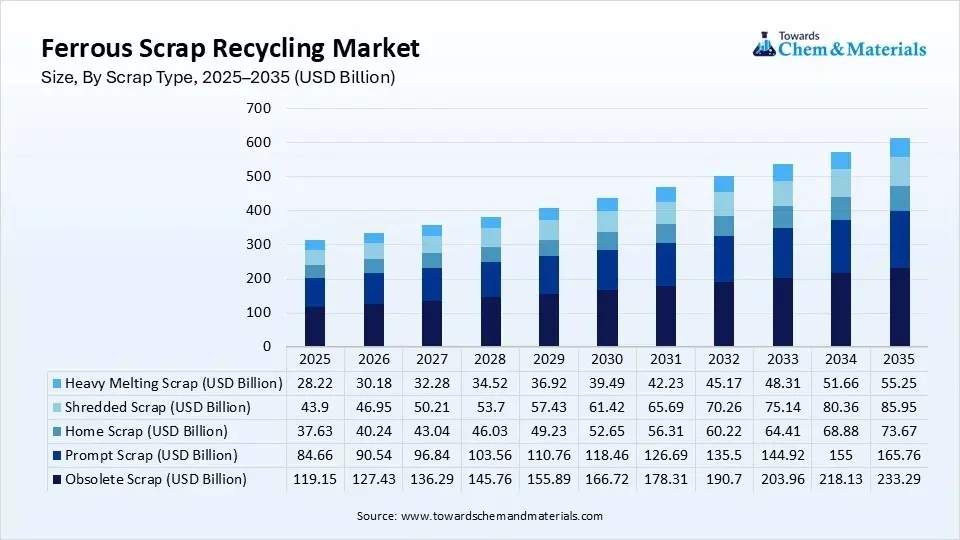
The heavy melting scrap segment held a 9% market share in 2025 and is expected to grow at the fastest CAGR of 7.8% over the forecast period, due to the rise in the share of Electric Arc Furnace steelmaking. This type of scrap is preferred by steel makers because of the ease with which it can be used to produce high-quality recycled steel products. The growing investment in modern recycling plants is enhancing collection, processing, and recuperation. With the rising demand for lower-emission steel production, the use of heavy melting scrap is increasing.
- For instance, in June 2026, GeT Metal Group and GeT Alloys launched a waste-to-energy project in June 2026, which is the beginning of the industrys efforts to increasingly recycle waste and make the best use of resources, using end-of-life tyres to replace fossil fuels in the melting of aluminium.(Source: iol.co.za)
Ferrous Scrap Recycling Market Share, By Scrap Type, 2025 (%)
| By Scrap Type | Market Share (%) |
| Obsolete Scrap | 38% |
| Prompt Scrap | 27% |
| Home Scrap | 12% |
| Shredded Scrap | 14% |
| Heavy Melting Scrap | 9% |
Source Insights
The construction & demolition segment dominated the market with the largest share of 33% in 2025 and is expected to grow at a CAGR of 6.7% over the forecast period, as it always produces huge quantities of structural steel that is suitable for recycling. Infrastructure redevelopment, commercial construction, and building replacement activities provide consistent amounts of recoverable materials. Organized collection practices help recycling facilities and steel producers to get more materials. Recycled steel is used to promote circular resource use and decrease the need for new raw materials.
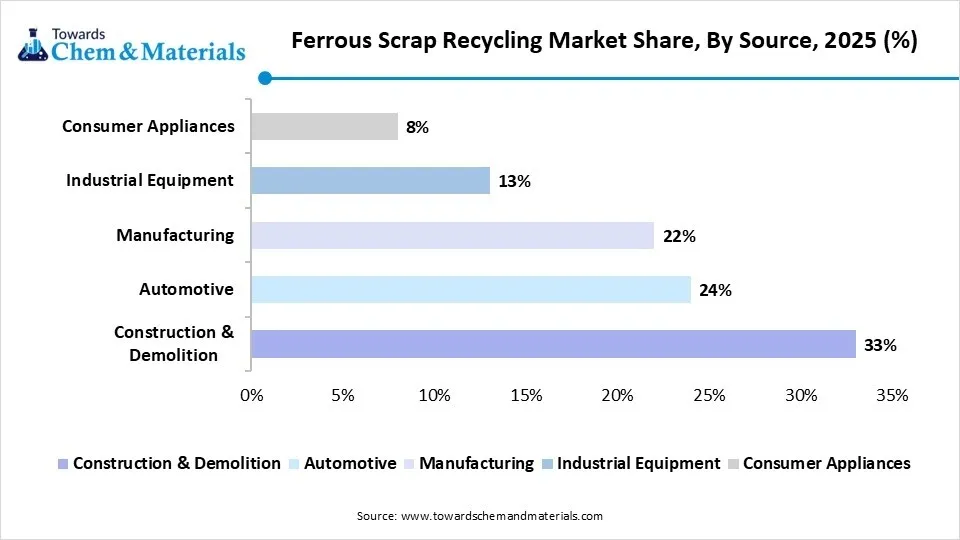
The consumer appliances segment held an 8% market share in 2025 and is expected to grow at the fastest CAGR of 7.5% over the forecast period, as the need for replacing household appliances will further boost the collection of recyclable metals. Increased waste disposal offers good potential for collection and efficient recovery of materials. Recycling facilities are increasing their capacity to recycle more components of appliances in an efficient manner. Greater awareness of responsible waste management also contributes to increased rates of recycling.
- For instance, in March 2026, Greenway Metal Recycling also expanded its services, adding electronics scrap from commercial and industrial customers, and tweaking its website to make it easier for customers to access recycling information and a guide on what can be recycled.(Source: www.newsfilecorp.com)
Ferrous Scrap Recycling Market Share, By Source, 2025 (%)
| By Source | Market Share (%) |
| Construction & Demolition | 33% |
| Automotive | 24% |
| Manufacturing | 22% |
| Industrial Equipment | 13% |
| Consumer Appliances | 8% |
Processing Method Insights
The collection segment dominated the market with the largest share of 29% in 2025 and is expected to grow at a CAGR of 5.9% over the forecast period, as it enables the recycling process and uninterrupted production of steel. There are well-developed collection networks that collect scrap from industrial facilities, construction sites, manufacturing plants, and end-of-life vehicles. Industry efficiency along the recycling supply chain is enhanced by having reliable supplies of feedstock. Organized collection systems also contribute to the recovery of resources and minimise loss of material prior to processing.
The shredding segment held a 15% market share in 2025 and is expected to grow at the fastest CAGR of 6% over the forecast period, as advanced shredding equipment will help separate the material and shred with greater efficiency. New shredding technologies minimize contamination and deliver cleaner ferrous end-products for downstream processing. Improved material liberation increases the rate of recovery and promotes quality recycled steel production. Technology is evolving continuously and improving processing capacity and productivity in recycling facilities.
Ferrous Scrap Recycling Market Share, By Processing Method, 2025 (%)
| By Processing Method | Market Share (%) |
| Collection | 29% |
| Sorting | 23% |
| Shredding | 21% |
| Shearing | 15% |
| Baling | 12% |
Grade Insights
The carbon steel scrap segment dominated the market with the largest share of 42% in 2025 and is expected to grow at a CAGR of 6.4% over the forecast period, as the material is widely used in construction as well as in transportation and industrial manufacturing. Reliable supplies of raw material and continuous recycling activities are possible with large quantities of recoverable carbon steel. Recycled carbon steel is used widely to maximize the efficiency of the use of resources and minimize environmental impacts by steel manufacturers.
- For instance, in October 2025, Steel Dynamics, Inc. launched BIOEDGE™ and EDGE™ steel products using recycled scrap in October 2025, which enabled customers to help achieve lower greenhouse gas emissions, support circular manufacturing, and lower carbon steel production.
(Source: www.prnewswire.com )
The stainless steel scrap segment held a 21% market share in 2025 and is expected to grow at the fastest CAGR of 7.9% over the forecast period, since the demand for corrosion-resistant materials remains strong among various end-use industries. Recycling stainless steel promotes effective resource utilization and minimises reliance on newly mined metals. Increased industrial applications promote higher recovery and re-use of stainless steel materials. Better sorting and processing methods also increase recycling efficiency and the quality of materials. These all remain to be a positive forces for future market growth.
Ferrous Scrap Recycling Market Share, By Grade, 2025 (%)
| By Grade | Market Share (%) |
| Carbon Steel Scrap | 42% |
| Alloy Steel Scrap | 17% |
| Stainless Steel Scrap | 21% |
| Cast Iron Scrap | 11% |
| Mixed Ferrous Scrap | 9% |
End Use Industry Insights
The steel manufacturing segment dominated the market with the largest share of 56% in 2025 and is expected to grow at a CAGR of 6.8% over the forecast period, driven by the steel manufacturing segment, as ferrous materials are used as important raw materials in steel production. The demand for high-quality recycled scrap is continuing to rise as the number of Electric Arc Furnace operations continues to grow. Additionally, sustainable manufacturing is a focus that can contribute to the broader adoption of recycled steel during production. These factors remain to strengthen the market position of the segment.
- For instance, in June 2026, to promote the use of steel recycling practices, SSAB Americas, The Greenbrier Companies, and Alter Trading initiated a project in June 2026 to showcase how recycled materials can be used to make a sustainable steel product with near-zero emissions.(Source: gmk.center )
The automotive manufacturing segment held a 10% market share in 2025 and is expected to grow at the fastest CAGR of 7.7% over the forecast period, as automotive manufacturers are increasingly using recycled steel in their manufacturing. As vehicles are increasingly replaced, there are also more ferrous materials to be recovered. Modern recycling facilities enable the recycling of vehicle waste into useful raw materials. Increased adoption of sustainability programs in the automotive industry will drive up the use of recycled steel.
Ferrous Scrap Recycling Market Share, By End Use Industry, 2025 (%)
| By End Use Industry | Market Share (%) |
| Steel Manufacturing | 56% |
| Foundries | 14% |
| Construction | 11% |
| Automotive Manufacturing | 10% |
| Machinery & Equipment | 9% |
Recycling Technology Insights
The mechanical recycling segment dominated the market with the largest share of 47% in 2025 and is expected to grow at a CAGR of 5.8% over the forecast period, as it efficiently crushes, shreds, and sorts ferrous waste. The method recovers a high amount of materials, and the quality of the recycled metals is uniform. Mechanical processing is widely used in recycling facilities for its operational reliability and usability with existing facilities. It also minimizes loss of materials and maximizes recycling resource utilization. It remains the leader in the market owing to these benefits.
- For instance, in December 2025, The Borealis-Borouge alliance launched Recleo, a new, global brand offering mechanically recycled polyolefins, in December 2025, reflecting an increasing focus within the industry on advanced recycling options and increasing availability of sustainable recycled materials.(Source: www.plasticstoday.com )
The AI-based sorting segment held a 7% market share in 2025 and is expected to grow at the fastest CAGR of 9.8% over the forecast period, as intelligent solutions enhance the identification accuracy and separation accuracy of material. AI is used to improve processing efficiency by detecting contaminants and determining the grade of metals in real-time. Automated sorting also helps to boost recovery rates and minimise manual handling and operational risks. Recycling companies still invest in smart technology to boost productivity and the quality of recycled materials. All these are contributing to robust future growth for AI sorting solutions.
Ferrous Scrap Recycling Market Share, By Recycling Technology, 2025 (%)
| By Recycling Technology | Market Share (%) |
| Mechanical Recycling | 47% |
| Sensor-Based Sorting | 16% |
| Magnetic Separation | 21% |
| AI-Based Sorting | 7% |
| Advanced Material Recovery | 9% |
Regional Insights
How Did the Asia Pacific Dominate the Ferrous Scrap Recycling Market In 2025?
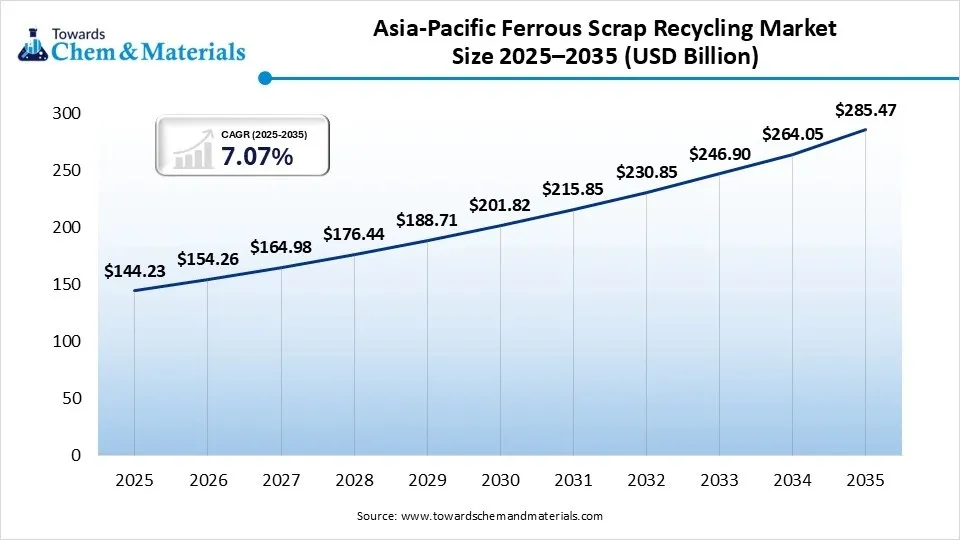
The Asia Pacific ferrous scrap recycling market size was estimated at USD 144.23 billion in 2025 and is projected to reach USD 285.47 billion by 2035, growing at a CAGR of 7.07% from 2026 to 2035. Asia Pacific dominated the market with the largest share of 46% in 2025 and is expected to grow at a CAGR of 7.3% during the forecast period. with the rapidly growing demand for steel production driving the market. Electric Arc Furnace technology is being increasingly used to facilitate the use of scrap in manufacturing processes. Organised recycling and efficient use of resources are promoted by the governments initiatives. There are significant amounts of recoverable steel for processing created due to rising construction and infrastructure activities.
Promote the development of the Chinese Ferrous Scrap Recycling Industry
China has a strong presence in the regional market with its huge production of steel and growing use of recycled ferrous material. The country keeps improving its organized scrap collection and processing systems for better utilization of resources. The growth of Electric Arc Furnace (EAF) operations enables more recycled steel to be used in manufacturing. The Governments initiatives to promote circular economy practices continue to boost sustainable recycling and to increase the quality of secondary raw materials available.
Promoting the advancement of Indias Ferrous Scrap Recycling capability.
Indias ferrous scrap recycling industry is growing with the increase in steel manufacturing activities and the rise in infrastructure. A rise in demand for recycled materials boosts investments in organized collection and modern processing facilities. Supportive recycling policies further promote resource conservation and enhance steel producers raw material supply. Increased industrialization also plays its part in the increasing use of ferrous scraps in manufacturing operations.
Middle East & Africa
The Middle East & Africa ferrous scrap recycling market size was estimated at USD 21.95 billion in 2025 and is projected to reach USD 46.04 billion by 2035, growing at a CAGR of 7.69% from 2026 to 2035. The Middle East & Africa held 7% market share in 2025 and is expected to grow at the fastest CAGR of 8.2% over the forecast period. As the industry expands, so does demand for recycled ferrous materials in various sectors. Governments are promoting efficient use of resources by promoting better recycling and organized programs. Increasing investment in recycling infrastructure has helped to further build processing capacity and supply chain efficiency. This growing awareness of sustainable manufacturing, combined with the need for recycled steel in the region, further helps facilitate the use of recycled steel in the region.
Increasing the number of recycling facilities in Saudi Arabia
Saudi Arabia is still building its recycling infrastructure and promoting the use of resources efficiently and diversifying its industry. Increased demand for recycled ferrous materials is driven by the growing investments in the steel industry. Enhance material recovery with a growth in collection and processing facilities to facilitate sustainable industrial development. This work remains the countrys commitment to the regional recycling sector.
Supporting South Africas Resource Recovery Activities
South Africa has initiatives in place to improve ferrous scrap recycling, and metal recovery activities are growing. Industrial recycling remains a source of trustworthy secondary raw materials for the steel industry. A focus on efficient use of resources promotes recycling throughout the country. Continuous investments in processing facilities further develop recycling efficiency and long-term market expansion.
North America
The North America ferrous scrap recycling market size was estimated at USD 56.44 billion in 2025 and is projected to reach USD 113.58 billion by 2035, growing at a CAGR of 7.24% from 2026 to 2035. North America held 18% market share in 2025 and is expected to grow at a CAGR of 6.1% during the forecast period, characterized by established recycling infrastructure and advanced steel manufacturing abilities, putting the region in a strong position. A well-developed collection network provides a stable flow of ferrous materials from around the industrial sector for recycling. The increasing usage of Electric Arc Furnace technology hastens the use of recycled steel in manufacturing activities. Ongoing investments in processing technologies increase material recovery and operational efficiency. All of these contribute to sustainable steel production and market stability in the region.
Fostering the growth of the United States Ferrous Scrap Recycling Sector
The US has a large recycling infrastructure and a robust steel production capability in the region. Significant amounts of ferrous scrap, including industrial and post-consumer, are collected in organized collections annually. The focus on sustainable steel production keeps growing and promotes higher recycling rates. The advanced processing technologies are also improving the quality of recycled material and operational efficiency in the country.
Advancing the Canadian Circular Steel Economy
Canadian ferrous scrap recycling activities are still growing, with efficient resource recovery and recycling practices. Increasingly, industrial sectors are using recycled ferrous materials to help meet their sustainable manufacturing goals. Modern collection and processing facilities make feedstock available and make recycling more efficient. The countrys steel and manufacturing sectors are also benefiting from a growing awareness of the environment, which allows for the use of more circular economy practices.
Europe
The Europe ferrous scrap recycling market size was estimated at USD 75.25 billion in 2025 and is projected to reach USD 150.41 billion by 2035, growing at a CAGR of 7.17% from 2026 to 2035. Europe held 24% market share in 2025 and is expected to grow at a CAGR of 6.5% over the forecast period, due to the high priority on implementing circular economy projects and sustainable steelmaking. Adopting more modern recycling technologies leads to better materials recovery and resource efficiency. Recycled ferrous (steel) materials are increasingly being used in the production of steel to minimize environmental impacts. Recycling activities are further enhanced by organized collection systems and a supportive regulatory framework. The trends underpin the viability of the European market.
Promoting Sustainable Steel Recycling Industry in Germany
Germany is still investing in its ferrous scrap recycling industry with new and improved processing technologies and recycling facilities. More manufacturers of steel are using recycled materials to contribute to production methods that minimize the amount of emissions generated. Technologies for intelligent sorting and contamination reduction are being adopted to meet the growing focus on material quality.
Enhancing the circular recycling practices of France.
The policy to encourage recycling of ferrous scrap in France is through increased resource recovery and sustainable waste management. Collecting ferrous materials that are recyclable through organized systems helps to ensure that materials are collected efficiently and consistently. Steel manufacturers continue to boost the use of recycled materials to better conserve resources and be better environmental stewards.
Latin America
Latin America ferrous scrap recycling market size was estimated at USD 15.68 billion in 2025 and is projected to reach USD 33.77 billion by 2035, growing at a CAGR of 7.97% from 2026 to 2035.Latin America held 5% market share in 2025 and is expected to grow at a CAGR of 5.8% over the forecast period, with the rising industrialization and developments in recycling technologies. The construction industry produces good ferrous scraps, which are useful to the steel manufacturing industry. Resource recovery and material availability through organized collection systems are on the rise in regional markets. As awareness of sustainability grows in the realm of manufacturing, that translates to more recycled steel in industries.
Speeding Up the Activities of Ferrous Scrap Recycling in Brazil
The Brazilian steel industry and its recycling activities are important players in the regional market. For ferrous materials, industrial development is still producing significant amounts of materials that can be processed into recycled materials. Enhanced collection and recovery systems boost feedstock sources for domestic steel producers. The greater focus on sustainable production further promotes the use of recycled ferrous scrap in more applications.
Increasing the Competitiveness ff The Chilean Metal Recycling Industry
Chile is further enhancing ferrous scrap recycling through the efforts of organised collection and the growth of industrial recycling. More and more, steel producers are using recycled materials to make better use of resources and to decrease their reliance on primary raw materials. Continuous investments in recycling facilities enhance material recovery and promote sustainable industrial development. The projects help to drive ongoing growth in the market throughout the country.
Recent Developments
- In February 2026, Recycling Today Media Group announced it has unveiled a new webinar series for the scrap metal community, called Scrap Expo Lunch & Learn, for the first time in the quarter. The programme offers ongoing information on new technology, market trends and recycling developments to help enable knowledge sharing across the industry and informed business decision-making.(Source: www.recyclingtoday.com )
Competitive Analysis
Featuring a number of established ferrous scrap recyclers and integrated steel manufacturers, the ferrous scrap recycling market is driven to enhance resource recovery capabilities. Investors are still seeking to increase the quality of recycled materials by developing advanced sorting technology, automated processing systems, and effective mobile collection systems. A rational shift to Electric Arc Furnace (EAF) steelmaking is stimulating the use of ferrous scrap in all production activities. Companies are also increasing processing capacity to ensure a reliable supply of feedstock and to boost efficiency.
- For instance, in July 2026, Nucor Corp. reported second-quarter net income of $104.5 million compared with $104.3 million for the same quarter of 2025 and $103.3 million for the same period the prior year. The improvement is due to continuing good performance in recycled content steel production and efficient recycling operations.(Source: www.recyclingtoday.com)
- In March 2025, ArcelorMittal Nippon Steel India (AMNS India) installed a specific scrap processing unit in Khopoli, Maharashtra in March, 2025. The project is part of the companys investment programme to boost the recycling capacity of scrap in India, and will be the first of four such facilities.(Source: gmk.center )
Top Players in the Market & Their Offerings
| Company | Company Type/Position | Major Headquarters | Geographic Presence | Ferrous Scrap Recycling Offerings | Key Strength |
| Nucor Corporation | Public / North Americas Largest Recycler | Charlotte, North Carolina, USA | North America | Ferrous scrap processing | Recycles ~18 million gross tons annually |
| Commercial Metals Company (CMC) | Public / Manufacturer & Recycler | Irving, Texas, USA | United States and Central Europe | Recycled metal products | Vertically integrated network connecting regional metal recycling operations |
| Radius Recycling | Public / Major Metal Recycler & Exporter | Portland, Oregon, USA | North America with global export | Ferrous and nonferrous recycled metal | Advanced auto-shredding infrastructure |
Other Key Players
- European Metal Recycling
- Sims Limited
- Commercial Metals Company
- Nucor Corporation
- ArcelorMittal
- Gerdau
- Schnitzer Steel Industries (Radius Recycling)
- Tata Steel
- OmniSource
Segment Covered in the Report
By Scrap Type
- Obsolete Scrap
- End-of-Life Vehicles
- Demolition Scrap
- Machinery Scrap
- Consumer Goods Scrap
- Prompt Scrap
- Manufacturing Offcuts
- Industrial Turnings
- Production Rejects
- Home Scrap
- Internal Mill Scrap
- Process Scrap
- Shredded Scrap
- Heavy Shredded Scrap
- Light Shredded Scrap
- Heavy Melting Scrap
- HMS 1
- HMS 2
- Mixed HMS
By Source
- Construction & Demolition
- Building Structures
- Infrastructure Projects
- Automotive
- Passenger Vehicles
- Commercial Vehicles
- Automotive Components
- Manufacturing
- Metal Fabrication
- Machinery Production
- Equipment Manufacturing
- Industrial Equipment
- Heavy Machinery
- Plant Equipment
- Consumer Appliances
- White Goods
- Household Equipment
By Processing Method
- Collection
- Municipal Collection
- Industrial Collection
- Sorting
- Manual Sorting
- Automated Sorting
- Shredding
- Hammermill Shredding
- High-Torque Shredding
- Shearing
- Hydraulic Shearing
- Mechanical Shearing
- Baling
- High-Density Baling
- Standard Baling
By Grade
- Carbon Steel Scrap
- Low Carbon Steel Scrap
- Medium Carbon Steel Scrap
- High Carbon Steel Scrap
- Alloy Steel Scrap
- Chromium Alloy Scrap
- Nickel Alloy Scrap
- Stainless Steel Scrap
- Austenitic Scrap
- Ferritic Scrap
- Duplex Scrap
- Cast Iron Scrap
- Grey Iron Scrap
- Ductile Iron Scrap
- Mixed Ferrous Scrap
- Industrial Mix
- Municipal Mix
By End Use Industry
- Steel Manufacturing
- Electric Arc Furnace Steelmaking
- Basic Oxygen Furnace Blending
- Foundries
- Automotive Castings
- Industrial Castings
- Construction
- Structural Products
- Reinforcement Products
- Automotive Manufacturing
- Vehicle Components
- Body Structures
- Machinery & Equipment
- Industrial Machinery
- Agricultural Equipment
By Recycling Technology
- Mechanical Recycling
- Crushing
- Shredding
- Sorting
- Sensor-Based Sorting
- X-Ray Systems
- Optical Systems
- Magnetic Separation
- Drum Magnets
- Overband Magnets
- AI-Based Sorting
- Machine Vision
- Automated Classification
- Advanced Material Recovery
- Multi-Stage Recovery
- Integrated Recovery Systems
By Regions
- North America
- Europe
- Asia Pacific
- Middle East & Africa
- Latin America
FAQ's




Select User License to Buy
Figures (6)










 sales@towardschemandmaterials.com
 Download Sample
 Schedule a Meeting