
Extruded Polystyrene Market Size and Forecast 2024 to 2034
The global extruded polystyrene market size was reached at USD 7.19 billion in 2024 and is expected to be worth around USD 12.70 billion by 2034, growing at a compound annual growth rate (CAGR) of 5.85% over the forecast period 2025 to 2034. The growth of the market is driven by the growing demand for energy-efficient buildings and increasing construction activities due to the growing population, which fuels the growth of the market.

Key Takeaways
- By region, Europe dominated the market in 2024. The Europe region held approximately 35% share in the market in 2024. The expanding construction sector fuels the growth.
- By region, the Asia Pacific is expected to have significant growth in the market in the forecast period. The infrastructure development projects.
- By product type, the boards segment dominated the market in 2024. The boards segment approximately held 55% share in the market in 2024. The growing use of construction fuels the growth of the market.
- By product type, the sheets segment is expected to grow significantly in the market during the forecast period. The lightweight properties and performance increase the growth of the market.
- By application, the residential construction segment dominated the market in 2024. The residential construction segment approximately held 40% share in the market in 2024. The growing population and demand fuel the growth.
- By application, the infrastructure segment is expected to grow in the forecast period. The government infrastructure development projects boost the growth of the market.
- By end use, the wall & roof insulation segment dominated the market in 2024. The wall & roof insulation segment approximately held 50% share in the market in 2024. The benefits and high-performance properties fuel the growth of the American market.
- By end use, the foundation & basement insulation segment is expected to grow in the forecast period. The durability and energy efficiency fuel the growth.
- By distribution channel, the construction material distributors segment dominated the market in 2024. The construction material distributors segment approximately held 60% share in the market in 2024. The growing demand due to increased construction activities boosts the growth of the market.
- By distribution channel, the online platforms segment is expected to grow in the forecast period. The easy accessibility and convenience offered fuel the growth.
Market Overview
Rising Demand For Durable Materials: Extruded Polystyrene Market To Expand
The extruded polystyrene (XPS) market covers the production, distribution, and application of rigid foam insulation materials manufactured via extrusion of polystyrene. XPS is widely used in construction and infrastructure due to its high compressive strength, moisture resistance, and superior thermal insulation.
Key applications include wall, roof, and floor insulation, as well as foundation and below-grade insulation in residential, commercial, and industrial buildings. Market growth is driven by urbanization, rising energy efficiency regulations, green building initiatives, and infrastructure investments.
What Are The Key Growth Drivers That Support The Growth Of the Extruded Polystyrene Market?
The growth of the market is driven by the growing construction sector, which demands extruded polystyrene due to its properties and benefits offered for thermal insulation, moisture management, and structural integrity, fueling the growth of the market.
The other key growth driver of the market is the increasing focus of consumers as well as the government on energy efficiency for conservation of energy, and increasing focus on green buildings further boosts the demand for the materials. The growing demand for E-commerce and packaging due to its moisture resistance for long-term performance drives the growth of the market.
Market Trends
- Sustainable solutions increase the demand for the market, and the development of products without harmful fluorochlorohydrocarbons creates an opportunity for growth.
- The technological advancements in product portfolios help in market expansion and in business further fuel the growth.
- Incorporation of recycling processes for sustainability goals boosts the growth of the market.
- The energy efficiency focus for conservation of energy and development of high-performance insulation fuels the growth of the market.
Report Scope
| Report Attributes | Details |
| Market Size in 2025 | USD 7.61 Billion |
| Expected Size by 2034 | USD 12.70 Billion |
| Growth Rate from 2025 to 2034 | CAGR 5.85% |
| Base Year of Estimation | 2024 |
| Forecast Period | 2025 - 2034 |
| Dominant Region | Europe |
| Segment Covered | By Product Type, By Application, By End-Use Area (Insulation Focus), By Distribution Channel, By Region |
| Key Companies Profiled | BASF SE: (Germany), Owens Corning: (U.S.), Kingspan Group Plc: (Ireland), DuPont: (U.S.), Saint-Gobain: (France), Ravago S.A.: (Belgium), Dow Inc. (U.S.), Kaneka Corporation: (Japan), Knauf Insulation: (Germany), Synthos S.A.: (Poland), Supreme Petrochem Ltd. (India), Austrotherm GmbH: (Germany), Soprema Group: (France), Emirates Extruded Polystyrene L.L.C.: (UAE), TechnoNICOL Corporation (Russia), Jackon Insulation GmbH: (Germany) |
Market Opportunity
What Are The Key Growth Opportunities That Support The Growth Of The Extruded Polystyrene Market?
The key growth opportunities that support the growth are product innovation, like the development of graphite-enhanced and foil-laminated XPS boards create new growth opportunities. The high-performance product and material demand.
The strict waste management rules and incorporation of recycled polystyrene for improving sustainability credentials and for creating new market positioning strategies further fuel the growth of the market. Regulatory compliance is also a major key opportunity influencing product development, creating an opportunity for growth and expansion of the market.
Market Challenge
What Are The Key Challenges That Hinder The Growth Of The Extruded Polystyrene Market?
The key challenge that hinders the growth of the market is the environmental concerns and regulations for the use of plastic waste and chemical scrutiny, leading to restrictions and a push for safer alternatives. Strict regulations and initiatives aimed at reducing single-use plastics and promoting sustainable alternatives.
The other major challenge is the fluctuation in raw material costs and supply chain disruption. Geopolitical factors, natural disasters, and logistical issues can disrupt the supply of raw materials, leading to shortages and market instability. These factors restrict the growth and expansion of the market.
Regional Insights
How Did Europe Dominated The Extruded Polystyrene Market In 2024?
Europe dominated the extruded polystyrene market in 2024. The growth of the market in the region is driven by the growing regulatory policies and focus of the government on the lifecycle performance of the material, aligning with the energy efficiency standards, which fuels the growth of the market in the region. The mature and strict building energy codes, with shifting towards green building initiatives, further fuel the growth and expansion of the market in the region, aligning with sustainability goals.
The UK Has Seen Substantial Growth, Driven By The Heavy Investments.
The growth of the market in the UK is driven by the heavy and large investments by the government and other regulatory bodies in infrastructure development fuels the growth. The growing construction of residential and non-residential areas also increased the demand for the product due to its high performance and benefits offered in construction, further fueling the growth and expansion of the market.
Asia Pacific Is Experiencing Growth, Driven By The Large And Expanding Infrastructure Projects.
Asia Pacific is experiencing significant growth in the extruded polystyrene market in the forecast period. The growth of the market in the region is driven by the large and expanding infrastructure expansion and urban redevelopment through government initiatives and projects for infrastructure development projects which boosts the growth of the armlet in the region. Rapid infrastructure expansion and the use of advanced materials for insulation, like XPS, further boost the growth and expansion of the market in the region.
Segmental Insights
Product Type Insights
Which Product Segment Dominated The Extruded Polystyrene Market In 2024?
The boards segment dominated the market in 2024. Boards are the most widely used product type in the market, offering high compressive strength, durability, and moisture resistance. These boards are preferred for large-scale construction projects due to their efficiency in thermal insulation and ease of installation. They are extensively used in wall, roof, and floor insulation applications, making them a key material for enhancing energy efficiency in buildings and supporting sustainable construction practices worldwide.
The sheets segment expects significant growth in the extruded polystyrene market during the forecast period. Extruded polystyrene sheets provide flexibility and lightweight properties, making them suitable for applications requiring easy handling and cutting. These sheets are commonly utilized in residential and commercial construction projects for interior and exterior insulation. Their water-resistant nature makes them ideal for applications in basements and foundations. Growing demand for energy-efficient materials in urban infrastructure and housing projects continues to boost the adoption of extruded polystyrene sheets across different geographies.
Application Insights
How did Application Segment dominate the Extruded Polystyrene Market in 2024?
The residential construction segment dominated the market in 2024. In residential construction, extruded polystyrene is a preferred insulation material for walls, roofs, and flooring systems. Its high thermal resistance and long lifespan contribute to reduced energy consumption and improved comfort in homes. With rising urbanization and demand for affordable, energy-efficient housing, the use of XPS in residential projects is expanding steadily. Governments encouraging green building certifications are also fueling the adoption of XPS in residential construction activities.
The infrastructure segment expects significant growth in the extruded polystyrene market during the forecast period. Extruded polystyrene plays a crucial role in infrastructure development projects, particularly in transportation and civil engineering works. Its durability, resistance to moisture, and structural strength make it suitable for roads, bridges, and utility infrastructure insulation. Infrastructure projects often require materials that can withstand harsh environmental conditions, and XPS fits these requirements effectively. Rising investments in infrastructure modernization and energy-efficient solutions are propelling this application segment globally.
End-Use Area Insights
Which End Use Area Segment Dominated The Extruded Polystyrene Market In 2024?
The wall & roof insulation segment dominated the market in 2024. Wall and roof insulation is a key end-use area for extruded polystyrene, driven by the growing focus on reducing building energy consumption. XPS provides excellent thermal performance, reducing heating and cooling costs. Its lightweight and rigid structure enables easy installation in both residential and commercial buildings. Rising emphasis on sustainable architecture and stringent energy codes in construction are accelerating demand for XPS in wall and roof insulation applications.
The foundation & basement insulation segment expects significant growth in the market during the forecast period. Extruded polystyrene is widely used in foundation and basement insulation due to its superior resistance to moisture and compressive strength. These properties make it ideal for below-ground applications where exposure to soil and water is common. By preventing thermal bridging and dampness, XPS enhances building durability and efficiency. Increasing adoption of energy-efficient building practices is driving the use of XPS in foundation and basement insulation globally.
Distribution Channel Insights
How Did the Distribution Channel Segment Dominated The Extruded Polystyrene Market In 2024?
The construction material distributors segment dominated the market in 2024. Construction material distributors form a significant channel for extruded polystyrene sales, catering to builders, contractors, and large-scale infrastructure projects. Distributors ensure the availability of XPS in bulk quantities and offer a wide range of product types to meet specific project requirements. Their established networks help manufacturers expand market reach and support the rising demand for insulation materials in both developed and emerging markets.
The online platforms segment expects significant growth in the extruded polystyrene market during the forecast period. Online platforms are emerging as an efficient distribution channel for extruded polystyrene, enabling customers to access a wide variety of products with ease. The convenience of price comparison, bulk ordering, and direct delivery has boosted the adoption of digital platforms for purchasing construction materials. With the growing digitalization of the construction supply chain, online sales are increasingly complementing traditional distribution networks, particularly in urban and high-demand regions.
Extruded Polystyrene Market Value Chain Analysis
Chemical Synthesis and Processing : The extruded polystyrene is synthesised and processed through monomer production, polymerization, and resin formation.
- Key players : Supreme Petrochem Ltd., Dow Chemical, and DuPont Packaging and Industrial Polymers
Quality Testing and Certification : The extruded polystyrene requires common certification standards like European standards, Indian Standards, Quality Management System, and product-specific certification, which is offered by Control Union.
- Key players: Kiwa or Intertek
Distribution to Industrial Users : The extruded polystyrene is distributed to residential and commercial construction, infrastructure projects, and industrial and agricultural buildings.
- Key players: BASF SE, DuPont, Owens Corning, Kingspan Group, and Saint-Gobain
Recent Developments
- In January 2025, the Plastic Industry Association (PLASTICS) established the Polystyrene Recycling Alliance. The motive behind these establishments is to unite expandable polystyrene industries and polystyrene together while creating a diverse group of stakeholders from brands, as per the published report.(Source: www.recyclingtoday.com)
- In April 2025, ThermoSafe introduced its latest biodegradable EPS QPMC pallet shipper. Moreover, the newly launched shipper can degrade 90% within four years, as per the company's published news.(Source : www.stattimes.com)
Extruded Polystyrene Market Top Companies

- BASF SE: (Germany)
- Owens Corning: (U.S.)
- Kingspan Group Plc: (Ireland)
- DuPont: (U.S.)
- Saint-Gobain: (France)
- Ravago S.A.: (Belgium)
- Dow Inc. (U.S.)
- Kaneka Corporation: (Japan)
- Knauf Insulation: (Germany)
- Synthos S.A.: (Poland)
- Supreme Petrochem Ltd. (India)
- Austrotherm GmbH: (Germany)
- Soprema Group: (France)
- Emirates Extruded Polystyrene L.L.C.: (UAE)
- TechnoNICOL Corporation (Russia)
- Jackon Insulation GmbH: (Germany)
Segments Covered
By Product Type
- Boards
- Sheets
- Blocks
- Others (Foam Panels, Customized Shapes)
By Application
- Residential Construction
- Commercial Construction
- Industrial Buildings
- Infrastructure (Roads, Bridges, Airports, Railways)
By End-Use Area (Insulation Focus)
- Wall Insulation
- Roof Insulation
- Floor & Ceiling Insulation
- Foundation & Basement Insulation
- Others (Cold Storage, Industrial Uses)
By Distribution Channel
- Direct Sales to Contractors & Builders
- Construction Material Distributors
- Retail/Hardware Stores
- Online Platforms
By Region
- North America
- U.S.
- Canada
- Europe
- Germany
- UK
- France
- Italy
- Spain
- Sweden
- Denmark
- Norway
- Asia Pacific
- China
- Japan
- India
- South Korea
- Thailand
- Latin America
- Brazil
- Mexico
- Argentina
- Middle East and Africa (MEA)
- South Africa
- UAE
- Saudi Arabia
- Kuwait
A Seven-Phase Framework
Our methodology is designed to be universally applicable across commodity chemicals, specialty chemicals, petrochemicals, construction chemicals, coatings, electronic chemicals, industrial gases, agrochemicals, water treatment chemicals, and performance materials. Each phase builds upon the last, creating a layered validation structure that minimizes estimation error and maximizes analytical confidence.
The framework ensures comprehensive market coverage, robust cross-validation, and reliable long-term forecasting — producing market estimates that withstand scrutiny from investors, regulators, and corporate strategy teams.

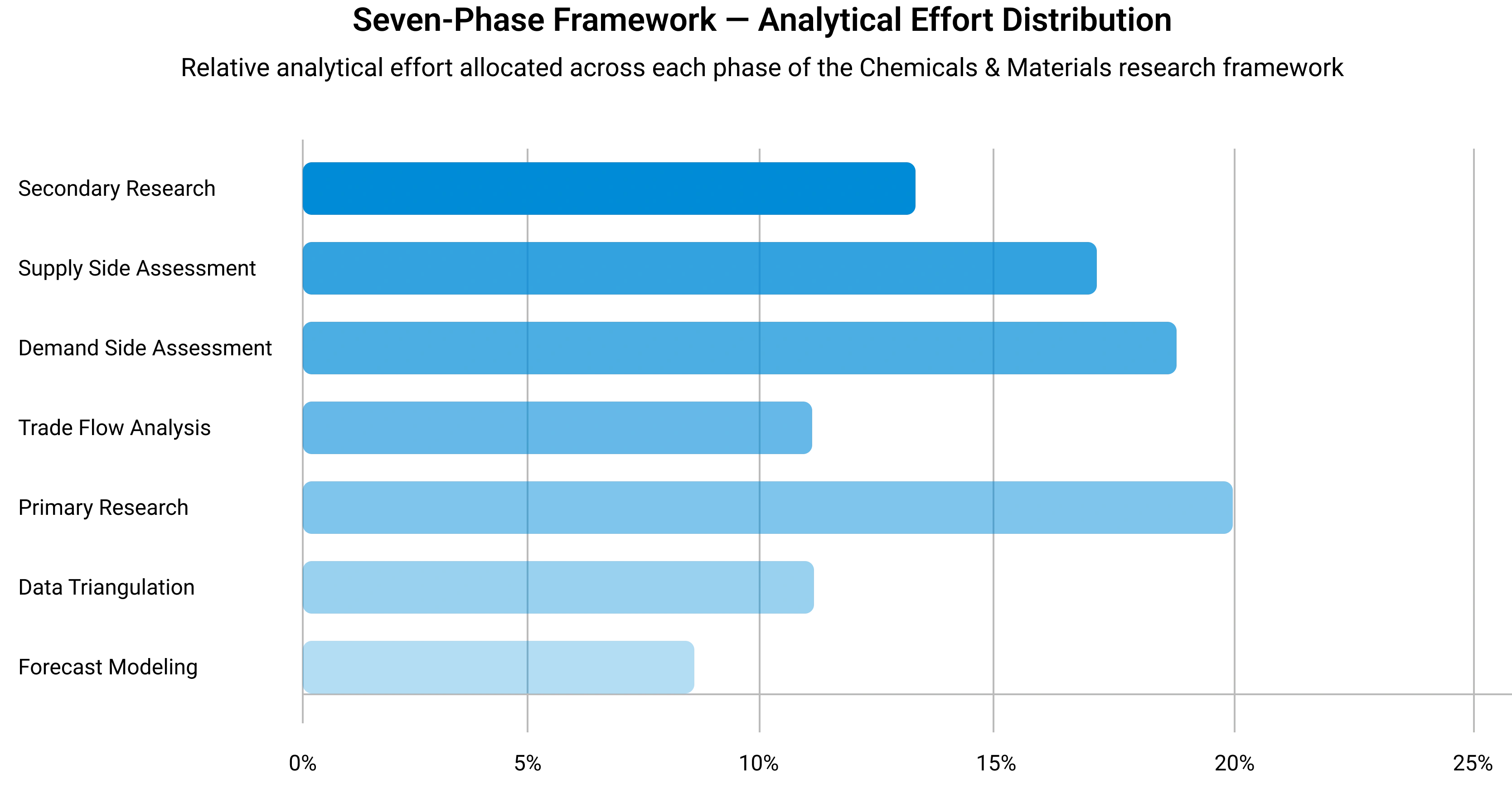
Seven-Phase Framework — Analytical Effort Distribution
Relative analytical effort allocated across each phase of the Chemicals & Materials research framework
Phase 1 - Secondary Research: Establishing the Foundation
Secondary research collects and evaluates publicly available information from authoritative sources, establishing the foundational understanding of market structure, value chain dynamics, competitive landscape, and end-use demand patterns. Every source is evaluated for credibility, recency, geographic relevance, and methodological soundness before inclusion.
Industry Associations
Sources include ACC, CEFIC, ICCA, JCIA, CPCIF, and SOCMA providing production volumes, consumption trends, capacity developments, and sustainability initiatives.
Company Disclosures
Annual reports, investor presentations, earnings transcripts, and regulatory filings reveal product portfolios, manufacturing footprints, capacity expansions, and revenue segmentation.
Government Databases
National statistical offices, customs authorities, environmental agencies, and industrial production databases provide verified statistics on output, trade flows, and regulatory compliance.
Trade Databases
UN Comtrade, ITC, Eurostat, and national customs authorities enable assessment of global product movement, import dependency, and export competitiveness across regions.
Our Secondary Research Sources
- Ministry of Chemicals and Fertilizers
- European Chemicals Agency
- United States Department of Energy
- Ministry of Industry and Information Technology
- Ministry of Economy Trade and Industry
- Ministry of Trade Industry and Energy
- National Institute of Standards and Technology
- Council of Scientific and Industrial Research
- Fraunhofer Society
- National Institute for Materials Science
Phase 2 — Supply-Side Assessment: Mapping Production Capabilities
Production Capacity Analysis
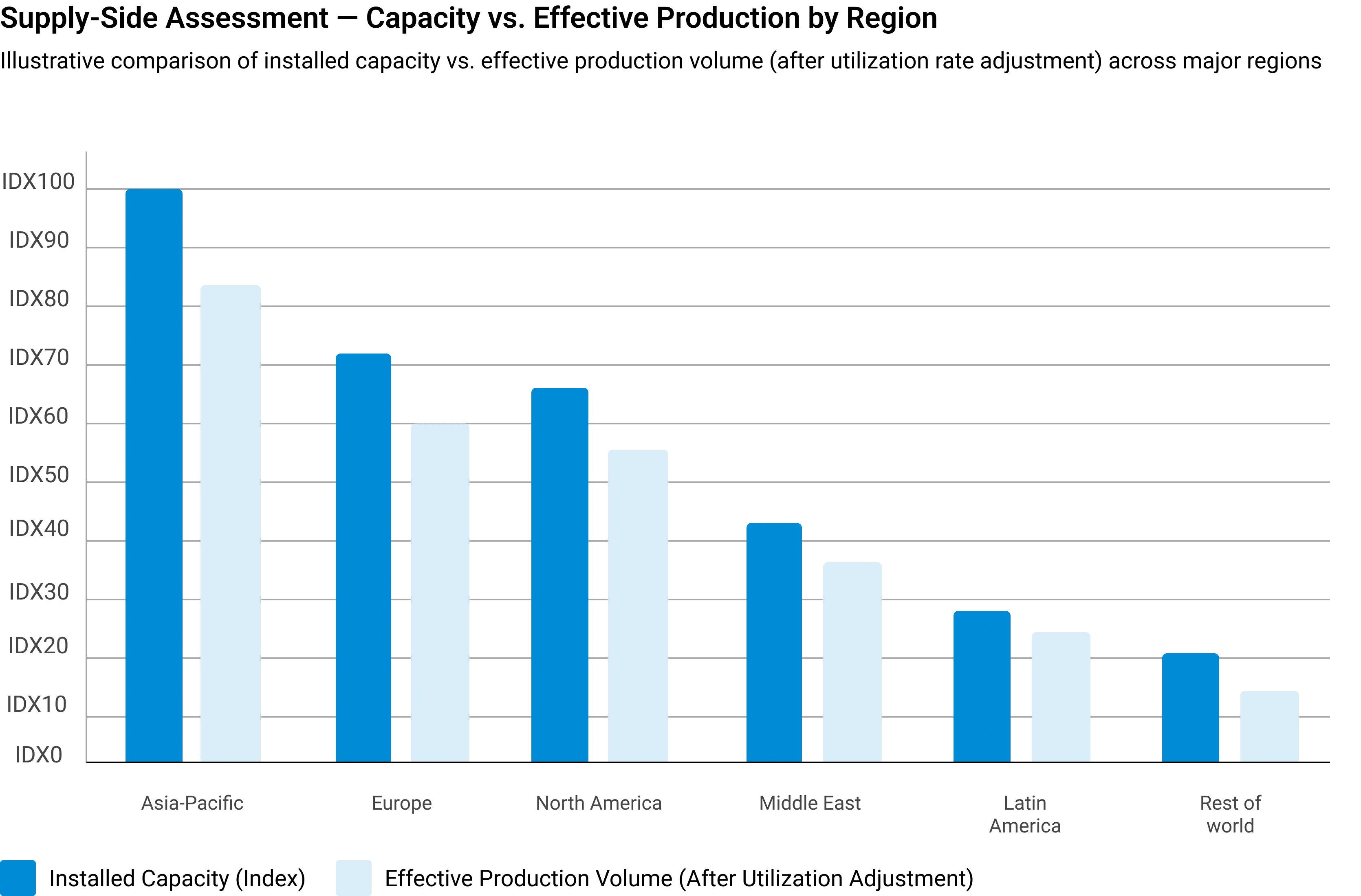
All major manufacturers are assessed for existing installed capacity, planned additions, expansions, new plant announcements, and technology adoption — mapped at global, regional, and country levels.
Capacity Utilization Adjustment
Installed capacity is adjusted using utilization rates based on demand conditions, feedstock availability, plant operating rates, maintenance schedules, and regulatory restrictions.
Manufacturer Revenue Analysis
Product-specific revenues, segment-level performance, regional distribution, average selling prices, and margin trends are evaluated to establish market value estimates.
Supply-Side Assessment — Capacity vs. Effective Production by Region
Illustrative comparison of installed capacity vs. effective production volume (after utilization rate adjustment) across major regions
Phase 3 — Demand-Side Assessment: Quantifying Chemical Consumption
Demand-side analysis quantifies chemical consumption across industries, applications, and geographies — identifying where and how chemicals are consumed throughout the value chain with precision.
End-Use Industry Analysis
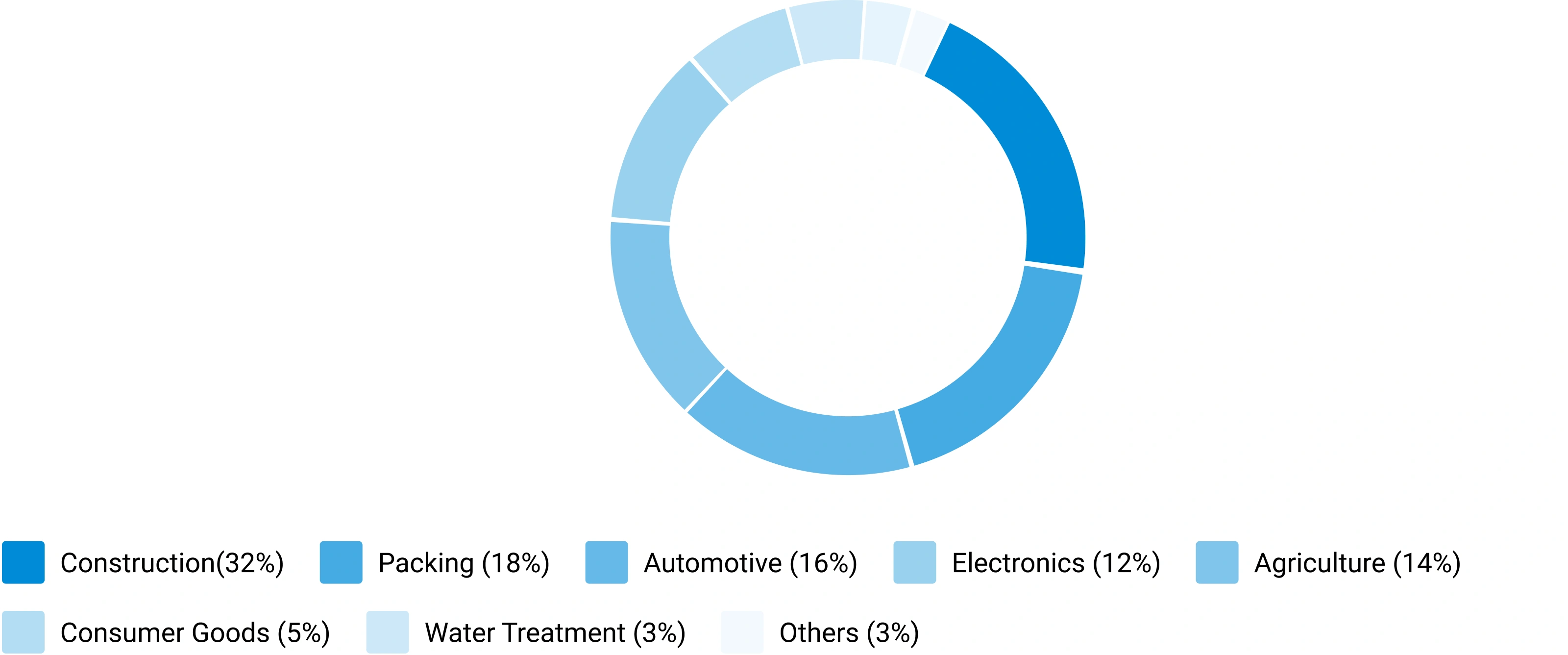
Chemical demand is evaluated across automotive, construction, packaging, electronics, agriculture, healthcare, consumer goods, industrial manufacturing, energy and utilities, and water treatment. Industry output, production trends, and consumption intensity are analyzed to determine demand patterns.
Consumption Modeling
Demand is estimated using measurable indicators: kilograms per vehicle, kilograms per square meter of construction, dosage per cubic meter of water treated, kilograms per hectare of agricultural land, and kilograms per ton of manufactured products. Consumption factors are validated through industry publications and primary interviews.
Application Analysis
The market is segmented by application area to understand product performance requirements, formulation trends, technology adoption, customer preferences, and regulatory requirements improving demand accuracy and segmentation granularity.
Demand-Side Assessment — End-Use Industry Demand Distribution
Illustrative distribution of chemical & materials demand across key end-use industries
Phase 4 - Trade Flow Analysis: Balancing Regional Supply and Demand
Trade flow analysis reconciles regional supply and demand estimates through import and export data, identifying net supply positions, regional dependencies, and market imbalances. It serves as an independent validation layer that tests the consistency of supply-side and demand-side estimates.
Import Analysis
Import data is evaluated to determine volumes, source countries, product dependency, regional supply gaps, and pricing trends — identifying markets that rely heavily on external supply and where domestic production is insufficient to meet demand.
Export Analysis
Export assessments reveal production surplus, export competitiveness, regional manufacturing strength, and global market participation. Export patterns also help validate domestic production estimates and identify net exporting regions.
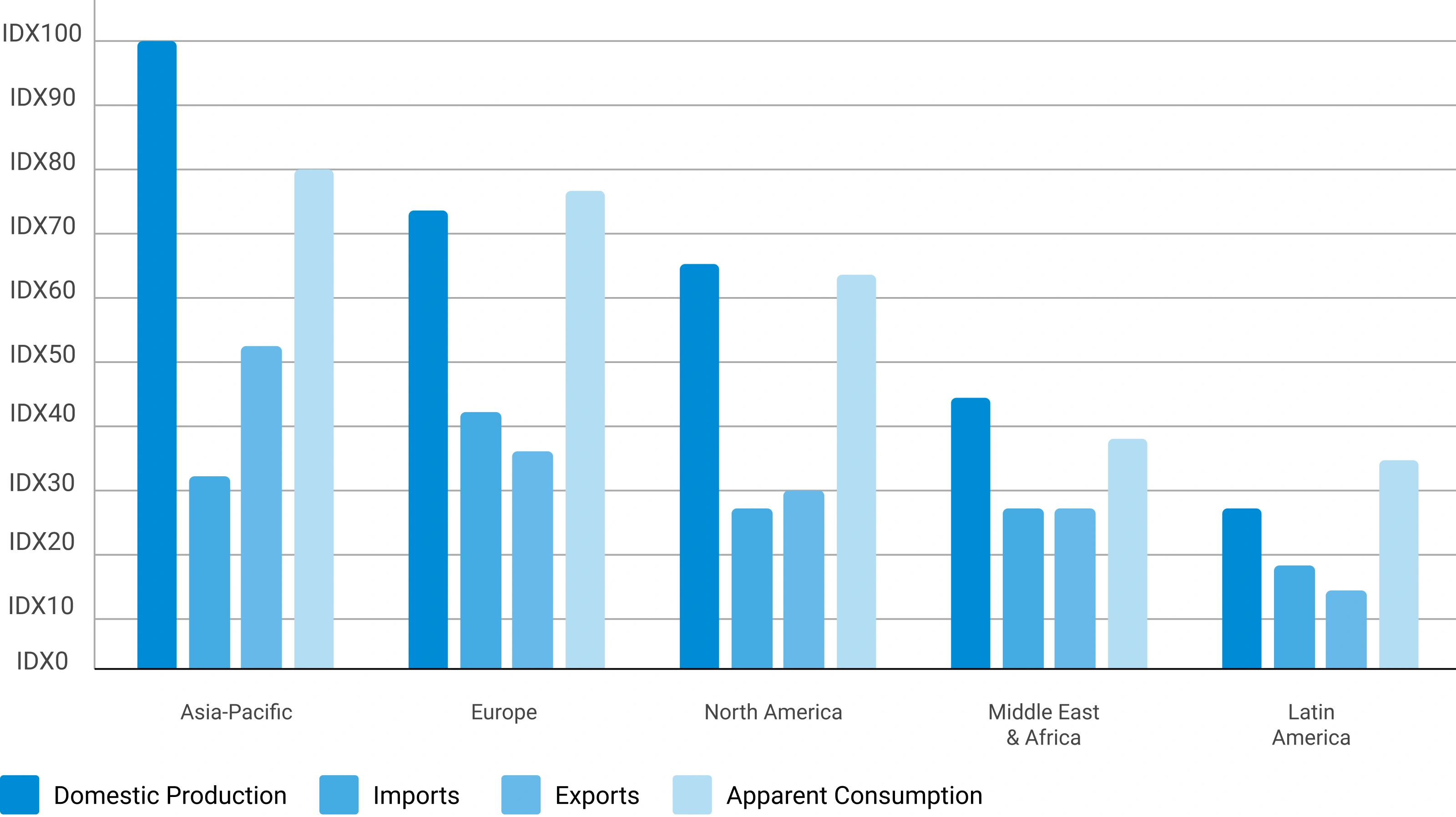
Apparent Consumption Model
Regional consumption is assessed using the standard apparent consumption formula:
Results identify net importing regions, net exporting regions, regional deficits, and surpluses — serving as an independent validation of supply and demand estimates.
Trade Flow Analysis — Net Supply Position by Region
Illustrative apparent consumption vs. domestic production across major regions — positive gap indicates net import dependency
Phase 5 — Primary Research: The Critical Validation Layer
Primary research tests and refines findings from secondary research through direct engagement with industry participants across the supply chain, demand side, and expert community. It captures intelligence that no database or published report can provide — the real-world experience of manufacturers, buyers, and specialists operating in the market.

Supply-Side Interviews
Conversations with chemical manufacturers, raw material suppliers, contract manufacturers, technology providers, and plant operators cover production trends, capacity utilization, pricing developments, technology shifts, and competitive dynamics.

Demand-Side Interviews
Engagement with OEMs, industrial consumers, procurement managers, distributors, formulators, and end-use manufacturers focuses on consumption trends, purchasing behavior, product substitution, demand outlook, and emerging applications.

Industry Expert Consultations
Additional interviews with industry consultants, independent experts, regulatory specialists, technical professionals, and research institutions provide deeper market context and validate key analytical assumptions.
Focus Areas of Primary Research:
Market Size & Forecast Validation
Revenue estimates, volume consumption, growth rates, forecast assumptions, regional demand.Supply Chain & Value Chain Assessment
Raw material sourcing, supply chain challenges, distribution networks, procurement practices.Production & Capacity Analysis
Manufacturing capacity, utilization rates, expansion projects, plant investments.Pricing & Cost Structure Analysis
Product pricing trends, feedstock costs, energy costs, margin pressures, pricing outlook.Competitive Landscape Assessment
Volume and value estimates confirmed to be fully consistent with one another before publicationInterview Volume by Market Scope
| Study Scope | Number of Interviews |
|---|---|
| Niche Market | 20 – 30 |
| Mid-Sized Market | 30 – 50 |
| Global Market | 50 – 80 |
| Highly Fragmented Market | 80 – 120 |
Interview Details:
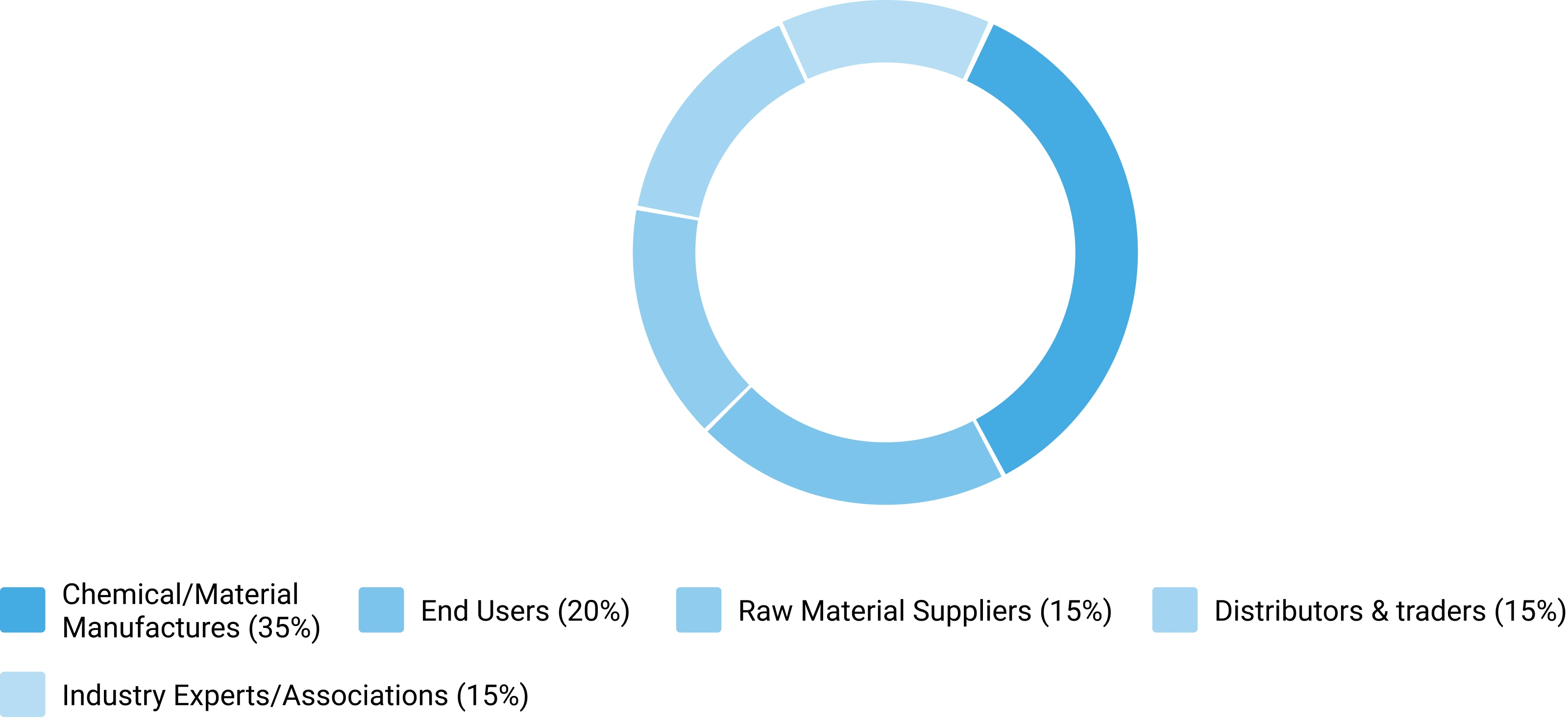
Category : Manufacturers, Suppliers, Distributors, End Users, Experts/Associations
Average Duration : 30–60 Minutes
Interview Mode : Video calls, telephonic interviews, expert consultations
Interview Format : Structured / Semi-Structured questionnaire
Focus Areas of Primary Research:
Market Size & Forecast Validation :
Revenue estimates, volume consumption, growth rates, forecast assumptions, regional demand.
Supply Chain & Value Chain Assessment :
Raw material sourcing, supply chain challenges, distribution networks, procurement practices.
Production & Capacity Analysis :
Manufacturing capacity, utilization rates, expansion projects, plant investments.
Pricing & Cost Structure Analysis :
Product pricing trends, feedstock costs, energy costs, margin pressures, pricing outlook.
Competitive Landscape Assessment :
Market share, competitor positioning, strategic initiatives, partnerships, acquisitions.
Primary Research — Stakeholder Coverage by Category
Distribution of interview respondents across stakeholder categories (% share from PPT data)
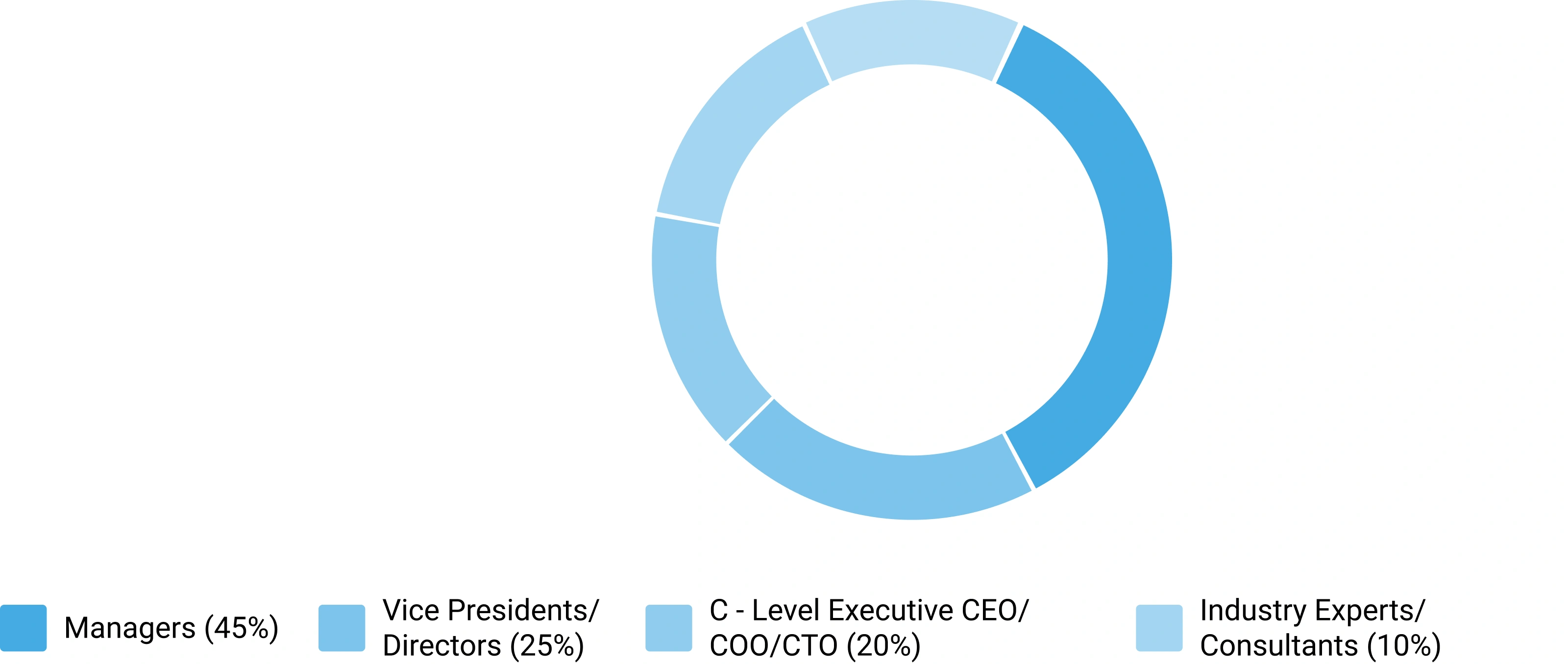
Primary Research — Respondent Designation Profile
Seniority breakdown of interview respondents (% share from PPT data)
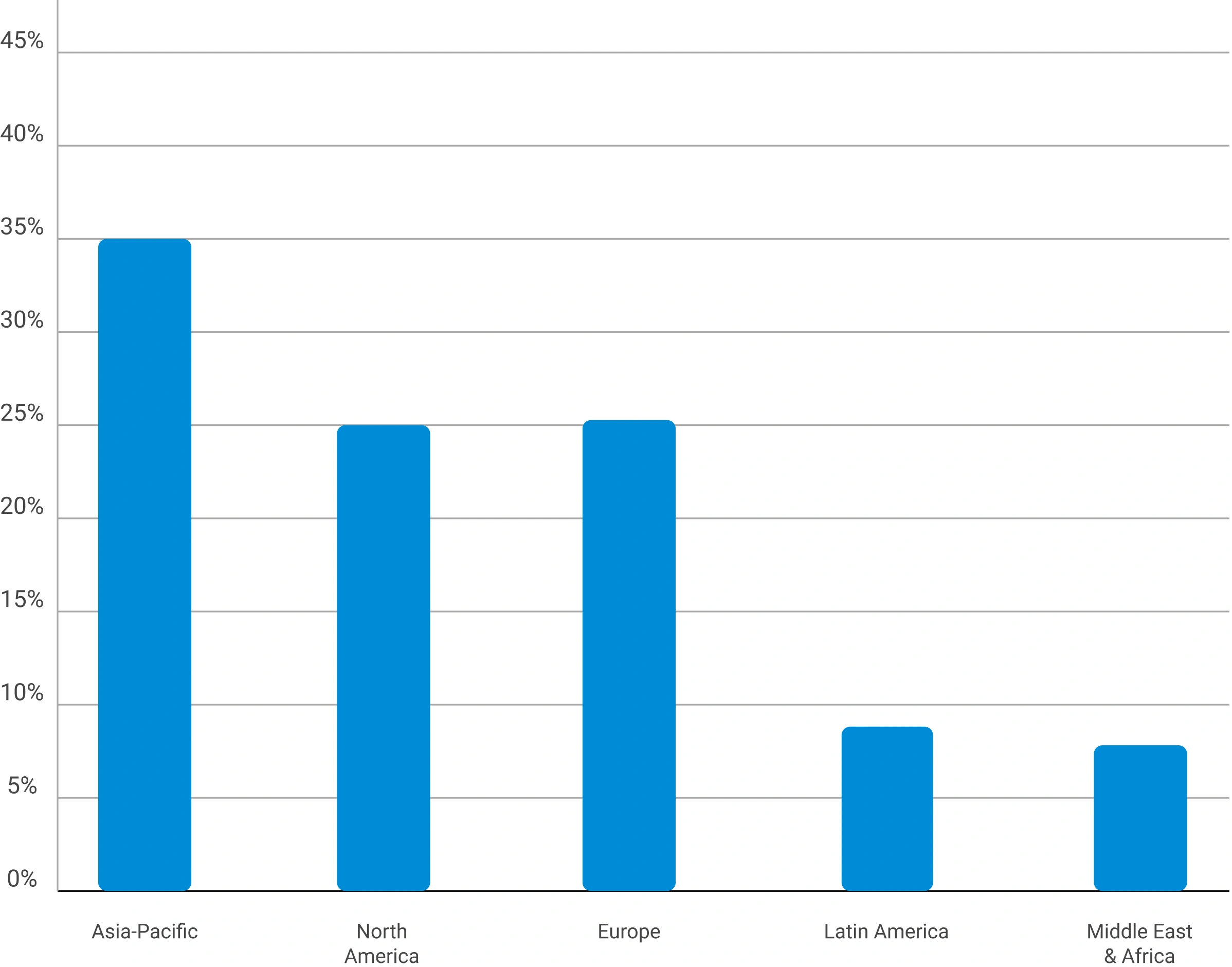
Primary Research — Geographic Coverage of Interviews
Regional distribution of primary research engagement (% share from PPT data)
Phase 6 — Data Triangulation and Market Validation
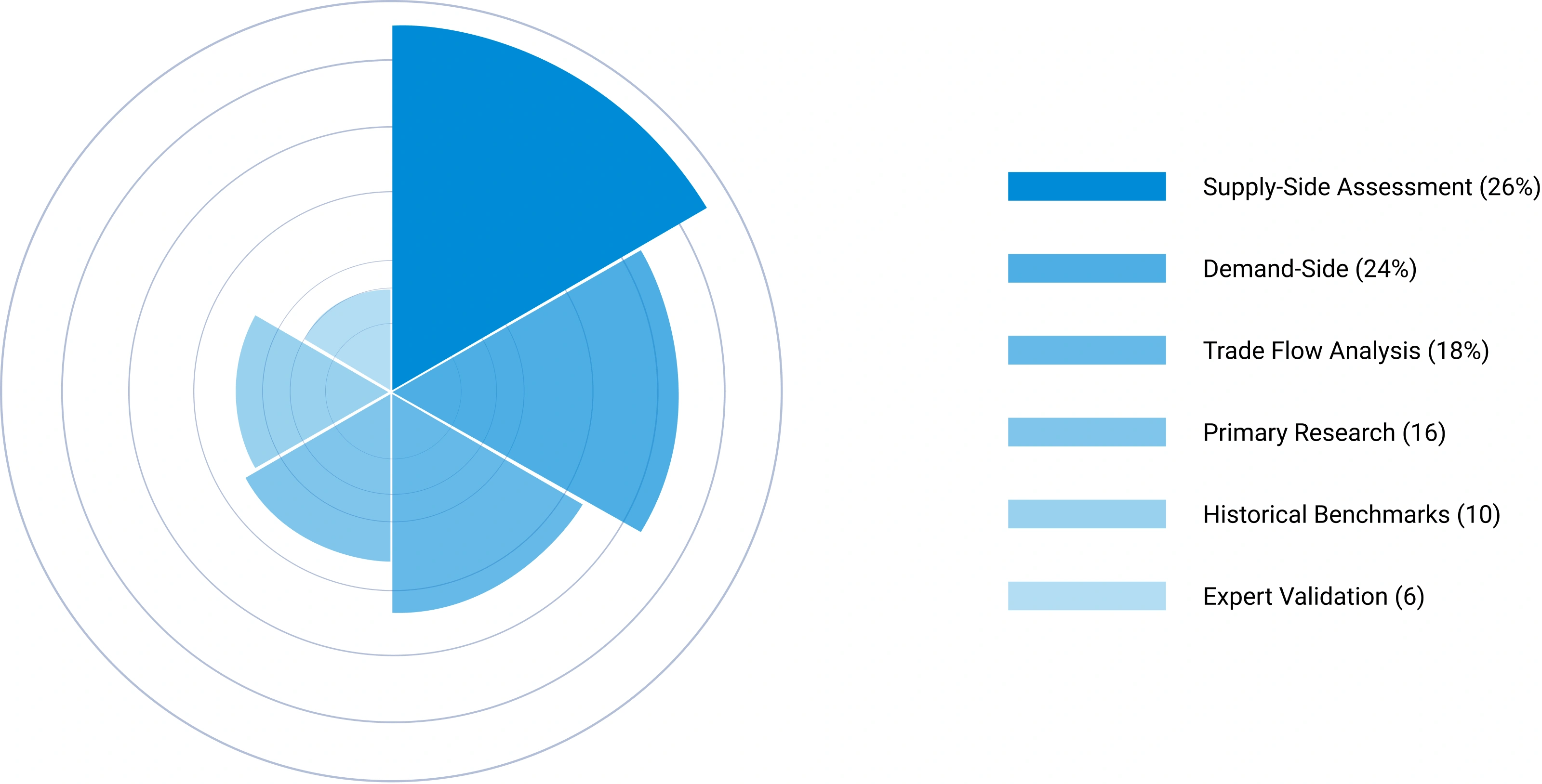
No single methodology is relied upon in isolation. Multiple independent estimation approaches are combined and reconciled to ensure consistency, accuracy, and analytical defensibility. Any material deviations between approaches are investigated and adjusted through additional validation cycles.
The final market size is derived through weighted triangulation of all validated methodologies. Any material deviations between approaches are investigated and adjusted through additional validation cycles. The outcome represents the most realistic assessment of the market based on available evidence and expert confirmation ensuring that volume and value estimates are fully consistent with one another.
Triangulation Framework — Input Contribution Weight
Relative weight each sizing input contributes to the final reconciled market estimate
Phase 7 — Forecast Modeling: Projecting Future Market Evolution
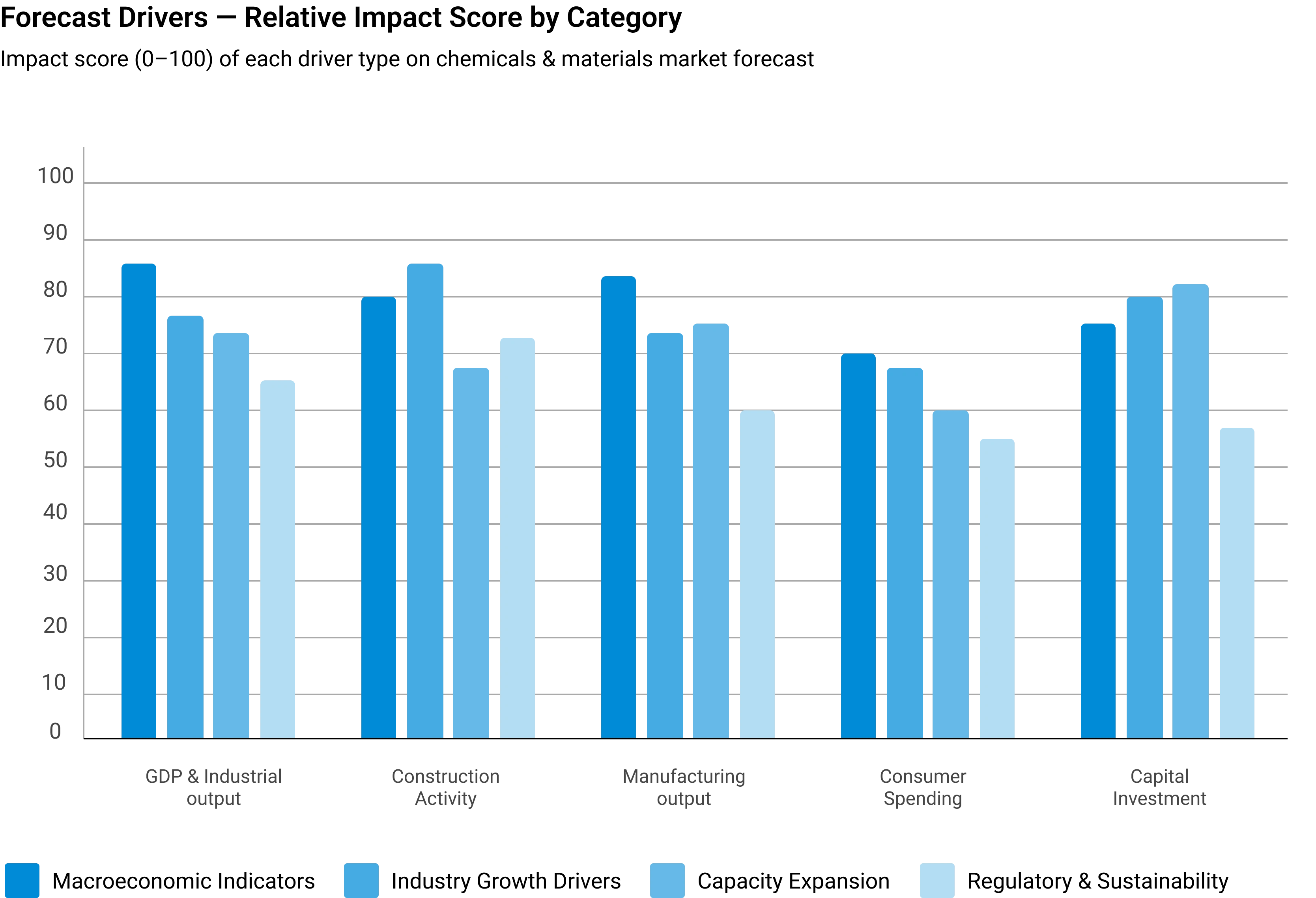
Forecasting evaluates the future trajectory of the market using a combination of quantitative indicators and qualitative assessments across economic, industry, and regulatory dimensions. Rather than simple extrapolation, each driver is independently modeled and integrated into a composite forecast.
Macroeconomic Indicators
GDP growth, industrial production, manufacturing output, construction activity, consumer spending, and capital investment form the quantitative foundation of long-term demand projections. These are applied at country, regional, and global levels.
Industry Growth Drivers
Urbanization, infrastructure development, industrialization, technological innovation, sustainability initiatives, and evolving product performance requirements are assessed at regional and industry levels — capturing both structural and cyclical demand drivers.
Capacity Expansion Analysis
Announced plant expansions, new manufacturing facilities, technology upgrades, and strategic investments are evaluated to determine future supply-demand dynamics and potential market tightness or oversupply situations.
Regulatory & Sustainability
Environmental regulations, chemical safety standards, emission reduction targets, circular economy initiatives, and sustainability requirements are incorporated as they often influence product adoption rates and market growth trajectories.
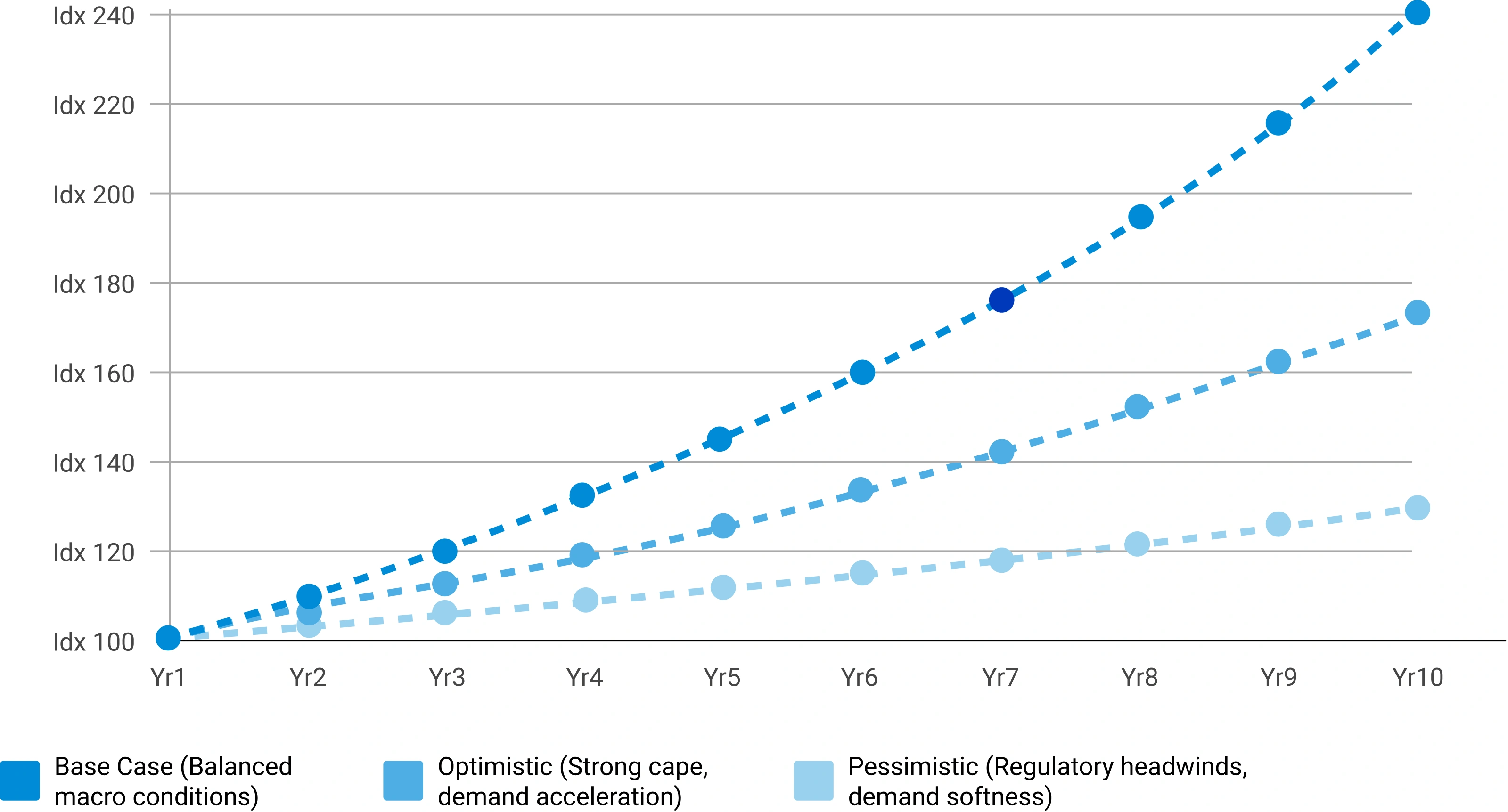
Scenario Forecast Range — Indexed Market Growth (Year 1–10)
Illustrative indexed growth trajectories across Base, Optimistic, and Pessimistic scenarios over a 10-year forecast horizon
Forecast Drivers — Relative Impact Score by Category
Impact score (0–100) of each driver type on chemicals & materials market forecast



Comments
Share your thoughts, ask a question, or provide feedback about this report.