Find the Right Market Report
Search thousands of industry reports, market insights, and research studies in one place.
Not sure where to start? Try one of these:
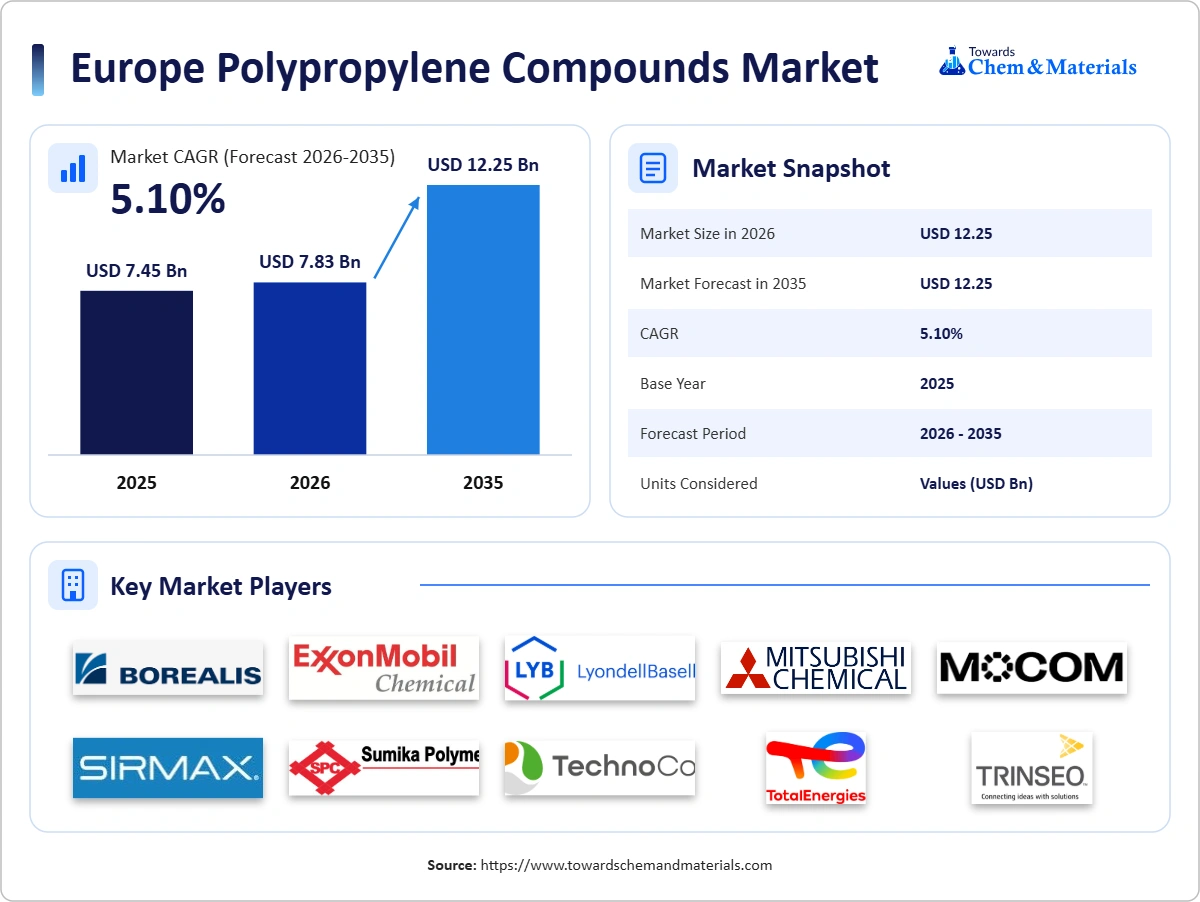
The Europe polypropylene compounds market size was valued at USD 7.45 billion in 2025 and is expected to reach USD 12.25 billion by 2035, growing at a CAGR of 5.10% during the forecast period of 2026-2035. The market was valued at USD 7.45 billion in 2025, which is the base year. The market comprises polypropylene blended with minerals, glass fibers, elastomers, additives and recycled materials to meet specific performance needs in Europe, including mineral-filled, glass fiber-reinforced, TPO, and elastomer-modified, recycled-content and other compounds, based on homopolymer and copolymer PP, used in automotive, building and construction, consumer goods and appliances, electrical and electronics, packaging, and other applications.
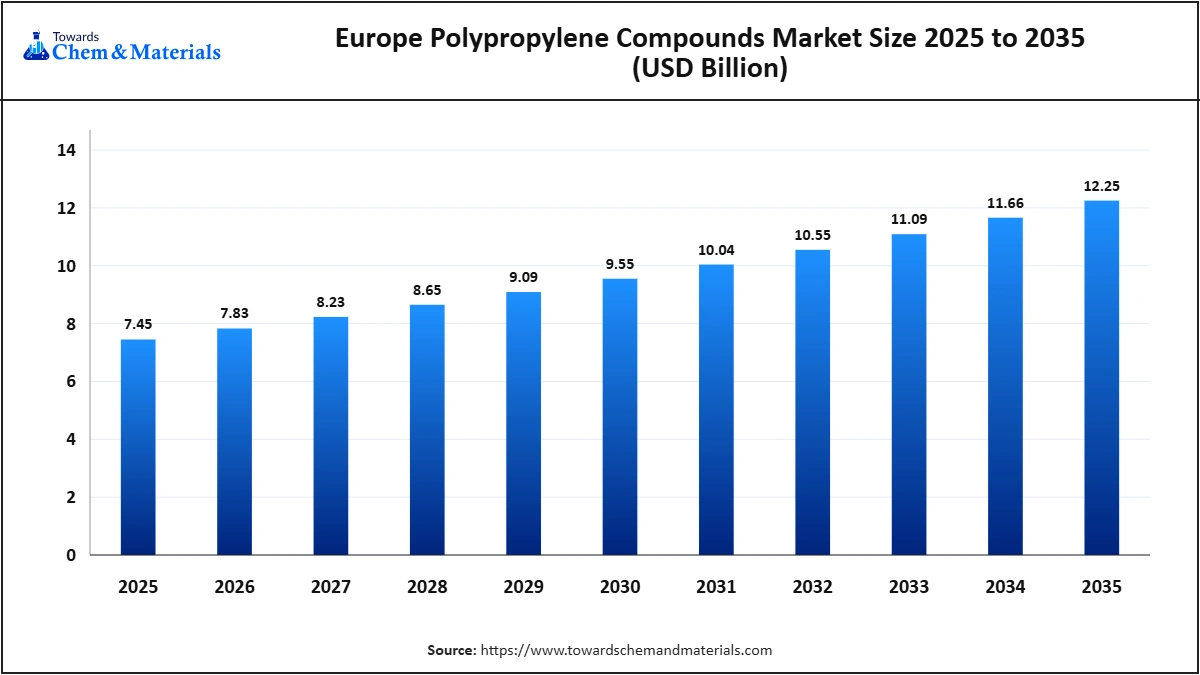
Note: 2025 is the base year; 2026-2035 values are forecasts.
Sources: Expert interviews, secondary sources, Towards Chemical and Materials database, and Towards Chemical and Materials analysts.
Mineral-filled compounds accounted for the largest product share of 43.00% in 2025, because talc- and calcium carbonate-filled PP gives stiffness, dimensional stability, and lower cost for car interiors, appliances and household goods. Germany accounted for 19.00% of revenue in 2025, owing to its large automotive and appliance industries and compounding plants. The demand for polypropylene compounds is being driven by vehicle lightweighting, especially in electric vehicles, appliance and consumer goods production, construction pipes and profiles, and EU recycled-content targets that are increasing the use of recycled PP compounds. Producers are investing in compounding capacity, such as Borealis' investment of more than EUR 100 million in Schwechat, Austria, with a new line due to start in the second half of 2026.
The market is projected to expand from USD 7.45 billion in 2025 to USD 12.25 billion by 2035 because carmakers, appliance makers, and builders make use of PP compounds to cut weight and cost, and recycled-content rules are creating new demand. The market benefits from EV lightweighting, recycled-content compounds, Central European manufacturing and construction demand. The market is expected to reach USD 9.55 billion by 2030 and sustain a CAGR of 5.10% during the forecast period. Polypropylene compounds are a value-added part of the wider European polyolefin chain, with compounders adding fillers, glass fibers and additives to base resin.
Analyst View: We built the estimate from compound consumption by product, polymer type, end use and country, multiplied by average prices, and cross-checked it against producer revenues and published European estimates. The growth rate is a testament to the growing trend in the usage of recycled-content and EV demand, which supports a slightly higher rate than comparable estimates. The market is being negatively affected by a weak European car production ecosystem.
Driver: The growing focus on vehicle weight reduction is driving the adoption of polypropylene compounds. The growing EV vehicle ecosystem adds to market demand for battery housings and interior components. Rising appliance production and increasing recycled-content targets benefit the market. Polypropylene compounds are increasingly replacing metal and engineering plastics in applications where weight reduction, cost efficiency, and mechanical performance are important.
Restraint: Weak automotive production across Europe limits market growth. High energy costs result in steep manufacturing and compounding expenditures. Quality inconsistency and lack of adequate supply of recycled polypropylene make it difficult for manufacturers to achieve performance and recycled-content goals. Significant fluctuations in polypropylene resin prices make it difficult for manufacturers to manage profit margins. Competition from lower-cost imports is putting significant pressure on European players.
Opportunity: Growing demand from OEMs for recycled compounds drives the demand for recycled polypropylene compounds. Increasing EV production fuels the demand for polypropylene compounds for use in EV batteries and charging parts. Expansion of production capacity in Central Europe and rising construction activity (polypropylene compounds find applications in the production of durable pipes) benefits the market. Rising demand for specialty flame-retardant polypropylene grades presents market growth potential in electrical, electronic, and automotive applications which require enhanced fire safety.
Market Drivers - Impact & CAGR Contribution (2026-2035)
| Driver | Impact | ≈ CAGR Contribution | Time Horizon | Key Regions |
| Vehicle lightweighting | High | +1.99 pp | Short to long term | Europe-wide, strongest in Germany |
| EV component demand | Medium | +1.68 pp | Medium to long term | Europe-wide, fastest uptake in Poland |
| Appliance production | Medium | +1.43 pp | Short to medium term | Europe-wide |
| Recycled-content targets | Low | +1.12 pp | Long term | Germany and Poland |
Note: Contributions are indicative estimates of each factor's effect on annual growth.
Sources: Expert interviews, secondary sources, Towards Chemical and Materials database and Towards Chemical and Materials analysts.
Taken together, these drivers add about 6.22 percentage points to the annual growth of the Europe polypropylene compounds market, with vehicle lightweighting having the largest effect. Their influence is strongest in Germany, while uptake grows fastest in Poland.
Market Restraints - Impact & Negative CAGR Contribution (2026-2035)
| Restraint | Impact | ≈ Negative CAGR Contribution | Time Horizon | Key Regions |
| Weak European car output | High | -0.50 pp | Short to medium term | Europe-wide |
| High energy costs | High | -0.37 pp | Medium term | Smaller and price-sensitive markets |
| Recyclate quality and supply | Medium | -0.25 pp | Short term | Germany and other mature markets |
Note: Contributions are indicative estimates of each factor's effect on annual growth.
Sources: Expert interviews, secondary sources, Towards Chemical and Materials database and Towards Chemical and Materials analysts.
These restraints are expected to reduce annual growth of the Europe polypropylene compounds market by about 1.12 percentage points, led by weak European car output. Their effect eases over the forecast period as suppliers, buyers and regulators adapt, leaving a net CAGR of 5.10% from 2026 to 2035.
| Segments | 2025 Share | 2025 Value (USD Billion) | 2035 Value (USD Billion) | CAGR 2026-2035 |
| Mineral-Filled | 43.00% | 3.20 | 4.95 | 4.44% |
| Glass Fibre-Reinforced | 22.00% | 1.64 | 2.63 | 4.84% |
| TPO & Elastomer-Modified | 18.00% | 1.34 | 2.15 | 4.84% |
| Recycled-Content | 9.00% | 0.67 | 1.56 | 8.84% |
| Others | 8.00% | 0.60 | 0.96 | 4.84% |
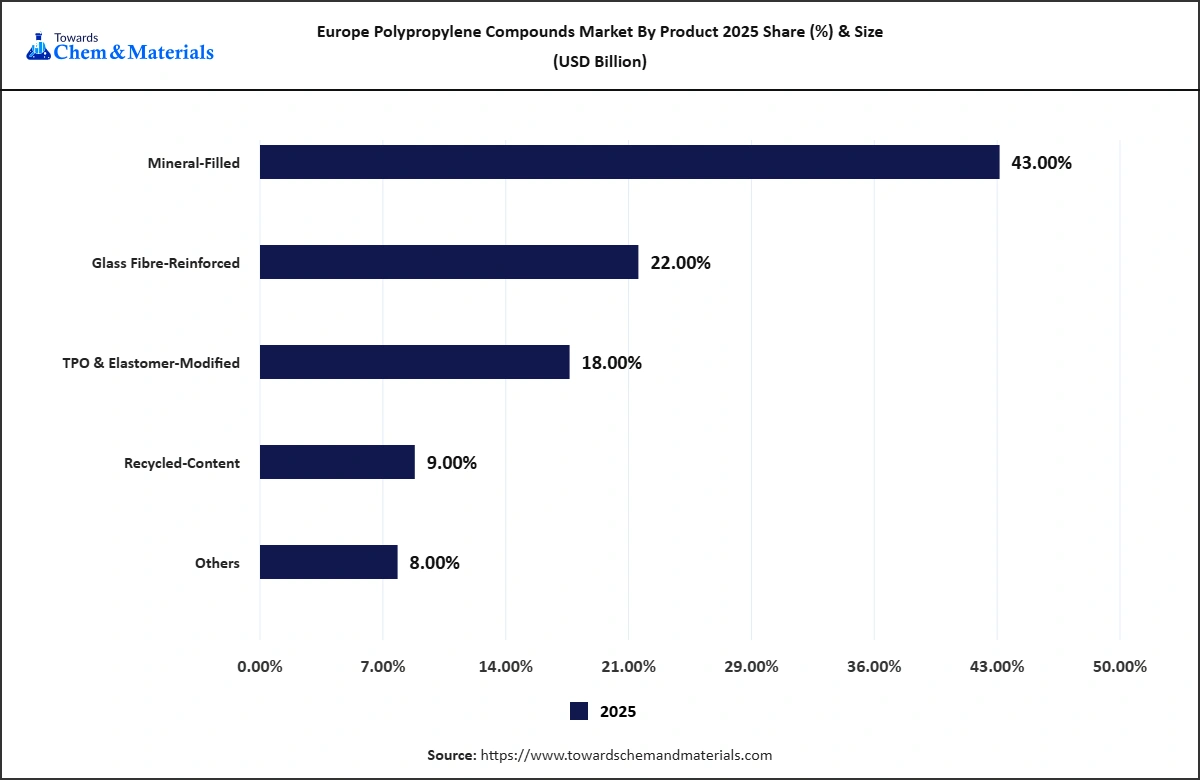
Note: 2025 is the base year; 2035 values are forecasts.
Sources: Expert interviews, secondary sources, Towards Chemical and Materials database, and Towards Chemical and Materials analysts.
Mineral-filled compounds accounted for the major revenue share of 43.00% (USD 3.20 billion) in 2025, glass fiber-reinforced compounds for 22.00% (USD 1.64 billion), TPO and elastomer-modified compounds for 18.00% (USD 1.34 billion), recycled-content compounds for 9.00% (USD 0.67 billion), and others for 8.00% (USD 0.60 billion). Recycled-content compounds are growing at the fastest pace in the product segment.
Mineral-Filled compounds held a 43.00% (USD 3.20 billion) share in 2025 and are projected to reach USD 4.95 billion by 2035, expanding at a CAGR of 4.44% during the forecast period. Mineral-filled compounds hold the leading position because talc and calcium carbonate add stiffness and heat resistance at low cost for dashboards, door panels, appliance housings, and furniture. The pace of growth of this segment is expected to be lower than the overall market growth rate.
Glass Fiber-Reinforced accounted for 22.00% (USD 1.64 billion) of revenue in 2025 and is projected to reach USD 2.63 billion by the end of the forecast period, expanding at a CAGR of 4.84% from 2026 to 2035. Glass fibre-reinforced compounds are increasingly replacing metal and engineering plastics in structural car parts, fans, and appliance components. The growth of this segment is expected to be aligned with the market growth over the forecast period.
TPO & Elastomer-Modified captured a market share of 18.00% (USD 1.34 billion) in 2025 and is projected to reach USD 2.15 billion by 2035, expanding at a CAGR of 4.84% from 2026 to 2035. TPO and elastomer-modified compounds provide impact resistance for bumpers, exterior trims, and interior skins. The TPO & Elastomer-Modified segment is expected to grow broadly in line with the overall market over the forecast period.
Recycled-Content accounted for 9.00% (USD 0.67 billion) of revenue in 2025 and is projected to reach USD 1.56 billion by 2035, expanding at a CAGR of 8.84% throughout the forecast period. This segment is growing at the fastest rate in the product category because carmakers, appliance makers, and packaging brands must meet recycled-content targets. This segment is expected to grow at a faster rate than the market growth rate over the forecast period.
Others held an 8.00% (USD 0.60 billion) share in 2025 and is projected to reach USD 0.96 billion by 2035, expanding at a CAGR of 4.84% during the forecast period. Others include flame-retardant, conductive, and specialty compounds. The growth of this segment is expected to be aligned with the market growth over the forecast period.
Segment Outlook: Mineral-Filled is expected to be the largest product segment through the end of the forecast period, reaching about USD 4.95 billion, while Recycled-Content is expected to grow at the highest CAGR of 8.84% from 2026 to 2035. Others hold the smallest share today and serve more specialised needs within the market.
| Segments | 2025 Share | 2025 Value (USD Billion) | 2035 Value (USD Billion) | CAGR 2026-2035 |
| Homopolymer | 72.00% | 5.36 | 8.53 | 4.75% |
| Copolymer | 28.00% | 2.09 | 3.72 | 5.95% |
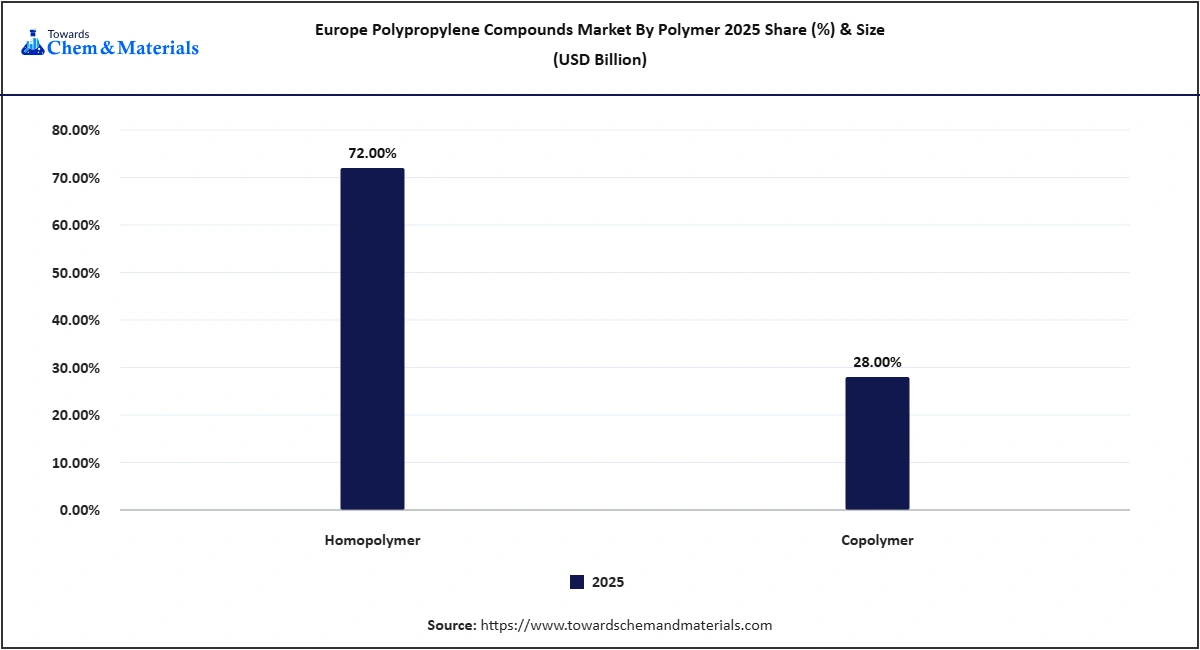
Note: 2025 is the base year; 2035 values are forecasts.
Sources: Expert interviews, secondary sources, Towards Chemical and Materials database and Towards Chemical and Materials analysts.
Homopolymer-based compounds accounted for 72.00% (USD 5.36 billion) in 2025 and copolymer-based compounds for 28.00% (USD 2.09 billion).
Homopolymer held the largest share of 72.00% (USD 5.36 billion) in 2025 and is projected to reach USD 8.53 billion by 2035, expanding at a CAGR of 4.75% during the forecast period. The leadership of this segment can be attributed to the fact that they offer stiffness and heat resistance at low cost. The homopolymer segment is expected to grow slower than the overall market over the forecast period.
Copolymer accounted for 28.00% (USD 2.09 billion) of the market in 2025 and is projected to expand to USD 3.72 billion by 2035, growing at a CAGR of 5.95% from 2026 to 2035. Copolymer-based compounds are growing faster than homopolymers because they offer better impact strength for automotive and cold-temperature uses. The rate of growth of this segment is expected to be higher than the overall market growth rate over the forecast period.
Segment Outlook: Homopolymer is expected to continue to lead the polymer type segment through 2035, reaching about USD 8.53 billion, while Copolymer records the highest CAGR of 5.95% from 2026 to 2035. Copolymer started from a smaller base, but its faster growth shows how demand is shifting within the market.
| Segments | 2025 Share | 2025 Value (USD Billion) | 2035 Value (USD Billion) | CAGR 2026-2035 |
| Automotive | 36.00% | 2.68 | 4.22 | 4.66% |
| Building & Construction | 16.00% | 1.19 | 1.95 | 5.06% |
| Consumer Goods & Appliances | 14.00% | 1.04 | 1.71 | 5.06% |
| Electrical & Electronics | 14.00% | 1.04 | 1.92 | 6.26% |
| Packaging | 12.00% | 0.89 | 1.47 | 5.06% |
| Others | 8.00% | 0.60 | 0.98 | 5.06% |
Note: 2025 is the base year; 2035 values are forecasts.
Sources: Expert interviews, secondary sources, Towards Chemical and Materials database and Towards Chemical and Materials analysts.
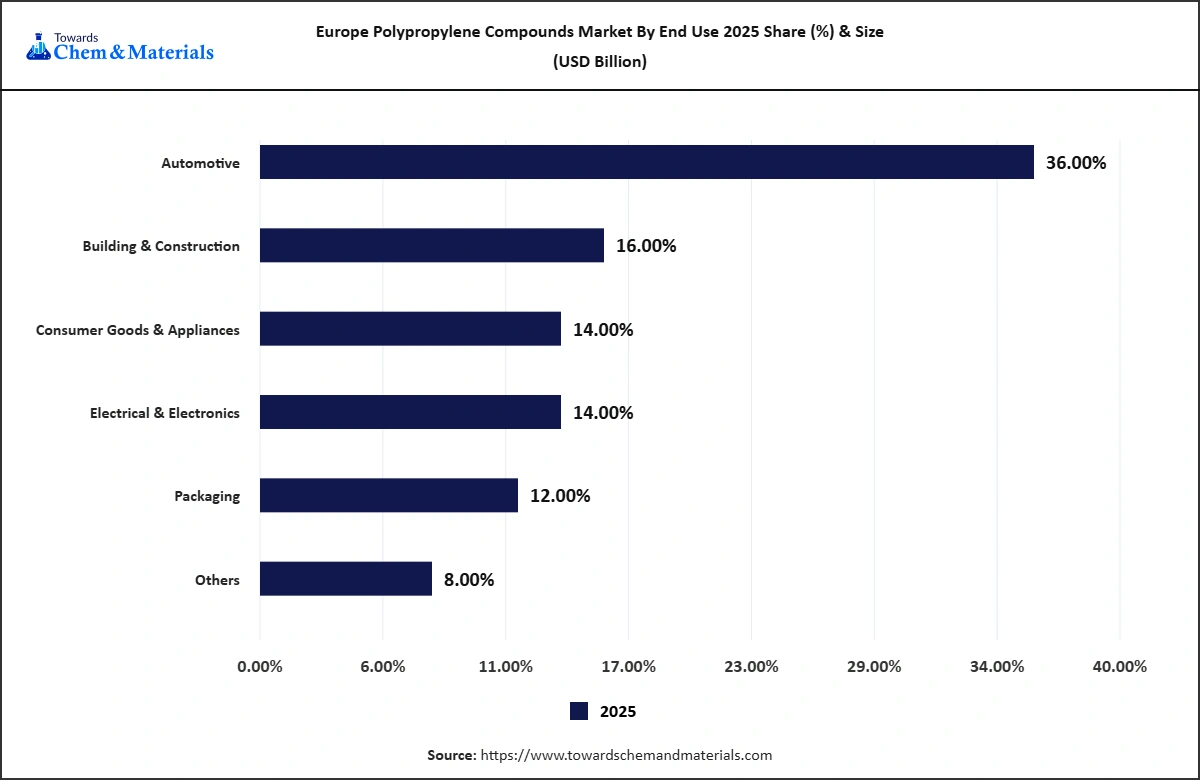
Automotive accounted for 36.00% (USD 2.68 billion) in 2025, building and construction for 16.00% (USD 1.19 billion), consumer goods and appliances for 14.00% (USD 1.04 billion), electrical and electronics for 14.00% (USD 1.04 billion), packaging for 12.00% (USD 0.89 billion) and others for 8.00% (USD 0.60 billion).
Automotive held a 36.00% (USD 2.68 billion) share in 2025 and is projected to reach USD 4.22 billion by 2035, expanding at a CAGR of 4.66% from 2026 to 2035. Automotive represents the largest end-user base because PP compounds are the most used plastic in cars for bumpers, interiors, and under-hood parts, as they help to reduce weight. The automotive segment is expected to grow slower than the overall market over the forecast period.
Building & Construction accounted for 16.00% (USD 1.19 billion) of the market in 2025 and is projected to reach USD 1.95 billion by 2035, expanding at a CAGR of 5.06% throughout the forecast period. Building and construction uses PP compounds in pipes, fittings and profiles. This segment is expected to grow broadly in line with the market over the forecast period.
Consumer Goods & Appliances held a market share of 14.00% (USD 1.04 billion) in 2025 and is projected to reach USD 1.71 billion by 2035, expanding at a CAGR of 5.06% during the forecast period. Consumer goods and appliances use PP compounds for washing machines, small appliances and furniture. The consumer goods & appliances segment is expected to grow broadly in line with the overall market over the forecast period.
Electrical & Electronics captured a 14.00% (USD 1.04 billion) share in 2025 and is projected to reach USD 1.92 billion by 2035, expanding at a CAGR of 6.26% from 2026 to 2035. This segment is growing at the fastest pace in the end-user category because of EV battery components, charging equipment and cable systems. This segment is expected to exhibit a faster rate of growth than the overall market from 2026 to 2035.
Packaging accounted for 12.00% (USD 0.89 billion) of revenue in 2025 and is projected to reach USD 1.47 billion by 2035, expanding at a CAGR of 5.06% during the forecast period. Packaging makes use of PP compounds for caps, closures and rigid containers. The packaging segment is expected to grow broadly in line with the overall market over the forecast period.
Others held a market share of 8.00% (USD 0.60 billion) in 2025 and is projected to reach USD 0.98 billion by 2035, expanding at a CAGR of 5.06% from 2026 to 2035. Others include textiles, medical and agricultural uses. The other segments are expected to grow broadly in line with the overall market over the forecast period.
Segment Outlook: Automotive is expected to continue to be the largest end use segment through 2035, reaching about USD 4.22 billion, while Electrical & Electronics is expected to expand at the highest CAGR of 6.26% from 2026 to 2035. Others holds the smallest share today and serves more specialized needs within the market.
Analyst View: Segment values were allocated by matching consumption and prices to products, polymer types and end uses. Mineral-filled compounds, homopolymers and automotive lead, while recycled-content compounds, copolymers and electrical uses gain share.
| Country | 2025 Share | 2025 Value (USD Billion) | 2035 Value (USD Billion) | CAGR 2026-2035 |
| Germany | 19.00% | 1.42 | 2.22 | 4.67% |
| France | 13.00% | 0.97 | 1.59 | 5.07% |
| Italy | 12.00% | 0.89 | 1.47 | 5.07% |
| Spain | 9.00% | 0.67 | 1.10 | 5.07% |
| Poland | 8.00% | 0.60 | 1.10 | 6.27% |
| UK | 8.00% | 0.60 | 0.98 | 5.07% |
| Czech Republic | 7.00% | 0.52 | 0.86 | 5.07% |
| Belgium | 5.00% | 0.37 | 0.61 | 5.07% |
| Netherlands | 4.00% | 0.30 | 0.49 | 5.07% |
| Rest of Europe | 15.00% | 1.12 | 1.83 | 5.07% |
Note: 2025 is the base year; 2035 values are forecasts.
Sources: Expert interviews, secondary sources, Towards Chemical and Materials database and Towards Chemical and Materials analysts.
Germany captured the highest market share of 19.00% (USD 1.42 billion) in 2025, France for 13.00% (USD 0.97 billion), Italy for 12.00% (USD 0.89 billion), Spain for 9.00% (USD 0.67 billion), Poland for 8.00% (USD 0.60 billion), the UK for 8.00% (USD 0.60 billion), the Czech Republic for 7.00% (USD 0.52 billion), Belgium for 5.00% (USD 0.37 billion), the Netherlands for 4.00% (USD 0.30 billion) and the rest of Europe for 15.00% (USD 1.12 billion). Poland is growing at a higher rate than any other region in Europe.
Germany accounted for a 19.00% (USD 1.42 billion) share in 2025 and is projected to reach USD 2.22 billion by 2035, expanding at a CAGR of 4.67% from 2026 to 2035. Germany is the largest country because of its car, appliance and machinery industries and compounding plants. The pace of growth of this country is expected to be lesser than overall market over the forecast period.
France captured a market share of 13.00% (USD 0.97 billion) in 2025 and is projected to reach USD 1.59 billion by 2035, expanding at a CAGR of 5.07% during the forecast period. France has significant demand for polypropylene compounds from the automotive, packaging and construction sectors. France is expected to grow broadly in line with the overall market between 2026 and 2035.
Italy accounted for 12.00% (USD 0.89 billion) of the market in 2025 and is projected to reach USD 1.47 billion by 2035, expanding at a CAGR of 5.07% from 2026 to 2035. Italy has a strong appliance, automotive and consumer goods production ecosystem. This country is expected to grow broadly in line with the overall market between 2026 and 2035.
Spain captured 9.00% (USD 0.67 billion) of the market in 2025 and is projected to reach USD 1.10 billion by 2035, expanding at a CAGR of 5.07% during the forecast period. Spain is a major car production hub. Spain is expected to grow broadly in line with the overall market between 2026 and 2035.
Poland accounted for an 8.00% (USD 0.60 billion) share in 2025 and is projected to reach USD 1.10 billion by 2035, expanding at a CAGR of 6.27% from 2026 to 2035. Poland is the fastest-growing country because automotive, appliance, and battery production is expanding there. Poland is expected to grow faster than the overall market between 2026 and 2035.
UK held a market share of 8.00% (USD 0.60 billion) in 2025 and is projected to reach USD 0.98 billion by 2035, expanding at a CAGR of 5.07% during the forecast period. The UK has significant automotive and packaging demand. UK is expected to grow broadly in line with the overall market between 2026 and 2035.
Czech Republic captured 7.00% (USD 0.52 billion) of the market in 2025 and is projected to expand to USD 0.86 billion by 2035, growing at a CAGR of 5.07% from 2026 to 2035. The Czech Republic has large car and parts production that uses PP compounds. Czech Republic is expected to grow broadly in line with the overall market between 2026 and 2035.
Belgium: This country accounted for 5.00% (USD 0.37 billion) of the Europe polypropylene compounds market in 2025 and is projected to reach USD 0.61 billion by 2035, expanding at a CAGR of 5.07% from 2026 to 2035. Belgium hosts petrochemical and compounding plants around Antwerp. Belgium is expected to grow broadly in line with the overall market between 2026 and 2035.
Netherlands: This country accounted for 4.00% (USD 0.30 billion) of the Europe polypropylene compounds market in 2025 and is projected to reach USD 0.49 billion by 2035, expanding at a CAGR of 5.07% from 2026 to 2035. The Netherlands hosts polymer production and compounding sites. Netherlands is expected to grow broadly in line with the overall market between 2026 and 2035.
Rest of Europe: This country accounted for 15.00% (USD 1.12 billion) of the Europe polypropylene compounds market in 2025 and is projected to reach USD 1.83 billion by 2035, expanding at a CAGR of 5.07% from 2026 to 2035. The rest of Europe includes Slovakia, Hungary, Romania, Austria, Sweden and other markets, with large automotive production in Central Europe. Rest of Europe is expected to grow broadly in line with the overall market between 2026 and 2035.
Analyst View: Country shares were built from compound demand in each country. Germany leads, while Poland grows fastest with manufacturing growth.
| Rank | Company Name | Market-Specific Revenue (USD Billion) | 2025 Share | Key Products / Business | Headquarters |
| 1 | LyondellBasell | 0.95 | 12.75% | Hifax, Hostacom and recycled-content PP compounds | Netherlands |
| 2 | Borealis | 0.85 | 11.41% | Daplen and Fibremod PP compounds | Austria |
| 3 | SABIC | 0.45 | 6.04% | STAMAX and PP compounds | Saudi Arabia |
| 4 | ExxonMobil | 0.30 | 4.03% | PP compounds and resins | United States |
| 5 | TotalEnergies | 0.30 | 4.03% | PP compounds | France |
| 6 | Ravago | 0.25 | 3.36% | PP compounds and recycled compounds | Belgium |
| 7 | Avient | 0.20 | 2.68% | Specialty PP compounds | United States |
| 8 | Celanese | 0.15 | 2.01% | Glass-reinforced PP compounds | United States |
| 9 | Mitsubishi Chemical Group | 0.15 | 2.01% | PP compounds | Japan |
| 10 | Kingfa | 0.10 | 1.34% | Modified PP compounds | China |
Note: Company revenues and shares are 2025 estimates.
Sources: Company press releases, expert interviews, secondary sources, Towards Chemical and Materials database and Towards Chemical and Materials analysts.
LyondellBasell led the Europe polypropylene compounds market with an estimated 12.75% (USD 0.95 billion) of 2025 revenue, followed by Borealis at 11.41% (USD 0.85 billion) and SABIC at 6.04% (USD 0.45 billion). LyondellBasell leads with Hifax and Hostacom PP compounds and recycled-content grades for automotive and appliances. Borealis supplies Daplen and Fibremod compounds and is expanding compounding capacity in Austria, and SABIC offers STAMAX long glass fibre and other PP compounds. ExxonMobil, TotalEnergies, Ravago, Avient, Celanese, Mitsubishi Chemical Group and Kingfa compete through PP compounds, recycled compounds, specialty and glass-reinforced grades and modified compounds. The top 10 companies accounted for an estimated 49.66% (USD 3.70 billion) of 2025 revenue, while the remaining 50.34% (USD 3.75 billion) was shared among many independent compounders and recyclers. The Europe polypropylene compounds market is moderately concentrated, and competition centres on performance, recycled content, carmaker approvals, technical service, local production and price. Material informatics tools are starting to shorten the development of new compound grades.
LyondellBasell: The Netherlands serves as the headquarters of LyondellBasell. It generated an estimated USD 0.95 billion of market-specific revenue in 2025, about 12.75% of the Europe polypropylene compounds market. Its offering centres on Hifax, Hostacom and recycled-content PP compounds. It is classified as a Leader in the Towards Chemical and Materials Companies Quadrant.
Borealis: Borealis is headquartered in Austria. The company generated USD 0.85 billion in revenue from this market in 2025, equivalent to approximately 11.41% of the market. Daplen and Fibremod PP compounds form the core of its product portfolio. The company holds a Leader position in Towards Chemical and Materials Companies Quadrant.
SABIC: SABIC, part of Saudi Basic Industries Corporation, is headquartered in Saudi Arabia. Its market-specific revenue reached an estimated USD 0.45 billion in 2025, accounting for around 6.04% of the market. STAMAX products and PP compounds represent its principal product categories. In the Towards Chemical and Materials Companies Quadrant it is positioned as a Leader.
ExxonMobil: ExxonMobil has its global headquarters in the United States. The company held an estimated 4.03% share of the market in 2025, corresponding to approximately USD 0.30 billion in revenue. The company's main product offerings include PP compounds and resins. It occupies the Leader category in the Towards Chemical and Materials Companies Quadrant.
TotalEnergies: TotalEnergies is headquartered in France. The company accounted for an estimated 4.03% of the Europe polypropylene compounds market in 2025, with market-specific revenue of USD 0.30 billion. Its core business revolves around the production of PP compounds. According to Towards Chemical and Materials, the company ranks among the Leaders in its Companies Quadrant.
Ravago: Ravago is a Belgium-headquartered company. Market-specific revenue stood at an estimated USD 0.25 billion in 2025, accounting for around 3.36% of the Europe polypropylene compounds market. The company specializes in the development and supply of PP compounds and recycled compounds. Its competitive positioning is classified as Leader by Towards Chemical and Materials.
Avient: Avient is headquartered in the United States. The company accounted for approximately 2.68% of the Europe polypropylene compounds market in 2025, with market-specific revenue of USD 0.20 billion. The company's core offering comprises glass-fibre-reinforced PP compounds. Towards Chemical and Materials identifies the company as a Leader in its Companies Quadrant.
Celanese: Celanese maintains its headquarters in the United States. The company accounted for approximately 2.01% of the Europe polypropylene compounds market in 2025, with market-specific revenue of USD 0.15 billion. The company's core offering comprises glass-fibre-reinforced PP compounds. In the Towards Chemical and Materials Companies Quadrant it is positioned as an Innovator.
Mitsubishi Chemical Group: Mitsubishi Chemical Group has its global headquarters in Japan. The company accounted for approximately 2.01% of the Europe polypropylene compounds market in 2025, with estimated revenue of USD 0.15 billion. Its product portfolio primarily comprises polypropylene compounds. In the Towards Chemical and Materials Companies Quadrant, it is positioned as an Innovator.
Kingfa: Kingfa has its headquarters in China. In 2025, the company held an estimated 1.34% share of the European market, generating USD 0.10 billion in market-specific revenue. Its offering revolves around Modified PP compounds. In the Towards Chemical and Materials Companies Quadrant it is positioned as an Innovator.
The Europe polypropylene compounds ecosystem links PP resin, filler and recyclate suppliers with compounders, moulders, OEMs and recyclers. Compounders sit downstream of polyolefin and alpha olefin producers, which supply base polymers and comonomers.
| Ecosystem Stage | Role in the Market | Key Companies |
| Resin & Fillers | Supply PP, talc, glass fibre | Polymer producers and mineral suppliers |
| Recyclate Suppliers | Supply recycled PP | Mechanical recyclers |
| Compounders | Make PP compounds | LyondellBasell, Borealis, SABIC, Ravago, Avient |
| Moulders | Make parts | Injection moulders and tier suppliers |
| OEMs | Use parts | Carmakers, appliance and packaging firms |
Sources: Company press releases, expert interviews, secondary sources, Towards Chemical and Materials database and Towards Chemical and Materials analysts.
Resin & Fillers: Supply PP, talc, glass fiber. Key participants include Polymer producers and mineral suppliers.
Recyclate Suppliers: Supply recycled PP. Key participants include Mechanical recyclers.
Compounders: Make PP compounds. Key participants include LyondellBasell, Borealis, SABIC, Ravago, Avient.
Molders: Make parts. Key participants include Injection molders and tier suppliers.
OEMs: Use parts. Key participants include Carmakers, appliance and packaging firms.
Value in the Europe polypropylene compounds market flows from upstream material and technology suppliers to manufacturers and service providers, then through distribution partners to end users. Companies that integrate several stages or build long-term relationships with end users capture a larger share of this value.
The Towards Chemical and Materials Companies Quadrant positions key participants in the Europe polypropylene compounds market by market strength, reflecting revenue scale, market share and geographic reach, and by innovation and growth strategy, reflecting product portfolio breadth, R&D intensity and partnerships. Positions reflect each company's estimated 2025 European PP compound revenue and our assessment of its innovation, recycled-content offerings and reach.
Sources: Company press releases, expert interviews, secondary sources, Towards Chemical and Materials database and Towards Chemical and Materials analysts.
Leaders: LyondellBasell, Borealis, SABIC, ExxonMobil, TotalEnergies, Ravago and Avient bring together large market revenue and broad portfolios and strong innovation.
Innovators: Celanese, Mitsubishi Chemical Group and Kingfa provide specialised and sustainable product innovation.
By Product
By Polymer Type
By End Use
By Country
The market is defined as polypropylene compounds including mineral-filled, glass-reinforced, elastomer-modified, recycled-content and other grades consumed in Europe. The 2025 base year was built bottom-up from PP compound consumption by product, polymer type, end use and country, and average prices, and checked top-down against the European compounding revenues of leading producers and published European estimates. Segment, country and company values were allocated from products, polymer types, end uses and country demand. Key estimates were verified by cross-checking company disclosures, regulatory and industry data and published third-party estimates, and inputs that could not be reconciled were excluded. All segment, regional and company figures were reconciled to the same 2025 base year, and the 2026-2035 forecast, which applies a constant CAGR from the 2025 base, was recalculated and validated.
The Europe polypropylene compounds market grows steadily, supported by lightweighting and recycled-content rules despite weak car output. The main upside comes from recycled compounds and EV parts, while the main risks are energy costs and automotive cycles.
Reliable market intelligence and data-driven insights across the global chemicals and materials industry, helping businesses understand trends, competition, pricing, and emerging opportunities.
Schedule a Demo