Find the Right Market Report
Search thousands of industry reports, market insights, and research studies in one place.
Not sure where to start? Try one of these:
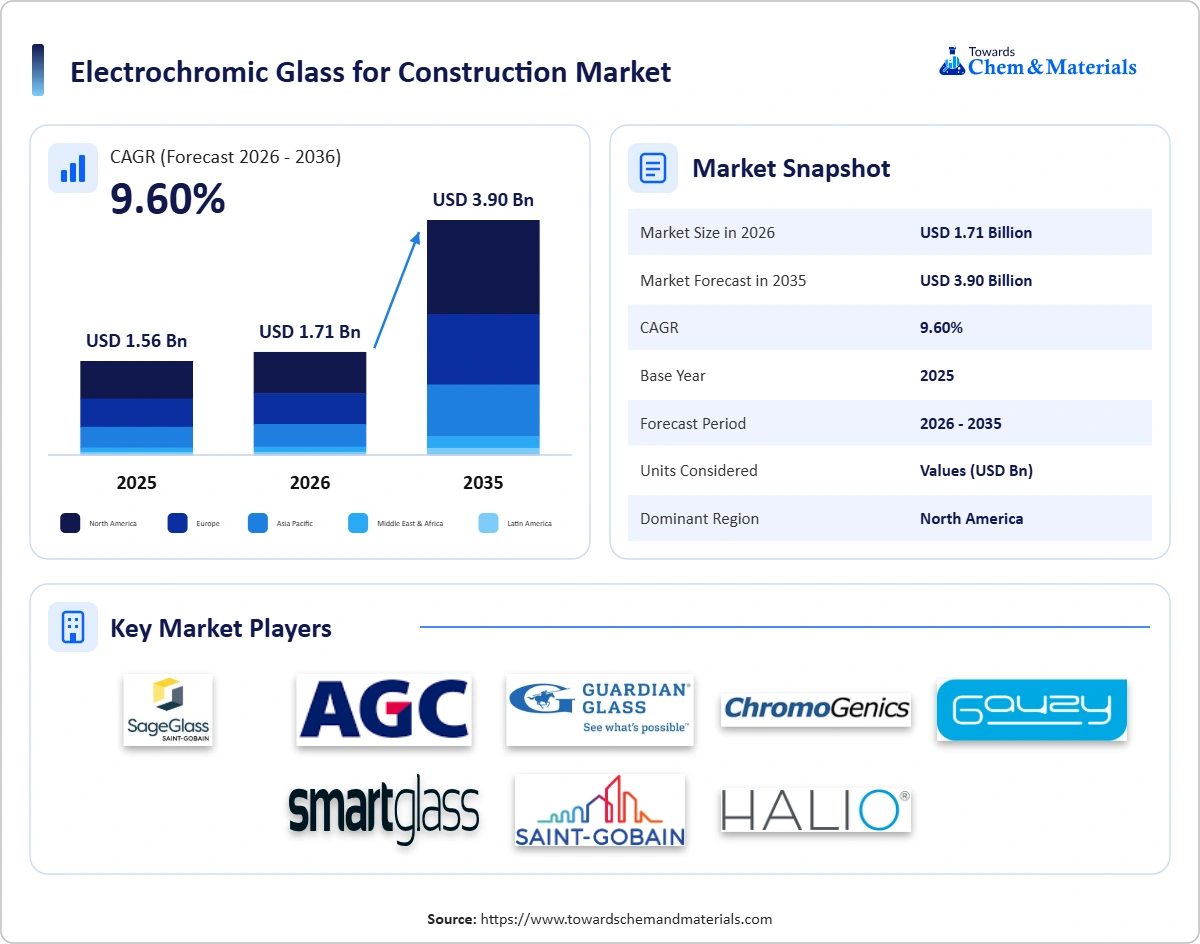
The global electrochromic glass for construction market size was valued at USD 1.56 billion in 2025 and is expected to reach USD 3.90 billion by 2035, growing at a CAGR of 9.60% during the forecast period of 2026-2035. The market was valued at USD 1.56 billion in 2025, the base year. The market covers glass for buildings that changes tint when a small electric voltage is applied, controlling sunlight, glare, and solar heat while keeping views. It includes inorganic tungsten oxide-based, organic and polymer-based, and other electrochromic technologies, used in windows and facades, skylights and roofs, interior partitions and doors, and other building applications, across commercial, residential, institutional and healthcare, and other buildings, for both new construction and retrofit projects. Inorganic (tungsten oxide) accounted for the largest material share in 2025, at 72.00%, because it is durable, proven in large architectural installations, and used by leading manufacturers such as SageGlass and View.
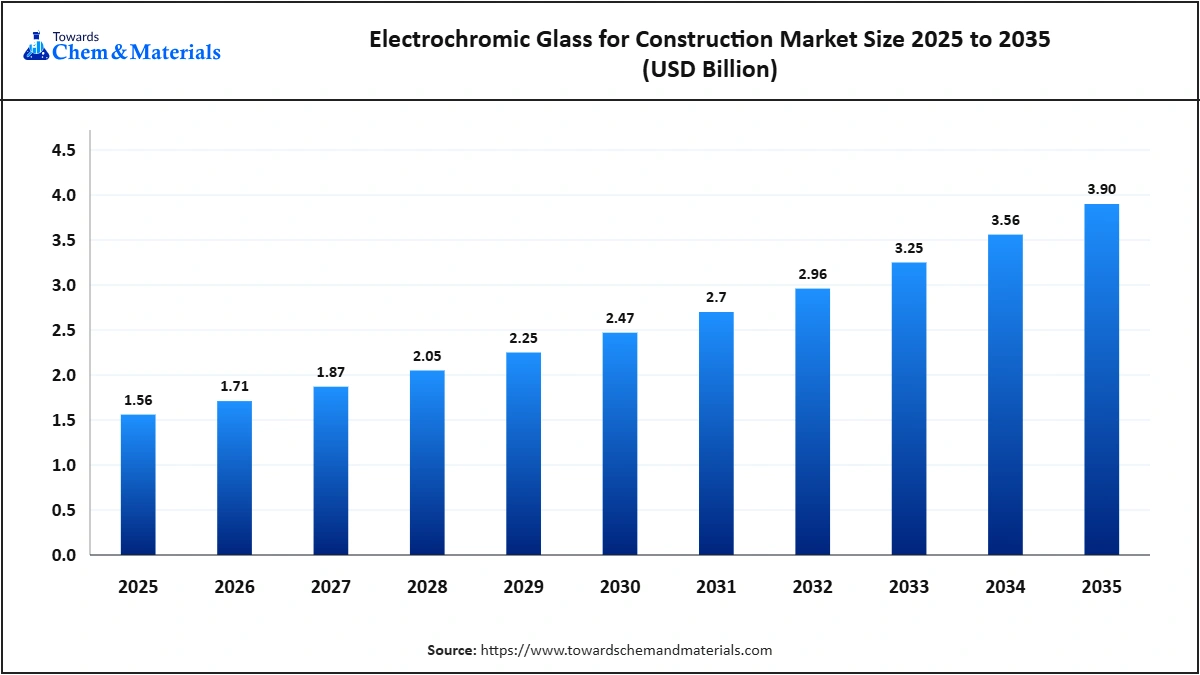
Note: 2025 is the base year; 2026-2035 values are forecasts.
Sources: Expert interviews, secondary sources, Towards Chemical and Materials database, and Towards Chemical and Materials analysts.
North America accounted for 40.00% of revenue in 2025, supported by green building codes, energy efficiency incentives, high adoption in offices, airports, universities, and hospitals, and the presence of leading electrochromic glass makers. Demand is driven by energy efficiency and net-zero building goals, rising cooling costs, demand for glare-free daylight and occupant well-being, smart building integration, and falling product costs, along with new color-neutral and bird-friendly products. Manufacturers are improving aesthetics, such as SageGlass's 2025 launch of RealTone, its most color-neutral electrochromic glass.
The electrochromic glass for construction market is projected to grow from USD 1.56 billion in 2025 to USD 3.90 billion by 2035 because building owners want to cut cooling and lighting energy, control glare and keep views, and electrochromic glass does this without blinds or shades. Green building codes and certifications, net-zero targets, smart building systems, use in offices, airports, healthcare and education, falling costs and better aesthetics support strong growth, lifting the market to USD 2.47 billion by 2030 and sustaining a CAGR of 9.60% during the forecast period.
Analyst View: The market is gaining momentum as building owners increasingly focus on energy efficiency, glare control and indoor comfort. Green building standards, net-zero targets and smart building adoption are driving demand, particularly across commercial infrastructure. Falling costs and improved aesthetics are further supporting wider adoption.
Driver: Buildings are under increasing pressure to reduce energy consumption, making electrochromic glass an attractive solution for improving efficiency. Green building certifications further encourage the adoption of dynamic glazing, while occupants increasingly seek natural daylight without glare.
Restraint: The market faces challenges due to high upfront costs and complex installation requirements, including electrical wiring. Limited switching speeds can restrict its use in certain applications, while low awareness among builders and long construction project cycles may slow adoption.
Opportunity: Retrofitting older buildings offers significant growth potential as property owners look to improve energy performance. Rising demand for residential smart windows, expanding commercial construction in Asia Pacific, and increasing adoption in hot-climate markets across the Middle East are creating new opportunities.
| Segments | 2025 Share | 2025 Value (USD Billion) | 2035 Value (USD Billion) | CAGR 2026-2035 |
| Inorganic (Tungsten Oxide) | 72.00% | 1.12 | 2.68 | 9.09% |
| Organic & Polymer | 18.00% | 0.28 | 0.83 | 11.49% |
| Others | 10.00% | 0.16 | 0.39 | 9.49% |
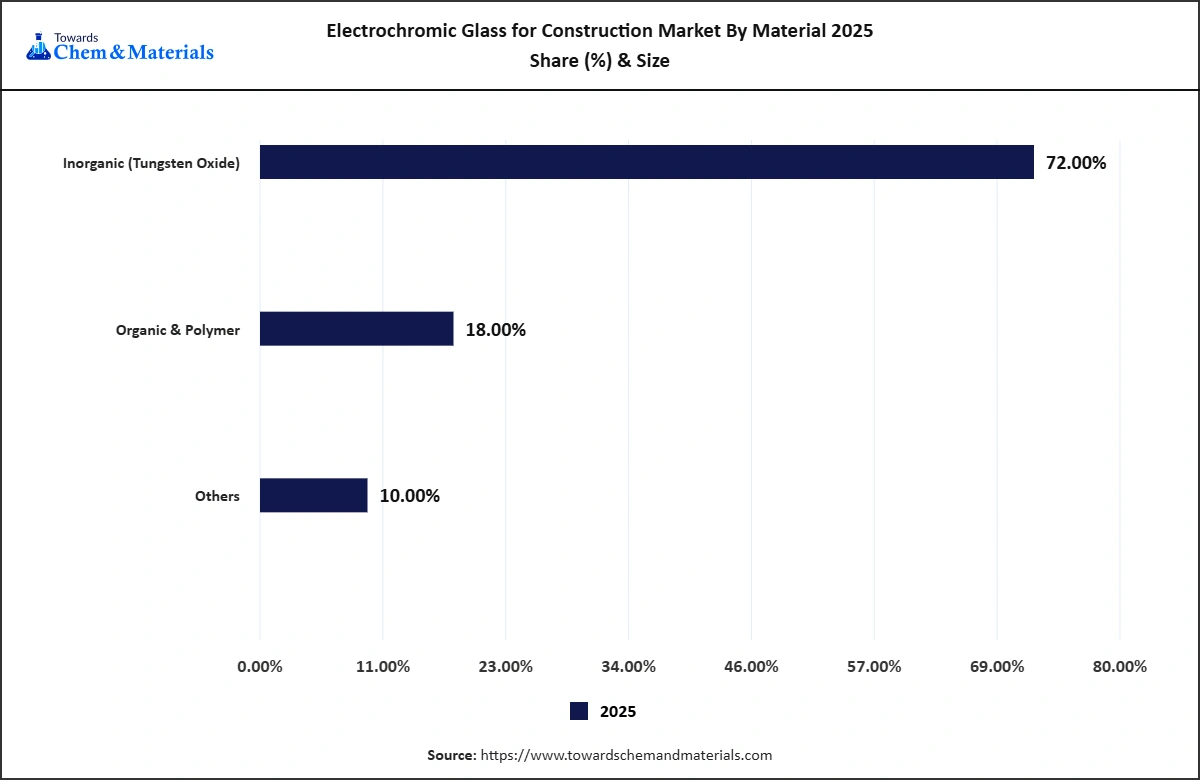
Note: 2025 is the base year; 2035 values are forecasts.
Sources: Expert interviews, secondary sources, Towards Chemical and Materials database, and Towards Chemical and Materials analysts.
Inorganic (tungsten oxide) accounted for 72.00% share and reached USD 1.12 billion in 2025, organic & polymer for 18.00% (USD 0.28 billion), and others for 10.00% (USD 0.16 billion).
Inorganic (Tungsten Oxide): This segment dominates the market with 72.00% share and was valued at USD 1.12 billion in 2025 and is estimated to reach USD 2.68 billion by 2035, at a CAGR of 9.09% from 2026 to 2035. Inorganic tungsten oxide-based electrochromic glass leads because it is durable, stable over many tinting cycles, and proven in large commercial facades, airports, and hospitals.
Organic & Polymer: In 2025, this segment generated USD 0.28 billion, representing 18.00% of the overall market. Its value is anticipated to reach USD 0.83 billion by 2035, registering a CAGR of 11.49% over the forecast period. Organic & polymer-based electrochromic glass is the fastest-growing material because it can offer faster switching, more color options, and lower-cost processing, including film-based products for retrofits.
| Segments | 2025 Share | 2025 Value (USD Billion) | 2035 Value (USD Billion) | CAGR 2026-2035 |
| Windows & Facades | 68.00% | 1.06 | 2.58 | 9.32% |
| Skylights & Roofs | 14.00% | 0.22 | 0.55 | 9.72% |
| Partitions & Doors | 12.00% | 0.19 | 0.53 | 10.92% |
| Others | 6.00% | 0.09 | 0.24 | 9.72% |
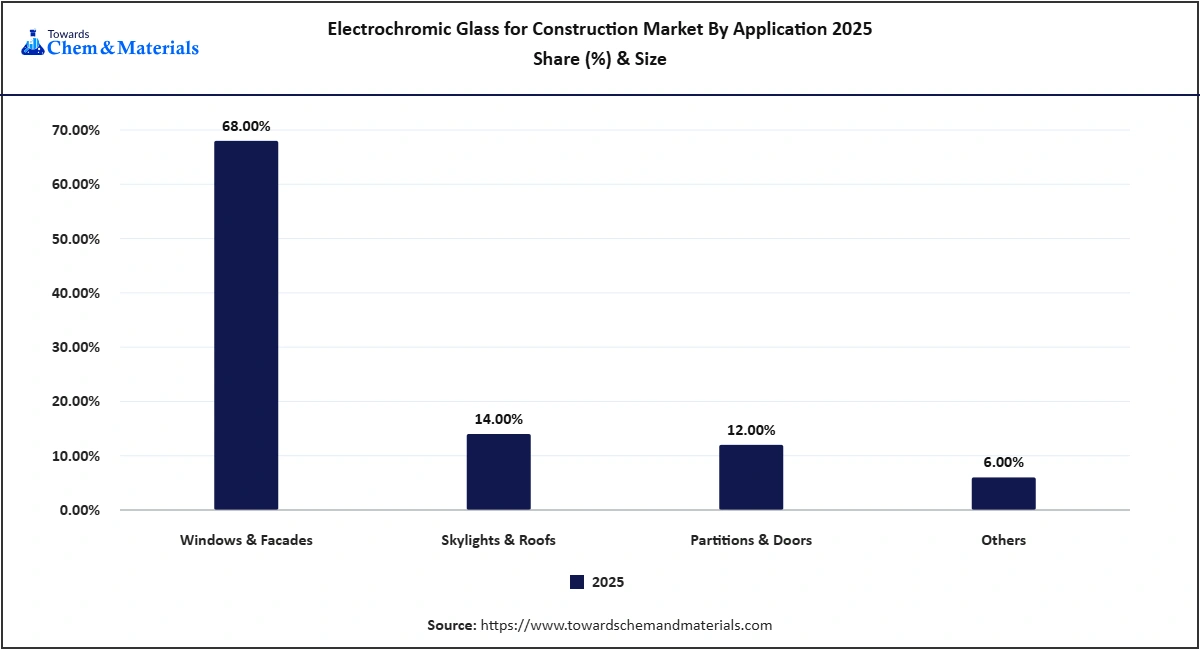
Note: 2025 is the base year; 2035 values are forecasts.
Sources: Expert interviews, secondary sources, Towards Chemical and Materials database, and Towards Chemical and Materials analysts.
Windows & facades accounted for 68.00% share (USD 1.06 billion) in 2025, skylights & roofs for 14.00% (USD 0.22 billion), partitions & doors for 12.00% (USD 0.19 billion), and others for 6.00% (USD 0.09 billion).
Windows & Facades: This segment held 68.00% share in 2025, valued at USD 1.06 billion, and is projected to reach USD 2.58 billion by 2035, growing at a CAGR of 9.32% from 2026 to 2035. Windows & facades are the largest application because they control most of a building's solar heat gain and glare, and electrochromic glazing replaces blinds and external shading.
Partitions & Doors: Accounting for 12.00% share in 2025, this segment was valued at USD 0.19 billion and is projected to witness steady growth, reaching USD 0.53 billion by 2035 at a CAGR of 10.92%. Partitions & doors are growing faster as offices, hospitals, and hotels use switchable glass for privacy and flexible spaces.
| Segments | 2025 Share | 2025 Value (USD Billion) | 2035 Value (USD Billion) | CAGR 2026-2035 |
| Commercial | 64.00% | 1.00 | 2.35 | 8.96% |
| Residential | 18.00% | 0.28 | 0.86 | 11.86% |
| Institutional & Healthcare | 12.00% | 0.19 | 0.46 | 9.36% |
| Others | 6.00% | 0.09 | 0.23 | 9.36% |
Note: 2025 is the base year; 2035 values are forecasts.
Sources: Expert interviews, secondary sources, Towards Chemical and Materials database, and Towards Chemical and Materials analysts.
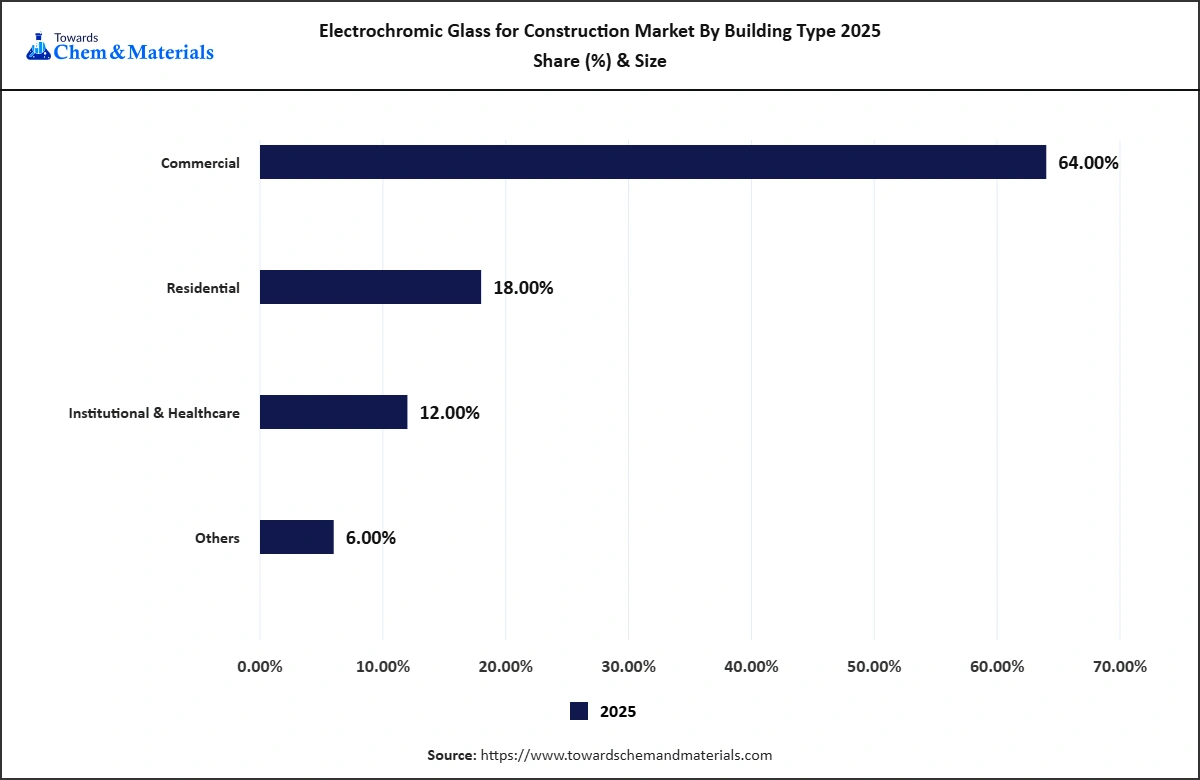
Commercial accounted for the largest share of 64.00% (USD 1.00 billion) in 2025, followed by residential buildings at 18.00% (USD 0.28 billion), institutional & healthcare buildings at 12.00% (USD 0.19 billion), and others at 6.00% (USD 0.09 billion).
Commercial: The segment captured 64.00% of the total market in 2025, with its valuation expected to rise from USD 1.00 billion to USD 2.35 billion by 2035, supported by a CAGR of 8.96%. Commercial buildings, including offices, airports, retail, and hospitality, are the largest building type because owners seek energy savings, green building certifications, and comfort for occupants.
Residential: The market size of this segment reached USD 0.28 billion in 2025 and is estimated to grow to USD 0.86 billion by 2035, exhibiting a CAGR of 11.86% from 2026 to 2035. Residential buildings are the fastest-growing segment as premium homes and apartments adopt smart windows and costs fall.
| Segments | 2025 Share | 2025 Value (USD Billion) | 2035 Value (USD Billion) | CAGR 2026-2035 |
| New Construction | 70.00% | 1.09 | 2.58 | 9.00% |
| Retrofit | 30.00% | 0.47 | 1.32 | 10.90% |
Note: 2025 is the base year; 2035 values are forecasts.
Sources: Expert interviews, secondary sources, Towards Chemical and Materials database, and Towards Chemical and Materials analysts.
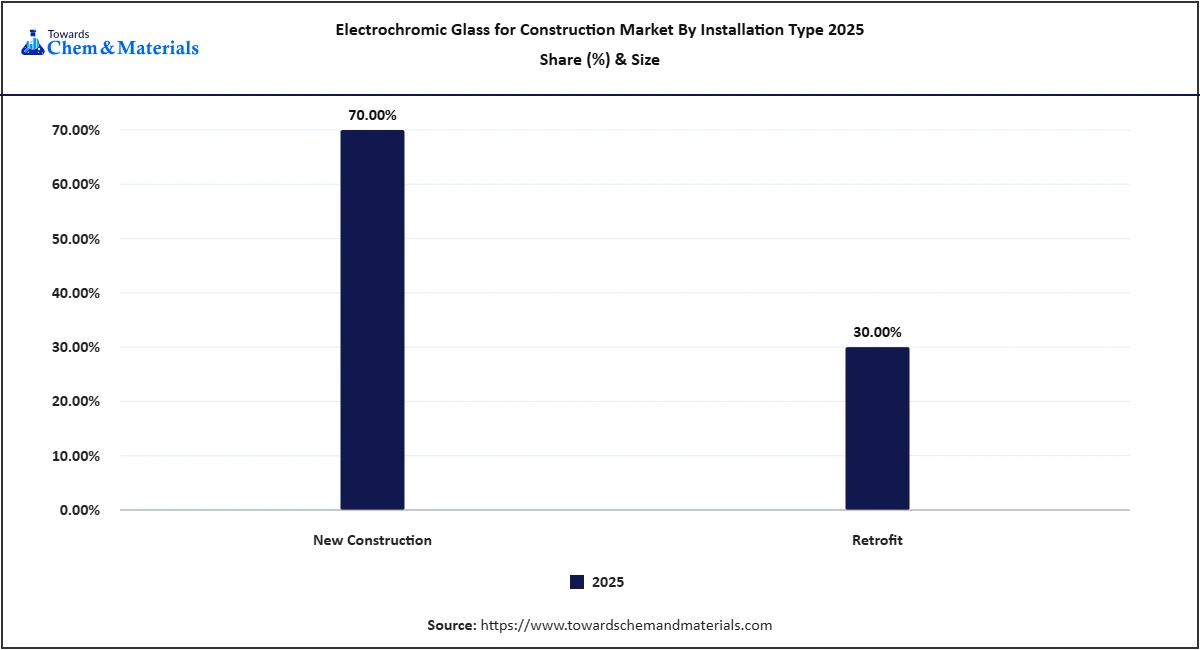
New construction accounted for 70.00% (USD 1.09 billion) in 2025 and retrofit projects accounted for 30.00% (USD 0.47 billion).
New Construction: This segment represented a significant portion of the market in 2025, with a valuation of USD 1.09 billion. It is forecast to grow at an annual rate of 9.00%, reaching USD 2.58 billion by 2035. New construction leads because electrochromic glass is easiest to specify and install during building design and construction.
Retrofit: This segment accounted for 30.00% share and generated USD 0.47 billion in 2025 and is expected to reach USD 1.32 billion by 2035, expanding at a CAGR of 10.90% from 2026 to 2035. Retrofit projects are growing faster as owners upgrade older buildings to meet energy rules and net-zero goals, supported by retrofit-friendly products.
Analyst View: The market is largely driven by inorganic (tungsten oxide), windows & facades, commercial buildings and new construction, reflecting strong demand for durable glazing in large-scale projects. However, faster growth in organic & polymer materials, residential applications, partitions & doors, and retrofit installations points to increasing demand for flexible, cost-effective and smart glazing solutions.
| Region | 2025 Share | 2025 Value (USD Billion) | 2035 Value (USD Billion) | CAGR 2026-2035 |
| North America | 40.00% | 0.62 | 1.46 | 8.88% |
| Europe | 30.00% | 0.47 | 1.14 | 9.28% |
| Asia Pacific | 22.00% | 0.34 | 1.00 | 11.28% |
| Middle East & Africa | 5.00% | 0.08 | 0.19 | 9.28% |
| Latin America | 3.00% | 0.05 | 0.11 | 9.28% |
Note: 2025 is the base year; 2035 values are forecasts.
Sources: Expert interviews, secondary sources, Towards Chemical and Materials database, and Towards Chemical and Materials analysts.
North America dominates with 40.00% share (USD 0.62 billion) in 2025, Europe at 30.00% (USD 0.47 billion), Asia Pacific at 22.00% (USD 0.34 billion), the Middle East & Africa at 5.00% (USD 0.08 billion), and Latin America at 3.00% (USD 0.05 billion).
North America: The market valuation of this region was valued at USD 0.62 billion in 2025, representing 40.00% market share. It is expected to reach USD 1.46 billion by 2035, expanding at a CAGR of 8.88% from 2026 to 2035. North America is the largest region because of green building codes, energy efficiency incentives, strong adoption in offices, airports, universities, and hospitals, and the presence of SageGlass, View, and Halio.
Europe: This region accounted for a 30.00% share and reached USD 0.47 billion in 2025 and is projected to reach USD 1.14 billion by 2035, growing at a CAGR of 9.28% over the forecast period. Europe has strict building energy rules, strong demand for sustainable architecture, and manufacturers such as Saint-Gobain, EControl-Glas, and ChromoGenics.
Asia Pacific: Accounting for 22.00% of the market in 2025, this region was valued at USD 0.34 billion and is projected to reach USD 1.00 billion by 2035 at a CAGR of 11.28%. Asia Pacific is the fastest-growing region because of large commercial construction in China, India, and Southeast Asia, green building programs in Singapore, Japan, and South Korea, and growing local glass manufacturers across the region.
Analyst View: North America leads the market, supported by strong green building regulations, energy-efficiency initiatives, and established industry players. Europe maintains a strong position due to strict energy standards and demand for sustainable buildings. Meanwhile, Asia Pacific is emerging as the fastest-growing market, driven by rapid urbanization, expanding commercial construction, and increasing adoption of green building technologies.
| Rank | Company Name | Market-Specific Revenue (USD Billion) | 2025 Share | Key Products / Business | Headquarters |
| 1 | SageGlass | 0.42 | 26.92% | SageGlass electrochromic glass | United States |
| 2 | View | 0.11 | 7.05% | View Smart Windows | United States |
| 3 | AGC | 0.09 | 5.77% | Electrochromic and smart glass | Japan |
| 4 | Guardian Glass | 0.07 | 4.49% | Architectural smart glass | United States |
| 5 | Halio | 0.06 | 3.85% | Halio smart-tinting glass | United States |
| 6 | EControl-Glas | 0.02 | 0.96% | ECONTROL smart glass | Germany |
| 7 | ChromoGenics | 0.01 | 0.51% | ConverLight dynamic glass | Sweden |
Note: Company revenues and shares are 2025 estimates.
Sources: Company press releases, expert interviews, secondary sources, Towards Chemical and Materials database, and Towards Chemical and Materials analysts.
SageGlass led the electrochromic glass for construction market with 26.92% (USD 0.42 billion) of 2025 revenue, followed by View at 7.05% (USD 0.11 billion) and AGC at 5.77% (USD 0.09 billion). SageGlass, part of Saint-Gobain, leads with the largest installed base of electrochromic glass in commercial, institutional and healthcare buildings. View offers smart windows with integrated controls for offices and other commercial buildings, and AGC supplies electrochromic and smart glass. Guardian Glass, Halio, EControl-Glas, and ChromoGenics compete through architectural smart glass, fast-switching smart-tinting glass and electrochromic glazing for European buildings.
The top players accounted for 49.36% (USD 0.77 billion) of 2025 revenue, while the remaining 50.64% (USD 0.79 billion) was shared among many glass processors, facade makers and smart glass start-ups. The electrochromic glass for construction market is concentrated, with SageGlass holding a leading position, and competition centers on switching speed, color neutrality, durability, control and building system integration, warranty, project support and cost per square meter. Partnerships with architects, facade manufacturers and glass processors are critical for winning projects.
The electrochromic glass for construction ecosystem links coating material suppliers with electrochromic glass makers, glass processors and facade makers, architects and contractors, building owners and regulators.
| Ecosystem Stage | Role in the Market | Key Companies |
| Materials Suppliers | Supply coatings and glass | Float glass and coating material makers |
| Electrochromic Makers | Make dynamic glass | SageGlass, View, Halio, EControl-Glas, ChromoGenics |
| Processors & Facade Makers | Fabricate insulated units and facades | Glass processors and curtain wall makers |
| Architects & Contractors | Specify and install | Architects, contractors, glaziers |
| Owners & Regulators | Buy and set rules | Building owners, green building bodies, code authorities |
Sources: Company press releases, expert interviews, secondary sources, Towards Chemical and Materials database, and Towards Chemical and Materials analysts.
The Towards Chemical and Materials Companies Quadrant positions key participants in the electrochromic glass for construction market by market strength, reflecting revenue scale, market share and geographic reach, and by innovation and growth strategy, reflecting product portfolio breadth, R&D intensity and partnerships. Positions reflect each company's estimated 2025 architectural electrochromic glass revenue and our assessment of its technology, aesthetics and project reach.
Sources: Company press releases, expert interviews, secondary sources, Towards Chemical and Materials database and Towards Chemical and Materials analysts.
Leaders: SageGlass, View, AGC, Guardian Glass, and Halio combine large electrochromic glass revenue with proven products and global project reach.
Innovators: EControl-Glas and ChromoGenics bring fast-switching and new electrochromic technologies.
By Material
By Application
By Building Type
By Installation Type
By Region
The electrochromic glass for construction market was defined as electrochromic glass used in buildings, including windows, facades, skylights, partitions and doors, worldwide. The 2025 base year was built bottom-up from installed electrochromic glass area by material, application, building type, installation type, and region, and average prices per square meter, and checked top-down against the architectural electrochromic revenues of leading makers and the construction share of electrochromic glass demand. Segment, regional, and company values were allocated from materials, applications, building types, installation types, and regional installations. Key estimates were verified by cross-checking company disclosures, regulatory and industry data and published third-party estimates, and inputs that could not be reconciled were excluded. All segment, regional, and company figures were reconciled to the same 2025 base year, and the 2026-2035 forecast, which applies a constant CAGR from the 2025 base, was recalculated and validated.
The electrochromic glass for construction market is gaining traction due to demand for energy-efficient buildings, improved occupant comfort, and smart glazing solutions. Market growth is supported by green building standards, rising commercial construction, and wider adoption across offices, airports, healthcare, and residential buildings. While inorganic tungsten oxide technology and commercial applications dominate, faster growth in residential adoption, alternative materials, and retrofit projects is creating new opportunities. However, high initial costs and installation complexity remain key challenges to wider market penetration.
Reliable market intelligence and data-driven insights across the global chemicals and materials industry, helping businesses understand trends, competition, pricing, and emerging opportunities.
Schedule a Demo