Find the Right Market Report
Search thousands of industry reports, market insights, and research studies in one place.
Not sure where to start? Try one of these:
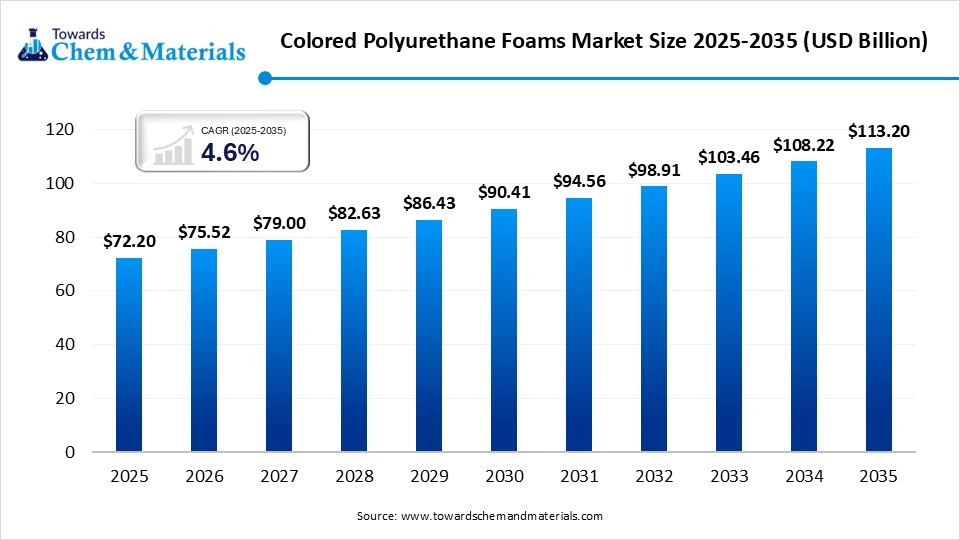
The global colored polyurethane foams market size is valued at USD 75.52 billion in 2026 and is projected to reach USD 113.2 billion by 2035, expanding at a CAGR of 4.6% from 2026 to 2035. Colored polyurethane foams are flexible or rigid polyurethane materials manufactured with liquid colorants or pigment pastes to achieve specific colors, improve product appearance, support material identification, and strengthen brand differentiation. These foams serve a wide range of applications, including furniture, mattresses, automotive interiors, construction insulation, footwear, packaging, and electronics.
Flexible foams dominated the market in 2025, accounting for 62.4% of total revenue. Their extensive use in furniture, bedding, automotive seating, and footwear drives demand, as coloring improves product aesthetics and supports material grade identification. Asia Pacific generated 36.8% of revenue in 2025, supported by robust industries in furniture, footwear, automotive, and construction, particularly in China, India, and Southeast Asia. Key demand drivers include bedding consumption, energy-efficient insulation, automotive lightweighting, and protective packaging. Producers are innovating with low-emission colorants and recyclable foams, while navigating raw material price volatility and sustainability regulations.
Note: 2025 is the base year; 2026-2035 values are forecasts.
Sources: Expert interviews, secondary sources, the Towards Chemical and Materials database, and Towards Chemical and Materials analysts.
The colored polyurethane foams market is likely to grow from USD 72.20 billion in 2025 to USD 113.20 billion by 2035, driven by demand from the furniture, bedding, construction, automotive, footwear, and packaging industries. These sectors use colored polyurethane foams for product identification, branding, and visual appeal. Rising demand for energy-efficient insulation, automotive interiors, furniture across Asia, and specialty-colored foams for consumer products further supports market growth. The market is projected to reach USD 90.41 billion by 2030, registering a CAGR of 4.6% during 2026-2035.
Analyst View: Our market estimate is based on global consumption of colored polyurethane foams, segmented by flexible and rigid foam types, colorant technology, end-use applications, and geographic markets. The analysis considers foam production volumes, the proportion of output manufactured in colored grades, and average selling prices across product categories and regions. We assess demand from furniture and bedding, construction, automotive, footwear, packaging, and other applications to establish the underlying consumption base. Upstream MDI, TDI, polyol, and colorant supplier revenues are used as supporting industry indicators rather than being directly added to finished-foam market revenue.
Growing demand for furniture and bedding is driving the consumption of flexible polyurethane foams across mattresses, sofas, and cushioning products. Energy-efficiency requirements in buildings are increasing the adoption of rigid foam insulation. Automotive manufacturers use polyurethane foams in seating, headrests, interior trim, acoustic insulation, and cushioning applications. Lightweight foam formulations contribute to vehicle weight reduction and passenger comfort, while colorants support interior aesthetics, product differentiation, and customized design requirements. Additionally, footwear and sports equipment manufacturers are using lightweight cushioning foams to enhance product performance, while color coding facilitates foam-grade identification and manufacturing consistency.
Fluctuations in MDI and TDI prices create uncertainty in raw material costs and reduce manufacturers' profit margins. Environmental concerns over foam disposal, recycling difficulties, and end-of-life waste management add further industry challenges. Regulations on chemical additives and industrial emissions increase compliance costs. In addition, fluctuations in construction activity affect demand for insulation foams, while alternative materials intensify competition across selected applications.
The development of bio-based and recycled-content polyurethane foams creates opportunities to meet sustainability requirements and serve premium market segments. Rising demand for cold-chain infrastructure and energy-efficient appliances supports the use of rigid polyurethane foams for insulation. Growing electric vehicle production also increases demand for lightweight interior cushioning and insulation materials. Meanwhile, expanding construction and furniture industries across Asia Pacific create additional growth opportunities. Specialty-colored foams for footwear, sports equipment, automotive interiors, and consumer products further support product differentiation, higher value addition, and market expansion.
Note: 2025 is the base year.
Sources: Expert interviews, secondary sources, the Towards Chemical and Materials database, and Towards Chemical and Materials analysts.
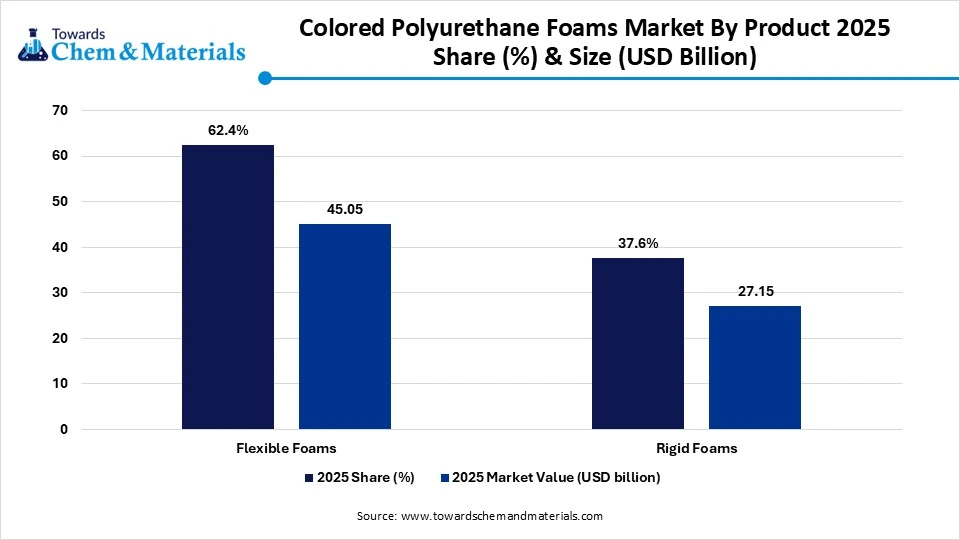
Flexible foams dominated the colored polyurethane foams market in 2025, accounting for 62.4% of revenue, valued at USD 45.05 billion. Their widespread use in sofas, mattresses, automotive seating, and footwear drives demand. Rigid foams held the remaining 37.6% share, generating USD 27.15 billion, and represented the fastest-growing product segment. Growth reflects rising demand for insulation panels and spray foams in energy-efficient buildings and cold-chain applications.
| Segments | 2025 Share | 2025 Market Value |
| Pigment Paste | 58.60% | USD 42.31 billion |
| Liquid Colorants | 41.40% | USD 29.89 billion |
Note: 2025 is the base year.
Sources: Expert interviews, secondary sources, the Towards Chemical and Materials database, and Towards Chemical and Materials analysts.
In 2025, pigment paste, valued at USD 42.31 billion, captured 58.6% of the market, attributed to its ability to provide strong, consistent colors at a low cost for high-volume foam production through pigment dispersions in polyol. Liquid colorants, worth USD 29.89 billion in revenue, accounted for 41.4%, providing easy dosing and vibrant colors for specialty foams.
Note: 2025 is the base year.
Sources: Expert interviews, secondary sources, the Towards Chemical and Materials database, and Towards Chemical and Materials analysts.
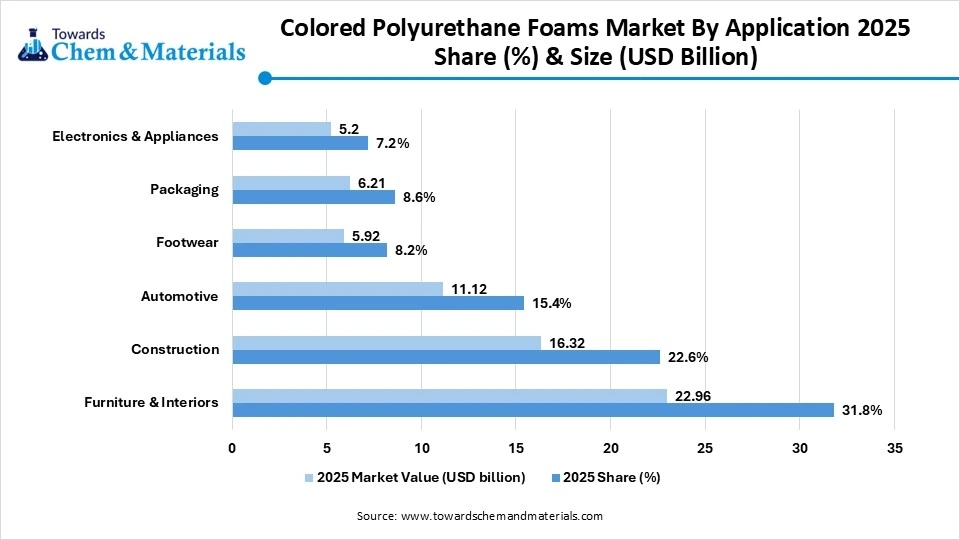
Furniture and interiors dominated the market in 2025, accounting for 31.8% of total revenue, equivalent to USD 22.96 billion. This dominance was primarily driven by the extensive use of flexible polyurethane (PU) foam in upholstered furniture, mattresses, and bedding products. Construction represented the second-largest application, capturing 22.6% of the market and generating USD 16.32 billion in revenue. The segment is also expected to register the fastest growth, supported by increasing demand for energy-efficient building insulation and thermal management solutions.
Automotive applications accounted for 15.4% of the market in 2025, valued at USD 11.12 billion, driven by the use of PU foam in vehicle seating, interiors, acoustic insulation, and cushioning. Packaging followed with an 8.6% share, equivalent to USD 6.21 billion, while footwear represented 8.2%, generating USD 5.92 billion. Electronics and appliances contributed 7.2% of the market, valued at USD 5.20 billion, supported by demand for insulation and protective cushioning. Other applications collectively accounted for the remaining 6.2%, representing USD 4.48 billion.
Analyst View: Flexible foams, pigment pastes, and furniture applications currently lead the market, supported by high-volume demand from upholstery and bedding manufacturers. However, we expect rigid foams and construction applications to gain market share as demand for energy-efficient building insulation and thermal management solutions accelerates.
Asia Pacific led the market in 2025, capturing 36.80% of global revenue, bolstered by China's extensive manufacturing sectors and increasing construction in India and Southeast Asia. The region is projected to experience the fastest growth due to rising demand for flexible and rigid foams. Major producers in the area include Wanhua Chemical and INOAC.
North America held a 28.4% market share in 2025, driven by consistent demand for foam in various sectors, including bedding and automotive interiors. Notable manufacturers in the region include Carpenter and FXI. Europe represented 25.2% of the market, with energy-efficiency regulations boosting building insulation demand and automotive production, featuring producers such as BASF, Covestro, and Recticel. Latin America and the Middle East and Africa accounted for 5.6% and 4% of the market, respectively. Growth in both regions is supported by expanding construction activity, rising furniture consumption, and increasing demand for foam-based products across residential and industrial applications.
| Region | 2025 Share | 2025 Market Value |
| Asia Pacific | 36.80% | USD 26.57 billion |
| North America | 28.40% | USD 20.50 billion |
| Europe | 25.20% | USD 18.19 billion |
| Latin America | 5.60% | USD 4.04 billion |
| Middle East & Africa | 4% | USD 2.89 billion |
Note: 2025 is the base year.
Sources: Expert interviews, secondary sources, Towards Chemical and Materials database, and Towards Chemical and Materials analysts.
Asia Pacific dominated the market in 2025, accounting for 36.8% of global revenue, worth USD 26.57 billion. China represents the region’s largest production and consumption hub for polyurethane foam, supported by strong demand from furniture, footwear, automotive, and appliance manufacturing.
North America held a 28.4% market share in 2025, valued at USD 20.50 billion, driven by the mattress and furniture manufacturing sectors, as well as the application of spray polyurethane foam for insulation in residential and commercial buildings.
In 2025, Europe captured 25.2% of the market, generating USD 18.19 billion in revenue, driven by energy-efficient building renovations and stricter recycling requirements promoting circular foam solutions.
Latin America represented 5.6% of the global market in 2025, equivalent to USD 4.04 billion. Brazil and Mexico are important regional markets, supported by established furniture, automotive, and footwear manufacturing industries.
The Middle East and Africa accounted for the remaining 4% of the market in 2025, valued at USD 2.89 billion, driven by construction activity in Gulf countries, supporting demand for polyurethane foam, especially for building insulation.
Analyst View: Asia Pacific leads the global market due to its large manufacturing base and strong downstream demand. We expect the region to maintain the highest growth momentum, supported by expanding construction activity, industrial production, and rising consumption of foam-based products.
| Rank | Company Name | Market-Specific Revenue (USD Billion) | 2025 Share | Key Products / Business | Headquarters |
| 1 | BASF | 3.6 | 4.99% | Polyurethane systems and foams | Germany |
| 2 | Covestro | 3.2 | 4.43% | MDI, TDI, polyols and foam systems | Germany |
| 3 | Dow | 2.8 | 3.88% | Polyurethane polyols and systems | United States |
| 4 | Huntsman | 2.2 | 3.05% | MDI-based polyurethane systems | United States |
| 5 | Wanhua Chemical | 2 | 2.77% | MDI and polyurethane systems | China |
| 6 | Carpenter | 1.8 | 2.49% | Flexible foams and cushioning | United States |
| 7 | INOAC | 1 | 1.39% | Polyurethane foams | Japan |
| 8 | FXI | 1 | 1.39% | Flexible foam products | United States |
| 9 | Recticel | 0.7 | 0.97% | Rigid insulation foams | Belgium |
| 10 | Rogers | 0.4 | 0.55% | PORON microcellular foams | United States |
Note: Company revenues and shares are 2025 estimates.
Sources: Company press releases, expert interviews, secondary sources, Towards Chemical and Materials database and Towards Chemical and Materials analysts.
The top 10 companies in the global colored polyurethane foams market collectively accounted for an estimated 25.9% of market revenue in 2025, valued at USD 18.70 billion. The remaining 74.1%, worth USD 53.50 billion, was distributed among regional foam manufacturers, colorant suppliers, and polyurethane system houses.
BASF held the largest estimated share among the companies assessed in 2025, capturing a revenue share of 4.99%, closely followed by Covestro at 4.43% and Dow at 3.88%. BASF's competitive advantage lies in its extensive portfolio catering to various applications such as furniture, automotive, construction, and footwear. Covestro offers a global supply of MDI, TDI, polyols, and polyurethane systems, while Dow specializes in polyols and integrated systems for both flexible and rigid foam production.
Other notable competitors in the market include Huntsman, Wanhua Chemical, Carpenter, INOAC, FXI, Recticel, and Rogers, all of whom engage in raw material production, integrated foam manufacturing, insulation boards, and specialty microcellular foam solutions.
The colored polyurethane foam manufacturing landscape is fragmented, with high concentration among major raw material suppliers. Key competitive factors include raw material costs, supply security, color consistency, foam performance, low-emission formulations, flame retardancy, sustainability, and pricing.
Colorant specialists such as Milliken and Chromaflo collaborate with foam manufacturers to create tailored color solutions, impacting the competitive environment.
The colored polyurethane foams ecosystem links isocyanate and polyol producers and colorant suppliers with system houses, foam producers, converters, and end-use manufacturers.
| Ecosystem Stage | Role in the Market | Key Companies |
| Raw Materials | Produce MDI, TDI and polyols | BASF, Covestro, Dow, Huntsman, Wanhua Chemical |
| Colorants & Additives | Supply pigment pastes, liquid colorants and additives | Milliken, Chromaflo, Clariant, Evonik |
| Foam Producers | Manufacture flexible and rigid-colored foams | Carpenter, FXI, INOAC, Recticel, Rogers |
| Converters | Cut, laminate and shape foam | Foam fabricators and component makers |
| End Users | Use foams in products | Furniture, bedding, construction, automotive, footwear, packaging companies |
Sources: Company press releases, expert interviews, secondary sources, Towards Chemical and Materials database and Towards Chemical and Materials analysts.
The Towards Chemical and Materials Companies Quadrant positions key participants in the colored polyurethane foams market by market strength, reflecting revenue scale, market share, and geographic reach, and by innovation and growth strategy, reflecting product portfolio breadth, R&D intensity, and partnerships. Positions reflect each company's estimated 2025 colored polyurethane foam revenue and our assessment of its technology, sustainability initiatives, and partnerships.
Sources: Company press releases, expert interviews, secondary sources, Towards Chemical and Materials database and Towards Chemical and Materials analysts.
By Product
By Colorant
By Application
By Region
The colored polyurethane foams market was defined as flexible and rigid polyurethane foams produced with liquid colorants or pigment pastes for furniture, construction, automotive, footwear, packaging and other applications, worldwide. The 2025 base year was built bottom-up from polyurethane foam consumption by product, colorant, application and region, share of colored grades and average foam prices, and checked top-down against the polyurethane revenue of leading raw material and foam producers. Segment, regional and company values were allocated from products, colorants, applications and regional demand. Key estimates were verified by cross-checking company disclosures, regulatory and industry data and published third-party estimates, and inputs that could not be reconciled were excluded. All segment, regional and company figures were reconciled to the same 2025 base year, and the 2026-2035 forecast, which applies a constant CAGR from the 2025 base, was recalculated and validated.
The colored polyurethane foams market is large and mature, growing with furniture, construction, automotive, and consumer goods demand. Our estimate links demand to foam consumption and prices, so the forecast follows end-use activity and insulation trends. The main upside comes from insulation and Asian demand, while the main risks are raw material volatility and sustainability pressures.
Reliable market intelligence and data-driven insights across the global chemicals and materials industry, helping businesses understand trends, competition, pricing, and emerging opportunities.
Schedule a Demo