Find the Right Market Report
Search thousands of industry reports, market insights, and research studies in one place.
Not sure where to start? Try one of these:
The global cobalt acetate market size was valued at USD 338 million in 2025 and is expected to reach USD 571.9 million by 2035, growing at a CAGR of 5.4% during the forecast period of 2026-2035. Cobalt acetate, also known as cobalt(II) acetate, is a specialty cobalt salt available as a tetrahydrate crystal and aqueous solution. It is supplied in industrial, battery, reagent, and high-purity grades and is primarily used as an oxidation catalyst in purified terephthalic acid (PTA) production, as a precursor for battery cathode materials, and as a chemical additive in paints, inks, rubber adhesion systems, and animal feed. Additional applications include electroplating, pigments, specialty chemical synthesis, and laboratory research.
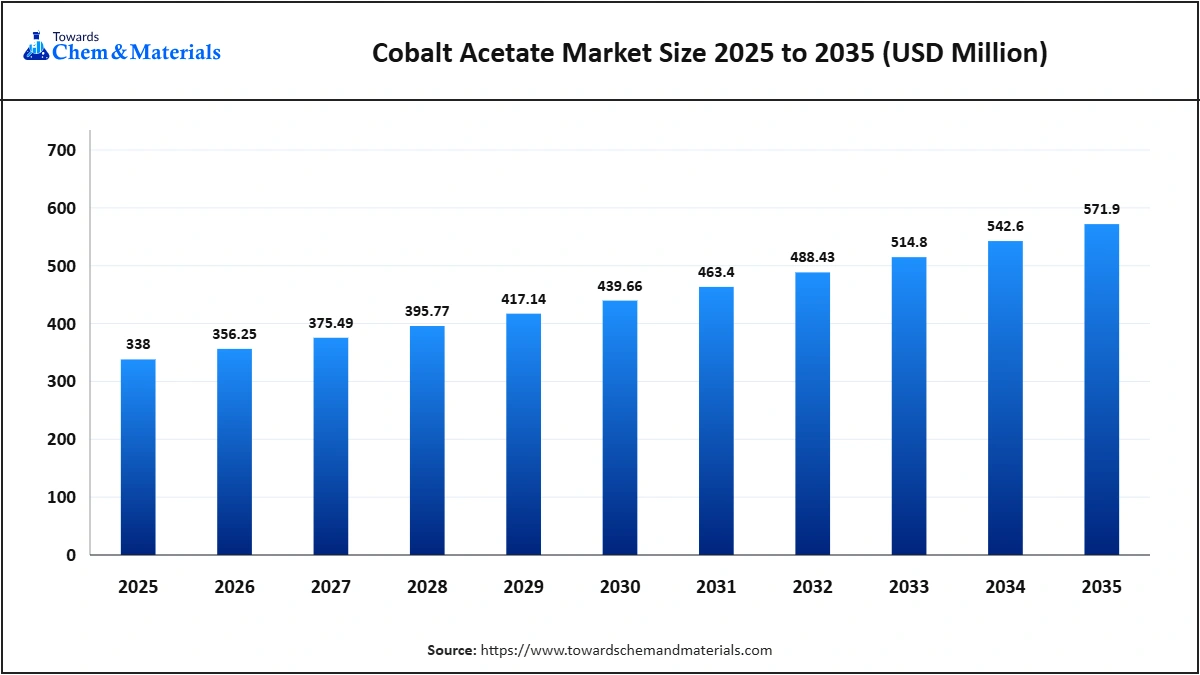
Note: 2025 is the base year; 2026-2035 values are forecasts.
Sources: Expert interviews, secondary sources, Towards Chemical and Materials database, and Towards Chemical and Materials analysts.
In 2025, chemical catalysts accounted for the largest application share, holding 44% of the market, as cobalt acetate plays a crucial role in cobalt-manganese-bromide catalyst systems for the oxidation of para-xylene to produce PTA, a vital raw material for polyester fibers, films, and PET bottles. According to our analysis, Asia Pacific dominated the market with a 63% revenue share in 2025, supported by China's cobalt refining and PTA production capacity, along with expanding polyester, battery, and specialty chemical manufacturing in India and Southeast Asia.
Market demand is supported by expanding PTA capacity, higher polyester and PET consumption, battery precursor production, and growing demand for specialty cobalt chemicals. Its established uses in paint drying, rubber-to-steel adhesion, and animal nutrition further support its growth. However, challenges such as fluctuating cobalt prices, concentrated supply from the DRC, environmental regulations, and a shift toward low-cobalt battery technologies pose significant risks, especially after the DRC's cobalt export suspension and the introduction of annual quotas for 2026 and 2027.
The cobalt acetate market is projected to grow from USD 338 million in 2025 to USD 571.90 million by 2035, supported by its established role in PTA oxidation catalysts and expanding applications in batteries, coatings, rubber processing, and animal nutrition. Increasing production of polyester and PET is driving demand for cobalt-based catalyst systems, especially in Asia Pacific, while the manufacturing of battery precursors and specialty cobalt chemicals is creating new opportunities for high-purity cobalt acetate products.
The expansion of PTA manufacturing capacity in China, India, and Southeast Asia, combined with demand for battery materials and specialty industrial chemicals, is expected to strengthen market consumption. Innovation in paint and ink formulations, rubber-to-steel adhesion applications, and animal feed additives is further contributing to market development. These factors are expected to increase market revenue to USD 439.66 million by 2030, sustaining a CAGR of 5.4% from 2026 to 2035.
Analyst View: We estimated the market by calculating cobalt acetate consumption volumes across applications and regions, measured in tonnes, and multiplying these volumes by average selling prices linked to cobalt metal prices and product grades. Consumption estimates consider PTA capacity and catalyst utilization rates, battery precursor requirements, specialty chemical production, coatings, rubber adhesion, and animal nutrition applications. We cross-checked the overall estimate against the cobalt chemical activities of leading producers and available cobalt salt trade information. Estimates for this specialized product category differ significantly and often lack clear methodologies. This estimate relies on a bottom-up analysis of consumption and pricing. Therefore, according to our analysis, projected growth is driven by increasing demand for PTA and specialty chemicals, alongside rising cobalt prices due to export restrictions, somewhat balanced by reduced cobalt intensity in certain battery types.
The cobalt acetate market is driven by increasing PTA production capacity, rising polyester and PET consumption, and growing demand for specialty cobalt chemicals. Cobalt acetate plays an important role in cobalt-manganese-bromide catalyst systems used in para-xylene oxidation for PTA manufacturing. Expanding polyester fibre and PET packaging production is therefore supporting industrial consumption. Battery precursor manufacturing, specialty chemical synthesis, paint drying, and rubber adhesion applications are providing additional demand. Selected authorized cobalt compounds, including cobalt(II) acetate tetrahydrate in applicable liquid-feed uses, contribute to demand for cobalt-based feed additives in the forecast period.
Volatility in cobalt prices remains a major challenge, as cobalt acetate production costs closely follow cobalt metal and intermediate prices. The concentration of global mined cobalt supply in the DRC exposes manufacturers to geopolitical risks, export restrictions, policy changes, and logistics disruptions. The growing adoption of low-cobalt and cobalt-free battery technologies also limits demand growth from battery-related applications. In addition, environmental and occupational safety regulations governing cobalt compounds increase compliance costs for producers and downstream users. Competition from alternative paint driers and catalyst formulations further intensifies substitution pressure.
Increasing investments in cobalt recycling and secondary raw material recovery are creating opportunities for cobalt acetate manufacturers to diversify supply sources and improve sourcing resilience. High-purity cobalt acetate may offer opportunities in selected specialty precursor and advanced-material applications, although commercial adoption should be distinguished from research-stage use. Expanding PTA production facilities in India and the Middle East is creating additional demand potential for catalyst-grade products. Manufacturers can sustain their market positions through catalyst recovery services, ready-to-use liquid formulations, long-term supply agreements, and traceable cobalt sourcing programs.
| Driver | Impact | ≈ CAGR Contribution | Time Horizon | Key Regions |
| PTA plants expand | High | +2.11 pp | Short to long term | Global, strongest in Asia Pacific |
| Polyester and PET demand grows | Medium | +1.78 pp | Medium to long term | Global, fastest uptake in Asia Pacific |
| Battery and specialty uses rise | Medium | +1.52 pp | Short to medium term | Global |
| Tyres need cobalt adhesion | Low | +1.19 pp | Long term | Developed and emerging markets |
Note: Contributions are indicative estimates of each factor's effect on annual growth.
Sources: Expert interviews, secondary sources, Towards Chemical and Materials database and Towards Chemical and Materials analysts.
The identified growth drivers contribute nearly 6.60 percentage points to annual growth in the cobalt acetate market, with PTA capacity expansion crafting the largest contribution. Increasing polyester and PET consumption provides additional demand momentum, especially across major Asian manufacturing hubs. Battery and specialty chemical applications are expected to contribute to growth through high-purity product requirements, while rubber adhesion applications provide a relatively stable industrial demand base.
| Restraint | Impact | ≈ Negative CAGR Contribution | Time Horizon | Key Regions |
| Cobalt prices swing | High | -0.53 pp | Short to medium term | Global |
| Supply is concentrated in the DRC | High | -0.39 pp | Medium term | Price-sensitive and emerging markets |
| Batteries use less cobalt | Medium | -0.26 pp | Short term | Asia Pacific and other mature markets |
Note: Contributions are indicative estimates of each factor's effect on annual growth.
Sources: Expert interviews, secondary sources, Towards Chemical and Materials database and Towards Chemical and Materials analysts.
Fluctuations in cobalt prices, concentrated raw material supply, and declining cobalt intensity in certain battery technologies are expected to reduce annual market growth by around 1.19 percentage points. Cobalt price volatility represents the largest restraint, followed by supply concentration in the Democratic Republic of Congo. Such challenges will be partially offset by PTA capacity expansion, recycling investments, and increasing demand for specialty cobalt chemicals, resulting in a net projected CAGR of 5.4% from 2026 to 2035.
| Segments | 2025 Share | 2025 Value (USD Million) | 2035 Value (USD Million) | CAGR 2026-2035 |
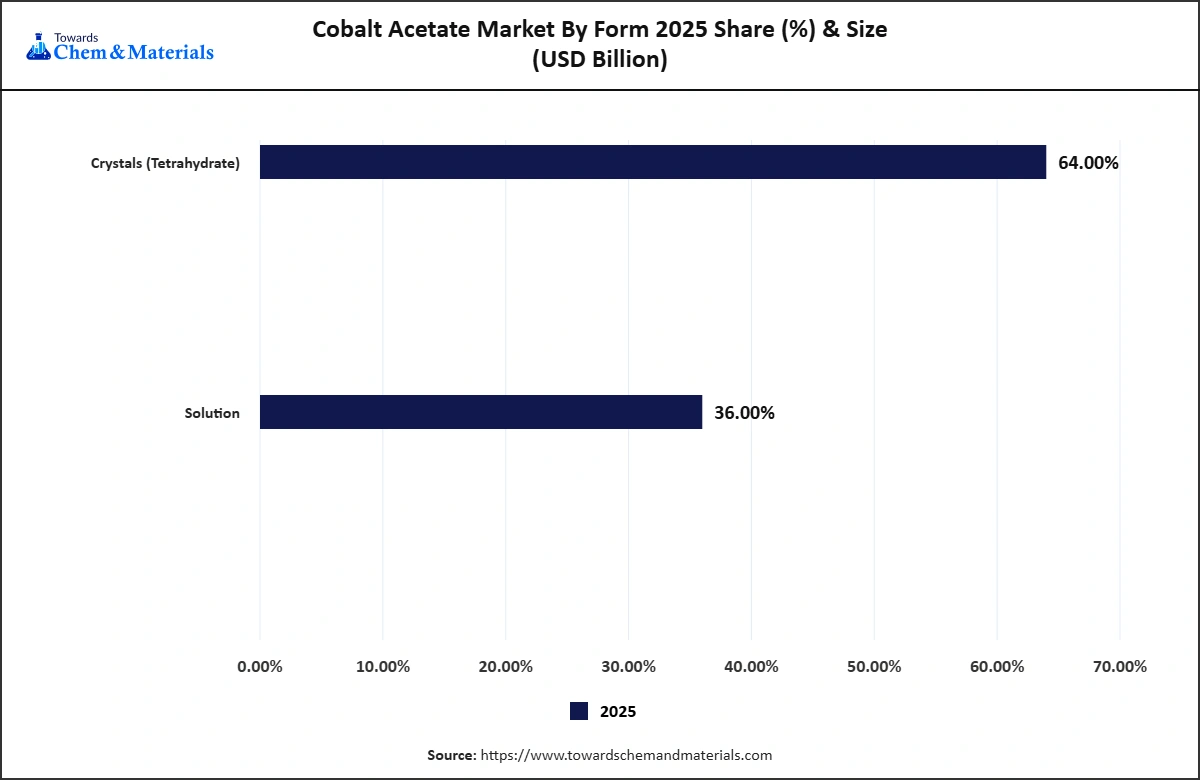
| Crystals (Tetrahydrate) | 64.00% | 216.32 | 353.37 | 5.03% |
| Solution | 36.00% | 121.68 | 218.53 | 6.03% |
Note: 2025 is the base year; 2035 values are forecasts.
Sources: Expert interviews, secondary sources, Towards Chemical and Materials database, and Towards Chemical and Materials analysts.
In 2025, crystals (Tetrahydrate) dominated the cobalt acetate market with a 64% share, valued at USD 216.32 million, while solution accounted for 36%, worth USD 121.68 million.
Crystals (Tetrahydrate) are projected to reach USD 353.37 million by 2035, expanding at a CAGR of 5.03% from 2026 to 2035. Cobalt acetate tetrahydrate crystals are favored for their storage convenience, efficient transport, and solubility in acetic acid. They are primarily utilized in PTA catalyst preparation and specialty chemical synthesis. While established purchasing practices will sustain demand, the rising preference for liquid formulations may hinder growth during the forecast period.
The solution segment is projected to reach USD 218.53 million by 2035, registering a CAGR of 6.03%. Cobalt acetate solutions are gaining adoption because PTA manufacturing facilities and battery precursor producers increasingly prefer ready-to-dose liquid formulations. These products reduce dust generation, simplify handling, and minimize the need for on-site dissolution and preparation. The emphasis on operational efficiency and consistent catalyst dosing is expected to support above-average segment growth.
Segment Outlook: Based on the analysis, crystals (Tetrahydrate) are expected to remain the largest product form through 2035, reaching around USD 353.37 million. However, Solution is projected to register the fastest growth, with a CAGR of 6.03%. Increasing demand for ready-to-use catalyst formulations and simplified industrial chemical handling is expected to gradually strengthen the position of the solution segment.
| Segments | 2025 Share | 2025 Value (USD Million) | 2035 Value (USD Million) | CAGR 2026-2035 |
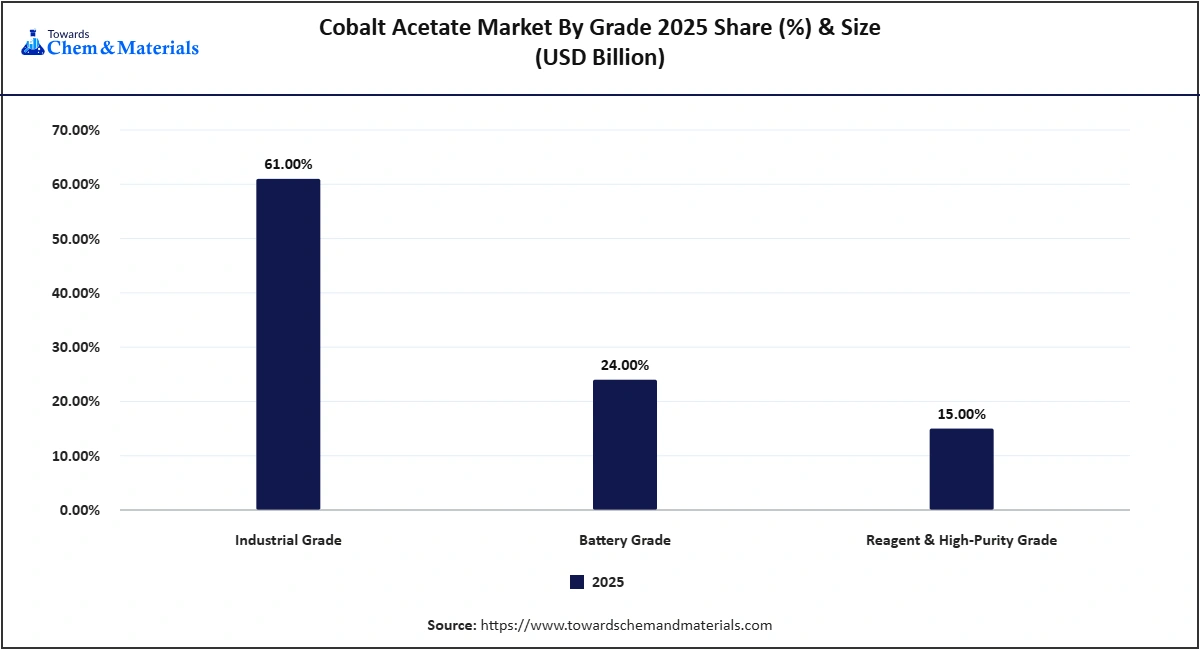
| Industrial Grade | 61.00% | 206.18 | 333.83 | 4.94% |
| Battery Grade | 24.00% | 81.12 | 152.80 | 6.54% |
| Reagent & High-Purity Grade | 15.00% | 50.70 | 85.27 | 5.34% |
Note: 2025 is the base year; 2035 values are forecasts.
Sources: Expert interviews, secondary sources, Towards Chemical and Materials database, and Towards Chemical and Materials analysts.
In 2025, industrial-grade cobalt acetate accounted for 61% of the market, valued at USD 206.18 million. Battery grade follows with 24%, equivalent to USD 81.12 million, and reagent and high-purity grade cobalt acetate captured the remaining 15% of the market, worth USD 50.70 million. Although industrial grade held the largest share of the global market, during the forecast period, battery-grade cobalt acetate is projected to record the fastest growth.
Industrial-grade cobalt acetate is projected to reach USD 333.83 million through 2035, expanding at a CAGR of 4.94% from 2026 to 2035. Industrial-grade cobalt acetate is primarily utilized in PTA catalysts, paint driers, rubber adhesion systems, and animal feed, driving significant demand in the industrial sector. These applications focus on performance, consistent cobalt content, and cost-effectiveness, which are projected to foster steady growth in this market segment.
Battery-grade cobalt acetate is expected to reach USD 152.80 million by 2035, registering a CAGR of 6.54%. Battery-grade cobalt acetate is significant as a high-purity source for producing cathode precursors and in advanced materials research for new battery technologies. Unlike cobalt sulfate, which dominates traditional supply chains, cobalt acetate offers unique opportunities in specialty synthesis. The growing need for controlled impurity levels and high-purity cobalt compounds is expected to fuel significant growth in this sector.
Reagent and high-purity grade cobalt acetate is projected to attain USD 85.27 million by 2035, expanding at a CAGR of 5.34%. Reagent and high-purity products are used in laboratory research, analytical chemistry, electronics-related applications, and specialty chemical synthesis. Increasing research into cobalt-based materials and advanced catalyst systems is supporting demand for products with consistent purity and controlled chemical composition.
Segment Outlook: Through 2035, industrial grade is expected to retain its leading position, reaching around USD 333.83 million. However, battery grade is projected to record the fastest growth, with a CAGR of 6.54%. Increasing requirements for high-purity cobalt compounds in specialized battery applications are expected to support the gradual diversification of the grade segment.
| Segments | 2025 Share | 2025 Value (USD Million) | 2035 Value (USD Million) | CAGR 2026-2035 |
| Chemical Catalysts (PTA & Others) | 44.00% | 148.72 | 240.71 | 4.93% |
| Battery Materials | 19.00% | 64.22 | 120.93 | 6.53% |
| Paints, Inks & Driers | 12.00% | 40.56 | 68.19 | 5.33% |
| Rubber Adhesion | 8.00% | 27.04 | 45.46 | 5.33% |
| Animal Feed | 7.00% | 23.66 | 39.78 | 5.33% |
| Electroplating, Pigments & Others | 10.00% | 33.80 | 56.83 | 5.33% |
Note: 2025 is the base year; 2035 values are forecasts.
Sources: Expert interviews, secondary sources, Towards Chemical and Materials database, and Towards Chemical and Materials analysts.
In 2025, chemical catalysts (PTA and others) represented the largest application category with a 44% share (USD 148.72 million), followed by battery materials at 19% (USD 64.22 million), paints, inks and driers at 12% (USD 40.56 million), electroplating, pigments and others at 10% (USD 33.80 million), rubber adhesion at 8% (USD 27.04 million), and animal feed at 7% (USD 23.66 million).
Chemical catalysts (PTA and others) dominated the market because of cobalt acetate's established role in industrial oxidation catalyst systems. However, battery materials are projected to record the fastest growth during the forecast period as specialty cobalt precursor applications and advanced battery research create additional demand.
Chemical catalysts (PTA and others) are projected to reach USD 240.71 million by 2035, expanding at a CAGR of 4.93% from 2026 to 2035. Cobalt acetate supplies the cobalt component in cobalt-manganese-bromide catalyst systems for oxidizing para-xylene to produce PTA, a key ingredient for polyester fibres, films, and PET bottles. Increased PTA production capacity in China, India, and Southeast Asia is anticipated to sustain catalyst demand.
Battery materials are expected to reach USD 120.93 million by 2035, registering a CAGR of 6.53%. Battery materials are projected to see rapid application growth due to specialty cathode precursor manufacturers investigating cobalt acetate for cobalt sourcing. Demand is also driven by research into solid-state batteries and unique cathode compositions. However, the rise of lithium iron phosphate and low-cobalt battery chemistries may restrict long-term growth in this sector.
Paints, inks and driers are projected to reach USD 68.19 million through 2035, recording a CAGR of 5.33%. Cobalt salts serve as drying agents in alkyd-based paints, coatings, and printing inks by enhancing oxidative curing and drying performance. However, due to rising environmental and safety concerns, some manufacturers are considering cobalt-free alternatives. During the forecast period, moderate growth is anticipated in industrial coatings and specialty inks.
Rubber adhesion is anticipated to reach USD 45.46 million by 2035, registering a CAGR of 5.33%. Cobalt salts serve as adhesion promoters, enhancing the bond between rubber compounds and steel cords in tyre manufacturing, which is crucial for durability and performance. The rising automotive production and demand for replacement tyres are anticipated to sustain this consumption.
Animal feed is expected to reach USD 39.78 million through 2035, expanding at a CAGR of 5.33%. Cobalt is an essential trace mineral for ruminants, facilitating the microbial synthesis of vitamin B12 in their digestive systems. Its role in feed additives is crucial for livestock nutrition, particularly for dietary supplementation. The rising demand for livestock products is expected to promote growth in this sector, while ensuring compliance with feed safety regulations.
Electroplating, pigments, and others are expected to reach USD 56.83 million by 2035, registering a CAGR of 5.33%. Applications of cobalt include electroplating, ceramic pigments, specialty colors, and laboratory chemistry, with cobalt acetate serving as a key source for surface treatments and pigment production. The demand from specialty manufacturing and laboratory sectors is expected to spur gradual market growth.
Segment Outlook: Through the forecast period, chemical catalysts (PTA and others) are expected to remain the largest application, reaching USD 240.71 million. Battery materials are projected to register the fastest growth, with a CAGR of 6.53%. PTA production will continue to provide the strongest industrial demand base, while battery-related applications are expected to contribute an increasing share of specialty cobalt acetate consumption.
Analyst View: Based on our analysis, segment values were allocated with matching cobalt acetate consumption volumes and average prices across product forms, grades, and applications. Crystals (Tetrahydrate), industrial grade, and chemical catalysts dominate the market in 2025. However, solutions, battery-grade products, and battery material applications are expected to gain relative importance as industrial processing requirements and specialty chemical demand evolve in the forecast period.
| Region | 2025 Share | 2025 Value (USD Million) | 2035 Value (USD Million) | CAGR 2026-2035 |
| Asia Pacific | 63.00% | 212.94 | 370.32 | 5.69% |
| Europe | 15.00% | 50.70 | 81.72 | 4.89% |
| North America | 13.00% | 43.94 | 70.83 | 4.89% |
| Middle East & Africa | 5.00% | 16.90 | 27.24 | 4.89% |
| Latin America | 4.00% | 13.52 | 21.79 | 4.89% |
Note: 2025 is the base year; 2035 values are forecasts.
Sources: Expert interviews, secondary sources, Towards Chemical and Materials database, and Towards Chemical and Materials analysts.
In 2025, Asia Pacific dominated the cobalt acetate market with a 63% revenue share (USD 212.94 million), followed by Europe at 15% (USD 50.70 million) and North America at 13% (USD 43.94 million). Middle East and Africa represented 5% (USD 16.90 million), while Latin America accounted for 4% (USD 13.52 million). Asia Pacific leads due to China's robust cobalt refining and significant PTA production capacity, alongside increases in polyester, battery, and specialty chemical manufacturing in India and Southeast Asia.
Analyst View: In 2025, Asia Pacific maintains its leadership owing to China's cobalt refining and PTA manufacturing infrastructure, combined with expanding battery and polyester production in India and Southeast Asia. The region is also expected to receive the highest growth premium because new PTA and battery-related manufacturing investments are concentrated there. Europe and North America are projected to maintain steady demand through established industrial applications, while the Middle East and Latin America offer additional opportunities through downstream manufacturing expansion.
| Rank | Company Name | Market-Specific Revenue (USD Million) | 2025 Share | Key Products / Business | Headquarters |
| 1 | Umicore | 42.00 | 12.43% | Cobalt salts and specialty chemicals | Belgium |
| 2 | Huayou Cobalt | 38.00 | 11.24% | Cobalt salts and battery materials | China |
| 3 | GEM Co. | 30.00 | 8.88% | Cobalt salts and recycled cobalt materials | China |
| 4 | Jinchuan Group | 22.00 | 6.51% | Cobalt chemicals and salts | China |
| 5 | Shepherd Chemical | 16.00 | 4.73% | Cobalt carboxylates and salts | United States |
| 6 | Hunan Jiayu Chemical | 10.00 | 2.96% | Cobalt acetate and salts | China |
| 7 | Jervois Global | 8.00 | 2.37% | Cobalt chemicals and powders | Australia |
| 8 | Merck KGaA | 5.00 | 1.48% | Reagent-grade cobalt acetate | Germany |
| 9 | Thermo Fisher Scientific | 4.50 | 1.33% | Laboratory cobalt chemicals | United States |
| 10 | American Elements | 3.00 | 0.89% | Cobalt acetate in multiple grades | United States |
Note: Company revenues and shares are 2025 estimates.
Sources: Company press releases, expert interviews, secondary sources, Towards Chemical and Materials database and Towards Chemical and Materials analysts.
In 2025, Umicore led the global cobalt acetate market with an estimated 12.43% of the revenue, followed by Huayou Cobalt at 11.24% and GEM Co. at 8.88%. Umicore maintains a strong position through its cobalt refining operations and specialty cobalt salt portfolio. Huayou Cobalt benefits from its integrated cobalt production and battery materials business in China, while GEM Co. participates through cobalt chemical production and recycled cobalt material processing.
Other significant participants include Jinchuan Group, Shepherd Chemical, Hunan Jiayu Chemical, Jervois Global, Merck KGaA, Thermo Fisher Scientific, and American Elements. These companies compete in cobalt production by offering various products, including cobalt acetate, cobalt carboxylates, and battery materials. Their strategies emphasize raw material availability, chemical purity, product consistency, responsible sourcing, and strong customer relationships, enabling them to provide both crystal and solution formulations.
The top 10 companies accounted for 52.81% of global revenue in 2025, while the remaining 47.19% was distributed among smaller Chinese cobalt salt manufacturers and specialty chemical suppliers. The market is concentrated around established cobalt refiners and specialty chemical manufacturers, particularly in China. Competition is determined by cobalt raw material access, production costs, purity standards, supply consistency, traceable sourcing, and technical support for PTA and battery precursor customers. Increasing investment in cobalt recycling is also influencing competitive strategies as manufacturers seek to diversify their supply chains and reduce dependence on newly mined cobalt.
Umicore: Headquartered in Belgium, Umicore generated an estimated USD 42 million in cobalt acetate market-specific revenue in 2025, representing 12.43% of the market. Its offering is centered on cobalt salts and specialty chemicals, supported by established cobalt refining and materials operations. In the Towards Chemical and Materials Companies Quadrant, the company is positioned as a Leader.
Huayou Cobalt: Headquartered in China, Huayou Cobalt, part of Zhejiang Huayou Cobalt Co., Ltd., generated an estimated USD 38 million in market-specific revenue in 2025, accounting for 11.24% of the global market. Its portfolio includes cobalt salts and battery materials, supported by integrated cobalt processing and downstream chemical manufacturing capabilities. In the Towards Chemical and Materials Companies Quadrant, the company is positioned as a Leader.
GEM Co.: Headquartered in China, GEM Co. generated an estimated USD 30 million in cobalt acetate market-specific revenue in 2025, representing 8.88% of the market. Its offering includes cobalt salts and recycled cobalt materials, supported by its presence in battery material recycling and specialty cobalt processing. In the Towards Chemical and Materials Companies Quadrant, the company is positioned as a Leader.
Jinchuan Group: Headquartered in China, Jinchuan Group generated an estimated USD 22 million in market-specific revenue in 2025, accounting for 6.51% of the market. Its portfolio focuses on cobalt chemicals and salts, supported by its integrated nonferrous metals and cobalt processing operations. In the Towards Chemical and Materials Companies Quadrant, the company is positioned as a Leader.
Shepherd Chemical: Headquartered in the United States, Shepherd Chemical generated around USD 16.00 million in cobalt acetate market-specific revenue in 2025, equating to 4.73% of the market. Its offering centers on cobalt carboxylates and specialty metal salts, supported by its expertise in specialty inorganic and organic metal compounds. In the Towards Chemical and Materials Companies Quadrant, the company is positioned as a Leader.
Hunan Jiayu Chemical: Headquartered in China, Hunan Jiayu Chemical generated an estimated USD 10 million in market-specific revenue in 2025, accounting for 2.96% of the cobalt acetate market. Its product portfolio focuses on cobalt acetate and related cobalt salts. In the Towards Chemical and Materials Companies Quadrant, the company is positioned as an Innovator.
Jervois Global: Headquartered in Australia, Jervois Global generated an estimated USD 8 million in cobalt acetate market-specific revenue in 2025, holding 2.37% of the market. Its offering includes cobalt chemicals and powders, supported by its participation in the global supply chain of cobalt. In the Towards Chemical and Materials Companies Quadrant, the company is positioned as an Innovator.
Merck KGaA: Headquartered in Germany, Merck KGaA accounted for USD 5.00 million in market-specific revenue in 2025, capturing 1.48% of the global market. Its offering includes reagent-grade cobalt acetate and specialty laboratory chemicals. In the Towards Chemical and Materials Companies Quadrant, the company is positioned as an Innovator.
Thermo Fisher Scientific: Headquartered in the United States, Thermo Fisher Scientific reported USD 4.50 million in cobalt acetate market-specific revenue in 2025, representing 1.33% of the market. Its portfolio includes laboratory cobalt chemicals and specialty research materials. In the Towards Chemical and Materials Companies Quadrant, the company is positioned as an Innovator.
American Elements: Headquartered in the United States, American Elements generated an estimated USD 3 million in cobalt acetate market-specific revenue in 2025, accounting for 0.89% of the market. Its offering includes cobalt acetate in multiple grades and specialty cobalt compounds for industrial and research applications. In the Towards Chemical and Materials Companies Quadrant, the company is positioned as an Innovator.
The cobalt acetate ecosystem links cobalt miners and recyclers with refiners and salt producers, distributors, end-use industries and regulators.
| Ecosystem Stage | Role in the Market | Key Companies |
| Miners & Recyclers | Supply cobalt hydroxide and recycled cobalt | DRC miners, Indonesian nickel-cobalt projects, battery recyclers |
| Refiners & Salt Producers | Refine cobalt and make acetate | Umicore, Huayou Cobalt, GEM, Jinchuan |
| Distributors | Supply smaller users | Chemical distributors and laboratory suppliers |
| End Users | Use in PTA, batteries, coatings and feed | PTA producers, cathode makers, paint and tyre makers |
| Regulators & Sourcing Bodies | Set safety and sourcing rules | REACH, EPA, Responsible Minerals Initiative |
Sources: Company press releases, expert interviews, secondary sources, Towards Chemical and Materials database and Towards Chemical and Materials analysts.
Miners & Recyclers: This stage involves supplying cobalt hydroxide, cobalt intermediates, and recycled cobalt materials for downstream chemical manufacturing. Key participants include mining operations in the Democratic Republic of the Congo, Indonesian nickel-cobalt projects, and battery recycling companies.
Refiners & Salt Producers: These companies process cobalt intermediates and convert refined cobalt materials into specialty cobalt salts, including cobalt acetate. Key refiners and producers include Umicore, Huayou Cobalt, GEM, and Jinchuan Group.
Distributors: Chemical distributors and laboratory suppliers provide cobalt acetate to smaller industrial users, research institutions, and specialty chemical manufacturers. Their activities include product sourcing, inventory management, packaging, technical assistance, and regional distribution.
End Users: Downstream consumers use cobalt acetate in PTA oxidation catalysts, battery material synthesis, paints, printing inks, rubber-to-steel adhesion systems, animal feed additives, electroplating, and pigment manufacturing. Key customers include PTA producers, cathode material manufacturers, paint companies, tyre producers, and animal nutrition manufacturers.
Regulators & Sourcing Bodies: Regulatory authorities and industry organizations establish requirements for cobalt sourcing, chemical safety, environmental protection, and responsible supply chain management. Relevant frameworks and organizations include REACH, the U.S. Environmental Protection Agency, and the Responsible Minerals Initiative.
The value chain of cobalt acetate begins with upstream cobalt extraction and recycling, followed by refining and specialty salt production. Manufacturers and distributors then supply cobalt acetate to industrial users and specialty chemical customers. Companies that integrate multiple stages of the supply chain, secure reliable cobalt feedstock, and maintain long-term relationships with PTA producers and battery material manufacturers are better positioned to capture value across the market.
The Towards Chemical and Materials Companies Quadrant positions key participants in the cobalt acetate market by market strength, reflecting revenue scale, market share and geographic reach, and by innovation and growth strategy, reflecting product portfolio breadth, R&D intensity and partnerships. Positions reflect each company's estimated 2025 cobalt acetate revenue and our assessment of its cobalt integration, product quality and sourcing.
Sources: Company press releases, expert interviews, secondary sources, Towards Chemical and Materials database and Towards Chemical and Materials analysts.
Leaders: Umicore, Huayou Cobalt, GEM Co., Jinchuan Group, and Shepherd Chemical combine large cobalt refining with broad salt supply and responsible sourcing.
Innovators: Hunan Jiayu Chemical, Jervois Global, Merck, Thermo Fisher Scientific, and American Elements offer specialised grades and carboxylate expertise.
By Form
By Grade
By Application
By Region
The 2025 market estimate was developed through a bottom-up assessment of cobalt acetate consumption volumes across PTA oxidation catalysts, specialty battery-material applications, coatings, rubber-related chemical formulations, animal nutrition, electroplating, pigments, and laboratory uses. PTA-related demand was estimated using catalyst formulations, cobalt acetate dosage, production volumes, and catalyst replenishment requirements. Other applications were assessed using product-specific consumption and average selling prices by grade and form. Battery-related demand was evaluated separately to distinguish established commercial applications from specialty synthesis and research activity. The resulting estimates were aggregated by region and cross-checked against identifiable cobalt acetate product portfolios, supplier information, and relevant trade data. Broader cobalt salt trade statistics were used only as contextual indicators because they do not isolate cobalt acetate reliably. The forecast separates changes in physical consumption from cobalt feedstock price movements and applies application-specific growth assumptions through 2035.
The cobalt acetate market represents a specialized segment of the broader cobalt chemicals industry, driven primarily by PTA oxidation catalysts and industrial applications. Its growth is tied to polyester and PET production, cobalt refining, battery precursor manufacturing, and specialty chemical use. Chemical catalysts, notably PTA, are the main demand source, as cobalt acetate is integral to catalyst systems for para-xylene oxidation. The Asia Pacific region, particularly China, leads the market due to robust cobalt refining and PTA production, alongside growth in battery and polyester manufacturing in India and Southeast Asia.
The strongest opportunities in the cobalt market include increased PTA capacity, recycled cobalt feedstock, high-purity cobalt acetate products, battery-related specialty applications, and ready-to-use catalyst solutions. However, challenges such as cobalt price volatility, concentrated raw material supply in the Democratic Republic of the Congo, and the shift toward low-cobalt battery technologies persist.
The market is projected to grow steadily through 2035, driven by ongoing industrial catalyst demand and rising use of specialty chemicals. Manufacturers with dependable cobalt sourcing, efficient refining, high-purity products, and robust customer relations will likely enhance their competitive standing.
Reliable market intelligence and data-driven insights across the global chemicals and materials industry, helping businesses understand trends, competition, pricing, and emerging opportunities.
Schedule a Demo