Find the Right Market Report
Search thousands of industry reports, market insights, and research studies in one place.
Not sure where to start? Try one of these:
The global chromium fluoride market size was valued at USD 46 million in 2025 and is expected to reach USD 72.12 million by 2035, growing at a CAGR of 4.60% during the forecast period of 2026-2035. The market was valued at USD 46.00 million in the base year 2025. The chromium fluoride market covers chromium (III) fluoride in anhydrous and hydrated forms, available in industrial and high-purity grades. It is used as a catalyst in fluorination reactions for fluorochemical production and as a mordant in textile dyeing and wool mothproofing. Other applications include metal surface treatment, polishing, laboratory research, and related industrial uses. Hydrated chromium accounted for the largest share in 2025, at 60.00%, because chromium-based catalysts are used to make refrigerants and fluorochemicals.
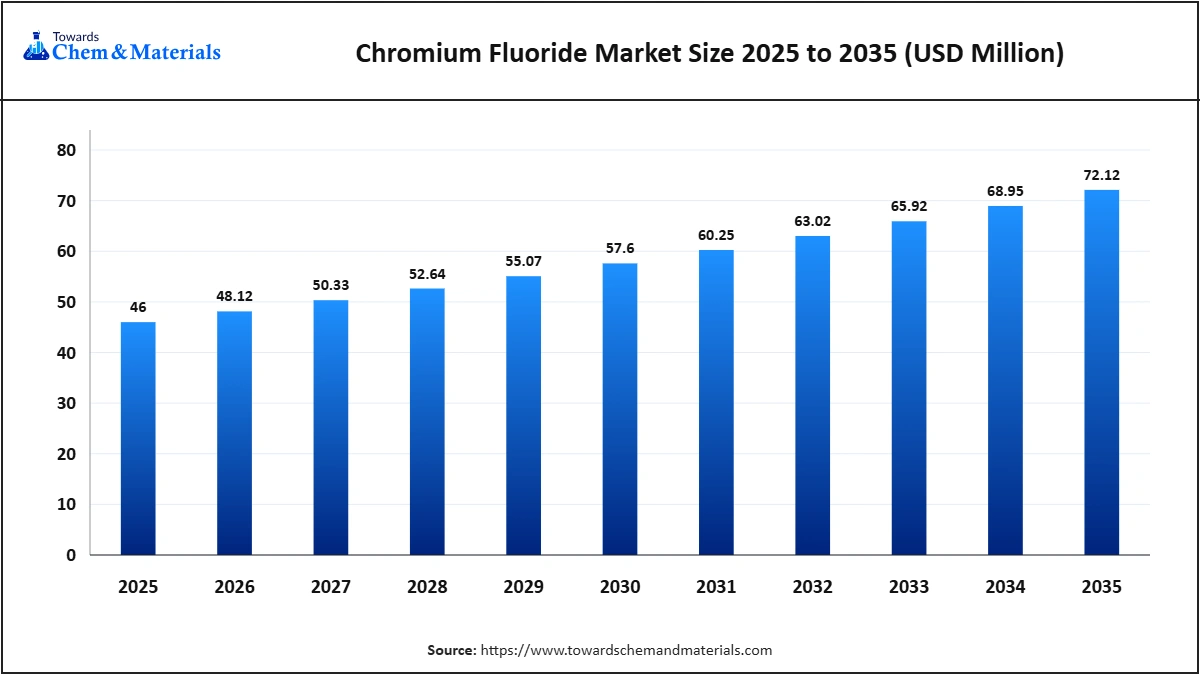
Note: 2025 is the base year; 2026-2035 values are forecasts.
Sources: Expert interviews, secondary sources, Towards Chemical and Materials database, and Towards Chemical and Materials analysts.
Asia Pacific accounted for 56.00% of revenue in 2025, supported by most fluorochemical and chromium salt production in China. Fluorochemical manufacturers, textile producers, and research institutions drive market demand through their use of chromium fluoride. Chromium chemicals ownership has shifted, with Elementis selling its chromium business to Yildirim.
The chromium fluoride market is projected to grow from USD 46.00 million in 2025 to USD 72.12 million by 2035 because chromium fluoride is a niche but useful chemical for fluorination catalysts and textile mordants. Demand from fluorochemical catalysts, textile applications, and research is expected to drive the market to USD 57.60 million by 2030, registering a CAGR of 4.60% from 2026 to 2035.
Analyst View: We built the estimate from chromium fluoride consumption by application and region and average prices, cross-checked against producer activity and trade data. Published estimates are very limited, so our value is evidence-based.
Drivers: Expanding fluorochemical production and the transition toward alternative refrigerants are supporting demand for chromium fluoride as a fluorination catalyst. Textile processing, laboratory research, and growing chemical manufacturing activities across Asia are further contributing to market consumption.
Restraints: Toxicity concerns and stricter regulations on chromium compounds increase compliance and handling costs for manufacturers. Relatively small market volumes, the availability of alternative textile mordants, and concentrated supply sources further constrain market growth.
Opportunities: Growing demand for catalysts used in next-generation refrigerant production creates opportunities for chromium fluoride suppliers. Rising demand for high-purity research grades, expanding Asian fluorochemical manufacturing, safer handling formulations, and specialty metal treatment applications offer additional growth potential.
| Driver | Impact | ≈ CAGR Contribution | Time Horizon | Key Regions |
| Fluorochemical production | High | +1.80 pp | Short to long term | Global, strongest in Asia Pacific |
| Refrigerant transitions | Medium | +1.52 pp | Medium to long term | Global, fastest uptake in Asia Pacific |
| Textile uses | Medium | +1.29 pp | Short to medium term | Global |
| Research demand | Low | +1.01 pp | Long term | Developed and emerging markets |
Note: Contributions are indicative estimates of each factor's effect on annual growth.
Sources: Expert interviews, secondary sources, Towards Chemical and Materials database, and Towards Chemical and Materials analysts.
Taken together, these drivers add about 5.61 percentage points to the annual growth of the chromium fluoride market, with fluorochemical production having the largest effect. Their influence is strongest in Asia Pacific, while uptake grows fastest in Asia Pacific.
| Restraint | Impact | ≈ Negative CAGR Contribution | Time Horizon | Key Regions |
| Toxicity and regulation | High | -0.46 pp | Short to medium term | Global |
| Small volumes | High | -0.33 pp | Medium term | Price-sensitive and emerging markets |
| Substitution in textiles | Medium | -0.22 pp | Short term | Asia Pacific and other mature markets |
Note: Contributions are indicative estimates of each factor's effect on annual growth.
Sources: Expert interviews, secondary sources, Towards Chemical and Materials database and Towards Chemical and Materials analysts.
These restraints are expected to reduce annual growth of the chromium fluoride market by about 1.01 percentage points, led by toxicity and regulation. Their effect eases over the forecast period as suppliers, buyers, and regulators adapt, leaving a net CAGR of 4.60% from 2026 to 2035.
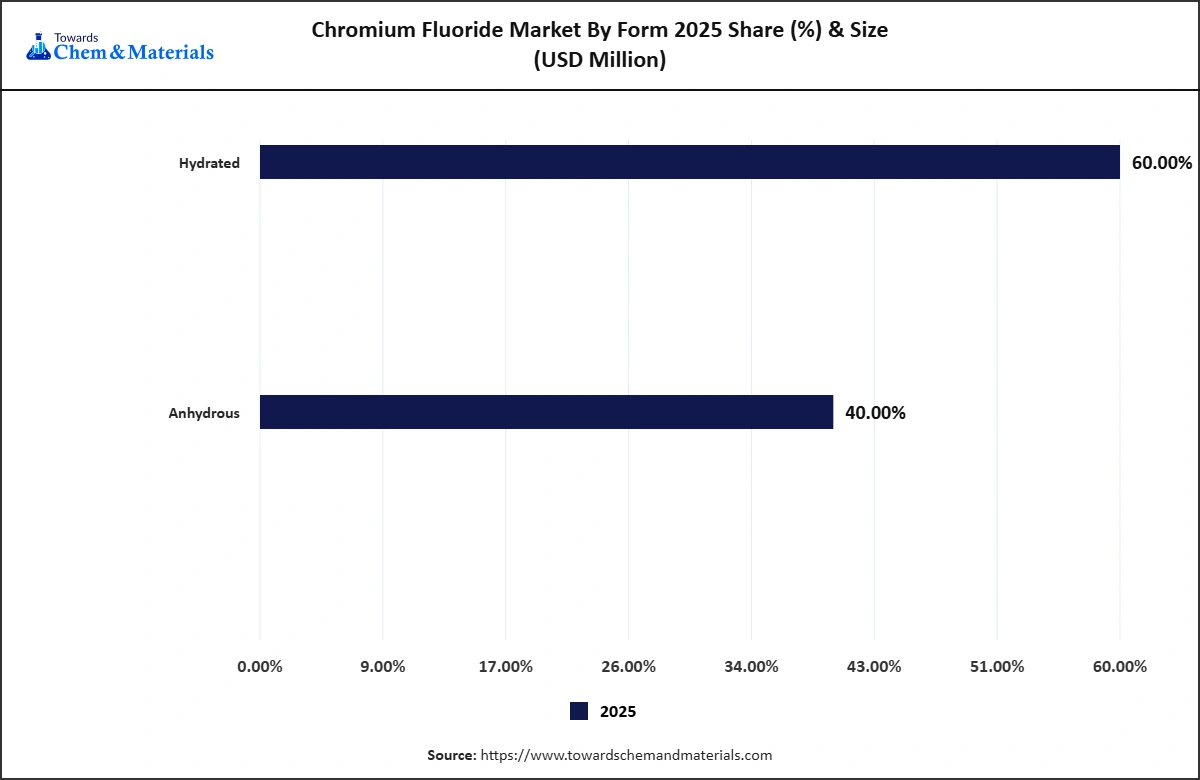
| Segments | 2025 Share | 2035 Share | CAGR 2026-2035 |
| Hydrated | 60.00% | 56.28% | 3.93% |
| Anhydrous | 40.00% | 43.72% | 5.53% |
Note: 2025 is the base year; 2035 shares and CAGRs are forecasts.
Sources: Expert interviews, secondary sources, Towards Chemical and Materials database, and Towards Chemical and Materials analysts.
Hydrated held the largest market share at 60.00% in 2025, while Anhydrous represented the remaining 40.00%. Hydrated dominates the market, whereas Anhydrous is projected to record the fastest growth.
Hydrated: This segment accounted for 60.00% of the chromium fluoride market in 2025 and is projected to expand at a CAGR of 3.93% by 2035. Hydrated chromium fluoride leads because it is the common commercial form. The hydrated segment is expected to grow slower than the overall market over the forecast period.
Anhydrous: Representing 40.00% of the market in 2025, this segment is anticipated to register a CAGR of 5.53% from 2026 to 2035. Its growth is driven by increasing demand for anhydrous chromium fluoride in fluorination catalyst applications. The segment is expected to grow faster than the overall market during the forecast period.
Segment Outlook: Hydrated remains the largest form segment through 2035, holding about 56.28% of the market in 2035, while Anhydrous records the highest CAGR of 5.53% throughout the forecast timeframe. Although Anhydrous starts from the smallest base, its faster growth shows how demand is shifting within the chromium fluoride market.
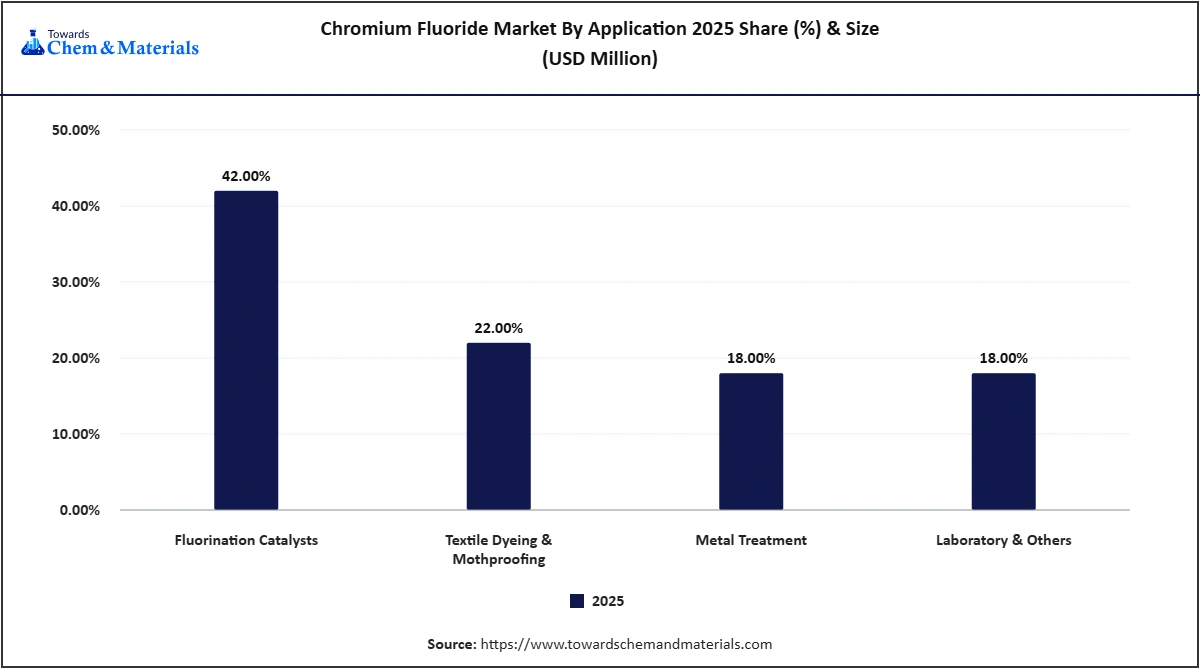
| Segments | 2025 Share | 2035 Share | CAGR 2026-2035 |
| Fluorination Catalysts | 42.00% | 43.40% | 4.94% |
| Textile Dyeing & Mothproofing | 22.00% | 21.46% | 4.34% |
| Metal Treatment | 18.00% | 17.57% | 4.34% |
| Laboratory & Others | 18.00% | 17.57% | 4.34% |
Note: 2025 is the base year; 2035 shares and CAGRs are forecasts.
Sources: Expert interviews, secondary sources, Towards Chemical and Materials database, and Towards Chemical and Materials analysts.
Fluorination Catalysts accounted for 42.00% in 2025, Textile Dyeing & Mothproofing for 22.00%, Metal Treatment for 18.00%, and Laboratory & Others for 18.00%. Fluorination Catalysts leads and is also growing the fastest.
Fluorination Catalysts: Holding the largest market share of 42.00% in 2025, this segment is projected to expand at a CAGR of 4.94% from 2026 to 2035. Fluorination catalysts lead because chromium-based catalysts are used to make refrigerants and fluorochemicals. The fluorination catalysts segment is expected to grow faster than the overall market over the forecast period.
Textile Dyeing & Mothproofing: This segment accounted for 22.00% of the chromium fluoride market in 2025 and is projected to expand at a CAGR of 4.34% by 2035. Textile dyeing and mothproofing use chromium fluoride as a mordant. The textile dyeing & mothproofing segment is expected to grow broadly in line with the overall market over the forecast period.
Metal Treatment: With an 18.00% market share in 2025, this segment is projected to grow at a CAGR of 4.34% from 2026 to 2035. Metal treatment uses it for surface finishing. The metal treatment segment is expected to grow broadly in line with the overall market over the forecast period.
Laboratory & Others: Accounting for 18.00% of the market in 2025, this segment is forecast to expand at a CAGR of 4.34% during the forecast period. Laboratory and other uses complete demand. The laboratory & others segment is expected to grow broadly in line with the overall market over the forecast period.
Segment Outlook: Fluorination Catalysts remains the largest application segment through 2035, holding about 43.40% of the market in 2035, and also records the highest CAGR of 4.94% throughout the forecast timeframe, strengthening its lead in the chromium fluoride market.
Analyst View: Segment shares were allocated from demand, product portfolios and pricing in each category. Hydrated and Fluorination Catalysts lead their categories because they meet the core needs of today's buyers. We expect Anhydrous to gain share as newer technologies, users and applications grow faster.
| Region | 2025 Share | 2035 Share | CAGR 2026-2035 |
| Asia Pacific | 56.00% | 58.82% | 5.11% |
| Europe | 20.00% | 18.72% | 3.91% |
| North America | 16.00% | 14.98% | 3.91% |
| Latin America | 4.00% | 3.74% | 3.91% |
| Middle East & Africa | 4.00% | 3.74% | 3.91% |
Note: 2025 is the base year; 2035 shares and CAGRs are forecasts.
Sources: Expert interviews, secondary sources, Towards Chemical and Materials database and Towards Chemical and Materials analysts.
Asia Pacific accounted for 56.00% in 2025, Europe for 20.00%, North America for 16.00%, Latin America for 4.00%, and the Middle East & Africa for 4.00%. Asia Pacific leads and is also growing the fastest.
Asia Pacific: Holding the largest regional market share of 56.00% in 2025, Asia Pacific is projected to expand at a CAGR of 5.11% from 2026 to 2035. Its dominance and faster growth reflect China's strong production base for fluorochemicals and chromium salts, supported by expanding industrial applications. The region is expected to grow faster than the overall market during the forecast period.
Europe: With a 20.00% market share in 2025, Europe is anticipated to register a CAGR of 3.91% by 2035. Regional demand comes from fluorochemical manufacturing and chromium fluoride applications in textile processing. The region is expected to grow slower than the overall market.
North America: North America represented 16.00% of the global market in 2025 and is forecast to grow at a CAGR of 3.91% through 2035. Fluorochemical production and demand from laboratory research and specialty chemical applications support regional consumption. The region is expected to grow slower than the overall market.
Latin America: Supported by textile processing applications, Latin America held a 4.00% share of the market in 2025. The region is projected to expand at a CAGR of 3.91% from 2026 to 2035, with demand primarily linked to industrial and textile-related uses. Growth is expected to remain slower than the overall market.
Middle East & Africa: Representing 4.00% of the global market in 2025, the Middle East & Africa region is projected to register a CAGR of 3.91% throughout the projection period. Relatively limited industrial applications and lower regional consumption constrain market expansion. The region is expected to grow slower than the overall market.
Analyst View: Regional shares were built from demand, installed base, spending, and supplier presence in each region. Asia Pacific leads because of its mature demand base and strong suppliers. We project Asia Pacific with the highest growth premium because investment, adoption, and capacity are expanding fastest there.
| Rank | Company Name | 2025 Share (%) | Key Products / Business | Headquarters |
| 1 | American Elements | 10.00% | Chromium fluoride grades | United States |
| 2 | Yildirim (Elementis Chromium) | 9.00% | Chromium chemicals | Turkey |
| 3 | Merck KGaA | 8.00% | Reagent chromium fluoride | Germany |
| 4 | Sichuan Yinhe Chemical | 8.00% | Chromium salts | China |
| 5 | Thermo Fisher Scientific | 6.00% | Laboratory chromium compounds | United States |
| 6 | Lanxess | 6.00% | Chromium chemicals | Germany |
| 7 | Hunan Nonferrous Fluoride Chemical | 6.00% | Fluoride chemicals | China |
| 8 | Strem (Ascensus) | 3.00% | High-purity metal compounds | United States |
| 9 | Noah Chemicals | 3.00% | Specialty inorganic chemicals | United States |
| 10 | Alfa Chemistry | 2.00% | Research chemicals | United States |
Note: Company shares are 2025 estimates.
Sources: Company press releases, expert interviews, secondary sources, Towards Chemical and Materials database and Towards Chemical and Materials analysts.
American Elements led the chromium fluoride market with an estimated 10.00% share of 2025 revenue, followed by Yildirim (Elementis Chromium) at 9.00% share and Merck KGaA at 8.00% share. American Elements leads with chromium fluoride grades, Yildirim (Elementis Chromium) competes with chromium chemicals, and Merck KGaA offers reagent chromium fluoride. Sichuan Yinhe Chemical, Thermo Fisher Scientific, Lanxess, Hunan Nonferrous Fluoride Chemical, Strem (Ascensus), Noah Chemicals and Alfa Chemistry compete through chromium salts, laboratory chromium compounds, chromium chemicals, fluoride chemicals, high-purity metal compounds, specialty inorganic chemicals and research chemicals.
The top 10 companies accounted for an estimated 61.00% of 2025 revenue, while the remaining 39.00% was shared among many Chinese chromium and fluoride salt producers. The chromium fluoride market is small and fragmented, and competition focuses on purity, consistency for catalysts, handling toxic chromium and fluoride compounds, regulatory compliance, and price.
American Elements: The U.S.-based company held an estimated 10.00% share of the chromium fluoride market in 2025. Its portfolio includes various chromium fluoride grades for industrial and specialized applications, securing a Leader position in the Towards Chemical and Materials Companies Quadrant.
Yildirim (Elementis Chromium): Headquartered in Turkey, Yildirim captured approximately 9.00% of the market in 2025. The company focuses on chromium chemicals, supporting its competitive position as a Leader in the Towards Chemical and Materials Companies Quadrant.
Merck KGaA: With an estimated 8.00% market share in 2025, Merck KGaA maintains a presence in the chromium fluoride market through its reagent-grade product offerings. The Germany-based company is positioned as a Leader in the Towards Chemical and Materials Companies Quadrant.
Sichuan Yinhe Chemical: Based in China, Sichuan Yinhe Chemical represented approximately 8.00% of the market in 2025. Its chromium salts portfolio supports its participation in the specialty chemicals industry, placing it among the Leaders in the Towards Chemical and Materials Companies Quadrant.
Thermo Fisher Scientific: The U.S.-headquartered company secured an estimated 6.00% market share in 2025. Its laboratory-grade chromium compounds serve research and analytical applications, earning it a Leader position in the Towards Chemical and Materials Companies Quadrant.
Lanxess: Accounting for 6.00% of the market in 2025, Lanxess maintains its presence through a portfolio of chromium chemicals for industrial applications. Headquartered in Germany, the company holds a Leader position in the Towards Chemical and Materials Companies Quadrant.
Hunan Nonferrous Fluoride Chemical: This China-based manufacturer held an estimated 6.00% share of the chromium fluoride market in 2025. Its focus on fluoride chemicals supports its positioning as an Innovator in the Towards Chemical and Materials Companies Quadrant.
Strem (Ascensus): Representing approximately 3.00% of the market in 2025, Strem specializes in high-purity metal compounds for research and specialty applications. The U.S.-based company is classified as an Innovator in the Towards Chemical and Materials Companies Quadrant.
Noah Chemicals: Headquartered in the United States, Noah Chemicals held an estimated 3.00% market share in 2025. Its specialty inorganic chemical portfolio supports its presence in the market, placing it in the Innovator category of the Towards Chemical and Materials Companies Quadrant.
Alfa Chemistry: The U.S.-based company captured an estimated 2.00% share of the market in 2025. Its research chemical offerings cater to laboratory and specialized applications, supporting its positioning as an Innovator in the Towards Chemical and Materials Companies Quadrant.
The chromium fluoride ecosystem links raw material suppliers, producers, distributors, end users, and regulators, with each stage adding value before products reach end users. AI in chemicals and materials informatics supports catalyst design.
| Ecosystem Stage | Role in the Market | Key Companies |
| Raw Material Suppliers | Supply chromium and hydrofluoric acid | Chromite processors, fluorspar producers |
| Producers | Make chromium fluoride | Chinese producers, American Elements, Yildirim |
| Distributors | Supply users | Chemical distributors |
| End Users | Use in catalysts, textiles, and metals | Fluorochemical makers, textile firms |
| Regulators | Control toxic chemicals | REACH, EPA, OSHA |
Sources: Company press releases, expert interviews, secondary sources, Towards Chemical and Materials database and Towards Chemical and Materials analysts.
Raw Material Suppliers: Supply chromium and hydrofluoric acid. Key participants include Chromite processors and fluorspar producers.
Producers: Make chromium fluoride. Key participants include Chinese producers, American Elements, and Yildirim.
Distributors: Supply users. Key participants include Chemical distributors.
End Users: Used in catalysts, textiles, and metals. Key participants include Fluorochemical makers and textile firms.
Regulators: Control toxic chemicals. Key participants include REACH, EPA, and OSHA.
Value in the chromium fluoride market flows from upstream material and technology suppliers to manufacturers and service providers, then through distribution partners to end users. Companies that integrate several stages or build long-term relationships with end users capture a larger share of this value.
The Towards Chemical and Materials Companies Quadrant evaluates key participants in the chromium fluoride market based on market strength and innovation and growth strategy. Market strength considers revenue scale, market share, and geographic reach, while innovation and growth strategy assesses product portfolio breadth, R&D intensity, and strategic partnerships. Company positions are determined by estimated 2025 market shares and our assessment of product innovation, portfolio breadth, and partnerships.
Sources: Company press releases, expert interviews, secondary sources, Towards Chemical and Materials database, and Towards Chemical and Materials analysts.
Leaders: American Elements, Yildirim (Elementis Chromium), Merck, Sichuan Yinhe Chemical, Thermo Fisher Scientific, and Lanxess combine high market share with broad portfolios and strong innovation.
Innovators: Hunan Nonferrous Fluoride Chemical, Strem (Ascensus), Noah Chemicals and Alfa Chemistry bring newer technologies and specialized products.
By Form
By Application
By Region
The chromium fluoride market covers chromium (III) fluoride in anhydrous and hydrated forms, available in industrial and high-purity grades. It includes applications as a catalyst in fluorination reactions for fluorochemical production, a mordant in textile dyeing and wool mothproofing, and in metal surface treatment, polishing, laboratory research, and other industrial uses. The 2025 base-year market size was estimated using a bottom-up approach based on demand volumes and average selling prices across product forms, applications, and geographic regions. The estimates were cross-validated through a top-down assessment of market-specific revenues reported by leading companies and published industry estimates. Segment, regional, and company-level market values were allocated based on their respective demand contributions. Key estimates were verified against company disclosures, regulatory records, industry data, and published third-party sources, while inconsistent or unsupported inputs were excluded. All segment, regional, and company estimates were reconciled with the 2025 base-year market size. The 2026–2035 forecast was calculated by applying the assumed CAGR to the 2025 base-year value and subsequently validating the projections for consistency across segments and regions.
The chromium fluoride market is set for steady expansion as fluorochemical catalysts and related demand keep growing. Our estimate links value to underlying demand, installed base and pricing, so the forecast follows real adoption rather than headline hype. The main upside comes from new refrigerant catalysts and research grades, while the main risks are toxicity and regulation.
Reliable market intelligence and data-driven insights across the global chemicals and materials industry, helping businesses understand trends, competition, pricing, and emerging opportunities.
Schedule a Demo