Find the Right Market Report
Search thousands of industry reports, market insights, and research studies in one place.
Not sure where to start? Try one of these:
The global chromium acetate market size was valued at USD 52.4 million in 2025 and is expected to reach USD 82.16 million by 2035, growing at a CAGR of 4.6% during the forecast period of 2026-2035. The chromium acetate market was valued at USD 52.40 million in 2025, the base year. The chromium acetate market covers chromium(III) acetate, also called chromic acetate or basic chromium acetate, sold as powder, crystals and aqueous solution in technical, industrial and high-purity grades, and used as a crosslinker for polymer gels in oilfield water shut-off and conformance control, as a mordant in textile dyeing, in leather tanning and finishing, as a catalyst and catalyst precursor, and in laboratory and other applications. Oilfield polymer gel crosslinking accounted for the largest application share in 2025, at 39.00%, because chromium(III) acetate crosslinks partially hydrolysed polyacrylamide to form gels that block water channels and improve oil recovery in mature fields.
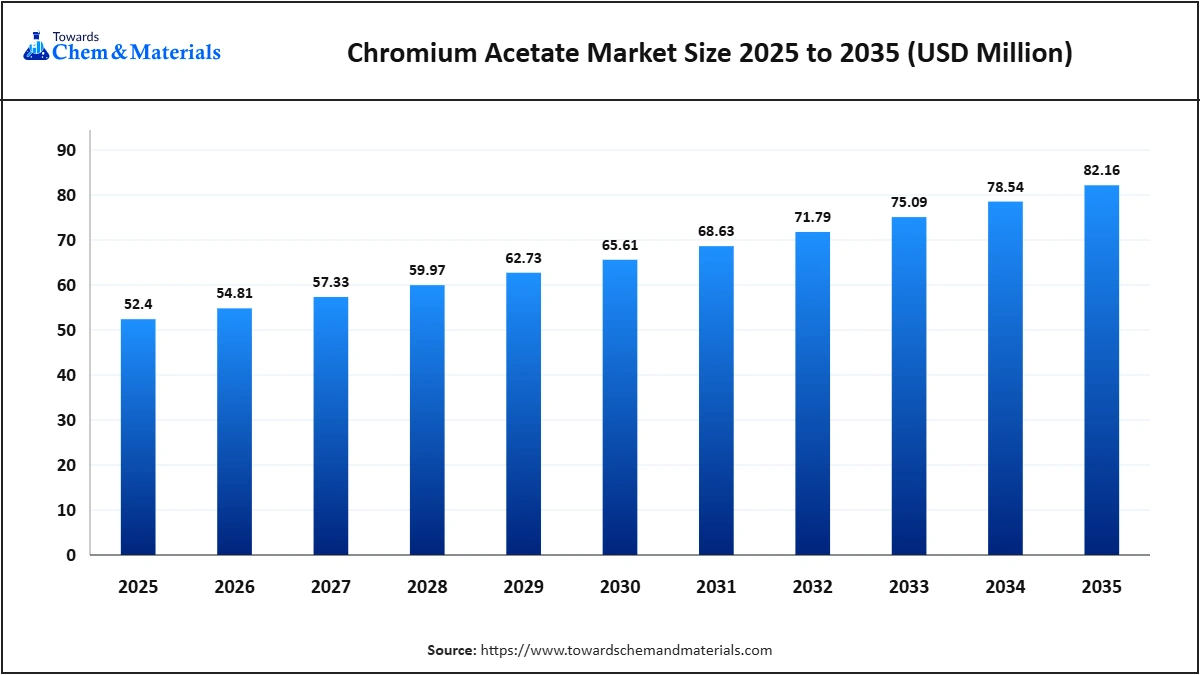
Note: 2025 is the base year; 2026-2035 values are forecasts.
Sources: Expert interviews, secondary sources, Towards Chemical and Materials database and Towards Chemical and Materials analysts.
Asia Pacific accounted for 41.00% of revenue in 2025, supported by chromium chemical production in China and India, large textile and leather industries and oilfield activity in China. Demand is driven by enhanced oil recovery and water shut-off treatments in mature oilfields, textile dyeing and printing, leather processing, catalyst preparation and research uses, while environmental rules on chromium handling and competition from alternative crosslinkers limit growth. Chromium supply chains are expanding, with Vishnu Chemicals and DCX Chrome agreeing in September 2026 to build a 6,000-tonne-a-year high-purity chromium metal plant in Visakhapatnam, India.
The chromium acetate market is projected to grow from USD 52.40 million in 2025 to USD 82.16 million by 2035 because chromium(III) acetate is a specialty chromium salt used in relatively small volumes, mainly as an oilfield crosslinker and a textile mordant. Mature oilfield water shut-off and conformance treatments, textile dyeing, leather finishing, catalyst preparation and steady chromium chemical supply in Asia support moderate growth, lifting the market to USD 65.61 million by 2030 and sustaining a CAGR of 4.60% from 2026 to 2035.
Analyst View: We built the estimate from chromium acetate consumption by application and region, measured in tonnes, based on polymer gel treatment volumes, textile and leather chemical use and catalyst and laboratory demand, multiplied by average prices by grade and form. The total was cross-checked against the chromium chemical activities of leading producers and against trade data for chromium salts. Published estimates for this small product market are limited and vary widely, so our value is evidence-based rather than set against a single comparable figure. The growth rate reflects steady oilfield and textile demand, partly offset by environmental pressure on chromium chemicals.
Driver: Mature oilfields need water control. Polymer gel treatments spread. Textile dyeing uses mordants. Catalyst research grows. Asian supply is reliable.
Restraint: Chromium rules tighten. Alternative crosslinkers compete. Oil price swings affect treatments. Small volumes limit scale.
Opportunity: Middle East enhanced oil recovery. High-purity grades. Liquid crosslinker packages. Catalyst preparation. Safer handling formats.
| Driver | Impact | ≈ CAGR Contribution | Time Horizon | Key Regions |
| Mature oilfields need water control | High | +1.80 pp | Short to long term | Global, strongest in Asia Pacific |
| Polymer gel treatments spread | Medium | +1.52 pp | Medium to long term | Global, fastest uptake in Middle East & Africa |
| Textile dyeing uses mordants | Medium | +1.29 pp | Short to medium term | Global |
| Catalyst research grows | Low | +1.01 pp | Long term | Developed and emerging markets |
Note: Contributions are indicative estimates of each factor's effect on annual growth.
Sources: Expert interviews, secondary sources,Towards Chemical and Materials database and Towards Chemical and Materials analysts.
Taken together, these drivers add about 5.61 percentage points to the annual growth of the chromium acetate market, with mature oilfields need water control having the largest effect. Their influence is strongest in Asia Pacific, while uptake grows fastest in Middle East & Africa.
| Restraint | Impact | ≈ Negative CAGR Contribution | Time Horizon | Key Regions |
| Chromium rules tighten | High | -0.46 pp | Short to medium term | Global |
| Alternative crosslinkers compete | High | -0.33 pp | Medium term | Price-sensitive and emerging markets |
| Oil price swings affect treatments | Medium | -0.22 pp | Short term | Asia Pacific and other mature markets |
Note: Contributions are indicative estimates of each factor's effect on annual growth.
Sources: Expert interviews, secondary sources, Towards Chemical and Materials database and Towards Chemical and Materials analysts.
These restraints are expected to reduce annual growth of the chromium acetate market by about 1.01 percentage points, led by chromium rules tighten. Their effect eases over the forecast period as suppliers, buyers and regulators adapt, leaving a net CAGR of 4.60% from 2026 to 2035.
| Segments | 2025 Share | 2025 Value (USD Million) | 2035 Value (USD Million) | CAGR 2026–2035 |
| Solution | 46.00% | 24.10 | 39.75 | 5.13% |
| Powder & Crystals | 54.00% | 28.30 | 42.41 | 4.13% |
Note: 2025 is the base year; 2035 values are forecasts.
Sources: Expert interviews, secondary sources, Towards Chemical and Materials database and Towards Chemical and Materials analysts.
Solution accounted for 46.00% (USD 24.10 million) in 2025 and Powder & Crystals for 54.00% (USD 28.30 million). Powder & Crystals leads, while Solution is growing fastest.
Solution: This segment accounted for 46.00% (USD 24.10 million) of the chromium acetate market in 2025 and is projected to reach USD 39.75 million by 2035, expanding at a CAGR of 5.13% from 2026 to 2035. Aqueous chromium acetate solutions are growing faster because oilfield service companies prefer ready-to-mix liquids that blend easily with polymer solutions on site. The solution segment is expected to grow faster than the overall market over the forecast period.
Powder & Crystals: This segment accounted for 54.00% (USD 28.30 million) of the chromium acetate market in 2025 and is projected to reach USD 42.41 million by 2035, expanding at a CAGR of 4.13% from 2026 to 2035. Powder and crystals lead because they are easier to store and ship over long distances and are preferred by textile, leather and catalyst users. The powder & crystals segment is expected to grow slower than the overall market over the forecast period.
Segment Outlook: Powder & Crystals remains the largest form segment through 2035, reaching about USD 42.41 million, while Solution records the highest CAGR of 5.13% from 2026 to 2035. Although Solution starts from the smallest base, its faster growth shows how demand is shifting within the chromium acetate market.
| Segments | 2025 Share | 2025 Value (USD Million) | 2035 Value (USD Million) | CAGR 2026–2035 |
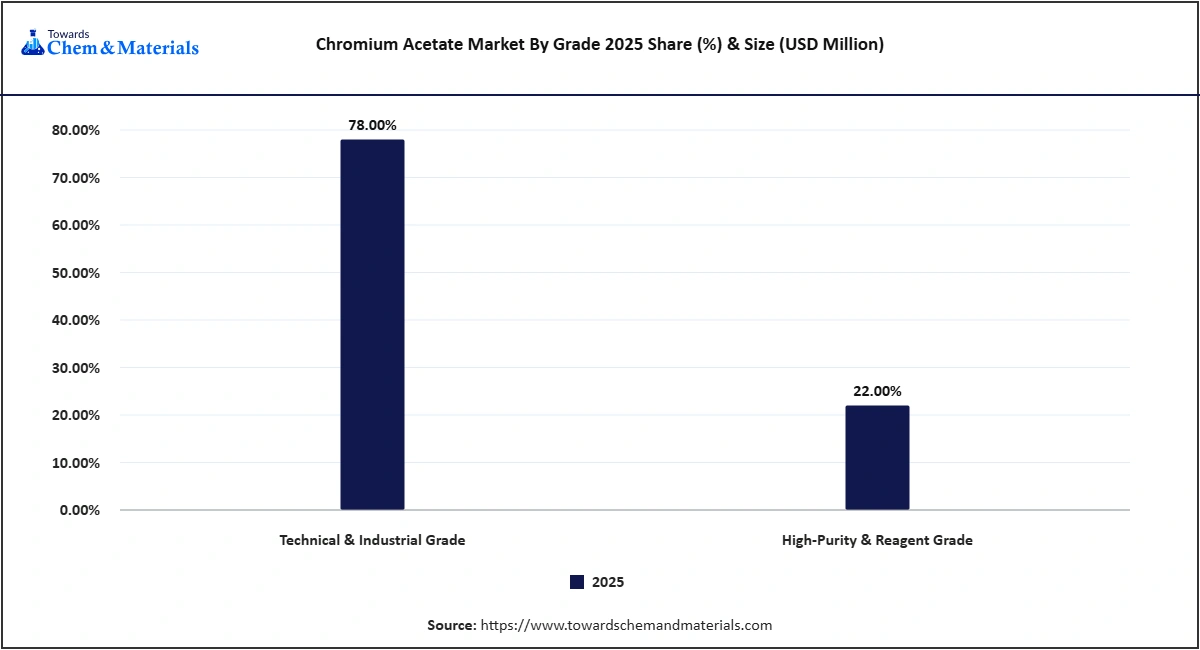
| Technical & Industrial Grade | 78.00% | 40.87 | 62.14 | 4.28% |
| High-Purity & Reagent Grade | 22.00% | 11.53 | 20.02 | 5.68% |
Note: 2025 is the base year; 2035 values are forecasts.
Sources: Expert interviews, secondary sources, Towards Chemical and Materials database and Towards Chemical and Materials analysts.
Technical & Industrial Grade accounted for 78.00% (USD 40.87 million) in 2025 and High-Purity & Reagent Grade for 22.00% (USD 11.53 million). Technical & Industrial Grade leads, while High-Purity & Reagent Grade is growing fastest.
Technical & Industrial Grade: This segment accounted for 78.00% (USD 40.87 million) of the chromium acetate market in 2025 and is projected to reach USD 62.14 million by 2035, expanding at a CAGR of 4.28% from 2026 to 2035. Technical and industrial grades make up most volume because oilfield, textile and leather uses do not need very high purity. The technical & industrial grade segment is expected to grow slower than the overall market over the forecast period.
High-Purity & Reagent Grade: This segment accounted for 22.00% (USD 11.53 million) of the chromium acetate market in 2025 and is projected to reach USD 20.02 million by 2035, expanding at a CAGR of 5.68% from 2026 to 2035. High-purity and reagent grades are growing faster from a small base, used in catalyst preparation, research and electronics-related applications. The high-purity & reagent grade segment is expected to grow faster than the overall market over the forecast period.
Segment Outlook: Technical & Industrial Grade remains the largest grade segment through 2035, reaching about USD 62.14 million, while High-Purity & Reagent Grade records the highest CAGR of 5.68% from 2026 to 2035. Although High-Purity & Reagent Grade starts from the smallest base, its faster growth shows how demand is shifting within the chromium acetate market.
| Segments | 2025 Share | 2025 Value (USD Million) | 2035 Value (USD Million) | CAGR 2026–2035 |
| Oilfield Polymer Gel Crosslinking | 39.00% | 20.44 | 33.54 | 5.08% |
| Textile Dyeing & Printing | 24.00% | 12.58 | 19.13 | 4.28% |
| Leather Tanning & Finishing | 17.00% | 8.91 | 13.55 | 4.28% |
| Catalysts | 11.00% | 5.76 | 8.77 | 4.28% |
| Laboratory & Others | 9.00% | 4.72 | 7.17 | 4.28% |
Note: 2025 is the base year; 2035 values are forecasts.
Sources: Expert interviews, secondary sources, Towards Chemical and Materials database and Towards Chemical and Materials analysts.
Oilfield Polymer Gel Crosslinking accounted for 39.00% (USD 20.44 million) in 2025, Textile Dyeing & Printing for 24.00% (USD 12.58 million), Leather Tanning & Finishing for 17.00% (USD 8.91 million), Catalysts for 11.00% (USD 5.76 million) and Laboratory & Others for 9.00% (USD 4.72 million). Oilfield Polymer Gel Crosslinking leads and is also growing fastest. Some catalyst makers use chromium compounds to make polyolefin catalysts.
Oilfield Polymer Gel Crosslinking: This segment accounted for 39.00% (USD 20.44 million) of the chromium acetate market in 2025 and is projected to reach USD 33.54 million by 2035, expanding at a CAGR of 5.08% from 2026 to 2035. Oilfield polymer gel crosslinking is the largest and fastest-growing application. Chromium(III) acetate crosslinks polyacrylamide slowly and controllably, forming gels that seal high-permeability zones, reduce water production and improve oil recovery in mature fields in China, North America and the Middle East. The oilfield polymer gel crosslinking segment is expected to grow faster than the overall market over the forecast period.
Textile Dyeing & Printing: This segment accounted for 24.00% (USD 12.58 million) of the chromium acetate market in 2025 and is projected to reach USD 19.13 million by 2035, expanding at a CAGR of 4.28% from 2026 to 2035. Textile dyeing and printing use chromium acetate as a mordant that fixes certain dyes to wool, silk and other fibres. The textile dyeing & printing segment is expected to grow slower than the overall market over the forecast period.
Leather Tanning & Finishing: This segment accounted for 17.00% (USD 8.91 million) of the chromium acetate market in 2025 and is projected to reach USD 13.55 million by 2035, expanding at a CAGR of 4.28% from 2026 to 2035. Leather tanning and finishing use chromium acetate in specialty tanning and retanning steps, alongside the much larger use of basic chromium sulphate. The leather tanning & finishing segment is expected to grow slower than the overall market over the forecast period.
Catalysts: This segment accounted for 11.00% (USD 5.76 million) of the chromium acetate market in 2025 and is projected to reach USD 8.77 million by 2035, expanding at a CAGR of 4.28% from 2026 to 2035. Catalyst uses include preparing chromium-based catalysts for polymerisation and oxidation reactions. The catalysts segment is expected to grow slower than the overall market over the forecast period.
Laboratory & Others: This segment accounted for 9.00% (USD 4.72 million) of the chromium acetate market in 2025 and is projected to reach USD 7.17 million by 2035, expanding at a CAGR of 4.28% from 2026 to 2035. Laboratory and other uses include research, analytical chemistry and specialty syntheses. The laboratory & others segment is expected to grow slower than the overall market over the forecast period.
Segment Outlook: Oilfield Polymer Gel Crosslinking remains the largest application segment through 2035, reaching about USD 33.54 million, and also records the highest CAGR of 5.08% from 2026 to 2035, strengthening its lead in the chromium acetate market.
Analyst View: Segment values were allocated from consumption volumes and prices by form, grade and application. Powder, technical grades and oilfield uses lead. We expect solutions, high-purity grades and oilfield uses to gain share.
| Region | 2025 Share | 2025 Value (USD Million) | 2035 Value (USD Million) | CAGR 2026–2035 |
| Asia Pacific | 41.00% | 21.48 | 32.49 | 4.22% |
| North America | 25.00% | 13.10 | 20.58 | 4.62% |
| Europe | 17.00% | 8.91 | 14.00 | 4.62% |
| Middle East & Africa | 11.00% | 5.76 | 10.15 | 5.82% |
| Latin America | 6.00% | 3.14 | 4.94 | 4.62% |
Note: 2025 is the base year; 2035 values are forecasts.
Sources: Expert interviews, secondary sources, Towards Chemical and Materials database and Towards Chemical and Materials analysts.
Asia Pacific accounted for 41.00% (USD 21.48 million) in 2025, North America for 25.00% (USD 13.10 million), Europe for 17.00% (USD 8.91 million), Middle East & Africa for 11.00% (USD 5.76 million) and Latin America for 6.00% (USD 3.14 million). Asia Pacific leads, while Middle East & Africa is growing fastest.
Asia Pacific: This region accounted for 41.00% (USD 21.48 million) of the chromium acetate market in 2025 and is projected to reach USD 32.49 million by 2035, expanding at a CAGR of 4.22% from 2026 to 2035. Asia Pacific is the largest region because China and India produce most chromium chemicals, have large textile and leather industries, and China uses polymer gel treatments widely in mature oilfields such as Daqing and Shengli. Asia Pacific is expected to grow slower than the overall market between 2026 and 2035.
North America: This region accounted for 25.00% (USD 13.10 million) of the chromium acetate market in 2025 and is projected to reach USD 20.58 million by 2035, expanding at a CAGR of 4.62% from 2026 to 2035. North America uses chromium acetate mainly in oilfield conformance treatments in Texas, Oklahoma and Canada, along with catalyst and laboratory uses. North America is expected to grow broadly in line with the overall market between 2026 and 2035.
Europe: This region accounted for 17.00% (USD 8.91 million) of the chromium acetate market in 2025 and is projected to reach USD 14.00 million by 2035, expanding at a CAGR of 4.62% from 2026 to 2035. Europe has smaller demand from textile, leather and catalyst users, and strict REACH rules on chromium compounds limit growth. Europe is expected to grow broadly in line with the overall market between 2026 and 2035.
Middle East & Africa: This region accounted for 11.00% (USD 5.76 million) of the chromium acetate market in 2025 and is projected to reach USD 10.15 million by 2035, expanding at a CAGR of 5.82% from 2026 to 2035. The Middle East and Africa are the fastest-growing region because national oil companies in Oman, Saudi Arabia and Kuwait are expanding water management and enhanced oil recovery in mature fields. Middle East & Africa is expected to grow faster than the overall market between 2026 and 2035.
Latin America: This region accounted for 6.00% (USD 3.14 million) of the chromium acetate market in 2025 and is projected to reach USD 4.94 million by 2035, expanding at a CAGR of 4.62% from 2026 to 2035. Latin America is supported by oilfield activity in Argentina, Brazil and Colombia and leather processing in Brazil. Latin America is expected to grow broadly in line with the overall market between 2026 and 2035.
Analyst View: Regional shares were built from consumption by application in each region. Asia Pacific leads because of chromium chemical production and textile, leather and oilfield demand. We assign the Middle East and Africa the highest growth premium because oilfield water management treatments are expanding fastest there.
| Rank | Company Name | Market-Specific Revenue (USD Million) | 2025 Share | Key Products / Business | Headquarters |
| 1 | Vishnu Chemicals | 5.20 | 9.92% | Chromium chemicals and salts | India |
| 2 | Brother Enterprises | 5.00 | 9.54% | Chromium salts and compounds | China |
| 3 | Elementis | 4.20 | 8.02% | Chromium chemicals | United Kingdom |
| 4 | Thermo Fisher Scientific | 2.80 | 5.34% | Laboratory and research chemicals | United States |
| 5 | Merck KGaA | 2.40 | 4.58% | Reagent-grade chemicals | Germany |
| 6 | Shepherd Chemical | 2.00 | 3.82% | Metal carboxylates and salts | United States |
| 7 | Hunan Jiayu Chemical | 1.80 | 3.44% | Chromium acetate and salts | China |
| 8 | American Elements | 1.60 | 3.05% | Chromium acetate in multiple grades | United States |
| 9 | Strem Chemicals | 0.90 | 1.72% | High-purity metal compounds | United States |
| 10 | Alfa Chemistry | 0.60 | 1.15% | Research chemicals | United States |
Note: Company revenues and shares are 2025 estimates.
Sources: Company press releases, expert interviews, secondary sources, Towards Chemical and Materials database and Towards Chemical and Materials analysts.
Vishnu Chemicals led the chromium acetate market with an estimated 9.92% (USD 5.20 million) of 2025 revenue, followed by Brother Enterprises at 9.54% (USD 5.00 million) and Elementis at 8.02% (USD 4.20 million). Vishnu Chemicals leads with a large chromium chemicals business in India, Brother Enterprises is a major Chinese chromium salt producer that bought Lanxess's chrome business, and Elementis supplies chromium chemicals from its US operations. Thermo Fisher Scientific, Merck KGaA, Shepherd Chemical, Hunan Jiayu Chemical, American Elements, Strem Chemicals and Alfa Chemistry compete through laboratory and reagent chemicals, metal carboxylates, chromium acetate production, multi-grade supply and high-purity compounds. The top 10 companies accounted for an estimated 50.57% (USD 26.50 million) of 2025 revenue, while the remaining 49.43% (USD 25.90 million) was shared among small Chinese and Indian chromium salt producers and oilfield chemical blenders. The chromium acetate market is fragmented, and competition centres on chromium raw material access, product consistency, environmental compliance, solution and powder supply, oilfield service relationships and price. Oilfield service companies often blend chromium acetate into their own crosslinker products.
Vishnu Chemicals: Vishnu Chemicals is headquartered in India. It generated an estimated USD 5.20 million of market-specific revenue in 2025, about 9.92% of the chromium acetate market. Its offering centres on Chromium chemicals and salts. In the Towards Chemical and Materials Companies Quadrant it is positioned as a Leader.
Brother Enterprises: Brother Enterprises is headquartered in China. It generated an estimated USD 5.00 million of market-specific revenue in 2025, about 9.54% of the chromium acetate market. Its offering centres on Chromium salts and compounds. In the Towards Chemical and Materials Companies Quadrant it is positioned as a Leader.
Elementis: Elementis is headquartered in the United Kingdom. It generated an estimated USD 4.20 million of market-specific revenue in 2025, about 8.02% of the chromium acetate market. Its offering centres on Chromium chemicals. In the Towards Chemical and Materials Companies Quadrant it is positioned as a Leader.
Thermo Fisher Scientific: Thermo Fisher Scientific is headquartered in the United States. It generated an estimated USD 2.80 million of market-specific revenue in 2025, about 5.34% of the chromium acetate market. Its offering centres on Laboratory and research chemicals. In the Towards Chemical and Materials Companies Quadrant it is positioned as a Leader.
Merck KGaA: Merck KGaA is headquartered in Germany. It generated an estimated USD 2.40 million of market-specific revenue in 2025, about 4.58% of the chromium acetate market. Its offering centres on Reagent-grade chemicals. In the Towards Chemical and Materials Companies Quadrant it is positioned as a Leader.
Shepherd Chemical: Shepherd Chemical, part of The Shepherd Chemical Company, is headquartered in the United States. It generated an estimated USD 2.00 million of market-specific revenue in 2025, about 3.82% of the chromium acetate market. Its offering centres on Metal carboxylates and salts. In the Towards Chemical and Materials Companies Quadrant it is positioned as a Leader.
Hunan Jiayu Chemical: Hunan Jiayu Chemical is headquartered in China. It generated an estimated USD 1.80 million of market-specific revenue in 2025, about 3.44% of the chromium acetate market. Its offering centres on Chromium acetate and salts. In the Towards Chemical and Materials Companies Quadrant it is positioned as an Innovator.
American Elements: American Elements is headquartered in the United States. It generated an estimated USD 1.60 million of market-specific revenue in 2025, about 3.05% of the chromium acetate market. Its offering centres on Chromium acetate in multiple grades. In the Towards Chemical and Materials Companies Quadrant it is positioned as an Innovator.
Strem Chemicals: Strem Chemicals, part of Ascensus Specialties LLC, is headquartered in the United States. It generated an estimated USD 0.90 million of market-specific revenue in 2025, about 1.72% of the chromium acetate market. Its offering centres on High-purity metal compounds. In the Towards Chemical and Materials Companies Quadrant it is positioned as an Innovator.
Alfa Chemistry: Alfa Chemistry is headquartered in the United States. It generated an estimated USD 0.60 million of market-specific revenue in 2025, about 1.15% of the chromium acetate market. Its offering centres on Research chemicals. In the Towards Chemical and Materials Companies Quadrant it is positioned as an Innovator.
The chromium acetate ecosystem links chromite and chromium chemical producers with acetate makers, distributors and oilfield chemical blenders, end users and environmental regulators. Chromium producers also supply chrome oxide for aluminum refractory materials such as alumina-chrome bricks.
| Ecosystem Stage | Role in the Market | Key Companies |
| Chromite & Chromium Chemicals | Mine chromite and make chromium salts | Chromite miners, Vishnu Chemicals, Brother Enterprises |
| Acetate Producers | React chromium compounds with acetic acid | Chromium chemical and fine chemical makers |
| Distributors & Blenders | Supply and blend crosslinkers | Chemical distributors, oilfield service firms |
| End Users | Use in gels, dyeing, leather and catalysts | Oil producers, textile mills, tanneries, catalyst makers |
| Regulators | Control chromium handling and waste | EPA, REACH, national environmental agencies |
Sources: Company press releases, expert interviews, secondary sources, Towards Chemical and Materials database and Towards Chemical and Materials analysts.
Chromite & Chromium Chemicals: Mine chromite and make chromium salts. Key participants include Chromite miners, Vishnu Chemicals, Brother Enterprises.
Acetate Producers: React chromium compounds with acetic acid. Key participants include Chromium chemical and fine chemical makers.
Distributors & Blenders: Supply and blend crosslinkers. Key participants include Chemical distributors, oilfield service firms.
End Users: Use in gels, dyeing, leather and catalysts. Key participants include Oil producers, textile mills, tanneries, catalyst makers.
Regulators: Control chromium handling and waste. Key participants include EPA, REACH, national environmental agencies.
Value in the chromium acetate market flows from upstream material and technology suppliers to manufacturers and service providers, then through distribution partners to end users. Companies that integrate several stages or build long-term relationships with end users capture a larger share of this value.
The Towards Chemical and Materials Companies Quadrant positions key participants in the chromium acetate market by market strength, reflecting revenue scale, market share and geographic reach, and by innovation and growth strategy, reflecting product portfolio breadth, R&D intensity and partnerships. Positions reflect each company's estimated 2025 chromium acetate revenue and our assessment of its product range, quality and supply reach.
Sources: Company press releases, expert interviews, secondary sources, Towards Chemical and Materials database and Towards Chemical and Materials analysts.
Leaders: Vishnu Chemicals, Brother Enterprises, Elementis, Thermo Fisher Scientific, Merck and Shepherd Chemical combine large chromium chemical operations with broad supply.
Innovators: Hunan Jiayu Chemical, American Elements, Strem Chemicals and Alfa Chemistry offer specialised grades and custom products.
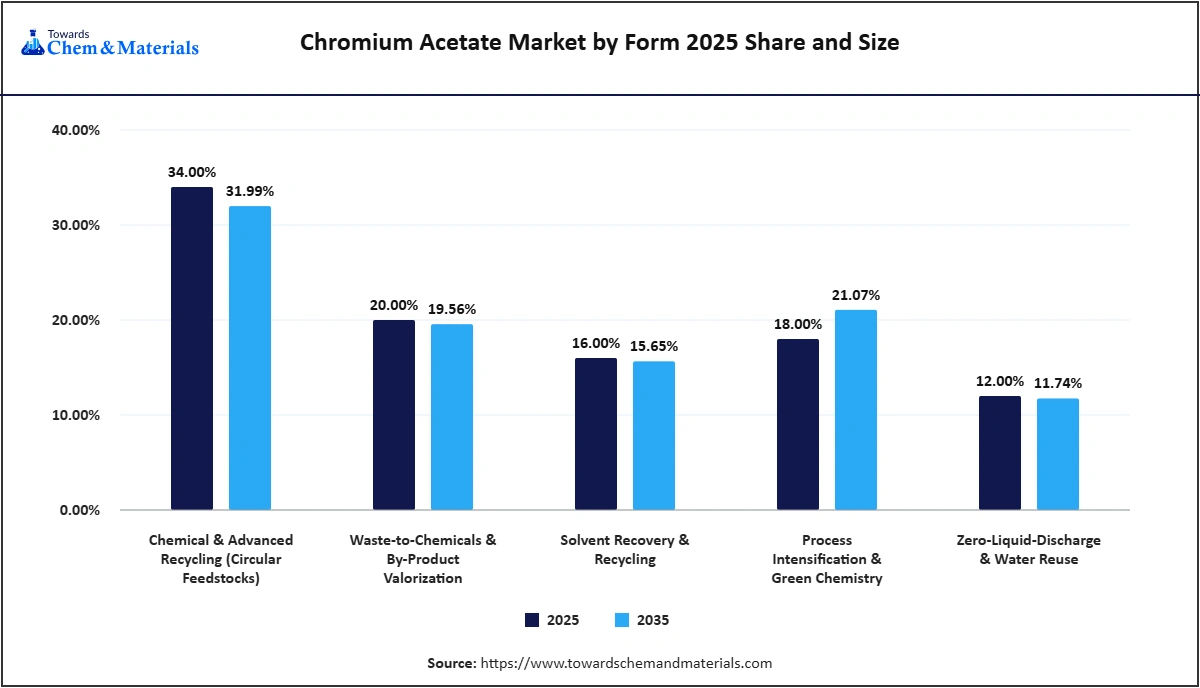
By Form
By Grade
By Application
By Region
The chromium acetate market was defined as chromium(III) acetate in solution, powder and crystal forms used as a crosslinker, mordant, catalyst and reagent worldwide. The 2025 base year was built bottom-up from chromium acetate consumption by application and region and average prices by grade and form, and checked top-down against the chromium chemical activities of leading producers and chromium salt trade data. Segment, regional and company values were allocated from forms, grades, applications and regional consumption. Key estimates were verified by cross-checking company disclosures, regulatory and industry data and published third-party estimates, and inputs that could not be reconciled were excluded. All segment, regional and company figures were reconciled to the same 2025 base year, and the 2026–2035 forecast, which applies a constant CAGR from the 2025 base, was recalculated and validated.
The chromium acetate market is a small specialty chromium salt market that grows with oilfield water management and steady textile and leather demand. Our estimate links demand to consumption by application and prices, so the forecast follows oilfield treatment activity and industrial use. The main upside comes from enhanced oil recovery in the Middle East and high-purity grades, while the main risks are chromium regulation and alternative crosslinkers.
Reliable market intelligence and data-driven insights across the global chemicals and materials industry, helping businesses understand trends, competition, pricing, and emerging opportunities.
Schedule a Demo